BGP Multihoming: The Complete Enterprise Guide to Dual ISP Connectivity
Businesses increasingly depend on Internet connectivity for customer transactions, cloud applications, remote access, supply-chain integration and distributed computing. An outage at the Internet edge can interrupt all of them. Buying a second circuit helps, but it does not automatically solve the problem. Both circuits may traverse the same conduit. The backup may use an unrelated public IP address. A firewall may discard return traffic after routing changes. Or both BGP sessions may be established while a critical application remains unreachable.
BGP multihoming allows an enterprise to exchange Internet routes with multiple upstream providers and, when appropriately designed, advertise the same portable public IP prefixes through both. This creates alternative network paths and reduces dependence on a single carrier. True business continuity, however, requires the routing system, physical access, security controls and applications to work together.
This guide explains when enterprises should deploy BGP multihoming rather than conventional dual-WAN failover; how to select public ASN and addressing resources; how to design a dual-router Internet edge; and what actually happens when a provider fails. It also provides a practical carrier-diversity methodology, three design examples, a failure-test matrix and a provider-sourcing framework. Readers seeking a broader introduction to the protocol can consult Macronet Services’ BGP Routing Explained; for the economics and procurement of upstream connectivity, see our IP Transit Guide.

1. What Is BGP Multihoming?
BGP multihoming is a network design in which a site or organization connects to more than one upstream Internet provider and uses Border Gateway Protocol to exchange reachability information and apply routing policy across those relationships. In the conventional public multihoming model, a company advertises its authorized IP prefixes through two or more transit providers. Remote networks can learn multiple paths toward those prefixes, while the enterprise can select among available routes for outbound traffic.
The IETF’s RFC 4116 describes a multihomed site as one with multiple transit providers, distinguishing it from a site with several attachments to just one provider. That difference is significant: two fibers into one ISP may protect against an access failure but leave the enterprise exposed to that ISP’s routing, operational and backbone risks.
BGP supplies reachability and policy, not application availability. Consider an online customer portal hosted at a company’s data center. If its public prefix is announced through ISP A and ISP B, the prefix can remain reachable through B after A withdraws its path. That is an important improvement over a public IP address usable only within A’s assigned space. But the applications, firewall and internal path behind B must still be working. Even with the same destination IP, sessions may reset while the network converges.
Multihoming can also create commercial flexibility. An organization controlling its public ASN and portable addressing may replace one transit provider without renumbering its public applications. Whether that advantage justifies the routing and operational overhead depends on the services at risk, their allowable outage duration and the cost of alternative approaches.
2. Dual ISP, SD-WAN and BGP Multihoming: Different Problems
The common question, “Do I need BGP for two Internet providers?” has no universal answer. A headquarters that mostly consumes Microsoft 365 and other SaaS applications needs continued outbound access. A SaaS operator hosting applications on its own public address space may need its existing destination IPs to remain reachable from the Internet after one ISP fails. Those are different continuity objectives.
In a conventional dual-ISP design, a firewall or SD-WAN appliance connects to two DIA services, often with provider-assigned addresses. Link monitoring can move new connections to the surviving circuit. For outbound SaaS access, this is frequently sufficient. The public source IP may change, so connections that depend on fixed allowlists or stateful sessions can be interrupted; still, the business can usually restore access without public BGP.
Public BGP multihoming solves a narrower and more demanding routing problem: eligible public prefixes can be originated by the enterprise AS and propagated through multiple independent upstream networks. It can preserve public address reachability, but does not inherently preserve transport sessions. SD-WAN and BGP also can coexist: the data center can use BGP for public routing independence while branches use an SD-WAN overlay across available Internet access paths.
| Connectivity model | What it provides | What it does not automatically provide | Typical fit |
| Single ISP | Simple Internet access | Independent upstream availability | Small office with modest requirements |
| Dual DIA / firewall failover | Alternative outbound access path | Continuity of ISP-assigned public addresses | Enterprise offices and SaaS users |
| SD-WAN over two ISPs | Application- and health-aware path selection, depending on product | Public prefix origination through two independent ASes | Distributed offices and hybrid WAN |
| Public BGP multihoming | Multiple upstream paths for eligible portable prefixes | Stateful application continuity or true physical path diversity | Data centers, public applications, sophisticated Internet edges |
| BGP plus SD-WAN | Public Internet routing control plus overlay traffic management | Guaranteed resilience absent end-to-end design | Larger distributed enterprises |
A practical decision test is whether the organization must keep one public prefix reachable through different carriers, control its own interdomain advertisements, or maintain direct peering/transit relationships. If not, the simpler approach deserves serious consideration. High availability is a business requirement, not an obligation to deploy the most complex protocol available.
3. The Four BGP Multihoming Architectures Enterprises Should Compare
A resilient topology should be defined by the failures it must survive. Merely counting circuits is not enough. Four patterns account for many enterprise requirements.
One edge router, two providers. A single router maintains eBGP sessions to two upstream ASes and can select among their routes. This reduces dependence on a single ISP, but that router, its power and its link toward the firewall remain shared failure points. It may be appropriate for a cost-sensitive organization that accepts the equipment risk.
Two edge routers, two providers. Router A connects to ISP A and Router B to ISP B. Both must have functional paths toward the protected application networks and security layer. An internal routing design, often involving iBGP, allows the enterprise to coordinate reachability and route preference. This is our core reference architecture because it can protect against the loss of one provider, circuit or edge router when the rest of the topology is built correctly.
Multiple circuits per provider. Additional connections may protect against a single access or router failure without abandoning the same carrier. They increase the number of possible paths, but also policy complexity. Multiple ports or circuits provide little improvement if all share the same building entrance, metropolitan conduit or carrier aggregation site.
Multiple geographically distributed Internet edges. An enterprise with data centers in different metros can advertise prefixes from several sites, but only when traffic entering a surviving site can reach the intended application. A route that remains visible after a facility failure does not recreate the workload or its data. Multi-site designs must coordinate application delivery, transport, security and routing, sometimes using anycast for services suited to that pattern or separate application-level failover for stateful workloads.
The right topology follows the recovery objective. A single-provider outage, edge-router failure, conduit cut and complete-site loss are distinct events. The network should be intentionally engineered for the subset that the business actually needs to survive.
Reference architecture used throughout this guide
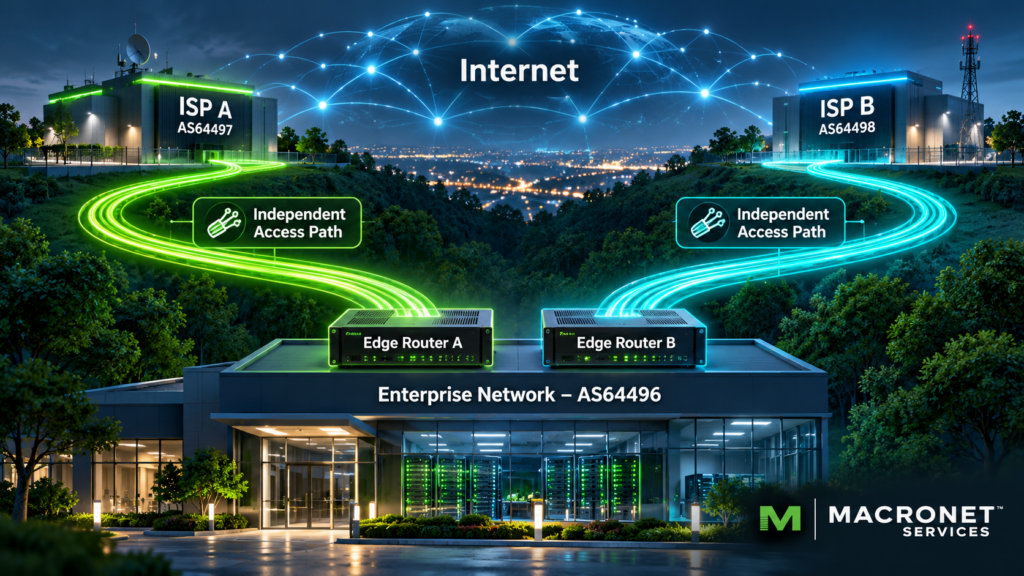
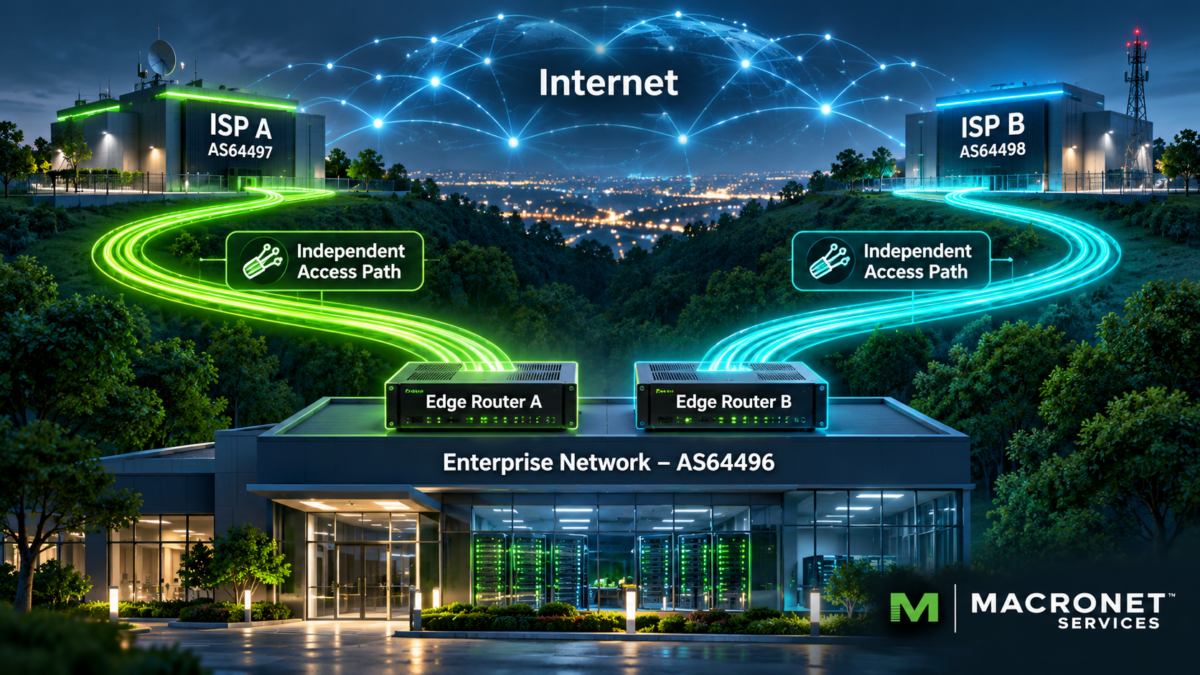
Our hypothetical company uses AS64496. ISP A uses AS64497, and ISP B uses AS64498. The enterprise advertises illustrative IPv4 prefix 198.51.100.0/24 and IPv6 prefix 2001:db8:100::/48, subject to an agreed provider policy. Router A and Router B lead to a redundant firewall and application environment; both upstreams are physically diverse to the degree documented by the providers.
These values are documentation-only, not deployable Internet resources. RFC 5398 reserves those ASNs, while RFC 5737 and RFC 3849 reserve the example IP blocks. A real enterprise must use appropriately assigned and authorized resources. The diagram accompanying this chapter should visually distinguish BGP control relationships from packet-forwarding paths; it is illustrative rather than a vendor configuration.
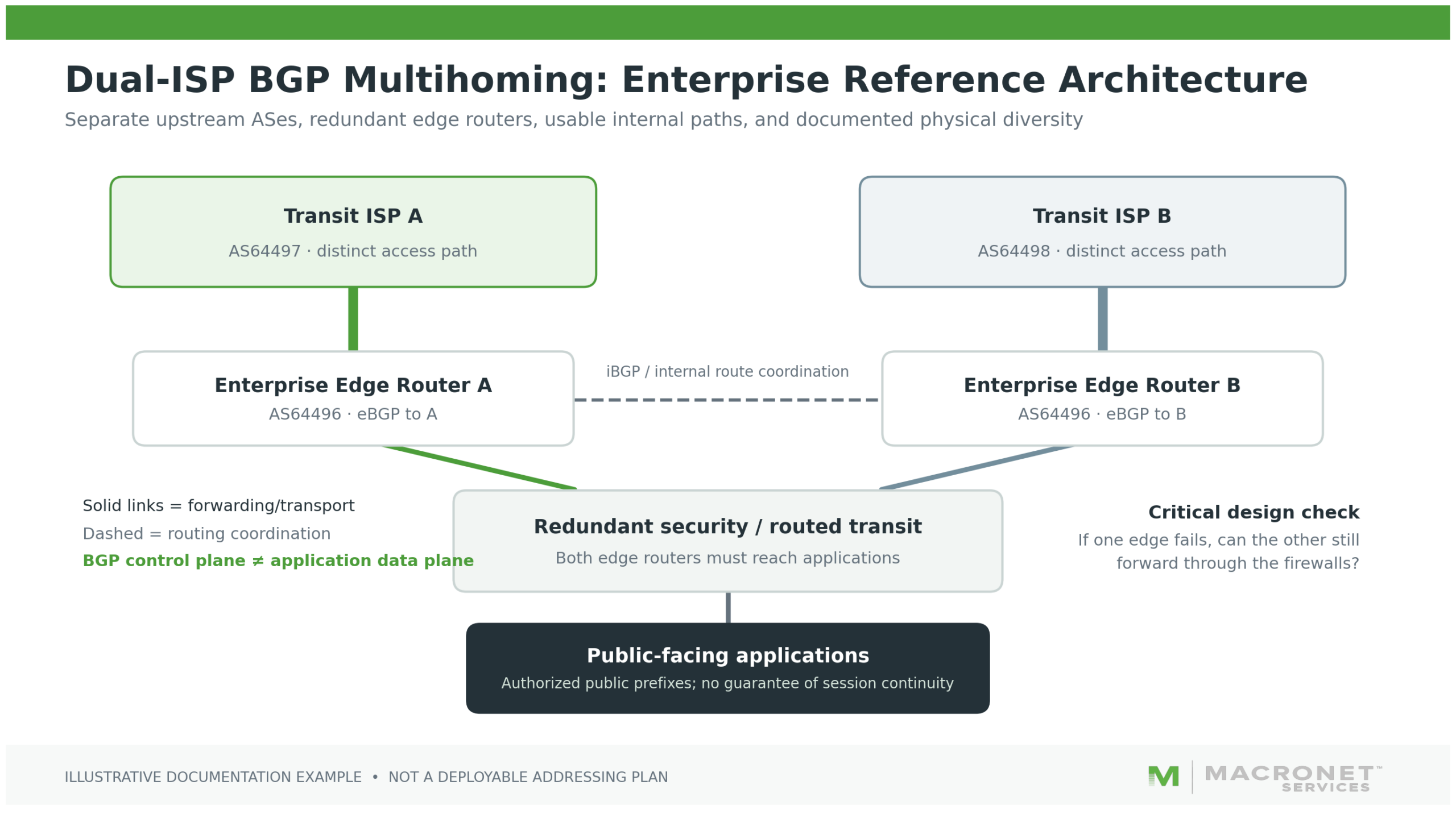
Figure 1. Logical dual-ISP reference topology. Actual physical diversity must be validated.
4. Public ASN, PI vs. PA Addressing and Route Acceptance
Addressing is often the determining factor in whether BGP multihoming meets the business objective. An enterprise with two reliable providers may still lose access to a public application if the only usable destination addresses belong to the failed provider.
A public ASN identifies the organization’s routing domain in global BGP. Under ARIN’s current Number Resource Policy Manual, Section 5, an organization may request an initial ASN; additional ASNs require a distinct policy or technical justification. ASN eligibility, however, is separate from eligibility for portable IPv4/IPv6 address resources. A private ASN may be entirely appropriate for some cloud or provider-managed BGP sessions, but public Internet origination typically calls for a globally unique origin identity.
Provider-independent (PI) address space is not tied to the assignment of one transit carrier. When eligible and properly authorized, an enterprise can originate an appropriate PI prefix through multiple upstreams. Provider-assigned (PA) space is part of a carrier’s allocation; announcing it through another carrier requires explicit authorization and may not be accepted or portable. A company should never assume that its ISP-provided /29 or /28 can be advertised as an independent global route.
For public IPv4, /24 is a common practical boundary for global route acceptance. It is not a universal guarantee: upstreams apply filtering policies, and individual arrangements vary. Enterprises planning to purchase or transfer IPv4 resources should establish the required prefix size and carrier acceptance before committing to equipment or circuit orders. ARIN explains the resource process in its IPv4 request guidance.
For IPv6, the available address space is much larger, but public prefix allocation and route filtering still matter. Multihoming with a PI IPv6 prefix can resemble the familiar public IPv4 model. Multihoming with a different PA prefix from each ISP introduces separate source-address and return-path challenges, addressed later in this guide.
Route Origin Authorizations (ROAs) are essential in an enterprise-owned prefix design. In our example, the enterprise’s ASN remains the origin of its prefixes; ISP A and ISP B are alternative upstream paths, not necessarily separate authorized origins. ROAs should authorize the actual origin and intended maximum prefix length. Incorrect ROA data can cause legitimate routes to be classified Invalid by networks performing Route Origin Validation. See ARIN’s RPKI and ROA guidance.
Registration and authorization are not the entire turn-up. Both providers must accept the prefix, install suitable customer filters and advertise it as agreed. An eBGP session in Established state does not prove the public prefix is visible beyond the provider edge.
5. Engineering a Dual-Router Enterprise Internet Edge
The routing and forwarding design must connect every viable upstream to the applications it is supposed to protect. In our example, Router A peers with ISP A while Router B peers with ISP B. The routers may exchange relevant routes using iBGP, with an appropriate internal routing system or connected design ensuring the BGP next hops are reachable. Exactly how iBGP and next-hop handling are implemented depends on the devices, topology and route feeds.
The crucial requirement is that either edge has a usable forwarding path through the security infrastructure to the application. If Router B maintains a perfect BGP session but cannot reach the firewall, the backup path is of little value. Likewise, advertising a public prefix from B when the application network is unreachable behind B can blackhole inbound traffic.
A resilient firewall design must account for session state and NAT. Internet paths are commonly asymmetric: packets can arrive through one ISP and return through another. IP routing allows this, but stateful inspection can reject packets if the firewall handling the return traffic does not possess the corresponding connection state. If multiple firewalls share responsibility, the enterprise must validate how synchronization, inspection ownership, NAT mappings and failover operate on that platform. Public IP continuity alone does not guarantee session continuity.
The BGP export policy should be narrowly scoped. AS64496 purchases connectivity from ISP A and ISP B; it is not intended to become an Internet transit provider between them. It should advertise only its authorized prefixes and specifically approved downstream routes, not re-advertise a large route set learned from ISP A to ISP B. Explicit filters, next-hop validation and protection of the BGP sessions follow guidance in RFC 7454, BGP Operations and Security.
Three operating states must be documented before implementation: normal operation, when both providers are available; degraded operation, when one path fails and the network uses the other; and restoration, when the repaired path returns. Failback can be as disruptive as the initial outage if the network repeatedly changes preference during an unstable recovery. Design and acceptance criteria should cover all three.
6. Default vs. Partial vs. Full BGP Tables
An enterprise can originate its own prefixes to two providers without receiving every Internet route in return. The outbound advertisement describing how to reach the company’s public services is a separate choice from the route feed the company receives for traffic leaving the enterprise. Treating them as one decision can lead to unnecessarily expensive routers and a more complicated operating model.
With default-only BGP, each upstream advertises 0.0.0.0/0 and, where appropriate, ::/0. The enterprise chooses the preferred default using its routing policy and can use the surviving upstream when one route becomes unavailable. This is attractive for straightforward dual-ISP continuity. Its limitation is that one default route contains no information about alternative paths to a specific remote destination. Moreover, a default route can remain present even when an ISP has a selective reachability problem deeper in its backbone.
A partial route feed supplies selected prefixes—perhaps those in a carrier’s own and customer networks—plus a default for other destinations. This gives more destination-specific control without full-table scale. It also requires precision about what each provider is exporting: two carriers’ “partial” offerings may contain different sets of prefixes and behave differently under failure.
A full route feed provides a broad view of eligible Internet prefixes from each provider. That makes it possible to compare paths to many destinations and implement more detailed outbound policy. It also increases the number of candidate routes the control plane must store and process. Memory and route-processing capacity, forwarding-table capacity, IPv6 scale and software behavior all matter; port bandwidth alone does not establish a router’s suitability. Receiving multiple full tables does not, by itself, make failover faster, prevent remote outages or reduce application latency.
| Route-feed choice | Main benefit | Main design tradeoff | Good starting use case |
| Default-only | Lower complexity and limited route scale | Little destination-specific path control | Primary/secondary ISP resilience |
| Partial | Selected destination visibility | Provider-specific content and policy complexity | Targeted traffic steering |
| Full | Broad path visibility and policy flexibility | Greater hardware and operational demands | Advanced multihoming or large public platform |
The selection should follow a question: Which decisions will this additional routing information allow us to make? If the answer is merely “we would like a larger table,” the added complexity is hard to justify. Where richer path control is needed, the router platform should be validated for realistic IPv4/IPv6 growth, route churn, policy processing and forwarding performance.
7. Active-Active vs. Active-Standby BGP: Route Policy and Capacity
Active-standby usually means the enterprise prefers one provider for normal outbound traffic and keeps the other usable as a backup. Active-active means both providers intentionally carry production traffic in normal operation. Neither phrase by itself tells us how inbound traffic is distributed. Other Autonomous Systems decide which paths they prefer toward the enterprise’s prefix, and those decisions can differ across the Internet.
For our example AS64496, a simple outbound policy could assign LOCAL_PREF 200 to routes from ISP A and LOCAL_PREF 100 to routes from ISP B. Under the relevant BGP decision rules, A is preferred for an eligible destination when all else required for selection holds. If its route becomes unavailable, B is eligible. These are illustrative local-policy values, not universal provider settings.
In an active-active design, the enterprise might prefer A for one destination group and B for another, or use BGP multipath on compatible equipment for eligible route sets. Do not assume two sessions generate equal utilization. BGP chooses routes and a destination’s traffic volume is not controlled by route count; a small set of destinations may account for most bytes. Actual distribution must be measured.
The difference between outbound control and inbound influence
Outbound BGP decisions are made on the enterprise’s own routers. Local Preference is therefore a strong tool for outbound route selection. Inbound decisions are made on remote networks. The enterprise can influence those choices through its advertisements, but cannot command every remote AS to select a particular carrier.
AS-path prepending adds repetitions of the enterprise’s own ASN to an advertisement, potentially making one path less attractive. Provider-supported communities may request regional announcements, selective prepends, blackholing or preference changes inside the transit provider. MED can signal preferred entry in certain neighbor relationships. All are conditional on other networks’ policies. None guarantees an Internet-wide inbound split. Selective more-specific prefix announcements can influence forwarding through longest-prefix match, but must be eligible, consistent with ROAs, accepted by providers and designed so the covering aggregate remains safely reachable when a path fails.
A practical design should state the intent and the observable acceptance criterion: for example, “outbound traffic for these destinations normally prefers A; B remains a usable alternative,” and “the public prefix is independently visible through both providers.” Avoid promises such as “exactly 50% of all Internet users will enter through each carrier.”
Design for the N−1 traffic load
The next problem is capacity. Suppose A normally carries 7 Gbps and B carries 5 Gbps over two 10 Gbps ports. If A fails, the surviving B link cannot necessarily carry all 12 Gbps of offered traffic at the required quality. If its commercial commitment, router, firewall or access transport capacity is lower still, the constraint may appear earlier. Even when BGP fails over correctly, applications can suffer congestion.
The engineering question is whether the network meets its N−1 service objective after losing a critical component. The answer may justify more bandwidth, application prioritization, regional distribution or a documented degraded operating mode. A redundant route and adequate failover capacity are separate achievements.
8. What Actually Happens During BGP Failover?
“Automatic ISP failover” is not a single event. It is a sequence of interacting changes in the local control plane, forwarding plane, upstream networks and applications. This sequence is one of the strongest reasons to test real failures rather than relying on advertised router features.
Before failure, AS64496 advertises the same authorized public prefix through both providers. Router A and Router B have appropriate BGP sessions, B is a usable alternate outbound route, and both edges can reach the application through the firewall environment. A is preferred for most outbound traffic. External networks may use either ingress path according to their own policies.
Failure detection begins when A’s local connection, router or upstream path becomes unusable. If the interface drops, detection can be rapid. If the BGP peer becomes silent over an otherwise live interface, the Hold Timer may expire. Bidirectional Forwarding Detection (BFD) can accelerate detection of certain adjacent forwarding-path faults. Neither an established BGP session nor a successful BFD session to a nearby router proves reachability to every destination farther into the Internet.
Local route selection follows once A’s route is withdrawn or otherwise made ineligible. The enterprise can select the surviving route via B, provided the internal next hop, route installation and firewall paths remain functional. The local transition can occur before remote networks have updated their inbound preferences.
External convergence is distinct. Remote ASes that had preferred the path through A need to process withdrawals or changed routing information and select remaining eligible paths. The Internet has no universal convergence timer, and route collectors see only particular vantage points. Some clients can recover sooner than others, especially during nonlocal provider failures.
Application recovery is a fourth outcome. Even after packets reach the alternative edge, a stateful firewall may lack session state, TCP may retransmit or time out, NAT assumptions may change, or the application may not tolerate the interruption. Public prefix continuity does not guarantee continuous active sessions. The test must report time to routing recovery, time to new application connections and impact on existing sessions separately.
| Failure / event | What BGP can help with | What else must succeed |
| Primary access circuit fails | Remove or disfavor unusable path; select alternative | Surviving route, internal forwarding, adequate backup capacity |
| Primary edge router fails | Use second edge if reachable | Firewalls, power, next-hop resolution, internal routes |
| One ISP has remote backbone impairment | Routing can change if impairment produces actionable routing information | Health detection, provider route behavior and policy automation |
| Both access circuits share a cut conduit | Neither link has physical reachability | Truly diverse access route or alternative technology |
| Backup ISP rejects enterprise prefix | Outbound access may still work | Carrier prefix filters, RPKI/IRR authorization, external inbound visibility |
| Stateful firewall drops return traffic | Alternative BGP path may exist | Session-state handling and asymmetric-path support |
| Entire data center fails | Other sites may advertise routes | Working applications and data at surviving site |
Why some “failovers” do not occur
Consider a scenario where ISP A’s BGP neighbor remains Established and continues advertising a default route, but A has lost reachability to selected upstream destinations. The enterprise may keep choosing A even though B could reach those destinations. BGP is not an end-to-end performance monitor. Complementary path tests or application-aware systems may be justified, but they should not withdraw all routes because one probe target happens to fail.
Failback and planned maintenance
When A recovers, the higher Local Preference may cause outbound traffic to shift back, and external networks may again prefer A for inbound paths. A flapping provider can therefore produce a second or recurring outage. Document restoration checks, stability expectations and controlled cutback procedures. For maintenance rather than failure, the GRACEFUL_SHUTDOWN community in RFC 8326 can support deliberate traffic draining where neighboring policies implement it. It differs from Graceful Restart, which concerns retaining forwarding during certain BGP control-plane restarts.
The acceptance criterion is business service recovery, not merely a change in the BGP best-path field. Measure failure introduction, detection, route selection, external visibility, new transaction success, existing session disruption and recovery under representative load. Do the same when the primary path returns.
BGP failover involves distinct stages from failure detection to application recovery.
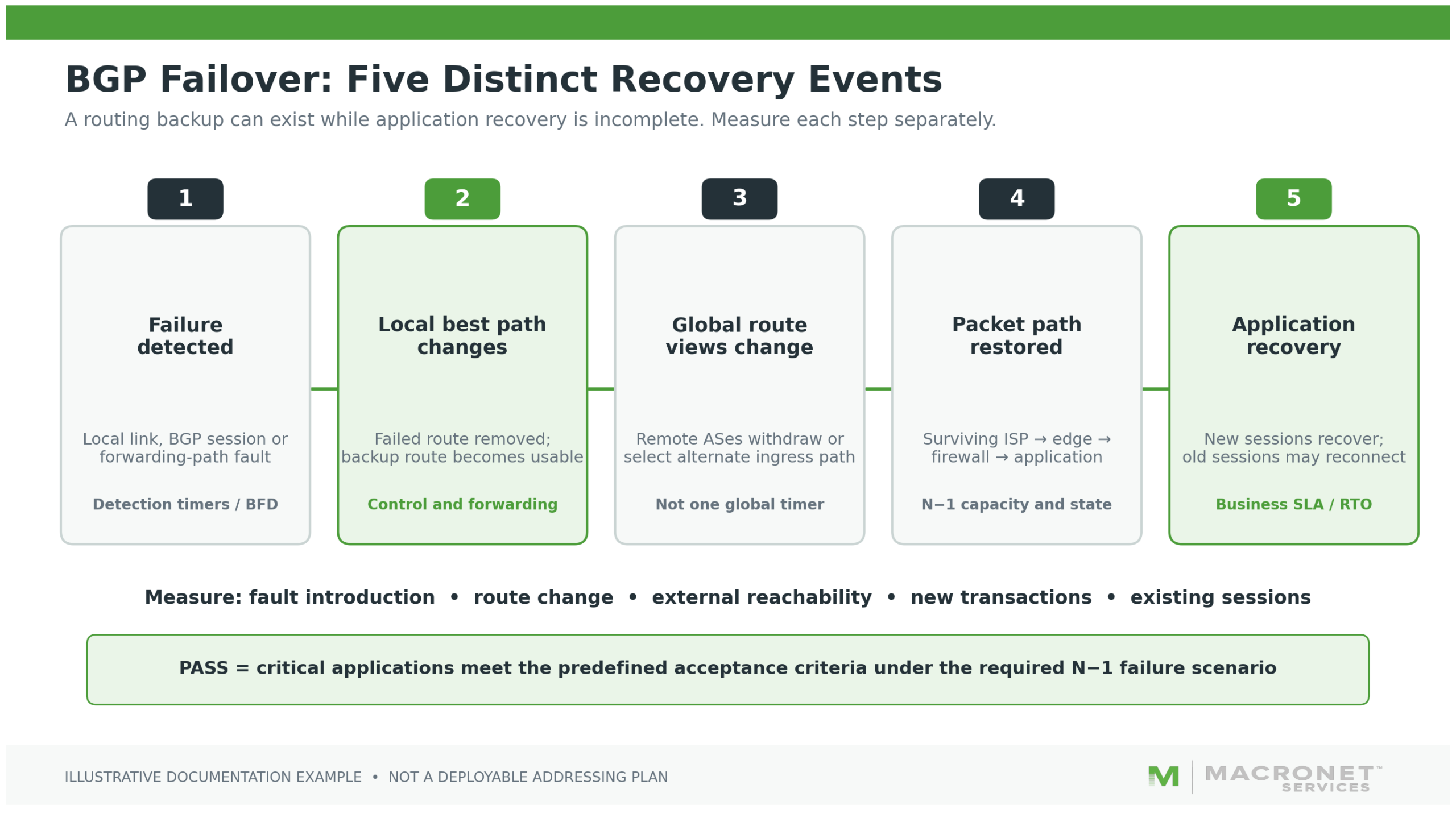
Figure 2. The five recovery events should be measured independently during acceptance testing.
9. Carrier Diversity Is Not Physical Path Diversity
Two provider contracts do not prove two independent physical paths. A national ISP may lease last-mile access from a regional carrier. A second ISP may lease the same carrier’s fiber. Both circuits can share a conduit, utility pole line, building entrance, patching point, metro aggregation facility or wholesale transport network. BGP cannot reroute packets onto a surviving path if both physical links fail together.
Carrier diversity reduces exposure to failures specific to one upstream AS, operational organization or backbone. Physical diversity reduces common points of failure in the infrastructure carrying each connection. Both are desirable in a high-availability design, but they must be evaluated independently.
The diversity review should begin at the building: do the connections enter through different ducts and terminate on independently powered equipment? Continue through the access plant: which local carriers actually own the fiber and where are their common corridors? Examine the provider POPs and regional backhaul: are both services aggregated at the same facility? In a colocation environment, two cross connects may still depend on the same meet-me room or facility. For the broader carrier-network layer, examine upstream dependencies, peering and backbone characteristics rather than equating a brand name with diverse topology.
| Layer | Shared failure point to investigate | Useful evidence |
| Customer site | Router, firewall, power, entrance duct | Site drawings and physical walk-through |
| Access network | Same underlying access provider or conduit | Access-provider disclosure, route-diversity assessment |
| Metro transport | Same aggregation POP or regional corridor | Provider design and diversity representation |
| Colocation | Common meet-me room or fiber distribution | Facility cross-connect topology |
| Upstream | Shared backbone segment or wholesale provider | Carrier network disclosures and topology review |
Providers may not release exact protected fiber maps. In that case, request a written statement describing which form of diversity has actually been verified and which common dependencies remain unknown. “Diverse” is not a sufficient procurement specification without a defined scope.
Where a second diverse fiber route is prohibitively expensive, a fixed wireless, microwave, cellular or satellite backup may offer a different physical failure profile. Those technologies can have significant differences in bandwidth, latency, service-level guarantees, weather susceptibility and operational behavior. They should be evaluated against the actual recovery requirement rather than treated as interchangeable with dedicated fiber.
The sourcing process should price the design the business wants to buy: independent providers and, where necessary, verified independent paths. Macronet Services’ Global WAN Using Tier 1 ISPs and Data Center Connectivity guide examine related access, interconnection and backbone issues.
10. Security and Operational Guardrails for a Multihomed Edge
A network with two upstreams has more than one route through which incorrect information can enter or leave. Its BGP security design should therefore be explicit, not an afterthought. The organization should protect its own prefix announcements, limit received information to intended routes, prevent accidental transit between providers, and monitor for unexpected changes on the global Internet.
Origin authorization and filtering
Resource Public Key Infrastructure (RPKI) lets resource holders publish ROAs specifying the ASN authorized to originate a prefix and its permitted maximum length. In our example, AS64496 remains the origin while AS64497 and AS64498 carry the route through different upstream paths. Route Origin Validation can identify an unauthorized origin announcement, but it does not validate every AS hop or prevent every route leak. Incorrect ROA data can also make a legitimate enterprise advertisement Invalid.
Customer export filters should allow precisely the enterprise’s authorized prefixes and any approved downstream routes. They should prevent ISP A’s full or partial route set from being re-advertised to ISP B: the enterprise is not selling transit between them. Import filters should reflect the purchased feed, reject inappropriate routes according to policy and apply max-prefix thresholds suited to expected IPv4/IPv6 scale. RFC 7454 gives authoritative operational guidance.
Some networks support BGP Roles and the Only-to-Customer (OTC) attribute defined in RFC 9234, helping enforce customer/provider/peer route-propagation relationships. Support and deployment vary; these mechanisms complement rather than replace explicit prefix policy. RPKI-based ASPA techniques are an evolving route-leak defense, not something a procurement checklist should assume every ISP has deployed.
Anti-spoofing with asymmetric routing
Source-address validation matters, but strict reverse-path filtering can reject legitimate traffic in a multihomed network when the route back to a source uses a different interface. Operators need a validation method suited to the topology. RFC 3704 and RFC 8704 describe relevant multihomed anti-spoofing considerations. The correct response is not to abandon source filtering; it is to implement appropriate feasible-path or interface-aware controls.
DDoS and multi-provider mitigation
Two ISPs do not automatically protect against a large DDoS attack. Traffic can exceed either access link’s capacity, and attack traffic may enter through whichever carrier remote networks select. Providers may offer scrubbing, BGP-based diversion and remote-triggered blackholing (RTBH). RTBH can discard traffic upstream to protect other services, but it also sacrifices reachability to the blackholed destination. A multihomed design should coordinate mitigation across both carriers so a routing change does not merely redirect attack traffic onto an unprotected path.
Independent route visibility
RIPE RIS, RIPEstat and RouteViews provide external observations of prefixes and AS paths. They are essential complements to local interface and BGP-session monitoring. A public prefix can vanish from important networks while local peers remain established; conversely, a route can be visible at a collector without being selected by every AS on the Internet. Combine routing evidence with real application probes from relevant user geographies.
Routing governance must also establish who updates ROAs, authorizes prefix changes, adjusts carrier filters, reviews alerts and coordinates incidents. The safest multihoming network is one whose operators know exactly what it should advertise and have evidence that it is doing so.
11. IPv6, Cloud Connections and Application Continuity
Dual-stack multihoming requires two separate validation exercises. Public IPv6 can use a provider-independent enterprise prefix originated through both transit carriers, much as in our IPv4 example. The organization still needs IPv6 BGP sessions, filtering, ROAs, external visibility, security policies and an internal forwarding path that survives an upstream failure. A working IPv4 design does not establish that any of those IPv6 components are correct.
A more difficult scenario uses a different provider-assigned IPv6 prefix from each ISP. A host might have one address from A’s space and another from B’s. If it chooses an A-source address but the packet exits through B, B or a farther upstream may reject the packet under source-address validation. Even when outbound transit succeeds, the return path toward A’s prefix may be lost when A fails. RFC 8678 describes this problem and the requirements for host source-address selection and source-aware routing. It is one reason the simple instruction to “add IPv6 addresses from both providers” is not a complete multihoming design.
A PI IPv6 prefix with conventional BGP is often conceptually clearer for organizations that require stable public destinations, although it carries the registration and operating responsibilities of global routing. Provider-assigned approaches, DNS-based techniques and translation mechanisms can be viable in selected circumstances but require honest expectations about address and session continuity.
Cloud BGP is a separate routing context. AWS Direct Connect, Azure ExpressRoute, Google Cloud Interconnect/Cloud Router and Oracle FastConnect use BGP for supported cloud connections. Their route advertisement rules, gateway policies and private/public service definitions differ from those of IP transit. A redundant Direct Connect or ExpressRoute configuration does not automatically act as a second public Internet provider, and public ISP redundancy does not imply the enterprise’s private cloud circuits are protected. Macronet Services explores those relationships in the Multi-Cloud Networking guide.
For public applications, record three separate recovery outcomes: is the public IP still reachable? Can a customer establish a new connection? What happens to an existing connection? BGP primarily supports the first. Firewall state, TCP retransmission, application timeouts, NAT, load balancers and back-end health influence the other two. Higher-layer solutions, including DNS or global application delivery, may complement routing redundancy or be preferable to public BGP for some workloads.
12. Three Worked Enterprise Designs
Design A: A headquarters that primarily consumes SaaS
A regional company has hundreds of employees using Microsoft 365, CRM, remote access and hosted business applications. It has limited public services inside its building. The goal is to restore employee Internet access after a fiber or ISP failure, not to preserve a globally advertised enterprise prefix. Two physically diverse DIA circuits connected to redundant firewalls or an appropriate SD-WAN system may meet the requirement with less complexity than public BGP. The design must still test public source-address changes, SaaS allowlists, VPNs, authentication and failover capacity.
Decision: Start with dual DIA/SD-WAN; deploy public BGP only if a concrete routing or public-address requirement emerges. Buying a second carrier but leaving both links on one firewall or conduit would still undermine the project.
Design B: A data center hosting customer-facing services
AS64496 hosts public applications behind a redundant firewall layer. It operates authorized PI IPv4/IPv6 prefixes, two edge routers and independent transit relationships with AS64497 and AS64498. Both upstreams accept the enterprise’s origin. A standard routing policy prefers A for outbound traffic but leaves B eligible. Inbound traffic may use either provider; the service is engineered to accept both paths. If A fails, outbound policy moves to B and external networks can select the remaining public route. The public destination prefix stays unchanged, although active sessions might not.
Decision: Public BGP multihoming has a clear purpose here. Acceptance requires external prefix visibility from both carriers, router/firewall forwarding through either edge and documented recovery under load. The backup needs enough capacity for the critical traffic in the N−1 state.
Design C: A distributed platform with two data centers
A software business operates important applications in two regions and wants to survive a facility outage as well as individual provider failures. It has independent Internet edges in both cities. Simply advertising the same public aggregate from both sites is insufficient: the surviving location must actually host the service or have a valid path to it. Stateful applications, data synchronization, traffic stickiness and security requirements may favor DNS-based or global-load-balancer failover; selected stateless services may be well suited to anycast.
Decision: Treat the project as application and site resilience with BGP as one supporting mechanism. Validate site withdrawal/origination triggers carefully. A healthy edge should not advertise service reachability into a dead application environment, but a flaky health check should not induce repeated global route changes either.
These three designs demonstrate why the best network is not necessarily the most complex. Business continuity begins with identifying what must remain available and selecting the least complicated architecture that meets that objective.
13. Total Cost and Provider Selection for Dual-ISP BGP
The cost of multihoming extends beyond “ISP A monthly charge plus ISP B monthly charge.” A fair sourcing model includes access transport, IP transit or DIA, port and cross-connect charges, construction and entrances, edge routers and licenses, firewall high availability, route-monitoring tools, addressing resources, implementation effort and ongoing support.
These components differ markedly by location. A carrier-neutral data center may offer inexpensive physical access to several transit networks but bill cross connects and ports separately. An office or industrial facility may require substantial last-mile construction for a genuinely independent second path. Provider-assigned DIA and data-center IP transit may have different commercial structures; our IP Transit guide addresses commitments, port pricing and usage-based billing in detail.
The reference three-year model is straightforward:
Three-year TCO = 36 × recurring service and support expense + one-time construction/install + equipment/licensing + registration/number-resource expenses + implementation.
That formula is not an estimate; it is a framework for normalizing carrier quotations. Contract duration, renewal terms, excess usage, construction exclusions, early-termination rights and ownership of managed equipment may also materially change cost. Current ARIN fee schedules and IPv4 resource availability should be reviewed when PI addressing is required.
A provider comparison should consider the actual topology and routing capabilities. Can it accept and propagate the enterprise prefix? Does it support appropriate IPv6 routing, RPKI validation and community controls? Is route feed selection documented? Can its network operations team assist with routing incidents and failover tests? Is the access network genuinely distinct from the other proposed carrier’s? What does the SLA actually cover, and are the service credits meaningful relative to the business loss from an outage?
One carrier may be preferable for regional paths, another for cloud interconnection or geographic reach. Macronet Services’ Leading Global Tier 1 ISPs gives useful context for evaluating networks beyond advertised bandwidth. The lowest-priced second circuit is not necessarily the best source of independent capacity. Conversely, the most expensive global backbone is not automatically the best access route to a specific building.
To quantify value, compare the cost of eliminating a failure mode with its estimated business impact. For a mostly SaaS-dependent office, an application-aware dual-WAN design may be the economically appropriate answer. For a revenue-generating platform that needs portable public addressing and carrier independence, public BGP’s added costs may be justified. Do not manufacture a single outage-cost-per-minute number for every organization: use application-specific, defensible assumptions.
14. Implementation, Monitoring and Measurable Acceptance Tests
A multihoming project should not be accepted because two BGP neighbors report Established. That proves a control-plane session exists; it does not prove the providers are propagating the prefixes, forwarding works through each edge, or an application remains usable under failure.
Start with a baseline: normal routes, prefix advertisements, application reachability from representative external networks, traffic distribution, interface errors, bandwidth, latency and packet loss. Validate public ASN and address registration, ROAs, provider prefix filters and the intended IPv4/IPv6 route feeds before migrating production traffic. Commission each upstream separately, then verify that both complete forwarding paths work through the firewalls and application networks.
Use independent observations to verify the intended prefix origin and upstream paths, while remembering that no route collector sees every routing decision. Operational monitoring should join four layers: BGP session and route state; interface/transport performance; external public-prefix visibility; and real application checks. An unexpected AS origin, a route-count collapse or a path change may need different escalation from a local optical fault.
Enterprise multihoming acceptance matrix
| Controlled test | Expected routing behavior | Business-level validation |
| Primary ISP access down | Preferred routes through A removed; surviving eligible B path used | New customer connections work; record existing session interruption |
| Backup ISP down | A continues carrying intended traffic | No unacceptable application degradation |
| Router A powered off | Alternate router forwards if its internal path exists | Services remain reachable through B |
| One router–firewall path down | Invalid next hops removed or avoided | Surviving edge can still reach protected applications |
| Planned maintenance | Paths drained according to supported policy before teardown | Loss and disruption within approved thresholds |
| Primary route restored | Intended preference returns after stability checks | No repeated oscillation or unexpected second outage |
| IPv6 upstream failed | IPv6 route uses surviving eligible path | IPv6-specific probes and application tests succeed |
| Prefix advertisement rejected by B | Alert exposes lost inbound redundancy | External visibility and incident process verified |
| N−1 load test | Surviving access and firewall have adequate capacity | Priority applications meet throughput/latency objectives |
| Application backend unavailable | Advertisement strategy avoids knowingly attracting traffic to a dead service, if designed to do so | Users are directed to a functioning endpoint or receive the documented degraded behavior |
Set acceptance thresholds before the test. Record when the fault was induced, when it was detected, when routes changed, when external observers saw alternatives, when new transactions succeeded and how existing sessions behaved. Do not invent one “BGP failover time” that compresses these distinct phenomena. Tests should include controlled restoration as well as failure. A bad failback policy can produce a second outage even after the carrier has recovered.
For mission-critical public services, simulate more than a local cable disconnect. Where feasible, coordinate with providers to test selective route withdrawal, loss of a router or internal segment, and other failures relevant to the stated resilience objective. A provider backbone incident may leave the local neighbor Established; a cable-pull test does not cover that scenario. Keep a change plan, rollback procedure and stakeholder communications for every production test.
Documentation is part of delivery: topology diagrams, ASN/prefix ownership, ROA responsibilities, route filters, policy intent, provider contacts, diversity evidence, monitoring thresholds, test results and emergency operating steps. A resilient architecture that only its original designer can understand is an operational risk.
15. The Macronet Services Dual-ISP Design and Sourcing Framework
The most effective sourcing process starts before carrier quotations. First establish the business and application continuity requirements: which services must survive, which failures matter, whether public IP addresses must remain constant, and how much degradation is acceptable. Then audit the actual network: the enterprise edge, firewall topology, number resources, access circuits, cloud connections, facility entrances and physical common dependencies.
With that baseline, design the simplest architecture that meets the requirements. Some enterprises will benefit most from conventional dual DIA or SD-WAN. Others need a public ASN, portable prefixes, two independent transit ASes, capable edge routers, route policy and controlled failover. Still others need geographically distributed application infrastructure, not merely another Internet connection.
Carrier selection then becomes an engineering and commercial comparison against the design. The RFP should define prefix-acceptance requirements, route feeds, communities, IPv6, security, intended access diversity, port capacity, SLA and escalation expectations. Quotations should be normalized to the same scope and three-year cost model. Implementation should coordinate the carriers, the customer’s routing and security teams, number-resource authorization, monitoring, cutover and acceptance testing.
Macronet Services works across more than 400 service providers to help enterprises evaluate network architecture, independently compare carrier options and source connectivity in a provider-agnostic manner. This approach is particularly useful when nominally independent carrier offers may use common access plant or when the preferred commercial quote does not fit the required BGP capability. For qualifying connectivity sourcing engagements, the design and sourcing assistance is typically provided at no direct cost to the client; project scope and service availability should be confirmed during the discussion.
Get a Free Dual-ISP Network Design and Unbiased Circuit Sourcing
If your organization is considering BGP multihoming, dual ISP redundancy or a network redesign, Macronet Services can help assess the current architecture, identify physical and routing risks, develop an appropriate connectivity design and competitively source providers. Contact Macronet Services to discuss the requirements and available sourcing assistance.
Conclusion: Design for the Failure, Not the Diagram
BGP multihoming can preserve global reachability to portable public prefixes and create alternatives when an upstream ISP fails. But the real objective is not a second route in a routing table. It is a working path from the customer to the application, including physical access, routing policy, firewalls, sufficient capacity and an environment that can recover safely.
The enterprise that clearly defines its failure scenarios, validates carrier and path diversity, implements disciplined routing security and measures actual application recovery is in a far stronger position than one that simply buys two circuits and assumes resilience. The best dual-ISP architecture is the least complex design that demonstrably meets the business’s availability requirements.
BGP Multihoming FAQs
1. What is BGP multihoming?
BGP multihoming is an architecture in which an organization connects to multiple upstream Internet providers and uses BGP to advertise reachable prefixes and select available routing paths. With appropriately authorized portable addresses, the same public prefix can remain reachable through more than one carrier.
2. Do I need BGP to use two Internet providers?
No. A firewall or SD-WAN solution can fail over ordinary outbound Internet access between two providers. Public BGP is more compelling when you must originate your own public prefixes through multiple carriers, maintain routing independence or perform sophisticated interdomain traffic engineering.
3. What is the difference between dual ISP and BGP multihoming?
Dual ISP describes having two Internet services. BGP multihoming adds interdomain route exchange and policy across upstream provider relationships. Two ISP connections do not inherently mean that the enterprise can advertise the same public IP addresses through both.
4. Does BGP multihoming require a public ASN?
Conventional public multihoming with enterprise-originated portable prefixes generally uses a globally unique public ASN. Some provider-managed or private/cloud BGP arrangements can use private ASNs instead. The requirement depends on the routing model.
5. Can I use provider-assigned IP addresses for BGP multihoming?
Only if the addressing and routing arrangement permits it. PA addresses are typically tied to one provider’s allocation; another ISP may not accept them. PI space is generally more flexible for advertising the same eligible public prefix through independent transit providers.
6. Do I need a /24 for IPv4 BGP multihoming?
A /24 is a common practical minimum for independent global IPv4 announcements because many networks filter more-specific routes. It is not a universal guarantee of acceptance. Check the prefix’s authorization, allocation status, upstream filters and intended routing model before ordering circuits.
7. What is active-active BGP multihoming?
Both providers carry production traffic during normal operation. Routing policies may prefer different providers for different destinations, and some platforms support multipath forwarding for eligible routes. Active-active does not automatically result in an equal traffic split.
8. What is active-passive or active-standby BGP?
The enterprise prefers one provider for outbound traffic while keeping another eligible as a backup. Inbound traffic may still arrive through either provider because remote networks make their own route selections. The network must therefore support both ingress paths even under an outbound standby policy.
9. How does BGP multihoming failover work?
After an upstream path becomes unusable and its routes are withdrawn or made ineligible, the enterprise can select a surviving path. Remote networks may independently converge on alternate routes toward the public prefix. Firewalls, NAT, capacity and application behavior determine whether business services recover successfully.
10. How fast is BGP failover?
There is no single guaranteed interval. Detection, local path selection, external route propagation and application recovery have different timelines. BFD can help detect certain neighboring path failures faster, but cannot guarantee end-to-end application recovery. Measure the actual design under controlled failure tests.
11. Can BGP keep existing TCP sessions alive when an ISP fails?
Sometimes sessions survive a brief path change, but not reliably by BGP alone. Convergence loss, changed forwarding paths, stateful firewall behavior, NAT mappings and application timeouts can interrupt existing connections even when the public destination IP stays the same.
12. Do I need full BGP tables from both ISPs?
Not necessarily. Default routes may satisfy straightforward primary/backup requirements. Partial or full route feeds provide more destination-specific control but require appropriate hardware and operating practices. Full tables do not automatically improve failover or latency.
13. How do I control which ISP carries outbound traffic?
Local routing policy—especially BGP Local Preference—can select the preferred eligible route among upstreams. The result depends on next-hop reachability and the routing implementation. Destinations and actual traffic volume must be monitored to confirm the intended distribution.
14. How do I influence inbound traffic between two ISPs?
Common techniques include AS-path prepending, provider-supported BGP communities, MED in suitable relationships and selective advertisements of eligible prefixes. These influence rather than universally dictate the policies of remote Autonomous Systems.
15. Can two different ISPs share the same fiber route?
Yes. Different ISPs can lease last-mile access from one provider or share conduits, building entrances, carrier hotels or aggregation facilities. Obtain a documented physical-diversity assessment; provider brand diversity alone does not guarantee route diversity.
16. What happens if the backup ISP rejects my BGP prefix?
The enterprise may still have outbound connectivity, but external networks may not be able to reach its public service through the backup. Verify prefix authorization, ROAs, IRR records, provider filters and independent route visibility before treating the path as a valid inbound backup.
17. Does BGP multihoming protect against DDoS attacks?
No, not by itself. An attack can saturate either or both access paths. Appropriate protection may require provider scrubbing, route diversion, RTBH, application delivery defenses and a mitigation plan coordinated across both upstreams.
18. How is IPv6 multihoming different from IPv4?
PI IPv6 multihoming with BGP is broadly analogous to public IPv4 multihoming. Using separate provider-assigned IPv6 prefixes raises source-address selection and return-path problems that ordinary destination-only routing does not solve. IPv4 and IPv6 failover should be tested separately.
19. How should I test dual-ISP BGP failover?
Test each provider separately, confirm external prefix visibility, remove a primary circuit, fail an edge router, validate firewall forwarding, test IPv4/IPv6, observe N−1 capacity and measure new and existing application sessions. Also test recovery and failback rather than only the initial outage.
20. How much does BGP multihoming cost?
Costs depend on Internet services, physical access construction, routers, firewalls, cross connects, portable address resources, licensing and operations. Compare providers on a normalized multi-year TCO basis and evaluate the cost of preventing specific outages, not only the second circuit’s monthly price.
21. Is BGP better than SD-WAN for redundant Internet?
They serve different purposes. BGP supports interdomain reachability and public routing policy; SD-WAN often provides application-aware path selection over available underlay connections. Many headquarters can use SD-WAN or firewall failover without public BGP, while public application platforms may benefit from both.
22. Does BGP multihoming protect against an entire data center failure?
Not on its own. Other locations can advertise public prefixes, but the application and required data must also exist or be reachable at a surviving site. Geographic resilience requires application failover, security, routing and transport designed together.