
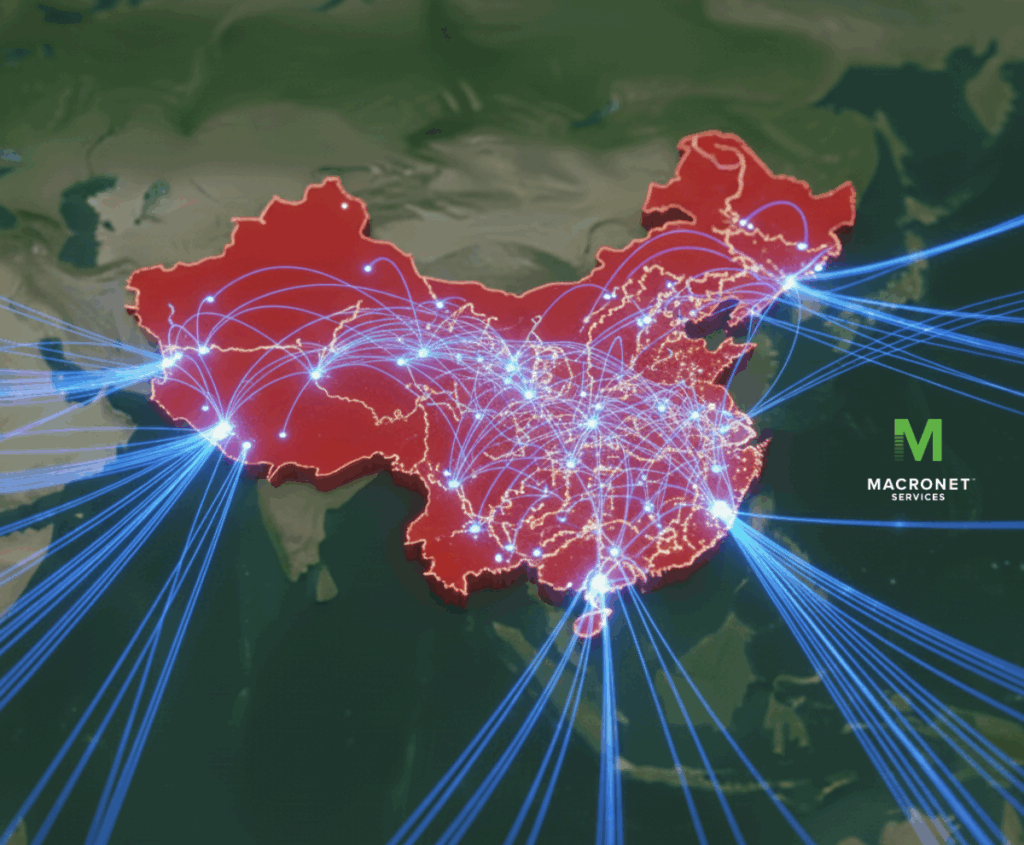
This extensive article has been developed by the highly technical and globally experienced team at Macronet Services as a practical resource for organizations who are designing secure and compliant networks in China. Drawing on decades of expertise in international carrier ecosystems, Tier-1 ISP architectures, SD-WAN engineering, cloud connectivity, and cross-border regulatory compliance, the Macronet Services team provides a clear, deeply researched framework for navigating the unique legal, operational, and performance challenges of China-related network design.
This guide is intended to help CIOs, CTOs, network architects, and global IT leaders make informed, compliant, and future-resilient decisions as they build and scale worldwide connectivity strategies.
1.Introduction
- Context: WAN design for US enterprises operating in China
- Why China connectivity is unique (regulatory, technical, geopolitical)
- Scope of the article and research questions
2. Historical and Macroeconomic Context
- Evolution of China’s telecom ecosystem
- Regulatory tightening (CSL, DSL, PIPL)
- China’s role in global manufacturing and supply chains
- The geopolitics of subsea cables and cross-border data flows
3. Technical Constraints and Connectivity Options
- China’s domestic carrier landscape
- MPLS, DIA, and hybrid underlay options
- SD-WAN/overlays: regulatory limitations
- Cloud and SASE integration
- Internet performance characteristics inside/outside China
4. Legal Analysis of Network Design Patterns
- Cross-border data transfer (CBDT) obligations
- Application of PIPL, DSL, CSL to network architectures
- Legality of VPNs, SD-WAN, and encryption
- US regulatory constraints (FCC, Covered List, CLOUD Act)
- Combining legal and technical constraints to determine feasible designs
5. Technical Design Space: Reference Architectures
- Design principles (compliance-by-design, zero trust, observability)
- Reference Architectures:
- 5.2.1 Classic MPLS hub + SD-WAN edge
- 5.2.2 Hybrid SD-WAN with regional egress
- 5.2.3 China-localized + API-bridged
- 5.2.4 Cloud-centric regional hub architectures
- Trade-offs and best-fit scenarios
6. Designing Exit Path Diversity “Out of China”
- Physical, carrier, and BGP path diversity
- Regional hub strategies (HK, Singapore, Tokyo, Seoul)
- Segment-specific exit strategies
- Crisis/failure scenario analysis
- Metrics and measurement frameworks (SRLGs, AS-path diversity, failover testing)
7. Case Studies and Archetypes
- 7.1 Manufacturing firm with two major China plants
- 7.2 SaaS company with a China subsidiary
- 7.3 Professional services/consulting firm with small China offices
- 7.4 Global manufacturer with 12–20 China sites and worldwide WAN footprint
- Comparative lessons across archetypes
8. Governance, Contracting, and Operationalization
- Cross-functional governance model
- Policies: network standards, data-transfer rules, vendor engagement
- Carrier and managed service contracts
- Monitoring, audit, and enforcement mechanisms
- Organizational culture and training
9. Discussion
- Key tensions: performance vs. compliance, security vs. observability, diversity vs. cost
- Strategic implications for mid-enterprises
- Broader geopolitical and infrastructural considerations
- Future of global WANs under jurisdictional fragmentation
10. Conclusions and Future Research
- Synthesis of key findings
- Practical recommendations for enterprises
- Opportunities for future research:
- Jurisdiction-constrained routing models
- Empirical WAN performance studies
- Comparative regulatory analysis
- Standards and best-practice development
-
Introduction
Global enterprises increasingly depend on tightly integrated networks that span continents, time zones, and regulatory systems. For US-headquartered mid-enterprise firms—large enough to run global operations but small enough to lack hyperscaler-style in-house legal and engineering teams—the challenge is particularly acute when operations extend into the People’s Republic of China (PRC). These organizations must deliver reliable, performant connectivity between sites inside mainland China and the rest of the world while navigating overlapping regimes of data protection, cybersecurity, telecommunications regulation, and national security policy.
Over the last decade, China has built a dense, interlocking framework of laws governing cyberspace, data security, and personal information protection, including the Cybersecurity Law (CSL), Data Security Law (DSL), and Personal Information Protection Law (PIPL). These laws are complemented by detailed implementing rules on cross-border data transfer (CBDT), such as the Provisions on Promoting and Regulating the Cross-Border Flow of Data and successive FAQs and Q&A documents from the Cyberspace Administration of China (CAC). At the same time, China is refining sector-specific guidance (for example, financial-data guidelines) and has announced new certification rules for cross-border transfers of personal information that will take effect in 2026.
In parallel, the United States has increasingly viewed Chinese technology firms and carriers as national-security risks. The Federal Communications Commission (FCC) has revoked section 214 authorizations for multiple Chinese telecom carriers—including China Telecom Americas and China Unicom Americas—and is now moving to tighten restrictions on equipment and undersea-cable technologies associated with firms on its “Covered List.” These actions directly affect how US enterprises purchase and rely on international connectivity that involves Chinese entities, including undersea cable systems and wholesale transit.
This article aims to synthesize these legal, geopolitical, and technical dynamics into a coherent design framework for US mid-enterprise networks that include sites in mainland China. It approaches the problem as a socio-technical system: network architectures cannot be evaluated solely on throughput and latency; they must also be assessed in terms of regulatory compliance, exposure to state power, and resilience under geopolitical stress.


We focus on four core research questions:
- Legal constraints: How do PRC data-protection and telecom regulations constrain WAN designs that connect mainland China with global networks for US enterprises?
- Technical options: What connectivity architectures—spanning MPLS, SD-WAN, cloud interconnects, and SASE—are technically viable and legally compliant in this context?
- Path diversity: How can enterprises design diverse and resilient exit paths “out of China,” given the topology of subsea cables and the growing securitization of undersea infrastructure?
- Governance and contracting: What governance structures and vendor-management strategies reduce regulatory, operational, and geopolitical risk for mid-enterprise organizations?
The scope of analysis is deliberately constrained. We focus on US-headquartered firms with roughly 500–10,000 employees—large enough to operate multiple sites in China and abroad, but typically dependent on managed network and security services rather than building everything in-house. We concentrate on mainland China (not Hong Kong or Taiwan), and we assume “conventional” enterprise workloads: ERP/CRM, collaboration tools, line-of-business applications, and some OT/plant data, rather than highly classified defense environments.
Methodologically, the article combines:
- Doctrinal legal analysis of PRC CBDT and telecom rules, including the Provisions on Cross-Border Data Flows (2024), PIPL, and related Q&As and FAQs, alongside recent US FCC and national-security actions involving Chinese telecoms and cable technology.
- Technical architecture analysis based on vendor documentation and industry guidance on MPLS, carrier-delivered SD-WAN, cloud connectivity, and SASE, especially where those materials address China-specific constraints.
- Geopolitical and infrastructure studies of undersea cable deployment, rerouting, and security concerns in East and Southeast Asia, which shape what “path diversity” actually means in practice.
The contribution of this article is threefold. First, it develops a taxonomy of WAN architectures suitable for US firms with China operations, mapping each pattern to CBDT mechanisms, telecom constraints, and realistic performance expectations. Second, it proposes a design framework for exit-path diversity that accounts for physical cables, carrier mix, routing policies, and regulatory exposure. Third, it articulates a governance and contracting playbook for mid-enterprise organizations that lack the internal depth of a hyperscaler but still need defensible, Board-level justifications for their network decisions.
2. Background: Regulatory and Infrastructure Context
2.1 PRC Legal and Regulatory Framework
2.1.1 Core Statutes: CSL, DSL, and PIPL
China’s contemporary data and network-governance regime rests on three pillar statutes:
- The Cyber Security Law (CSL) emphasizes the protection of “critical information infrastructure” (CII), security reviews, and baseline network-security obligations for network operators.
- The Data Security Law (DSL) introduces a national system for data classification and hierarchical protection of “important data” and “core data,” requiring risk assessments and imposing restrictions on export of certain categories. Emerging national standards, such as GB/T 43697-2024 on data classification and grading, are intended to operationalize these concepts.
- The Personal Information Protection Law (PIPL) is China’s first comprehensive data-protection statute, setting out principles for lawful processing, data-subject rights, and obligations for “personal information processors,” including foreign entities processing data of individuals in China under certain circumstances.
For network designers, the key implication is that topology is now legally salient. The same logical application architecture can be lawful or unlawful depending on where data is stored and how it traverses borders. PIPL and DSL obligations apply not only to storage but to access and processing from outside China.
2.1.2 Cross-Border Data Transfer (CBDT) Mechanisms
Historically, PIPL envisaged three main legal mechanisms for systematic cross-border transfers of personal information (PI):
- CAC security assessment for transfers by CII operators or where certain volume thresholds are exceeded;
- Standard Contractual Clauses (SCCs) filed with the CAC;
- Certification (personal information protection certification) via approved bodies.
In 2024, the Provisions on Promoting and Regulating the Cross-Border Flow of Data (the “Provisions”) and subsequent guidance significantly re-calibrated this framework. The Provisions:
- Clarified six categories of transfers that are exempt from the full CBDT mechanisms (security assessment, SCC, certification), such as small-volume PI exports, certain HR transfers, and transfers necessary for concluding or performing contracts at the data subject’s request.
- Introduced a “negative list” approach, under which many routine business transfers outside that list can proceed with reduced formalities, provided other PIPL obligations are met.
In 2025, additional CAC Q&A documents and sector-specific guidance (for example, on financial data) have refined these exemptions and clarified how they apply in practice. At the same time, regulators have announced new rules that will require “non-critical information infrastructure operators” to obtain certifications before certain personal data categories may be exported as of January 2026, further tightening oversight.
For enterprises, the upshot is that cross-border data transfer (CBDT), is no longer a binary “allowed vs. forbidden” question, but a calibrated system in which:
- Data type (PI vs. non-PI, “important data,” sector-specific categories);
- Volume and frequency; and
- Purpose (contract performance, HR management, emergency response, etc.)
jointly determine which mechanism or exemption applies. Any WAN design that moves traffic between China and the rest of the world must therefore begin with data-flow mapping and classification, not with routing protocols.
2.1.3 VPN and SD-WAN Regulation
China’s regulatory stance on VPNs and SD-WAN has evolved from a gray zone to a whitelisting regime. While there is no blanket, statute-level prohibition on VPNs, authorities have made clear that:
- Only government-approved VPNs are legal.
- Approval generally requires that the service be operated by, or in partnership with, licensed telecom carriers, enabling regulatory oversight and potential lawful access.
Recent guidance aimed at enterprise users makes this more explicit:
- Traditional IP-based, over-the-top VPN services are not permitted for corporate use.
- VPN or SD-WAN functionality must be delivered via MPLS or carrier-approved SD-WAN services, with SD-WAN providers required to obtain approval from authorized telecom operators and comply with requirements that may include enabling government access to transmitted data.
From a design standpoint, this means that DIY IPSec overlays from a US data center directly into China over commodity DIA are not merely fragile but potentially non-compliant. The PRC expects international enterprise connectivity to traverse carriers and services that it can supervise. This puts a structural premium on:
- Buying underlay services (MPLS, DIA, SD-WAN access) from the “Big Three” carriers (China Telecom, China Unicom, China Mobile) or their approved partners; and
- Designing overlays (SD-WAN, SASE) that respect these constraints rather than bypass them.
2.1.4 Cloud and Internet Content Provider (ICP) Licensing
Enterprises that host internet-facing services targeting users in China generally require an ICP license or filing, which must be obtained via a domestic entity or qualified cloud provider. Major cloud platforms have created China-specific regions that are legally and technically segregated from their global networks—e.g., Azure China, operated by 21Vianet, and similar arrangements by AWS and others. These regions:
- Are subject to Chinese law and operated by Chinese partners;
- Provide a limited set of services relative to global regions;
- Often have controlled, non-transparent connectivity to non-China regions. This segmentation means that “multi-region” cloud designs are not neutral with respect to law and routing. For example, bridging Azure China to global Azure via site-to-site VPNs or ExpressRoute-like services requires attention to both CBDT rules and telecom licensing, and it frequently depends on domestic carriers as intermediaries.


2.2 US and International Regulatory Overlay
2.2.1 FCC and National-Security Actions
On the US side, the FCC has progressively treated Chinese state-linked carriers and equipment vendors as security threats. Key milestones include:
- 2021 – Revocation of China Telecom Americas’ section 214 authority, based on findings that continued operation posed unacceptable national-security and law-enforcement risks.
- 2022 – Revocation of China Unicom Americas’ authorizations, similarly justified by concerns over Chinese government control and the potential for traffic manipulation or surveillance.
- Ongoing actions to restrict or revoke authorizations of other entities, including a recent proceeding aimed at a Hong Kong carrier affiliated with China Unicom, as well as broader restrictions on equipment from Huawei, ZTE, China Mobile, and others.
The FCC has also become increasingly active in undersea-cable security, playing a role in halting or reshaping cable projects that would have connected the US to Hong Kong or used Chinese-supplied technology.
For enterprise network architects, these developments have two implications:
- The risk profile of contracting directly with certain carriers (or buying capacity on particular cable systems) is no longer purely commercial; it now includes the possibility of regulatory disruption or forced divestment.
- US authorities are sending a clear signal that “trusted routing” and “trusted vendors” are policy priorities, which may influence due-diligence expectations, especially in regulated sectors.
2.2.2 Export Controls and Sanctions (High-Level)
While a full treatment of export controls is beyond scope, certain controls can impact network design:
- Restrictions on exporting advanced networking and encryption hardware to certain Chinese entities;
- Sanctions lists that may cover specific carriers, data-center operators, or cloud providers;
- Anticipatory risk that entities not currently listed may become subject to restrictions, disrupting long-term contracts.
As a result, mid-enterprise firms increasingly need sanctions and export-control screening as part of carrier and cloud-provider selection, not only for application vendors.
2.2.3 International Instruments and “Data Diplomacy”
Unlike the EU’s GDPR, there is no comprehensive adequacy-style regime between China and the US. Instead, cross-border data governance is fragmented across:
- Sector-specific guidelines (e.g., financial markets; cross-border financial data);
- Bilateral or multilateral initiatives that are still embryonic compared to the EU’s data-transfer ecosystem.
This absence means that enterprise CBDT compliance is heavily domestic-law driven: US firms must treat PRC CBDT rules as the primary legal constraint, rather than relying on international agreements to simplify compliance.
2.3 Physical and Logical Network Infrastructure
2.3.1 Domestic Chinese Backbone and Carriers
At the physical and routing layers, mainland China is dominated by the three major state-controlled carriers:
- China Telecom
- China Unicom
- China Mobile
These carriers:
- Operate the dominant national backbone and handle most domestic transit;
- Control the majority of international gateways and landing stations;
- Act as gatekeepers for enterprise connectivity, offering MPLS VPNs, dedicated internet access (DIA), and international private leased circuits.
Foreign carriers typically operate in China via joint ventures, partnerships, or limited-scope licenses, often reselling or overlaying services provided by the Big Three. For most mid-enterprise networks, the realistic options for underlay within mainland China therefore involve one or more of these carriers, with foreign global carriers providing overlay management and cross-border integration.
Unlike global Tier-1 ISPs—such as Lumen, Arelion, GTT, and NTT—China’s major carriers do not peer settlement-free across the global Internet and instead operate regionally dominant but internationally restricted networks. This has major implications for enterprises: cross-border routing from China inevitably depends on partnerships between domestic carriers and Tier-1 ISPs outside China, creating chokepoints and path-dependence that must be accounted for in WAN design
2.3.2 Submarine Cable Topology and Geopolitics
Nearly all intercontinental data traffic travels over undersea cables. Recent analyses estimate that over 95–99% of international internet traffic flows via subsea fiber systems rather than satellites.
In the East Asia–US context, key features of the cable landscape include:
- Multiple systems linking East Asia (Japan, South Korea, Taiwan, Singapore, Hong Kong, mainland China) to the US West Coast;
- Cable landing stations concentrated in a small number of coastal sites, which become physical chokepoints;
- Increasing rerouting around sensitive jurisdictions, such as the deferral or cancellation of cables landing in Hong Kong due to US security concerns and licensing blocks.
In Southeast Asia, cables traversing the South China Sea and surrounding waters have faced delays and rerouting due to disputes over maritime jurisdiction and permit requirements. These tensions illustrate how geostrategic competition is now embedded in the physical network: routing a cable via Singapore instead of Hong Kong, or around contested waters instead of through them, changes latency, capacity, and legal exposure.
For enterprises designing path diversity “out of China,” this means:
- “Diverse” paths may still share long stretches of common subsea routes or landing sites;
- Some paths may be politically less stable than others, even if they appear equivalent in BGP;
- Regulatory measures (such as US moves to ban certain Chinese technology from US-linked cables) can quickly reshape what routes are viable.
2.3.3 Data-Center and Cloud Edge Geography
China-adjacent digital infrastructure has coalesced around a set of regional hubs:
- Hong Kong – historically a preferred hub for China-ex-China connectivity, though recent political and regulatory changes have increased risk perception and prompted re-routing of some cables and traffic flows.
- Singapore – a politically stable, highly connected hub with dense data-center presence, central to many rerouted subsea systems.
- Japan (Tokyo/Osaka) and South Korea (Seoul/Incheon) – key East Asian hubs with strong connectivity to both the US and the wider Asia–Pacific region.
Cloud providers typically locate their major regional PoPs and cloud regions in these hubs, then connect them to China border-gateway cities (e.g., Beijing, Shanghai, Guangzhou) via domestic fiber and cross-border links. From an enterprise architecture perspective, these hubs represent the natural candidates for “China exit points” in a hub-and-spoke or regional-mesh design.
-
Taxonomy of Connectivity Models for US Enterprises with China Sites
With the regulatory and physical context in place, we can classify enterprise network designs that connect China and the rest of the world into a manageable set of patterns. This taxonomy is not exhaustive, but it covers the dominant architectures encountered in practice and serves as a scaffold for later legal and technical analysis.
3.1 Legacy MPLS and International Private Lines
3.1.1 Point-to-Point International Private Lines
The most traditional model for China–global connectivity is the international private line:
- A point-to-point circuit from a China site (or carrier PoP) to a foreign site (often a Hong Kong, Singapore, or Tokyo PoP), delivered as MPLS L3VPN, Ethernet private line (EPL), or Ethernet virtual private line (EVPL).
- Underlay entirely provided by one of the Big Three Chinese carriers, sometimes with a foreign carrier reselling or aggregating service for the global side.
Advantages:
- Well-established regulatory pattern: carriers and regulators are accustomed to approving and operating such circuits.
- Predictable performance characteristics (latency, jitter, loss), often backed by SLA-grade guarantees.
- Clear demarcation points for governance and troubleshooting.
Disadvantages:
- Cost and rigidity: provisioning is slow, re-routing is difficult, and capacity upgrades can be expensive.
- Limited diversity: if both primary and backup circuits are procured from the same carrier, they may share physical infrastructure even if logically separated.
- Operational opacity: enterprises have limited visibility into the actual cable systems and paths used, which complicates risk assessment.
For mid-enterprise organizations, private lines often appear only as core backbone links (e.g., China → Hong Kong → global core), with branch aggregation handled domestically via cheaper services.
3.1.2 MPLS Hub-and-Spoke Architectures
Building on private lines, many enterprises use MPLS hub-and-spoke architectures:
- China branches connect via domestic MPLS VPN to a regional hub (e.g., Shanghai, Beijing), which then connects via international MPLS to a global hub in Hong Kong, Singapore, or Japan.
- Global hubs often sit in carrier-neutral data centers, where enterprises can cross-connect to other carriers, internet exchanges, and cloud on-ramps.
The MPLS cloud provides QoS, traffic engineering, and integrated VPN membership, making it attractive for latency-sensitive applications like ERP and VoIP. The main design choices involve:
- Whether to maintain a single global MPLS provider that partners with domestic Chinese carriers;
- Whether to split domestic (China-only) MPLS and international MPLS among multiple providers for diversity.
In regulatory terms, these designs generally align with PRC expectations: they use licensed carriers and avoid unapproved, over-the-top VPNs. Compliance questions arise more from data classification and CBDT rules (what data crosses the border) than from the mere existence of the MPLS circuit.
3.2 SD-WAN Overlays and Hybrid Architectures
As SD-WAN has matured, enterprises have increasingly sought to overlay application-aware routing and zero-trust connectivity on top of MPLS and DIA. In China, however, SD-WAN must be adapted to the VPN/telecom rules discussed in Section 2.1.3.
3.2.1 SD-WAN Overlays on Licensed Underlay
In a compliant pattern, SD-WAN devices at China sites:
- Use MPLS and/or DIA links provisioned by licensed domestic carriers as underlay;
- Form encrypted tunnels to SD-WAN gateways in regional hubs (e.g., Hong Kong, Singapore, Tokyo) and to other branches;
- Are typically delivered as a managed service by a global carrier or MSSP that has structured its offering to satisfy PRC approval requirements.
Technical benefits include:
- Dynamic path selection based on loss/latency/jitter across MPLS vs. DIA;
- Centralized policy control (e.g., steering SaaS traffic to local internet, backhauling sensitive traffic);
- Easier incorporation of cloud on-ramps and SASE services.
The key compliance constraint is that SD-WAN functionality must not resemble an unregistered, over-the-top VPN. Accordingly, enterprises:
- Prefer to consume SD-WAN as a carrier-delivered product (or in partnership with carriers) rather than roll their own from public internet servers;
- Avoid tunnels that originate in China and terminate directly on US or European endpoints over commodity internet without passing through approved infrastructure.
3.2.2 Internet-Based SD-WAN via Regional Hubs
A common hybrid pattern for mid-enterprise firms is:
- China sites obtain DIA from licensed carriers;
- SD-WAN edges create tunnels to regional SD-WAN hubs located outside mainland China (Hong Kong, Singapore, Tokyo), often housed in cloud or carrier-neutral data centers;
- Those hubs then connect to global backbones, cloud VPCs, and security stacks.
This pattern:
- Reduces dependence on MPLS for all traffic, using internet paths for best-effort or SaaS traffic and MPLS for critical flows;
- Allows the enterprise to apply SASE/zero-trust controls nearer to end users by chaining SD-WAN with cloud security services.
However, it also:
- Relies on carriers’ willingness to support such DIA-plus-SD-WAN offerings;
- Raises subtle questions about whether certain tunnel topologies constitute “approved VPN” usage, which must be addressed in vendor contracts and compliance documentation.
3.2.3 Cloud-Centric and SASE Designs
An increasingly popular direction is to treat cloud regions and SASE PoPs as the “new WAN.” In this model:
- China sites connect via MPLS or DIA + SD-WAN to cloud on-ramps in nearby regions (Azure/AWS/Alibaba gateways in Hong Kong, Singapore, Tokyo, etc.);
- Security and access control are enforced via SASE platforms (secure web gateway, CASB, ZTNA) hosted in those regions;
- Branch-to-branch connectivity is de-emphasized; instead, users and systems connect to services via identity-driven, zero-trust policies.
Within China, the feasibility of this approach depends on:
- The availability of approved partner PoPs and cloud interconnects;
- The provider’s ability to operate within PRC constraints on VPN and encryption while still delivering meaningful security guarantees.
From a legal standpoint, cloud-centric design does not reduce CBDT obligations; it simply shifts where and how data crosses borders (for example, via data-plane connections between cloud regions instead of between on-prem networks). CBDT analysis must therefore be integrated into cloud architecture decisions.


3.3 Localized and Partitioned Architectures
3.3.1 Logical Segmentation and Data Localization
Under PIPL and DSL, many enterprises conclude that certain data classes—e.g., China-resident customer PI, certain industrial or mapping data, or sector-specific “important data”—should be stored and processed entirely within China, with only derived or aggregated data leaving the country.
This leads to logically partitioned architectures:
- A China “data domain” (on-prem + China cloud) that holds raw PI and important data;
- A global “data domain” that holds aggregated analytics, financial data, and other global workloads;
- Strict controls on cross-domain exchanges, often mediated via API gateways or message queues that enforce data minimization and CBDT compliance.
In network terms, this often corresponds to:
- Segmented VRFs/VLANs and SD-WAN segments dedicated to China-localized workloads;
- Separate identity domains or conditional-access policies for China versus non-China users and systems.
3.3.2 Application-Level Federation
Instead of a single, global ERP or CRM instance, enterprises may deploy:
- A China-specific instance (potentially hosted in a local cloud region, with ICP licensing) for China users and data; and
- A global instance for the rest of the world, with limited, controlled interoperability (e.g., batch replication of non-sensitive data, tokenized references to China-resident customer records).
This “federated application” approach:
- Reduces the volume and sensitivity of data crossing borders, which may allow reliance on exemptions under the Provisions (e.g., contract performance, small volumes).
- Simplifies certain CBDT filings, because the organization can demonstrate that only necessary data is exported and that PI of China-resident individuals is largely kept in-country.
However, it increases application complexity and may require careful identity, authorization, and master-data management to avoid data drift.
3.3.3 Cross-Border SaaS Access
Finally, many mid-enterprise firms rely heavily on global SaaS platforms (e.g., collaboration, CRM, HR). For users in China, there are three broad patterns:
- Direct access to global SaaS endpoints over the public internet or SD-WAN, accepting performance variability and ensuring the SaaS provider’s CBDT posture is compliant.
- Access via nearby regional gateways (Hong Kong/Singapore PoPs) provided either by the SaaS vendor or by SASE partners, which can improve performance and centralize security enforcement.
- Use of China-specific SaaS offerings—either local versions of global products or entirely local platforms—integrated with global systems via APIs.
Each of these patterns interacts differently with PRC data-transfer rules and telecom constraints. They also carry differing path-diversity implications: a SaaS application served primarily from a single US or European region may represent a de facto monoculture, even if enterprise WAN designs are otherwise diverse.
-
Legal Analysis of Network Design Patterns
Section 3 treated connectivity largely as a technical design space. This section re-reads those same patterns through a legal lens, focusing on (i) cross-border data transfer (CBDT) rules, (ii) VPN/SD-WAN legality, and (iii) US national-security and telecom constraints that shape carrier and vendor choices.
4.1 Cross-Border Data Transfer Compliance by Architecture
4.1.1 Mapping Data Flows as a Precondition to Design
China’s current CBDT regime under the PIPL, DSL, CSL and the 2024 Provisions on Promoting and Regulating Cross-Border Data Flows (the “Provisions”) has two important consequences for network architecture.
- Data is not homogeneous. The regime differentiates between personal information (PI), sensitive PI, important data, and sector-specific regulated data (e.g., some financial information).
- CBDT obligations are triggered by flows, not cables. The legality of a path does not depend solely on whether MPLS, SD-WAN, or DIA is used, but on what categories of data traverse borders, at what volumes, and for what stated purposes.
For any of the architectures in Section 3, a defensible compliance posture therefore starts with data-flow mapping:
- Identify systems and datasets in China that include PI (e.g., HR, CRM), sensitive PI (e.g., health, biometrics), “important data” (e.g., certain industrial, mapping, or critical infrastructure data), and non-personal data.
- Trace cross-border paths: which apps or jobs send data from China to non-China regions (synchronous transactions, batch exports, analytics feeds, support tools, etc.).
- Allocate each flow to a business purpose category that may align with Provisions exemptions (e.g., HR management, contract performance, emergency response) or, if not, require a formal mechanism.
Only once this classification is done does it make sense to talk about whether a given MPLS/SD-WAN configuration is “compliant.”
4.1.2 Applying PIPL and CBDT Rules to Common Architectures
The Provisions and related guidance essentially organize CBDT into three formal mechanisms plus exemptions:
- CAC security assessment (for CII operators, large-volume PI, or where important data is exported);
- Standard contractual clauses (SCCs) filed with CAC;
- Certification by accredited bodies;
- Exempted transfers, subject to conditions. Against that background:
(a) Legacy MPLS and international private lines
For MPLS hub-and-spoke or private-line architectures:
- The use of licensed carriers and conventional enterprise VPN products typically satisfies telecom-law expectations (addressed in 4.2).
- CBDT obligations hinge on whether China-origin PI or important data is exported over these links.
Typical patterns:
- Global ERP/CRM with China users: user PI and transactional data will cross borders; if volumes or sensitivity are high, security assessment or SCCs may be needed.
- Centralized HR systems: global HR integration is explicitly recognized as a use case that the Provisions aim to facilitate, often allowing reliance on exemptions or SCCs rather than mandatory security assessments, provided thresholds and conditions are respected.
Thus, a “classic” MPLS design can be fully compliant, but the enterprise may need a portfolio of CBDT mechanisms (e.g., SCCs for HR/ERP exports, exemption-based justification for small-volume support data).
(b) SD-WAN overlays and hybrid designs
For SD-WAN overlays using licensed underlay (MPLS/DIA):
- From a CBDT standpoint, SD-WAN merely changes how traffic is routed and optimized, not which data crosses borders.
- The same classification logic applies: if SD-WAN tunnels carry PI out of China, then a CBDT mechanism or exemption analysis is required.
Where SD-WAN becomes legally salient is when application-aware routing is used deliberately to:
- Keep certain categories of data in-country (e.g., SD-WAN policies that prevent sensitive PI from leaving China except through specific inspected paths);
- Steer other categories (e.g., anonymized telemetry) over less constrained links.
In an ideal design, network policy encodes CBDT decisions:
data-classification → policies → SD-WAN segments and tunnels. This gives the enterprise a concrete demonstration that its technical architecture enforces the risk assessments and filings described in legal documentation.
(c) Localized / partitioned architectures
In partitioned designs (China-local “data domain” plus global domain), CBDT analysis is often more favorable:
- Most raw PI and important data remain in China; cross-border flows are limited to pseudonymized identifiers, aggregates, or operational metrics.
- Many such flows may qualify for exemptions (e.g., contract performance, HR, small-scale exports of non-sensitive PI), especially after 2024 Provisions raised volume thresholds and carved out specific routine business scenarios.
This makes partitioned architectures attractive for mid-enterprises that cannot easily navigate full security-assessment procedures. The trade-off is higher application and data-governance complexity.
(d) Cross-border SaaS access
When China users access global SaaS:
- Often the SaaS vendor, not the enterprise, is the “personal information processor” exporting data, but the enterprise still has obligations to ensure lawful processing and choose vendors with adequate CBDT strategies.
- Enterprises should obtain documentation on the vendor’s CBDT mechanism (e.g., security assessment, SCC filings, or reliance on exemptions) and confirm whether any China-specific data-localization arrangements are in place.
If the enterprise also exports logs, telemetry, or support data from China to non-China regions of the SaaS ecosystem (e.g., via API integration or SIEM), these flows must be separately classified and mapped to CBDT mechanisms.
4.1.3 Exemptions and Risk-Based Approaches
The 2024 Provisions and subsequent guidance significantly softened the prior “everything must go through a mechanism” stance by:
- Introducing volume-based exemptions for small-scale PI exports;
- Explicitly easing routine scenarios such as cross-border HR management and certain B2B transactions;
- Providing a more granular negative-list approach for data categories subject to strict controls. However, the October 2025 CAC FAQ and recent practitioner commentary emphasize that exemptions must be narrowly construed and supported by internal documentation, data-mapping, and risk assessments.
For network design, this suggests a risk-layered architecture:
- Green flows: small-volume, low-risk PI (e.g., certain support tickets) that clearly fall within exemptions – routed with fewer constraints but logged;
- Amber flows: larger volumes or higher-sensitivity data that rely on SCCs or certifications – routed through controlled, well-documented paths with enhanced monitoring;
- Red flows: data that either cannot be exported at all (e.g., certain “important data”) or can only be exported after security assessment – confined to China-local segments/regions or routed exclusively through paths tied to the approved transfer mechanism.
This “traffic light” model concretizes CBDT decisions into routable constructs (VRFs, SD-WAN segments, SASE policies), making it easier to demonstrate compliance during audits or investigations.
4.2 Legality of VPN, SD-WAN, and Encryption Approaches
Where Section 4.1 treats data-protection law, Section 4.2 addresses China’s telecom and VPN rules, which constrain how tunnels and overlays may be built.
4.2.1 Corporate VPN Rules and “Self-Built” Links
Chinese authorities have repeatedly clarified that:
- Only government-approved VPNs are legal;
- Individuals generally may not use VPNs to circumvent content restrictions;
- Enterprises may use VPN-like services only via licensed telecom operators and subject to oversight.
Examples from public guidance and practitioner analyses include:
- Businesses are prohibited from self-establishing private circuits (including VPN) without telecom-regulator approval; long-distance VPNs for office networking must be leased from authorized carriers.
- Building an SD-WAN or VPN network without authorization can lead to fines and inclusion on “unreliable entity” lists, with some sources noting fines up to RMB 500,000.
- Recent commentary frames this as a practical “VPN/SD-WAN ban” on unapproved, over-the-top services, not on carrier-delivered enterprise connectivity per se.
For network architects, the central design implication is:
Do not deploy DIY IPSec/SSL VPNs directly from China sites to foreign endpoints over unmanaged DIA without involving licensed Chinese carriers or approved service constructs.
Instead:
- Use MPLS-based VPNs or carrier-delivered SD-WAN services;
- Ensure contracts explicitly recognize that the service is authorized and compliant under PRC telecom law;
- Treat “lab-style” or shadow VPNs as legal and operational liabilities.
4.2.2 SD-WAN Regulatory Approval and Service Models
China has not banned SD-WAN as a technology; rather, it has constrained who may operate SD-WAN networks and under what conditions:
- SD-WAN solutions may be used for internal office access, but only if applications are approved, traffic is auditable, and the service is tied to authorized telecom operators.
- Some guidance and market commentary state that SD-WAN providers must obtain regulatory approval via licensed operators, and may be required to enable certain forms of government access to transmitted data.
This creates a three-layered SD-WAN ecosystem in China:
- Domestic carriers’ own SD-WAN offerings (MPLS + DIA + edge devices), clearly within the regulated perimeter;
- Global carriers and MSSPs that have structured their SD-WAN services in partnership with Chinese carriers, relying on their licenses;
- Unapproved, “overlay-only” SD-WAN vendors that attempt to run internet-only tunnels over DIA directly into or out of China without local carrier integration – high legal risk.
For US mid-enterprises, the safest options are (1) and (2). Architecturally, this implies:
- Underlay first: choose licensed MPLS/DIA inside China from one or more of the Big Three;
- SD-WAN as a managed overlay: ensure the SD-WAN product being consumed has documented compliance, including where its PoPs are hosted and how it handles lawful intercept requests;
- Avoid designs where China-resident SD-WAN edges tunnel directly to foreign cloud PoPs over public internet without a clear regulatory story.
4.2.3 Encryption and Key Management
Encryption is a subtler area. China has historically regulated the import, export, and use of commercial encryption, and there are ongoing debates about how strongly encrypted traffic should be treated under security-assessment regimes. While detailed rules are beyond this article’s scope, several principles are relevant:
- Strong encryption is not prohibited per se, but encrypted cross-border channels are more likely to attract scrutiny if they appear to be used to evade lawful access or data-localization rules.
- For carrier-delivered VPN/SD-WAN services, the carrier typically manages or at least has visibility into tunnel endpoints and traffic metadata, satisfying oversight expectations better than opaque overlays.
- Key-management location is legally salient. If keys for decrypting China-origin data are held exclusively offshore, regulators may see this as undermining their ability to supervise data processing; conversely, purely onshore key custody may increase exposure to domestic law-enforcement requests.
In practice, enterprises often adopt a split-key or tiered encryption strategy:
- Transport-layer encryption (e.g., SD-WAN/IPSec) anchored partly with carrier-integrated systems;
- Application-level encryption, tokenization, or pseudonymization controlled by the enterprise, so that data leaving China is already de-identified according to internal policies and CBDT analyses.
This dual approach allows the WAN to remain compliant and observable at the network layer, while data-protection objectives are achieved at the application and data-governance layers.
4.3 US Legal Considerations in Carrier and Vendor Selection
The legal analysis does not stop at China’s border. US law and policy—especially national-security driven telecom oversight—also constrain how US enterprises should think about carriers, cable systems, and cloud providers.
4.3.1 FCC Revocations and the “Covered List”
Since 2021, the FCC has taken a series of actions against Chinese-affiliated telecom carriers:
- China Telecom Americas (CTA): In 2021, the FCC issued an Order on Revocation and Termination, directing CTA to discontinue domestic and international services provided under its section 214 authorizations, citing national-security and law-enforcement risks that could not be mitigated.
- China Unicom Americas (CUA): In 2022, the FCC similarly revoked CUA’s section 214 authority, again emphasizing concerns over Chinese government control and potential access to US communications. Subsequent court decisions have upheld FCC revocation powers as a lawful national-security tool.
- Pacific Networks and ComNet: In 2022, additional Chinese-affiliated carriers lost their authorizations on similar grounds.
These actions are part of a broader tightening:
- The FCC maintains a “Covered List” of companies deemed security threats (e.g., Huawei, ZTE, China Mobile, China Telecom, Hikvision, Dahua). Equipment from these entities is restricted or banned for many uses.
- In 2025, the FCC voted to expand restrictions, enabling prohibition of devices that merely incorporate components from Covered List entities and moving to revoke the authorization of additional carriers (e.g., a Hong Kong carrier affiliated with China Unicom).
For enterprise network design, these measures translate into real operational risk:
- Services bought from carriers later stripped of US operating authority may become unavailable or subject to forced migration;
- Use of banned or suspect equipment in US-side POPs, data centers, or campuses can create compliance exposure and remediation costs;
- LONG-term contracts with such carriers increase the risk of stranded investments.
4.3.2 Contracting with Chinese vs. Non-Chinese Carriers
Mid-enterprise buyers often do not directly contract with Chinese carriers; instead, they purchase services from global carriers or MSPs that, in turn, rely on Chinese partners. The legal and risk differences between direct and indirect arrangements include:
- Privity and transparency: Direct contracts with Chinese carriers may bring greater exposure to PRC law and regulatory intervention; indirect contracts may obscure underlying dependencies, complicating due diligence.
- National-security perception: Regulators may be more tolerant of global carriers that have undergone US security review and mitigation negotiations, compared to direct contracting with state-controlled firms already subject to adverse FCC findings.
- Remediation flexibility: Global carriers can sometimes re-route or re-source underlay services more quickly if a particular Chinese partner becomes untenable, whereas a direct enterprise-carrier contract may be harder to unwind.
From a design perspective, the safest pattern for many US mid-enterprises is to:
- Anchor the global WAN in carriers that are not on the FCC Covered List and are unlikely to face US national-security restrictions;
- Allow those carriers to orchestrate domestic Chinese connectivity via their vetted local partners, negotiating contractual assurances about compliance with PRC law and resilience in case of regulatory disruption.
4.3.3 Cloud, Law-Enforcement Access, and Conflicting Demands
Cloud adds another layer of legal complexity. US-based cloud providers are subject to the CLOUD Act and other mechanisms that can, under certain conditions, compel disclosure of data stored overseas. At the same time, PRC authorities claim jurisdiction over data processed within China and have powers to demand access under the CSL, DSL, and PIPL enforcement framework.
For architectures that span China cloud regions and non-China regions (for example, Azure China + global Azure), this can create conflicting demands:
- Hosting certain data in a China region may increase exposure to PRC law-enforcement and national-security requests;
- Keeping data exclusively outside China may complicate compliance with PIPL localization and CBDT requirements if that data pertains to China-resident individuals or “important data”;
- Using a non-Chinese cloud provider’s non-China region as the primary processing location may subject data to US legal process while also triggering PRC CBDT controls when imported/exported.
Network design cannot resolve these legal tensions, but it can make them tractable:
- By partitioning data and workloads such that the most sensitive China-origin data is processed and stored onshore, and only de-identified or aggregate data is exported;
- By choosing region pairings and exit hubs that balance performance with legal risk (e.g., Singapore or Tokyo hubs rather than direct US termination, depending on the data);
- By creating documented routing and segmentation policies that map explicitly to legal rationales (e.g., “this traffic remains in-country because it includes sensitive PI; that traffic exits via hub X because it is anonymized telemetry under exemption Y”).
-
Technical Design Space: Architectures for Resilient, Compliant Connectivity
Sections 2–4 established that connectivity into and out of mainland China is constrained not only by physics and carrier economics, but also by data-protection law, telecom regulation, and national-security measures. Section 5 translates those constraints into concrete reference architectures that a US mid-enterprise can plausibly deploy.
The goal is not to prescribe a single optimal design but to articulate a design space with clear trade-offs: performance vs. compliance, simplicity vs. resilience, and cost vs. diversity.
5.1 Design Principles
5.1.1 Compliance-by-Design
A central claim of this article is that CBDT and telecom compliance must be implemented as network behavior, not as static legal memos. This implies:
- Encoding data-classification into routing constructs.
- Data categories (e.g., China PI vs. anonymized telemetry) map to SD-WAN segments, VRFs, or VLANs.
- Only specific segments are allowed to cross borders, and only through designated hubs that align with documented CBDT mechanisms (security assessment, SCC, certification, exemption).
- Explicit “no-export” enforcement.
- Flows identified as non-exportable (certain “important data,” highly sensitive PI) are technically prevented from leaving China through route filters, firewall policies, and cloud-region constraints.
- Auditability.
- Flow logs, routing policies, and SD-WAN configs must be intelligible to auditors, showing that the network consistently implements the CBDT logic described in legal filings.
In practice, compliance-by-design means that network policy artefacts—route-maps, SD-WAN policy objects, SASE rules—become legal artefacts as well.
5.1.2 Zero-Trust and Least-Privilege Connectivity
Given the overlapping security and compliance risks, a zero-trust stance is almost mandatory:
- Identity-centric access.
- Users and workloads authenticate via identity providers; network location (inside/outside China, inside/outside MPLS) is not treated as inherently trusted.
- Micro-segmentation.
- China sites, DMZs, and cloud VPCs are segmented so that compromise in one zone does not yield unmediated lateral movement across the China/non-China boundary.
- Context-aware policies.
- Policies adjust based on device posture, geolocation, and data-classification: for example, access to certain global systems from China may require hardened devices and step-up authentication, even if routing is technically available.
Zero-trust principles integrate well with SASE and SD-WAN, where network and security policy engines can express conditions that reference identity, data type, and route characteristics.
5.1.3 Observability and Forensics
Resilience and compliance are unprovable without observability:
- End-to-end performance monitoring.
- Active probes, synthetic transactions, and flow telemetry across cross-border links to detect congestion, degradation, or path changes (e.g., re-routing onto higher-risk cables).
- Data-flow visibility.
- e.g., NetFlow/IPFIX, cloud traffic mirrors, and SD-WAN analytics to show which applications are sending what volumes of data over which exits.
- Change detection.
- Alerts when default paths, next-hop ASNs, or cloud region pairings change, since such changes can affect both risk exposure and CBDT compliance.
Without this layer, enterprises cannot credibly claim to “control” their cross-border data flows; they at best hope for compliance.
5.2 Reference Architectures (Mid-Enterprise Focus)
The following reference designs assume a US-headquartered firm with several mainland China sites and multiple global locations. Each pattern can be instantiated with different vendors; the emphasis here is on structure and trade-offs.
5.2.1 “Classic” MPLS Hub with SD-WAN Edge
High-level idea: Preserve the regulatory familiarity of MPLS for China connectivity, while adding SD-WAN at the edge to improve flexibility and integrate cloud/SaaS.
Topology (conceptual):
- China branches connect via domestic MPLS VPN to a Chinese carrier core (China Telecom/Unicom/Mobile).
- One or more international MPLS circuits provide connectivity from China to a regional hub (e.g., Hong Kong and/or Singapore).
- In those regional hubs, the enterprise deploys SD-WAN hubs that:
- terminate MPLS;
- attach to a global SD-WAN fabric spanning other regions and data centers;
- connect to cloud on-ramps (Azure/AWS/Alibaba) and security stacks.
Key characteristics:
- Compliance posture:
- Underlay uses licensed carriers and conventional MPLS VPN services, matching regulatory expectations for corporate connectivity.
- CBDT obligations focus on which applications traverse the MPLS international segment; SD-WAN can help classify and steer traffic at the hub.
- Performance and reliability:
- MPLS offers predictable SLAs; QoS for latency-sensitive apps (voice, ERP) is straightforward.
- SD-WAN can add backup DIA paths and dynamic failure handling outside China, but China-internal resilience still depends heavily on the domestic MPLS provider.
- Complexity:
- Requires operational competence in both MPLS and SD-WAN, but clear demarcations exist (carrier vs. enterprise).
When attractive:
- Enterprises with existing global MPLS contracts seeking an incremental evolution rather than redesign.
- Environments where regulatory risk tolerance is low and the organization wants the comfort of “traditional” connectivity under well-understood contracts.
Limitations:
- International MPLS circuits can be expensive and slow to provision.
- Physical path diversity is often opaque; multiple “backup” circuits from the same carrier may share fiber or landing stations.
- SD-WAN overlay is largely confined outside mainland China; China sites may not enjoy full SD-WAN functionality because of regulatory constraints.
5.2.2 Hybrid SD-WAN with Regional Internet Egress
High-level idea: Use SD-WAN (delivered in partnership with licensed carriers) to blend MPLS and DIA underlays inside China, with regional hubs providing internet egress, security, and cloud connectivity.
Topology (conceptual):
- Each China site has:
- One MPLS link to a domestic carrier;
- One or more DIA circuits from licensed ISPs.
- A managed SD-WAN service (ideally carrier-delivered) runs CPE devices at China sites and SD-WAN hubs in:
- Mainland aggregation sites;
- Hubs in Hong Kong/Singapore/Tokyo, etc.
- SD-WAN policies:
- Use MPLS for stateful, latency-sensitive, export-controlled flows;
- Use DIA for SaaS, internet, and low-risk traffic;
- Failover between MPLS and DIA based on health metrics;
- Steer traffic to regional SASE PoPs for security inspection and to cloud on-ramps.
Key characteristics:
- Legal/regulatory stance:
- SD-WAN is operated as a service in cooperation with licensed carriers; this satisfies VPN/telecom constraints if properly structured.
- CBDT design uses SD-WAN to implement data-flow policies: some segments are allowed to exit via regional hubs; others are confined to China.
- Performance and flexibility:
- Dynamic path selection greatly improves resilience and utilization: DIA can offload SaaS and web traffic, reducing MPLS costs.
- Local internet breakout (where permitted) can improve user experience for global SaaS.
- Security/zero-trust integration:
- SD-WAN and SASE form a unified plane: branch traffic is identified and classified at the edge, then sent to the appropriate inspection or application endpoint.
When attractive:
- Organizations that want to optimize cost and performance without sacrificing regulatory compliance.
- Firms with significant SaaS usage and cloud workloads near China that benefit from flexible routing.
Limitations:
- Dependence on carrier-delivered or carrier-approved SD-WAN; attempting to DIY this model over unmanaged DIA can be non-compliant.
- The design is more complex to operate: multiple underlays, per-application routing, and sophisticated policies must be maintained and audited.
5.2.3 China-Localized + API-Bridged Architecture
High-level idea: Strongly partition China workloads and data, using the network to enforce strict localization and only allowing carefully controlled API-level exports of minimized data.
Topology (conceptual):
- A China “data domain”:
- On-prem data centers and/or China cloud regions (e.g., Alibaba Cloud, Azure China).
- All systems handling raw PI or “important data” for China customers/employees.
- A Global “data domain”:
- Non-China data centers and global cloud regions.
- Global ERP, finance, analytics, and collaboration systems.
- Inter-domain connectivity:
- One or more API gateways or message buses in regional hubs (often Hong Kong or Singapore).
- Only approved flows—aggregates, pseudonymized IDs, selected transactional data—are allowed through, under CBDT mechanisms or exemptions.
- Network segmentation:
- Dedicated SD-WAN/VRF segments for traffic between China and the API gateway; strict firewalling between domains; no broad “flat” connectivity.
Key characteristics:
- CBDT advantages:
- The architecture is explicitly designed to minimize cross-border PI exports, making it easier to rely on exemptions or SCCs for remaining flows.
- “No-export” enforcement is embedding in routing and firewall rules: sensitive data simply has no network path off the China domain.
- Security posture:
- Attack surfaces are reduced; compromise of a global system does not automatically expose full China-resident PI.
- Application-level controls (e.g., tokenization, field-level encryption) complement network segmentation.
- Operational considerations:
- Requires duplicative infrastructure and application deployments in China.
- Data synchronization and master-data management become complex, especially where global processes span China and non-China entities.
When attractive:
- Sectors with heightened regulatory sensitivity (e.g., financial services, industrial sectors handling “important data,” high PI volumes).
- Firms seeking to pre-emptively reduce CBDT risk rather than navigating repeated security assessments.
Limitations:
- Higher up-front cost and significant architectural change for organizations used to globally centralized systems.
- Business stakeholders must accept functional differences between China and non-China applications.
5.2.4 Cloud-Centric Design with Regional Hubs
High-level idea: Treat regional cloud and SASE platforms as the primary connectivity substrate, using them as “software-defined hubs” for policy enforcement, diversity, and application access.
Topology (conceptual):
- China sites connect, via MPLS/DIA and carrier-approved SD-WAN, to:
- Cloud gateways in nearby regions (e.g., ExpressRoute/Direct Connect-like links to Hong Kong or Singapore);
- SASE PoPs that provide security services (SWG, CASB, ZTNA).
- Core applications run in multi-region cloud architectures, with distinct China and non-China regions as needed.
- The “WAN” is largely the cloud connectivity mesh between regions and the SASE fabric, with SD-WAN providing last-mile connectivity into that fabric.
Key characteristics:
- Policy centralization:
- A small number of regional hubs (cloud regions + SASE PoPs) become the locus of data-flow control, security inspection, and CBDT enforcement.
- This reduces the complexity of per-branch policy while enabling global visibility.
- Diversity potential:
- Multiple cloud providers and multiple regions per provider can be used to create multi-cloud, multi-region diversity, especially for exit paths out of East Asia (e.g., Singapore vs. Tokyo vs. Seoul).
- Legal complexity:
- CBDT and telecom compliance hinge on how cloud providers have structured their China/n-China connectivity and how the enterprise configures region pairings and routing.
- Law-enforcement access regimes from multiple jurisdictions must be considered.
When attractive:
- Enterprises already heavily invested in cloud and SASE, with relatively thin on-prem footprints.
- Organizations wanting to abstract away carrier complexity and manage policies via cloud/security platforms.
Limitations:
- Risk of vendor/platform lock-in: if the chosen cloud/SASE provider has limited options for compliant China integrations, the architecture may be boxed in.
- Heavy reliance on provider-defined SLAs and transparency; some aspects of physical path diversity may be opaque.
-
Designing Path Diversity “Out of China”
Having defined connectivity patterns, the remaining question is how to make them resilient. For networks that include China, resilience is not simply a matter of adding “more links”; it requires a nuanced understanding of:
- Physical cable geography;
- Carrier and AS-level topology;
- Regulatory and geopolitical exposure along different paths.
This section develops a taxonomy of diversity, shows practical design patterns, and outlines quantitative evaluation techniques.
6.1 Taxonomy of Diversity
6.1.1 Physical Diversity
Physical diversity refers to distinctness in the fiber routes and facilities that traffic traverses, including:
- Different subsea cable systems;
- Different landing stations and terrestrial backhaul corridors;
- Different buildings and PoPs in cities.
Two logical paths that share the same subsea system, landing beach, and metro fiber ring are not physically diverse, even if they appear as different “circuits” on invoices.
For China-to-global connectivity, physical diversity design must consider:
- Avoiding a single “choke point” (e.g., all traffic crossing via a single landing station or only via Hong Kong).
- Combining routes via multiple regional hubs (e.g., one via Hong Kong/Southern China, one via Tokyo/Northern China, one via Singapore/Southeast Asia), recognizing each has distinct geopolitical risks.
6.1.2 Carrier Diversity
Carrier diversity is the use of multiple independent providers, ideally with:
- Different ASNs and backbone topologies;
- Different contractual and regulatory exposures;
- Different ecosystem relationships (e.g., one global Tier-1, one regional specialist).
However, carrier diversity is not automatically equal to physical diversity. Two carriers may:
- Buy capacity from the same subsea system;
- Co-locate equipment in the same landing stations or data centers;
- Share last-mile fiber.
Therefore, enterprise designs should go beyond “two carriers” to ask:
- Do these carriers demonstrate proven path independence between key points?
- Are they using different underlying cable systems and PoPs where it matters?
6.1.3 Logical / BGP Path Diversity
At the routing layer, diversity can be measured by AS-path differences and policy independence:
- Paths that traverse distinct sets of ASNs reduce the risk that a single operator misconfiguration or hijack event disrupts all connectivity.
- Diversity may involve using different upstreams or IXPs in regional hubs, so that congestion or failures in one ecosystem do not propagate to all traffic.
However, BGP diversity can be illusory:
- Two AS-paths may differ only in peripheral segments, while sharing the same critical trunk or cable.
- Policy changes by upstream providers can re-converge “diverse” paths onto a small set of physical routes.
In short, physical, carrier, and BGP diversity are related but distinct dimensions. Robust design requires attention to all three.
6.2 Practical Patterns for Exit-Path Diversity
This section maps the taxonomy onto concrete network designs.
6.2.1 Dual-Hub Architecture (Regional Diversity)
Pattern: Deploy at least two independent regional hubs for China exit—e.g., Hong Kong + Singapore, or Tokyo + Singapore, or Hong Kong + Tokyo—and engineer SD-WAN/MPLS to use them in active-active or active-standby mode.
Key elements:
- Each hub is a concentration point for:
- MPLS handoff;
- SD-WAN hubs;
- Security and SASE services;
- Cloud on-ramps.
- China sites establish policies such that:
- Primary traffic uses the closest hub (e.g., Hong Kong for southern China, Tokyo for northern China);
- Backup paths reroute through the other hub when performance or availability degrades;
- Some application classes may always use a specific hub for compliance reasons (e.g., traffic under a given CBDT mechanism).
Diversity benefits:
- Regional diversity: different hubs connect to different cable systems and IXPs.
- Operator diversity: hubs can be served by different carriers and data-center operators.
Design considerations:
- The two hubs should not themselves become single points of failure; each hub’s infrastructure must be internally redundant.
- Latency differences between hubs and global cores must be acceptable for failover scenarios.
- Legal factors: data flows via each hub must be consistent with CBDT filings and exemption rationales.
6.2.2 Multi-Cloud Edge Diversity
Pattern: Use multiple cloud providers and cloud regions as WAN edges, creating path diversity at the level of:
- Provider: e.g., connecting China sites to both Azure and AWS edges in different regions.
- Region: e.g., one set of edges in Singapore; another in Tokyo or Seoul.
Implementation:
- SD-WAN or carrier gateways terminate into VPC/VNet constructs in each cloud.
- Inter-cloud connectivity (via public internet, private interconnect services, or third-party fabrics) ties these edges into a global backbone.
- Application front-ends expose endpoints in multiple clouds, with DNS-level or application-level failover.
Diversity benefits:
- Cloud providers generally use different backbones, cable partnerships, and IXPs.
- Cloud edges are often located in distinct data centers and campuses, reducing shared-facility risk.
Design considerations:
- Operational complexity increases: multiple cloud networking teams, different tooling and SLAs.
- Consistent security and CBDT enforcement must be ensured across clouds; policies should be expressed in provider-agnostic abstractions where possible.
- Cost models differ; egress charges and cross-cloud traffic pricing may be significant.
6.2.3 Segment-Specific Exit Strategies
Rather than treating “China traffic” as monolithic, enterprises can adopt segment-specific exit strategies:
- Critical PI flows:
- Routed over MPLS or tightly controlled SD-WAN paths that exit via designated hubs with strong monitoring and logging.
- This path is justified by CBDT mechanisms; its configuration is relatively static and conservative.
- Non-sensitive or anonymized flows (e.g., telemetry, some logs, content distribution):
- Routed over more aggressive DIA + SD-WAN paths, potentially via different hubs or cloud edges than PI flows.
- Designed to exploit cheaper bandwidth and broader diversity options, since CBDT risk is lower.
- SaaS and web browsing:
- Often break out locally (within China or via nearby hubs) to minimize latency and reduce load on backbone links.
By decoupling exit strategies by data type, enterprises avoid constraining all traffic to the “tightest” regime. This also prevents low-risk traffic from competing for capacity with high-risk, high-priority flows during failover events.
6.2.4 Disaster and Crisis Scenarios
Diversity patterns must be evaluated against plausible event scenarios, such as:
- Cable break in a primary route
- e.g., a subsea cable from Hong Kong to Singapore or to the US West Coast is cut.
- Questions:
- How quickly do SD-WAN/MPLS failover policies detect and reroute?
- Does all traffic converge onto a single remaining high-latency path, or do multiple alternative routes exist?
- Regulatory or sanctions shock
- e.g., US or Chinese authorities restrict a particular carrier, landing station, or cable system.
- Questions:
- Does the design rely on that carrier/system for all China exits?
- Are there pre-negotiated contracts with alternative carriers that can be scaled up?
- Censorship or throttling event
- e.g., during politically sensitive periods, certain cross-border links experience systematic throttling or intermittent blocking.
- Questions:
- Are there alternative paths via different hubs/providers that may be less affected?
- Can application behavior be adapted (e.g., more caching, offline modes) to tolerate episodic disruption?
Robust designs incorporate runbooks: pre-defined reconfiguration plans and business-continuity procedures for each scenario, including communication plans to business stakeholders and regulators.
6.3 Quantitative Evaluation of Diversity
Qualitative reasoning about diversity must be grounded in measurement and modeling.
6.3.1 Metrics
Key metrics include:
- Edge-disjoint and node-disjoint path counts
- For critical pairs (e.g., Shanghai hub ↔ Singapore hub ↔ US core), estimate how many truly independent paths exist at physical and logical levels.
- Shared-risk link group (SRLG) analysis
- Group links that share a common failure domain (e.g., same cable system, same landing station); measure how much traffic is vulnerable to each SRLG.
- Latency and jitter distributions
- Measure not just average latency but variance and outliers across different paths under normal and degraded conditions.
- Failover performance
- Time to detect failure, time to reconverge, and application-level impact (packet loss during failover events, transaction retries).
- Traffic-mix resilience
- How performance for different data classes degrades under stress (e.g., PI flows vs. bulk flows); whether QoS policies behave as intended.
6.3.2 Measurement and Simulation Approaches
Enterprises can combine observation, active probing, and simulation:
- Path discovery and verification
- Periodic traceroutes and AS-path analysis from China sites and hubs to key destinations to map actual BGP paths and detect convergence towards single chokepoints.
- Correlate BGP information with carrier-provided maps and public cable/landing-station data where available.
- Active performance monitoring
- Deploy continuous latency/jitter/loss probes across all primary and backup links.
- Intentionally induce failovers (e.g., disabling primary MPLS on a weekend) to verify that actual behavior matches design assumptions.
- Scenario simulations
- Use network-simulation tools or lab topologies to model major failures, verifying that routing policies and SD-WAN behavior produce the desired outcomes.
- Simulate regulatory scenarios by “removing” particular carriers or hubs from the topology and evaluating remaining connectivity.
- Compliance analytics
- Overlay data-classification information onto flow logs to confirm that “red” data categories never leave China, “amber” categories follow designated paths, and “green” categories behave as expected.
The result should be a continuous assurance loop: data-flow mapping (legal), architecture (technical), diversity strategy (resilience), and monitoring (operations) feed back into each other.
-
Case Studies and Archetypes
To illustrate how legal, regulatory, and infrastructural forces shape real-world WAN architectures for US enterprises operating in mainland China, this section presents four archetypal case studies. Each captures a distinct strategic posture, industry profile, and network maturity level. While anonymized, these scenarios reflect common patterns encountered in mid-enterprise and large-enterprise consulting engagements.
Each case study is analyzed through the same lens:
- Business context and constraints
- Legal and CBDT (cross-border data transfer) considerations
- Network and path-diversity architecture
- Operational and governance lessons
7.1 Global Manufacturing Plants Requiring Stable China Connectivity
7.1.1 Context and Requirements
Manufacturing organizations with plants in mainland China often discover very quickly that their global WAN strategy breaks down the moment it crosses the Chinese border. Factories depend on uninterrupted access to ERP, MES, quality systems, and supply-chain platforms. Even minor latency spikes can disrupt just-in-time workflows, create batch delays, or cause false alarms in production analytics.
But here’s the challenge: China’s network, regulatory, and ISP landscape forces design constraints that simply don’t exist elsewhere. Domestic carriers, restricted VPN usage, and strict cross-border data rules all shape how traffic can flow between China and the rest of the world.
When we engage with manufacturers, we start by mapping which data must remain in China (supplier details, sensitive production telemetry), which data can be exported under CBDT rules (aggregated KPIs, sanitized sensor readings), and which systems should operate in “China-local operational mode.”
From there, we design the connectivity model:
– MPLS + DIA from licensed Chinese carriers
– SD-WAN optimized for in-country routing and approved cross-border egress
– Regional exit hubs—Hong Kong for low latency, Tokyo or Singapore for diversity
– Segmentation between OT, ERP, and collaboration workloads
The end state is a network that doesn’t just “work”—it supports the factory’s heartbeat. Failover is predictable. Compliance is built in. And operational teams finally get global visibility without jeopardizing uptime or regulatory exposure.
The US-based industrial manufacturer operates two large production plants in mainland China alongside global R&D centers in the US and Europe. Key workloads include:
- SAP-based ERP and supply chain systems
- OT (Operational Technology) data from factories
- Global collaboration via Teams/Zoom/PLM tools
Requirements include:
- Low-latency access to ERP and supply-chain data
- Secure movement of production telemetry to global QA teams
- Highly reliable WAN connectivity to prevent line stoppages
7.1.2 Legal and CBDT Analysis
Data categories:
- Employee HR PI (personal information)
- Supplier and manufacturing process data (potentially “important data”)
- OT telemetry at high volume
CBDT approach:
- HR and ERP data exported via SCCs or certification.
- OT telemetry locally aggregated; only KPI summaries exported under exemptions or SCCs.
- Sensitive supplier or technical data classified as “no-export,” accessible globally only via controlled remote sessions.
7.1.3 Network & Diversity Architecture
Architecture pattern: Hybrid SD-WAN + regional MPLS hubs
- China plants use MPLS + DIA links via licensed carriers.
- SD-WAN hubs are deployed in Hong Kong (primary) and Tokyo (secondary) for exit diversity.
- Traffic segmentation:
- Red: Sensitive OT data; remains in China.
- Amber: ERP/HR; crosses borders only via Hong Kong/Tokyo hubs.
- Green: SaaS traffic; utilizes DIA and SASE PoPs.
Path diversity achieved via:
- Dual carriers for MPLS and DIA
- Multi-region SD-WAN hubs
- Active-active DIA for low-risk traffic; active-standby MPLS for higher-risk categories
7.1.4 Lessons
- Data classification is the primary determinant of architecture.
- Diversifying exits (e.g., Hong Kong + Tokyo) reduces chokepoint exposure.
- Managed SD-WAN enables predictable compliance and operational scale.
7.2 SaaS Provider Supporting Customers in Mainland China
7.2.1 Context and Requirements
SaaS companies entering China face a unique dual pressure: deliver a great user experience and comply with rigid data governance rules.
Users expect responsiveness and local reliability—especially B2B SaaS customers running critical processes. But PIPL and related regulations restrict what telemetry, logs, and PI can be exported outside China. Meanwhile, global engineering teams still need visibility into performance, errors, usage trends, and product metrics.
For SaaS clients, we help design a China-local service plane that might include a domestic cloud deployment with:
– Local compute for customer-facing components
– Local data stores with strict retention and anonymization rules
– Controlled, aggregated, or encrypted telemetry streams crossing borders
– API-based synchronization with global services
Meanwhile, the network layer is engineered with carrier-approved SD-WAN and cloud-onramp hubs through Hong Kong or Singapore. This gives engineering and SRE teams a reliable, predictable link between the China instance and the global platform—without violating CBDT requirements or relying on unsupported VPN infrastructure.
The result? A SaaS experience that feels fast and native to Chinese customers, while global teams retain the insights they need to operate, support, and evolve the product responsibly.
The US SaaS company with China customers operates:
- A global multi-tenant platform (US/EU regions)
- A China subsidiary requiring low-latency access and legal compliance
- Heavy telemetry for analytics and product improvement
China customers expect:
- Local data residency
- ICP-compliant front-end hosting
- Integration with global analytics where possible
7.2.2 Legal and CBDT Analysis
Challenges:
- SaaS provider acts as a personal information processor under PIPL.
- Exporting raw customer telemetry to the US may exceed volume thresholds.
Approach:
- Deploy a China-specific application instance in a domestic cloud region.
- Export only:
- Aggregated usage statistics
- Anonymized logs
- Relevant product telemetry
All governed by SCCs or exemptions; sensitive PI remains entirely in China.
7.2.3 Network & Diversity Architecture
Pattern: Localized + API-bridged + cloud-centric
- China instance runs in local cloud; customers access through Chinese carriers.
- API gateways in Singapore and Hong Kong publish aggregated analytics to the global platform.
- Engineering access to China-resident data occurs via remote bastion hosts within China.
Path diversity:
- Dual SD-WAN exits via Hong Kong and Singapore
- Optional Tokyo edge as tertiary failover
- Multi-cloud edges (Alibaba + Azure + AWS regional interconnects) enhance diversity
7.2.4 Lessons
- Partitioning isolates CBDT compliance to China, reducing global entanglement.
- API gateways become the border control points.
- Engineering workflows must adapt to reduced direct access to China-resident data.
7.3 Professional Services Firm With Small but Strategic China Offices
7.3.1 Context and Requirements
Professional services firms operate on trust—and that trust extends to how they handle sensitive documents, client strategies, financial analyses, and intellectual property. When these firms open offices in China, even if just a handful of consultants, they often run into unforeseen compliance questions:
– Can client files be accessed from China?
– Can they be edited locally?
– Which collaboration tools are legal and performant?
– How do we prevent accidental cross-border data violations?
These firms don’t typically have the massive OT or ERP workflows of manufacturing, but their data sensitivity is just as high.
For these organizations, we design lightweight, cloud-first, SASE-driven architectures:
– DIA circuits from licensed providers
– SASE PoPs in Hong Kong and Tokyo for routing, filtering, and DLP
– Strict identity-based access to global repositories
– Policies preventing high-risk files from being stored locally in China
– Zero Trust enforcement rather than static perimeters
This approach keeps the footprint minimal while giving the firm confidence that consultants can collaborate with global teams safely and compliantly. It’s simple, scalable, and incredibly effective for firms that need China connectivity without China complexity.
The mid-sized professional-services firm with small teams in Shanghai and Shenzhen primarily uses:
- Microsoft 365
- Document-management systems
- Client data requiring high confidentiality
Constraints include:
- Minimal IT presence inside China
- Need for strong client-data protection
- Heavy use of collaboration tools
7.3.2 Legal and CBDT Analysis
Data categories include:
- Client contact PI
- Sensitive strategy and financial information
- Employee HR data
CBDT design revolves around strict minimization:
- Most client documents stay in global DMS under SCCs.
- China-specific client work may use a China-local DMS for highly sensitive cases.
- Collaboration data flows handled through SASE with strict DLP.
7.3.3 Network & Diversity Architecture
Pattern: SASE-first + hybrid SD-WAN
- China offices use DIA/MPLS under licensed ISPs.
- All traffic enters a global SASE fabric (Hong Kong + Tokyo PoPs).
- ZTNA enforces identity-centric, least-privilege access.
Path diversity:
- Dual DIA when possible
- SD-WAN and SASE cooperate for PoP failover
- Local internet breakout for global collaboration tools
7.3.4 Lessons
- For knowledge businesses, identity and SASE matter more than underlay topology.
- Policies must tightly control data egress from endpoints.
- Complexity is minimized by centralizing security in cloud PoPs rather than on-prem equipment.
7.4 Multinational Enterprise With 12–20 China Sites and a Global WAN
7.4.1 Context and Requirements
This is the use case where everything comes together—scale, compliance, resilience, geopolitics, and global operations. Enterprises with a dozen or more China locations face network challenges that mirror those of hyperscalers, but without hyperscaler budgets or internal engineering armies.
Inside China:
– Dual or triple carriers across sites
– MPLS + DIA combinations for redundancy
– Local SD-WAN edges with in-country failover paths
– Regional domestic hubs (Beijing, Shanghai, Guangzhou, Chengdu)
China-to-Global Layer:
– Multiple cross-border hubs (Hong Kong, Singapore, Tokyo, Seoul)
– Tier-1 ISP partnerships for diverse long-haul routing
– Data segmentation: red (stay in China), amber (controlled), green (free flow)
– Dedicated paths for ERP, OT, engineering collaboration, and monitoring
Global Backbone:
– Multi-carrier MPLS
– Multi-cloud SD-WAN
– Full observability for latency, loss, and path changes
The outcome is a resilient, compliant, multi-layer WAN capable of supporting global manufacturing, logistics, engineering, and enterprise operations—even under conditions that would collapse a single-hub or single-carrier design.
The major global manufacturer with:
- 12–20 mainland China sites
- Manufacturing and R&D nodes in every major economic region worldwide
- Highly integrated global ERP/MES/PLM systems
- Massive IoT/OT telemetry flows
- Safety-critical production requirements
This is the closest a mid-enterprise gets to hyperscaler-scale WAN complexity.
Key requirements:
- Deterministic uptime to avoid production line shutdowns
- Multi-region failover for China-to-global paths
- Consistent observability and zero-trust security policies at scale
- Strict compliance with Chinese data laws across dozens of systems
7.4.2 Legal and CBDT Analysis
Data includes:
- Large volumes of employee PI
- Sensitive supplier and product data (often “important data”)
- High-volume OT telemetry
CBDT strategy:
- Establish multiple China-local data domains (north/east/south/west) hosting raw PI, supplier data, and OT telemetry.
- Export only aggregated analytics and non-sensitive PI under SCCs or exemptions.
- Certain project-level data involving regulated technologies remains fully China-bound with remote access only.
7.4.3 Network & Diversity Architecture
Pattern: Multi-layer, multi-carrier, multi-region global WAN
- Inside China
- All 12–20 sites have MPLS + DIA from licensed carriers.
- Regional aggregation hubs in Beijing, Shanghai, Guangzhou, and Chengdu.
- China–Global Border Layer
- Multiple exit hubs: Hong Kong, Singapore, Tokyo, optionally Seoul.
- Each hub hosts:
- SD-WAN hubs
- SASE PoPs
- Cloud on-ramps
- Multi-carrier cross-connects
- Global Backbone
- Dual MPLS networks + global SD-WAN
- Multi-cloud presence in US, EU, APAC regions
Segmentation & Diversity
- “Red” networks (sensitive/important data): China-local only
- “Amber” networks (regulated PI/ERP flows): strictly exit via approved hubs
- “Green” networks (low-risk traffic): flexible DIA/SASE-driven routes
Physical diversity achieved via:
- Multiple carriers inside China
- Alternate subsea systems via Japan vs. Southeast Asia
- Multi-cloud regional routing (Azure + AWS + Alibaba)
7.4.4 Lessons
- Scale demands standardized policies and rigorous governance.
- Meaningful diversity requires vendor transparency and SRLG-level route knowledge.
- China cannot be treated as a single region; architectural regionalization within China becomes necessary.
- Cross-border architecture must be jointly governed by global HQ and local China experts.
-
Governance, Contracting, and Operationalization
Designing a compliant, high-performance WAN for China is only half the challenge—running it successfully over time requires a governance model as deliberate and engineered as the network itself. The realities of operating across China’s regulatory, carrier, and data-sovereignty landscape mean that enterprises must treat governance not as an afterthought, but as a core architectural pillar.
In practice, this is where many otherwise well-designed networks fail. Policies drift, new applications move data in unexpected ways, contracts lack the transparency needed for path-diversity assurance, and compliance teams are left reacting instead of guiding. Because Chinese regulations evolve faster than most global IT governance frameworks, companies need a living model for oversight—one that blends legal, security, network engineering, and vendor management into a unified operating rhythm.
This section explores how organizations can build that model. We examine the governance structures required to ensure continuous compliance with PIPL/DSL/CSL, the contracting strategies that create real leverage with Chinese and global carriers, and the operational practices that keep a complex, multi-hub, multi-path WAN functioning reliably. Ultimately, Section 8 provides the blueprint for turning architecture into repeatable, auditable, defensible operational practice—the foundation for any enterprise operating in and out of China at scale.
8.1 Internal Governance
8.1.1 Cross-Functional Oversight
Robust governance requires a standing, cross-functional body that includes:
- Network and infrastructure engineering
- Information security / CISO
- Data protection / privacy office
- Legal (with China expertise)
- Business stakeholders representing China operations
This body should:
- Approve the data-classification schema and its mapping onto network segments.
- Review CBDT strategies and vendor claims (e.g., cloud provider’s China posture, SD-WAN provider’s licensing model).
- Own incident response plans for cross-border data incidents and network disruptions.
8.1.2 Policies and Standards
Key policy artefacts include:
- Network-design standards that explicitly:
- Prohibit unapproved VPNs and overlays from China sites;
- Define acceptable connectivity models (e.g., carrier-delivered MPLS/SD-WAN only);
- Map data categories to allowed egress points and cloud regions.
- Data-transfer policies that:
- Specify which data categories may leave China and under what mechanisms;
- Require documentation (e.g., DPA annexes, SCCs) for each system and vendor.
- Third-party engagement policies that:
- Mandate sanctions/export-control screening for carriers and cloud providers;
- Require disclosure of sub-processors and underlying carriers where possible.
8.1.3 Change Management
In a regulatory environment as fluid as China’s, change management is essential:
- Network changes (new PoPs, new SD-WAN policies, new China sites) must be reviewed not just by engineering but by legal/privacy teams.
- CBDT filings and internal risk assessments must be updated when:
- Data flows change materially (new application, new data type exported);
- Cloud regions or providers are added;
- Carriers or physical paths are materially altered.
This encourages an iterative, lifecycle view of compliance, rather than a one-time project mindset.
8.2 Vendor and Carrier Contracting
8.2.1 SLAs, Transparency, and Resilience
Contracts with carriers, managed SD-WAN/SASE providers, and cloud vendors should address:
- Service-level agreements not only for uptime and latency but for recovery from major failures (e.g., cable cuts, PoP outages) and provisioning times for alternative capacity.
- Transparency commitments, including:
- High-level description of primary and backup paths;
- Notification obligations when routes are changed in ways that may affect data flows or risk exposure;
- Availability of security-compliance documentation relevant to China (e.g., confirmation that VPN/SD-WAN services operate under valid licenses).
- Resilience and exit clauses:
- Rights to re-route, downgrade, or terminate services if regulatory, sanctions, or national-security events make continued use high-risk.
8.2.2 Multi-Vendor Strategies
For path diversity and regulatory risk mitigation:
- Use at least two independent carriers for critical China exits where economically feasible.
- Where direct dual-carrier contracts are impractical, rely on a global provider that can transparently support multi-carrier sourcing inside China.
- Avoid exclusive, long-term lock-in with any single vendor whose regulatory posture is fragile or opaque.
However, multi-vendor strategies must be balanced against operational complexity and the mid-enterprise’s limited staffing. A common compromise is:
- One primary global carrier with strong China capabilities and clear governance;
- One or two specialist providers (e.g., for SASE, cloud connectivity) that can provide independent paths or controls.
8.3 Monitoring, Audit, and Enforcement
8.3.1 Continuous Technical Monitoring
As argued in Section 6, monitoring is both a security and a compliance function. Enterprises should:
- Maintain dashboards that visualize China-origin flows by data classification, egress point, and destination region.
- Automate alerts when flows deviate from expected patterns (e.g., PI suddenly egresses via a non-approved hub).
- Integrate SD-WAN, firewall, SASE, and cloud logs into a central SIEM that supports cross-border data analysis.
8.3.2 Internal and External Audits
Internal audit should periodically:
- Confirm that actual data flows match the CBDT and network-design documentation;
- Validate that unapproved VPNs or shadow IT networks are not in use;
- Test incident response procedures specific to cross-border breaches or misrouting.
External audit or third-party assessments may be appropriate for:
- High-sensitivity sectors;
- Times of major architecture change (e.g., migration to new cloud providers or SD-WAN platforms).
8.3.3 Enforcement and Culture
Policies and technical controls only work when supported by culture:
- Employees should understand that unauthorized VPNs, data transfers, or “workarounds” are not minor infractions but potential regulatory violations.
- Training for teams working with China sites should emphasize how network choices are tied to legal risk—for example, why a “simple” VPN to a US dev environment may be prohibited.
-
Discussion
This section synthesizes the prior analysis and draws broader implications for mid-enterprise strategy and global network design under conditions of geopolitical fragmentation.
9.1 Trade-Offs and Design Tensions
Three recurrent tensions emerge:
- Performance vs. Compliance
- Direct, low-latency paths between China and the US are technically desirable but may cross regulatory, national-security, or CBDT boundaries.
- Designs that prioritize compliance (e.g., strict localization, limited exits) may introduce additional hops, higher latency, or more complex failover logic.
- Security vs. Lawful Intercept / Observability
- The strongest cryptographic posture (end-to-end, application-layer encryption under keys controlled solely outside China) may conflict with expectations for government visibility or lawful access.
- Carrier-integrated SD-WAN and MPLS services meet telecom requirements but reduce independence from domestic surveillance and control.
- Diversity vs. Simplicity and Cost
- Adding hubs, carriers, and clouds increases diversity but also multiplies contracts, integration points, and operational burden.
- Mid-enterprises in particular must choose carefully where diversity yields material risk reduction vs. where it is simply architectural ornament.
Rather than seeking to eliminate these tensions, a mature strategy acknowledges and explicitly balances them, with Board-level visibility for key trade-offs.
9.2 Implications for Mid-Enterprise Strategy
Large hyperscalers and multinationals can afford:
- In-house legal and regulatory teams in Beijing and Washington
- Custom cable investments and proprietary backbones
- Bespoke, software-defined peering and interconnection strategies
US mid-enterprises cannot. Yet their risk exposure is non-trivial: a compliance failure or extended outage affecting China sites can have outsized financial and reputational impact.
Key strategic implications:
- Leverage managed services, but own the policy.
- Mid-enterprises should lean on carriers, SD-WAN/SASE vendors, and cloud providers for operational execution, while keeping firm control of data-classification, CBDT strategy, and network-policy intent.
- Invest in architecture leadership.
- Even if most operations are outsourced, an internal architect (or trusted advisor) must be capable of interrogating vendor claims, understanding underlay/overlay interactions, and relating them to legal obligations.
- Think in “china mode,” not just “global mode plus China.”
- Design patterns for China may be sufficiently distinct that they require a tailored network and data architecture, rather than treating China as another branch attached to a global template.
9.3 Broader Geopolitical and Economic Implications
The case of China illustrates a broader phenomenon: the “splintering” of the global internet into overlapping jurisdictions that assert control over data, infrastructure, and routing.
- Subsea cables have become instruments of national power; approvals, landing rights, and vendor selection are increasingly shaped by security agencies rather than purely commercial actors.
- Data-protection and cybersecurity laws in multiple jurisdictions (not only China) embed national industrial and security priorities into the fabric of routing and storage.
- Enterprises that once treated the internet as a neutral medium must now manage jurisdictionally segmented networks, each with its own legal, commercial, and political constraints.
For network science and policy, this raises open questions:
- How can we model and optimize networks under multi-jurisdictional constraints, where feasible paths are restricted not just by capacity and cost but by legal rules?
- How can measurement infrastructures provide meaningful transparency into geopolitically sensitive routing without themselves becoming security risks?
- What role should international standards bodies and multilateral processes play in stabilizing cross-border data flows amid strategic competition?
The answers will shape not only enterprise WAN architectures but the future topology of the global internet.
-
Conclusions and Future Research
As global enterprises continue to expand into—and depend on—operations within mainland China, the complexity of designing compliant, resilient, and high-performance WAN architectures will only intensify. The interplay between regulatory obligations, cross-border data controls, carrier limitations, and real-world performance constraints creates a landscape that is fundamentally different from any other region in the world. This paper has shown that successful network design for China is not a single decision, but an ongoing discipline—one requiring continuous alignment between technology, governance, and business strategy.
Looking forward, enterprises must prepare for a future where China’s data governance system becomes more granular, where geopolitical pressures reshape global internet pathways, and where cloud, edge, and AI workloads place new demands on network performance and sovereignty. These shifts will require not just technical adaptation, but new models of measurement, compliance automation, and multi-region architectural planning.
Section 10 outlines the key insights gained from this research, identifies where enterprises should focus their investments next, and highlights emerging opportunities for deeper study—particularly in areas such as jurisdiction-aware routing, dynamic data-classification engines, and AI-driven WAN optimization. The team at Macronet Services understands that the road ahead is complex, but with the right architectural foundation and governance model, global organizations can operate confidently, compliantly, and competitively across borders.
10.1 Summary of Findings
- Legal frameworks are architecture drivers.
- PIPL, DSL, and the evolving CBDT regime in China, along with US telecom and national-security measures, directly constrain feasible WAN topologies and data flows.
- Connectivity models are not legally equivalent.
- Legacy MPLS, carrier-delivered SD-WAN, cloud-centric designs, and localized architectures each present distinct compliance, performance, and resilience profiles.
- Path diversity is multi-dimensional.
- Physical, carrier, and BGP-level diversity must be considered together, with particular attention to subsea cables and regional hubs (Hong Kong, Singapore, Tokyo, etc.).
- Compliance must be implemented as network behavior.
- Data-classification schemes must map onto segments, routes, and SASE policies; CBDT decisions must be reflected in which traffic is allowed to cross which borders by which paths.
- Governance and contracting are as critical as technology.
- Cross-functional oversight, clear policy artefacts, rigorously negotiated carrier/cloud contracts, and continuous monitoring are indispensable for sustainable compliance.
10.2 Practical Recommendations for US Mid-Enterprises
For practitioners, the analysis suggests a concrete agenda:
- Start with data, not circuits.
- Build a high-quality data-flow map for China-related systems. Classify data and identify which flows are legally constrained, which can be minimized, and which can be localized.
- Choose an architecture pattern consciously.
- Decide whether your posture is closer to:
- Classic MPLS with SD-WAN edges,
- Hybrid SD-WAN with regional hubs,
- Strong localization + API federation, or
- Cloud-centric/SASE-heavy designs.
- Document why, in terms of CBDT, performance, and resilience requirements.
- Decide whether your posture is closer to:
- Engineer path diversity with scenarios in mind.
- Design for failure of a hub, carrier, cable, or region. Use dual hubs, multi-carrier and multi-cloud strategies where justified, but ensure that diversity is real, not only contractual.
- Embed legal and compliance logic into network policy.
- Implement “traffic light” segmentation and align route policies with CBDT mechanisms. Make it possible for auditors to trace a line from a legal memo to a route-map or SD-WAN policy.
- Invest in monitoring and governance.
- Treat observability as a compliance function. Establish cross-functional governance to manage change and handle incidents.
10.3 Directions for Future Research
Several avenues remain open for deeper inquiry, appropriate both for academic research and advanced industry practice:
- Formal Models of Jurisdiction-Constrained Routing
- Develop mathematical or algorithmic models that incorporate legal and regulatory constraints into network optimization—e.g., shortest path subject to both capacity and jurisdictional constraints.
- Empirical Studies of China-Related WAN Performance
- Gather real-world time-series data from diverse architectures to quantify how different designs fare under everyday conditions and during geopolitical or regulatory events.
- Comparative Regulatory Analysis
- Extend the framework to other jurisdictions with restrictive or rapidly evolving data and network laws (e.g., Russia, India, Middle Eastern countries), comparing how enterprises can design globally coherent yet locally compliant networks.
- Standardization and Best-Practice Frameworks
- Explore the role of industry consortia and standards organizations in codifying best practices for cross-border data flows and WAN design under multi-jurisdictional constraints, potentially reducing fragmentation.
In conclusion, the question “How should a US mid-enterprise connect its China sites?” is a proxy for a larger challenge: how to build global networks in a world where law, politics, and infrastructure are deeply entangled.
Meeting that challenge requires not only technical sophistication but also institutional capacity—a blend of legal insight, architectural discipline, and operational excellence. The experienced team at Macronet Services can help your business navigate these intertwined domains will be your trusted resource in the next phase of global digital transformation. Please reach out to us anytime for a conversation about how we can help.
FAQs for Designing Secure and Compliant Networks in China
- Why is network design in China fundamentally different from other countries?
China’s telecom ecosystem is tightly regulated, dominated by the three state-controlled carriers (China Telecom, China Unicom, China Mobile), and governed by laws such as PIPL, CSL, and DSL. These rules impact VPN legality, SD-WAN architecture, data-localization requirements, and cross-border data transfer approvals.
- What is the legal status of VPNs and SD-WAN solutions inside mainland China?
Only carrier-approved enterprise VPN and SD-WAN services are legal. Over-the-top VPNs built on unmanaged DIA links are prohibited. Enterprises must use licensed carriers or SD-WAN offerings that operate in partnership with those carriers.
- How do PIPL, DSL, and CSL affect cross-border network designs?
These laws regulate the movement of personal information, “important data,” and sensitive industrial data. Any WAN architecture must map data categories to allowed routing paths and implement CBDT mechanisms (security assessments, SCCs, certification, or exemptions).
- What are the approved methods for cross-border data transfer (CBDT) from China?
Transfers must use one of the following:
– CAC security assessment
– Standard Contractual Clauses (SCCs)
– Certification
– Qualifying exemptions (e.g., HR data, small-volume PI exports, contract fulfillment).
Network routes must enforce these decisions via segmentation and policy controls.
- What connectivity underlays are typically available inside mainland China?
Enterprises can procure MPLS, DIA, or carrier-approved SD-WAN underlay only from the Big Three carriers or their approved partners. Foreign carriers provide global integration but rely on Chinese carriers inside the mainland.
- Is SD-WAN a viable option in China for global enterprises?
Yes—if delivered through an authorized carrier. DIY SD-WAN over commodity internet is non-compliant. Carrier-delivered SD-WAN allows policy control, segmentation, QoS, and integration with SASE while meeting PRC telecom regulations.
- What are the safest design patterns for global WANs that include China sites?
Common compliant patterns include:
– MPLS hub-and-spoke with SD-WAN at the edge
– Hybrid MPLS + DIA with regional SD-WAN hubs
– China-localized architectures with API-bridged data sharing
– Cloud-centric regional hub designs using SASE
- How can companies ensure compliance with China’s data-localization rules?
By storing raw PI and “important data” entirely within China, enforcing “no-export” technical policies, using China-resident cloud regions, and exporting only aggregated or anonymized data through approved gateways.
- How should companies design path diversity for traffic exiting China?
Use multiple regional exit hubs (Hong Kong, Singapore, Tokyo, Seoul), different carriers, and diverse subsea cable systems. True diversity requires analyzing SRLGs, landing stations, and BGP AS-path separation—not just purchasing “two circuits.”
- What are the biggest risks of using non-approved VPN or SD-WAN links in China?
Risks include regulatory penalties, link shutdowns, fines, and enterprise inclusion on “unreliable entity” lists. Illicit VPNs can also increase interception risk and disrupt business operations.
- How do US regulations—like FCC carrier bans—impact China network design?
US authorities have revoked authorizations from Chinese carriers (e.g., China Telecom Americas, China Unicom Americas) due to national-security risks. Enterprises must evaluate carrier choices for potential US regulatory exposure and avoid services that may be forcibly discontinued.
- What role do cloud regions play in China-global WAN architecture?
Cloud providers operate China regions separately (e.g., Azure China, AWS China). These do not behave like global regions and require different connectivity, CBDT analysis, and compliance documentation. Regional hubs (HK, SG, JP) often act as bridges between China and global clouds.
- How should enterprises classify data when designing compliant WAN routes?
Use a tiered model:
– Red: No-export (important data, sensitive PI)
– Amber: Exportable with SCCs, certifications, or assessments (ERP/HR)
– Green: Low-risk or anonymized data (telemetry, SaaS access).
Then map each category to specific SD-WAN segments, VRFs, and exit hubs.
- What monitoring is required to maintain ongoing regulatory compliance?
Enterprises must track path usage, data-flow volumes, cross-border traffic patterns, AS-path changes, cloud region selection, and SD-WAN policy enforcement. Continuous monitoring is required for both audit readiness and resilience.
- How can my company determine the best network architecture for China?
The answer depends on your data types, performance requirements, regulatory exposure, cloud strategy, and physical geography. Most enterprises benefit from a professional assessment. Macronet Services specializes in designing compliant, high-performance global networks—including SD-WAN, MPLS, SASE, and multi-cloud architectures—for organizations operating in China.