
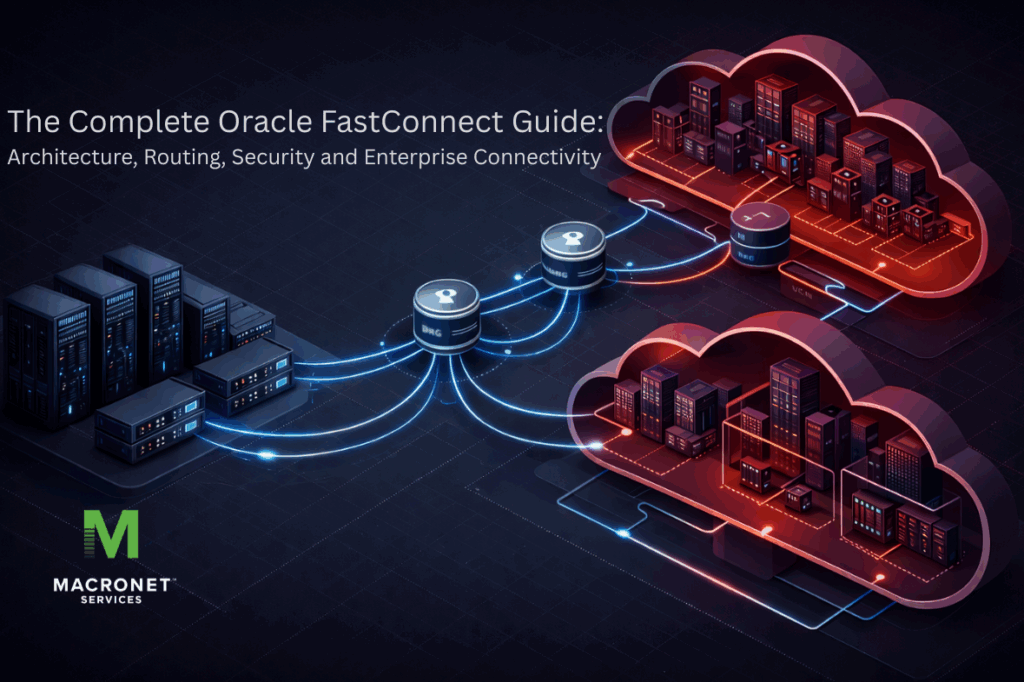
OCI FastConnect supports multi-cloud, hybrid cloud, including enterprises’ on-premise colocation data centers globally, serving as the on-ramp into Oracle Cloud. Following years of design and implementation of hundreds of OCI FastConnect networks, the experienced engineering team at Macronet Services developed this technical guide for clients. It provides and enterprise OCI network and cloud architecture teams with a clear, authoritative resource on designing and deploying Oracle FastConnect.
We have designed and implemented hundreds of OCI FastConnect networks for clients across the globe. Drawing on decades of Tier 1 ISP global network engineering, WAN transformation, and hybrid cloud integration experience, our engineers created this document to help organizations accelerate their cloud connectivity strategy, avoid common design pitfalls, and implement FastConnect architectures that meet the highest standards of performance, security, and operational resilience. This guide reflects real-world expertise gained across complex enterprise environments and is intended to support technical teams as they build scalable, predictable, and future-ready connectivity to Oracle Cloud Infrastructure. As always, contact us anytime for a conversation about what you are seeking to accomplish.

- Introduction
1.1 Motivation for private/dedicated cloud connectivity
1.2 Limitations of the public Internet for enterprise-cloud links
1.3 What FastConnect offers — a summary - Background & Related Work
2.1 Overview of Oracle Cloud Infrastructure (OCI) — networks, Virtual Cloud Networks (VCNs), etc.
2.2 Other cloud providers’ comparable offerings (brief comparative context)
2.3 Networking primitives: BGP, VLANs, virtual circuits, cross-connects, colocation, etc. - FastConnect: Concepts & Architecture
3.1 Definition and core principles of FastConnect
3.2 FastConnect components: Virtual circuits, edge routers, peering types (private vs public), DRG, VCN, subnets.
3.3 Connectivity modes: direct cross-connect (colocation), via partner, via third-party provider.
3.4 Bandwidth, port speeds, and performance characteristics.
3.5 Routing and peering — BGP, route advertisement, separation of public and private address spaces.
3.6 High availability/redundancy best practices.
3.7 Security considerations (private paths, optional encryption, avoiding public Internet). - Deployment Models & Enterprise Connection Options
4.1 Colocation / Direct Cross-Connect (on-premises or co-located data center)
4.2 Partner-mediated connectivity (via a certified FastConnect Partner)
4.3 Third-party provider connectivity (non-partner networks)
4.4 Multi-VCN and multi-DRG architectures (connecting multiple cloud VCNs to on-premises networks)
4.5 Public peering vs private peering: when and why to use each.
4.6 Hybrid and multi-cloud scenarios (e.g., connecting OCI to other clouds) via FastConnect + partner/third-party routers. - Operational Considerations: Management, Monitoring, and Maintenance
5.1 Virtual circuit provisioning, modification (e.g. bandwidth changes), and lifecycle.
5.2 Routing management: BGP configuration, route tables, DRG, route advertisement, conflict resolution with Internet routing.
5.3 Redundancy and SLA compliance (e.g. requirement for redundant circuits for SLA).
5.4 Security best practices: network segmentation, private vs public peering, optional layering of VPN / encryption such as MACsec or Site-to-Site VPN over FastConnect. - Use Cases and Enterprise Scenarios
6.1 On-premises to cloud (lift-and-shift), hybrid cloud migrations, hybrid data centers.
6.2 High-bandwidth, low-latency workloads: analytics, data warehousing, AI/ML pipelines, media workloads.
6.3 Multicloud connectivity: linking OCI with other cloud providers via third-party networks or partners.
6.4 Disaster recovery and data replication scenarios; secure content management or private-instance workloads.
6.5 Access to public OCI services (storage, APIs, console) without using the public Internet via public peering. - Limitations, Challenges, and Best Practices
7.1 Geographical and colocation constraints — FastConnect only available at certain “FastConnect locations.”
7.2 Complexity in routing and potential for misconfiguration (public vs private, route advertisement, overlapping prefixes).
7.3 Need for redundancy for SLA — cost and management overhead.
7.4 Security trade-offs — private connectivity reduces exposure but does not eliminate need for proper firewalling, network controls; encryption optionally implemented.
7.5 Cost considerations: port-hour billing; data transfer is not charged by Oracle, but connectivity provider may bill separately. - Future Directions & Enhancements
8.1 Trends in bandwidth scaling (ports up to 400 Gbps) per recent Oracle documentation.
8.2 Integration with multi-cloud networking fabrics (e.g. SDN-based providers, virtual cross-connects).
8.3 Potential for enhanced security (e.g. default encryption, integration with cloud-native encryption services, MACsec / VPN over FastConnect).
8.4 Evolving enterprise network architectures: hybrid, multi-cloud, edge computing — the role of FastConnect in those. - Conclusion
9.1 Summary of what FastConnect is and why it matters for enterprise-cloud connectivity
9.2 Tradeoffs — why and when enterprises should (or should not) adopt it
9.3 Final thoughts — best practices, architectural guidance, and future outlook
FastConnect — A Deep Technical Examination
-
Introduction
As enterprise workloads migrate increasingly to the cloud, one persistent challenge remains: how to connect existing on-premises infrastructure or private data centers to cloud environments in a way that provides the performance, reliability, security, and control that enterprises expect. Conventional Internet-based connectivity—via VPNs over public Internet or public-internet routing—introduces variability in latency and bandwidth, potential security exposure, and dependence on transit ISPs.
To address these challenges, private / dedicated connectivity services have emerged. For Oracle Cloud Infrastructure (OCI), this solution is provided by Oracle Cloud Infrastructure FastConnect (FastConnect): a mechanism to establish a dedicated, private connection between an enterprise’s on-premises (or colocation) network and OCI, bypassing the public Internet entirely, with predictable performance, higher bandwidth, and enterprise-grade reliability.
In this paper, we provide a comprehensive, technical deep dive into FastConnect — its architecture; the ways enterprises can connect; operational, security and performance considerations; deployment models; typical use cases; limitations; and future directions.
- Background & Related Work
2.1 OCI Networking Fundamentals
At its core, OCI provides cloud services (compute, storage, database, etc.) within a global infrastructure of data centers and regions. Within a region, OCI allows tenants to create one or more Virtual Cloud Networks (VCNs): software-defined, configurable networks analogous to a traditional on-premises LAN, but operating in the cloud. A VCN may be subdivided into subnets (public or private), assigned CIDR address ranges, and associated with routing rules, security lists (firewall-like controls), and other network constructs.
To connect a VCN to networks external to OCI — such as an on-premises data center, another VCN in a different region, or even another cloud provider — OCI provides routing and gateway options. For private connectivity between on-premises and OCI, FastConnect is the primary mechanism.
2.2 Comparative Context: Private Connectivity Services
The idea of providing dedicated private connectivity between enterprise datacenters and cloud infrastructure is not unique to Oracle. Other major cloud providers offer similar services (e.g., direct connect services). These offerings all share common objectives: low latency, high throughput, predictable performance, improved security, and avoidance of the public Internet’s unpredictability.
Understanding FastConnect in this broader context helps to appreciate its design choices, strengths, and tradeoffs.
2.3 Networking Primitives Underlying FastConnect
To support private connectivity, FastConnect leverages several well-known networking primitives:
- Virtual circuits (VCs) implemented via Layer-2 or Layer-3 connections (VLANs, cross-connects, carrier Ethernet, MPLS, etc.) depending on the chosen connectivity mode.
- BGP (Border Gateway Protocol) for dynamic route exchange between customer on-premises routers (or partner/third-party routers) and Oracle edge routers. This enables dynamic advertisement of prefixes (private or public), automated route updates, and easier network management.
- Colocation / Cross-connects when the customer’s data center is physically co-located with an Oracle FastConnect location, facilitating direct Layer-2 connectivity.
- VPN / Encryption Overlays (optional) for organizations requiring encryption even over private links — e.g., MACsec, or layering a Site-to-Site VPN over the FastConnect path.
These primitives allow FastConnect to deliver a flexible yet robust connectivity solution that can adapt to different enterprise network architectures.
- FastConnect: Concepts & Architecture
3.1 What is FastConnect
FastConnect is a dedicated networking service offered by OCI that enables enterprises to create a private, deterministic connection between their data center (on-premises or colocated) and OCI, bypassing the public Internet.
By using FastConnect, enterprises realize several benefits:
- higher bandwidth than typical public-internet links,
- lower and more predictable latency,
- improved stability and consistency (less variability than public Internet),
- enhanced security, since traffic does not traverse the public Internet, and
- cost efficiency: Oracle charges per port-hour (not per GB transferred) when using private peering.
3.2 Core Components
A FastConnect deployment involves the following core components:
- Virtual Cloud Network (VCN) and Subnet(s) — placed inside OCI; represents the cloud-side network that will be connected to on-premises.
- Dynamic Routing Gateway (DRG) — a virtual router in OCI that enables routing between the VCN(s) and external networks (on-premises, other clouds) via FastConnect.
- FastConnect Edge Routers (Oracle side) — routers within Oracle’s network at designated FastConnect locations that serve as the termination points for customer connections.
- Virtual Circuit(s) — logical circuits over physical or virtual links (depending on connectivity mode) that carry traffic between on-premises (or partner/third-party) network and OCI. Virtual circuits can be private or public.
- On-premises (or Partner / Provider) network equipment — customer edge routers, MPLS/VPN or carrier-grade Ethernet, or colocation cross-connects.
Depending on the chosen mode (see below), the physical underlay may differ (direct fiber, carrier-provided Ethernet, MPLS, VPN overlay, etc.), but logically they all map to a FastConnect virtual circuit and use BGP for routing.
3.3 Connectivity Modes
FastConnect supports three main connectivity modes:
- Colocation / Direct Cross-Connect (“with Oracle”): If your data center is physically co-located with an Oracle FastConnect location, you can provision a direct cross-connect between your routers and Oracle edge routers. This is often the simplest and most performant option.
- Partner-mediated connectivity (“with an Oracle Partner”): If you work with an approved FastConnect partner (e.g., network-service provider, MPLS VPN provider, data center exchange provider), the partner can provide the connectivity to OCI on your behalf. You configure the FastConnect virtual circuit in OCI console, and order the corresponding service from your partner.
- Third-party provider connectivity: You may also use non-partner third-party providers (carriers, colocation providers, WAN providers) to reach an OCI FastConnect location. This is more ad-hoc but can provide flexibility, especially for enterprises with existing carrier relationships with Tier-1, Tier-2 or Tier-3 providers.
From a logical perspective, regardless of the mode, traffic flows over a virtual circuit, is routed via BGP, and terminates at a DRG attached to your VCN in OCI.
3.4 Performance: Bandwidth & Port Speeds
Originally, FastConnect offered 1 Gbps and 10 Gbps port speeds. More recently, OCI documentation indicates support for much higher port capacities — up to 400 Gbps.
Because Oracle charges by port-hour (not by data transferred) for private peering, this can make FastConnect especially cost-effective for large or sustained data transfers — e.g., data warehousing, backups, large application workloads — compared to bandwidth-based billing models.
3.5 Routing and Peering: Private vs Public
A crucial design aspect of FastConnect is its support for two peering types: private peering and public peering.
- With private peering, FastConnect extends your on-premises private network into OCI: your on-premises private IP address space (e.g., RFC 1918) is routable in your VCN subnets, enabling hybrid-cloud connectivity without NAT. This is invaluable for lift-and-shift scenarios, hybrid deployments, and seamless connectivity between on-prem and cloud resources.
- With public peering, FastConnect allows access to public OCI services — e.g., Object Storage, OCI APIs/console, public load balancers — over the private leased connection, rather than over the public Internet. Traffic is routed via public (routable) IPv4 addresses, but still traverses the private circuit. This improves performance, reliability, and security compared to public-internet access.
Some organizations may configure both kinds of circuits (public + private) over the same physical underlay (or separate underlays) depending on requirements.
3.6 High Availability and Redundancy
While a single virtual circuit provides connectivity, it does not inherently guarantee high availability. For enterprise SLAs, redundancy must be architected: best practices recommend provisioning redundant virtual circuits (on different physical devices) and redundant BGP peers, to avoid single points of failure and to meet Oracle’s 99.9% connectivity SLA.
Distributed architectures — e.g., multiple circuits into different DRGs/VCNs, or multi-region connectivity — can further enhance resilience, support disaster recovery, and enable traffic engineering.
3.7 Security Considerations
Because FastConnect traffic does not traverse the public Internet, it inherently avoids many of the threats associated with Internet-based connectivity (e.g., DDoS, eavesdropping, transit ISP instability).
Nevertheless, enterprises must still apply standard network security best practices: segmentation, firewalling (OCI security lists / network security groups), access controls, and — where compliance or regulatory requirements demand — encryption. OCI allows layering of encrypted tunnels (e.g., VPN, MACsec) over FastConnect for additional protection.
Because routing is managed via BGP, misconfiguration poses a risk (e.g., unintended route consistent prefix management are crucial to avoid disruptions or security exposures.
- Deployment Models & Enterprise Connection Options
4.1 Colocation / Direct Cross-Connect
For enterprises whose data center is physically co-located with an Oracle FastConnect location, the direct cross-connect model provides the most straightforward, high-performance option. After provisioning the cross-connect in the OCI console, the customer’s data center provider (colocation operator) must provision the physical cross-connect (fiber, Ethernet) between the customer’s routers and Oracle’s edge routers. Once the physical link is in place, customer routers use BGP over the link to peer with Oracle edge and advertise their internal (private) prefixes or public prefixes (if doing public peering).
This model is often preferred for latency-sensitive or high-throughput workloads (e.g., real-time data processing, backbone connectivity, disaster recovery replication) since it has minimal hops and high determinism.
4.2 Partner-Mediated Connectivity
Many enterprises do not have co-location with Oracle data centers, or may be geographically remote from an on-ramp. In these cases, using an approved FastConnect partner (e.g., a managed network service provider, MPLS or VPN provider, colocation exchange partner) is often the most practical route. According to OCI documentation, you begin by creating a FastConnect virtual circuit in the OCI console (specifying partner, peering type, bandwidth, etc.), then engage your partner to order the corresponding connectivity service.
Once the partner provisions the circuit (often as a layer-2 or layer-3 VLAN or MPLS VPN), BGP peering is established between the partner’s edge and Oracle’s edge, and your on-premises network may peer with the partner, enabling routing over the leased path.
This model is widely used by enterprises that already have MPLS / VPN providers or want to minimize management overhead (no need to manage cross-connects themselves), and offers good flexibility.
4.3 Third-Party Provider Connectivity
In some cases, enterprises may choose to arrange connectivity via a third-party not formally listed as an Oracle partner (for example, a carrier, a different colocation provider, or a private network provider). FastConnect supports this flexibility: the third-party establishes (or already has) connectivity to an Oracle FastConnect location, and the enterprise creates a virtual circuit accordingly.
This path may introduce more variability (depending on the third party’s capabilities), but can provide cost or geographic advantages, especially for organizations with existing network relationships.
4.4 Multi-VCN / Multi-DRG Architectures
Large enterprises often organize their cloud infrastructure into multiple VCNs (e.g., by environment – dev / test / prod – or by department / business unit). Using FastConnect, each VCN can have its own private virtual circuit connected to the on-premises network via a common or distinct DRG.
This design allows fine-grained control over which on-premises subnets have connectivity to which VCNs; network segmentation and isolation can be preserved, and access controls enforced at the VCN/subnet level.
Moreover, enterprises can combine both private and public peering circuits, or mix partner-based and direct cross-connect-based circuits, depending on region, performance, and redundancy requirements.
4.5 Public vs Private Peering: Use Cases
- Private peering is ideal for hybrid-cloud workloads, lift-and-shift migrations, database replication, private application hosting, and any scenario requiring private IP connectivity between on-prem and cloud.
- Public peering is useful when on-premises clients or backend systems need access to OCI public services (e.g., object storage, APIs, console) but want to avoid the public Internet (for latency, reliability or regulatory reasons).
Some enterprises deploy both peering types: e.g., private peering for application back-end communication, and public peering for cloud-service consumption.
4.6 Hybrid and Multi-Cloud Connectivity
Because FastConnect supports partner and third-party network providers, it enables hybrid or multi-cloud architectures — for example, connecting OCI to another public cloud (or multiple clouds) via a common carrier or SDN-based network.
This is particularly attractive for organizations seeking to distribute workloads across clouds (multi-cloud), implement cloud-to-cloud data flows, or build disaster-recovery / backup architectures across heterogeneous cloud infrastructure, while maintaining high performance and predictable connectivity.
- Operational Considerations: Management, Monitoring, and Maintenance
5.1 Virtual Circuit Lifecycle: Provisioning & Bandwidth Changes
FastConnect virtual circuits are created via the OCI console (or via API/SDK/CLI). At creation time, you choose the connectivity mode (partner, direct cross-connect, third-party), peering type (private / public), and port capacity (bandwidth). Once the circuit is provisioned and the underlay connectivity established, the circuit becomes active, and you can route traffic over it.
Bandwidth is not fixed in stone: for partner-based circuits, Oracle allows changing the bandwidth after provisioning (e.g., reducing from 10 Gbps to 1 Gbps or increasing to a higher supported port speed) through the console.
Because billing is by port-hour, scaling bandwidth up or down can align connectivity costs with actual usage — an important consideration for cost-conscious enterprises.
5.2 Routing Management & BGP Considerations
Once connectivity is up, BGP sessions between your side (customer or partner) and Oracle edge routers handle route advertisements. For private peering, your private prefixes (RFC 1918 or other internal ranges) are advertised; for public peering, public IPv4 prefixes (for OCI public services) are advertised.
Within OCI, the advertised routes must propagate via the DRG to the attached VCN(s). This requires configuration of route tables, and possibly firewall / security list configuration to permit desired traffic.
If an enterprise also has Internet connectivity (via ISP), routing preference must ensure that traffic destined for OCI public IPs uses FastConnect instead of the Internet link. Failure to set appropriate route priorities / BGP path preferences can cause suboptimal routing or leakage back to the Internet.
Large enterprises may also need to manage multiple circuits (redundancy), multiple DRGs/VCNs, overlapping or adjacent address spaces, route summarization, prefix aggregation, and possibly inter-VCN / inter-DRG routing — all of which complicate network management.
5.3 Redundancy & SLA Compliance
Oracle provides a connectivity SLA for FastConnect, but only when redundancy best practices are followed: typically requiring at least two virtual circuits on different physical links (or different equipment) plus redundant BGP peers.
Thus, enterprises must plan for redundant cross-connects (or redundant partner circuits), dual BGP sessions, and possibly geographic redundancy (if applicable) to meet resilience requirements.
Operational processes should include monitoring of circuit health, BGP status, route propagation, failover testing, and alerting. OCI provides metrics and monitoring tools for FastConnect virtual circuits.
5.4 Security Best Practices
While FastConnect already bypasses the public Internet, network security remains critical. Enterprises should:
- Use VCN security lists or Network Security Groups to restrict ingress/egress traffic based on least-privilege principles.
- Apply segmentation: map different on-prem subnets or departments to different VCNs, potentially via different DRGs and virtual circuits.
- For sensitive data or compliance-heavy workloads, consider encrypting data in transit by layering VPNs or MACsec over FastConnect.
- Regularly audit BGP configurations, prefix announcements, route filters. Misconfigurations can lead to route leaks, overlapping prefixes, or unintended access.
- Integrate FastConnect monitoring and logging into enterprise network operations, to detect anomalies, misconfigurations, or performance degradation.
- Use Cases and Enterprise Scenarios
6.1 On-premises → Cloud (Hybrid Cloud / Lift-and-Shift)
Perhaps the most straightforward use case: a company with existing on-premises infrastructure (e.g., data center, storage arrays, databases) wants to migrate workloads to OCI, but needs to maintain connectivity to on-premises systems — maybe for legacy dependencies, data sharing, compliance, or phased migration strategies. FastConnect’s private peering enables a seamless extension of the on-prem network into the cloud, minimizing latency and preserving IP-addressing schemes.
This is especially valuable for large-scale “lift & shift” migrations, or hybrid architectures where some components remain on-prem, others in cloud.
6.2 High-Throughput / Low-Latency Workloads: Analytics, AI/ML, Media, Data Warehousing
Workloads that involve large data transfers — big data analytics, data warehousing, machine learning, media production, backups — benefit significantly from FastConnect’s high bandwidth, predictable throughput, and low-latency network. Enterprises can move massive datasets between on-premises storage and OCI compute/storage at scale, without concern for public Internet bottlenecks or unpredictable performance.
Moreover, because Oracle charges by port-hour (not by data transfer), the cost model can often be more economical than using Internet-based bandwidth metered by volume.
6.3 Multi-Cloud & Cloud-to-Cloud Connectivity
In architectures where an enterprise uses OCI alongside other cloud providers (e.g., AWS, Azure, GCP), FastConnect offers a way to integrate OCI into a broader multi-cloud network via a neutral third-party or partner network provider. Through this, the enterprise can build an “any-to-any” private network fabric, enabling data flow, replication, and unified networking across clouds — bypassing public Internet entirely.
This is useful for hybrid-cloud strategies, redundancy across clouds, data portability, and cloud-agnostic architectures.
6.4 Disaster Recovery / Backup / Private Service Access
FastConnect supports secure, high-performance use cases such as replicating databases, backups, disaster recovery, and accessing private-instance workloads such as private content management.
By avoiding public Internet and using dedicated links, organizations reduce exposure to network congestion, ISP outages, and security risks — crucial for enterprise-grade resilience and compliance.
6.5 Access to Public OCI Services over Private Links
Through public peering, enterprises can access public OCI services (e.g., object storage, APIs, management console) via their private FastConnect circuit — rather than traversing the public Internet. This improves performance, reduces latency, and adds consistency for workloads that depend on frequent access to cloud services.
For example: automated backups to Object Storage, API calls, management tasks, container orchestration, CI/CD pipelines, etc., all benefit from stable connectivity over FastConnect.
- Limitations, Challenges, and Best Practices
7.1 Geographic / Colocation Constraints & On-Ramp Availability
FastConnect is only available at specific “FastConnect locations” (OCI on-ramps, colocation data centers, partner POPs). Enterprises remote from these locations may face challenges: they might need to contract third-party providers or partners, incurring additional cost and complexity.
This can limit the feasibility for smaller organizations or those with distributed infrastructure across many remote sites.
7.2 Routing Complexity & Risk of Misconfiguration
Because routing is managed via BGP, and because enterprises may have multiple circuits, DRGs, VCNs, and potentially overlapping address spaces (private on-prem, multiple VCNs, public prefixes), the risk of misconfiguration increases. For example: overlapping CIDRs, route leaks, unintended route advertisement, suboptimal path preference (Internet vs FastConnect), prefix conflicts.
These risks underscore the need for rigorous network planning, prefix management, route filtering, monitoring, and frequent audits.
7.3 Redundancy Overhead and Cost
Achieving high availability and meeting SLAs requires redundant physical circuits, redundant BGP sessions, and possibly redundant partner links — which increases cost, administrative overhead, and operational complexity.
Furthermore, managing failover, testing redundancy, and ensuring proper route failover (with minimal disruption) demands mature network operations practices.
7.4 Security — While Improved, Not Automatic
Although FastConnect avoids the public Internet, it does not automatically provide encryption or end-to-end protection. Without additional encryption (VPN, MACsec, etc.), data travels over private leased lines — which may traverse third-party infrastructure (if using a partner or third-party provider). Organizations with strict compliance, regulatory, or data-protection requirements must plan accordingly.
Similarly, internal network segmentation, firewalling, access controls, and security governance remain essential.
7.5 Cost Considerations & Billing Model
While Oracle charges only for port-hours (not per-GB data transfer), the enterprise still pays for the underlying connectivity (cross-connect fees, carrier charges, partner charges), and redundant circuits double those costs. For workloads with sporadic usage, the port-hour model may lead to paying for unused capacity unless circuits are dynamically adjusted (e.g., bandwidth scaled down during low utilization).
Also, because only port-hour is charged and not per-byte, there may be economic inefficiency if the port is underutilized.
- Future Directions & Enhancements
8.1 Scaling Bandwidth: High-Capacity Ports (Up to 400 Gbps)
OCI documentation now cites port speeds up to 400 Gbps for FastConnect. This scaling trend aligns with increased demand for high-throughput workloads — big data, AI/ML, real-time analytics, large-scale backup and restore, video/media workflows, etc.
As enterprises shift more of their core systems to cloud, having multi-hundred Gbps private links may become standard, enabling cloud-outsize workloads to run nearly as if in a private data center.
8.2 Integration with Multi-Cloud Networking Fabrics & SDN-based Providers
FastConnect’s support for partner and third-party connectivity — and the growing ecosystem of SDN-based network providers — facilitates hybrid multi-cloud architectures. Enterprises may increasingly adopt “cloud fabrics” allowing seamless connectivity across multiple public clouds, on-premises, and edge locations. FastConnect can serve as a backbone for such fabrics.
This will help organizations avoid cloud provider lock-in, and enable dynamic workload placement, data mobility, and unified network operations across multi-cloud stacks.
8.3 Enhanced Security & Encryption-by-Default
Going forward, cloud providers (including Oracle) may add stronger security features by default — e.g., mandatory encryption (MACsec), zero-trust network segmentation, integration with cloud-native key management and identity services. For organizations in regulated sectors (finance, health, government), such enhancements would make FastConnect even more attractive.
8.4 Edge & Hybrid Cloud / Edge-to-Cloud Connectivity
As edge computing grows (IoT, real-time analytics, distributed services, 5G edge), enterprises will need reliable, high-performance connectivity between edge locations and cloud. FastConnect — especially combined with colocation or partner network providers — could play a critical role in edge-to-cloud or hybrid edge-cloud architectures.
-
Conclusion
FastConnect provides a powerful, flexible, and enterprise-grade solution for connecting on-premises networks (or partner networks) to OCI. By offering dedicated, private connectivity with high bandwidth, predictable latency, and enterprise-level reliability, it enables hybrid cloud architectures, large-scale data migration, high-volume data processing, multi-cloud integration, and secure access to cloud services — all without the unpredictability of the public Internet.
However, these benefits come with tradeoffs: complexity in network design, need for careful routing configuration, potential cost for redundant circuits and underutilized capacity, and ongoing operational overhead. Additionally, enterprises must still apply rigorous network security practices, especially when data sensitivity or regulatory compliance is involved.
In designing a FastConnect deployment, enterprises should carefully architect their network topology (VCNs, DRGs, subnets), plan redundancy (physical and logical), manage routing (BGP, prefix filtering, path preference), secure traffic (segmentation, optional encryption), and monitor performance and availability.
Looking ahead, as cloud workloads grow in scale and diversity (big data, AI/ML, edge computing, multi-cloud), and as networking demands increase (hundreds of Gbps, hybrid fabrics, multi-cloud connectivity), FastConnect — particularly with improved bandwidth, integration with SDN-based providers, and enhanced security features — is likely to remain a foundational component of enterprise cloud strategy.
Contact us anytime at Macronet Services to discuss what you are looking to achieve with your network and for assistance with OCI FastConnect solutions.
OCI FastConnect Frequently Asked Questions
1. What is Oracle FastConnect and how does it work?
Oracle FastConnect is a dedicated, private network connection between an enterprise data center and Oracle Cloud. It bypasses the public internet and uses BGP routing over private virtual circuits to provide predictable, high-performance cloud connectivity.
Oracle FastConnect is Oracle Cloud Infrastructure’s private connectivity service that enables enterprises to establish a direct, dedicated network path between on-premises environments and OCI regions. Instead of routing traffic across the public internet, FastConnect uses a private backbone, Oracle edge routers, and enterprise-provisioned virtual circuits to deliver higher bandwidth, lower and more consistent latency, and improved security. FastConnect supports both private peering—extending RFC1918 networks into OCI Virtual Cloud Networks—and public peering, which provides private-path access to OCI services such as Object Storage or Autonomous Database endpoints. BGP handles dynamic route exchange between customer edge routers and the Dynamic Routing Gateway (DRG) inside OCI, ensuring resilient routing and seamless hybrid cloud operation. Deployment is flexible: enterprises can connect via colocation cross-connect, FastConnect partners, or third-party carriers, making it suitable for hybrid cloud, multicloud, analytics, and database replication workloads.
-
Is Oracle FastConnect better than a VPN?
Yes. FastConnect provides more predictable latency, higher bandwidth, and better reliability than an internet-based IPsec VPN, making it ideal for enterprise workloads and large data transfers.
FastConnect and VPNs serve different purposes. An IPsec VPN travels over the public internet, which introduces variable latency, congestion, and performance unpredictability. FastConnect avoids these problems by using a private, dedicated circuit between the enterprise and Oracle Cloud. This allows bandwidth options up to 400 Gbps and delivers near-deterministic performance. VPNs remain useful for backup connectivity, lightweight workloads, or remote offices, but for mission-critical systems—database replication, AI/ML pipelines, analytics, HPC workloads, or large-scale hybrid cloud applications—FastConnect is significantly more stable and scalable. Many enterprises deploy VPNs as a secondary failover path while relying on FastConnect as their primary enterprise transport.
- How do you connect a data center to Oracle Cloud?
You can connect a data center to Oracle Cloud using a direct cross-connect, a FastConnect partner network, or a third-party carrier, all terminating with BGP routing to Oracle’s Dynamic Routing Gateway.
Data center connectivity to Oracle Cloud is achieved using FastConnect’s flexible deployment options. When an enterprise is colocated in the same facility as an Oracle FastConnect location, it can order a direct physical cross-connect to Oracle edge routers. If the data center is remote, the enterprise can use an approved FastConnect partner (e.g., Equinix, Megaport, AT&T, Verizon) or a third-party carrier providing Layer 2 or Layer 3 transport to a FastConnect on-ramp. Each option terminates on a FastConnect virtual circuit inside OCI, where a BGP session exchanges routing information with the Dynamic Routing Gateway. This enables seamless private connectivity between on-prem environments and OCI VCNs. Enterprises frequently deploy redundant circuits to ensure high availability and compliance with Oracle’s FastConnect SLA requirements. Oracle has engaged Macronet Services for many network designs where a client owns their datacenter or collocates in a 3rd party facility. Many factors should be evaluated especially if you deploy in a multi-OCI region topology as 3rd party datacenters do not connect to their competitors. This can be alleviated with a few different options Macronet Services can design and recommend to avoid multiple vendors, billing and support.
- What is the difference between FastConnect private peering and public peering?
Private peering connects your internal networks directly to OCI VCNs. Public peering provides private-path access to Oracle public services like Object Storage, bypassing the public internet.
FastConnect private peering allows enterprises to extend their internal RFC1918 address space directly into Oracle Cloud Infrastructure. This enables hybrid architectures where applications in OCI communicate privately with on-prem servers without NAT or internet exposure. Public peering, on the other hand, does not connect directly to VCNs. Instead, it provides a secure, private-path alternative to access public-facing OCI services—such as Object Storage, Autonomous Database, and API endpoints—without routing traffic over the public internet. Public peering requires a public ASN and validated public IP prefixes, while private peering allows private ASNs and private subnets. Many enterprises deploy both peering types for complete hybrid-cloud functionality.
- What does the Dynamic Routing Gateway (DRG) do in FastConnect?
The DRG acts as the routing hub that connects FastConnect virtual circuits to OCI VCNs, enabling private IP communication and centralized route distribution.
The Dynamic Routing Gateway is the core routing component for hybrid connectivity in Oracle Cloud. When a FastConnect private virtual circuit is created, it attaches to a DRG rather than directly to a VCN. The DRG exchanges routes with the enterprise edge router through BGP, learns on-prem prefixes, and advertises VCN and regional networks back to the customer. It also manages traffic between multiple VCNs, Site-to-Site VPNs, transit designs, multicloud connections, and remote networks using routing tables and attachments. The DRG’s modular architecture allows enterprises to segment routes, apply routing policies, and build advanced hybrid topologies. It serves as OCI’s equivalent of a cloud router, ensuring scalability and consistent path selection across diverse network environments.
- How does BGP work with Oracle FastConnect?
BGP exchanges routes between the customer’s router and Oracle’s DRG, determining which prefixes are reachable over FastConnect and enabling dynamic failover.
BGP is the control-plane protocol that powers FastConnect. When a virtual circuit is established, Oracle assigns a BGP IP pair and expects the customer edge router to initiate a session using the customer’s ASN (private or public). Oracle uses ASN 31898 (or 14544 in Serbia Central). Through this session, the customer advertises on-premises prefixes that should reach OCI, and Oracle advertises VCN and regional services. BGP supports route filtering, AS-path manipulation, MED settings, and local preference tuning to control traffic flows. In redundant FastConnect designs, BGP also determines failover behavior and enables equal-cost multipathing where supported. This standardized routing approach ensures consistent, dynamic, and scalable connectivity across hybrid cloud environments.
- What IP ranges can I advertise over FastConnect?
You can advertise private RFC1918 ranges for private peering and validated public IP blocks for public peering, following Oracle’s prefix-validation rules.
FastConnect allows enterprises to advertise private IP prefixes (RFC1918 or non-RFC1918 private blocks) over private peering sessions using BGP. These prefixes must not overlap with OCI VCN ranges unless carefully managed with routing policies. For public peering, Oracle requires publicly routable address blocks owned by the customer and validated against global routing registries. Public peering also requires a public ASN. Oracle performs prefix filtering and may reject overly broad or improperly registered routes. Organizations typically advertise summarized blocks for simplified routing and to avoid excessive BGP updates. Proper IP planning is critical because FastConnect integration impacts DRG routing, VCN route tables, and multicloud network design.
- What ASN do I need for FastConnect?
Private peering supports private or public ASNs. Public peering requires a public ASN. Oracle’s ASN for FastConnect is typically 31898.
FastConnect supports both private and public ASNs for private peering. This flexibility allows enterprises to use their internal routing policies without requiring globally registered ASNs. However, public peering requires a publicly registered ASN to ensure route authenticity and global uniqueness. Oracle uses ASN 31898 for nearly all regions (except Serbia Central, which uses ASN 14544). Customers must avoid using special-purpose ASNs or those reserved under RFC 6996. For large hybrid designs, enterprises often implement consistent ASN strategy across VPNs, FastConnect circuits, and multicloud connectivity to simplify route aggregation and avoid AS-path conflicts. Oracle provides clear ASN guidelines to ensure stable, secure routing.
- Does Oracle FastConnect support IPv6?
Yes. FastConnect supports IPv6 for both private and public peering, depending on region and provider support.
Oracle Cloud Infrastructure is fully supporting IPv6 across VCNs, DRGs, and public internet gateways, and FastConnect continues this support on private and public virtual circuits. When enabled, enterprises can establish parallel IPv4 and IPv6 BGP sessions or a dual-stack BGP session, depending on router capabilities. IPv6 support allows modern workloads—such as container platforms, microservices, IoT systems, and global applications—to operate natively without NAT complexity. Availability may vary by FastConnect provider or colocation site, so enterprises should validate carrier capabilities. For hybrid IPv6 designs, careful planning around prefix delegation, route aggregation, and dual-stack traffic engineering is recommended.
- How do I set up FastConnect with a network provider?
You order a FastConnect virtual circuit in OCI, request a connection from a supported provider, and establish a BGP session once the circuit is active.
Setting up FastConnect through a provider begins with selecting a FastConnect partner in the OCI Console. Oracle will generate a virtual circuit with a unique OCID, VLAN assignment, and BGP IP pair. The enterprise then contacts the partner—such as Equinix, Megaport, AT&T, Verizon, or others—to provision the corresponding Layer 2 or Layer 3 connectivity to the selected Oracle region. Once provisioned, the provider hands off the circuit to the customer’s router, where BGP is configured using the Oracle-assigned parameters. After the BGP session reaches the Established state, traffic flows directly to OCI through the provider’s backbone. This model is ideal for enterprises not colocated at an Oracle facility. Macronet Services averages 1 hour for OCI FastConnect installations to another cloud globally. This includes, pricing and installation from the provider.
- What partners support Oracle FastConnect?
FastConnect partners include major carriers, colocation providers, and SDN exchange fabrics such as Equinix, Megaport, AT&T, Verizon, BT, Lumen, and more. It is strongly recommended you engage a Solution Architect from Macronet Services to be sure one of these providers is available to the regions or on-premise data centers you wish to connect to. Macronet Services can run the locations in the proprietary fiber tools first before engaging a telecom vendors.
Oracle maintains a global ecosystem of FastConnect partners that provide high-performance network connectivity into OCI regions. This includes telecom carriers (AT&T, Verizon, BT, Lumen, Orange), colocation operators (Equinix, CoreSite, Digital Realty), and SDN-based interconnection platforms (Megaport, PacketFabric). These partners allow enterprises to extend their WANs or MPLS backbones into OCI without deploying equipment in an Oracle FastConnect facility. Partner-based FastConnect simplifies provisioning, enables flexible bandwidth adjustments, supports multicloud fabrics, and offers global region coverage. Oracle’s partner list is published and updated regularly, and enterprises typically choose providers based on geography, resiliency requirements, and existing WAN contracts. Oracle refers clients to Macronet Services who has designed networks into FastConnects using over 100 different providers across hundreds of customers. It’s recommended to run your design by Macronet Services first with our Solution Architecture team to validate if your current or potential provider can work in your OCI region.
- Can I use FastConnect with multiple VCNs?
Yes. FastConnect can support multiple VCNs using multiple DRGs or multiple virtual circuits with separate VLANs and BGP sessions.
FastConnect is designed for scalable hybrid-cloud architectures, and Oracle provides multiple patterns for connecting many VCNs. The most common approach is to deploy a single FastConnect physical link and create multiple private virtual circuits—each mapped to a different DRG or DRG attachment. Each circuit uses its own VLAN ID and BGP session. Enterprises can route shared services, segmentation, or multi-environment designs (prod, dev, test) using DRG route tables and policy controls. You may also use a transit DRG architecture to connect VCNs together and forward traffic from on-premises to multiple cloud networks. This multi-VCN capability is essential for large enterprises, service providers, and multicloud operators.
- How do you make FastConnect redundant?
You provision at least two independent FastConnect circuits—ideally from different providers or facilities—and configure dual BGP sessions for failover.
Redundancy is required for FastConnect’s SLA. Oracle recommends deploying two separate virtual circuits from distinct physical paths, diverse routers, or even different FastConnect locations. Ideally, the enterprise uses different providers to mitigate shared risks. Each circuit has its own VLAN and BGP session. On the customer edge router, BGP attributes such as local preference or AS-path can be tuned for preferred routing and deterministic failover. Enterprises often deploy an IPsec VPN as a tertiary fallback path. Effective redundancy ensures continuous connectivity even during fiber cuts, equipment failures, or provider outages.
- Can I use FastConnect for multi-cloud networking?
Yes. FastConnect can connect OCI to other clouds using SDN fabrics or carrier networks, enabling secure, high-performance multicloud architectures.
Many enterprises use FastConnect as part of a broader multicloud WAN. Using SDN interconnection platforms like Megaport or PacketFabric, organizations can establish virtual cross-connects between OCI, AWS, Azure, Google Cloud, and colocation facilities. Carriers also offer multicloud routing solutions using MPLS or Ethernet VPN. With FastConnect as the OCI entry point, enterprises can create centralized, low-latency data paths for database replication, Kubernetes clusters, analytics workloads, and shared services between clouds. DRG route tables and traffic engineering policies can enforce segmentation, compliance boundaries, and optimized routing between cloud regions.
- Is FastConnect encrypted?
No, FastConnect is not encrypted by default. Enterprises can add MACsec or IPsec VPN overlays for encryption when required.
FastConnect provides physical isolation and private routing pathways but does not natively encrypt data. For compliance-heavy workloads—such as financial, healthcare, or government applications—enterprises commonly use IPsec VPN, MACsec, or application-level encryption in addition to FastConnect. OCI supports routing VPN tunnels over FastConnect, allowing secure and high-speed hybrid connectivity. Security teams should evaluate encryption requirements based on regulatory frameworks, internal risk assessments, and data classification. Oracle has referred many clients to Macronet Services to assit with a private connection into FastConnect, typically one who allows IPSEC or MACsec for example. Contact Macronet Services for a free design with a Solution Architect to assist with a FastConnect topology.
- How fast is Oracle FastConnect?
FastConnect supports speeds ranging from 50 Mbps up to 400 Gbps, depending on the provider and region.
Oracle FastConnect provides an extensive range of bandwidth tiers to support workloads from small deployments to massive enterprise data pipelines. Partner-provided circuits often start as low as 50 Mbps and scale into multi-gigabit links. Oracle’s newest interfaces support 10 Gbps, 40 Gbps, 100 Gbps, and even 400 Gbps port speeds in select regions. Because FastConnect pricing is based on port-hours—not data transfer volume—it is cost-effective for sustained traffic patterns such as backups, replication, big-data ingest, AI/ML pipelines, and media workloads. Keep in mind, this is only the cost to use FastConnect, you will typically require a 3rd party connection to Oracle. This may seem easy; however not all carriers and providers can establish a direct connection into Oracle or even offer 100G or more connectivity if required. This is not an Oracle limitation, rather falls on the provider. Clients contact Macronet Services to identify the right provider for FastConnect port connections and depends on the use case. We can design and obtain a price from a carrier as short as an hour, please contact us for a Solution Architect to work with.
- Does FastConnect improve database performance?
Yes. FastConnect dramatically improves database replication, backup performance, and hybrid application latency compared to internet-based VPNs.
Oracle Database migration, replication, backup, and hybrid application architectures rely heavily on stable latency and sustained bandwidth. FastConnect eliminates the jitter and congestion of public internet routes, enabling consistent throughput for Data Guard, GoldenGate replication, RMAN backups, Autonomous Database ingest, and Exadata Cloud Service operations. Many customers see significant reductions in replication lag and backup windows when moving from VPN-based connectivity to FastConnect. For hybrid applications, low-latency private connectivity improves user experience, reduces transaction time, and minimizes application timeouts. Keep in mind, this is only the cost to use FastConnect, you will typically require a 3rd party connection to Oracle. This may seem easy; however not all carriers and providers can establish a direct connection into Oracle. This is not an Oracle limitation, rather falls on the provider. Clients contact Macronet Services to identify the right provider for FastConnect port connections and depends on the use case. We can design and obtain a price from a carrier as short as an hour, please contact us for a Solution Architect to work with.
- How reliable is Oracle FastConnect?
FastConnect is highly reliable, especially when deployed with redundant circuits and diverse providers.
Reliability in FastConnect comes from its private backbone, dedicated virtual circuits, and enterprise-grade routing architecture. Oracle provides a high availability SLA when customers deploy redundant circuits connected to diverse edge devices or facilities. Failover is handled using BGP, allowing automated route shifts during provider outages, equipment failures, or fiber cuts. When properly architected, FastConnect becomes a resilient, deterministic hybrid connectivity path suitable for mission-critical workloads such as ERP systems, financial applications, industrial control systems, and large-scale data platforms.
- How much does Oracle FastConnect cost?
Oracle charges per port-hour, not per gigabyte, and providers may add their own transport fees.
FastConnect pricing is unique compared to other cloud providers. Oracle charges for the virtual circuit based on port-hour consumption (e.g., 1 Gbps, 10 Gbps, 100 Gbps), meaning enterprises pay for dedicated capacity rather than per-GB usage. This makes FastConnect cost-efficient for sustained or high-volume workloads. However, the total cost also includes fees from the carrier or partner delivering the physical transport. These charges depend on distance, bandwidth tier, and service-level agreements. Companies often find FastConnect pricing favorable for large data movements, backups, replication, and analytics pipelines. Keep in mind, this is only the cost to use FastConnect, you will typically require a 3rd party connection to Oracle. This may seem easy; however not all carriers and providers can establish a direct connection into Oracle. This is not an Oracle limitation, rather falls on the provider. Clients contact Macronet Services to identify the right provider for FastConnect port connections and depends on the use case. We can design and obtain a price from a carrier as short as an hour, please contact us for a Solution Architect to work with.
- How do you troubleshoot Oracle FastConnect issues?
Check BGP session status, verify DRG and VCN routing tables, validate prefix advertisements, confirm provider circuit health, and test failover paths.
Troubleshooting FastConnect involves examining the routing and physical layers. First, verify whether BGP is in the Established state and review advertised/received prefixes. Next, inspect DRG route tables, VCN route tables, and security lists/NSGs to ensure correct packet forwarding. Use traceroute and ping to confirm path consistency and detect asymmetry. Check the provider’s circuit status for errors, drops, or congestion. In redundant designs, simulate failover by shutting down one circuit and verifying that traffic flows over the secondary path. OCI’s Network Visualizer, Flow Logs, and Monitoring services provide deep visibility into traffic flows. Most issues arise from misconfigured routing, overlapping CIDRs, incorrect VLAN assignments, or provider transport problems.
People Also Ask
Oracle FastConnect is a dedicated, private network connection that links an organization’s on-premises data center to Oracle Cloud Infrastructure (OCI) with predictable latency, high bandwidth, and improved reliability compared to internet-based VPNs. It supports both private peering for extending RFC1918 networks into VCNs and public peering for accessing OCI public services over a private path, using BGP to exchange routing information between customer edge routers and Oracle’s DRG. FastConnect can be provisioned through direct cross-connects, approved partners, or third-party network providers, and scales from tens of megabits to 400 Gbps with optional redundancy for enterprise-grade high availability. It enables hybrid and multi-cloud architectures, accelerates database replication and analytics workloads, and integrates with security controls such as VCN security lists, NSGs, route tables, encryption overlays, and BGP filtering. Organizations commonly ask how FastConnect differs from VPN, how redundancy works, what ASNs and IP ranges are allowed, whether it supports IPv6, how pricing is structured, and how to troubleshoot BGP or performance issues—and the answers all revolve around understanding FastConnect’s architecture, DRG routing behavior, and the operational role of private virtual circuits in ensuring reliable cloud connectivity.