
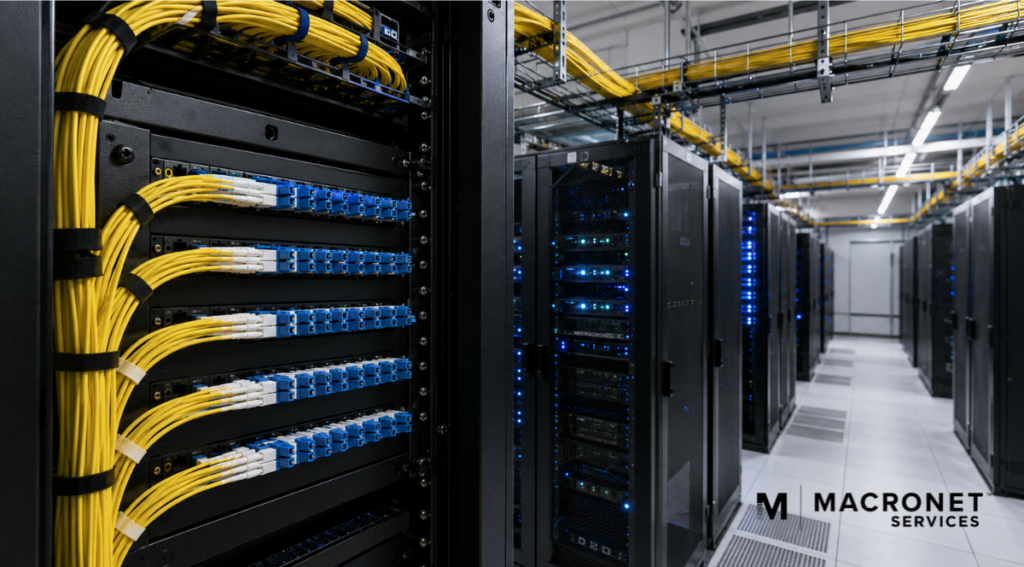
What Is a Data Center Cross Connect?
In a carrier neutral data center, the facility is more than a place to house servers, storage, and network equipment. It is a connectivity hub where enterprises can connect directly to network carriers, cloud providers, SaaS platforms, financial exchanges, ecosystem partners, and other tenants. At the center of that interconnection model is the Cross Connect.
A data center cross connect is a dedicated physical Layer 1 connection between two separate hardware environments inside the same colocation facility or data center campus. In practical terms, it is usually a fiber or copper connection that links your cabinet, cage, router, firewall, or switch to another party’s equipment or termination point inside the same facility.
That other party may be an internet service provider, cloud on-ramp, private network provider, security platform, content provider, financial trading platform, or business partner. Instead of sending traffic across the public internet or through a long-haul carrier route with multiple hops, a cross connect gives the enterprise a direct physical path inside the data center’s structured cabling environment.
For CIOs and infrastructure leaders, cross connects matter because they directly affect latency, throughput, resiliency, cost, cloud performance, vendor choice, and the overall value of a colocation deployment.


Why Cross Connects Matter in Modern Enterprise IT
Modern enterprise infrastructure is increasingly distributed. Applications may live across on-premises environments, colocation data centers, hyperscale cloud platforms, SaaS platforms, edge locations, and partner ecosystems. The performance of that architecture is often limited by the quality of the underlying network.
Cross connects solve a very specific but important problem: they create a direct, private, high-performance connection between two endpoints that are already physically present inside the same colocation environment.
This is especially important for:
- Hybrid cloud connectivity
- Internet edge design
- Multi-cloud architectures
- AI and high-performance computing workloads
- Financial services and trading platforms
- Disaster recovery environments
- SaaS and ecosystem connectivity
- Private backbone access
- Low-latency application environments
- Carrier diversification and procurement flexibility
A well-designed cross connect strategy can reduce latency, improve predictability, increase bandwidth, simplify network architecture, and reduce dependency on expensive or less flexible last-mile circuits.

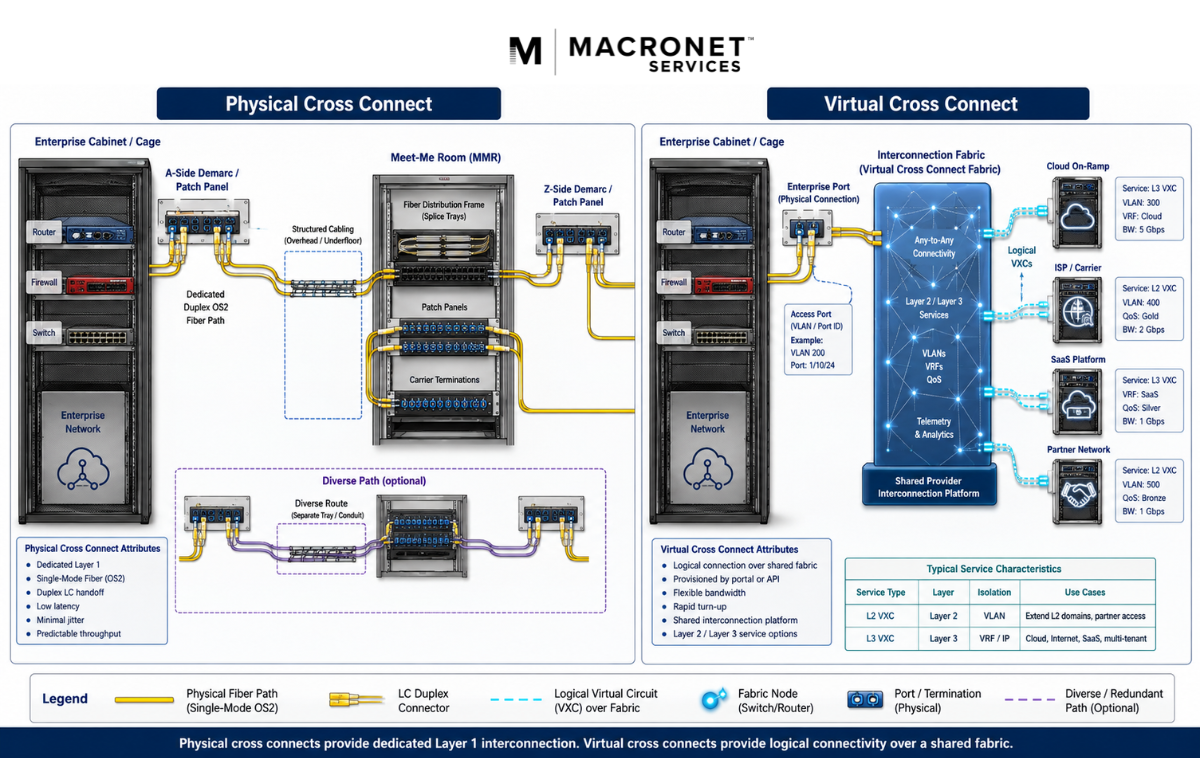
Physical Cross Connects vs. Virtual Cross Connects
The term “cross connect” is sometimes used broadly, but CIOs and network teams should understand the difference between a physical Layer 1 cross connect and a virtual cross connect.
Physical Cross Connects
A physical cross connect is an actual fiber or copper connection installed between two physical demarcation points. It is a dedicated hardware-level path. In most enterprise colocation environments, this is the traditional cross connect ordered through the data center provider.
Physical cross connects provide:
- Dedicated Layer 1 infrastructure
- Strong hardware isolation
- Very low latency
- Minimal jitter
- Predictable throughput
- Performance limited primarily by optics, media type, and equipment
- Support for speeds such as 1G, 10G, 100G, 400G, and beyond
Physical cross connects are the preferred option when performance, determinism, resiliency, and long-term production stability matter.
Virtual Cross Connects
A virtual cross connect, often called a VXC, is a logical connection created over an existing shared network fabric. These are commonly provided by software-defined networking platforms, cloud exchange providers, or colocation interconnection fabrics.
Virtual cross connects can be provisioned quickly, often through a portal or API. They are useful when an enterprise needs agility, flexible bandwidth, or quick connectivity to multiple destinations without ordering a new physical cable each time.
However, virtual cross connects typically rely on a shared provider fabric. They may introduce additional packet processing, serialization delay, backplane dependency, and provider-specific architecture considerations.
The right answer is not always physical versus virtual. Many enterprises use both. Physical cross connects often form the foundational network layer, while virtual cross connects provide flexibility above that physical infrastructure.
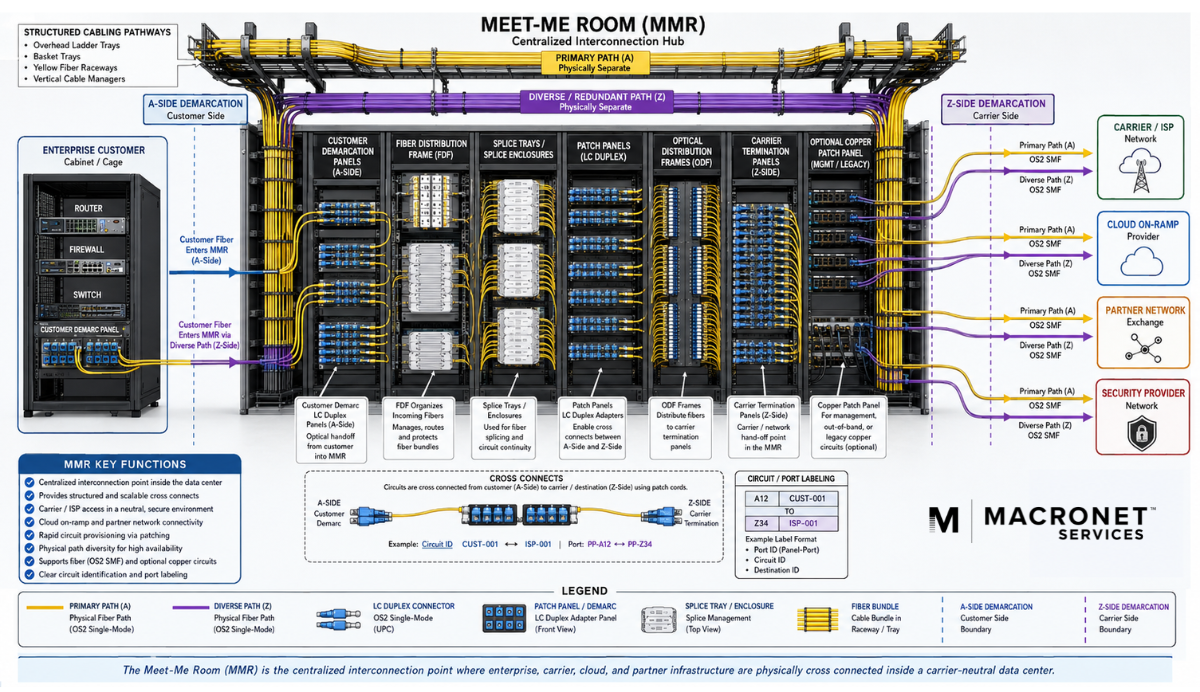
The Meet-Me Room: The Heart of Data Center Interconnection
The most important physical location in a carrier neutral colocation facility is the Meet-Me Room, commonly called the MMR.
The MMR is a secure, restricted-access room that contains centralized fiber distribution frames, patch panels, optical termination systems, and network carrier infrastructure. Carriers entering the building typically terminate their backbone facilities in or near the MMR. Enterprise customer cages and cabinets are also connected back to the MMR through structured cabling systems.
When an enterprise orders a cross connect to a carrier, cloud provider, or other tenant, the data center provider usually completes the connection by patching the customer’s infrastructure to the target party’s termination point through the MMR.
A simplified example looks like this:
Customer Cabinet or Cage → A-Side Demarc → Meet-Me Room → Z-Side Demarc → Carrier, Cloud Provider, or Partner
This architecture is what allows a colocation facility to function as a true connectivity marketplace. The enterprise does not need to build a new outside fiber route every time it wants a new provider. Instead, the cross connect is provisioned inside the data center.

Key Cross Connect Terms CIOs Should Know
Cross connect projects often get delayed because of unclear terminology, incomplete documentation, or misunderstanding between the enterprise, data center provider, and carrier. These are the key terms every IT leader should understand.
| Term | Meaning |
| A-Side | The party ordering the cross connect. This is usually the enterprise customer and typically the party financially responsible for the installation and monthly recurring charge. |
| Z-Side | The party receiving the cross connect. This may be a carrier, cloud provider, exchange, SaaS platform, security provider, or another data center tenant. |
| LOA / CFA | Letter of Authorization / Customer Facility Assignment. This document authorizes the data center operator to connect into the Z-side party’s space, rack, patch panel, and port. |
| Demarcation Point | The boundary between the data center provider’s infrastructure and the customer’s equipment or cabling. This is often a patch panel at the top of a cabinet or within a cage. |
| Meet-Me Room | The centralized interconnection area where carrier and customer infrastructure can be patched together. |
| Campus Cross Connect | A physical connection between separate buildings within the same data center campus. This may require longer fiber paths and special design considerations. |
| NRC | Non-Recurring Charge. The one-time installation cost for the cross connect. |
| MRC | Monthly Recurring Charge. The ongoing monthly cost for the cross connect pathway. |
| Diverse Path Cross Connect | A secondary cross connect that is intentionally routed through a different physical path to improve resiliency. |
| OTDR | Optical Time-Domain Reflectometer. A test instrument used to identify fiber faults, bends, breaks, and loss events. |
Common Enterprise Use Cases for Cross Connects
Cross connects are not just data center cabling. They are a core part of enterprise network architecture.
- Internet Service Provider Connectivity
Many enterprises use colocation facilities to build a high-performance internet edge. Instead of relying on local access loops at an office or headquarters, they place routers and security appliances in a data center and cross connect directly to multiple internet service providers.
This allows the enterprise to:
- Compare multiple ISPs inside the same facility
- Build redundant internet architectures
- Connect directly to Tier 1 or regional backbone providers
- Improve route diversity
- Reduce last-mile dependency
- Increase available bandwidth
- Improve uptime and failover design
For companies with large internet requirements, cross connects are often the key to building a more competitive and resilient ISP sourcing strategy.
- Cloud On-Ramps
Cross connects are commonly used to connect enterprise environments to hyperscale cloud on-ramps such as AWS Direct Connect, Microsoft Azure ExpressRoute, Oracle Cloud Infrastructure, and Google Cloud Interconnect.
These private cloud connections can deliver:
- More predictable latency
- More consistent application performance
- Private connectivity that avoids the public internet
- Higher throughput options
- Improved hybrid-cloud database and application performance
- Better control over routing and security policy
For CIOs moving critical workloads into the cloud, the cross connect is often the physical foundation of the cloud network architecture.
- Colocation and Hybrid Data Center Architecture
Enterprises often move infrastructure into colocation facilities to gain access to better power, cooling, redundancy, security, and connectivity options. The cross connect is what unlocks much of the value of colocation.
A cabinet or cage in a carrier neutral data center can be connected to:
- Multiple internet providers
- MPLS or private network providers
- SD-WAN and SASE providers
- Public cloud platforms
- Managed security providers
- Backup and disaster recovery platforms
- Partner networks
- Content delivery networks
- Financial exchanges
- AI infrastructure and data platforms
Without cross connects, a colocation facility is primarily real estate and power. With cross connects, it becomes a network ecosystem.
- B2B Data Exchange and Partner Connectivity
Some enterprises need direct private connectivity to business partners, financial platforms, data providers, trading systems, or application ecosystems. Cross connects make this possible when both parties are present in the same facility or campus.
This is common in:
- Financial services
- Healthcare networks
- Logistics platforms
- SaaS ecosystems
- Media and content distribution
- AI and data-intensive environments
- Payment processing
- Research and high-performance computing
In industries where milliseconds matter, cross connects can be a strategic advantage.
- AI, Machine Learning, and High-Performance Workloads
AI and machine learning workloads often require rapid movement of large datasets between compute, storage, and cloud environments. As enterprises deploy GPU clusters, high-performance storage, and distributed training infrastructure, the physical network becomes increasingly important.
Cross connects can support:
- Direct access to cloud GPU services
- Connectivity to high-capacity storage platforms
- Private links between AI infrastructure partners
- High-throughput data ingestion
- Low-latency access to model training data
- Segmented architectures across colocation and cloud environments
As AI infrastructure expands, cross connect planning will become increasingly important for enterprise architecture.
Technical Media Options for Cross Connects
Selecting the right physical media is essential. The wrong choice can create performance limitations, compatibility issues, or expensive redesign work.
Single-Mode Fiber
Single-mode fiber, often abbreviated SMF or OS2, is the standard for most enterprise, carrier, and cloud cross connects. It usually has a yellow jacket and uses a narrow core that supports long-distance optical transmission with low signal loss.
Single-mode fiber is typically used for:
- Carrier connectivity
- Cloud on-ramps
- Long-distance data center paths
- Campus cross connects
- 10G, 100G, 400G, and future high-speed optics
- Runs over 100 meters
- High-capacity enterprise backbones
For most enterprise colocation designs, single-mode fiber is the default and most future-ready choice.
Multi-Mode Fiber
Multi-mode fiber, often OM3, OM4, or OM5, usually has aqua or lime-green jackets. It has a wider core than single-mode fiber and is suitable for shorter distances.
Multi-mode fiber is typically used for:
- Short intra-data-center connections
- Adjacent cabinet patching
- Legacy data center infrastructure
- Some short-range optical applications
However, multi-mode fiber is limited by modal dispersion and is generally not the best choice for longer runs, cloud on-ramps, or future high-capacity carrier connectivity.
Copper
Copper cross connects use twisted-pair cabling such as Category 6 or Category 6A with RJ45 handoffs. Copper is limited to 100 meters and is more susceptible to electromagnetic interference than fiber.
Copper may still be used for:
- Legacy connections
- Low-bandwidth services
- Out-of-band management
- Console access
- Short-distance operational links
For most modern production enterprise network designs, fiber is preferred.
Fiber Connector Types: LC, MPO, and MTP
Connector selection is another area where cross connect projects can fail.
The most common connector in modern data center cross connects is the LC connector. LC is a small-form-factor connector with a push-pull latch and is widely used for enterprise fiber handoffs.
For higher-density environments, MPO or MTP connectors may be used. These connectors can contain 12, 24, or 32 fiber strands in a single interface. They are common in dense optical systems, high-capacity trunking, and certain 40G, 100G, 400G, or 800G architectures.
Before ordering a cross connect, network teams should verify:
- Fiber type
- Connector type
- Strand count
- Duplex or parallel optics requirement
- Polishing type
- Transceiver standard
- Patch panel handoff
- A-side and Z-side port assignments
Small mismatches can lead to failed activation windows.
Critical Warning: UPC vs. APC Fiber Polishing
One of the most common and damaging cross connect mistakes is mixing UPC and APC fiber connectors.
UPC stands for Ultra Physical Contact. UPC connectors are polished flat and are usually blue.
APC stands for Angled Physical Contact. APC connectors are polished at an 8-degree angle and are usually green. The angled polish helps deflect back-reflection into the fiber cladding.
These two connector types should not be casually mixed.
Plugging a blue UPC connector into a green APC bulkhead can cause severe attenuation, return loss, and potential physical damage to the ceramic ferrule faces. This can create a failed link, high optical loss, or intermittent errors that are difficult to diagnose.
Before patching, always confirm the connector polishing requirements listed in the LOA/CFA and the data center provider’s handoff documentation.
Optical Loss Budget: Why Signal Loss Matters
Every physical fiber path introduces signal loss, known as attenuation. In high-speed optical networking, engineers need to understand whether the total loss across the cross connect is within the acceptable range for the optics being used.
A simplified optical loss budget formula is:
Total Loss = (Fiber Attenuation × Fiber Length) + (Connector Count × Connector Loss) + (Splice Count × Splice Loss) + Safety Margin
More formally:
LossTotal = (α × L) + (Nc × C) + (Ns × S) + M
Where:
- α = Fiber attenuation coefficient per unit distance
- L = Total fiber length in kilometers
- Nc = Number of connector pairings
- C = Average insertion loss per connector pairing
- Ns = Number of splices
- S = Average insertion loss per splice
- M = Safety margin
Typical planning assumptions include:
- Approximately 0.35 dB/km for 1310nm single-mode fiber
- Approximately 0.22 dB/km for 1550nm single-mode fiber
- Approximately 0.25 dB to 0.5 dB loss per connector pairing
- Approximately 0.1 dB per fusion splice
- Approximately 2.0 dB safety margin for aging, dirt, and operational conditions
For short in-building cross connects, optical loss is usually manageable. However, for high-speed optics, campus cross connects, or longer engineered paths, loss budget matters.
Designing Cross Connects for High Availability
A single cross connect can become a single point of failure. A technician error, accidental cable disturbance, patch panel issue, or pathway problem can interrupt connectivity if there is no redundant path.
For production enterprise environments, cross connects should often be designed in pairs.
A resilient architecture may include:
- Two separate cross connects
- Separate A-side demarcation panels
- Separate router, switch, or firewall interfaces
- Separate physical pathways through the data center
- Separate Meet-Me Rooms where available
- Separate Z-side ports
- Separate provider equipment when possible
This is known as diverse path design.
A basic high-availability topology may look like this:
Primary Path: Enterprise Cage → Demarc Panel A → MMR 1 → Carrier or Cloud Provider
Secondary Path: Enterprise Cage → Demarc Panel B → MMR 2 → Carrier or Cloud Provider
When ordering redundancy, it is not enough to simply order a second cross connect. The order must explicitly request diverse pathing. Otherwise, both circuits may be routed through the same overhead tray, same riser, same Meet-Me Room, or same patching infrastructure.
For CIOs, this distinction matters. Two circuits are not necessarily diverse. True resiliency requires intentional physical diversity.
The Cross Connect Provisioning Lifecycle
Understanding the provisioning process helps IT teams avoid delays and set realistic expectations.
- Ingress Validation and LOA Review
The data center provider reviews the cross connect order and validates the LOA/CFA. The LOA must identify the Z-side party, location, cabinet, patch panel, and port assignment. The provider confirms that the target port is valid, available, and authorized.
If the LOA is incomplete, expired, or inconsistent with the data center layout, the order may be rejected.
- Path Engineering
The data center provider determines the physical route for the cable. This may involve overhead basket trays, yellow fiber raceways, secured conduits, or inter-building pathways in a campus environment.
For diverse cross connects, the provider must engineer a physically separate route from the primary connection where possible.
- Cable Pull
Data center technicians physically route the cable through the facility. Depending on the layout, this may involve multiple data halls, secure access zones, fire barriers, risers, or campus pathways.
- Termination and Splicing
The fiber or copper is terminated at the A-side and Z-side locations. In fiber environments, technicians may splice or patch the fiber into the correct bulkhead or panel positions.
- Quality Assurance Testing
The provider tests the completed path. For fiber, this may include OTDR testing to detect micro-bends, breaks, reflections, and splice faults. A light power meter may also be used to measure end-to-end loss.
- Circuit Handoff
Once the cross connect passes testing, the provider closes the ticket, assigns a circuit ID, updates the customer portal, and billing begins.
This final point is important: a completed cross connect usually becomes billing-active even if the enterprise has not yet activated the logical service riding over it.
IT Team Cross Connect Implementation Checklist
A successful cross connect project requires coordination between the enterprise, the data center provider, and the Z-side party.
Phase 1: Pre-Procurement and Target Engagement
Before placing the order:
- Identify the target provider, cloud platform, carrier, or partner.
- Request the formal LOA/CFA from the Z-side party.
- Confirm the physical data center address.
- Confirm the room, cage, rack, cabinet, patch panel, and port information.
- Confirm fiber type, connector type, polishing type, and speed requirements.
- Confirm whether the LOA has an expiration date.
- Confirm whether the project requires a standard or diverse cross connect.
- Validate that the LOA expiration window extends beyond the planned installation date.
Phase 2: Order Entry
When entering the order in the data center provider portal:
- Select the correct media type.
- Select the correct connector type.
- Specify single-mode, multi-mode, or copper.
- Specify duplex LC, MPO/MTP, RJ45, or other handoff requirements.
- Upload the LOA/CFA.
- Include engineering notes.
- Identify any existing circuit ID if ordering a diverse pair.
- Clearly request diverse pathing if required.
- Confirm billing terms, NRC, MRC, and expedite fees if applicable.
Phase 3: On-Site Staging
Before the cross connect is delivered:
- Procure compatible optics such as SFPs, SFP+, QSFPs, or QSFP-DD modules.
- Confirm optic standards such as 10G-LR, 100G-LR4, 100G-DR, or 400G-FR4.
- Confirm vendor compatibility for the network equipment.
- Confirm patch cord type and polishing.
- Confirm adequate internal cable management.
- Use radius-protecting hooks or guides to avoid fiber bend issues.
- Confirm router, switch, or firewall ports are available.
Phase 4: Activation and Testing
During activation:
- Clean all fiber endfaces before insertion.
- Patch internal cabling from network equipment to the assigned demarc port.
- Confirm physical link state.
- Check interface status on both sides.
- Validate optical transmit and receive levels.
- Confirm routing, VLAN, BGP, or service-level configuration as required.
- If the link is dark, check Tx/Rx polarity.
- Open a data center ticket if optical levels are outside expected range.
Typical Cross Connect Provisioning Timelines
Cross connect delivery times vary by provider, facility, region, and complexity. However, enterprises should generally expect physical cross connects to require hands-on provisioning inside a secure facility, which means delivery is not always instant.
Common delivery expectations include:
- Standard orders: Often completed in approximately 3 to 5 business days.
- Efficient digital facilities: Some providers may deliver in approximately 48 to 72 hours.
- Expedited orders: Rush delivery may be available in approximately 12 to 24 hours, often with additional fees.
- Large projects: Dozens of cross connects may need phased scheduling over several weeks.
For large migrations, data center exits, cloud migrations, or multi-carrier deployments, project managers should coordinate cross connect timelines early. Cross connect delays can hold up a broader network, security, cloud, or application migration.
Cross Connect Costs: NRC, MRC, and Financial Management
Cross connects are powerful, but they are not free. Most data center providers charge both installation and recurring fees.
The two main cost categories are:
- NRC: Non-recurring installation charge
- MRC: Monthly recurring charge
The NRC covers the one-time work required to engineer, install, terminate, and test the cross connect. The MRC covers the ongoing use of the data center pathway, patching infrastructure, and physical interconnection environment.
Monthly cross connect costs can vary widely by provider, facility, market, and media type. Many enterprise cross connects may fall in the range of approximately $150 to $550 or more per month per circuit.
Expedite fees may also apply. Rush orders can add several hundred dollars per circuit depending on the provider and urgency.
For a single connection, the cost may seem manageable. But in a large enterprise environment with dozens or hundreds of cross connects, monthly charges can become significant.
The Zombie Circuit Problem
One of the most common sources of wasted telecom and data center spend is the zombie cross connect.
A zombie circuit is a physical cross connect that remains installed and billing even after the logical service has been cancelled. The team at Macronet Services has Telecom Expense Management solutions for businesses of all sizes to identify savings and eliminate the zombie circuit problem.
For example, an enterprise may cancel an internet circuit, cloud port, private network, or vendor service. The carrier or provider may stop billing for the logical service. But the data center cross connect does not automatically disappear. Unless the enterprise submits a separate disconnect request to the data center provider, the physical cable may remain patched and the MRC may continue indefinitely.
This is an easy mistake to make because network teams often focus on the service provider disconnect, while finance teams continue paying the data center invoice.
To prevent zombie circuits:
- Maintain a master cross connect inventory.
- Track every cross connect by circuit ID, provider, A-side, Z-side, purpose, owner, and associated service.
- Require a physical disconnect ticket whenever a logical service is cancelled.
- Review data center invoices monthly.
- Perform semi-annual physical infrastructure audits.
- Compare active router ports against billed cross connects.
- Remove unused, dark, or undocumented interconnections.
- Include cross connects in telecom expense management reviews.
For organizations with multiple data center locations, this audit can produce meaningful savings.
Troubleshooting Common Cross Connect Problems
Even when a cross connect is physically delivered, activation can fail. Most problems fall into a few common categories.
| Symptom | Likely Cause | Remediation |
| No link light / dark fiber | Tx/Rx polarity inversion | Flip the transmit and receive strands at the local patch interface and test again. |
| Intermittent link flapping or high bit-error rate | Dirty fiber endfaces | Disconnect, clean patch cords and bulkheads with a dry fiber click cleaner, reconnect, and inspect if needed. |
| High optical loss | UPC/APC polishing mismatch | Confirm panel and patch cord polishing type. Replace mismatched cables. |
| SFP unrecognized or no link | Wrong optic type, wavelength, or media standard | Confirm both endpoints use compatible optics, such as matching LR optics over single-mode fiber. |
| Data center ticket rejected | Invalid, incomplete, or expired LOA/CFA | Review ticket notes, request a corrected LOA, and resubmit with exact facility, rack, panel, and port details. |
The most important practical rule is simple: clean, verify, and document before escalating.
Many cross connect issues are caused by dirty fiber, polarity mismatches, invalid LOAs, or inconsistent optic standards. These can often be resolved quickly if the team follows a disciplined troubleshooting process.
Cross Connect Design Best Practices for CIOs
CIOs do not need to know every fiber detail, but they should ensure the organization has a strong cross connect governance model.
Key best practices include:
- Design for the Business Outcome
A cross connect should map to a business purpose. Is the goal cloud performance, internet resiliency, lower latency, carrier diversification, disaster recovery, or partner connectivity? The design should reflect that outcome.
- Avoid Single Points of Failure
For critical workloads, one cross connect is often not enough. Evaluate redundant ports, redundant devices, redundant carriers, diverse physical paths, and separate Meet-Me Rooms.
- Standardize Media Choices
Where possible, standardize on single-mode fiber and modern connector standards. This improves scalability and reduces operational confusion.
- Validate LOAs Before Ordering
Incomplete LOAs are a major cause of provisioning delay. Teams should review every LOA for facility address, room, cage, cabinet, patch panel, port, media type, connector, and expiration date.
- Track Every Cross Connect
Cross connects should be part of the enterprise network inventory. Every connection should have an owner, business purpose, provider, cost, circuit ID, related service, and decommission plan.
- Include Cross Connects in TEM Reviews
Telecom expense management should include data center cross connects. Otherwise, zombie circuits and unused interconnections can remain hidden in colocation invoices.
- Coordinate Cross Connects During Provider Sourcing
When evaluating carriers or cloud connectivity providers, cross connect availability and cost should be part of the sourcing process. The best provider on paper may not be the best option if the interconnection path is expensive, delayed, or operationally difficult.
Cross Connects and Carrier Neutral Data Centers
The value of a carrier neutral data center is choice. Enterprises can evaluate multiple carriers, cloud platforms, and network providers inside the same facility. Cross connects are what turn that choice into usable architecture.
Instead of buying connectivity from only the incumbent local provider, the enterprise can source services from multiple providers already present in the building. This improves competition, redundancy, and negotiating leverage.
For companies that need high-capacity internet, private WAN, SD-WAN underlay, SASE connectivity, cloud access, or partner interconnection, carrier neutral facilities can be highly strategic.
However, the benefits are only realized when cross connects are designed and managed correctly.
How Macronet Services Helps Enterprises with Cross Connect and Colocation Strategy
Macronet Services helps enterprises design, source, and optimize data center, colocation, carrier, cloud, and network connectivity services. Cross connects are often a small line item in a larger architecture, but they can have an outsized impact on performance, resiliency, and cost.
Our team helps clients evaluate:
- Carrier neutral data center options
- Colocation providers
- Internet service providers
- Tier 1 ISP connectivity
- Cloud on-ramp architecture
- Private network services
- Diverse path design
- Cross connect requirements
- Data center migration planning
- Telecom expense management
- Provider sourcing and pricing
- Implementation risk
Because Macronet Services works as a channel partner with leading providers, clients can use our experience to compare options, design better solutions, and source competitive proposals without paying consulting fees.
Final Takeaway
A data center cross connect may look like a simple cable, but architecturally it is much more important than that. It is the physical foundation that connects enterprise infrastructure to carriers, clouds, partners, platforms, and digital ecosystems.
For CIOs, the key is to treat cross connects as part of the enterprise network architecture, not as a minor data center task. The right cross connect strategy can improve performance, reduce latency, increase resilience, support hybrid cloud, improve carrier choice, and lower unnecessary cost.
The wrong approach can create delays, outages, zombie billing, and hidden single points of failure.
Enterprises that depend on colocation, cloud, internet connectivity, or high-performance networking should have a clear cross connect strategy, a disciplined ordering process, and a regular audit model to ensure every physical interconnection still supports a real business need.
Need help designing or sourcing colocation, cloud connectivity, internet, or cross connect options? Macronet Services can help you compare providers, design resilient connectivity, and source the right solution at no cost to your organization.
Frequently Asked Questions about Data Center Cross Connects
- What is a data center cross connect?
A data center cross connect is a dedicated physical connection between two separate hardware environments inside the same colocation facility or data center campus. It is usually a fiber or copper cable that connects an enterprise cabinet, cage, router, switch, or firewall to a carrier, cloud provider, business partner, or another tenant inside the facility. The team at Macronet Services can help to design and source connectivity solutions at no cost.
- Why are cross connects important in a carrier-neutral data center?
Cross connects are what make a carrier-neutral data center valuable from a network perspective. They allow enterprises to connect directly to multiple internet providers, cloud platforms, private network providers, SaaS platforms, and business partners without building a new outside fiber route for every connection.
- How does a cross connect work inside a data center?
A cross connect typically runs from the customer’s cabinet or cage to a demarcation point, then through the data center’s structured cabling system or Meet-Me Room, and finally to the other provider’s equipment or termination point. The data center operator usually provisions, tests, documents, and bills for the physical connection.
- What is the difference between a physical cross connect and a virtual cross connect?
A physical cross connect is a dedicated Layer 1 fiber or copper connection between two physical endpoints. A virtual cross connect is a logical connection created over a shared software-defined network fabric, often used for faster provisioning and flexible connectivity to cloud or network providers.
- What is a Meet-Me Room in a data center?
A Meet-Me Room, or MMR, is the secure interconnection area where carriers, cloud providers, data center customers, and network platforms can be physically patched together. It is the central hub that allows a colocation facility to function as a connectivity marketplace.
- Why do enterprises use cross connects for internet connectivity?
Enterprises use cross connects to connect directly to internet service providers inside a data center. This can improve bandwidth availability, reduce dependency on last-mile circuits, support redundant internet designs, and allow companies to compare multiple carriers in the same facility.
- How are cross connects used for cloud connectivity?
Cross connects are commonly used to connect enterprise colocation environments to cloud on-ramps such as AWS Direct Connect, Microsoft Azure ExpressRoute, Oracle Cloud Infrastructure FastConnect, and Google Cloud Interconnect. These private connections can improve performance, reduce exposure to the public internet, and support more predictable hybrid-cloud networking. Our team has decades of experience with global network design. Contact Macronet Services anytime for assistance with optimizing connectivity solutions.
- What information is needed to order a data center cross connect?
To order a cross connect, the enterprise typically needs the facility address, A-side location, Z-side provider, room, cage, cabinet, patch panel, port assignment, media type, connector type, and an LOA/CFA from the receiving provider. Missing or inaccurate information can delay provisioning.
- What is an LOA/CFA for a cross connect?
An LOA/CFA stands for Letter of Authorization / Customer Facility Assignment. It authorizes the data center provider to connect to the Z-side party’s equipment, cabinet, patch panel, and port, and it is one of the most important documents in the cross connect ordering process.
- What type of fiber should be used for a data center cross connect?
Single-mode fiber is usually the preferred choice for modern enterprise, carrier, cloud, and high-capacity data center cross connects because it supports longer distances and higher-speed optics. Multi-mode fiber may still be used for short in-building connections, but it is less future-ready for carrier and cloud connectivity.
- What is the difference between UPC and APC fiber connectors?
UPC connectors are usually blue and use a flat polish, while APC connectors are usually green and use an angled polish. Mixing UPC and APC connectors can cause optical loss, return loss, failed links, or even physical damage to the connector faces, so the required polish type should always be verified before patching.
- How long does it take to provision a cross connect?
A standard physical cross connect is often completed in roughly three to five business days, although some digital facilities may complete orders faster. Expedited delivery may be available for an additional fee, while large projects or diverse-path designs may require more coordination and scheduling.
- How much does a data center cross connect cost?
Cross connect pricing varies by provider, facility, market, media type, and complexity. Most data center providers charge a non-recurring installation charge and a monthly recurring charge, and enterprise cross connects can become a meaningful cost item when dozens or hundreds are deployed.
- What is a zombie cross connect?
A zombie cross connect is a physical cross connect that remains installed and billing after the related internet circuit, cloud port, private network, or vendor service has been cancelled. Enterprises can avoid zombie billing by maintaining a cross connect inventory, reviewing invoices, and submitting a separate disconnect request whenever the associated service is retired.
- How can enterprises make cross connects more resilient?
Enterprises can improve resiliency by ordering redundant cross connects with diverse physical paths, separate demarcation panels, separate network ports, separate Meet-Me Rooms where available, and separate provider equipment. Simply ordering two cross connects does not guarantee diversity; diverse pathing must be explicitly requested and validated.