
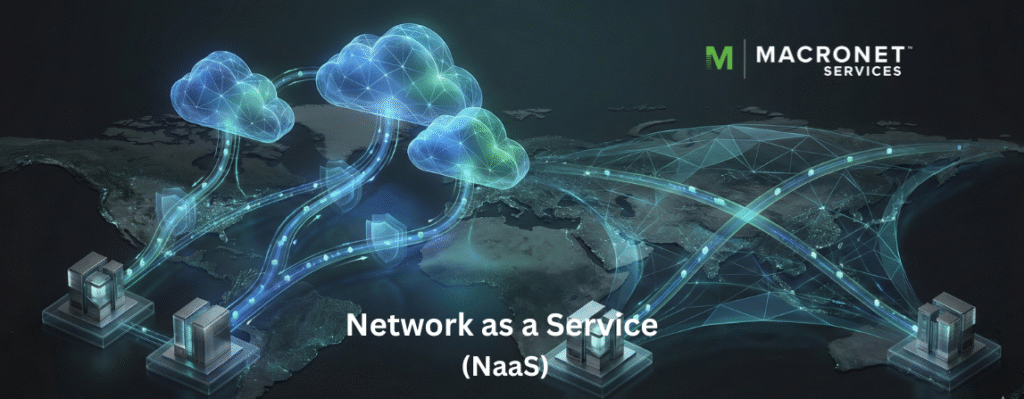
Enterprise networking is undergoing a fundamental shift. Traditional Dedicated Internet Access (DIA)—built on fixed bandwidth tiers, long-term contracts, and manual provisioning—no longer aligns with the demands of multi-cloud architectures, distributed workforces, and AI workloads. As organizations scale digital platforms and deploy data-intensive AI models, connectivity must become elastic, programmable, and performance-driven.
Network as a Service (NaaS) delivers that evolution. By combining software-defined networking, real-time telemetry, integrated security, and flexible commercial models, NaaS transforms internet connectivity into a scalable, on-demand platform. Enterprises can dynamically adjust bandwidth, optimize routing, enforce policy centrally, and align connectivity costs with workload demand—critical capabilities for cloud migration and AI infrastructure.
However, selecting the right NaaS solution requires deep expertise in Tier-1 ISP backbones, peering ecosystems, SLA structures, cloud interconnect options, and contract design. Subtle differences in carrier architecture can significantly impact performance, resiliency, and long-term cost.
The team at Macronet Services brings decades of global network design experience and represents all leading Tier-1 ISPs. We understand the technical and commercial nuances of carrier products and help enterprises design, source, and implement the optimal Network as a Service and Dedicated Internet Access strategy for their business.
In this guide, we explore NaaS architecture, DIA modernization, service level agreements, contractual frameworks, security integration, AI workload support, and governance considerations—providing a comprehensive roadmap for organizations seeking flexible, AI-ready internet connectivity.
1. What Is Network as a Service?
Network as a Service is a cloud-consumption model for network infrastructure. Rather than purchasing static circuits with fixed bandwidth and multi-year commitments, enterprises consume connectivity—Internet, private transport, interconnection, security, and sometimes SD-WAN—through an on-demand, software-defined platform.
At a technical level, NaaS combines:
- Software-defined networking (SDN)
- Virtualized network functions (VNFs)
- API-driven provisioning
- Multi-provider aggregation
- Real-time performance analytics
- Portal-based lifecycle management
Unlike traditional DIA, which is often tied to a single carrier and physical access loop, NaaS abstracts the physical underlay and exposes a programmable overlay. The enterprise experiences connectivity as a controllable service rather than a static circuit.
2. Network as a Service Architecture: Technical Components That Power Flexible Dedicated Internet Access
Understanding Network as a Service (NaaS) architecture is critical for enterprises seeking flexible Dedicated Internet Access (DIA), multi-cloud connectivity, and AI-ready infrastructure. While the physical transport technologies—IP Transit, Ethernet, MPLS, and optical backbone services—remain foundational, NaaS transforms how these resources are orchestrated, managed, and consumed.
At its core, NaaS architecture is built on three integrated layers: the physical underlay network, the software-defined control plane, and virtualized network services. Together, these components create a programmable connectivity fabric designed for scalability, visibility, and operational agility.
The Physical Underlay: Carrier-Grade Backbone Infrastructure
The foundation of Network as a Service is the global transport infrastructure provided by Tier-1 ISPs, regional carriers, metro fiber providers, IXPs, and subsea cable operators. These high-capacity backbone networks deliver the raw bandwidth that powers enterprise internet connectivity.
In a traditional Dedicated Internet Access model, enterprises contract directly with one or more carriers for static circuits. In a NaaS architecture, however, this physical infrastructure is abstracted and aggregated into a unified service layer. The enterprise no longer manages individual carrier relationships at the operational level. Instead, the NaaS provider integrates multiple backbone networks into a cohesive platform.
This abstraction enhances resiliency. Multi-carrier aggregation improves route diversity and reduces dependency on a single provider’s infrastructure. Geographic redundancy across points of presence (POPs) supports high availability and global scalability.
For enterprises requiring global internet connectivity, understanding the diversity and peering relationships of the underlying backbone is essential when evaluating a NaaS provider.
The Software-Defined Control Plane: Programmable Internet Connectivity
The defining characteristic of Network as a Service is its centralized, software-defined control plane. Unlike traditional DIA circuits, which are configured manually and adjusted through carrier change requests, NaaS environments leverage SDN controllers and policy engines to manage connectivity dynamically.
This control layer enables:
- On-demand bandwidth scaling
- Automated traffic steering
- Dynamic path optimization
- Real-time performance monitoring
- Centralized policy enforcement
Through continuous telemetry ingestion—measuring latency, jitter, packet loss, and congestion—the control plane can make intelligent routing adjustments. This is particularly valuable for enterprises operating latency-sensitive applications or AI workloads that require predictable performance.
In practical terms, the network becomes programmable. Enterprises can modify routing policies, prioritize specific traffic classes, and adjust capacity without waiting for manual circuit reconfiguration. Connectivity begins to resemble cloud infrastructure—elastic and API-driven.
Virtual Network Functions: Integrated Security and Service Delivery
Modern NaaS platforms incorporate virtual network functions (VNFs) directly into the connectivity architecture. Historically, enterprises deployed dedicated hardware appliances for firewalls, WAN optimization, and DDoS mitigation at each site. This created operational complexity and scalability limitations.
In a Network as a Service model, these services are virtualized and instantiated within the provider’s edge or backbone infrastructure. Security inspection, traffic shaping, and cloud gateway routing can be deployed programmatically and scaled in parallel with bandwidth.
This architectural convergence reduces hardware dependency and aligns network services with workload lifecycles. As organizations expand into new regions or scale AI compute clusters, associated security and routing services can be provisioned instantly within the NaaS platform.
Unified Service Fabric for AI and Cloud-First Enterprises
When these layers—physical underlay, software-defined control plane, and virtualized services—operate together, they create a unified service fabric. Enterprises no longer manage isolated circuits and hardware appliances. Instead, they consume a cohesive, centrally managed connectivity platform. See our Oracle FastConnect Guide here.
This architecture is especially important for AI-driven enterprises. AI training environments generate high-throughput, burst-intensive traffic. Distributed inference platforms demand low latency and deterministic routing. Multi-cloud AI deployments require seamless interconnection between regions and providers.
A traditional static Dedicated Internet Access circuit cannot adapt efficiently to these demands. A NaaS architecture, however, enables bandwidth elasticity, optimized path selection, and integrated policy enforcement through a centralized portal or API framework.
Why NaaS Architecture Matters for Dedicated Internet Access
For organizations evaluating flexible internet connectivity, understanding Network as a Service architecture is critical. The value of NaaS is not merely in consumption-based billing or shorter contract terms—it is rooted in the architectural transformation of connectivity into a programmable platform.
By abstracting carrier infrastructure, centralizing control, virtualizing services, and integrating real-time telemetry, NaaS delivers a scalable and AI-ready foundation for modern enterprise networking.
As cloud adoption accelerates and AI workloads become more data-intensive, the underlying network architecture must evolve accordingly. Network as a Service provides the technical framework that allows Dedicated Internet Access to operate with the flexibility, intelligence, and resilience required in the AI era.
3. Dedicated Internet Access in a Network as a Service (NaaS) Model
Dedicated Internet Access (DIA) has long been the gold standard for enterprises that require uncontended, high-performance internet connectivity. Unlike broadband services, DIA delivers symmetrical bandwidth, service-level guarantees, and enterprise-grade routing control. However, in its traditional form, DIA has been rigid—procured through long-term carrier contracts, provisioned over extended timelines, and constrained by fixed bandwidth tiers.
The emergence of Network as a Service (NaaS) fundamentally transforms how enterprises consume Dedicated Internet Access. Instead of treating DIA as a static circuit, NaaS enables organizations to manage internet connectivity as a flexible, programmable resource aligned to real-time business demand.
The Limitations of Traditional Dedicated Internet Access
Historically, enterprises purchasing Dedicated Internet Access have faced structural constraints. Contracts often require 36- to 60-month commitments, locking organizations into bandwidth tiers that may not reflect future demand. Provisioning timelines can extend from 60 to 120 days, particularly when new last-mile construction is required. Once deployed, scaling bandwidth typically involves contract amendments, hardware changes, and manual carrier coordination.
Operational visibility is also limited in traditional DIA environments. Enterprises may receive basic interface statistics and monthly SLA reports, but granular telemetry—such as real-time latency patterns, microburst analysis, or path-level performance—is rarely accessible. Billing structures, often based on fixed port speeds or 95th percentile usage, can be opaque and difficult to reconcile with dynamic workload demands.
For organizations undergoing digital transformation, cloud migration, or AI adoption, these constraints introduce inefficiency. Bandwidth may be underutilized for long periods, yet insufficient during peak events. Scaling becomes reactive rather than strategic.
How NaaS Reinvents Dedicated Internet Access
In a Network as a Service model, Dedicated Internet Access becomes elastic, software-defined, and centrally managed. Rather than purchasing a fixed 1 Gbps or 10 Gbps circuit for multiple years, enterprises can dynamically adjust bandwidth based on operational requirements. Capacity increases can be scheduled, automated, or triggered via API—enabling internet connectivity to align directly with application and workload demand.
This elasticity is particularly valuable for businesses with fluctuating traffic profiles. Retail organizations preparing for seasonal surges, enterprises integrating acquisitions, or companies running AI model training cycles can temporarily increase internet capacity without committing to permanent overprovisioning. Once demand subsides, bandwidth can be scaled back, preserving cost efficiency.
NaaS platforms also enhance routing flexibility. Enterprises can manage Border Gateway Protocol (BGP) configurations through a customer portal, adjust route advertisements, implement traffic engineering policies, and distribute traffic across multiple upstream providers. Multi-carrier aggregation improves resilience and reduces dependency on a single ISP. In effect, the enterprise gains greater control over internet path selection and performance optimization.
Performance Visibility and SLA Alignment
Another defining advantage of NaaS-enabled Dedicated Internet Access is operational transparency. Modern NaaS platforms provide real-time dashboards displaying latency, jitter, packet loss, and throughput metrics across geographic regions. Historical reporting enables capacity planning and SLA validation. Instead of relying on post-incident analysis, network teams gain proactive visibility into performance trends and potential congestion risks.
For enterprises supporting latency-sensitive workloads—such as real-time analytics, SaaS platforms, VoIP, or AI inference APIs—this transparency is critical. Performance variability can directly impact user experience and application reliability. With programmable path selection and telemetry-driven decision-making, NaaS enhances both uptime and deterministic performance.
Flexible Billing and Cost Optimization
Traditional Dedicated Internet Access often relies on static billing models. In contrast, NaaS introduces more flexible pricing structures, including usage-based billing, burst capacity pricing, tiered commit discounts, and hybrid port-plus-consumption models. This allows organizations to align networking costs more closely with business activity rather than fixed infrastructure assumptions.
From a financial planning perspective, this model shifts networking from a capital-like commitment toward a more operational, cloud-aligned expense structure. For CFOs and CIOs evaluating total cost of ownership, the ability to match internet spend with demand variability can significantly improve budget efficiency.
Strategic Implications for AI and Cloud-Driven Enterprises
As enterprises expand multi-cloud deployments and adopt AI-driven workloads, Dedicated Internet Access becomes more than a connectivity service—it becomes a performance-critical backbone. AI training cycles generate high-throughput data ingestion demands. Distributed inference workloads require low-latency access across regions. Data synchronization between edge environments and centralized GPU clusters can create sudden traffic spikes.
A static DIA circuit cannot efficiently accommodate this variability. A NaaS-enabled DIA architecture, however, allows bandwidth scaling, path optimization, and cloud on-ramp integration in near real time. The result is a connectivity layer capable of supporting modern AI infrastructure without long-term overprovisioning.
In summary, Network as a Service redefines Dedicated Internet Access by introducing elasticity, programmability, enhanced visibility, and flexible commercial structures. For enterprises seeking flexible internet connections to support cloud transformation and AI workloads, NaaS transforms DIA from a fixed utility into a strategic, software-defined platform aligned with digital business demands.
4. Customer Portal and Lifecycle Management in a Network as a Service Model
One of the most transformative aspects of Network as a Service (NaaS) is not merely its elastic bandwidth or multi-carrier abstraction—it is the operational interface through which enterprises manage connectivity. The customer portal becomes the control surface of the network. For organizations consuming Dedicated Internet Access (DIA) through a NaaS platform, the portal replaces traditional ticket-driven carrier interactions with real-time, self-service lifecycle management.
This shift has profound implications for agility, operational transparency, and automation.
From Manual Provisioning to On-Demand Activation
In legacy networking models, provisioning a new DIA circuit often requires weeks or months of coordination between the enterprise, carrier sales teams, provisioning departments, and field technicians. Configuration changes typically involve change tickets, manual router updates, and multiple communication cycles.
In a NaaS environment, provisioning is orchestrated through a centralized portal. Enterprises can order new connectivity services, select bandwidth tiers, designate geographic endpoints, configure IP addressing, and initiate BGP peering relationships through a structured workflow interface. For virtual connections or pre-provisioned access loops, activation can occur in minutes rather than months.
This dramatically accelerates time-to-service for branch deployments, data center migrations, or cloud expansion initiatives. The network lifecycle moves from procurement-centric to software-driven.
Real-Time Visibility and Performance Analytics
Modern NaaS customer portals provide far deeper operational insight than traditional carrier reporting. Rather than relying on monthly SLA summaries or basic interface counters, enterprises gain access to live telemetry dashboards that display latency, jitter, packet loss, and throughput across regions and paths.
Advanced platforms ingest streaming telemetry and expose granular analytics that support capacity planning and performance troubleshooting. Network engineers can identify microbursts, congestion points, and traffic distribution trends across multi-carrier paths. Historical reporting enables enterprises to correlate application performance with network behavior, strengthening root-cause analysis and service assurance.
For organizations running AI workloads, SaaS platforms, or latency-sensitive applications, this visibility is critical. Real-time analytics allow proactive optimization rather than reactive remediation.
Policy Management and Bandwidth Control
Beyond monitoring, NaaS portals empower enterprises to directly control their network behavior. Bandwidth scaling—one of the defining characteristics of Network as a Service—can often be executed directly through the portal. Enterprises may schedule capacity increases for planned events or dynamically adjust throughput limits during high-demand periods.
Quality of Service (QoS) policies can also be managed through centralized policy engines. Traffic shaping, application prioritization, and routing adjustments can be implemented without dispatching hardware changes at remote sites. In multi-site environments, these policies can be replicated across regions with consistency and minimal operational overhead.
This level of control is particularly valuable for businesses with fluctuating internet traffic patterns or AI training windows that temporarily require elevated bandwidth and deterministic routing.
API Integration and Infrastructure Automation
For more advanced enterprises, the customer portal extends beyond a graphical interface. Most mature NaaS providers expose robust APIs that enable integration with IT service management (ITSM) platforms, cloud orchestration tools, and infrastructure-as-code frameworks such as Terraform.
This allows network provisioning and configuration changes to become part of automated deployment pipelines. When a new cloud environment is instantiated or an AI cluster is spun up, connectivity can be provisioned programmatically as part of the same workflow. Networking ceases to be a bottleneck and becomes an integrated component of digital infrastructure automation.
In effect, the NaaS portal evolves from a dashboard into a programmable interface layer—aligning network operations with DevOps and AI engineering methodologies.
Lifecycle Transparency and Governance
Another critical advantage of portal-driven lifecycle management is governance. Enterprises can track service orders, monitor SLA compliance, review billing metrics, and download performance reports directly from a centralized platform. Audit trails of configuration changes enhance compliance posture and support internal change management policies.
For regulated industries or multinational enterprises, this centralized visibility simplifies oversight. Rather than managing disparate carrier portals across geographies, organizations operate from a unified service fabric with consolidated reporting.
In a Network as a Service model, the customer portal is not a convenience feature—it is the operational nucleus of the connectivity platform. By replacing manual ticketing with real-time provisioning, integrating performance analytics, enabling programmable policy control, and supporting API-driven automation, NaaS transforms Dedicated Internet Access into a software-defined asset.
For enterprises seeking flexible internet connections capable of supporting cloud expansion and AI workloads, portal-driven lifecycle management ensures that connectivity evolves at the speed of the business.
5. Service Level Agreements (SLAs) in a Network as a Service Environment
Service Level Agreements (SLAs) are the contractual backbone of enterprise connectivity. In traditional Dedicated Internet Access (DIA) contracts, SLAs provide assurances around uptime and basic performance thresholds. However, in a Network as a Service (NaaS) model, SLA frameworks evolve from static contractual guarantees into measurable, transparent, and often real-time service performance commitments.
For enterprises relying on flexible internet connectivity to support cloud applications and AI workloads, SLA design becomes not just a legal safeguard—but an operational necessity.
Core Performance Metrics in NaaS SLAs
At a foundational level, NaaS SLAs include commitments around availability, latency, jitter, packet loss, and mean time to repair (MTTR). Availability targets often reach 99.99% or higher for core backbone services, with higher guarantees available when multi-path diversity is implemented. Latency and jitter thresholds are frequently defined on a region-to-region basis, particularly when traffic traverses global backbone infrastructure.
Packet loss guarantees are critical for applications sensitive to retransmissions, such as real-time collaboration tools, financial trading systems, and AI inference APIs. Mean time to repair commitments outline the provider’s obligation to restore service within defined windows following an outage, reinforcing enterprise continuity planning.
What differentiates NaaS from traditional DIA, however, is the granularity and enforceability of these metrics.
Real-Time SLA Visibility and Validation
In legacy carrier environments, SLA validation often occurs retrospectively. Enterprises review monthly reports or open support tickets to dispute perceived performance degradation. In contrast, NaaS platforms typically integrate SLA tracking directly into the customer portal.
Enterprises can access real-time dashboards displaying latency, jitter, and packet loss across specific paths or geographic segments. Historical reports can be downloaded to validate compliance, and automated alerts can be configured to notify teams when performance thresholds approach defined limits.
This transparency transforms SLAs from reactive dispute mechanisms into proactive operational tools. Network teams can identify emerging congestion or path instability before it impacts application performance. For organizations running AI workloads—where distributed training clusters or inference services depend on deterministic latency—this proactive insight is especially valuable.
Path-Specific and Application-Aware SLAs
Advanced NaaS providers increasingly offer path-specific SLA commitments, particularly when leveraging proprietary backbone infrastructure. Rather than providing a generic internet availability guarantee, they may define performance thresholds between specific points of presence (POPs) or cloud on-ramps.
In some cases, SLAs extend to application-aware performance metrics. For example, connectivity to major public cloud providers may include defined latency ceilings or guaranteed throughput baselines. This level of specificity aligns directly with multi-cloud strategies and hybrid AI architectures.
For enterprises architecting high-performance AI environments, such guarantees reduce uncertainty when synchronizing data across regions or delivering latency-sensitive inference APIs to end users.
Service Credits and Remediation Frameworks
SLA contracts typically include service credit provisions in the event of non-compliance. Credits are often structured as a percentage of monthly recurring charges tied to the severity and duration of the performance deviation.
In a NaaS context, credit structures may scale based on the impacted service tier or path segment. Some providers offer cumulative credits when multiple SLA metrics are breached simultaneously. More sophisticated agreements may incorporate root-cause transparency, requiring the provider to disclose the underlying cause of the outage or degradation event.
While financial credits rarely offset the operational impact of downtime, they reinforce accountability and incentivize continuous network optimization.
SLA Design for AI and Cloud-Driven Enterprises
As enterprises deploy AI workloads and cloud-native applications, SLA expectations evolve. AI training clusters require sustained high throughput during ingestion cycles. Distributed inference systems demand predictable latency across regions. Even minor jitter fluctuations can cascade into degraded user experiences or computational inefficiencies.
In this context, SLA evaluation must extend beyond headline uptime percentages. Enterprises should assess backbone diversity, peering density, cloud interconnect proximity, and the provider’s ability to enforce performance guarantees across multi-carrier environments.
For CIOs and network architects, SLA negotiation becomes a strategic exercise. It should incorporate not only traditional performance metrics but also considerations such as scalability commitments, burst capacity guarantees, API responsiveness, and change management timelines.
Governance, Reporting, and Compliance
Modern NaaS SLAs often intersect with broader governance frameworks. Enterprises operating in regulated industries may require compliance certifications such as SOC 2 or ISO 27001. Data sovereignty requirements may dictate routing constraints or regional performance guarantees.
Through integrated reporting tools, NaaS platforms simplify compliance audits by consolidating SLA documentation, performance reports, and change logs into a centralized repository. This reduces administrative overhead and strengthens risk management posture.
In a Network as a Service environment, Service Level Agreements evolve from static contractual obligations into measurable, transparent performance frameworks. Real-time visibility, path-specific guarantees, integrated reporting, and enforceable remediation structures align connectivity performance with modern enterprise demands.
For organizations seeking flexible Dedicated Internet Access capable of supporting cloud expansion and AI-driven workloads, robust and transparent SLAs are not optional—they are foundational to operational resilience and strategic confidence in the network fabric.
6. Contractual Structures and Commercial Frameworks in Network as a Service
The technical flexibility of Network as a Service (NaaS) is only fully realized when supported by equally flexible contractual frameworks. Historically, Dedicated Internet Access (DIA) agreements were defined by long-term commitments, rigid pricing models, and limited exit options. In contrast, NaaS introduces commercial models designed to align with cloud consumption patterns, dynamic bandwidth demand, and AI-driven infrastructure requirements.
For enterprises evaluating flexible internet connectivity, understanding the contractual architecture of NaaS is as important as understanding its technical capabilities.
Term Flexibility and Commitment Models
Traditional DIA contracts frequently require multi-year commitments—often 36 to 60 months—with significant penalties for early termination. These long terms were justified by infrastructure amortization and physical loop construction costs. However, such rigidity can conflict with rapidly evolving enterprise strategies, including cloud migration, mergers and acquisitions, or AI infrastructure scaling.
NaaS providers increasingly offer more adaptable term structures. Options may include month-to-month agreements, shorter 12- to 24-month terms, or hybrid models where a baseline bandwidth commit is paired with elastic capacity. Enterprises can negotiate committed data rates at discounted pricing while retaining the ability to scale above baseline thresholds on demand.
This flexibility reduces the risk of overcommitting to capacity that may become unnecessary due to architectural changes, such as shifting workloads from on-premises data centers to public cloud environments.
Pricing Models: From Static Circuits to Usage-Based Consumption
The pricing evolution in Network as a Service reflects its software-defined foundation. Instead of solely relying on fixed port speeds, NaaS billing structures often incorporate dynamic or consumption-based components.
Common pricing frameworks include flat-rate bandwidth for baseline connectivity, 95th percentile billing for burst traffic, or hybrid models combining port charges with variable usage fees. Some providers offer burstable bandwidth tiers that allow enterprises to exceed committed rates during defined windows without permanent contract modifications.
For enterprises managing AI workloads, these models are particularly advantageous. AI training cycles can generate temporary surges in internet utilization, especially when ingesting large datasets or synchronizing distributed GPU clusters. A usage-aligned billing model allows organizations to scale capacity during these periods without locking in permanently elevated recurring charges.
Financially, this shifts networking closer to an operational expenditure (OpEx) model consistent with cloud infrastructure spending. CIOs and CFOs gain improved cost alignment between connectivity spend and business activity.
Commercial Protections and Enterprise Addenda
Beyond term and pricing flexibility, NaaS contracts often incorporate clauses tailored to enterprise governance requirements. These may include data sovereignty provisions ensuring traffic remains within specific geographic regions, compliance certifications such as SOC 2 or ISO 27001, and transparency commitments regarding peering relationships or backbone diversity.
Change management SLAs are another important contractual element. Enterprises may require defined timelines for implementing configuration changes, activating new bandwidth tiers, or provisioning additional endpoints. In programmable NaaS environments, these commitments reinforce operational predictability.
Liability caps, indemnification clauses, and force majeure provisions remain standard contractual components. However, in a NaaS model, enterprises should carefully evaluate how these protections interact with SLA commitments and service credit mechanisms.
Portability, Exit Clauses, and Vendor Risk Mitigation
One of the primary concerns for enterprises adopting any as-a-service model is vendor lock-in. Modern NaaS contracts increasingly address this by incorporating portability provisions. These may allow circuit reallocation across locations, bandwidth transfer between sites, or simplified early termination options under defined business scenarios.
In some cases, enterprises can migrate connectivity between geographic regions or cloud on-ramps within the same service framework, minimizing disruption during organizational restructuring or expansion.
From a risk management perspective, enterprises should assess not only contractual exit clauses but also the provider’s underlying carrier relationships and financial stability. Because NaaS platforms often aggregate multiple underlay carriers, understanding how those relationships are structured contractually can provide additional assurance of service continuity.
Contractual Considerations for AI and Cloud-First Enterprises
As enterprises scale AI-driven operations and multi-cloud environments, contractual frameworks must accommodate unpredictable traffic patterns and evolving infrastructure footprints. Negotiations should consider not only baseline bandwidth and SLA commitments but also scalability ceilings, burst pricing transparency, API access rights, and geographic expansion options.
Enterprises investing in AI should also evaluate how quickly additional capacity can be provisioned under contract terms and whether temporary performance tiers can be activated without renegotiation. The ability to align contractual commitments with experimental AI initiatives can significantly reduce friction during innovation cycles.
In a Network as a Service environment, contractual structures move beyond static circuit agreements toward flexible, consumption-aligned commercial frameworks. Term adaptability, usage-based pricing, enterprise governance clauses, and portability provisions collectively reduce financial risk and increase operational agility.
For organizations seeking flexible Dedicated Internet Access capable of supporting cloud transformation and AI workloads, the commercial architecture of NaaS is not merely a procurement detail—it is a strategic enabler that aligns network economics with digital business velocity.
7. Security Integration in a Network as a Service (NaaS) Architecture
Security is no longer a perimeter function—it is a distributed, continuously enforced discipline embedded directly into the network fabric. In a traditional Dedicated Internet Access (DIA) environment, security controls are often deployed as standalone hardware appliances at branch offices or data centers. Firewalls, DDoS mitigation devices, and secure web gateways operate independently from the transport layer, creating operational silos and inconsistent policy enforcement.
Network as a Service (NaaS) fundamentally changes this model by integrating security directly into the connectivity architecture. For enterprises seeking flexible internet connections that support cloud transformation and AI workloads, this convergence of networking and security is both strategic and operationally critical.
Security as an Embedded Network Function
In a NaaS environment, security capabilities are typically delivered as virtualized or cloud-native network functions embedded within the provider’s backbone or edge infrastructure. Rather than deploying physical appliances at each site, enterprises can instantiate security controls within the service fabric itself. Securing AI across a global WAN is now a topic that IT leaders must understand.
This includes distributed firewalls, secure web gateways, intrusion detection and prevention systems (IDS/IPS), and inline DDoS mitigation. Traffic inspection can occur at regional points of presence (POPs), cloud exchange locations, or edge nodes closest to users and workloads. Because these controls are software-defined, they can be scaled dynamically as bandwidth increases or new sites are added.
The result is a security architecture that scales in parallel with network capacity—eliminating the bottlenecks often introduced by hardware-bound solutions.
Zero Trust and SASE Convergence
Modern NaaS platforms frequently align with Secure Access Service Edge (SASE) principles, integrating networking and security into a unified cloud-delivered framework. Instead of relying solely on traditional VPNs and perimeter firewalls, enterprises can implement Zero Trust Network Access (ZTNA) policies that authenticate and authorize users and workloads based on identity, context, and policy.
In this model, access to applications—whether hosted in a data center, public cloud, or SaaS platform—is governed by identity-driven controls rather than static IP-based trust boundaries. Policies are enforced within the NaaS fabric, reducing lateral movement risks and strengthening segmentation.
For distributed enterprises and hybrid workforces, this integration simplifies secure connectivity. Dedicated Internet Access becomes not just a transport channel, but a policy-aware pathway where authentication, inspection, and segmentation occur seamlessly.
Distributed DDoS Mitigation and Traffic Scrubbing
As enterprises increase their reliance on public internet connectivity, exposure to volumetric and application-layer attacks grows. In traditional architectures, DDoS mitigation may require separate scrubbing services or manual rerouting during an attack event.
In a Network as a Service model, DDoS protection is often integrated at the backbone level. Traffic anomalies can be detected through continuous telemetry analysis, and malicious traffic can be filtered or rate-limited before it reaches enterprise endpoints. Because NaaS providers aggregate traffic across global infrastructure, they can apply large-scale mitigation capabilities that exceed the capacity of individual enterprise appliances.
For organizations operating digital platforms, SaaS services, or AI-powered APIs, this embedded protection enhances uptime and SLA compliance while reducing operational complexity.
Micro-Segmentation and Policy Consistency
NaaS platforms enable centralized policy management across geographically dispersed environments. Security rules can be applied consistently across branch offices, data centers, and cloud interconnects through a unified policy engine. Micro-segmentation capabilities allow enterprises to define granular traffic rules between applications, workloads, or business units.
This centralized control reduces configuration drift and simplifies governance. Instead of managing disparate firewall rule sets across multiple vendors, enterprises can define global security policies and replicate them across the entire network footprint.
For AI-driven environments, where sensitive training data and model artifacts traverse multiple regions, micro-segmentation helps ensure that data flows remain restricted to authorized pathways.
Security Considerations for AI Workloads
AI workloads introduce unique security challenges. Large datasets must be ingested from distributed sources. GPU clusters may synchronize across regions. Inference endpoints exposed to the public internet can become attractive attack surfaces. Moreover, AI models themselves represent valuable intellectual property.
In a NaaS architecture, encrypted backbone transport, identity-aware access controls, and inline inspection help mitigate these risks. Secure cloud on-ramps reduce exposure to public internet volatility, while policy-based routing ensures that sensitive traffic follows predefined, controlled paths.
For enterprises deploying AI at scale, integrating security directly into Network as a Service infrastructure reduces the operational burden of managing separate security overlays. Instead, security enforcement becomes an intrinsic characteristic of the connectivity platform.
Governance, Compliance, and Visibility
Security integration within NaaS also enhances governance. Centralized dashboards provide visibility into traffic patterns, policy enforcement events, and potential anomalies. Logs and audit trails can be exported for compliance reporting, supporting regulatory frameworks and internal audit requirements.
Because the network and security layers are converged, performance and protection can be evaluated simultaneously. This is particularly important when latency-sensitive applications must coexist with deep packet inspection or encryption services.
In a Network as a Service environment, security is no longer an afterthought layered on top of Dedicated Internet Access. It is embedded within the network fabric, delivered through software-defined controls, and managed centrally through programmable policy engines.
For enterprises seeking flexible internet connectivity capable of supporting cloud expansion and AI workloads, integrated security within NaaS provides scalability, consistency, and operational resilience. The convergence of networking and security ensures that as bandwidth scales and architectures evolve, protection scales alongside them—transforming the network into both a performance engine and a security enforcement platform.
8. Network as a Service (NaaS) and AI Workloads
Artificial Intelligence is reshaping enterprise infrastructure requirements in ways that traditional networking models were never designed to support. AI workloads introduce extreme bandwidth variability, latency sensitivity, distributed data flows, and massive east-west traffic patterns between compute clusters. In this environment, static Dedicated Internet Access (DIA) circuits with fixed bandwidth commitments can become operational bottlenecks.
Network as a Service (NaaS) provides a connectivity model that aligns directly with the dynamic and compute-intensive nature of AI infrastructure. For enterprises building AI training environments, deploying inference APIs, or orchestrating multi-cloud GPU clusters, elastic and programmable internet connectivity becomes a foundational requirement.
Bandwidth Elasticity for AI Training
AI model training cycles are characterized by burst-intensive data ingestion and synchronization phases. Large datasets may be pulled from object storage repositories, replicated across regions, or transferred between on-premises infrastructure and public cloud GPU clusters. During these windows, bandwidth demand can spike dramatically—sometimes increasing by an order of magnitude compared to baseline enterprise traffic.
In a traditional DIA model, accommodating these spikes would require permanent overprovisioning of internet capacity, resulting in unnecessary recurring costs during idle periods. In contrast, a NaaS architecture allows enterprises to scale bandwidth dynamically. Capacity can be increased temporarily during model training windows and reduced once processing completes.
This elasticity enables organizations to align network resources directly with AI compute cycles. Instead of treating connectivity as a fixed constraint, enterprises can treat it as a variable input that adjusts in tandem with GPU utilization.
Multi-Cloud AI Connectivity
Modern AI architectures are rarely confined to a single environment. Enterprises frequently operate hybrid infrastructures that include on-premises data centers, multiple public cloud providers, edge inference nodes, and SaaS-based AI platforms. Synchronizing models and datasets across these environments requires reliable, high-throughput interconnectivity.
NaaS platforms typically integrate direct cloud on-ramps and backbone interconnections that provide deterministic routing paths between enterprise sites and cloud regions. Rather than relying solely on unpredictable public internet routing, traffic can traverse optimized backbone paths with defined latency characteristics.
For distributed AI training environments, this reduces variability in synchronization latency between GPU clusters. For multi-cloud deployments, it simplifies cross-region replication and improves performance consistency.
Low-Latency Requirements for AI Inference
Inference workloads present a different but equally demanding networking challenge. Unlike batch-oriented training jobs, inference APIs often operate in real time, serving end-user requests that require immediate responses. Even small increases in latency or jitter can degrade user experience or reduce application reliability.
NaaS architectures support path optimization and dynamic traffic steering based on real-time telemetry. By continuously monitoring congestion and performance metrics, the network can adjust routing decisions to maintain predictable latency. Integrated Service Level Agreements (SLAs) provide defined performance baselines, reinforcing application stability.
For enterprises delivering AI-powered customer experiences—such as recommendation engines, fraud detection systems, or conversational interfaces—this level of network determinism becomes essential.
Data Sovereignty and AI Governance
AI workloads frequently involve sensitive datasets, including intellectual property, financial records, healthcare information, or proprietary training corpora. As organizations expand globally, data sovereignty and compliance requirements add complexity to network design.
NaaS platforms can enforce policy-based routing to ensure that traffic remains within designated geographic boundaries. Integration with security frameworks allows encryption, segmentation, and access control policies to be applied consistently across regions. Centralized portal visibility supports governance and audit requirements.
For enterprises operating under regulatory oversight, the ability to align connectivity policy with AI governance frameworks reduces compliance risk while preserving performance.
Automation and AI-Orchestrated Networking
As enterprises mature in their AI capabilities, networking itself can become integrated into automated orchestration workflows. Through API-driven control planes, bandwidth provisioning and routing adjustments can be triggered programmatically in response to AI workload demands.
For example, when an AI training job is scheduled, automation frameworks can request temporary bandwidth expansion. Once the workload completes, capacity can be scaled down automatically. This convergence of infrastructure automation and programmable networking ensures that connectivity adapts seamlessly to computational demand.
In effect, Network as a Service enables the network to behave like cloud infrastructure—scalable, programmable, and responsive to application logic.
AI workloads amplify the importance of flexible, high-performance Dedicated Internet Access. They demand elastic bandwidth, predictable latency, secure multi-cloud connectivity, and programmable policy enforcement. Traditional static circuits struggle to accommodate this variability without significant overprovisioning.
Network as a Service provides the architectural foundation required for AI-era infrastructure. By combining dynamic scaling, real-time telemetry, optimized backbone routing, and integrated governance controls, NaaS transforms internet connectivity from a fixed utility into a strategic enabler of AI innovation.
For enterprises investing in machine learning, large language models, and distributed inference platforms, the network is no longer a passive transport layer. It becomes an active participant in workload orchestration—and NaaS delivers the flexibility required to support that evolution.
9. Operational Impacts of Network as a Service on Enterprise IT and Networking
The adoption of Network as a Service (NaaS) extends far beyond a technical upgrade to Dedicated Internet Access. It fundamentally reshapes how enterprises design, procure, manage, and optimize their network infrastructure. For CIOs, network architects, and operations teams, NaaS introduces a new operational model—one that aligns networking with the speed, flexibility, and automation standards established by cloud computing and AI-driven infrastructure.
At its core, NaaS transforms network operations from static circuit management to dynamic service orchestration.
Procurement and Deployment Acceleration
Traditional enterprise networking has historically been constrained by long procurement cycles and manual provisioning processes. Ordering Dedicated Internet Access often requires multiple vendor negotiations, extended construction timelines, and complex coordination between internal teams and carrier operations. This model slows down business initiatives such as branch expansion, data center migration, or cloud onboarding.
Network as a Service compresses this lifecycle dramatically. With centralized platforms and aggregated carrier relationships, enterprises can provision connectivity through a unified interface. New sites can be activated faster, bandwidth can be scaled on demand, and cloud interconnects can be integrated without multi-vendor coordination. As a result, network deployment timelines begin to align with application and infrastructure deployment schedules.
For organizations undergoing digital transformation or rapid geographic expansion, this acceleration can remove one of the most persistent operational bottlenecks in enterprise IT.
Network Operations and Visibility
Operationally, NaaS shifts network management from reactive troubleshooting to proactive optimization. In legacy Dedicated Internet Access environments, visibility into performance is often limited to interface statistics and periodic SLA reporting. Diagnosing latency spikes or congestion events can require coordination across multiple carriers and tools.
In contrast, Network as a Service platforms typically provide centralized telemetry dashboards, real-time performance analytics, and historical reporting within a single operational pane. Network teams gain comprehensive visibility into latency, jitter, packet loss, and bandwidth utilization across regions and providers. This unified insight reduces mean time to detect (MTTD) and mean time to resolve (MTTR) incidents.
For enterprises supporting AI workloads and cloud-native applications, this level of operational transparency is critical. Performance anomalies can impact distributed GPU synchronization, inference response times, or SaaS application reliability. Proactive monitoring and dynamic traffic steering enhance resilience and maintain consistent user experience.
Financial Planning and Cost Optimization
NaaS also changes the financial operating model of enterprise networking. Instead of committing to fixed-capacity circuits for multi-year terms, organizations can align connectivity spend with real-time business activity. Usage-based pricing and elastic bandwidth models reduce overprovisioning and allow enterprises to adjust capacity in response to seasonal demand, product launches, or AI training cycles.
From a financial governance perspective, this introduces greater cost predictability and alignment between operational expenditure and digital workload growth. CIOs and CFOs can model network spending as a variable expense tied to measurable business drivers rather than as a static infrastructure commitment.
This operational flexibility is especially valuable in AI-driven enterprises, where compute intensity—and corresponding network demand—can fluctuate significantly over short time horizons.
Disaster Recovery and Business Continuity
Business continuity planning also evolves under a NaaS framework. Traditional network redundancy often requires separate carrier contracts, diverse physical paths, and complex manual failover configurations. Managing these relationships can be administratively burdensome and operationally fragmented.
Network as a Service abstracts much of this complexity by enabling multi-carrier aggregation and automated failover policies within a unified control plane. Enterprises can implement path diversity, geographic redundancy, and dynamic traffic rerouting without managing multiple independent vendor portals. Real-time telemetry supports rapid detection of outages and automated traffic rebalancing.
For organizations operating mission-critical applications, financial platforms, healthcare systems, or AI-powered digital services, this architectural resilience enhances uptime and reduces operational risk.
Organizational and Cultural Shifts
Perhaps most significantly, NaaS influences the culture of network operations. Networking transitions from a hardware-centric discipline to a software-defined service layer integrated with cloud and DevOps workflows. Through API-driven control and infrastructure-as-code integration, connectivity becomes programmable and automatable.
This convergence enables tighter collaboration between network engineering, cloud architecture, and AI development teams. Connectivity provisioning can become part of automated deployment pipelines, ensuring that network resources scale alongside application infrastructure.
In effect, Network as a Service aligns enterprise networking with modern IT operating models. It reduces friction between infrastructure layers, enhances visibility and governance, and enables dynamic responsiveness to AI workloads and cloud expansion.
For enterprises seeking flexible Dedicated Internet Access and scalable, AI-ready infrastructure, the operational impact of NaaS is transformative. It elevates the network from a static utility to a responsive, data-driven platform—capable of evolving at the pace of digital business.
10. Risk, Governance, and Strategic Evaluation of Network as a Service
While Network as a Service (NaaS) delivers compelling advantages in flexibility, scalability, and operational visibility, its adoption requires disciplined risk assessment and governance oversight. For enterprises transitioning from traditional Dedicated Internet Access (DIA) models to a programmable, multi-carrier service fabric, due diligence becomes both a technical and strategic exercise.
The goal is not simply to adopt elastic internet connectivity, but to ensure that the NaaS platform aligns with enterprise resilience, compliance, and long-term infrastructure strategy.
Vendor Stability and Underlay Transparency
A foundational risk consideration in any NaaS deployment is vendor viability and architectural transparency. Because NaaS providers aggregate underlying carriers and abstract physical transport into a unified service layer, enterprises must understand how those carrier relationships are structured.
Key evaluation criteria include backbone diversity, peering density, geographic reach, and the maturity of interconnection ecosystems. Enterprises should assess whether the provider operates proprietary backbone infrastructure, leases capacity from Tier-1 ISPs, or relies on regional aggregation. Understanding the physical underlay helps determine exposure to systemic outages and routing concentration risk.
Financial stability is equally important. As connectivity becomes more centralized within a NaaS platform, vendor continuity directly impacts enterprise operations. Thorough vendor risk assessments and contractual protections are essential components of governance.
Performance Assurance and SLA Enforceability
Although NaaS platforms often provide enhanced Service Level Agreements (SLAs) and real-time telemetry, enterprises must validate that performance guarantees are enforceable and measurable. This includes evaluating latency commitments across defined geographic paths, packet loss thresholds, and Mean Time to Repair (MTTR) provisions.
Enterprises should examine whether SLAs are tied to the provider’s proprietary backbone or extend across aggregated third-party carriers. The ability to validate SLA compliance through downloadable telemetry reports strengthens governance oversight and reduces ambiguity during dispute resolution.
For AI-driven environments—where distributed model training and inference depend on predictable performance—SLA precision becomes particularly critical. Governance frameworks should treat connectivity performance as a measurable operational dependency rather than a generalized uptime guarantee.
Security Governance and Compliance Alignment
Network as a Service integrates security functions into the connectivity fabric, but this convergence requires clear governance structures. Enterprises must evaluate how policy enforcement, encryption standards, access controls, and data residency requirements are implemented within the NaaS architecture.
Regulated industries may require compliance certifications such as SOC 2, ISO 27001, or region-specific data protection frameworks. Governance teams should confirm that audit logs, performance reports, and change management records are accessible through centralized portals or APIs.
As AI workloads increasingly involve sensitive training data and proprietary models, governance considerations expand to include data sovereignty and intellectual property protection. Policy-based routing controls and encrypted backbone transport must align with corporate risk management policies.
API Governance and Operational Controls
One of the defining advantages of NaaS is programmability through APIs. However, this introduces a new category of governance responsibility. Enterprises must manage API authentication, access controls, rate limits, and integration points with internal automation frameworks.
Improperly governed API access could create configuration drift or unintended service changes. Therefore, role-based access controls (RBAC), audit trails, and change approval workflows should be incorporated into operational governance models. Connectivity changes—particularly bandwidth scaling or routing policy adjustments—should follow structured authorization processes aligned with enterprise IT standards.
For organizations integrating AI orchestration workflows with programmable networking, governance frameworks must ensure that automation does not bypass compliance or resilience safeguards.
Strategic Alignment and Long-Term Flexibility
Beyond technical and contractual risk considerations, enterprises must evaluate whether NaaS aligns with their long-term digital strategy. This includes assessing scalability ceilings, geographic expansion capabilities, multi-cloud integration maturity, and portability options.
As AI adoption accelerates, network demand patterns will likely become more variable and compute-intensive. Governance teams should confirm that contractual frameworks support rapid capacity scaling, cloud interconnect expansion, and geographic reallocation of resources without excessive renegotiation.
Enterprises should also assess exit provisions and vendor portability. The ability to transition services or redistribute bandwidth across regions reduces dependency risk and preserves strategic optionality.
Resilience and Architectural Diversity
Resilience planning remains a core governance priority. Even in a unified NaaS platform, enterprises should evaluate path diversity, physical route separation, and redundancy across metropolitan and international segments. Multi-carrier aggregation is only valuable if underlying diversity is genuine and verifiable.
Disaster recovery planning should incorporate dynamic failover capabilities, automated traffic rerouting, and real-time outage detection. Governance frameworks should test these mechanisms through simulated scenarios to validate operational readiness.
Adopting Network as a Service is not simply a technical modernization of Dedicated Internet Access—it is a strategic shift toward programmable, consumption-based connectivity. With this shift comes a responsibility to implement disciplined risk management, enforceable SLAs, security oversight, and API governance controls.
For enterprises investing in cloud transformation and AI-driven infrastructure, robust governance ensures that the flexibility of NaaS does not compromise resilience or compliance. When properly evaluated and managed, Network as a Service provides not only operational agility but also a secure and strategically aligned foundation for digital growth in the AI era.
11. Strategic Implications of Network as a Service for the AI-Driven Enterprise
Network as a Service (NaaS) is often introduced as a more flexible model for Dedicated Internet Access (DIA), but its long-term significance extends well beyond bandwidth elasticity. At a strategic level, NaaS reshapes how enterprises think about connectivity as a business enabler. It aligns the network with cloud economics, AI-driven workloads, and digital transformation initiatives—elevating connectivity from a static utility to a programmable platform.
For CIOs and executive decision-makers, the implications of this shift are profound.
From Infrastructure Constraint to Business Accelerator
In traditional enterprise environments, networking has frequently acted as a gating function. Application deployments, cloud migrations, and geographic expansion were often delayed by circuit provisioning timelines and rigid contract structures. Dedicated Internet Access was procured as a fixed asset, sized conservatively to avoid future disruption.
NaaS reverses this paradigm. By enabling on-demand bandwidth scaling, programmable routing policies, and centralized lifecycle management, it removes networking as a bottleneck in digital initiatives. Connectivity becomes responsive to business velocity rather than an impediment to it.
For organizations pursuing aggressive cloud adoption or AI experimentation, this agility can materially shorten time-to-market. When a new AI training environment is deployed or a multi-cloud integration is required, the network can adapt in parallel with compute resources.
Aligning Network Economics with Cloud and AI Consumption
One of the most significant strategic advantages of Network as a Service is its alignment with cloud consumption models. Enterprises have already embraced Infrastructure as a Service (IaaS), Platform as a Service (PaaS), and Software as a Service (SaaS). These models provide elasticity, usage-based pricing, and automation. NaaS extends these same principles to connectivity.
Instead of overprovisioning internet circuits to accommodate peak demand, enterprises can scale bandwidth dynamically and align cost with workload intensity. This is particularly important for AI workloads, where compute and data transfer requirements can fluctuate dramatically during model training cycles or data ingestion phases.
By synchronizing network expenditure with AI compute utilization, organizations reduce stranded capacity and improve capital efficiency. The network transitions from a fixed cost center to a variable operational resource directly tied to digital output.
Enabling Multi-Cloud and Distributed AI Architectures
Modern enterprises rarely operate within a single infrastructure domain. Multi-cloud strategies, edge computing, hybrid data centers, and globally distributed AI clusters require seamless interconnection. In such environments, Dedicated Internet Access must provide deterministic performance, secure routing, and rapid scalability.
NaaS supports these architectures by abstracting multi-carrier connectivity into a unified service fabric. Direct cloud on-ramps, backbone optimization, and centralized policy control simplify cross-region data movement. Enterprises gain the ability to orchestrate traffic flows between on-premises environments, public cloud GPU clusters, and edge inference nodes without complex carrier negotiations.
For AI-driven enterprises, this architectural coherence enables experimentation and innovation without network redesign. The connectivity layer becomes adaptable to evolving model architectures and deployment strategies.
Strengthening Competitive Differentiation
At a macro level, connectivity agility increasingly influences competitive positioning. Digital customer experiences, AI-enhanced analytics, and real-time operational intelligence depend on resilient, high-performance networking.
Organizations that adopt programmable, elastic internet connectivity are better positioned to deploy AI-powered services quickly, respond to market changes, and scale operations globally. Conversely, enterprises constrained by rigid connectivity contracts may struggle to adapt as AI workloads grow more data-intensive and latency-sensitive.
Network as a Service thus becomes a strategic differentiator. It enables faster integration of acquisitions, smoother entry into new markets, and more efficient scaling of AI platforms that underpin modern customer engagement.
Governance as Strategic Enablement
Importantly, the strategic value of NaaS is maximized only when accompanied by disciplined governance and architectural planning. Vendor evaluation, SLA enforcement, API integration controls, and security oversight must be embedded into enterprise frameworks.
When properly managed, NaaS reduces vendor lock-in risk, enhances operational transparency, and strengthens resilience. The convergence of networking, security, and automation under a unified service fabric simplifies oversight while preserving agility.
The Network as a Digital Platform
Ultimately, Network as a Service represents the evolution of connectivity into a digital platform. It combines software-defined control, real-time analytics, integrated security, and flexible contractual frameworks into a cohesive operating model.
For enterprises investing heavily in Artificial Intelligence, cloud transformation, and distributed digital operations, this evolution is not optional. AI workloads amplify the need for elastic bandwidth, deterministic latency, secure multi-region connectivity, and programmable infrastructure. The network must behave with the same flexibility and responsiveness as the compute layer it supports.
In this context, NaaS becomes more than a procurement alternative to traditional Dedicated Internet Access. It becomes the architectural foundation upon which AI-era enterprises build scalable, resilient, and innovation-ready digital ecosystems.
As connectivity continues to converge with cloud and automation paradigms, Network as a Service will increasingly define how forward-looking organizations design, manage, and optimize the infrastructure that powers their competitive advantage.
Conclusion
Network as a Service represents the structural evolution of Dedicated Internet Access from a static, contract-bound utility into a programmable, elastic, and strategically aligned platform. Throughout this discussion, we have examined how NaaS integrates software-defined control planes, real-time telemetry, flexible contractual frameworks, embedded security, and AI-ready scalability into a unified service fabric. The result is a connectivity model that aligns with modern enterprise demands—cloud consumption, distributed architectures, automation, and data-intensive AI workloads.
For organizations navigating digital transformation, the implications are clear. Connectivity can no longer be treated as a fixed background service sized for worst-case scenarios. AI training cycles, multi-cloud synchronization, edge inference, and global data flows require bandwidth elasticity, deterministic latency, transparent SLAs, and programmable governance. Network as a Service enables enterprises to align their internet connectivity with workload dynamics—scaling when necessary, optimizing paths in real time, and maintaining operational visibility across geographies.
However, while NaaS introduces flexibility, designing the right architecture requires deep carrier knowledge and global network expertise. Underlying transport diversity, Tier-1 backbone selection, peering density, SLA enforceability, cloud interconnect proximity, and contractual portability all materially impact long-term performance and resilience. Not all NaaS offerings are architected equally.
The team at Macronet Services brings decades of experience in global network design and enterprise connectivity strategy. We represent all of the leading Tier-1 ISPs and maintain deep insight into carrier products, backbone architectures, and interconnection ecosystems worldwide. We understand how each provider structures its Dedicated Internet Access, cloud on-ramps, SLAs, burst models, and contractual frameworks—and we help our clients navigate those nuances with precision.
Whether an organization is seeking elastic internet connectivity to support AI workloads, redesigning a global WAN, consolidating carriers, or evaluating a transition to Network as a Service, we help design, source, and implement the solution that best aligns with business objectives. Our role is not simply to procure circuits, but to architect resilient, scalable connectivity platforms tailored to each enterprise’s operational and strategic goals.
Network as a Service is not a one-size-fits-all product. It is an architectural decision that shapes digital agility, AI readiness, and long-term competitive positioning.
If you are evaluating flexible internet connectivity, exploring NaaS for AI-driven workloads, or simply seeking clarity on what model best supports your business, we invite you to contact the team at Macronet Services for a conversation. We are always available to discuss what you are looking to accomplish and how to design the right network foundation to get you there.
Frequently Asked Questions
- What is Network as a Service (NaaS) and how does Macronet Services help enterprises implement it?
Network as a Service (NaaS) is a cloud-based networking model that delivers flexible, programmable internet connectivity with elastic bandwidth, integrated security, and centralized management. Instead of static long-term circuits, enterprises consume connectivity on demand.
Macronet Services helps organizations evaluate, design, source, and implement NaaS solutions by leveraging decades of global network design experience and relationships with leading Tier-1 ISPs. We ensure the architecture aligns with business objectives, AI workloads, and multi-cloud strategies.
- How does Network as a Service improve Dedicated Internet Access (DIA)?
NaaS enhances Dedicated Internet Access by introducing bandwidth elasticity, real-time performance visibility, programmable routing, and flexible contract models. Instead of fixed 1 Gbps or 10 Gbps circuits, enterprises can dynamically scale capacity.
Macronet Services helps clients compare Tier-1 ISP DIA offerings and NaaS platforms to design resilient, multi-carrier internet architectures optimized for cost, performance, and SLA compliance.
- How can NaaS support AI workloads and high-performance computing environments?
AI workloads generate burst-intensive traffic, large-scale data ingestion, and latency-sensitive inference demands. NaaS enables elastic bandwidth scaling, optimized backbone routing, and integrated cloud on-ramps to support AI training clusters and distributed inference.
Macronet Services architects AI-ready connectivity strategies by aligning Tier-1 ISP backbone diversity, cloud interconnect proximity, and SLA guarantees with enterprise AI initiatives.
- What are the key SLA metrics in a Network as a Service agreement?
Critical SLA metrics include availability (uptime), latency, jitter, packet loss, and Mean Time to Repair (MTTR). Advanced NaaS providers also offer path-specific guarantees and real-time telemetry validation.
Macronet Services analyzes SLA structures across carriers to ensure clients receive enforceable, transparent performance guarantees aligned with mission-critical applications and AI operations.
- How should business IT teams evaluate Tier-1 ISPs for NaaS deployments?
Macronet Services represents all leading Tier-1 ISPs and understands the nuances of their backbone architecture, peering relationships, DIA products, burst models, and cloud interconnect services.
We compare performance metrics, contract terms, global reach, and pricing models to design the most resilient and cost-effective NaaS solution for each client’s geographic footprint and workload profile.
- Is Network as a Service more cost-effective than traditional DIA contracts?
NaaS can reduce overprovisioning by aligning bandwidth costs with real-time demand. Flexible billing models such as usage-based pricing or burst capacity allow enterprises to avoid long-term excess commitments.
Macronet Services helps clients model total cost of ownership (TCO) across multiple carriers and NaaS platforms to ensure financial efficiency without compromising performance.
- How does NaaS improve multi-cloud connectivity?
NaaS platforms integrate direct cloud on-ramps and optimized backbone routing to reduce latency between enterprise environments and public cloud providers. This improves application performance and simplifies cloud migrations.
Macronet Services designs multi-cloud network architectures leveraging Tier-1 ISP interconnection ecosystems to ensure high-performance connectivity between on-prem, AWS, Azure, Google Cloud, and AI platforms.
- What security capabilities are integrated into Network as a Service?
Modern NaaS solutions often include embedded firewalls, DDoS mitigation, secure web gateways, Zero Trust Network Access (ZTNA), and SASE capabilities. Security policies can be enforced centrally across all locations.
Macronet Services evaluates integrated security architectures and ensures compliance, encryption standards, and governance controls align with enterprise risk management requirements.
- How quickly can NaaS bandwidth be scaled compared to traditional circuits?
Traditional DIA upgrades may take weeks or months. NaaS platforms often allow bandwidth increases in minutes or hours via customer portals or APIs.
Macronet Services helps enterprises design scalable connectivity models that support rapid AI training cycles, M&A integration, and global expansion without delay.
- What should enterprises consider when evaluating a NaaS provider?
Key considerations include backbone diversity, Tier-1 ISP partnerships, peering density, SLA transparency, API capabilities, contract flexibility, and financial stability.
Macronet Services provides independent advisory expertise, ensuring clients select the optimal provider and architecture rather than being locked into a single carrier’s limited portfolio.
- How does NaaS improve network visibility and monitoring?
NaaS platforms offer real-time telemetry dashboards displaying latency, jitter, packet loss, and bandwidth utilization. This enhances proactive troubleshooting and capacity planning.
Macronet Services ensures clients leverage these analytics effectively and integrate them into enterprise IT governance and AI infrastructure monitoring frameworks.
- Can NaaS reduce vendor lock-in risk?
Yes. Multi-carrier aggregation and flexible contract structures reduce dependency on a single provider. Portability provisions and elastic capacity models increase strategic flexibility.
Macronet Services designs diversified, globally resilient architectures across leading Tier-1 ISPs to mitigate concentration risk and improve long-term agility.
- How does Network as a Service align with digital transformation initiatives?
NaaS aligns networking with cloud-like consumption models, enabling elastic scaling, automation, and API-driven orchestration. This accelerates digital transformation by removing connectivity bottlenecks.
Macronet Services works with executive leadership to align network strategy with broader AI, cloud, and digital growth objectives.
- Is NaaS suitable for global enterprises with complex WAN environments?
Yes. NaaS simplifies global WAN management by centralizing provisioning, monitoring, and policy enforcement across multiple regions and carriers.
With decades of global network design experience, Macronet Services helps multinational enterprises consolidate and modernize complex WAN infrastructures using NaaS frameworks.
- How can a Technology Success Partner help enterprises evaluate Network as a Service?
Network as a Service offerings vary significantly by provider. Backbone architecture, SLA enforceability, pricing models, and cloud interconnect maturity all impact long-term performance.
Macronet Services represents all leading Tier-1 ISPs and brings decades of global network design expertise. We help enterprises design, source, negotiate, and implement the optimal NaaS and Dedicated Internet Access solutions tailored to their AI workloads, cloud strategy, and business objectives.
Organizations exploring flexible internet connectivity or AI-ready network architectures can contact Macronet Services anytime for a strategic conversation about what they are looking to accomplish.