
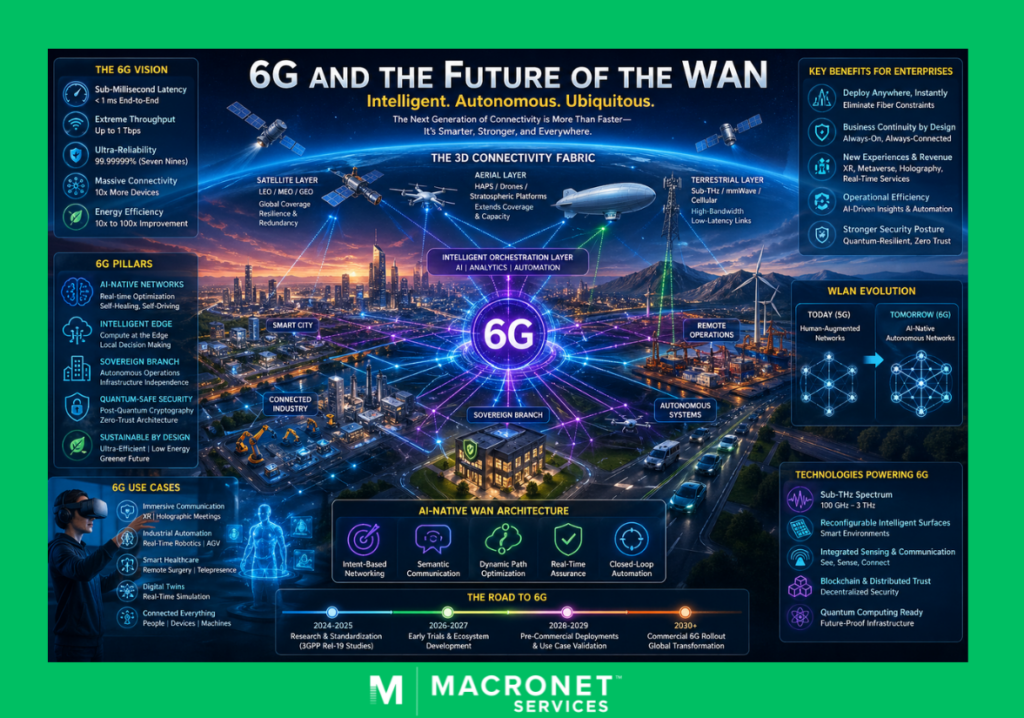
The next era of enterprise networking will not be defined by incremental improvement—it will be defined by architectural reinvention.
As organizations continue to invest in cloud, AI, edge computing, and real-time digital experiences, the limitations of today’s wide area network (WAN) are becoming increasingly visible. Even the most advanced 5G deployments are struggling to keep pace with the demands of distributed enterprises, autonomous systems, and data-intensive applications.
This is where 6G networking enters the conversation.
While often framed as the successor to 5G, 6G is not simply a faster wireless standard. It represents a fundamental shift in how networks are designed, operated, and monetized. For CIOs and technical business leaders, the implications are profound: the WAN itself is evolving into a distributed, intelligent, and autonomous platform.
The decisions made today will determine whether your organization is ready for that future—or constrained by the past.
The Breaking Point of the Modern WAN
For decades, enterprise WAN strategy has revolved around one assumption: that reliable, high-performance connectivity requires fixed infrastructure—primarily fiber.
That assumption is now under pressure.
Provisioning new fiber circuits can take months, and in many regions, it is economically or physically impractical. Costs associated with trenching, permitting, and construction continue to rise, while business expectations are moving in the opposite direction. Enterprises expect to stand up new locations, connect remote environments, and scale globally in near real time.
This growing disconnect—often referred to as the “fiber gap”—is forcing a reevaluation of how connectivity is delivered .
At the same time, the nature of enterprise traffic is changing. AI workloads, real-time analytics, immersive collaboration, and machine-to-machine communication are placing new demands on latency, reliability, and network intelligence.
The traditional WAN was never designed for this.
6G Networking: A New Foundation for Enterprise Connectivity
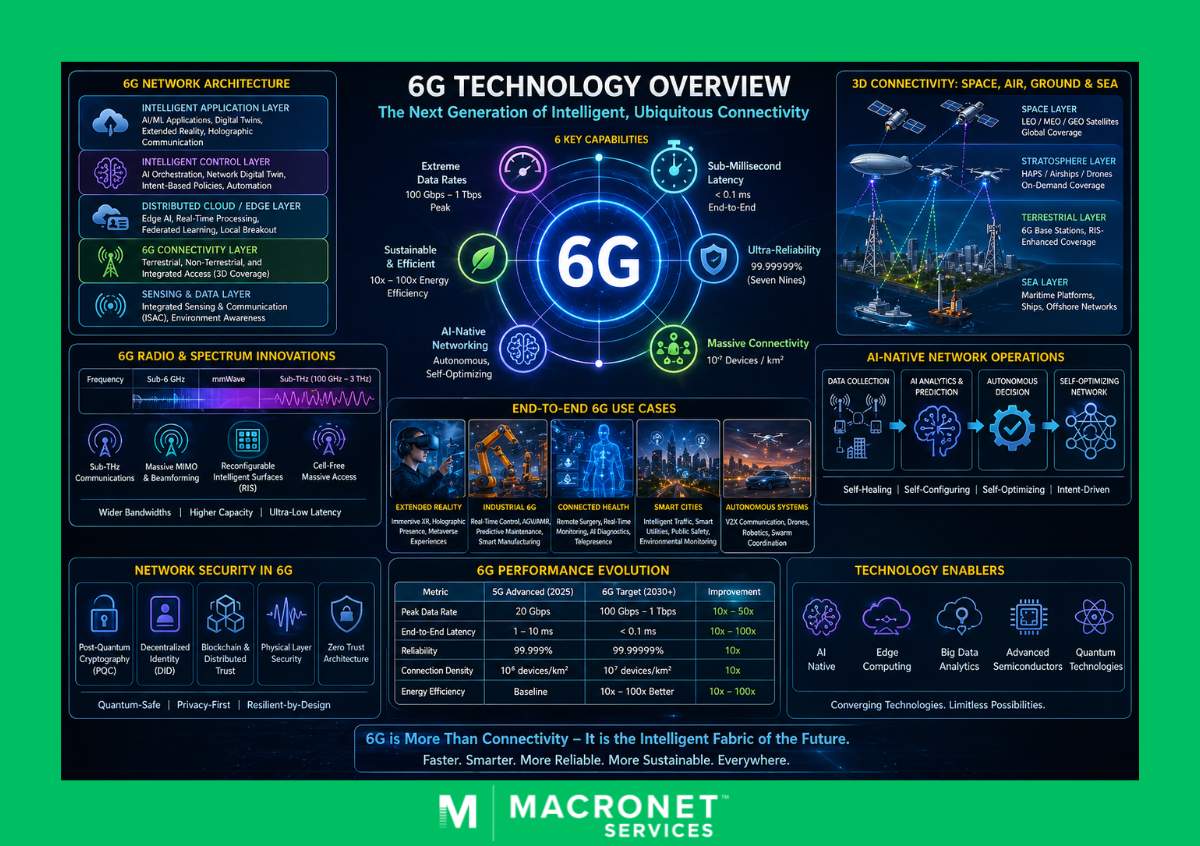
To understand the impact of 6G technology, it is important to move beyond the headline metrics. Yes, 6G promises extraordinary performance—sub-millisecond latency, terabit-per-second throughput, and near-perfect reliability. But those metrics, while impressive, are not what will reshape the enterprise.
The real transformation lies in how 6G is being designed.
Unlike previous generations, 6G is being built as an AI-native network that will extend the reach of Tier 1 ISPs and private network solutions. Intelligence is not layered on top—it is embedded into the fabric of the network itself. The result is a system that can understand context, adapt dynamically, and optimize itself in real time.
This is where the comparison of 5G vs 6G becomes meaningful. 5G extended connectivity. 6G redefines it. It collapses the boundaries between networking, computing, and data, creating a unified platform that supports business outcomes rather than simply transporting packets.
For CIOs, this means the WAN is no longer just infrastructure. It becomes a strategic asset.

From Branch Office to Autonomous Node
One of the most important implications of 6G is the transformation of the branch office.
In traditional architectures, the branch is dependent on centralized resources. Connectivity flows through fixed paths, security is enforced at the perimeter, and intelligence resides primarily in the cloud or core data center.
In the 6G era, that model dissolves.
The modern branch evolves into an autonomous, intelligent node—capable of maintaining operations, processing data locally, and dynamically selecting the best available connectivity path. It is no longer a passive endpoint but an active participant in the network.
This shift introduces a new paradigm for enterprise WAN design. Instead of building networks around fixed locations and static paths, organizations will design for resilience, adaptability, and independence.
The WAN becomes decentralized by design.
The Emergence of the 3D WAN
Perhaps the most visible architectural change in 6G is the transition from a two-dimensional network to a three-dimensional connectivity fabric.
Historically, enterprise networks have been terrestrial. Connectivity has been delivered through fiber routes, MPLS networks, and cellular towers. With 6G, that model expands vertically.
Connectivity will be orchestrated across terrestrial wireless, satellite constellations, and high-altitude platforms operating in the stratosphere. These layers will not function as separate networks but as a unified system, dynamically routing traffic based on performance, availability, and business intent.
For enterprises, this introduces a level of resilience that has never been possible before. A fiber cut, a regional outage, or a congestion event no longer represents a single point of failure. The network can shift seamlessly across layers, maintaining continuity without manual intervention.
This is not simply redundancy. It is continuous availability by design.
Wireless Fiber and the End of Physical Constraints
One of the most disruptive aspects of 6G is its use of sub-terahertz (sub-THz) spectrum, enabling what is often referred to as “wireless fiber.”
These frequencies allow for extremely high bandwidth—comparable to fiber—but delivered wirelessly. For enterprises, this has significant implications.
The ability to deploy high-capacity connectivity without trenching or physical buildouts changes the economics of network expansion. New sites can be connected in days rather than months. Remote or previously inaccessible locations become viable. Temporary environments, such as construction sites or pop-up operations, can operate with full enterprise-grade connectivity.
However, this capability also introduces new design considerations. Sub-THz signals behave differently than traditional wireless, requiring line-of-sight, advanced beamforming, and intelligent routing mechanisms. This is where technologies such as reconfigurable intelligent surfaces and AI-driven beam management come into play.
The result is a network that is both more powerful and more dynamic—but also more dependent on intelligent orchestration.
AI-Native Networking and the Shift to Intent
As networks become more complex, they also become more autonomous.
In the 6G era, the WAN will increasingly operate on intent-based models, where business requirements are translated directly into network behavior. Instead of configuring policies manually, IT leaders will define desired outcomes, and the network will determine how to achieve them.
This is made possible by agentic AI embedded within the network fabric. These systems continuously monitor conditions, predict disruptions, and optimize performance in real time.
Equally important is the emergence of semantic communication, where networks prioritize meaning rather than raw data transmission. Instead of sending entire datasets, the network transmits only what is necessary to achieve a specific outcome, dramatically reducing bandwidth requirements while improving efficiency.
For CIOs, this represents a shift away from managing infrastructure toward governing intelligent systems.
Security in the 6G Era: Preparing for Quantum Risk
The transition to 6G also coincides with a critical inflection point in cybersecurity.
As quantum computing advances, traditional encryption methods face increasing risk. The concept of “harvest now, decrypt later” is no longer theoretical—organizations must assume that sensitive data transmitted today could be decrypted in the future.
6G addresses this through the integration of post-quantum cryptography, decentralized identity models, and advanced physical-layer security techniques. Encryption becomes more dynamic, trust becomes distributed, and security is embedded into every layer of the network.
This requires a fundamental shift in how enterprises approach risk. Security can no longer be treated as a perimeter function. It must be integrated into the architecture from the outset.
The Economics of 6G: From Cost Center to Value Engine
Beyond the technical transformation, 6G introduces a new economic model for enterprise networking.
By reducing reliance on physical infrastructure, organizations can shift from capital-intensive deployments to more flexible, software-defined consumption models like NaaS. Deployment timelines shrink, operational overhead decreases, and networks become more responsive to business needs.
At the same time, 6G enables entirely new sources of value. Capabilities such as integrated sensing allow networks to generate real-world insights, turning connectivity into a source of intelligence. Enterprises can leverage this data to optimize operations, improve customer experiences, and create new revenue streams.
This fundamentally changes how the WAN is measured. The conversation moves from cost per megabit to value per outcome.
How CIOs Should Prepare for 6G Today
Although commercial 6G deployments are expected closer to 2030, the preparation window is already open.
The most important step is architectural. Organizations must begin moving away from rigid, hardware-centric network designs toward more flexible, software-defined models. This includes embracing open architectures, enabling multi-vendor interoperability, and ensuring that infrastructure can evolve without requiring full replacement.
At the same time, enterprises should evaluate their readiness for AI-driven operations. As networks become autonomous, governance, policy definition, and oversight will become more important than manual configuration.
Security strategies must also evolve. Planning for post-quantum cryptography and decentralized trust models today will help avoid costly retrofits in the future.
Finally, organizations should begin exploring how emerging capabilities—such as satellite integration and edge intelligence—fit into their long-term WAN strategy.
The Strategic Opportunity for Business Leaders
6G is often discussed as a future technology, but its real significance lies in what it enables.
It enables enterprises to operate without the constraints of physical infrastructure. It enables real-time, intelligent decision-making at the edge. It enables new business models built on data, automation, and continuous connectivity.
For CIOs and technical leaders, the question is not whether 6G will arrive. It is whether your organization will be ready to take advantage of it.
Those who begin preparing now will not just adopt 6G—they will use it to redefine how their business operates.
Final Thought: The WAN Becomes a Strategic Platform
The evolution to 6G marks the moment when the WAN transitions from infrastructure to platform.
It is no longer just about connecting sites. It is about enabling outcomes, driving efficiency, and creating competitive advantage.
At Macronet Services, we are already helping enterprise clients evaluate how emerging technologies like 6G, satellite integration, and AI-native networking will reshape their global infrastructure strategies. Because the organizations that win in the next decade will not be those with the fastest networks—they will be those with the most intelligent ones. Contact us anytime to talk about your current and future network strategies.