

Carrier Diversity vs Path Diversity: Why Two ISPs May Not Be Redundant
Carrier Diversity vs Path Diversity: Why Two ISPs May Not Be Redundant explores why having two Internet service providers doesn’t always guarantee network redundancy. Discover how shared fiber infrastructure, hidden carrier dependencies, and common points of failure can put enterprise connectivity at risk. Learn how to evaluate physical path diversity, verify independent fiber routes, and select truly resilient Internet connectivity solutions.

IP Transit vs. Dedicated Internet Access (DIA): What’s the Difference?
IP Transit vs. Dedicated Internet Access (DIA): What’s the Difference? This comprehensive enterprise guide explains how IP transit and DIA compare in network architecture, BGP routing, performance, costs, redundancy, and operational responsibilities. Discover when managed Dedicated Internet Access is the better choice, when IP transit offers greater routing flexibility, and how to evaluate Tier 1 ISPs, multihoming, and cloud connectivity. Learn how Macronet Services helps enterprises design resilient networks, compare providers, and optimize Internet connectivity costs.

Tier 1 ISP Pricing: Dedicated Internet and IP Transit Costs Explained
Tier 1 ISP Pricing: Dedicated Internet and IP Transit Costs Explained is a comprehensive 2026 guide to enterprise Internet pricing, including Dedicated Internet Access (DIA), wholesale IP transit, and global Tier 1 ISP costs. Explore current pricing benchmarks for 100 Mbps, 1 Gbps, 10 Gbps, and 100 Gbps connectivity, understand 95th-percentile billing, and learn how local access, bandwidth commitments, and contract terms affect total costs. Discover how Macronet Services helps enterprises compare providers, negotiate competitive rates, and optimize network performance and connectivity spending.
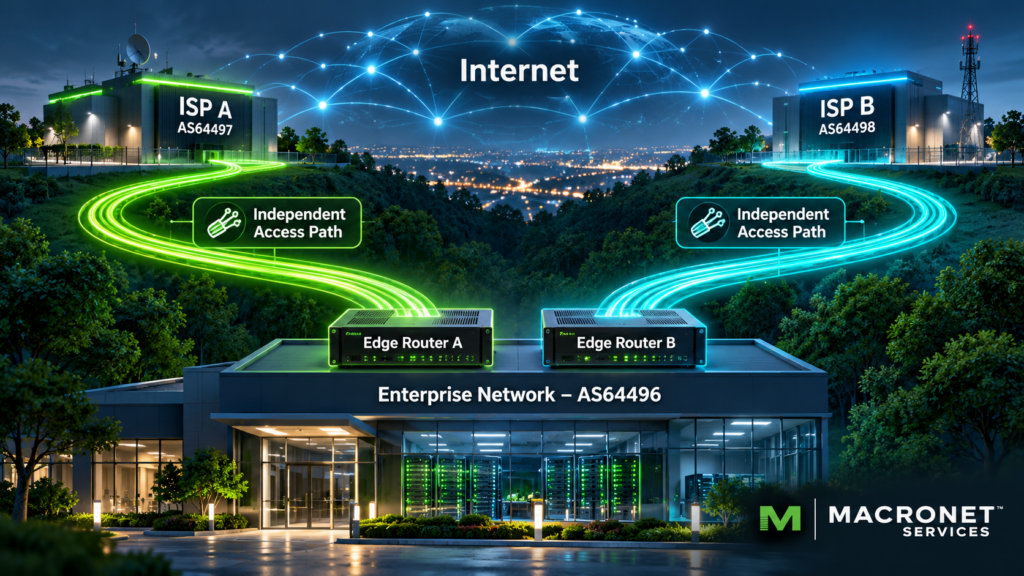
BGP Multihoming: The Complete Enterprise Guide to Dual ISP Connectivity
BGP Multihoming: The Complete Enterprise Guide to Dual ISP Connectivity explains how businesses can design resilient Internet networks using multiple ISPs, Border Gateway Protocol (BGP), and redundant network infrastructure. Explore dual ISP architecture, active-active vs. active-standby configurations, BGP failover, routing policies, public IP addressing, and physical carrier diversity. Learn how to evaluate providers, prevent single points of failure, optimize costs, and maintain reliable connectivity for mission-critical enterprise applications.

BGP Routing Explained: The Enterprise Guide to Internet Routing
BGP Routing Explained: The Enterprise Guide to Internet Routing explores how Border Gateway Protocol powers global Internet connectivity and enterprise networks. Learn how BGP works, how routers select the best paths, and how organizations use BGP multihoming, traffic engineering, and redundant ISPs to improve network resilience. This comprehensive guide also covers eBGP vs. iBGP, BGP security, RPKI, route hijacking, cloud connectivity, and best practices for designing reliable enterprise Internet architectures.

IP Transit: The Complete Enterprise Guide to Providers, Pricing, Peering & BGP
IP Transit: The Complete Enterprise Guide to Providers, Pricing, Peering & BGP explains how IP transit works, how providers differ, what drives pricing, how BGP and peering shape performance, and how enterprises can design and source resilient Internet connectivity.

Telecom Expense Management: How Macronet Services and E78 Help Enterprises Reduce Costs and Optimize Network Investments
How to Read and Compare a Data Center Colocation Quote: learn how to evaluate power pricing, MRC, NRC, PUE, cross connects, escalators, TCO, and contract risks. This guide explains how to normalize competing colocation proposals, uncover unmodeled costs, compare power and connectivity structures, calculate total contract value, and identify the provider offering the best risk-adjusted economics.

How to Read and Compare a Data Center Colocation Quote
How to Read and Compare a Data Center Colocation Quote: learn how to evaluate power pricing, MRC, NRC, PUE, cross connects, escalators, TCO, and contract risks. This guide explains how to normalize competing colocation proposals, uncover unmodeled costs, compare power and connectivity structures, calculate total contract value, and identify the provider offering the best risk-adjusted economics.

AI Colocation: How to Choose a Data Center for GPU and High-Density AI Infrastructure
AI Colocation: How to Choose a Data Center for GPU and High-Density AI Infrastructure. Learn how to evaluate power, liquid cooling, networking, scalability, resiliency and cost when selecting a facility for enterprise AI workloads. This guide explains the technical and commercial requirements behind GPU colocation, from rack density and high-speed networking to commissioning, expansion planning, and long-term infrastructure strategy.

Colocation RFP Guide: Build, Evaluate & Negotiate a Data Center RFP
This Colocation RFP Guide explains how to build, evaluate and negotiate a Data Center RFP, including technical requirements, power and cooling, connectivity, security, pricing, vendor scoring, site visits, contract terms and AI-ready infrastructure considerations. Use it to create more comparable proposals, reduce risk and make better colocation sourcing decisions.