

SIP Trunking in the AI Era: The CIO’s Guide to Enterprise Voice
For many enterprises, SIP trunking began as a straightforward modernization initiative: replace aging T1, E1, and Primary Rate Interface circuits with IP-based connectivity and reduce the cost of voice services. That business case still matters, but it no longer captures the strategic importance of enterprise voice. In the AI era, the enterprise voice environment is becoming a programmable operating layer that connects public telephone networks, Microsoft Teams, Zoom Phone, cloud contact centers, recording systems, analytics platforms, automated workflows, and conversational AI agents.
This architectural shift is significant because voice is no longer confined to a proprietary PBX or treated as an isolated telecommunications service. SIP separates call control from the media stream, allowing an enterprise to route, secure, observe, record, analyze, and increasingly automate conversations without rebuilding its carrier infrastructure every time an application changes. A properly designed SIP architecture can support conventional business calling, complex contact-center routing, phased PBX migration, real-time agent assistance, live transcription, AI voice agents, branded calling, fraud controls, emergency services, and global number management through a coordinated set of network and governance decisions.
That flexibility does not make SIP simple. The modern enterprise voice environment spans carrier networks, cloud communications platforms, session border controllers, enterprise WANs, telephone-number inventories, emergency-location databases, encryption domains, recording systems, AI models, and regulatory obligations. Services that appear similar during procurement can produce very different outcomes in resiliency, control, cost, data access, international coverage, implementation complexity, and future flexibility.
A CIO choosing among native cloud calling, Microsoft Operator Connect, Teams Direct Routing, Zoom Bring Your Own Carrier (BYOC), a managed SBC service, a traditional SIP carrier, or a Communications Platform as a Service provider is therefore making more than a telecommunications purchasing decision. The organization is deciding who will control its phone numbers, signaling, media, routing policies, calling identity, service data, security boundaries, customer interactions, and future AI integrations.
Macronet Services helps enterprises navigate these decisions. The Macronet Services team represents the leading providers of enterprise voice, Tier 1 ISPs, SIP trunking, UCaaS, CCaaS, cloud calling, managed SBC, CPaaS, and global telecommunications services. Drawing on years of experience designing complex voice-network solutions for large and geographically distributed enterprises, the team helps clients assess their current environment, define technical and business requirements, evaluate providers, benchmark pricing, negotiate contracts, design resilient architectures, and coordinate implementation.
Because Macronet Services works across the provider landscape rather than promoting a single carrier or platform, its recommendations can account for the enterprise’s complete operating environment. That may include Microsoft Teams or Zoom connectivity, contact-center requirements, legacy PBX coexistence, domestic and international telephone numbers, emergency calling, carrier diversity, network access, security, compliance, and emerging AI voice use cases. The objective is not simply to procure a SIP trunk. It is to design an enterprise voice architecture that remains reliable, secure, economically efficient, and adaptable as communications technology continues to evolve.
This guide provides a decision-oriented framework for that process. It explains how SIP signaling and media work, where the session border controller fits, how Microsoft Teams and Zoom connectivity models differ, what network conditions determine voice quality, how to design meaningful resilience, how STIR/SHAKEN relates to caller identity and reputation, how enterprise telephony can connect to AI, and what governance controls are required before autonomous voice systems are trusted with customer interactions. It also includes provider-selection criteria, a total-cost framework, a migration blueprint, and a CIO checklist that can be used during architecture reviews, sourcing initiatives, and requests for proposal.

Contents
1. Why SIP Trunking Matters in the AI Era
2. What SIP Trunking Is—and What It Is Not
3. How SIP Signaling, Media, Codecs, and SBCs Work
4. Choosing a Cloud Voice Connectivity Model
5. Network Design and Voice-Quality Engineering
6. Resilience, Carrier Diversity, and Inbound Continuity
7. Enterprise Calling Identity, Reputation, and Brand Trust
8. Connecting Enterprise Voice to AI
9. AI Voice Governance, Privacy, and Operational Control
10. Enterprise Voice Security and Fraud Prevention
11. Emergency Calling and Location Management
12. Global SIP, Numbering, and Regulatory Architecture
13. Provider Evaluation, RFP Design, and SLA Strategy
14. Pricing, Capacity Planning, and Total Cost of Ownership
15. Enterprise SIP Migration and Cutover Blueprint
16. CIO Decision Checklist
17. Frequently Asked Questions
18. Strategic Roadmap for the CIO
Selected Authoritative Resources
1. Why SIP Trunking Matters in the AI Era
SIP trunking remains essential because the public switched telephone network is still the universal access layer for business voice. Customers, employees, suppliers, regulators, emergency services, and mobile users continue to depend on telephone numbers. What has changed is what happens after a call enters the enterprise. A call may be delivered to a desk phone, a Microsoft Teams user, a Zoom client, a cloud contact center, an outsourced service desk, an AI receptionist, a fraud engine, or several systems simultaneously.
The strategic role of SIP is to provide a standards-based control plane between those destinations and the carrier network. The IETF’s SIP standard defines the protocol used to establish, modify, and terminate multimedia sessions. The media itself generally travels separately using the Real-time Transport Protocol, with security added through Secure RTP where supported. Because call control and media are distinct, an enterprise can change applications, carriers, SBCs, recording platforms, and AI services without treating every change as a full replacement of the voice network.
This separation also turns voice into a usable data source. A conversation can generate a transcript, intent classification, quality score, compliance event, customer record, knowledge-base query, workflow trigger, or escalation. In a contact center, the same media stream can support an agent and a real-time copilot. In an autonomous interaction, the voice application may authenticate the caller, retrieve account information, complete a transaction, and transfer the call to a person with context intact. These outcomes depend on more than an AI model. They depend on reliable telephony, clean audio, predictable routing, controlled access to tools, and clear governance.
The result is a broader CIO agenda. Enterprise voice now intersects with five strategic priorities: cloud migration, customer experience, cyber resilience, data governance, and AI-enabled operating-model transformation. The best architecture is therefore not necessarily the one with the lowest per-minute rate. It is the one that gives the enterprise the right balance of control, simplicity, geographic coverage, resilience, data access, and future flexibility.
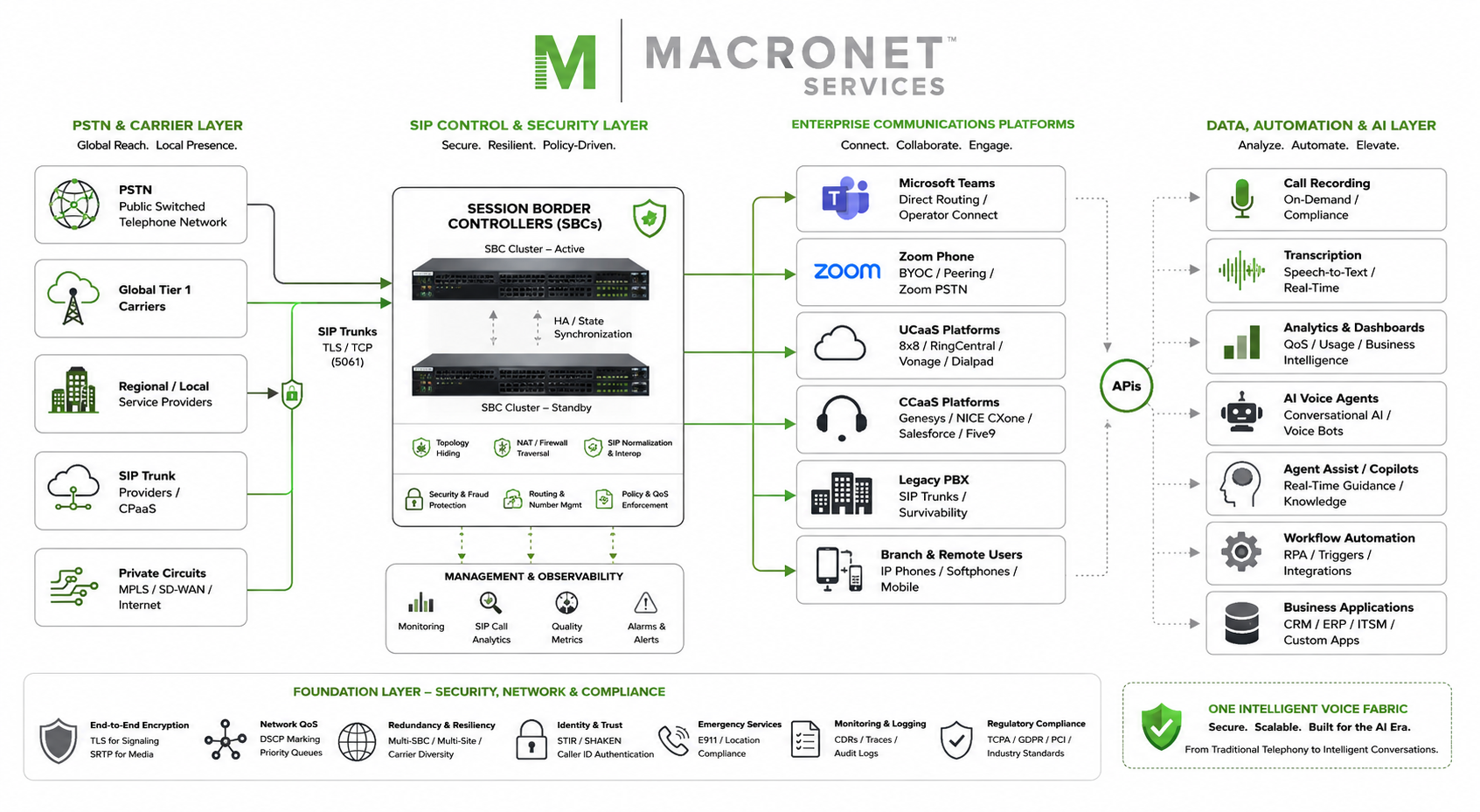
Below is an image of the modern Enterprise Voice Architecture Blueprint:

2. What SIP Trunking Is—and What It Is Not
A SIP trunk is an IP-based logical connection used to exchange SIP signaling and associated media between communications systems. It replaces the fixed physical channel model of legacy PRI service with a more flexible session model. A single trunk can support many simultaneous calls, multiple telephone-number ranges, inbound and outbound traffic, toll-free services, emergency calling, and connections to several enterprise platforms, depending on the provider and design.
SIP trunking is not the same as hosted VoIP, UCaaS, CCaaS, or CPaaS. Those services may use SIP internally, but they package different layers of the communications stack. A SIP trunk primarily provides connectivity between a carrier and an enterprise-controlled or enterprise-selected call-control environment. UCaaS provides end-user calling and collaboration. CCaaS provides customer-service routing, workforce tools, recording, and omnichannel interaction management. CPaaS provides programmable communications APIs. A managed voice provider may combine several of these layers.
Table 1. Enterprise voice service models
| Model | What the enterprise buys | Typical control level | Best fit |
| SIP trunking | PSTN connectivity and concurrent sessions delivered to an SBC, PBX, UCaaS, CCaaS, or voice application. | High when the enterprise controls the SBC and routing. | Complex enterprises, BYOC, hybrid PBX, contact centers, AI integration, global carrier strategy. |
| Native cloud calling | PSTN service bundled directly into a UCaaS platform. | Low to moderate. | Organizations prioritizing simplicity and standardized user calling. |
| UCaaS | Calling, meetings, messaging, administration, and often native or optional PSTN connectivity. | Moderate; varies by connectivity model. | Knowledge workers, branch users, remote work, collaboration consolidation. |
| CCaaS | Contact routing, agent desktop, IVR, recording, analytics, workforce tools, and digital channels. | Moderate to high at the application layer. | Customer service, sales, support, and regulated interactions. |
| CPaaS | APIs for voice, messaging, numbers, verification, media streaming, and workflow integration. | High for developers; carrier control varies. | Custom applications, rapid experimentation, embedded communications, and AI agents. |
| Managed SBC or managed SIP | Carrier connectivity plus SBC operation, routing, security, monitoring, and support. | Moderate; contractual control is critical. | Enterprises that need flexibility without operating voice infrastructure directly. |
A second misconception is that every SIP trunk is delivered over the public internet. SIP can be provided over dedicated access, private WANs, carrier Ethernet, MPLS, cloud interconnects, SD-WAN, or internet connectivity. The appropriate transport depends on geography, call volume, risk tolerance, platform topology, and whether the provider can preserve routing and quality beyond the enterprise edge. Macronet Services’ SD-WAN guide and global WAN design guide provide additional context for enterprises that must coordinate voice and data-network decisions. Additionally, our 2026 SASE Leaders Guide is highly informative for teams seeking to deploy a modern SASE architecture.
A third misconception is that moving to SIP automatically eliminates complexity. It often removes legacy circuit constraints, but it introduces new dependencies: DNS, IP routing, certificates, firewalls, NAT, codec negotiation, cloud-region selection, number porting, E911 databases, and provider interoperability. The architecture becomes more flexible, but the enterprise must manage that flexibility deliberately.
3. How SIP Signaling, Media, Codecs, and SBCs Work
3.1 Signaling and media are separate
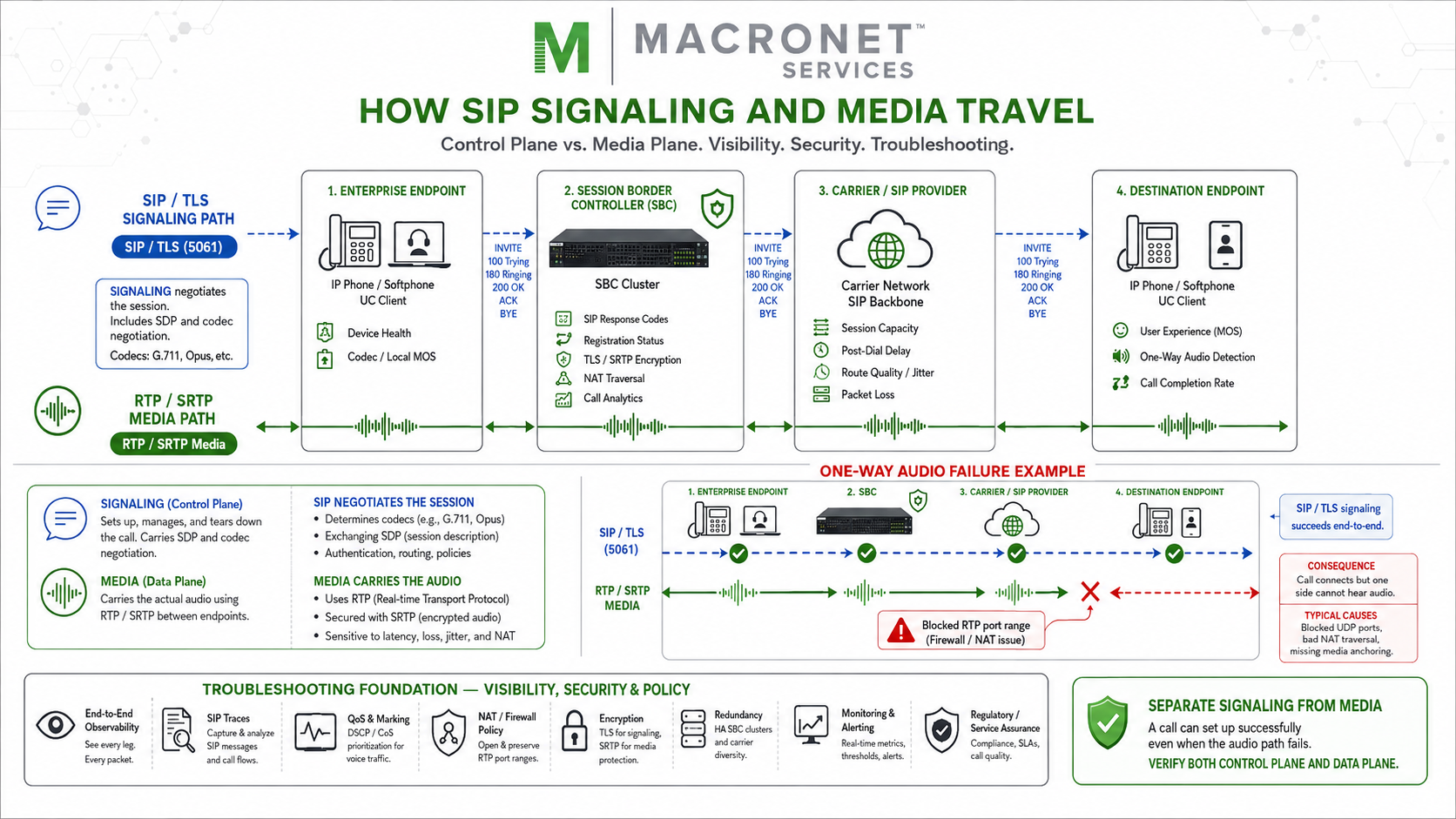
SIP is a signaling protocol. It negotiates who is calling, where the call should go, what media capabilities are available, and how the session will be established or terminated. A typical call setup includes an INVITE, provisional responses such as 100 Trying or 180 Ringing, a 200 OK response, and an ACK. Session details are described through the Session Description Protocol, including addresses, ports, codecs, and media direction.
The voice packets generally travel through RTP rather than inside the SIP messages. This distinction matters operationally. A call can have successful SIP signaling but failed or one-way media because the RTP path is blocked, misrouted, translated incorrectly by NAT, or negotiated with incompatible addresses. Troubleshooting must therefore examine both the signaling path and the media path.
SIP can run over UDP, TCP, or TLS-protected TCP. UDP remains common in carrier and legacy environments; it should not be described as universally deprecated. Secure enterprise designs increasingly favor SIP over TLS where the parties support compatible certificate, cipher, and transport configurations. The right choice depends on message size, provider requirements, encryption policy, network behavior, and interoperability.
3.2 The Session Border Controller
The Session Border Controller is the enterprise voice demarcation point. It sits between trust domains and acts as a stateful intermediary for signaling and often media. Depending on the platform and configuration, an SBC can perform topology hiding, admission control, protocol normalization, NAT traversal, media anchoring, codec negotiation, transcoding, encryption termination, call routing, fraud controls, SIP-message validation, and interoperability between carriers, PBXs, UCaaS platforms, contact centers, and AI applications.
The SBC should not be treated as a generic firewall or as a substitute for broader network security. Its value comes from understanding real-time communications at the session level. A well-designed SBC policy can reject malformed SIP, limit calls per second, prevent unauthorized registrations, control permitted destinations, normalize telephone numbers, validate certificates, and isolate an application from carrier-specific signaling. Those controls are especially important when voice workloads are exposed to the internet or distributed across multiple clouds.
Table 2. SBC deployment choices
| Deployment model | Advantages | Tradeoffs | Typical use |
| Physical appliance | Deterministic capacity, established HA models, local survivability, hardware isolation. | Capital cost, hardware lifecycle, fixed capacity, and site dependence. | Large data centers, regulated environments, legacy PBX estates, and heavy transcoding. |
| Virtual SBC | Flexible placement on VMware, Hyper-V, or cloud VMs; easier lifecycle than appliances. | Capacity and HA still depend on licenses, instance design, and platform constraints. | Direct Routing, hybrid voice, regional hubs, and cloud migration. |
| Cloud-native SBC | Automation, elastic design patterns, API integration, and regional deployment. | Operational maturity and feature parity vary; stateful media remains complex. | Large cloud voice platforms and service-provider architectures. |
| Carrier-hosted or managed SBC | Lower operational burden, standardized support, and faster deployment. | Less direct control; portability and observability depend on the contract. | Enterprises seeking BYOC flexibility without running SBCs. |
| SBC as a service | Consumption model, simplified scaling, and potentially rapid multi-region deployment. | Provider dependency, integration limits, data-path transparency, and commercial lock-in. | Distributed cloud calling, smaller IT teams, and rapid migrations. |
CIOs should evaluate SBCs on more than concurrent sessions. Critical measures include call attempts per second, encrypted-session capacity, transcoding capacity, media-bypass support, stateful high availability, certificate automation, API and infrastructure-as-code support, multi-tenant controls, SIPREC support, detailed call records, packet capture, observability, cloud-region availability, licensing flexibility, and support escalation.
3.3 Codecs and audio quality
A codec determines how audio is sampled, compressed, transported, and reconstructed. G.711 remains the most common PSTN interoperability codec and is often the cleanest choice when the source call is already narrowband. G.722 provides wideband enterprise audio. Opus supports a broad range of bitrates and audio bandwidths and is widely used in modern real-time communications. No codec is universally best, because the end-to-end path may include PSTN conversion, mobile networks, UCaaS platforms, SBCs, recorders, and AI services.
The most important architectural principle is to avoid unnecessary transcoding. Every conversion consumes compute, can add delay, may reduce quality, and can complicate recording or speech recognition. An Opus-capable AI service cannot recreate wideband information lost earlier on a narrowband PSTN segment. Conversely, preserving wideband media between cloud endpoints can materially improve human comprehension and automated transcription where the end-to-end path supports it.

4. Choosing a Cloud Voice Connectivity Model
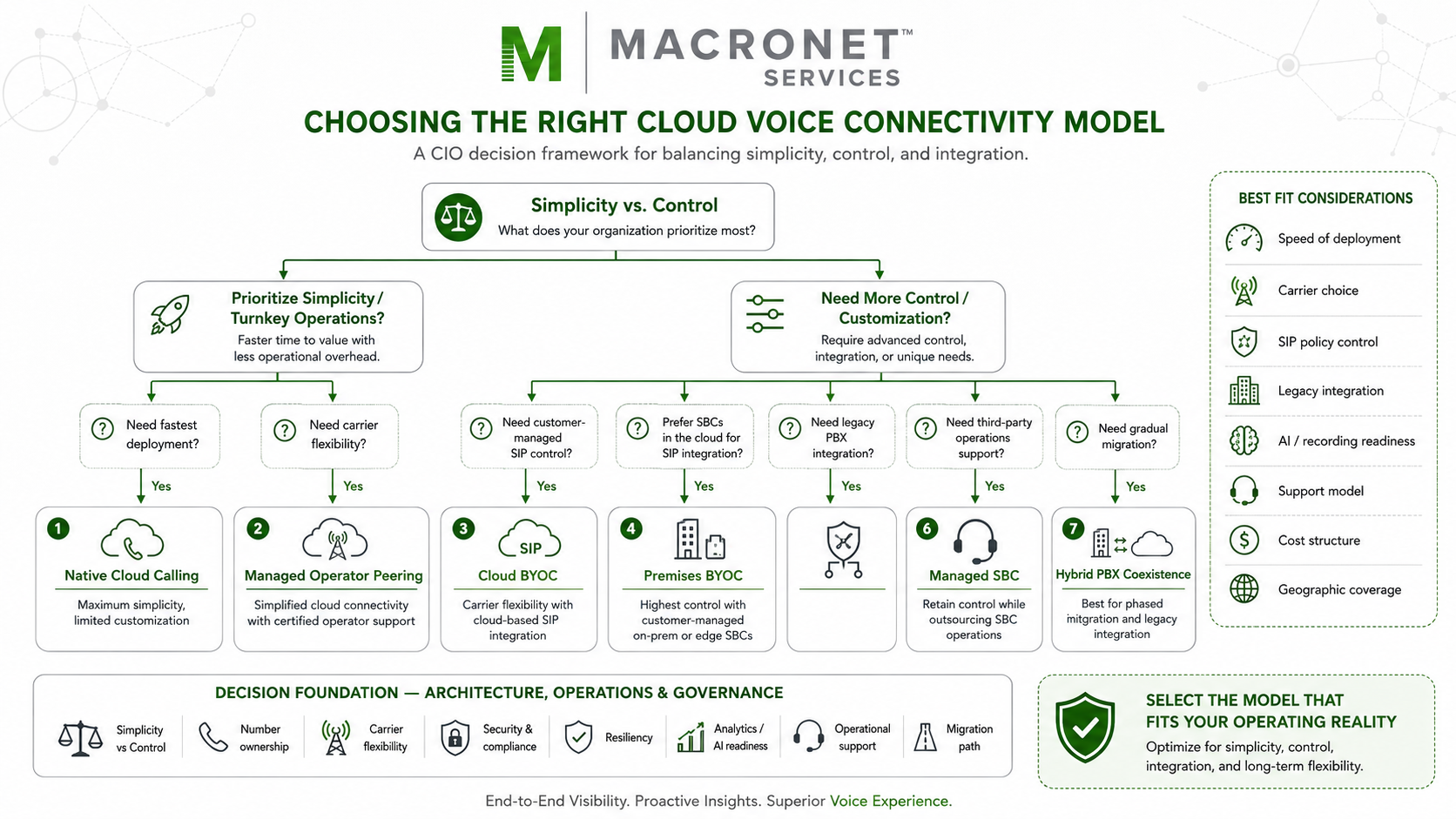
The first major CIO decision is not which SIP carrier to buy. It is which layer of the voice stack the enterprise wants to control. Native cloud calling offers simplicity. Managed operator models reduce infrastructure ownership while preserving carrier choice. BYOC and customer-controlled SBC models provide the greatest routing and integration flexibility. Hybrid models are often required while legacy PBXs, analog devices, contact centers, and cloud platforms coexist.
4.1 Microsoft Teams Phone
Microsoft currently documents four primary PSTN connectivity approaches for Teams Phone: Microsoft Calling Plans, Operator Connect, Teams Phone Mobile, and Direct Routing. Microsoft’s PSTN connectivity guidance should be treated as the authoritative source for current availability and product requirements.
Table 3. Microsoft Teams Phone connectivity models
| Model | Who provides PSTN service | SBC responsibility | Best fit | Key limitation |
| Microsoft Calling Plans | Microsoft. | Managed by Microsoft. | Organizations seeking the simplest all-cloud deployment in supported countries. | Coverage, pricing, and feature requirements may not fit complex global or high-volume environments. |
| Operator Connect | A participating operator integrated with Teams. | Managed by the operator. | Enterprises that want carrier choice with simplified Teams administration. | Choice is limited to participating operators and supported geographies. |
| Teams Phone Mobile | A participating mobile operator. | Managed through the operator and Microsoft integration. | Single-number experiences combining mobile service and Teams Phone. | Availability and capabilities depend on mobile-operator participation. |
| Direct Routing | An enterprise-selected carrier or carrier mix. | A customer or managed-service provider connects a supported SBC. | Complex routing, legacy integration, analog devices, global BYOC, contact centers, and custom policies. | Requires SBC design, lifecycle management, support coordination, and deeper expertise. |
Direct Routing is the most flexible model because it allows a supported SBC to connect Teams Phone to an enterprise-selected PSTN provider and to other voice systems. Microsoft specifically identifies interoperability with third-party PBXs and devices such as overhead paging and analog equipment as Direct Routing use cases. The flexibility is valuable, but it creates a multi-party support model: Microsoft, the SBC vendor or managed provider, the carrier, the network provider, and the enterprise may all participate in troubleshooting.
Operator Connect can be the better choice when the business wants carrier options without owning the SBC layer. It is often attractive for standard knowledge-worker calling, especially where provisioning through the Teams administration environment and operator-managed interconnection reduce operational complexity. Large enterprises may use more than one model—for example, Operator Connect for standard office users and Direct Routing for contact centers, special devices, or countries with unique requirements.
4.2 Zoom Phone
Zoom uses different terminology and should not be forced into the Microsoft framework. An enterprise may use Zoom’s native PSTN service, Bring Your Own Carrier through cloud peering, Bring Your Own Carrier through premises peering, Provider Exchange, or hybrid PBX connectivity. Zoom’s BYOC premises documentation explains how a customer-provided SBC can connect existing carriers to Zoom Phone and Zoom Contact Center, while Provider Exchange provides a cloud-based way to establish connectivity with participating providers.
Table 4. Zoom Phone connectivity models
| Model | Enterprise control | Infrastructure requirement | Best fit |
| Zoom native PSTN | Lowest carrier and routing control; simplest operations. | No customer SBC for standard service. | Enterprises prioritizing a unified Zoom operating model. |
| BYOC cloud peering or Provider Exchange | Carrier choice with cloud-managed interconnection. | Typically no on-premises SBC, depending on provider and model. | Organizations that want carrier choice without premises equipment. |
| BYOC premises peering | High control over carrier, SBC, routing, and hybrid integration. | Customer or managed SBC required. | Complex enterprises, existing carrier contracts, regional trunks, and custom routing. |
| Bring Your Own PBX or hybrid peering | Extends private dialing and coexistence between Zoom and legacy PBXs. | SBC and dial-plan integration required. | Phased migrations and mixed endpoint estates. |
Zoom requires disciplined dial-plan design in hybrid and BYOC deployments. Its documentation calls for E.164-formatted dialing strings on BYOC-P trunks. The enterprise should therefore normalize numbers at the SBC and treat E.164 as the canonical format even when legacy systems continue to use four- or five-digit extensions internally.
4.3 A vendor-neutral decision framework
The decision can be simplified into one question: where does the enterprise need control? If the requirement is ordinary business calling with limited integration, native cloud PSTN may be the fastest path. If the enterprise needs carrier choice but not SBC ownership, managed operator or cloud-peering models may be preferable. If the organization must bridge legacy PBXs, preserve complex routing, integrate special devices, use multiple carriers, control media, or connect custom AI systems, BYOC and Direct Routing models generally provide more architectural freedom.
Control also has an operational cost. An enterprise should not retain SBC and carrier complexity merely because it can. The correct model is the least complex architecture that still satisfies requirements for geography, reliability, data access, emergency calling, cost, and future integration.

5. Network Design and Voice-Quality Engineering
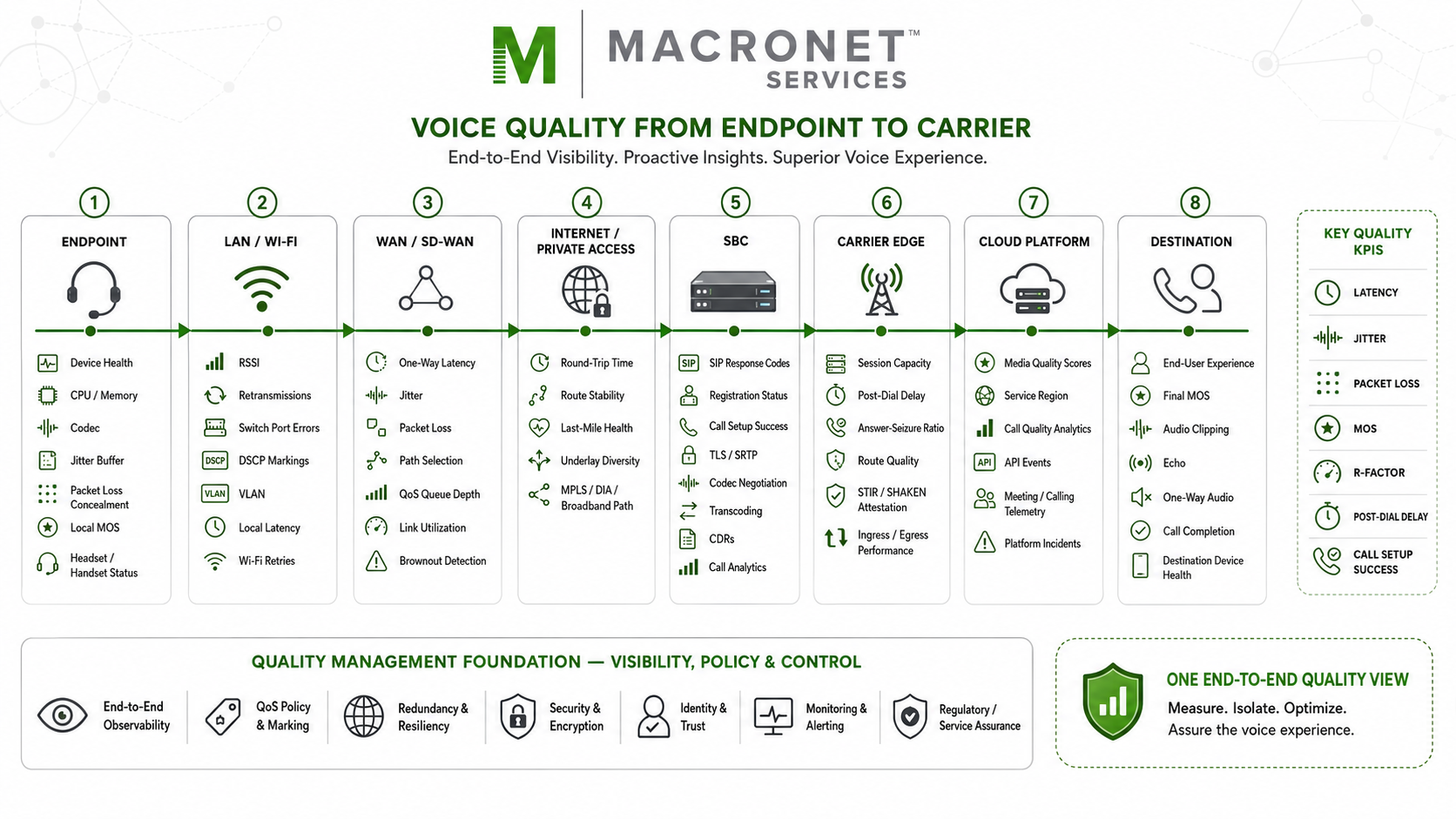
Voice quality is determined by the entire path, not by the SIP trunk alone. The endpoint, local network, Wi-Fi, access circuit, SD-WAN policy, internet path, carrier edge, SBC, cloud region, codec, and destination network can all contribute impairment. The enterprise must therefore design for quality and maintain enough telemetry to identify where degradation occurs.
The most familiar metrics are one-way latency, jitter, packet loss, and Mean Opinion Score. ITU-T G.114 remains a key reference for one-way transmission time, but a design target should not be mistaken for a hard failure boundary. Conversational quality degrades progressively. Echo, endpoint buffering, packet-loss concealment, codec behavior, and the interaction between impairments all influence the result. The ITU-T G-series recommendations provide the formal framework for transmission planning and E-model analysis.
Table 5. Practical voice-quality design objectives
| Metric | Preferred design objective | When to investigate | CIO interpretation |
| One-way latency | Aim for approximately 150 ms or less across the managed path when practical. | Sustained increases, route changes, or user reports of talk-over. | Higher delay can still work, but conversational naturalness declines. |
| Jitter | Keep packet-delay variation low enough for endpoint jitter buffers to absorb it without excessive delay. | Growing jitter-buffer depth, choppy audio, or route instability. | A single universal threshold is less useful than platform telemetry and trend analysis. |
| Packet loss | Target effectively zero on managed enterprise paths. | Any sustained loss, burst loss, or concealment events. | Even low average loss can be damaging when loss arrives in bursts. |
| MOS or quality score | Use as a trend and service-level indicator, not as the sole diagnostic. | Material decline from baseline or repeated scores below the enterprise target. | Calculated MOS varies by implementation and underlying assumptions. |
| Post-dial delay | Fast, consistent call setup appropriate to the route and country. | Sudden increases, carrier-specific patterns, or customer abandonment. | PDD affects perceived service quality even when audio is clear. |
| Call attempts per second | Capacity above busy-hour and incident peaks. | 503 errors, throttling, slow setup, or campaign failures. | CPS can be the limiting factor even when concurrent-session capacity is available. |
5.1 QoS and traffic treatment
Voice media is commonly marked EF, DSCP 46, within enterprise-controlled networks. Signaling may be marked CS3, DSCP 24, in traditional enterprise designs; AF31 is DSCP 26 and should not be confused with CS3. Cloud platforms may publish different recommendations. Microsoft, for example, maintains specific Teams QoS guidance, and those values should be followed for Teams media rather than replaced with a generic SIP table.
QoS only works where network devices honor the markings. The enterprise can control treatment across switches, Wi-Fi, routers, SD-WAN, MPLS, managed internet access, and private cloud connectivity. It cannot assume that the public internet will preserve priority. This is why route quality, local breakout, peering, and provider architecture matter as much as packet markings.
SD-WAN can materially improve voice performance by steering calls away from impaired links, maintaining policy across diverse access types, and exposing latency, jitter, and loss. It can also make troubleshooting harder if paths change dynamically without correlated voice telemetry. The voice team and network team should therefore share a common observability model rather than operating separate dashboards.
5.2 Capacity is more than bandwidth
Bandwidth calculations should include codec payload, packetization interval, RTP, UDP, IP, encryption, tunneling, and Layer 2 overhead. Yet bandwidth is rarely the only capacity constraint. SBC session licenses, transcoding resources, call attempts per second, carrier burst limits, contact-center ports, recording capacity, AI concurrency, and API rate limits may each become bottlenecks.
A voice-readiness assessment should test the network under congestion, not only when it is idle. Synthetic calls, packet captures, route analysis, Wi-Fi testing, failover tests, and cloud-region measurements provide far more confidence than a speed test. Enterprises should baseline performance before migration and continue monitoring after cutover so that carrier and network changes are visible before users report a widespread issue.

6. Resilience, Carrier Diversity, and Inbound Continuity
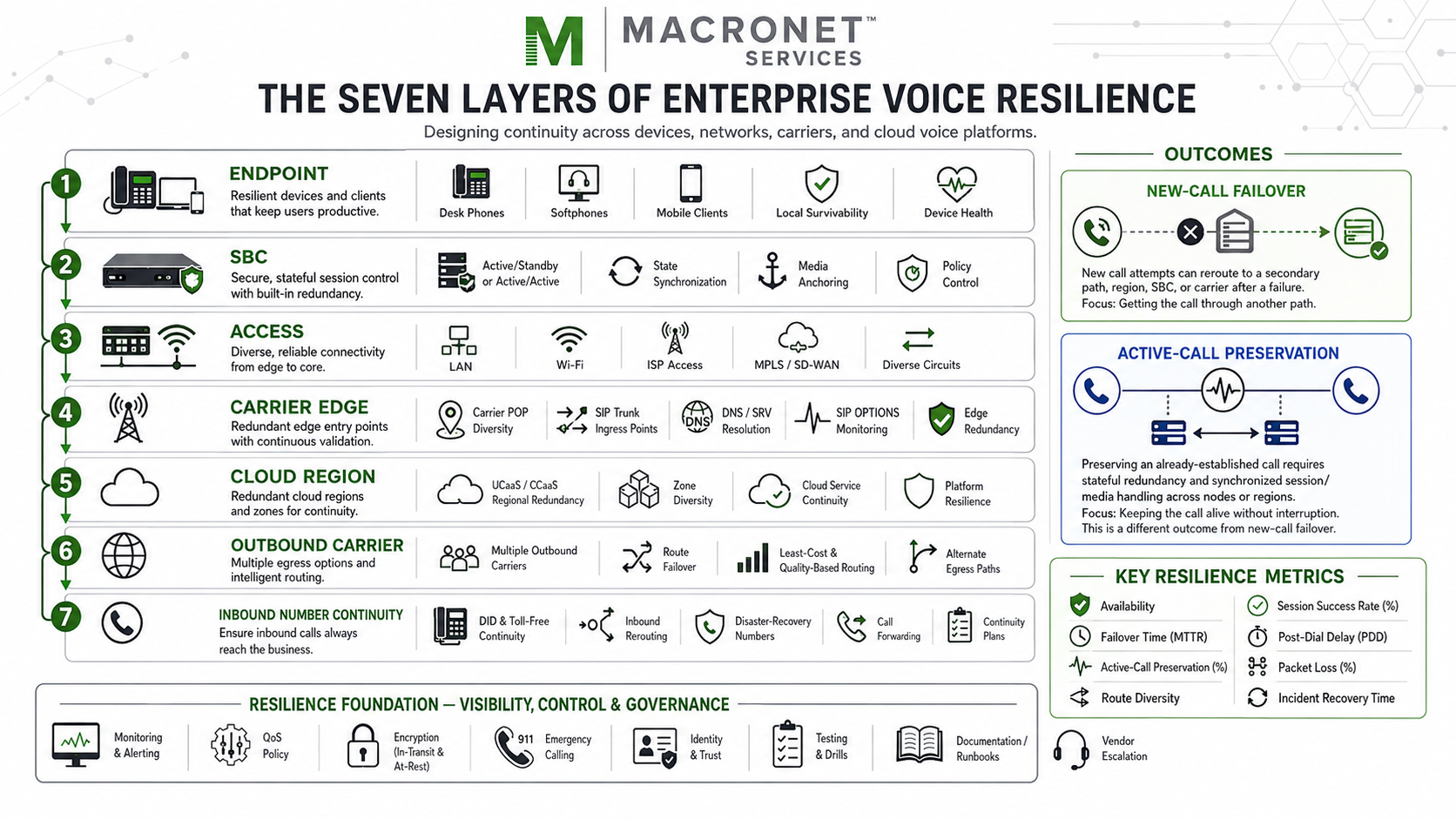
A resilient voice design begins by defining the failure that must be survived. An access-circuit failure is different from an SBC failure. A cloud-region outage is different from a carrier signaling outage. An outbound route can often be redirected more easily than an inbound telephone number. The architecture must distinguish new-call failover from preservation of established calls.
Table 6. The seven layers of enterprise voice resilience
| Layer | Primary risk | Typical controls | Important limitation |
| 1. Endpoint and site | Power, LAN, Wi-Fi, local internet, or device failure. | UPS, dual access, survivable devices, mobile fallback, and local gateways. | Cloud resilience does not help a site with no usable access. |
| 2. SBC | Appliance, VM, process, certificate, or configuration failure. | Stateful HA pairs, geographic clusters, configuration replication, and certificate monitoring. | Stateless DNS failover may not preserve active calls. |
| 3. WAN and access | Fiber cut, ISP outage, or routing brownout. | Diverse carriers, diverse entrances, SD-WAN, and private and internet paths. | Two circuits can share the same physical route or upstream dependency. |
| 4. Carrier edge | Signaling node, media gateway, or regional carrier failure. | Multiple carrier edge points, OPTIONS monitoring, route groups, and regional peering. | Two IP addresses are not automatically diverse. |
| 5. Cloud region | UCaaS, CCaaS, SBC, or AI regional outage. | Multi-region services, tested alternate routing, and local survivability. | Application state and media may not fail over identically. |
| 6. Outbound carrier | Termination provider or routing failure. | Secondary carriers, quality routing, and controlled overflow. | Caller identity, emergency calling, and regulatory rules must remain valid. |
| 7. Inbound numbering | Serving carrier, number-routing, or porting dependency. | Carrier-managed geographic redundancy, toll-free routing, alternate numbers, forwarding, and documented disaster plans. | A geographic DID is not automatically active-active across unrelated carriers. |
6.1 New-call failover versus active-call preservation
DNS SRV records and the procedures in RFC 2782 can help clients locate multiple service endpoints. SIP OPTIONS can help an SBC determine whether a destination is responsive. These mechanisms are useful for selecting routes for new calls. They do not, by themselves, preserve a call whose signaling state or media anchor disappears.
Active-call preservation requires a supported stateful design. The SBC pair may need synchronized dialog state, media state, registration state, and routing information. Network addresses must remain reachable, and failover behavior must be compatible with the carrier and platform. Even then, preservation may differ by call type, media topology, and failure mode. SLA language should therefore distinguish session-establishment availability from established-session survivability.
6.2 Why inbound diversity is harder
Outbound calls can usually be offered to another carrier when a route fails, provided the enterprise is authorized to present the calling number and the backup carrier accepts the traffic. Inbound geographic numbers are normally routed through a serving provider. The enterprise cannot assume that a DID block can be made simultaneously active on two unrelated carriers by changing DNS or SBC policy.
Inbound continuity may depend on a provider’s internal geographic redundancy, multiple ingress points, toll-free routing, call forwarding, number-hosting arrangements, alternate published numbers, mobile fallback, or a disaster-recovery contact plan. The RFP must ask how the provider will reroute calls when its serving switch, regional network, or enterprise access path fails—and how long that action takes.
6.3 Testing resilience
Resilience exists only if it is tested. A practical test plan should cover hard failures, brownouts, certificate expiration, DNS errors, SBC restart, route withdrawal, cloud-region loss, carrier 5xx responses, packet loss, asymmetric routing, and number-routing failure. Tests should validate not only that a call completes, but also that the correct caller ID, recording, emergency routing, analytics, and compliance controls remain intact on the alternate path.

7. Enterprise Calling Identity, Reputation, and Brand Trust
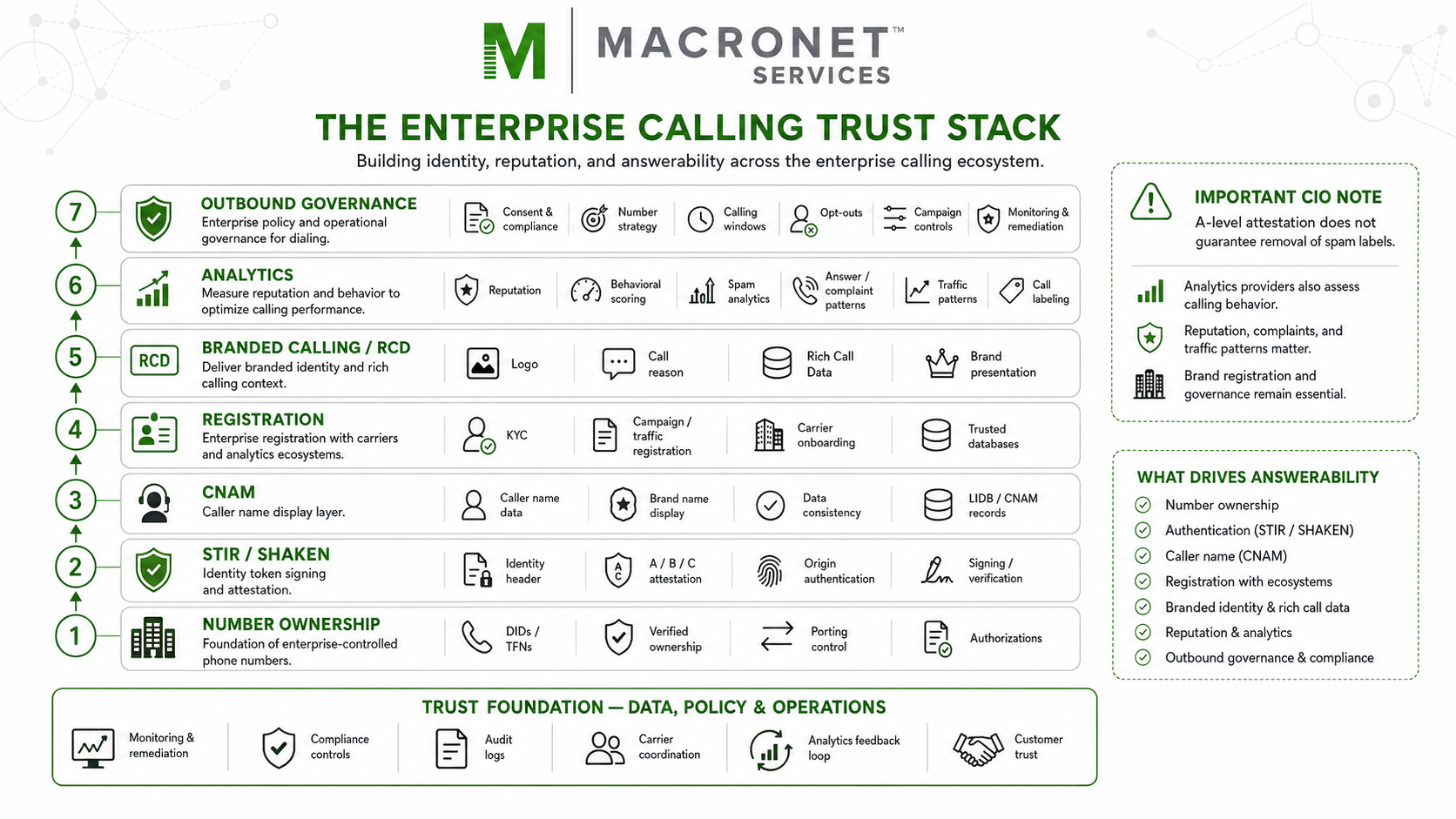
STIR/SHAKEN is often described too simply. It is a framework for authenticating calling-number information in IP voice networks. It does not prove that a call is wanted, that the caller’s brand will be displayed, or that the call will never be labeled as spam. The ATIS overview explains the relationship between STIR, the IETF identity standards, and SHAKEN, the implementation framework used by service providers.
Attestation is assigned by the originating provider. Full or A-level attestation generally indicates that the provider authenticated the customer and has confidence that the customer is authorized to use the calling number. B-level attestation indicates that the customer is known but the provider cannot fully validate its right to use the specific number. C-level or gateway attestation primarily identifies the point at which the call entered the signing network. These levels concern origin and number authorization; they are not a quality score for the business or call content.
Caller reputation is a separate analytics problem. Mobile operators and analytics providers may consider complaint history, call volume, short-duration calls, answer rates, repeated calling patterns, number age, campaign behavior, and other indicators. A legitimate enterprise with A-level attestation can still develop a poor reputation if its outbound practices resemble abusive calling.
Table 7. The enterprise calling trust stack
| Layer | Purpose | What it does not guarantee |
| Number ownership and inventory | Establishes which numbers the enterprise controls and which applications may use them. | Does not automatically update every carrier or analytics database. |
| STIR/SHAKEN attestation | Authenticates the call origin and authorization to use the number to the level supported by the provider. | Does not certify that the call is wanted or prevent spam labeling. |
| CNAM and directory data | Provides caller-name information in supported environments. | Display is inconsistent and may be stale. |
| Number registration and remediation | Associates enterprise identity and campaign information with analytics ecosystems. | Does not override poor calling behavior. |
| Branded calling and Rich Call Data | Can convey verified name, logo, and call reason where supported. | Interoperability and display remain dependent on networks and devices. |
| Outbound governance | Controls consent, cadence, number use, complaints, and campaign quality. | Requires continuous operational discipline. |
The FCC continues to examine call branding and Rich Call Data. Its recent materials recognize that RCD can carry verified identity and call-purpose information, but broad interoperability, vetting, display, and governance remain evolving. Enterprises should treat branded calling as a valuable layer in the trust stack, not as a guaranteed replacement for reputation management.
A mature program centralizes number ownership, maps each number to an approved use case, registers numbers where appropriate, monitors labeling across major mobile networks, investigates complaint patterns, and maintains remediation procedures. Number rotation should not be used as a substitute for fixing the behavior that caused reputation damage.

8. Connecting Enterprise Voice to AI
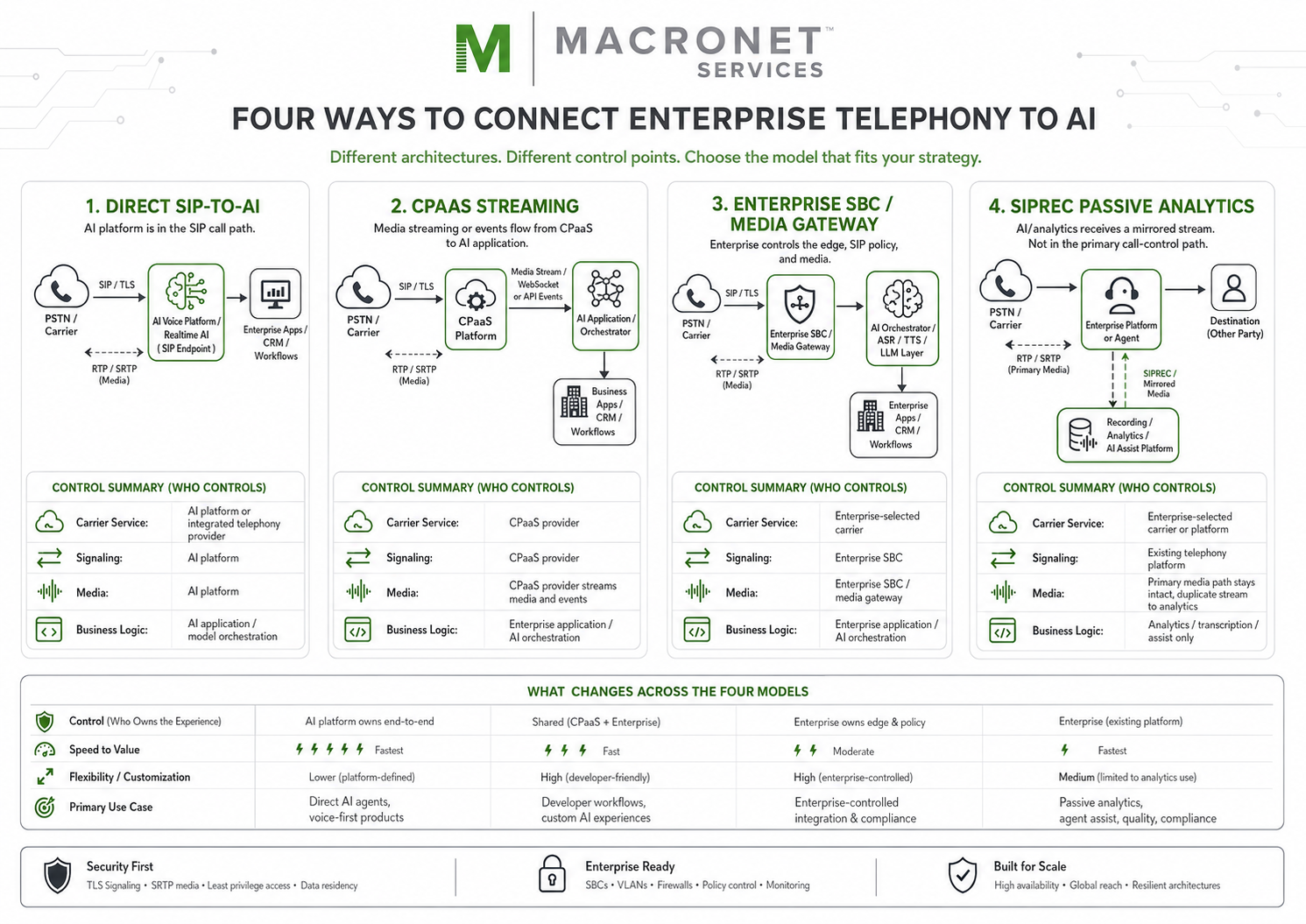
AI voice architecture should begin with the interaction model, not with the model vendor. The enterprise must decide whether AI is observing a conversation, assisting a human, handling a bounded task, or acting autonomously. Each role produces different requirements for media access, latency, tool permissions, error handling, disclosure, and human escalation.
Table 8. Four enterprise SIP-to-AI integration patterns
| Pattern | Call path | Best use | Primary design concern |
| Direct SIP-to-AI | The carrier or SBC sends a SIP call directly to a realtime AI platform. | AI receptionists, automated service, and bounded transactional agents. | Provider interoperability, call control, transfer, business-tool security, and regulatory controls. |
| CPaaS media streaming | A CPaaS provider terminates the call and streams audio and events to an application. | Rapid development, custom workflows, global number access, and experimentation. | Provider dependency, media format, latency, data location, and cost at scale. |
| Enterprise SBC or media gateway | The enterprise controls SIP and converts or routes media into the AI environment. | Complex routing, existing carriers, multi-platform estates, and security control. | Operational complexity, transcoding, scaling, and multi-region design. |
| SIPREC-based passive processing | The production call continues while a recording copy and metadata are sent to an analytics system. | Transcription, compliance, quality, sentiment, agent assist, and archival. | Media separation, privacy, recording consent, synchronization, and recorder capacity. |
8.1 Direct SIP-to-AI is now a first-class option
The architecture is no longer limited to converting SIP into a WebSocket stream through a custom gateway. OpenAI’s Realtime API SIP documentation, for example, supports directing incoming telephone calls from a SIP trunking provider to the API. The platform can accept and control a SIP call, while server-side application logic operates through a separate control channel. Other AI and communications platforms use different combinations of SIP, WebRTC, WebSocket, media streaming, and proprietary APIs.
Direct SIP simplifies some media plumbing, but it does not eliminate enterprise architecture. The organization still needs a phone number, carrier or SIP provider, routing policy, identity controls, failover, transfer strategy, tool integration, data governance, and a method for supervising the interaction. Direct integration also increases the importance of provider-specific call-control capabilities such as answer, hang-up, REFER transfer, DTMF, recording, and server-side event handling.
8.2 Passive AI and agent assistance
Many of the highest-value AI use cases do not require the model to control the call. Live transcription, compliance monitoring, next-best-action prompts, knowledge retrieval, translation, summary generation, quality scoring, and after-call work can operate on a copy of the media. This reduces operational risk because the human remains responsible for the conversation.
SIPREC provides a standardized architecture for sending media and metadata from a Session Recording Client to a Session Recording Server. The SIPREC architecture and protocol specification define the roles and signaling used to create the recording session. RFC 9806, published in 2025, updates the metadata media type used by SIPREC. Implementations can deliver separate participant streams, mixed media, or other arrangements depending on the SBC, recorder, and configuration. Separate streams are highly desirable because they improve speaker attribution and reduce dependence on diarization.
8.3 The latency budget
Conversational latency should be measured as a chain of events rather than a single number. Relevant metrics include end-of-turn detection, time to first transcription, time to first model token or audio frame, tool-execution delay, time to first synthesized speech, and barge-in interruption time. A tightly optimized speech-to-speech system can feel natural with low latency, but a universal sub-500-millisecond requirement is unrealistic for every call, geography, model, and tool workflow.
The enterprise should minimize avoidable delay: terminate media near the AI region, avoid repeated transcoding, stream rather than batch audio, use appropriate voice-activity detection, keep tools responsive, and design prompts that do not require unnecessary reasoning for routine interactions. More complex reasoning may justify a longer pause if the agent sets expectations and the outcome is accurate. Naturalness is a product-design issue as much as a network issue.
8.4 AI call transfer and continuity
A voice agent must know when and how to stop. Transfer architecture should preserve the caller’s identity, authentication state, reason for calling, transcript, completed steps, and any commitments already made. Blind transfers that force the customer to begin again undermine the economics of automation and create compliance risk. The call should also have a deterministic fallback when the AI service, tool, or knowledge source is unavailable.

9. AI Voice Governance, Privacy, and Operational Control
Conversational AI changes the risk profile of enterprise voice because the system can interpret speech, generate persuasive language, access customer data, and execute tools in real time. Traditional IVR systems followed deterministic menus. An AI agent can make inferences, improvise, and act. The governance model must therefore extend beyond telecom security into AI risk management, privacy, legal review, and business-process control.
The NIST AI Risk Management Framework organizes AI risk activities around Govern, Map, Measure, and Manage. Its Generative AI Profile adds considerations for risks that are amplified by generative systems. Those concepts translate well to enterprise voice: define ownership and acceptable use, map the call and data flows, test the system under realistic conditions, monitor performance and harm, and control deployment according to risk.
Table 9. Minimum governance controls for enterprise AI voice
| Control domain | Required decision | Evidence the CIO should require |
| Use-case boundaries | What may the agent discuss, decide, or execute? | Approved scope, prohibited actions, escalation rules, and process maps. |
| Identity and disclosure | How will callers know they are interacting with AI where required or appropriate? | Opening scripts, jurisdictional review, and recorded test calls. |
| Consent and outreach | What legal basis permits inbound recording, outbound AI calling, or automated dialing? | Consent records, do-not-call controls, revocation workflow, and legal sign-off. |
| Authentication | What must be verified before account access or consequential action? | Authentication policy, step-up controls, failure handling, and fraud testing. |
| Tool permissions | Which APIs can the agent call, with what limits? | Least-privilege credentials, allowlists, transaction caps, and approval gates. |
| Data handling | What audio, transcripts, prompts, and outputs are retained and where? | Data-flow diagram, retention schedule, vendor terms, and regional controls. |
| Accuracy and commitments | How are prices, policy statements, and promises constrained? | Approved knowledge sources, confirmation steps, sampling, and audit. |
| Human escalation | When must control transfer to a person? | Escalation triggers, queue design, and context-transfer test results. |
| Monitoring and incident response | How will failure, abuse, and harm be detected? | Dashboards, alerts, kill switch, incident playbook, and review cadence. |
9.1 AI-generated voice and outbound calling
The FCC has confirmed that AI-generated human voices fall within the Telephone Consumer Protection Act’s restrictions on artificial or prerecorded voice calls. The FCC declaratory ruling does not mean every AI-assisted call is prohibited, but it does mean enterprises must evaluate consent, purpose, recipient, dialing method, exemptions, opt-out requirements, and other applicable rules before launching outbound AI campaigns.
The architecture should make compliance executable. Consent records must be connected to the telephone number and approved purpose. Suppression and revocation must propagate quickly. Calling hours, jurisdiction, campaign type, disclosure language, and transfer behavior should be policy inputs, not instructions buried in a prompt. The enterprise should also preserve an audit trail showing why a call was placed and what the agent did.
9.2 Recording, transcription, and privacy
Recording and transcription obligations vary by jurisdiction and context. Some calls may require one-party consent, others all-party consent, and regulated sectors may impose additional notice, retention, access, and security rules. A multinational enterprise cannot rely on a single global greeting without legal review. The telephony design should support policy by caller location, agent location, business entity, queue, and use case.
Audio, transcripts, embeddings, summaries, and extracted entities may contain personal, financial, health, employment, or authentication information. The enterprise should determine which artifacts are actually needed. Retaining every raw audio stream indefinitely creates cost and risk. A defensible design applies data minimization, purpose limitation, role-based access, encryption, retention schedules, deletion procedures, and vendor restrictions on secondary use.
9.3 Voice biometrics and deepfake risk
Voice biometrics can reduce friction, but a voiceprint can be sensitive biometric information and may be subject to state, federal, or international privacy requirements. The FTC has warned that misuse of biometric information can create consumer harm. The FTC’s biometric policy statement emphasizes accuracy, deception, security, and foreseeable misuse.
Passive voice authentication should not be described as a simple feature that verifies every caller within a few seconds. Performance depends on enrollment quality, background noise, channel conditions, language, illness, replay attacks, synthetic speech, and threshold selection. False acceptance and false rejection must be measured in the actual call environment. High-risk actions should use layered authentication rather than relying on voice alone.
Deepfake detection is also probabilistic. An enterprise may combine network identity, device and carrier data, call history, behavioral signals, voice analysis, and step-up authentication into a risk score, but it should not promise that one acoustic model can reliably identify all synthetic speech in real time. Attackers and generation methods evolve quickly.
9.4 Prompt injection and tool safety
A spoken caller can attempt to manipulate an AI agent just as a text user can. The caller may instruct the agent to ignore policy, reveal internal information, use tools in an unauthorized way, or treat untrusted content as system instructions. The defense is not a stronger prompt alone. Business rules and permissions must be enforced outside the model through authenticated APIs, scoped credentials, transaction limits, schema validation, policy engines, and human approval for consequential actions.
Every tool call should be attributable to a session, user, model, and approved intent. The application should reject ambiguous account identifiers, require confirmation before irreversible actions, and prevent the model from constructing arbitrary backend queries. A production voice agent also needs a kill switch that can disable tools or route calls to humans without waiting for a software release.
10. Enterprise Voice Security and Fraud Prevention
SIP environments attract specialized attacks because telephone access can be monetized directly. Toll fraud, international revenue-share fraud, credential theft, registration hijacking, premium-rate abuse, robocalling, number spoofing, and telephony denial of service can create financial and operational damage quickly. Security must combine network controls, SBC policy, carrier controls, identity, monitoring, and commercial safeguards.
10.1 Signaling and media protection
SIP over TLS protects signaling between two adjacent parties that support compatible configurations. SRTP protects media confidentiality and integrity. The IETF’s SRTP specification and best-practices guidance for securing RTP media provide the standards foundation. Enterprises should focus on where encryption starts and stops. A call may be encrypted from the endpoint to the UCaaS cloud, decrypted at an SBC, re-encrypted to a carrier, and separately forked to a recorder or AI system. That is hop-by-hop protection, not necessarily end-to-end encryption between the human participants.
Certificate lifecycle management is an operational risk. Expired certificates can cause a complete signaling outage even when the network is healthy. Ownership, renewal, deployment, trust stores, cipher compatibility, and alerting should be documented. TLS 1.3 may be preferred where supported, but TLS 1.2 remains common in enterprise voice interoperability. The security policy should require the strongest mutually supported configuration rather than mandate a version that the carrier or platform cannot use.
10.2 Fraud controls
The most effective fraud program assumes that credentials or endpoints may eventually be compromised. International and premium destinations should be disabled by default for users and applications that do not need them. Dial plans should enforce explicit allowlists, geographic rules, time-of-day controls, and per-user or per-application permissions. Carriers and SBCs should apply call-rate, concurrent-session, and spend thresholds.
Detection must be fast enough to matter. Monthly invoice review will not stop a weekend fraud event. Alerts should consider destination, cost, call velocity, failed authentication, unusual CLI use, new source addresses, and deviations from normal behavior. The enterprise should know whether the carrier can automatically suspend a route, cap spend, or block a destination without waiting for manual approval.
10.3 Telephony denial of service
TDoS can target the SIP edge or the business process itself. A volumetric SIP flood may exhaust SBC resources, while a lower-volume campaign may occupy contact-center queues with nuisance calls. Controls include rate limiting, malformed-message screening, source reputation, access control, carrier filtering, queue policy, challenge mechanisms where appropriate, and alternate customer channels. Capacity planning should include attack scenarios rather than only legitimate busy-hour demand.
Voice security should be integrated into the enterprise security operations center. SBC events, carrier alerts, authentication failures, call-detail records, and AI-agent anomalies should feed common monitoring and incident-response processes. Telecom teams often possess critical fraud signals that never reach the SOC; that separation should end.
11. Emergency Calling and Location Management
Emergency calling is a life-safety requirement, not an implementation detail. In the United States, Kari’s Law requires covered multi-line telephone systems to support direct dialing of 911 without a prefix and to provide notification to an appropriate central location when a 911 call is made. The RAY BAUM’S Act rules address delivery of a dispatchable location. The FCC’s MLTS requirements page should be used as the authoritative starting point.
The challenge has increased as users move between offices, homes, hotels, Wi-Fi networks, VPNs, mobile devices, and softphones. A static address assigned to a user is often insufficient. The system may need to map subnets, switches, ports, wireless access points, device identifiers, user input, or platform-specific emergency locations to a validated dispatchable location.
HELD and PIDF-LO are important standards-based mechanisms for location discovery and conveyance, but they are not the only implementation model. Microsoft Teams, Zoom Phone, emergency-services providers, and enterprise PBXs may use different combinations of network topology, location information servers, provider databases, user confirmation, and application logic. The CIO should evaluate the end-to-end result rather than require one protocol indiscriminately.
Table 10. Emergency-calling scenarios to test
| Scenario | Required outcome |
| Fixed desk phone in a large campus | Correct street address plus building, floor, room, or equivalent dispatchable detail. |
| Nomadic laptop on a known office network | Automatic mapping to the current office location. |
| Remote worker at home | Validated user location and appropriate emergency routing for the user’s current location. |
| User connected through VPN | Emergency routing must not incorrectly follow the VPN egress location. |
| Mobile application | Clear understanding of whether the mobile network, UCaaS platform, or application handles the emergency call. |
| Analog elevator, alarm, or lobby phone | Reliable route, power, location, callback, and survivability. |
| WAN or cloud outage | Documented local or alternate calling path where business requirements demand survivability. |
Emergency calling should be tested with the provider’s approved test procedure, not by placing uncontrolled calls to a public safety answering point. Records should show the endpoint, callback number, dispatchable location, notification recipients, time, and result. Every office move, network redesign, UCaaS migration, or acquisition should trigger a location review.
12. Global SIP, Numbering, and Regulatory Architecture
Global SIP consolidation is attractive because it can reduce carrier fragmentation, standardize routing, centralize number management, and improve reporting. It can also fail when an enterprise assumes that telephone regulation behaves like cloud computing. Voice remains nationally regulated. Number ownership, local presence, emergency calling, lawful intercept, recording, data residency, CLI presentation, portability, and the permitted location of PSTN gateways can differ by country.
A global provider may offer one contract and portal while still relying on local entities and underlying carriers. That can be a sound model, but the enterprise should understand who holds the numbers, who is the regulated service provider, who files port orders, who supports emergency calling, where media enters the PSTN, and which party is accountable when a national service fails.
12.1 E.164 and global dial-plan normalization
The enterprise should use E.164-format numbers as the canonical representation: plus sign, country code, and national number. Legacy extensions can remain for user convenience, but the SBC or call-control layer should normalize them before routing. Consistent E.164 formatting reduces ambiguity across Microsoft Teams, Zoom, contact centers, carriers, CRM integrations, and AI applications.
Number normalization must account for local dialing habits, emergency codes, service numbers, short codes, toll-free services, and country-specific restrictions. The dial plan should be governed as enterprise data, not as an undocumented collection of SBC rules.
12.2 Country-by-country due diligence
A global voice RFP should not ask only, “Do you cover this country?” It should ask what kind of coverage is provided. Native local service, partner-delivered service, international inbound numbers, call forwarding, and best-effort outbound termination are not equivalent. The provider should identify the regulated entity, number types, porting support, emergency-service capability, local address requirements, installation lead time, outbound CLI rules, and support model for every country.
The architecture may need regional variation. One country may support cloud-native calling, another may require a local SBC or carrier, and a third may remain on a PBX during a regulatory transition. A standardized global governance model can coexist with different local technical patterns.
13. Provider Evaluation, RFP Design, and SLA Strategy
The market should not be reduced to a binary choice between Tier 1 carriers and CPaaS aggregators. Providers occupy several positions: facilities-based network operators, cloud PSTN and CPaaS providers, UCaaS-native calling providers, and managed SIP or carrier-aggregation providers. Some own extensive numbering and switching assets; others combine owned infrastructure with wholesale partners. The enterprise should evaluate the actual service chain rather than rely on a label.
Table 11. Provider evaluation framework
| Dimension | Questions for the RFP |
| Network and interconnection | Where are signaling and media points of presence? Which facilities, carriers, and cloud regions are used? Can private connectivity be provided? |
| Numbering | Who holds the numbers? Which number types and countries are native? How are ports, reversals, and emergency changes managed? |
| Resilience | How are carrier-edge, region, and inbound-number failures handled? What is preserved during failover? |
| Capacity | What are the session, CPS, burst, toll-free, and API limits? How quickly can they change? |
| Security | Which TLS and SRTP options, IP controls, fraud controls, certificates, logging, and DDoS protections are supported? |
| Identity and reputation | How are STIR/SHAKEN, enterprise attestation, number registration, branded calling, and remediation handled? |
| UCaaS and CCaaS | Which Microsoft, Zoom, contact-center, and SBC integrations are certified or supported? |
| AI and data access | Can media be streamed or recorded through SIPREC? What APIs, metadata, and event controls are available? |
| Global compliance | Which legal entity provides service in each country? What local restrictions and emergency capabilities apply? |
| Operations | What telemetry, portal access, APIs, ticketing, escalation, and change controls are provided? |
| Commercials | How are channels, minutes, numbers, toll-free, international, burst, taxes, surcharges, and minimums priced? |
| Contract | What are the term, renewal, termination, portability, data-export, transition-assistance, and SLA-credit provisions? |
13.1 The SLA must match the architecture
A five-nines availability promise is not meaningful unless the contract defines the measured component, exclusions, maintenance, calculation interval, and remedy. Carrier core availability does not guarantee that the enterprise site, SBC, cloud platform, or inbound number is available. The SLA should align with the actual service boundary and require enough telemetry to prove performance.
Relevant measures may include signaling availability, call-completion rate, post-dial delay, packet loss, jitter, latency, MOS or equivalent quality scoring, number-porting performance, incident notification, mean time to acknowledge, mean time to restore, and support escalation. Service credits should be automatic where practical and large enough to create operational accountability, although credits rarely compensate for the business impact of an outage.
13.2 Support model
Complex voice incidents often cross providers. The carrier may see successful signaling, the SBC vendor may see no fault, the UCaaS provider may report healthy service, and users may still experience one-way audio. The RFP should require packet-level cooperation, named escalation paths, bridge participation, and clear ownership of multi-vendor troubleshooting. A managed service is valuable only if it takes responsibility for coordination rather than simply opening tickets with other vendors.
Macronet Services can help enterprises develop requirements, compare providers, benchmark pricing, validate network and carrier diversity, negotiate contracts, and coordinate implementation. That independent perspective is particularly useful when voice, WAN, UCaaS, CCaaS, and AI decisions overlap. Enterprises evaluating contact-center platforms may also find the Macronet Services guide to leading contact-center providers useful as a companion resource.
14. Pricing, Capacity Planning, and Total Cost of Ownership
SIP economics are often summarized as channel price plus per-minute usage. That comparison is incomplete. The enterprise may also pay for DIDs, toll-free numbers, international termination, E911, CNAM, branded calling, number registration, SBC licenses, cloud compute, managed services, private connectivity, recording, storage, analytics, AI inference, porting, taxes, surcharges, and professional services.
Table 12. Enterprise SIP total-cost model
| Cost category | Examples | Common blind spot |
| Carrier recurring | Channels, metered usage, DIDs, toll-free, international, and emergency-service fees. | Taxes, regulatory recovery fees, minimum commitments, and rounding increments. |
| SBC and platform | Licenses, support, virtual appliances, cloud instances, HA pairs, and transcoding. | CPS limits and encrypted or transcoded capacity differ from simple session counts. |
| Network | Internet, private access, SD-WAN, cloud interconnect, and redundant circuits. | Two circuits may not be physically or operationally diverse. |
| Operations | Monitoring, managed service, NOC, certificate management, and moves, adds, and changes. | Internal labor and multi-vendor incident coordination. |
| Data and compliance | Recording, storage, retention, e-discovery, transcription, and quality analytics. | Duplicated data across CCaaS, recorder, AI, and CRM platforms. |
| AI | Audio input and output, model inference, tools, orchestration, testing, and supervision. | A low per-minute model price may exclude carrier, CPaaS, storage, and tool costs. |
| Migration | Discovery, porting, implementation, testing, training, and dual running. | Contract termination liability and extended overlap during port delays. |
| Risk | Fraud, outage impact, compliance failures, failed calls, and reputation damage. | The lowest unit price can create the highest business risk. |
14.1 Capacity planning
Capacity should be based on busy-hour behavior, not user count alone. The model should include concurrent calls, average handle time, call attempts per second, queue behavior, conference calls, recording streams, outbound campaigns, seasonal peaks, emergency events, growth, and AI-agent concurrency. Contact-center capacity may be constrained by rapid call attempts even when the average number of active calls appears modest.
Erlang models remain useful for conventional traffic engineering, but cloud and AI workloads can be burstier than traditional office calling. An outbound notification campaign or autonomous agent fleet can create thousands of attempts quickly. The carrier, SBC, CCaaS platform, APIs, and AI service must all be sized for the same event.
14.2 Commercial models
Flat-rate concurrent-session pricing can provide predictability for stable high-volume environments. Metered pricing can be efficient for variable or experimental workloads. Hybrid models combine committed baseline capacity with burst usage. There is no universal recommendation to commit at 70 percent of peak; the optimal mix depends on traffic distribution, contract minimums, overage rates, burst rights, seasonality, and the cost of blocked calls.
Enterprises should model at least three demand scenarios: expected operations, planned peak, and disruptive event. They should also model the effect of migration overlap and growth. A carrier proposal that looks inexpensive at average volume may become costly when toll-free, international, short-duration, or burst traffic is included.
A mature Telecom Expense Management program should continue after migration. Macronet Services’ Telecom Expense Management guide explains how inventory, contract, usage, and invoice controls can identify billing errors and unused services after the architecture changes.
15. Enterprise SIP Migration and Cutover Blueprint
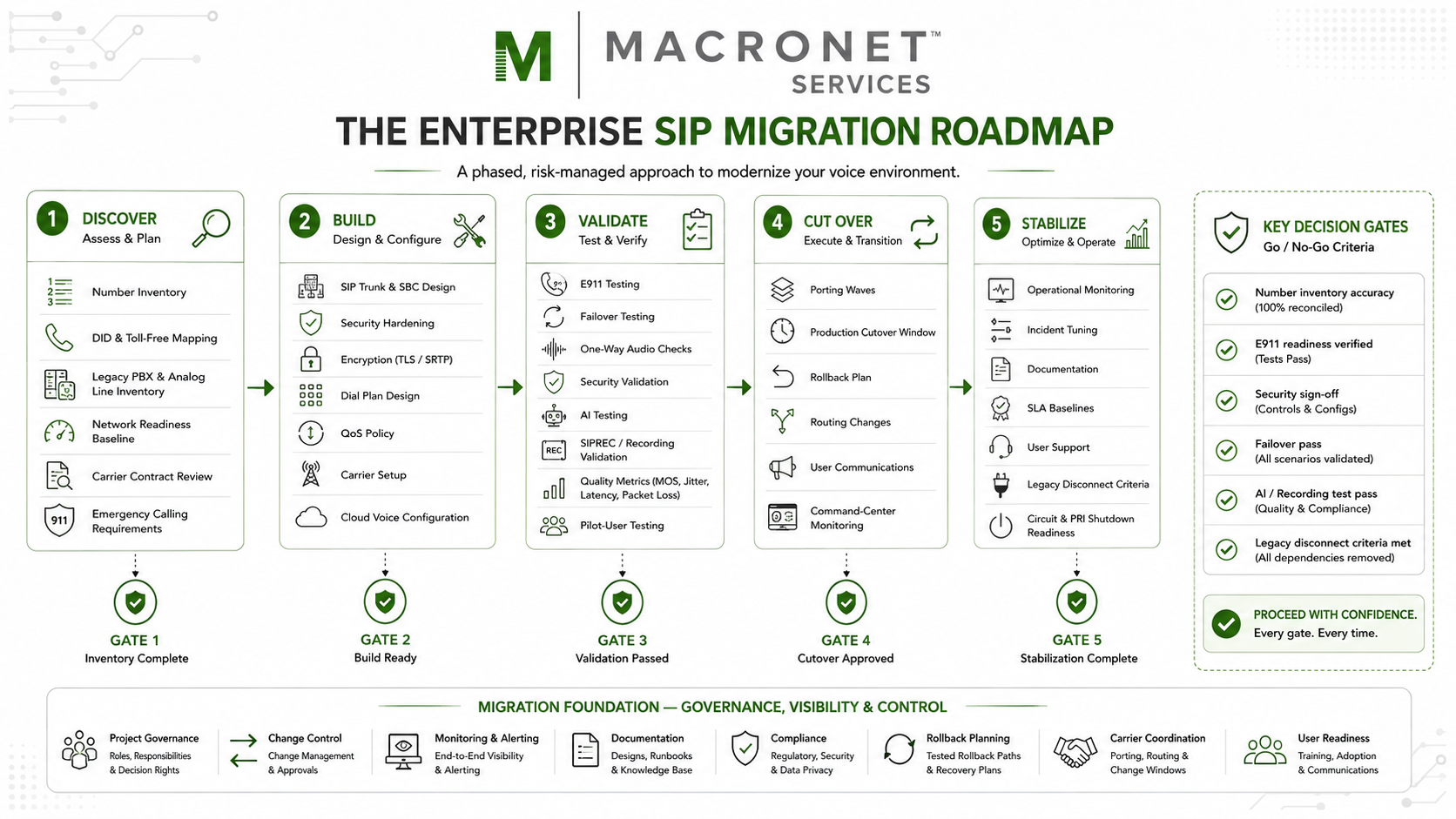
A SIP migration should be treated as a controlled business transition, not a trunk turn-up. The enterprise must know every number, device, route, contract, dependency, and regulatory requirement before the first production port. A domestic single-platform project may fit within 90 to 120 days, but a global migration can take much longer. The schedule should follow risk gates rather than a universal calendar.
15.1 Phase 1: Discovery and architecture
The discovery phase builds the source of truth. Inventory DIDs, toll-free numbers, extensions, trunks, carriers, contracts, PBXs, SBCs, call queues, emergency locations, recording systems, fax, paging, alarms, elevators, gate phones, intercoms, modems, building systems, nurse-call devices, blue-light phones, trading systems, call-accounting feeds, and every application that depends on call events or telephone numbers.
Capture current traffic by hour, day, site, destination, number, carrier, and application. Document dial plans, routing, caller ID, failover, emergency calling, recording, compliance notices, and number ownership. Measure network quality under load. The target architecture should be approved before carrier orders are placed.
15.2 Phase 2: Build, secure, and integrate
Deploy SBCs or managed connectivity, establish carrier trunks, configure TLS and SRTP where supported, normalize numbers, build routing, integrate UCaaS and CCaaS platforms, connect recording and analytics, and implement certificate monitoring. Create separate test numbers and routes so that production behavior can be validated without disrupting users.
Security policies should be in place before traffic is opened: source allowlists, destination restrictions, fraud thresholds, logging, SIEM integration, administrative access, change control, and incident response. AI integrations should begin with non-production data and bounded tools.
15.3 Phase 3: Validation and failure testing
Test inbound and outbound calls by carrier, geography, number type, codec, endpoint, and platform. Validate DTMF, transfer, hold, conference, voicemail, recording, fax where retained, contact-center routing, caller ID, STIR/SHAKEN, and emergency calling. Verify one-way-audio scenarios, NAT, firewall rules, DNS, and certificate behavior.
Then test failure. Remove an access circuit, disable a carrier route, restart an SBC, expire a test certificate, isolate a cloud region, and simulate a 503 response. Confirm what happens to new and active calls. Ensure alternate routes preserve identity, recording, emergency behavior, and compliance.
15.4 Phase 4: Pilot, port, and cut over
Begin with a representative pilot that is operationally important enough to expose real issues but small enough to recover. Port numbers in controlled waves. Maintain a documented rollback or forwarding option where feasible. Confirm the Firm Order Commitment, losing-carrier data, customer service records, authorized names, addresses, and number ranges before the window.
A porting plan should include communications, escalation contacts, bridge details, validation scripts, real-time call tests, carrier routing confirmation, and decision criteria for proceeding. Toll-free and geographic numbers may require different processes. Porting dates can move; business continuity must not depend on an optimistic schedule.
15.5 Phase 5: Stabilize and decommission
Do not disconnect legacy service simply because the first calls succeed. Stabilization should verify billing, number inventory, emergency calling, inbound and outbound routing, failover, recording, analytics, special devices, support processes, and user experience over a representative operating period. Critical environments may require 30 to 60 days or longer, depending on risk and contract terms.
Only then should the enterprise issue disconnect orders, recover hardware, remove firewall rules, retire certificates, close carrier accounts, update disaster plans, and reconcile invoices. Legacy services often continue billing after technical cutover because inventory and contract processes lag behind the project.
Table 13. Migration decision gates
| Gate | Required evidence before proceeding |
| Architecture approval | Approved target model, responsibilities, data flows, security, E911, resilience, and commercial design. |
| Production readiness | Successful functional, load, security, emergency, recording, and failure tests. |
| Port readiness | Accurate number inventory, accepted orders, FOC, rollback or forwarding plan, and support bridge. |
| Wave completion | Inbound and outbound validation, caller identity, routing, recording, analytics, and billing checks. |
| Legacy disconnect | Stable production period, resolved special devices, tested failover, and contract and invoice approval. |

16. CIO Decision Checklist
The following questions can be used to frame an executive architecture review. A “yes” answer is not automatically good or bad; the purpose is to reveal who controls each critical layer and whether the risk is understood.
Table 14. CIO decision checklist
| Decision area | Questions |
| Business outcome | Are we reducing cost, enabling cloud collaboration, modernizing contact centers, consolidating carriers, enabling AI, or all of these? Which outcome has priority? |
| Control model | Do we need native cloud simplicity, managed operator connectivity, BYOC, or customer-controlled SBCs? |
| Numbers | Who owns the numbers, where are they stored, and how can they be ported or reassigned? |
| Applications | Which PBXs, UCaaS, CCaaS, recording, CRM, analytics, and AI platforms must connect? |
| Network | Are latency, jitter, loss, Wi-Fi, access diversity, cloud paths, and QoS understood? |
| Resilience | Which failures must be survived? Are new-call failover and active-call preservation distinguished? |
| Inbound continuity | How will calls reach us if the serving carrier, region, or enterprise path fails? |
| Security | Where do TLS and SRTP terminate? How are certificates, toll fraud, TDoS, and administrative access controlled? |
| Trust | How will we manage STIR/SHAKEN, number reputation, registration, branded calling, and complaints? |
| AI | Is AI observing, assisting, or acting? What tools and data can it access? |
| Governance | How are consent, disclosure, recording, retention, authentication, escalation, and audit handled? |
| Emergency calling | Can every endpoint provide the correct dispatchable location under normal and failure conditions? |
| Global | Which countries require local variation, and who is the regulated provider in each? |
| Economics | Does TCO include carrier, SBC, network, operations, data, AI, migration, and risk? |
| Operations | Who owns incidents across Microsoft, Zoom, carriers, SBCs, networks, CCaaS, and AI providers? |
17. Frequently Asked Questions
What is SIP trunking?
SIP trunking is an IP-based service that connects an enterprise communications system to a telephone service provider using the Session Initiation Protocol for call signaling and RTP or related protocols for media. It can support inbound and outbound calling, telephone numbers, toll-free services, emergency calling, and connections to PBXs, UCaaS, CCaaS, and AI applications.
Is SIP trunking the same as VoIP?
No. VoIP is the broader practice of carrying voice over IP networks. SIP is one protocol used to establish and manage sessions, and a SIP trunk is a service connection between systems. A UCaaS call, WebRTC session, or proprietary cloud voice service may be VoIP without being an enterprise SIP trunk in the traditional sense.
Does Microsoft Teams require SIP trunks?
Teams Phone requires PSTN connectivity, but the enterprise may obtain it through Microsoft Calling Plans, Operator Connect, Teams Phone Mobile, or Direct Routing. Direct Routing uses a supported SBC and an enterprise-selected carrier, while the other models package more of the PSTN and interconnection layer as a managed service.
Can Zoom Phone use an existing carrier?
Yes. Zoom supports Bring Your Own Carrier through cloud and premises models, as well as Provider Exchange with participating providers. The appropriate model depends on carrier contracts, geography, SBC strategy, hybrid PBX requirements, and the level of routing control required.
What does an SBC do?
An SBC controls and secures SIP sessions between trust domains. It can normalize signaling, hide topology, traverse NAT, anchor media, negotiate codecs, encrypt signaling and media, enforce routing and fraud policy, provide interoperability, support recording, and connect carriers to PBXs, cloud platforms, and AI applications.
Is SIP over UDP obsolete?
No. UDP remains supported and widely used in many SIP environments. Enterprises increasingly use SIP over TLS or TCP where secure signaling is supported, but transport choice depends on provider requirements, message size, certificates, network behavior, and interoperability.
What codec is best for AI voice?
There is no universal answer. Opus is flexible and well suited to modern real-time communications, while G.711 remains common for PSTN interoperability. The more important goal is to preserve the highest-quality source audio and avoid unnecessary transcoding. Wideband audio improves AI accuracy only when the source and entire path actually support wideband media.
Does STIR/SHAKEN prevent Spam Likely labels?
No. STIR/SHAKEN helps authenticate the origin of a call and the right to use the calling number. Spam labeling also considers analytics such as complaints, calling patterns, answer rates, and number history. A-level attestation is important, but it is only one layer of enterprise calling trust.
What is SIPREC?
SIPREC is a standards-based architecture and protocol for sending a copy of a communication session’s media and metadata to a recording server. It is commonly used for recording, compliance, analytics, transcription, quality management, and agent assistance. Separate participant streams may be available depending on the implementation, but they are not automatic in every deployment.
Can a SIP trunk connect directly to an AI voice agent?
Yes, some realtime AI platforms now support direct SIP call handling. Other designs use CPaaS media streaming, an enterprise SBC or gateway, or SIPREC for passive processing. The enterprise still needs carrier service, phone numbers, routing, security, transfer, governance, and business-tool controls.
How low must AI voice latency be?
Lower latency generally creates a more natural interaction, but no single threshold applies to every use case. Teams should measure end-of-turn detection, model response, tool execution, time to first audio, and barge-in performance. A simple information request can feel fast, while a complex transaction may require a longer but well-managed pause.
Can two carriers provide active-active inbound service for the same DID?
Not automatically. Geographic numbers are normally routed through a serving provider. Outbound traffic can often use multiple carriers more easily than inbound traffic. Inbound resilience may require provider-managed routing, toll-free services, forwarding, alternate numbers, or other disaster-recovery arrangements.
How many SIP channels does an enterprise need?
Capacity should be based on busy-hour concurrency, call attempts per second, average handle time, queue behavior, campaigns, conferencing, growth, and AI workloads—not on user count alone. The SBC, carrier, CCaaS platform, recorder, and AI service must all support the same peak scenario.
How long does a SIP migration take?
A domestic project with a limited number of sites and numbers may be completed in several months. A global migration with complex porting, emergency calling, analog devices, contact centers, local regulation, and contract exits can take much longer. Risk gates are more reliable than a universal schedule.
What should a SIP trunk RFP include?
The RFP should cover network architecture, number ownership, country coverage, emergency services, SBC interoperability, capacity, security, STIR/SHAKEN, branded calling, resilience, inbound disaster recovery, monitoring, APIs, support, pricing, contract terms, porting, and transition assistance. It should require provider-specific answers rather than generic claims.
18. Strategic Roadmap for the CIO
The enterprise voice environment is moving from a collection of carrier circuits and PBX features toward a programmable communications fabric. SIP is not the only technology in that fabric, but it remains the principal standards-based bridge between telephone networks and enterprise applications. Its strategic value comes from preserving choice: choice of carrier, cloud platform, contact center, recording system, analytics engine, AI provider, and migration path.
That choice must be governed. The architecture should preserve clean media, enforce security, route calls predictably, maintain emergency-service accuracy, protect number reputation, and provide enough observability to resolve incidents across vendors. AI should be introduced according to the role it plays—observer, copilot, bounded agent, or autonomous actor—and its permissions should match the business risk.
For most CIOs, the right target is neither maximum control nor maximum outsourcing. It is the minimum complexity required to meet business, geographic, resilience, data, and innovation needs. Some users may be best served by native cloud calling, while contact centers and AI applications use BYOC and enterprise-controlled routing. Some countries may use a managed local carrier while the global core is consolidated. A coherent architecture can support those variations without returning to the fragmentation of the PRI era.
Macronet Services helps enterprises assess existing voice estates, define target architectures, compare SIP, UCaaS, CCaaS, and carrier options, benchmark pricing, design resilient connectivity, negotiate contracts, and coordinate migration. In many engagements, that advisory and sourcing support can be provided without a separate consulting fee when selected services are procured through Macronet Services’ channel relationships.
Call to action: Contact Macronet Services to evaluate your SIP trunking, Microsoft Teams, Zoom Phone, contact-center, carrier, and AI voice strategy—and to build an enterprise communications architecture that is secure, resilient, cost-effective, and ready for the next generation of intelligent voice services.
Selected Authoritative Resources
- IETF RFC 3261: SIP—Session Initiation Protocol
- IETF RFC 3550: Real-time Transport Protocol
- IETF RFC 3711: Secure RTP
- IETF RFC 6716: Opus Codec
- IETF RFC 7865 and RFC 7866: SIPREC Architecture and Protocol
- IETF RFC 9806: Updated SIPREC Metadata Media Type
- Microsoft Teams: PSTN Connectivity Options
- Microsoft Teams: Quality of Service Guidance
- Zoom: BYOC-P and BYOP-P Deployment Options
- OpenAI: Realtime API with SIP
- FCC: AI-Generated Voice and the TCPA
- FCC: Multi-Line Telephone System 911 Requirements
- ATIS: STIR/SHAKEN Overview
- NIST: AI Risk Management Framework
- FTC: Biometric Information Policy Statement
This guide is intended for strategic and technical planning. Regulatory, privacy, employment, recording, and consumer-contact requirements vary by jurisdiction and use case; enterprises should obtain qualified legal advice for specific deployments.