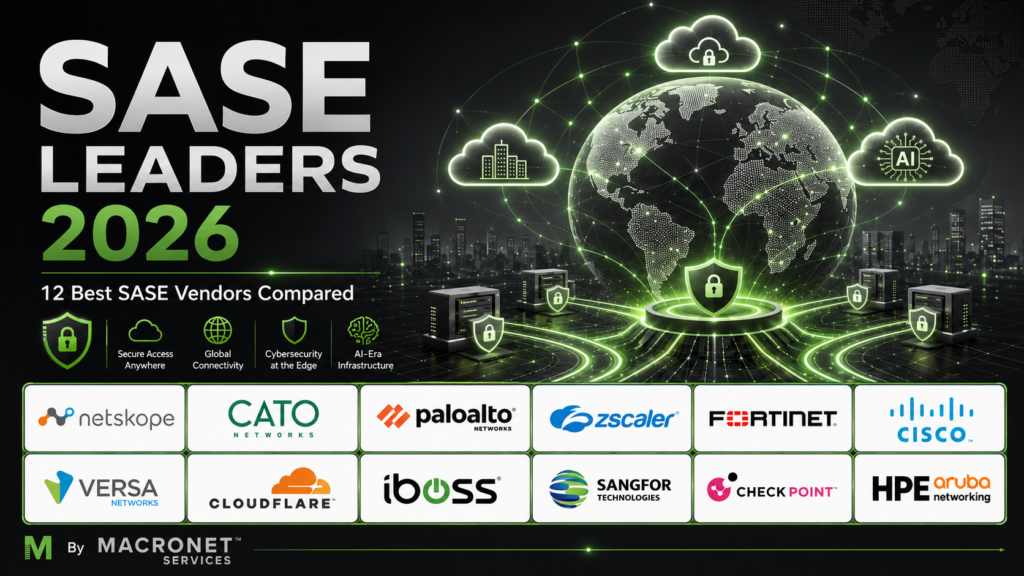
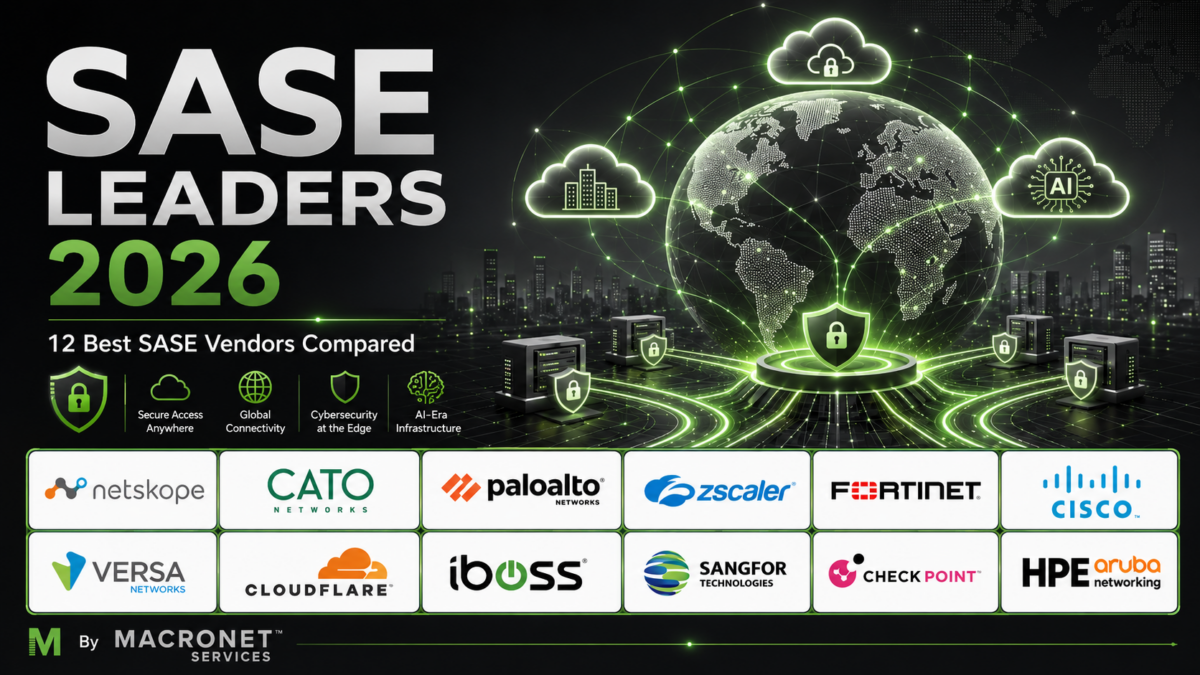
SASE Leaders 2026: 12 Best SASE Vendors Compared
SASE Leaders 2026: 12 Best SASE Vendors Compared
SASE has become one of the most consequential enterprise network and security decisions of the AI era. The architecture now governs how employees, branches, contractors, cloud workloads, private applications, generative AI services, and increasingly autonomous agents reach one another and exchange data. The decision is no longer limited to replacing VPN concentrators, proxies, firewalls, or MPLS. It determines where policy is enforced, where traffic is inspected, how data is protected, how applications perform, and how many separate operating systems the enterprise will continue to manage.
The market is large, fast moving, and architecturally diverse. The 12 vendors covered in this guide represent cloud-security specialists, purpose-built converged SASE providers, firewall and SD-WAN leaders, enterprise-networking incumbents, global edge platforms, and regional alternatives. They can all satisfy a recognizable definition of SASE, but they do not deliver the same branch depth, data controls, infrastructure, sovereignty, operating model, or commercial outcome.
There is therefore no universally best SASE vendor. Netskope is particularly strong where SaaS, data, and AI context dominate. Cato Networks offers the clearest purpose-built convergence of networking, security, and a private backbone. Palo Alto Networks provides one of the broadest security platforms, combining mature SD-WAN, threat prevention, data security, browser controls, and digital experience management. Zscaler remains a leading cloud-delivered zero-trust and SSE platform that is extending deeper into branch transformation. Fortinet, Cisco, Versa Networks, and HPE bring substantial branch, routing, firewall, campus, or service-provider strengths. Cloudflare offers a distinctive internet-native edge and application-services architecture, while iboss, Sangfor Technologies, and Check Point Software Technologies can be credible choices for specific isolation, regional, installed-base, or hybrid-enforcement requirements.
The right decision begins with the enterprise rather than the analyst ranking. A defensible evaluation identifies the small number of requirements that can change the outcome, including advanced routing, local survivability, SaaS and generative AI data controls, sovereign processing, post-quantum readiness, global service delivery, digital experience, and the practical burden of operating the platform. Those requirements should determine the shortlist, scoring weights, proof-of-concept design, and commercial comparison.
The network underlay remains equally important. SASE cannot repair two circuits that share the same local fiber, congested broadband, poor international routing, weak DNS design, inadequate cloud on-ramps, or a data-center interconnection architecture with hidden single points of failure. Tier 1 internet, access diversity, multi-cloud connectivity, colocation, peering, and cloud interconnection should be designed as part of the SASE program rather than as separate procurement exercises. Further, recent advancements in Network as a Service, or NaaS, are starting to enable true next-generation networks that are substantially easier to deploy and manage than legacy telecom networks. Now is a great time to plan your network for the AI era.
Macronet Services helps enterprise IT teams assess the current environment, design the target architecture, compare SASE platforms, source Tier 1 internet and cloud connectivity, negotiate commercial terms, and coordinate implementation. Technology Expense Management services can establish an accurate circuit, service, contract, and cost baseline; uncover immediate savings; and document the financial results of the new network. When selected services are procured through Macronet Services supplier relationships, this advisory, sourcing, and implementation support can often be provided without a separate consulting fee.
How to Use This Guide
The first part explains the market, the relationship among SASE, SSE, SD-WAN, and zero trust, the impact of AI, the importance of the network underlay, and the Macronet Services evaluation framework. The vendor profiles then analyze each platform using the same evidence standards while emphasizing its distinct architecture and buyer fit. The final chapters turn the research into a shortlist, total-cost model, RFP, proof of concept, migration plan, and ongoing operating process.
Readers seeking a quick answer should begin with Section 9 and Section 24. Readers designing an architecture should focus on Sections 3 through 7. Procurement and implementation teams should use Sections 25 through 30 together with the Macronet Services SASE Buyer Toolkit (contact us for a free toolkit and RFP template).

Table of Contents
How to Use This Guide
- The SASE Decision Has Become an AI-Era Network Decision
- SASE Market Overview for 2026
- What SASE Is – and What It Is Not
- How a SASE Architecture Works
- Why SASE Matters More in the AI Era
- Why the Network Underlay Still Matters
- The Macronet Services SASE Evaluation Framework
- How to Use the Vendor Profiles That Follow
- The 12 SASE Leaders at a Glance
- Netskope
- Cato Networks
- Palo Alto Networks
- Zscaler
- Fortinet
- Cisco
- Versa Networks
- Hewlett Packard Enterprise
- Cloudflare
- iboss
- Sangfor Technologies
- Check Point Software Technologies
- Cross-Vendor Conclusions
- How to Compare SASE Leaders Without Choosing the Wrong Winner
- Best-Fit SASE Platforms by Enterprise Requirement
- SASE Pricing and the Three-Year Total-Cost Model
- Why Technology Expense Management Should Precede the SASE Business Case
- How to Build a SASE RFP That Produces Comparable Answers
- How to Conduct a Credible SASE Proof of Concept
- A Practical SASE Migration Roadmap
- Common SASE Buying and Implementation Mistakes
- How Macronet Services Helps Enterprises Select and Implement SASE
- Frequently Asked Questions About SASE Platforms
- Methodology, Disclosure, and Update Process
Publication and Update Note
Part I: SASE Market, Architecture, AI, and Evaluation
1. The SASE Decision Has Become an AI-Era Network Decision
Secure access service edge, or SASE, emerged because the traditional enterprise network had stopped matching the way people and applications actually worked. Users were no longer concentrated in headquarters. Applications were no longer concentrated in the corporate data center. Branches were using broadband and software-as-a-service applications directly, remote users needed secure access from anywhere, and public-cloud environments had become an extension of the enterprise rather than an isolated destination.
The arrival of generative AI and agentic AI makes that architectural mismatch more consequential. Employees now send prompts and files to public AI services. Copilots are being embedded inside productivity, customer-service, development, finance, and security platforms. Enterprises are building private models and retrieval-augmented generation systems that connect models to internal repositories. AI agents are beginning to call APIs, query databases, exchange data with other agents, and take actions without a person initiating every individual transaction. The enterprise network must therefore govern not only where users connect, but also where data travels, which models and services may receive it, which machine identities may act, and how those interactions are inspected and recorded.
This is why 2026 is an unusually good time to plan the network for the AI era. Gartner’s July 2026 SASE market research describes a maturing market in which vendors are differentiating not only through their core networking and security capabilities, but also through AI security, sovereign controls, and post-quantum cryptography. Its companion Critical Capabilities research evaluates areas such as SD-WAN, cloud-enforced and on-premises security, private-application access, infrastructure delivery, data security, adaptive access, AI security, sovereign SASE, and secure branch modernization. The market is no longer debating whether SASE is a viable model. The harder question is which architecture is appropriate for a particular enterprise and how the platform should be combined with the underlying connectivity.
Macronet Services helps enterprise IT teams answer that question. The work can include current-state assessment, target architecture, vendor evaluation, Tier 1 internet design, multi-cloud connectivity, colocation, pricing benchmarks, contract negotiation, implementation coordination, and ongoing optimization. In many engagements, this advisory, sourcing, and implementation support can be provided at no direct consulting charge when the selected services are procured through Macronet Services’ supplier relationships. Macronet Services can also perform telecom expense management and network audits so that the enterprise begins with an accurate inventory, identifies existing cost savings, and can distinguish those savings from the financial results produced by the new SASE and network design.

2. SASE Market Overview for 2026
SASE has moved from an emerging architecture into a major networking and cybersecurity market. Dell’Oro Group reported that worldwide SASE revenue exceeded $3 billion in the first quarter of 2026, increasing 21 percent from the prior year. The research firm attributed the acceleration to cloud-delivered security, branch modernization, data protection, and the need to govern AI applications and agentic traffic. Gartner had previously forecast that the worldwide SASE market would reach $28.5 billion by 2028, with buyers continuing to use both single-vendor platforms and dual-vendor combinations. These figures are not proof that every enterprise should immediately replace its network, but they show that SASE has become a mainstream investment category rather than a niche security overlay.
The market is maturing, but it is not becoming uniform. The 12 vendors included in Gartner’s 2026 SASE Platforms research are Cato Networks, Check Point Software Technologies, Cisco, Cloudflare, Fortinet, Hewlett Packard Enterprise, iboss, Netskope, Palo Alto Networks, Sangfor Technologies, Versa Networks, and Zscaler. They do not all deliver the same architecture. Some began with secure web gateway, CASB, or zero trust network access and later added SD-WAN. Some began with firewalls, routing, or branch networking and extended those capabilities into cloud-delivered security. Others were designed around a global cloud network, a private backbone, or a universal software stack that could run in public, private, and service-provider environments.
That history matters because it shapes where each platform is naturally strong. A vendor with deep SaaS and data-security heritage may provide more granular application and data context than a branch-centric competitor. A vendor with decades of routing and firewall development may provide more local survivability, advanced topology, and appliance choice. A purpose-built cloud platform may reduce operational complexity, but it may also ask the enterprise to adopt its network model more completely. An internet-edge provider may integrate SASE with DNS, DDoS protection, application delivery, and developer services, while requiring closer scrutiny of traditional branch functions.
The market can therefore be understood as several overlapping architectural camps rather than a single ladder. Netskope and Zscaler are especially associated with cloud-delivered security, data controls, and zero trust. Cato Networks is associated with purpose-built convergence and a private backbone. Palo Alto Networks combines a broad security platform with mature SD-WAN, browser, data, and digital-experience capabilities. Fortinet, Cisco, Versa Networks, and HPE bring particularly strong branch, routing, firewall, campus, or service-provider foundations. Cloudflare approaches SASE through a global connectivity cloud and application edge. iboss, Sangfor Technologies, and Check Point Software Technologies offer credible alternatives shaped by containerized enforcement, regional strength, endpoint integration, existing firewall estates, or hybrid cloud and on-device controls. These descriptions are starting points for analysis, not final judgments.
Analyst placement can help an enterprise create an initial list, but it cannot determine the correct architecture. Gartner itself states that core capability differences remain and that infrastructure and cybersecurity leaders should use the research to identify the vendor that aligns with their needs. The practical implication is that the buying team must define those needs before evaluating demonstrations or responding to bundled pricing. Otherwise, an incumbent supplier can frame the requirements around the capabilities it already sells.
Forrester’s 2025 SASE evaluation also described a market transformed by the shift from vendor partnerships toward more complete all-in-one platforms, reinforcing the need to examine architectural unification rather than product packaging alone.
The shift from products to platforms
The original business case for SASE emphasized consolidation. Enterprises were often paying separately for MPLS or private WAN services, branch routers, firewalls, VPN concentrators, secure web gateways, CASB, remote-access software, DNS security, and multiple monitoring products. SASE promised to reduce this sprawl by delivering networking and security functions through a cloud-based architecture with common policy and management.
Consolidation remains important, but the market’s center of gravity is moving from product count to platform quality. Buyers now need to know whether the components share a policy model, endpoint client, data lake, inspection architecture, identity context, logging system, and operational workflow. Two vendors can both claim to offer SD-WAN, SWG, CASB, ZTNA, firewall as a service, and DLP while delivering very different levels of convergence. The more important question is not whether a checkbox exists, but whether the platform can use the same context and enforcement logic across users, branches, applications, clouds, and data.
Sovereignty and post-quantum readiness become mainstream requirements
Sovereignty has also become more precise. An enterprise may need to know where traffic is inspected, where logs and metadata are stored, who can administer the platform, where encryption keys are controlled, whether support personnel in another jurisdiction can access operational data, and whether the service can run in a customer-controlled or sovereign environment. A vendor that simply offers a regional point of presence may not satisfy all of those requirements.
Post-quantum readiness is moving into the same category. NIST finalized its first three post-quantum cryptography standards in August 2024 and has encouraged organizations to begin transitioning rather than waiting for cryptographically relevant quantum computers to arrive. SASE platforms sit in the path of TLS, IPsec, client, branch, and private-application traffic, so their ability to inventory cryptographic dependencies, support hybrid or quantum-resistant algorithms, and explain migration scope is becoming a legitimate selection criterion.
3. What SASE Is – and What It Is Not
SASE is best understood as an enterprise architecture that converges wide-area networking and cloud-delivered security around identity, application context, data, and policy. It is not merely a new label for a firewall subscription, an SD-WAN appliance with a cloud portal, or an SSE service sold alongside a separate WAN product.
Mplify’s current SASE service standard describes a framework in which security functions, policies, and connectivity services are defined together. The standard is important because it treats SASE as a service relationship among the subscriber, provider, security functions, policy, and connectivity rather than as a loose collection of product names. It also recognizes the importance of resiliency and the interface between policy and intelligent underlay connectivity. NIST’s guide to the secure enterprise network landscape similarly places SASE within a broader response to multi-cloud use, geographically distributed resources, remote users, microservices, and the erosion of the traditional enterprise perimeter.

This Macronet Services comparison explains how SD-WAN manages wide-area connectivity, SSE delivers cloud-based security, SASE combines networking and security, and zero trust provides the principles for continuously verified access.
NIST SP 800-207 makes the distinction particularly clear. Zero trust assumes that users and assets receive no implicit trust based solely on network location or ownership; authentication and authorization occur before access to a resource, and policy uses information about the subject, device, resource, and environment. SASE can supply many of the enforcement and connectivity mechanisms, but an enterprise does not become zero trust simply by purchasing a SASE license. Identity quality, device inventory, application classification, data governance, privileged access, segmentation, and operational processes remain essential.
The core SASE functions
At the networking layer, SASE normally includes SD-WAN capabilities that identify applications, choose among available links, segment traffic, and enforce business policy across branches, cloud resources, data centers, and the internet. The depth varies widely. Some platforms support advanced routing, local firewalling, WAN optimization, cellular links, complex topologies, and operation during cloud outages. Others provide lighter-weight connectivity designed primarily to send traffic to cloud security services.
At the security layer, secure web gateway controls internet access; CASB provides visibility and policy for SaaS and cloud applications; ZTNA provides identity- and context-based access to private applications; firewall as a service applies network security policy from the cloud; and DLP identifies and controls sensitive data. Mature platforms may add DNS security, malware prevention, sandboxing, remote browser isolation, SaaS security posture management, API-based application scanning, cloud security posture, digital experience monitoring, and secure enterprise browser capabilities.
The architectural value appears when these functions use common context. A single transaction may involve a user identity, managed or unmanaged device, SaaS application, file classification, country, risk score, branch segment, and access link. A converged platform should be able to use those attributes coherently rather than forcing the enterprise to create similar but independent policies in several products.
Single-vendor and dual-vendor SASE
A single-vendor SASE platform combines networking and security from one provider. This can reduce integration work, simplify accountability, and improve cross-domain visibility. It can also increase dependence on one vendor, create a broader migration, and force compromises when the provider is strong in one domain but merely adequate in another.
A dual-vendor design usually combines an SSE platform with a separate SD-WAN platform. This can preserve a strong branch architecture while adding best-of-breed cloud security, or it can allow an enterprise to modernize remote access before replacing the WAN. The tradeoff is integration. Identity, traffic steering, tunnels, policy, logs, support, service-level accountability, and troubleshooting may cross organizational and vendor boundaries.
The right answer is not determined by the number of vendors alone. A nominally single-vendor portfolio may still contain acquired components, separate clients, different policy engines, or multiple consoles. A carefully engineered dual-vendor architecture can operate more coherently than a loosely bundled single-vendor offering. The evaluation must therefore measure actual convergence rather than accept the commercial label.
Five levels of SASE convergence
Figure 1. The Macronet Services five-level SASE convergence model.

Macronet Services uses a five-level convergence model to distinguish platforms that may look similar in a feature table. At the first level, products are bundled and sold together but remain operationally separate. At the second, they are integrated through shared identity, telemetry, or workflows. At the third, the experience becomes operationally unified through common management, policy processes, reporting, or endpoint software. At the fourth, the platform becomes architecturally unified through a shared policy engine, data model, enforcement fabric, and analytics. At the fifth, networking and security functions operate through a coordinated single-pass or equivalent processing architecture that minimizes duplicated inspection and inconsistent policy.
A vendor may occupy different levels for different functions. Its web security and DLP may be architecturally unified, while its SD-WAN was acquired and remains operationally integrated. Its remote-access client may be common, while branch management remains separate. The purpose of the model is not to reward architectural purity for its own sake. It is to expose the integration work, operational burden, and troubleshooting boundaries the enterprise will inherit.
4. How a SASE Architecture Works
Figure 2. A simplified AI-era SASE traffic and enforcement architecture.

A SASE architecture begins by connecting users, branches, cloud environments, data centers, and applications to distributed policy-enforcement points. A remote user may connect through an endpoint client or browser. A branch may connect through an SD-WAN edge, firewall, router, or lightweight appliance. Cloud workloads may use virtual edges, service connections, agents, or private interconnects. The platform identifies the requesting entity, the device or workload, the destination, the application, the data involved, and the current risk context before allowing and continuously governing the session.
For internet and SaaS traffic, the nearest appropriate service edge normally applies web, firewall, threat, application, and data controls before forwarding the traffic to the destination. For a private application, a connector or service connection can allow outbound-only publication so that the application is not broadly exposed to the internet. For branch-to-branch or branch-to-cloud traffic, the SD-WAN layer may select a direct internet path, a vendor backbone, an IPsec tunnel, a private circuit, or a cloud on-ramp according to performance, security, and policy.
The phrase “nearest service edge” requires careful interpretation. Geographic proximity does not guarantee the best path. The user’s ISP may hand traffic to the SASE provider in another metro. The service edge may be close to the user but poorly connected to the destination cloud. Some advertised locations may provide peering or access but not the complete security stack. Capacity, congestion, service availability, backbone routing, and the location of encryption and decryption all affect the result. This is why point-of-presence counts should never be compared without understanding what runs in each location and how traffic enters and exits the platform.
Policy should operate across more than source and destination IP addresses. Modern SASE platforms can use identity, group, device posture, certificate, operating system, location, application, browser, data classification, behavioral risk, and session context. The architecture becomes adaptive when those signals can change the policy during the session. A device that falls out of compliance, a user whose behavior becomes anomalous, or a file that contains regulated data may require a different action than the initial connection request.
Operations are part of the architecture, not an afterthought. The platform should help the enterprise determine whether a poor experience was caused by the endpoint, Wi-Fi, local access circuit, SD-WAN policy, SASE service edge, backbone, public internet, cloud provider, or application. It should also allow security teams to trace a decision from identity and policy through the actual enforcement event. A platform that is technically capable but difficult to troubleshoot can shift cost from products to personnel and increase incident duration.
5. Why SASE Matters More in the AI Era
AI changes the SASE problem in two directions. First, the enterprise must secure the use of AI applications and models. Second, AI itself is becoming an actor on the network. Traditional controls were designed primarily around a human user opening a web session or an application communicating with a known service. The new environment includes embedded copilots, model APIs, AI coding tools, private inference endpoints, retrieval systems, plug-ins, MCP servers, autonomous agents, and machine identities that may operate at higher speed and greater scale than a person.
Discovering and governing enterprise AI use
The first requirement is visibility. Enterprises need to identify which generative AI services employees use, which embedded AI functions appear inside approved SaaS platforms, which model APIs developers call, and which browser extensions or unsanctioned tools can receive company data. A simple application category is not enough. The risk can differ by tenant, model, account type, enterprise agreement, data-retention policy, training policy, and the specific action the user performs.
The SASE platform can sit at an important control point because it sees the session and, when permitted and technically possible, the content. It may identify the AI application, distinguish an upload from a prompt, classify the data, block regulated or proprietary information, require an approved enterprise tenant, isolate the session in a controlled browser, coach the user, or record the event for investigation. API-based SaaS controls can complement inline inspection by discovering data already stored in an application or examining settings and posture that are not visible in a single transaction.
These capabilities should be evaluated carefully. “AI visibility” may mean only that the vendor recognizes a domain. “AI security” may refer to DLP applied to a chat interface, a dedicated AI gateway for model APIs, controls for AI agents, model-risk ratings, or protection of the enterprise’s own AI applications. The guide will therefore separate application discovery, data protection, model and API controls, agent security, browser controls, and AI infrastructure performance rather than treating them as one feature.
Protecting sensitive data without blocking useful AI
The goal is not simply to prohibit AI. Overly broad blocking can drive employees to personal devices or unapproved services and prevent the enterprise from realizing productivity gains. The stronger model is risk-based enablement. Approved users can access sanctioned tools under an enterprise tenant, while sensitive files, source code, customer records, intellectual property, or regulated data receive context-specific controls. The same person may be allowed to ask a general research question but prevented from uploading a confidential contract or a database extract.
This approach requires more than pattern matching. Strong data security may include exact data match, document fingerprinting, optical character recognition, data labels, source-code identification, user and application context, and understanding of whether the action is an upload, copy, paste, prompt, response, download, or API call. The evaluation must also determine whether the same policies apply across the browser, endpoint client, SaaS API, private application, branch, and cloud workloads.
AI agents and non-human identities
Agentic AI raises a different issue because the requesting entity may not be a person at the moment of action. An agent may receive a goal, retrieve documents, call tools, invoke an API, create a ticket, send a message, or instruct another agent. That creates a chain of identity and authorization decisions. The enterprise must know which human, service, workload, or business process delegated the authority; which credentials the agent is using; what data it can retrieve; which actions it may take; and how those actions are logged and revoked.
SASE is not the complete solution to agent security, but it can provide meaningful control. The platform may enforce network and application access, segment agents from sensitive resources, inspect model and API traffic, apply DLP, detect unusual destinations, and supply telemetry to identity, SIEM, XDR, and governance systems. The strongest architectures will combine network context with workload identity, short-lived credentials, application authorization, and continuous risk rather than treating the agent as an ordinary user with a permanent token.
AI performance is a network requirement
Security is only half of the AI-era requirement. AI applications can be highly sensitive to latency, jitter, packet loss, DNS behavior, cloud-region selection, and the path between the user, SASE service edge, model endpoint, data source, and application. A platform may add inspection and control while unintentionally creating a circuitous route. The design must therefore evaluate the complete path, not merely the latency from the branch to the SASE point of presence.
The architecture can include direct internet access to public AI services, private connectivity to models in AWS, Microsoft Azure, Google Cloud, or Oracle Cloud Infrastructure, colocation-based cloud on-ramps, regional data hubs, and high-capacity connectivity between private AI infrastructure and enterprise data. Different flows may require different treatment. User prompts to a SaaS copilot may traverse cloud SASE, while bulk data synchronization, model training, retrieval pipelines, or east-west cloud traffic may use private multi-cloud connectivity that bypasses the user-oriented SASE path without bypassing governance.
AI governance and the role of SASE
NIST’s AI Risk Management Framework is organized around the functions Govern, Map, Measure, and Manage and is intended to help organizations incorporate trustworthiness into the design, development, use, and evaluation of AI systems. NIST’s Generative AI Profile extends that framework to the specific risks of generative AI. A SASE platform can contribute evidence and enforcement to those functions, but it cannot replace the governance program. It can discover use, enforce approved access, protect data, segment resources, and create logs. The enterprise must still define ownership, acceptable use, risk tolerance, model approval, data policy, human oversight, incident response, and vendor governance.
This distinction matters when vendors describe AI security as a platform outcome. A strong product can help the enterprise implement policy, but it cannot decide which use cases are acceptable, which data is authoritative, or which actions require human approval. The final SASE selection should therefore connect to the organization’s AI governance model rather than operate as a separate security project.
Sovereignty and post-quantum planning in the AI architecture
AI also increases the importance of sovereignty because prompts, embeddings, training data, model responses, telemetry, and security logs may contain sensitive information. The enterprise must understand not only the model provider’s data practices but also where the SASE platform processes and stores the traffic and metadata. A sovereign design may require local processing, customer-managed keys, restricted support access, private enforcement, regional logging, or a customer-controlled service edge.
Long-lived AI and data assets make post-quantum planning relevant even before a quantum computer can break current cryptography. Information intercepted today could be stored for later decryption. NIST now advises organizations to inventory vulnerable cryptography and begin applying quantum-resistant standards. The SASE RFP should therefore ask which client, IPsec, TLS, service-edge, browser, workload, and private-application flows support post-quantum or hybrid cryptography, which algorithms are used, and whether the function is generally available or still on the roadmap.
6. Why the Network Underlay Still Matters
Figure 3. SASE Performance
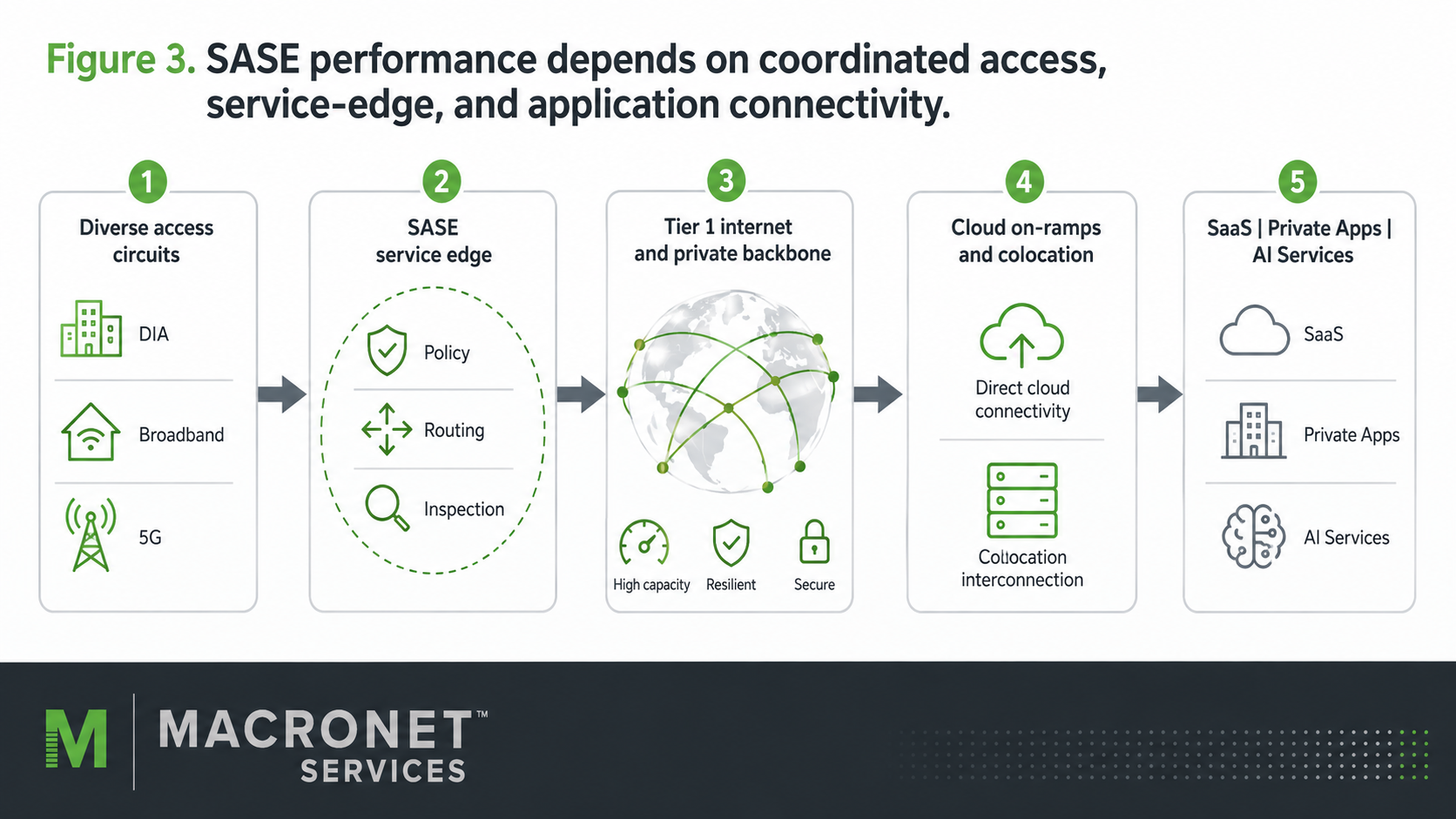
SASE performance is shaped by the full delivery chain: diverse access circuits, the SASE service edge, Tier 1 internet and private backbone routing, cloud on-ramps and colocation, and the final connection to SaaS, private applications, and AI services.
SASE moves important networking and security functions into a distributed service edge, but it does not repeal the physics or economics of the network underneath it. Every remote user, branch, data center, cloud environment, and colocation facility still needs a path to the SASE platform and to the ultimate application. If that path is congested, poorly routed, fragile, or dependent on a single carrier, the SASE experience will be constrained no matter how capable the security platform is.
Mplify’s standards make this relationship explicit. The SASE framework includes connectivity services and recognizes that policy must interface with intelligent underlay services. Its SD-WAN standard similarly defines the SD-WAN edge in relation to the underlay connectivity service and includes measurable performance attributes. The overlay can select among paths and respond to impairment, but it cannot create bandwidth that was never purchased, carrier diversity that was never engineered, or a cloud on-ramp that does not exist.
Last-mile design and true diversity
The first underlay issue is the access circuit. Two circuits are not necessarily diverse. They may enter the building through the same conduit, terminate in the same central office, use the same incumbent fiber, traverse the same aggregation equipment, or share power and construction risk. A resilient SASE design must examine physical entrance, local loop provider, upstream carrier, central office, path, handoff, equipment, and power rather than relying on two different logos on invoices.
The access mix should reflect the site. A major office may use diverse dedicated internet access from separate providers, perhaps with broadband or 5G as a tertiary path. A small branch may use business broadband and cellular. A manufacturing or healthcare site may require local survivability, deterministic failover, voice quality, and the ability to reach local systems when the cloud control plane is unavailable. The SD-WAN and SASE platform must be tested against those exact failure conditions.
Tier 1 internet and global routing
For multinational enterprises, the upstream internet architecture can materially affect performance. Tier 1 providers operate large global backbones and exchange traffic broadly without purchasing internet transit in the traditional sense. That label does not guarantee that every Tier 1 provider is best in every market, but global reach, peering, route control, capacity, and escalation can matter when branches and users depend on internet paths to reach SASE edges, SaaS platforms, and cloud regions. Macronet Services’ Tier 1 ISP research explains why provider selection should be based on the enterprise’s geography, destination mix, routing, support, and resilience requirements rather than tier branding alone.
The SASE provider’s network must be analyzed in the same way. A private backbone can improve consistency between service edges and destinations, but only if the enterprise has a good path into the backbone and the provider has a good path out. An anycast internet edge can provide broad reach, but the selected location and exit path still matter. A platform built on hyperscaler infrastructure may gain regional scale while depending on cloud routing and service availability. The design should trace representative application flows end to end.
Multi-cloud connectivity is not the same as user access
A common design error is to treat every cloud flow as though it were a user opening a SaaS application. User-to-cloud access, branch-to-cloud application traffic, data-center-to-cloud replication, cloud-to-cloud traffic, storage transfer, model training, inference, backup, and database synchronization can have very different requirements. SASE can secure and steer many of these flows, but it may not be the optimal transport for all of them.
Private multi-cloud connectivity can provide predictable bandwidth, reduced internet exposure, direct cloud on-ramps, and more deliberate routing between enterprise facilities and cloud providers. It may be delivered through a carrier, cloud exchange, network-as-a-service platform, colocation fabric, or direct hyperscaler connection. Macronet Services’ multi-cloud work illustrates how an enterprise can combine private cloud connectivity with internet, SASE, SD-WAN, and hybrid cloud rather than forcing all traffic through one architecture.
The target design should classify flows before choosing the path. Interactive user sessions may benefit from a nearby cloud SASE edge. Branch application traffic may use SD-WAN over diverse internet circuits. High-volume data movement may use private connectivity. Cloud-to-cloud traffic may use a multi-cloud fabric. Sensitive local applications may require private access through ZTNA while remaining in a data center. The SASE platform should integrate with this design rather than become a bottleneck or a reason to abandon fit-for-purpose connectivity.
The role of colocation and cloud on-ramps
Carrier-neutral colocation facilities can become strategic aggregation points in a SASE and AI-ready network. They provide access to multiple carriers, internet exchanges, cloud on-ramps, interconnection platforms, SASE providers, and data-center services through physical or virtual cross connects. An enterprise can use a colocation hub to aggregate regional sites, create carrier diversity, connect to several clouds, place security or routing equipment, and reduce the number of long-haul circuits that terminate in a corporate facility.
Cross connects can provide direct links to AWS Direct Connect, Microsoft Azure ExpressRoute, Google Cloud Interconnect, Oracle Cloud Infrastructure FastConnect, carriers, internet exchanges, and SASE or network-as-a-service platforms. They can improve performance and fault isolation, but they introduce port, cross-connect, fabric, egress, diversity, and contract considerations that must be modeled. Macronet Services’ cross-connect guide explains how these physical and virtual interconnections fit into multi-cloud, SASE, and resilient WAN designs.
DNS, peering, and application destinations
DNS is another overlooked part of the path. The resolver can influence content-delivery location, SaaS destination, security policy, and troubleshooting. A SASE service may provide protective DNS, but the design still needs to account for split DNS, private namespaces, local services, cloud resolvers, and what happens during tunnel or service-edge failures. The proof of concept should measure not only ping latency, but also DNS lookup time, TCP and TLS setup, application response, packet loss, and user-perceived experience.
Peering and destination connectivity matter because most enterprise traffic does not end at the SASE edge. It continues to Microsoft 365, Salesforce, ServiceNow, AWS, Azure, Google Cloud, AI providers, partners, and private applications. A vendor’s statement that it has a point of presence in a city does not reveal the quality of its path to those destinations. The design should use real application telemetry from the enterprise’s major user regions and should test both normal and degraded conditions.
SASE does not automatically replace MPLS or private WAN
Many enterprises can reduce or eliminate MPLS by using SD-WAN over diverse internet access, vendor backbones, and private cloud connectivity. Others retain MPLS, Ethernet, wavelength, or private IP services for selected sites and flows. The decision should consider application criticality, geographic availability, latency, packet loss, local regulation, security, operational support, and contract timing. The best architecture may be hybrid during migration or permanently hybrid for a small number of critical locations.
The goal is not to preserve legacy services by default or to remove them for ideological reasons. It is to determine the lowest-cost architecture that meets measurable performance, security, resilience, and operational requirements. SASE and SD-WAN make the internet a more viable enterprise transport, but they do not make every internet circuit equal and do not eliminate the value of private connectivity where it is justified.
TEM creates the financial and inventory baseline
A SASE project often begins with an incomplete picture of the current network. Circuit inventories may not match invoices. Services may still bill after a site has closed. Contract terms may be stored in email, procurement systems, and spreadsheets. Security licenses, remote-access tools, appliances, cloud connectivity, broadband, MPLS, voice, support, and managed services may be owned by different teams. Without a verified baseline, the enterprise cannot build an accurate business case or prove what the transformation saved.
Macronet Services’ telecom expense management process can reconcile invoices, inventory, contracts, service locations, bandwidth, equipment, taxes, fees, and usage. It can identify billing errors, unused services, duplicate services, re-pricing opportunities, and contracts that constrain the migration. Those savings should be separated from the benefits of the future architecture. If an audit discovers a circuit that should have been disconnected two years ago, the recovery is valuable, but it is not evidence that the SASE platform itself reduced cost.
The baseline should therefore distinguish current-state cleanup from transformation economics. It should identify immediate audit savings, avoided hardware refresh, eliminated point products, carrier changes, operational savings, implementation cost, dual-running periods, termination liability, and the new recurring SASE and connectivity charges. This produces a defensible total-cost model and gives finance and IT a common view of the project.

7. The Macronet Services SASE Evaluation Framework
Figure 4. The evidence-based SASE selection and implementation lifecycle.
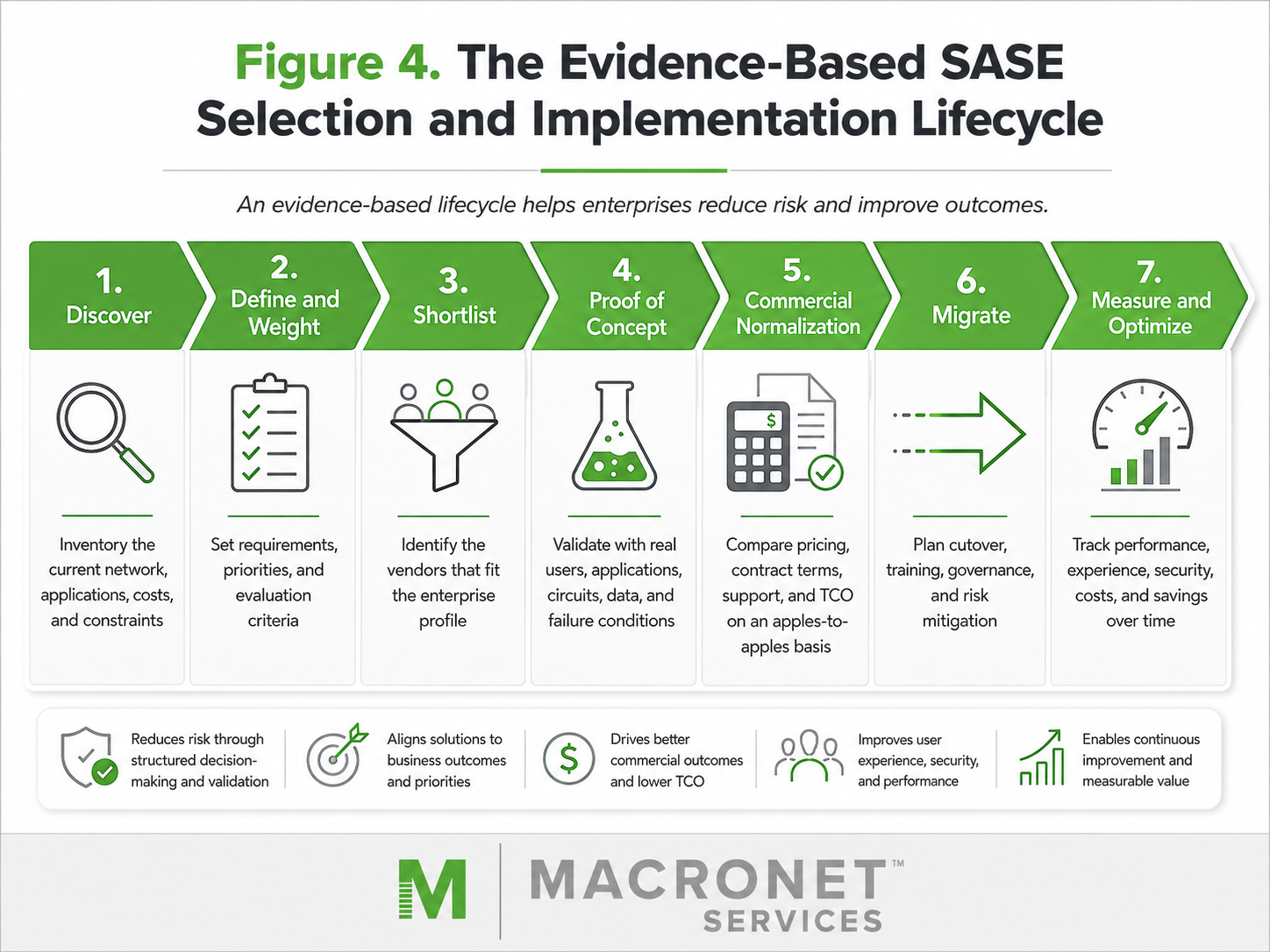
The vendor sections in this guide use a consistent evaluation framework developed from standards, government guidance, analyst research, primary technical documentation, and enterprise network-design experience. The framework is intended to prevent two common problems: allowing a vendor’s product taxonomy to define the requirements and producing a universal score that ignores the enterprise’s actual priorities.
Twelve dimensions are evaluated. The default weighting is an internal research control rather than a public league table. An organization with 1,000 small retail locations may place far more weight on branch hardware, cellular, zero-touch deployment, and local survivability. A software company with a remote workforce may emphasize SaaS security, private application access, developer workflows, and data controls. A government or regulated multinational may increase the weighting for sovereignty, cryptography, private enforcement, and support jurisdiction. The weights should change before the vendor scores do.

Architecture and convergence
This dimension asks whether networking and security are truly part of one platform. The research examines the policy model, console, client, telemetry, data lake, inspection path, logging, analytics, and the integration of acquired products. A shared brand or price sheet does not count as convergence. The practical outcome is whether the enterprise can define policy once, trace decisions consistently, and troubleshoot without transferring an incident among product teams.
Security, data, and AI depth
The framework separates core SSE and threat prevention from data and AI security because the two can mature at different rates. A vendor may provide strong web and firewall controls but limited SaaS API coverage or data classification. Another may lead in DLP and AI governance while offering less branch-local security. The analysis considers both the presence of a capability and the context, precision, enforcement modes, regional availability, and operational consistency behind it.
Networking, infrastructure, and experience
SD-WAN is evaluated as an enterprise network rather than a tunnel feature. Routing, topology, segmentation, remediation, high availability, local services, and operation during cloud failure all matter. Infrastructure is examined separately because the service edge, backbone, peering, cloud connectivity, and point-of-presence implementation can determine performance even when the product feature set is similar. Digital experience and operations measure whether the enterprise can see and resolve issues across those layers.
Zero trust, sovereignty, and cryptography
Zero trust is mapped to identity, device, resource, session, and risk principles from NIST rather than to a vendor label. CISA’s maturity model reinforces that zero trust extends across identity, devices, networks, applications and workloads, and data, with visibility, analytics, automation, and governance spanning the pillars. Sovereignty is evaluated as a set of controls over processing, data, keys, administration, support, and deployment. Post-quantum readiness is evaluated by protocol and traffic flow, because a general corporate announcement is not evidence that the relevant SASE client or tunnel supports the function.
Commercial and implementation reality
Public list pricing rarely captures the real cost of SASE. The evaluation examines user and site licensing, bandwidth, appliances, advanced security modules, logging, browser isolation, support, professional services, minimum commitments, renewal protections, and the overlap period during migration. Support and implementation are treated as technical criteria because an architecture that cannot be deployed, operated, or escalated effectively will not produce its expected outcome.
Evidence standards
Every material factual claim in the research workbook is assigned a source, date, evidence grade, confidence level, and capability status. Grade A evidence includes standards, government publications, official technical documentation, configuration guides, release notes, service-level agreements, security advisories, and audited filings. Grade B evidence includes current analyst research, independent technical testing, and reputable market research. Grade C includes vendor product pages, blogs, press releases, and case studies. Grade D includes partner pages, review sites, forums, and unsourced comparisons, which can reveal questions but cannot support a core conclusion without corroboration.
Independent laboratory evidence should complement documentation. CyberRatings.org’s 2025 SSE evaluation found a very wide range of security effectiveness across the products it tested, illustrating why test scope, product version, configuration, and date must be recorded rather than reduced to a permanent vendor label.
Capability status is recorded separately from evidence quality. Generally available, preview, roadmap, acquired but not fully integrated, third-party delivered, region-limited, not offered, and unable to verify are different findings. The methodology never treats the absence of a statement on a marketing page as proof that a capability does not exist. It also does not treat an announcement as equivalent to a deployed function.
Scoring and confidence
The internal research uses a zero-to-five scale. Zero indicates that a capability is unavailable or credible evidence cannot be found. One indicates a limited, roadmap, third-party, or materially constrained capability. Two represents basic functionality with meaningful gaps. Three represents a competitive enterprise capability. Four represents a strong and broadly integrated capability. Five is reserved for an exceptional and differentiated capability supported by strong evidence.
Each score also receives a confidence level. High confidence normally requires current technical documentation and corroboration. Medium confidence indicates that the evidence is mainly vendor-supplied or incomplete. Low confidence indicates that the conclusion depends on marketing, inference, dated information, or limited public evidence. The internal model reduces the contribution of low-confidence findings so that a vendor is not rewarded simply for making broad claims.
The final published guide should not present the composite score as a universal ranking. It will instead translate the findings into strengths, buyer watch-outs, best-fit scenarios, and proof-of-concept questions. The purpose of scoring is to force consistency in research, not to create false mathematical certainty.
How strengths and weaknesses will be written
A strength must identify why the capability matters and which buyer benefits. A weakness must identify the affected requirement and the evidence or validation gap. The guide will avoid vague statements such as “complex,” “expensive,” or “weak SD-WAN” without explaining what creates the complexity, what is included in the price, or which routing, survivability, or branch requirements are affected.
Some weaknesses are inherent tradeoffs rather than defects. A cloud-first architecture may reduce appliance management while providing fewer local controls. A sophisticated routing platform may solve complex branch requirements while demanding more operational expertise. A broad security platform may reduce vendor count while creating licensing and management breadth. The guide will state those tradeoffs directly and will not assume that the same characteristic is positive or negative for every enterprise.
Proof of concept over demonstration
The guide therefore turns important research uncertainties into tests. These include application performance, brownouts, ISP and service-edge failure, private-application access, DLP accuracy, AI prompt and upload controls, unmanaged devices, routing, segmentation, local survivability, logging, root-cause analysis, and support escalation.
Commercial validation is equally important. Vendors should provide itemized three-year pricing, explain generally available versus roadmap functions, identify third-party dependencies, specify which services run in each required region, and disclose the support and implementation model. References should match the enterprise in scale, geography, architecture, and regulatory requirements rather than simply confirm that a well-known company purchased the product.
8. How to Use the Vendor Profiles That Follow
The vendor profiles that follow use the same evidence framework but do not read like templated product descriptions. Each section begins with the platform’s lineage and architectural orientation, then examines convergence, SSE, data and AI security, SD-WAN, global infrastructure, zero trust, sovereignty, post-quantum readiness, digital experience, management, commercial considerations, and implementation risk. It concludes with the enterprise environments in which the vendor deserves a shortlist position and the issues that must be tested.
Readers should resist the urge to choose a vendor from the market label alone. A provider categorized as a market Leader may not fit a specialized sovereign, routing, regional, or installed-base requirement. A Challenger, Visionary, or Niche Player may be the correct choice when its architecture aligns more closely with the enterprise. Conversely, an incumbent advantage should not be allowed to substitute for technical and commercial comparison.
The most useful sequence is to establish the current inventory, define the target architecture, classify users and traffic flows, identify security and regulatory requirements, weight the evaluation criteria, and only then create the shortlist. The enterprise should compare the SASE platform and the underlay together, model the full three-year cost, test representative users and sites, and preserve the evidence behind the decision.
That is also the role Macronet Services can play. By combining network design, SASE and carrier sourcing, multi-cloud and colocation expertise, pricing benchmarks, TEM, implementation coordination, and ongoing expense management, Macronet Services can help the enterprise build an AI-ready architecture rather than purchase an isolated product.
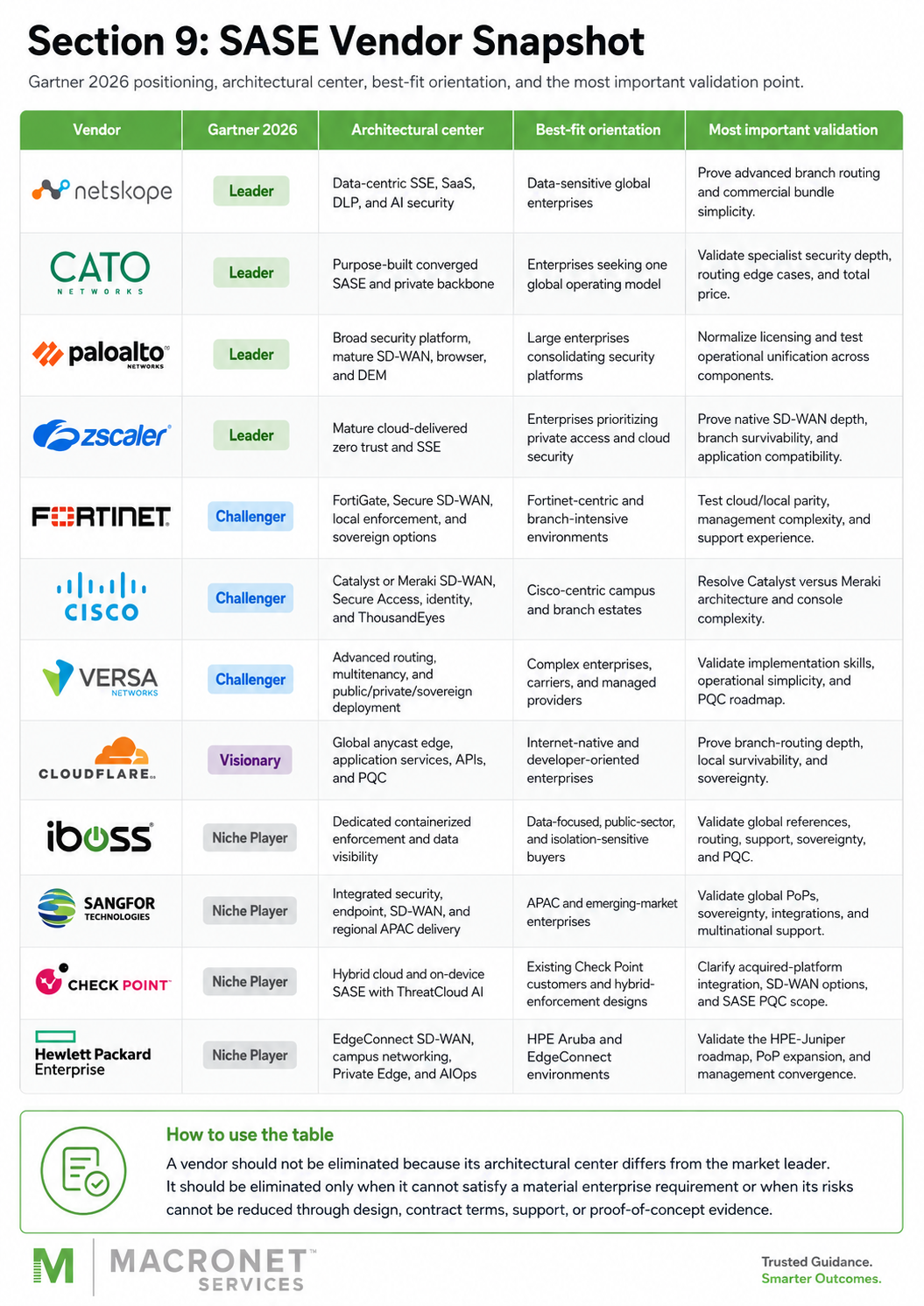
9. The 12 SASE Leaders at a Glance
The table below is an orientation tool rather than a ranking. It identifies the architectural reason each provider deserves consideration and the issue that should receive the closest validation. Gartner category labels refer to the July 2026 SASE Platforms evaluation and are included as market context; the table does not reproduce Gartner’s proprietary quadrant graphic or substitute for customer-specific analysis.
Part II: The Current SASE Leaders
The four vendors in this group occupy the Leaders quadrant in Gartner’s July 2026 SASE Platforms research, but they arrived there through markedly different paths. Netskope remains defined by data-centric SSE and cloud security, Cato Networks by purpose-built convergence, Palo Alto Networks by the breadth of its enterprise security platform, and Zscaler by cloud-delivered zero trust. Their strengths overlap, yet the architectural and operational differences are substantial enough that all four can produce very different enterprise outcomes.
10. Netskope
A data-centric SASE platform built around cloud, SaaS, data, and AI context.
Netskope One is best understood as a data- and application-aware security platform that has expanded into a more complete networking architecture. The company built its reputation by identifying cloud applications and activities at a level of detail that traditional web proxies and firewalls often could not provide. That lineage remains visible in the current platform: Netskope places the identity of the user, the application being used, the activity being performed, the device, the data involved, and the risk of the transaction at the center of policy decisions.
The platform now extends well beyond classic CASB and secure web gateway functions. Netskope One brings together SSE, private application access, cloud firewalling, advanced DLP, AI security, endpoint controls, digital experience functions, and native SD-WAN. Traffic is delivered through the NewEdge network, which Netskope describes as operating full-compute security services in more than 120 data centers across more than 75 regions. Gartner placed Netskope in the Leaders quadrant in its July 2026 SASE Platforms evaluation.
Architecture and operating model
Netskope presents Netskope One as one platform with a common Zero Trust Engine, policy framework, endpoint client, analytics foundation, and NewEdge service-delivery network. This is more than a commercial bundle. The same contextual model can be used to govern internet access, SaaS activity, private applications, data movement, generative AI, and increasingly network path selection. The unified client is important because it can support web and cloud security, private access, endpoint DLP, endpoint SD-WAN, and user coaching without requiring a different agent for every function.
The most important architectural question is how consistently that model extends into the branch. Netskope entered SD-WAN through the acquisition of Infiot, and its current Secure SD-WAN and SASE Branch portfolio is substantially more developed than the company’s older SSE-only positioning would suggest. Even so, an enterprise with advanced BGP requirements, unusual segmentation, extensive local services, or strict offline survivability should evaluate the branch implementation separately from the strength of the SSE platform.
Security, data protection, and AI
Netskope is at its strongest when security policy depends on understanding the application and the data rather than simply the destination IP address or URL category. Its platform supports secure web gateway, inline and API-based CASB, ZTNA, firewall as a service, malware defense, remote browser isolation, SaaS security, and a broad data-protection system that can use classification, exact data match, document fingerprints, optical character recognition, and contextual controls.
That foundation gives Netskope a credible advantage in the AI era. Netskope One AI Security is positioned to discover shadow AI, govern employee use of public AI services, protect prompts and uploads, secure private AI applications, and apply controls to agentic workflows, APIs, and MCP-based interactions. The company is also investing in AI Gateway, red teaming, guardrails, and traffic acceleration to major AI destinations. Enterprises should verify which of these newer capabilities are included in the proposed license, which are separate products, and which have the operational maturity required for production use.
Networking, infrastructure, and experience
NewEdge is central to the value proposition. Netskope says that it controls the network, peering, compute, and service delivery rather than relying solely on generic public-cloud regions. That can improve consistency because the full security stack can operate close to users and applications. The architectural benefit is not simply the number of locations; it is whether the required services, capacity, peering, private access, and network optimization are present at the locations serving the enterprise.
Netskope Secure SD-WAN adds application-aware routing, branch connectivity, multi-cloud access, and NewEdge mid-mile optimization. The platform also includes endpoint SD-WAN and converged access functions that can optimize remote-user traffic as well as secure it. The proof of concept should confirm whether the operational experience truly feels unified when an application problem could originate at the endpoint, local ISP, branch edge, NewEdge location, internet path, SaaS provider, or private application.
Principal strengths
Netskope should be regarded as one of the strongest choices when the SASE program is driven by SaaS adoption, sensitive-data movement, generative AI governance, and the need to apply granular controls without destroying user experience. Its application intelligence and data-security heritage are difficult to reproduce by adding a basic CASB or DLP module to a networking platform. The NewEdge architecture, common client, and current SD-WAN investments also make it a far more complete SASE option than older descriptions of Netskope as an SSE specialist imply.
Another strength is that the platform can support a phased transformation. An organization can begin with web, SaaS, private access, or data controls and later add branch and endpoint networking. That flexibility is useful, although it also means the enterprise must understand whether the purchased configuration achieves the level of convergence promised by the complete platform.
Weaknesses and buyer watch-outs
The first watch-out is comparative SD-WAN maturity. Netskope has a native offering, but enterprises should not assume that it automatically matches the routing depth, local services, appliance variety, or failure behavior of Fortinet, Cisco, Versa Networks, HPE EdgeConnect, or Palo Alto Networks. The issue is not whether Netskope has SD-WAN; it is whether the current implementation satisfies the specific branch design.
The second concern is commercial complexity. A platform that spans SSE, DLP, SaaS security, digital experience, AI security, endpoint controls, and SD-WAN can produce several bundles and add-ons. Buyers should require a line-item three-year model that identifies user, site, gateway, data, logging, support, and advanced AI costs. They should also verify regional functionality, customer-managed key options, and the exact generally available scope of post-quantum functions rather than treating strategy papers as implementation evidence.
Macronet Services bottom line
Netskope belongs on the shortlist when data and cloud context are central to the SASE decision. It is especially well suited to global enterprises with extensive SaaS use, regulated or sensitive information, significant shadow IT, and urgent generative AI governance requirements. It can also support a full single-vendor SASE design, but branch-heavy organizations should give the SD-WAN and local-survivability evaluation equal weight to the SSE evaluation.
The decision should turn on whether Netskope’s data and application advantages solve the enterprise’s most important risks while its current networking capabilities meet the real branch architecture. When that combination is proven, Netskope can provide one of the market’s most compelling data-centric SASE platforms.
What the proof of concept must establish
The test should use real SaaS applications, private applications, public and private AI services, sensitive documents, managed and unmanaged devices, branches with multiple access circuits, and users in several regions. It should validate DLP precision, application activity controls, prompt and upload governance, private-access segmentation, branch routing, local failure behavior, NewEdge path selection, user-experience telemetry, and the time required for an operator to isolate a performance or policy problem.
11. Cato Networks
A purpose-built, cloud-native SASE platform with integrated SD-WAN and a private global backbone.
Cato Networks is the vendor most closely associated with the original idea of a single, cloud-native SASE service. Rather than beginning with a firewall, proxy, CASB, or router and then adding adjacent products, Cato designed a platform in which sites, users, cloud resources, and data centers connect to a global service that performs networking and security through one software architecture. The company calls the processing system in its points of presence the Single Pass Cloud Engine.
The current Cato SASE Platform combines edge SD-WAN, a global private backbone, internet and private application security, remote access, cloud connectivity, analytics, digital experience, and AI security. Cato describes more than 85 points of presence and a 99.999 percent service-availability objective. Gartner placed Cato Networks in the Leaders quadrant in July 2026.
Architecture and operating model
Cato’s defining strength is the consistency of its architecture. A branch uses a Cato Socket or virtual edge to connect available access circuits to the nearest suitable point of presence. Remote users connect through the Cato client. Cloud resources and data centers can connect through virtual sockets, IPsec, or other supported methods. Once traffic enters the Cato service, the private backbone, SD-WAN logic, security inspection, segmentation, policy, and analytics operate as parts of the same platform.
This architecture can remove several layers of integration and operational handoff. The networking team and security team are looking at the same sessions and policy context rather than reconciling separate SD-WAN, proxy, firewall, remote-access, and monitoring systems. Cato also supports managed and co-managed models, which can be valuable when the enterprise wants a global architecture without building a large SASE operations team.
Security, data, and AI
Cato includes the expected SASE security controls, including secure web access, CASB, DLP, ZTNA, firewalling, intrusion prevention, malware protection, private application access, and identity-aware policy. Its security stack has historically been considered less specialized than the deepest standalone SSE products, but the comparison is changing as Cato continues to add data, SaaS, and AI capabilities.
The company acquired Aim Security in 2025 and has since expanded its treatment of shadow AI, prompt and response controls, private AI applications, and agentic workflows. In March 2026, Cato announced Cato Neural Edge, which places GPU resources across the backbone to support real-time AI inspection and policy enforcement. That is an ambitious architectural move because it treats AI security as an inline service at the SASE edge rather than a disconnected governance tool. Buyers should verify which Aim-derived functions are fully integrated and generally available in the proposed release.
Networking, backbone, and sovereignty
Unlike SASE vendors that primarily secure traffic riding over the public internet, Cato uses an SLA-backed private backbone as a central product component. The backbone can improve path consistency between offices, clouds, applications, and regions, especially where ordinary internet routing is circuitous or unstable. It does not eliminate the need for sound last-mile design, but it can replace or reduce MPLS and other private WAN services while maintaining centralized application policy.
Cato also offers Private PoPs for customers and service providers that require local control or sovereign processing. The private location can run the same SASE software stack while connecting to the wider Cato network. Cato has additionally published generally available post-quantum options for client-to-PoP and IPsec tunnels. Those are unusually concrete claims in a market where many vendors remain at the strategy or roadmap stage, although the enterprise should still map which application-side and TLS flows remain classically encrypted.
Principal strengths
Cato is compelling because architectural simplicity is not merely a user-interface claim. Networking, security, backbone, remote access, and policy were designed to operate together. This can reduce appliances, tunnel engineering, service chaining, policy duplication, and disputes about whether a problem belongs to the carrier, SD-WAN, firewall, proxy, or VPN team.
The platform is particularly strong for global branch transformation. An enterprise can combine diverse local internet access with Cato’s backbone and security service, giving every location a repeatable architecture. The managed-service option, single policy environment, private PoP capability, and current post-quantum implementation further strengthen the proposition for organizations that value operational clarity.
Weaknesses and buyer watch-outs
The tradeoff is that Cato intentionally abstracts many infrastructure decisions. An organization with specialized router functions, uncommon topologies, deep local appliance dependencies, unusual packet-processing requirements, or a desire to control every branch feature may find a more configurable platform preferable. Cato’s security and data controls should also be compared with the most specialized SSE and data-security platforms if those functions are the primary buying driver.
Commercially, Cato can be premium priced even when the consolidated architecture reduces total cost. The 2026 modular adoption model provides more flexibility, but it also requires the buyer to understand whether a partial purchase preserves the operational benefits associated with the full platform. Site bandwidth, user licensing, burst provisions, Socket sizing, log retention, support, managed services, and phased deployment terms should be modeled carefully.
Macronet Services bottom line
Cato Networks is one of the strongest choices for an enterprise that wants to simplify a global WAN and security estate rather than preserve existing product boundaries. It is especially suitable for multinational companies with many branches, lean network and security teams, unreliable international internet paths, or a desire to replace MPLS, VPN concentrators, branch firewalls, proxies, and separate remote-access systems with one operating model.
Cato is not automatically the best choice for every highly customized network or the deepest possible data-security requirement. Its value is highest when the enterprise is willing to adopt the architectural model rather than use Cato as one more product in a fragmented stack.
What the proof of concept must establish
The proof of concept should reproduce several branch types and regions, including brownouts rather than only complete circuit failures. It should test voice, video, SaaS, private applications, cloud-to-cloud traffic, segmentation, BGP requirements, local survivability, remote access, DLP, AI controls, backbone routing, support escalation, and the ability to trace a user-experience problem from the local circuit through the Cato service to the destination.
Related Macronet Services technical analysis: Cato Networks Deep Dive: A Technical SD-WAN & SASE Architecture Guide
12. Palo Alto Networks
A broad enterprise security platform that combines Prisma Access, Prisma SD-WAN, data security, browser controls, and digital experience management.
Palo Alto Networks approaches SASE as part of a much wider enterprise security platform. Prisma SASE combines Prisma Access, Prisma SD-WAN, cloud-delivered security, enterprise data controls, AI Access Security, Prisma Access Browser, and Autonomous Digital Experience Management. These services are increasingly administered through Strata Cloud Manager and are informed by the company’s threat intelligence and security research.
The breadth matters. An enterprise can use one strategic vendor across network firewalls, cloud-delivered security, branch SD-WAN, remote access, SaaS security, data protection, secure browser, AI security, experience monitoring, and security operations. Gartner placed Palo Alto Networks in the Leaders quadrant in July 2026.
Architecture and platform breadth
Prisma SASE is more unified than a loose bundle, but it is also the product of multiple technology lines. Prisma Access grew from Palo Alto Networks’ cloud security and firewall platform; Prisma SD-WAN originated with CloudGenix; browser, data, SaaS, and digital-experience capabilities have evolved through internal development and acquisition. Strata Cloud Manager is intended to provide common management and operational context across these components.
The buyer should therefore evaluate both functional breadth and workflow unity. It is possible for a platform to share identity, policy objects, threat intelligence, and analytics while still requiring different administrative models for branch networking, remote access, browser policy, SaaS posture, and data controls. A live operational exercise is more revealing than a presentation of the platform diagram.
Security, data, browser, and AI
Security depth is a principal reason to consider Prisma SASE. Prisma Access extends Palo Alto Networks’ application identification, threat prevention, firewalling, malware analysis, URL and DNS controls, and private access into a cloud-delivered service. Enterprise DLP, SaaS security, browser controls, and AI Access Security add policy for sensitive information and modern applications.
AI Access Security focuses on the discovery and control of public and enterprise AI use, while Palo Alto Networks is also extending security to AI applications, models, and agents through its broader portfolio. Prisma Access Browser can apply controls within the browsing session, which is useful for contractors, unmanaged devices, high-risk applications, and organizations seeking an alternative to a fully managed endpoint. The result is one of the market’s broadest security control sets, although advanced modules can increase both licensing and operational complexity.
SD-WAN, performance, and digital experience
Prisma SD-WAN is a mature application-aware branch platform. It can select paths based on application policy and link conditions, support resilient branch designs, and integrate the WAN with Prisma Access. The CloudGenix lineage gives Palo Alto Networks more networking depth than vendors that added a basic branch connector to an SSE service.
Autonomous Digital Experience Management is another important advantage. ADEM can examine endpoint, Wi-Fi, local network, internet, service-edge, SaaS, and private-application experience. In a large SASE deployment, that visibility can be as valuable as another security feature because it reduces the time required to determine whether a complaint originates in the device, access circuit, SASE service, public cloud, or application.
Sovereignty and post-quantum capabilities
Palo Alto Networks has expanded Prisma SASE sovereignty options through customer-controlled hardware security modules, private processing locations, and region-specific services. These mechanisms can support enterprises that cannot allow all traffic, metadata, or keys to be handled through a standard shared-cloud model. The exact processing, log, support, and management boundaries must still be documented for each jurisdiction.
The company is also making post-quantum security a visible platform theme. Current documentation addresses post-quantum traffic detection, decryption behavior, quantum-safe tunnels, and broader cryptographic discovery. These capabilities are relevant because a SASE platform may become the most practical place to observe and mediate the enterprise’s transition from classical to hybrid and post-quantum encryption.
Principal strengths
Palo Alto Networks offers a combination that few vendors can match: deep security inspection, mature branch networking, extensive data controls, an enterprise browser, experience monitoring, and alignment with a broad firewall and security operations ecosystem. An existing Palo Alto Networks customer may be able to reduce product fragmentation and apply consistent threat intelligence and policy across on-premises and cloud-delivered enforcement.
The platform is also well suited to large enterprises that need sophisticated functions rather than the simplest possible service. Prisma SASE can support complex branch, remote-user, SaaS, private-application, and regulatory scenarios while providing one strategic supplier accountable for a large portion of the security architecture.
Weaknesses and buyer watch-outs
The most obvious concern is cost. Palo Alto Networks is commonly positioned at the premium end of the market, and the full value proposition may depend on several separately licensed capabilities. The buyer should normalize base SASE, SD-WAN, browser, DLP, SaaS security, ADEM, logging, support, hardware, and implementation rather than compare an incomplete bundle with a competitor’s full proposal.
The second issue is operational breadth. A platform can contain excellent components and still demand significant skills, change control, and policy coordination. Branches that require extensive local inspection should test what occurs when cloud connectivity is impaired. Organizations should also verify the behavior of ION devices, service connections, local breakout, decryption, data policy, browser enforcement, and Strata Cloud Manager across the exact software versions being purchased.
Macronet Services bottom line
Palo Alto Networks should be a leading candidate for large enterprises that value security depth, already use Palo Alto Networks firewalls or security operations products, need a mature application-aware SD-WAN, or want to consolidate browser, data, AI, and experience controls into the SASE program. It is particularly attractive when the organization is prepared to invest in a broad strategic platform rather than optimize for the lowest license cost or the least complex feature set.
The decision should be based on the operational and commercial whole. Prisma SASE can be exceptionally capable, but the enterprise must prove that the selected components operate coherently and that the added breadth is worth the cost and administrative responsibility.
What the proof of concept must establish
The proof of concept should test branch routing and failover, cloud and local inspection, service connections, private applications, managed and unmanaged devices, enterprise-browser use cases, DLP, public and private AI applications, ADEM troubleshooting, Strata Cloud Manager workflows, sovereign processing, post-quantum traffic, log retention, and support escalation. It should include an exercise in which network and security teams jointly diagnose the same incident.
13. Zscaler
A mature cloud-delivered zero trust and SSE platform extending into branches through Zero Trust SD-WAN.
Zscaler helped establish the idea that user and application access should be delivered through a cloud security service rather than by backhauling traffic to a corporate firewall. The Zscaler Zero Trust Exchange is designed to connect a verified user, device, workload, or system to an authorized application without placing the user on the destination network or exposing the application to the internet.
The current Zscaler SASE portfolio combines Zscaler Internet Access, Zscaler Private Access, data protection, browser and experience functions, workload security, and Zero Trust SD-WAN. The company has also expanded its treatment of public AI applications, AI agents, workloads, and sovereign services. Gartner placed Zscaler in the Leaders quadrant in July 2026.
Architecture and zero trust model
Zscaler’s architecture is intentionally application-centric rather than network-centric. For private access, the platform brokers outbound connections from users and applications so that the application does not need to accept an inbound connection from a broadly reachable network. This can reduce attack surface and lateral movement compared with a traditional VPN, where a user is placed onto a network segment and then restricted with downstream controls.
The same cloud service provides secure internet and SaaS access through distributed service edges. Policy can use identity, device posture, application, data, risk, and session context. This model is highly mature for users and private applications, but it changes routing, addressing, troubleshooting, and application assumptions. Applications that depend on source IP, network adjacency, broadcast behavior, or legacy protocols should be identified early.
Security, data, and AI
Zscaler remains one of the deepest SSE platforms. Its services include secure web gateway, cloud firewall, CASB, private access, DLP, browser isolation, malware prevention, SaaS controls, workload protection, and digital experience monitoring. The company’s large installed base has exposed the platform to a wide range of remote-user, SaaS, and private-application patterns.
Current AI capabilities extend beyond identifying visits to public chatbots. Zscaler is addressing shadow AI, sensitive prompts and uploads, agent communications, model and workload access, and the use of AI within its own security and operations functions. The direction is strategically important, but buyers should distinguish generally available controls from announced agentic capabilities and determine how policy is enforced across user, browser, API, workload, and branch traffic.
Zero Trust SD-WAN and branch transformation
Zero Trust SD-WAN is Zscaler’s answer to the need for a complete SASE platform. It is designed to connect and segment branches, factories, campuses, OT, and IoT using the same zero-trust principles applied to users. Rather than recreating a flat routed corporate WAN over internet circuits, the design seeks to connect entities to authorized applications and services with minimal implicit reachability.
That can be powerful, but native branch networking is newer than Zscaler’s SSE foundation. Enterprises with complex dynamic routing, local data-center applications, extensive branch services, regulatory requirements for local inspection, or strict survivability should compare Zero Trust SD-WAN with mature routing-oriented alternatives. The evaluation must also consider whether the enterprise is prepared to redesign network assumptions rather than simply replace an existing SD-WAN appliance.
Infrastructure, sovereignty, and post-quantum readiness
Zscaler operates a very large distributed cloud and describes connectivity through more than 160 public exchanges and thousands of private exchanges. The architecture is designed to inspect traffic close to the user and then forward it efficiently to SaaS, internet, and private applications. The enterprise should nevertheless map the actual service edges, application connectors, data handling, and path selection that apply to its regions.
Zscaler has expanded options for data, telemetry, and control-plane sovereignty and has announced a European sovereign service with STACKIT. It is also publishing post-quantum inspection and crypto-translation functions. These are meaningful developments, but sovereignty must be defined across traffic processing, logs, metadata, keys, management, and support rather than by the geographic label alone.
Principal strengths
Zscaler is an obvious shortlist vendor when the primary objective is to replace VPN and legacy web-security architectures with a mature cloud-delivered zero-trust model. It has strong internet and private access, broad enterprise integrations, extensive operational experience, and a security architecture that minimizes application exposure.
The platform is also strong for large distributed user populations and organizations that need to apply consistent policies across office, home, contractor, and mobile access. Its current data and AI initiatives make it more relevant to the next phase of enterprise traffic governance.
Weaknesses and buyer watch-outs
The most important watch-out is the relative maturity and fit of native SD-WAN. Zscaler has a branch platform, but buyers should not assume that strength in SSE automatically translates into equivalent routing, appliance, topology, and survivability depth. The correct question is whether Zero Trust SD-WAN supports the target architecture or requires compromises that a networking-led platform would avoid.
Zscaler deployments can also become operationally complex when traffic forwarding, private application connectors, source-IP requirements, identity, browser behavior, multiple portals, and numerous licenses are considered together. A poorly planned migration may reproduce legacy complexity in a different form. Contract models should identify user, branch, bandwidth, data, logging, support, and advanced AI charges and should account for the period in which old and new systems run simultaneously.
Macronet Services bottom line
Zscaler should be prioritized by enterprises that want a mature zero-trust access and SSE platform and are willing to redesign connectivity around application access rather than network reachability. It is especially strong for hybrid work, SaaS, private application access, contractor access, and reduction of inbound attack surface.
Organizations with advanced branch networking requirements should conduct a distinct Zero Trust SD-WAN evaluation rather than allowing the SSE decision to determine the WAN decision automatically. Zscaler can be a complete SASE platform, but its best fit depends on the enterprise accepting its architectural model and proving the branch functions required for the target state.
What the proof of concept must establish
The proof of concept should test private application compatibility, source-IP behavior, identity and device posture, managed and unmanaged endpoints, DLP, public and private AI use, browser controls, branch segmentation, OT and IoT traffic, local survivability, regional service-edge selection, post-quantum sessions, user-experience monitoring, and the ability to troubleshoot a transaction across client, ISP, Zscaler cloud, connector, and application.
Part III: Networking- and Branch-Strong Platforms
The next four platforms have particularly strong roots in branch networking, routing, firewalls, campus infrastructure, or service-provider delivery. They can be superior choices when the WAN and local edge are as important as remote-user SSE. Their central buyer question is not whether they offer SASE functions, but how consistently those functions operate between on-premises and cloud enforcement and how much operational complexity remains.
14. Fortinet
A secure-networking-led SASE platform built around FortiGate, FortiOS, FortiSASE, and the Fortinet Security Fabric.
Fortinet approaches SASE from the branch and firewall outward. FortiGate appliances already combine routing, secure SD-WAN, next-generation firewalling, segmentation, and local security at a very large number of enterprise locations. FortiSASE extends the model into cloud-delivered secure web access, private application access, CASB, DLP, firewall as a service, and remote-user security.
The company describes Unified SASE as one architecture built on FortiOS, a common policy engine, FortiGuard threat intelligence, and an integrated management framework. Gartner placed Fortinet in the Challengers quadrant in July 2026.
Architecture and hybrid enforcement
Fortinet’s strongest architectural argument is that the same secure-networking foundation can operate at the branch, data center, cloud edge, and SASE point of presence. A FortiGate can make path decisions and enforce local security, while FortiSASE applies cloud-delivered controls to remote users, SaaS, internet, and private applications. This supports designs in which critical sites continue to inspect and route traffic locally rather than depending entirely on a remote service edge.
The challenge is operational unity. Fortinet has FortiSASE, FortiManager, FortiAnalyzer, FortiClient, FortiGate, and other Security Fabric components. They share technology and intelligence, but an enterprise may still use multiple consoles and workflows. The evaluation should therefore distinguish common operating system and policy concepts from a literal single administrative experience.
Security, data, AI, and sovereignty
FortiSASE provides the core SSE functions, including secure web gateway, ZTNA, CASB, firewall as a service, DLP, malware protection, sandboxing, and SaaS security. The wider Fortinet portfolio adds endpoint, email, firewall, network access, and security operations capabilities. This breadth can support strong consolidation, particularly for an existing Fortinet customer.
Fortinet is also extending Unified SASE for the AI era through GenAI controls, FortiGuard analysis, AI-assisted operations, and FortiOS 8. FortiSASE Sovereign is a particularly differentiated offering because it can be deployed in customer- or service-provider-controlled data centers. That makes it relevant where processing, logs, infrastructure, and operational control cannot reside in a standard shared SASE cloud.
SD-WAN and branch capabilities
FortiGate Secure SD-WAN is among the strongest branch platforms in the SASE market. It supports dynamic routing, application steering, segmentation, quality of service, high availability, cellular options, local internet breakout, and extensive appliance choices. Because firewall and SD-WAN functions run together, the branch can retain important controls even when connectivity to the FortiSASE cloud is degraded.
This makes Fortinet especially suitable for complex branches, industrial locations, retail, health care, and environments with local applications or strict uptime requirements. It also creates design choices. The enterprise must decide which functions run locally, which run in FortiSASE, whether traffic is inspected twice, how policies are synchronized, and what happens during outages or software maintenance.
Principal strengths
Fortinet offers a rare combination of deep branch networking, local enforcement, broad security functionality, hardware scale, and generally competitive price-performance. Existing FortiGate customers can often adopt SASE without replacing the entire branch architecture, and new customers can use the same platform from small branches through large campuses and data centers.
Sovereign and private deployment flexibility is another strength. FortiSASE Sovereign provides an option for governments, regulated enterprises, and service providers that require local control. Fortinet’s large channel ecosystem and installed base also make hardware, implementation, and operational expertise widely available.
Weaknesses and buyer watch-outs
The first concern is management and lifecycle complexity. A very broad platform can create significant software, patching, licensing, and policy-management work. Fortinet’s large firewall footprint also means that vulnerability and upgrade management must be treated as a continuing operational discipline. Buyers should ask how FortiSASE and FortiGate versions are coordinated and how emergency fixes are applied without disrupting branches.
The second concern is cloud-service consistency. The enterprise should verify which functions run in each required FortiSASE location, whether entitlements differ by appliance or subscription, how logs are handled, and whether the user experience and threat controls are equivalent across local and cloud enforcement. Support quality and escalation should be validated with references that resemble the proposed global deployment.
Macronet Services bottom line
Fortinet is one of the best choices when branch networking, local security, hybrid enforcement, appliance performance, and cost are major decision factors. It is particularly attractive to organizations with an existing FortiGate estate, sophisticated branch requirements, or sovereignty needs.
The platform will be less attractive to a buyer seeking the simplest cloud-only service or a single console that hides all infrastructure details. Fortinet’s value comes from flexibility and depth, and the enterprise must be prepared to govern that flexibility.
What the proof of concept must establish
The proof of concept should test FortiGate and FortiSASE policy consistency, branch routing, link brownouts, local and cloud inspection, FortiClient behavior, private access, DLP, GenAI controls, PoP selection, log and analytics workflows, sovereign deployment, patching, high availability, and the exact failure behavior when a branch loses access to the cloud service.
15. Cisco
A broad enterprise networking and security portfolio that combines Secure Access with Catalyst or Meraki SD-WAN and ThousandEyes.
Cisco brings an unmatched networking installed base to the SASE market. Its current architecture combines Cisco Secure Access with either Catalyst SD-WAN or Meraki SD-WAN, while ThousandEyes, Talos, Cisco Identity Intelligence, Security Cloud Control, campus networking, routing, and the wider Cisco ecosystem provide additional context and operations capabilities.
This breadth can be a major advantage for a Cisco-centric enterprise. It is also the source of the platform’s most important complexity because Catalyst and Meraki have different histories, management models, and target environments. Gartner placed Cisco in the Challengers quadrant in July 2026.
Architecture and product families
Cisco Secure Access delivers SSE functions through a cloud service, while Catalyst and Meraki provide the branch networking layer. Cisco has automated tunnel creation, shared objects, identity integration, and experience monitoring across these systems and continues to move toward more common management. The company’s 2026 secure-networking announcements also emphasize agentic operations, AI-aware access, and quantum-resilient routers.
The buyer must nevertheless choose a concrete architecture. Catalyst SD-WAN may be preferred for complex routing, segmentation, and large enterprise deployments. Meraki can provide a simpler cloud-managed experience and strong alignment with Meraki switching, wireless, and security appliances. The SASE design should not mix the two casually; it should define which branch family, client, policy tools, and support teams will be used.
Secure Access, identity, and AI
Cisco Secure Access includes secure web gateway, ZTNA, CASB, DLP, firewall as a service, DNS security, browser isolation, VPN as a service, reserved IP options, and digital experience monitoring. Talos threat intelligence and Cisco’s broader security portfolio can enrich detection and response. Identity Intelligence seeks to combine identity, device, access, and risk signals so that access decisions can adapt during a session.
Cisco is extending this model to AI entities. Current 2026 materials describe secure access for people, things, workloads, and AI agents, with least-privilege tokens and segmentation for agent communications. These initiatives are strategically important because Cisco can enforce policy in the network, branch, SSE cloud, identity layer, and application path. The enterprise should verify which agentic controls are generally available and which depend on future releases or other Cisco products.
Networking and observability
Catalyst and Meraki are both mature networking platforms. Cisco can support advanced routing, segmentation, high availability, cellular connectivity, campus and branch integration, and a wide range of physical and virtual devices. This is a significant advantage over SSE vendors whose branch offering is newer or intentionally abstracts traditional routing.
ThousandEyes is another differentiator. It can observe endpoints, local networks, internet paths, DNS, cloud services, SaaS, and application performance. In an internet-centric SASE architecture, this visibility helps determine whether an incident belongs to the device, access circuit, Cisco service, cloud provider, or application. The value is highest when ThousandEyes data is integrated into the normal operating workflow rather than licensed as an isolated monitoring tool.
Post-quantum and infrastructure readiness
Cisco is making post-quantum readiness part of its secure-routing and infrastructure strategy. Current 2026 materials describe NIST-aligned post-quantum protection across LAN, WAN, encrypted tunnels, secure boot, and new router platforms. The company has stated an objective of broad core-portfolio support, although release timing varies by product and feature.
This can matter to an enterprise planning a long-lived branch refresh because the router, SD-WAN, MACsec, IPsec, and SASE client may all need to evolve together. The buyer should request a product-by-product matrix for the exact hardware and Secure Access configuration rather than treating a portfolio-level announcement as universal support.
Principal strengths
Cisco is compelling when SASE is part of a broader campus, branch, identity, wireless, routing, and observability strategy. An existing Cisco enterprise may be able to use installed skills, contracts, hardware, and integrations while gaining cloud-delivered security and zero-trust access. The combination of mature networking and ThousandEyes can be especially strong for complex global operations.
The company also has one of the largest partner and support ecosystems in the market. For organizations that require worldwide equipment logistics, certified resources, integration with existing Cisco infrastructure, and long-term vendor scale, that ecosystem is a real advantage.
Weaknesses and buyer watch-outs
The central weakness is complexity across product families and management systems. Cisco can present a unified architectural vision while the customer still operates Meraki Dashboard, Catalyst SD-WAN Manager, Secure Access, Cloud Control, ThousandEyes, identity systems, and other tools. The proof of concept should measure ordinary changes and troubleshooting rather than only demonstrating high-level integration.
Licensing can also be difficult to normalize. Enterprise agreements may improve economics, but the buyer should identify the cost and entitlement for Secure Access, Catalyst or Meraki, ThousandEyes, clients, support, hardware, logs, and advanced functions. Product roadmap statements should be converted into contractual commitments when a future convergence feature is material to the decision.
Macronet Services bottom line
Cisco should be shortlisted when the enterprise has significant Catalyst, Meraki, routing, wireless, identity, or ThousandEyes investments and wants SASE to align with the wider network. It is also a strong candidate when sophisticated branch networking and full-path observability are more important than adopting a pure cloud-only architecture.
The platform is not automatically simple because it comes from one supplier. Cisco’s suitability depends on selecting the correct branch family, defining a manageable operating model, and proving that the desired cross-domain workflows are available in the exact products and releases being purchased.
What the proof of concept must establish
The proof of concept should use the selected Catalyst or Meraki branch platform and test automated integration with Secure Access, route and segmentation behavior, remote users, private applications, DLP, AI applications and agents, identity changes, ThousandEyes root-cause analysis, branch failure modes, cloud management, post-quantum tunnels, licensing, and the handoff among Cisco support organizations.
16. Versa Networks
A routing-rich universal SASE platform with public, private, sovereign, and service-provider delivery models.
Versa Networks occupies a distinctive position in the SASE market because it combines advanced SD-WAN, routing, security, multitenancy, and deployment flexibility in one software platform. VersaONE can be delivered through Versa-managed cloud services, a service provider, customer-controlled infrastructure, or a blended model. That makes Versa particularly relevant to complex enterprises, carriers, managed service providers, governments, and organizations with sovereignty requirements.
Versa describes a single operating system and software stack spanning edge appliances, virtual instances, cloud gateways, SSE, SD-WAN, SD-LAN, and network security. Gartner placed Versa Networks in the Challengers quadrant in July 2026.
Architecture and deployment flexibility
Versa’s architecture is built around common software running in several locations rather than forcing every customer into one shared public service. A branch, cloud gateway, data center, private SASE node, or provider-operated service can use the same core functions. Director, Analytics, Concerto, and the SASE portal provide orchestration, telemetry, and administration for different deployment and tenancy models.
This portability is a significant advantage for sovereignty, service-provider delivery, and hybrid environments. It also creates choices that must be governed. The enterprise should determine which management components are required, who operates each component, how versions are controlled, and whether a partner-operated design delivers the same features and support as Versa’s own cloud service.
Networking and branch depth
SD-WAN and routing are central Versa strengths. The platform supports advanced topologies, segmentation, dynamic routing, quality of service, application steering, high availability, cloud connectivity, and extensive edge deployment options. It is well suited to enterprises that want SASE without simplifying the WAN to the point that important routing and local functions are lost.
Versa can also support SD-LAN and branch security, which creates an opportunity to coordinate WAN, LAN, identity, and security policy. This can be valuable for large campuses, retail, industrial sites, and service providers, although it increases the need for skilled architecture and operational discipline.
SSE, AI, and data security
VersaONE provides secure web gateway, CASB, private access, firewalling, DLP, malware defense, sandboxing, and other SSE controls through cloud and private gateways. The same platform can combine these functions with SD-WAN traffic processing and network policy, reducing the need to service-chain unrelated products.
Current 2026 announcements emphasize AI-ready edge infrastructure, GenAI firewall functions, enhanced data protection, and AI-assisted network and security operations. Versa’s strength is the ability to apply these controls in public, private, and sovereign deployments. The buyer should determine which AI-governance functions are generally available, which are on the second-half 2026 roadmap, and how the controls compare with the deepest data-centric SSE platforms.
Sovereign SASE and service-provider fit
Versa is one of the strongest platforms for sovereign SASE because control can extend beyond data residency. A customer or provider can operate traffic inspection, access decisions, policy, management, and logs within defined sovereign boundaries. In February 2026, Versa introduced a sovereign SASE-as-a-service model intended to provide these controls without requiring every enterprise to build and operate the platform itself.
Multitenancy is equally important. Carriers and managed service providers can create and operate many customer environments through a shared platform while preserving separation and delegated control. Enterprises buying Versa through a provider should evaluate the underlying architecture and support responsibilities, not merely the service-provider brand.
Principal strengths
Versa’s greatest strength is that it does not force a trade between sophisticated networking and SASE security. It can support advanced routing, highly distributed environments, private processing, multitenancy, and local controls while still providing cloud-delivered security and remote access. Few vendors offer comparable deployment freedom.
The platform is also attractive where a carrier or managed service provider will operate the environment. Its architecture was designed with service-provider scale and tenancy in mind, which can produce stronger managed SASE offerings than products retrofitted for multitenancy.
Weaknesses and buyer watch-outs
The tradeoff for flexibility is complexity. Versa can require more architecture, training, and operational skill than a simplified cloud service. Director, Analytics, Concerto, portal, edge, gateway, and partner components must be assembled into a clear operating model. The quality of the implementation partner can materially affect the outcome.
Public evidence for broad post-quantum implementation is also less developed than for several competitors, so the enterprise should require a written roadmap by client, tunnel, gateway, and inspection function. AI-governance features, current PoP coverage, support escalation, direct versus partner responsibility, and three-year commercial terms should all be validated.
Macronet Services bottom line
Versa Networks should be a priority candidate for organizations with sophisticated routing, sovereign or private processing, service-provider delivery, multitenancy, and complex branch requirements. It can be particularly strong where an enterprise wants a unified SASE architecture but cannot accept a one-size-fits-all public-cloud operating model.
Versa is less suitable when the primary goal is the fewest possible design decisions and the smallest operational learning curve. Its value lies in flexibility and technical depth, which should be matched with an experienced implementation and operations team.
What the proof of concept must establish
The proof of concept should test complex routing, segmentation, high availability, gateway selection, public and private SASE parity, multitenant administration, client behavior, DLP and AI controls, sovereign operations, automation, analytics, software upgrades, partner support, and the staffing required to manage ordinary changes and incidents.
17. Hewlett Packard Enterprise
A unified SASE strategy built on EdgeConnect SD-WAN, Axis-derived SSE, Aruba networking, and the expanding HPE Juniper portfolio.
Hewlett Packard Enterprise enters the SASE market with one of the strongest SD-WAN foundations. EdgeConnect, originally developed by Silver Peak, is a mature platform for application-aware routing, WAN optimization, resiliency, segmentation, and branch transformation. HPE Aruba Networking SSE, derived from the acquisition of Axis Security, adds ZTNA, secure web access, CASB, and digital experience functions.
The Juniper acquisition expands the strategic context. HPE is now bringing together Aruba Central, Mist AI, EdgeConnect, SSE, Private Edge, Juniper SRX firewalls, data-center networking, and agentic operations. Gartner placed Hewlett Packard Enterprise in the Niche Players quadrant in July 2026, reflecting a platform that has strong networking assets but remains in an active phase of security and management integration.
Architecture and roadmap
Today’s unified SASE architecture combines EdgeConnect SD-WAN with HPE Aruba Networking SSE. Automated tunnels and policy integration can connect branches to cloud security, while Private Edge allows selected security functions to run within a customer-controlled environment. Aruba Central and associated management tools provide network visibility and operations.
The future architecture is broader. HPE has announced deeper management integration, agentic AIOps, and the incorporation of Juniper SRX capabilities into the SASE and secure-networking portfolio. This creates substantial potential, but a buyer must separate generally available functions from roadmap. Product naming, management ownership, migration paths, and release dates should be recorded contractually when they are central to the business case.
SD-WAN and branch networking
EdgeConnect is the clearest reason to shortlist HPE. It provides advanced routing, business-intent overlays, first-packet application identification, path conditioning, WAN optimization, segmentation, high availability, and strong branch performance. Organizations with latency-sensitive applications, hybrid WANs, expensive circuits, or complex application policies may find EdgeConnect more capable than SASE platforms with newer branch products.
HPE can also align the WAN with Aruba wired, wireless, and network access control. This makes the platform relevant when SASE is part of a larger campus and branch modernization rather than a stand-alone security purchase. The combined HPE and Juniper portfolio may eventually extend that alignment across even more routing, switching, firewalling, and data-center domains.
SSE, zero trust, and Private Edge
HPE Aruba Networking SSE includes ZTNA, secure web gateway, CASB, and digital experience management. The Axis architecture is application-centric and can connect users to private resources without extending broad network access. Private Edge allows enforcement to be located within the corporate boundary, which can support local performance, regulatory, and sovereignty requirements.
The current buyer question is security depth. HPE has the core SSE functions and a strong networking platform, but enterprises should compare advanced DLP, SaaS API controls, browser isolation, AI governance, malware inspection, and global service-edge coverage with Netskope, Palo Alto Networks, Zscaler, Fortinet, and other security-led vendors. Future SRX integration may strengthen the position, but it should not be credited before it is generally available in the proposed design.
AIOps, experience, and post-quantum readiness
Aruba Central, Mist, EdgeConnect analytics, and Axis digital experience functions give HPE a strong operational foundation. The company’s self-driving networking strategy aims to use agents and AI to identify, explain, and eventually remediate problems across campus, branch, WAN, data center, and security domains. That could be highly valuable in a large SASE deployment if the data and workflows are genuinely unified.
HPE has also announced post-quantum-ready capabilities in Junos and EdgeConnect. The enterprise should request an exact matrix for IPsec, MACsec, client access, SSE tunnels, cloud inspection, device software, and certificate operations. A portfolio-level quantum-ready statement is useful direction but not a substitute for release-specific evidence.
Principal strengths
HPE is especially strong for organizations that begin the SASE decision with WAN performance, application policy, branch resilience, campus integration, or WAN optimization. EdgeConnect is a proven platform, and HPE can combine it with a wider enterprise networking portfolio and increasingly sophisticated AIOps.
Private Edge is another meaningful differentiator. It provides an option between a purely shared cloud service and traditional appliance-centric security, which can help regulated enterprises, latency-sensitive environments, and organizations with local processing requirements.
Weaknesses and buyer watch-outs
The main risk is roadmap and management uncertainty following the Juniper combination. Aruba Central, Mist, EdgeConnect, Axis-derived SSE, SRX, and other systems have different histories. HPE has a credible convergence vision, but the buyer should not assume that every component is already operated through one policy, console, data model, and support organization.
The second concern is global SSE scale and security depth. Public reporting has identified a comparatively smaller SASE PoP footprint, and enterprises should validate the exact locations, functions, capacity, and service levels required for their users. Licensing and support should be modeled across current products and likely migration paths so that the organization is not forced into an unplanned replatforming as HPE integrates the portfolio.
Macronet Services bottom line
HPE should be considered by enterprises with EdgeConnect or Aruba investments, strong branch and campus requirements, a need for WAN optimization, or an interest in local Private Edge enforcement. It has the potential to become a broad AI-native networking and SASE platform as HPE integrates Juniper technologies.
The decision should be based on what is generally available now and on a documented migration plan for future convergence. HPE may be the right strategic choice, but the buyer should not pay today for integration that exists only in presentation slides.
What the proof of concept must establish
The proof of concept should test EdgeConnect routing and application policy, path conditioning, branch failover, automated SSE integration, Private Edge, ZTNA, cloud security, digital experience, Aruba Central and Mist workflows, local and global service-edge selection, post-quantum tunnels, support escalation, and the exact future role of SRX and Juniper management components.
Part IV: Global Edge, Cloud-Native Alternatives, and Regional Specialists
The final group contains platforms that can be highly effective in the right circumstances but do not fit the same pattern as the four Leaders or the branch-centric platforms. Cloudflare brings a global connectivity cloud and developer edge. iboss emphasizes dedicated containerized enforcement and data security. Sangfor Technologies offers an integrated stack with particular regional relevance. Check Point extends a mature security portfolio through a hybrid SASE architecture. These vendors should be evaluated for their specific architectural and commercial advantages rather than dismissed because of a broad market category.
18. Cloudflare
A global anycast connectivity cloud that joins SASE with DNS, DDoS protection, application delivery, developer services, and post-quantum networking.
Cloudflare One is built on a different foundation from a traditional enterprise networking or security vendor. Cloudflare operates a global anycast network that already delivers authoritative DNS, content delivery, application acceleration, DDoS protection, web application security, developer services, load balancing, and network connectivity. Cloudflare One adds zero-trust access, secure web gateway, CASB, DLP, browser isolation, firewalling, WAN connectivity, email security, and digital experience functions to that edge.
The architectural opportunity is significant: users, branches, applications, APIs, and cloud services can use a common network for both connectivity and security. Gartner placed Cloudflare in the Visionaries quadrant in July 2026.
Architecture and global edge
Cloudflare uses anycast so that the same service address can be announced from many locations and traffic can enter the network close to the user or site. The same edge can enforce Cloudflare One policy and connect to application-security, network, and developer services. This reduces the need to backhaul traffic to a small number of security gateways and can create efficient paths to internet and cloud destinations.
The platform is also highly API-oriented. Infrastructure teams can manage Cloudflare services through APIs and infrastructure-as-code tools, which can be valuable for organizations that want network and security policy to participate in software delivery workflows. The breadth of the connectivity cloud can reduce supplier count, but it also means the enterprise must define which Cloudflare services are inside the SASE operating model and which remain owned by application, security, or infrastructure teams.
Security, data, and AI
Cloudflare One provides ZTNA, secure web gateway, CASB, DLP, browser isolation, network firewalling, DNS security, and email security. Its DLP system can inspect AI prompts and responses, and the AI security dashboard can report sanctioned and unsanctioned tools and data movement. CASB integrations can inspect supported AI and SaaS applications through APIs.
Cloudflare is also relevant to enterprises building AI applications because the company provides AI Gateway, Workers, application security, API protection, and network services outside the narrow SASE definition. The ability to secure employee use of AI and the applications being built on the same global edge is strategically attractive, although buyers should define product boundaries, data flows, and administrative ownership carefully.
WAN, applications, and digital experience
Cloudflare WAN and the Cloudflare One Appliance connect sites to the network and can replace or supplement conventional WAN services. The appliance and IPsec services can carry private and internet traffic through Cloudflare, while load balancing, Magic Transit, and cloud connectivity can extend the design to data centers and public clouds.
The critical comparison is with mature SD-WAN. Cloudflare can provide global connectivity and policy, but enterprises should test dynamic routing, segmentation, local breakout, high availability, cellular support, appliance performance, local survivability, and branch services. Digital Experience Monitoring can observe endpoints and application paths, but the operational workflow should be validated for network teams accustomed to router- and circuit-centric tools.
Post-quantum strength and sovereignty questions
Cloudflare has one of the strongest public post-quantum implementations in the SASE market. It has documented hybrid post-quantum support for WARP users, secure web gateway and zero-trust traffic, IPsec, and the Cloudflare One Appliance. In 2026, the company stated that post-quantum IPsec was generally available and moved its target for full post-quantum security to 2029.
Sovereignty is a more nuanced issue. Cloudflare can provide regional services, key controls, cryptographic boundaries, and localized traffic handling, but some regulated enterprises require customer-controlled processing, logs, administration, and support in a specific jurisdiction. Those requirements should be mapped individually rather than answered by a general data-localization statement.
Principal strengths
Cloudflare’s global edge, anycast architecture, API orientation, application-security integration, and post-quantum implementation are major differentiators. It is one of the few vendors that can credibly connect workforce SASE with DNS, DDoS protection, application delivery, APIs, serverless computing, and cloud networking.
The platform can be especially effective for internet-native companies, global digital businesses, developers, and enterprises that already rely on Cloudflare for application services. Consolidating traffic onto the same edge can improve performance, security context, and automation.
Weaknesses and buyer watch-outs
The main watch-out is traditional branch depth. Cloudflare should be tested rather than assumed to provide the same routing, hardware, local services, and survivability as Fortinet, Cisco, Versa Networks, HPE, or Palo Alto Networks. It may be the better architecture for an internet- and application-centric enterprise, but it is not necessarily a drop-in replacement for every complex WAN.
Enterprise support and operational maturity also require diligence. Cloudflare develops rapidly and spans many product categories. The buyer should validate escalation, service levels, account coverage, migration support, configuration governance, and the effect of combining workforce, WAN, DNS, application, and developer services. Pricing should be normalized across traffic, users, sites, application services, logs, and support.
Macronet Services bottom line
Cloudflare should be shortlisted by enterprises that value a global internet edge, application and network convergence, developer automation, DDoS and DNS integration, AI traffic controls, and leading post-quantum support. It is particularly compelling when the organization already uses Cloudflare for public applications and wants to extend the same network to users and private resources.
The enterprise must determine whether Cloudflare’s branch and sovereignty model fits its requirements. The platform can be visionary precisely because it does not reproduce a traditional WAN, but that difference must be intentional.
What the proof of concept must establish
The proof of concept should test the Cloudflare One Appliance, IPsec and routing, branch failover, private access, DLP for prompts and responses, CASB API coverage, DEX, Magic WAN, application-service integration, cloud on-ramps, post-quantum tunnels, sovereign processing, Terraform and API workflows, and enterprise support escalation.
19. iboss
A containerized cloud SASE platform with dedicated customer gateways, a unified client, data protection, and native SD-WAN.
iboss offers a cloud-native SASE platform that differs from many shared-cloud services through its containerized enforcement model. The company states that each customer receives dedicated policy-enforcement gateways with customer-specific IP addresses, encryption keys, policies, and logs. Those containers can operate in iboss points of presence and can also be extended into customer-controlled environments.
The platform combines secure web gateway, CASB, DLP, ZTNA, browser isolation, malware defense, firewall functions, digital experience, VPN replacement, and native Zero Trust SD-WAN. Gartner placed iboss in the Niche Players quadrant in July 2026.
Architecture and isolation model
The containerized architecture is the most important reason to study iboss. It seeks to deliver cloud elasticity while giving each customer dedicated enforcement instances rather than placing policies and traffic in a completely shared service process. This can provide predictable source IP addresses, customer-specific SSL keys, policy isolation, and a deployment model that extends closer to customer applications or data centers.
iboss also emphasizes one agent, one policy system, and one reporting framework. That can simplify remote-user and web-security operations. The enterprise should confirm how containers are scaled, upgraded, failed over, and distributed across regions and whether the customer can control placement for sovereignty or performance purposes.
Security, DLP, and AI
iboss provides the expected SSE controls and places particular emphasis on data protection. Public materials describe exact data match, optical character recognition, content analysis, CASB, malware defense, browser isolation, and controls for chat-based AI and generative AI services. This can make iboss a credible alternative for organizations that want strong web and data security without selecting one of the largest platform vendors.
The company increasingly presents the platform as AI powered, using deep endpoint, network, and content signals to surface operational and security insights. As with every vendor, the enterprise should distinguish AI used to operate the product from controls that govern employee AI use, private AI applications, agents, APIs, and model traffic.
Zero Trust SD-WAN and infrastructure
iboss Zero Trust SD-WAN combines application steering, firewalling, security inspection, and VPN concentration with the cloud platform. This creates a path to replace branch proxies, VPN concentrators, and some SD-WAN functions through one product. The public evidence for advanced routing and topology is less detailed than that of established SD-WAN specialists, so complex branch requirements should be converted into explicit test cases.
iboss advertises more than 100 global points of presence. The important diligence is what runs at each location, how dedicated containers are assigned, what service levels apply, how the network peers with applications and clouds, and what happens if a preferred location or container becomes unavailable.
Commercial model and public-sector fit
iboss is more transparent than many competitors in advertising a simple per-user pricing concept. That can make the initial commercial model easier to understand, and platform consolidation may remove proxy appliances, VPN systems, CASB, DLP, browser isolation, and other products. Enterprise proposals should still identify SD-WAN, support, logging, regional containers, professional services, and any advanced modules.
The company has significant public-sector credentials, including FedRAMP and StateRAMP positioning, and reports use by thousands of organizations. Dedicated gateways and customer-specific controls can be appealing in regulated environments. Global enterprises should request references that match their scale, regions, branch complexity, and support needs.
Principal strengths
iboss offers an interesting combination of dedicated cloud enforcement, strong web and data controls, a unified agent, and a simpler commercial story. It may provide more customer-specific isolation than a conventional multitenant cloud service while avoiding the appliance burden of a traditional proxy and VPN architecture.
The platform can also be attractive to education, government, health care, and mid-to-large organizations that need detailed content controls and straightforward remote access. Native SD-WAN broadens the opportunity, provided that the required branch functions are proven.
Weaknesses and buyer watch-outs
The largest limitation is the amount of detailed public technical evidence. Compared with several larger vendors, iboss publishes less information about routing protocols, PoP-by-PoP service capabilities, backbone and peering, service-level commitments, automation, sovereign operations, and post-quantum implementation. A lack of public documentation does not prove a product gap, but it shifts more responsibility to the RFP and proof of concept.
The enterprise should also validate global support, partner depth, large multinational references, operational tooling, and the performance of dedicated containers under peak encrypted traffic and DLP inspection. The commercial simplicity should be tested against a complete three-year quote rather than accepted from a headline per-user price.
Macronet Services bottom line
iboss can be a strong alternative for enterprises that prioritize web security, DLP, AI chat protection, dedicated enforcement isolation, public-sector compliance, and a simpler purchase model. It deserves more attention than it often receives in comparisons focused only on the largest public companies.
It is not the safest selection for an organization that is unwilling to conduct detailed technical validation. Advanced branch design, global infrastructure, support, sovereignty, automation, and post-quantum readiness should be treated as open questions until iboss supplies current documentation and demonstrates the functions.
What the proof of concept must establish
The proof of concept should test dedicated gateway placement and failover, customer SSL keys and source IPs, DLP accuracy, generative AI controls, browser isolation, private access, SD-WAN routing, branch survivability, digital experience, APIs, log export, regional performance, support escalation, and behavior under high encrypted-traffic load.
20. Sangfor Technologies
An integrated SASE, endpoint, data, and SD-WAN platform with particular relevance in Asia-Pacific and emerging markets.
Sangfor Athena SASE combines secure web gateway, ZTNA, firewall as a service, CASB, DLP, endpoint protection, secure browser functions, and Secure SD-WAN in one platform. The wider Athena portfolio includes next-generation firewalls, XDR, MDR, network detection, Security GPT functions, endpoint security, and Zero Trust Data Protection.
Sangfor has a particularly strong presence in Asia-Pacific and selected emerging markets. Its inclusion in Gartner’s July 2026 SASE Platforms evaluation makes it relevant to a global comparison, although buyers outside its core regions should apply additional diligence to infrastructure, support, data handling, and referenceability.
Architecture and regional positioning
Athena SASE is designed as an all-in-one platform rather than as an SSE service that depends on a separate branch product. An all-in-one agent can provide user and endpoint access, while Secure SD-WAN connects sites and the Athena security stack applies policy to web, SaaS, private applications, and data. This can simplify procurement and operations for organizations that would otherwise assemble products from several vendors.
The architecture should be evaluated region by region. Sangfor describes global points of presence and a private backbone, but the enterprise should request an exact location map, service inventory, capacity model, cloud and SaaS peering, support coverage, and service-level commitments. The platform may be particularly effective where Sangfor has local infrastructure and experienced partners.
Security, data, and AI
Athena SASE documents the principal SASE security functions and integrates endpoint and browser protection more directly than some network-only platforms. Zero Trust Data Protection seeks to apply consistent policy across web, cloud, endpoints, applications, email, and AI services. This is relevant to enterprises that want a broad data-control layer rather than a basic URL and application policy.
Sangfor is also using generative AI within the Athena ecosystem through Detection GPT, Operations GPT, Anti-Phishing GPT, and other functions. The SASE platform includes GenAI access and data controls. Buyers should verify which functions use Sangfor-hosted models, where prompts and telemetry are processed, which languages are supported, and whether AI governance covers public services, private models, APIs, and agents.
SD-WAN and application performance
Sangfor Secure SD-WAN combines application-aware path selection with security inspection and acceleration features. Public materials describe forward error correction and packet duplication to improve applications over impaired links. These functions can be useful in geographies where international circuits are expensive, broadband quality varies, or applications are reached over long distances.
The proof of concept should test real international application paths, not only local traffic. Dynamic routing, segmentation, high availability, local survivability, cloud on-ramps, appliance scale, and failure behavior should be compared with the enterprise’s existing WAN and with established SD-WAN vendors.
Assurance, sovereignty, and ecosystem
Sangfor announced SOC 2 Type 2 certification for Athena SASE, which provides evidence of audited operational controls. The company also offers a broad security portfolio and a large channel presence in many Asian, Middle Eastern, African, and emerging markets. Local support and commercial flexibility can be important advantages where US-headquartered vendors have limited field coverage or higher pricing.
Sovereignty still requires a precise answer. A regional point of presence does not necessarily establish where logs, metadata, keys, management, support, threat analysis, and AI processing occur. Public evidence for broad post-quantum support is also limited, so both subjects should be addressed through written RFP responses and contractual commitments.
Principal strengths
Sangfor’s strongest proposition is the breadth of an integrated stack combined with regional focus and potentially attractive economics. An organization can obtain SASE, SD-WAN, endpoint, firewall, data, and security operations functions from one supplier and local partner ecosystem.
The platform may be particularly compelling for enterprises concentrated in Asia-Pacific or emerging markets where local language, support, contracting, infrastructure, and pricing are decisive. Secure SD-WAN and packet-loss remediation can also be valuable in difficult network environments.
Weaknesses and buyer watch-outs
The principal risk is global consistency. A multinational enterprise should not assume that the same PoP coverage, support, integrations, regulatory posture, and customer references available in Sangfor’s strongest regions extend everywhere. Detailed international testing and reference checks are essential.
The buyer should also review data governance, support access, geopolitical and procurement requirements, post-quantum readiness, APIs, infrastructure-as-code support, identity and SIEM integrations, and the maturity of AI and data controls. Product claims should be labeled by release and region so that announced functions are not mistaken for universally available capabilities.
Macronet Services bottom line
Sangfor Technologies deserves consideration when the enterprise has a major Asia-Pacific or emerging-market footprint, values local relationships and cost-effective consolidation, and wants to combine SASE with endpoint, firewall, data, and security operations functions. It should not be treated merely as a lower-cost substitute for a Western platform; its value is tied to regional delivery and integrated architecture.
For a global enterprise, selection should depend on rigorous proof of infrastructure, compliance, integration, and support in every required country. Sangfor may be an excellent regional fit while requiring another model elsewhere, or it may support a broader deployment if the evidence is strong.
What the proof of concept must establish
The proof of concept should test local and international SaaS and private applications, Secure SD-WAN path remediation, routing, failover, ZTNA, endpoint integration, GenAI access, Zero Trust Data Protection, PoP selection, log and data residency, identity and SIEM integration, multilingual operations, support response, and contract enforceability in each operating region.
21. Check Point Software Technologies
A hybrid SASE platform joining cloud and on-device enforcement with Check Point ThreatCloud AI and Quantum security.
Check Point SASE combines the former Perimeter 81 cloud-access platform with Check Point’s long-established firewall, threat prevention, SaaS security, browser security, and management technologies. The current platform supports private application access, secure internet access, CASB, DLP, SaaS posture, browser controls, cloud and on-device inspection, and SD-WAN.
The hybrid design is important. Check Point can apply policy through the SASE cloud, endpoint software, browser controls, and Quantum gateways rather than requiring every traffic flow to use the same enforcement location. Gartner placed Check Point Software Technologies in the Niche Players quadrant in July 2026.
Architecture and platform integration
The SASE platform has evolved through several product identities, including Perimeter 81 and Harmony SASE, and is now being integrated more closely with the Check Point Infinity Portal and Quantum management ecosystem. The company’s objective is to combine identity, endpoint, SaaS, network, browser, and threat intelligence in one security architecture.
The buyer should examine how much of that integration is operationally complete. A common vendor and threat-intelligence service do not automatically create one policy workflow. The proof of concept should include administration across private access, internet security, SaaS, browser, SASE SD-WAN, and Quantum gateways so that product and licensing boundaries are visible.
Threat prevention, SaaS, data, and AI
Check Point’s threat-prevention heritage is a meaningful strength. ThreatCloud AI provides intelligence across firewall, cloud, endpoint, email, SaaS, and SASE products. Check Point SASE can apply malware prevention, web policy, private access, DLP, SaaS discovery, SaaS posture management, and browser controls.
GenAI Protect and AI-powered DLP address the use of public AI applications and sensitive data. Browser security can apply controls to unmanaged and contractor devices without requiring full device management. Enterprises should compare the depth of SaaS activity controls, data classification, API scanning, and agentic AI protection with data-centric SSE platforms.
SD-WAN and hybrid branch options
Check Point offers more than one path to SD-WAN. The SASE platform advertises application-aware SD-WAN with recognition of thousands of applications and rapid link failover. Quantum gateways also provide secure SD-WAN integrated with on-premises firewalling. This flexibility can help an existing Check Point customer, but the proposal must identify which product is being used, where it is managed, and which security functions are local or cloud delivered.
The platform advertises more than 80 points of presence and optimized private access over Tier 1-connected infrastructure. The enterprise should validate actual service locations, bandwidth, peering, reserved IP options, high availability, and the relationship between cloud PoPs and branch gateways.
Post-quantum and sovereignty
Check Point has implemented hybrid post-quantum key exchange for site-to-site VPNs in Quantum software R82 and has described post-quantum TLS inspection in R82.10. These are important security-gateway capabilities. The broader SASE question is whether equivalent protection is available for the SASE client, cloud PoPs, remote access, SD-WAN, and all relevant inspection paths.
Hybrid on-device enforcement can support data locality because selected inspection can occur on the endpoint or customer gateway. However, a sovereign architecture must also address management, logs, keys, support, analytics, and threat-intelligence processing. Those boundaries should be documented by jurisdiction.
Principal strengths
Check Point can be attractive to an existing Quantum firewall customer that wants to extend the same threat intelligence, identity, SaaS, browser, and security strategy to remote users and cloud-delivered access. The hybrid model provides more enforcement options than a service that requires all traffic to be inspected in a shared cloud.
The company’s security research, global channel, firewall installed base, and broad product portfolio are additional advantages. SaaS and browser controls can support modern work patterns without abandoning the customer’s established network-security architecture.
Weaknesses and buyer watch-outs
The principal issue is integration clarity. The SASE platform, former Perimeter 81 technology, Infinity Portal, Quantum gateways, Quantum SD-WAN, SaaS security, browser, and endpoint products must be shown as a coherent operating model. Buyers should ask which policies and logs are shared, which licenses are separate, and which support team owns a cross-product incident.
Check Point should also be tested for very large branch designs, advanced routing, global cloud-service consistency, digital experience monitoring, sovereign operation, and broad post-quantum SASE coverage. The enterprise should not assume that post-quantum support in an on-premises gateway automatically protects a remote user or cloud SASE session.
Macronet Services bottom line
Check Point is a credible SASE candidate for organizations with a substantial Check Point security estate, strong threat-prevention requirements, interest in hybrid cloud and on-device enforcement, or a desire to combine private access, SaaS security, browser controls, and branch security without changing strategic suppliers.
The platform should be selected only after the customer proves the integration of the acquired SASE technology with the wider Check Point environment. When that operating model is coherent, existing customers may obtain considerable security and commercial leverage.
What the proof of concept must establish
The proof of concept should test the Infinity and SASE management workflow, Quantum identity and gateway integration, cloud and on-device inspection, SASE and Quantum SD-WAN options, private access, SaaS API controls, browser security, GenAI protection, branch failover, PoP performance, logging, post-quantum tunnels, support ownership, and policy migration from the current firewall estate.
22. Cross-Vendor Conclusions
The vendor research confirms that the SASE market cannot be reduced to a single feature table. The most important distinction is architectural center of gravity. Netskope and Zscaler remain strongest when cloud, SaaS, data, and zero-trust access drive the program. Cato Networks is the clearest expression of purpose-built convergence and a private-backbone operating model. Palo Alto Networks combines unusually broad security depth with mature SD-WAN and digital experience management. Fortinet, Cisco, Versa Networks, and HPE provide branch and networking capabilities that may be decisive in complex environments. Cloudflare brings a global edge and application-services model that can be superior for internet-native enterprises. iboss, Sangfor Technologies, and Check Point can be strong alternatives when their particular isolation, regional, installed-base, or hybrid-enforcement advantages match the requirements.
This guide deliberately resists ranking every vendor from first to twelfth. It identifies which platforms should make the shortlist for a specific enterprise and why. Every recommendation contains a caveat, and every weakness identifies the requirement or buyer it affects. A simplified cloud architecture is not weak because it offers fewer local controls; it is a tradeoff. A routing-rich platform is not weak because it requires more skill; it is a different operating model. The task is to make those tradeoffs visible before the contract and migration make them expensive.
Macronet Services can add the greatest value by connecting the platform decision to the complete network design. The enterprise needs a verified inventory and cost baseline, a target architecture, properly diverse internet access, cloud and colocation connectivity, application and data-flow requirements, an evaluation model, normalized commercial proposals, a realistic proof of concept, and a migration plan. When the selected services are procured through Macronet Services supplier relationships, that advisory, sourcing, negotiation, and implementation support can often be provided without a separate consulting fee. TEM services can establish the current-state baseline, identify immediate savings, and measure the financial results of the new design accurately.
Part V: Turning the Vendor Research into a Defensible Shortlist
23. How to Compare SASE Leaders Without Choosing the Wrong Winner
The easiest way to make a poor SASE decision is to ask which vendor is best without first defining what best means. The market includes platforms that began with cloud security, zero trust, SD-WAN, firewalls, campus networking, global edge infrastructure, and managed service delivery. Each heritage creates genuine advantages, but it also shapes what the vendor simplifies, what it exposes to the administrator, what it expects from the network underlay, and which capabilities remain newer or less integrated.
A data-centric enterprise may reasonably conclude that Netskope or Zscaler deserves the most attention. A multinational organization seeking one cloud-native WAN and security operating model may favor Cato Networks. A company that wants unusually broad security consolidation may prefer Palo Alto Networks. A branch-heavy organization may find Fortinet, Cisco, Versa Networks, or HPE more compelling. An internet-native company that already relies on Cloudflare for application delivery, DNS, and DDoS protection may see a different form of convergence than an organization built around routers and branch appliances.
The correct comparison therefore begins with the architectural center of gravity. The buyer should identify the small number of requirements that would materially change the decision and then determine which platforms are strongest in those areas. A long checklist in which every feature receives the same weight often rewards breadth over fit and allows minor capabilities to conceal a serious architectural mismatch.
Core buying principle: A platform should not win because it has the highest total number of checked boxes. It should win because it satisfies the requirements that matter most, reduces operating risk, and performs predictably in the enterprise’s actual environment.
A concise comparison of the 12 platforms
| Vendor | Strongest reason to shortlist | Most important issue to validate |
| Netskope | Data-centric SSE, SaaS, DLP, and AI governance expanded into native SD-WAN. | Advanced routing, local survivability, bundle complexity, and regional feature parity. |
| Cato Networks | Purpose-built convergence of SD-WAN, security, remote access, and a private global backbone. | Specialized routing or appliance requirements, data-security depth, and premium commercial model. |
| Palo Alto Networks | Broad security platform with mature SD-WAN, data security, browser controls, and DEM. | Licensing complexity, platform breadth, local branch inspection, and operational unification. |
| Zscaler | Mature cloud-delivered zero trust and SSE extended through Zero Trust SD-WAN. | Native branch maturity, routing requirements, application compatibility, and traffic-forwarding design. |
| Fortinet | Strong FortiGate branch, NGFW, and Secure SD-WAN foundation with cloud and sovereign SASE. | Management across components, cloud parity, patching burden, and support experience. |
| Cisco | Enterprise networking, identity, Talos security, Catalyst or Meraki SD-WAN, and ThousandEyes. | Catalyst versus Meraki architecture, console complexity, licensing, and ownership across products. |
| Versa Networks | Routing-rich universal SASE with public, private, sovereign, and multitenant deployment. | Operational skill, management components, partner dependence, and post-quantum roadmap. |
| HPE | EdgeConnect SD-WAN, campus integration, Private Edge, DEM, and expanding HPE-Juniper security. | Roadmap convergence, PoP scale, management consolidation, and product ownership after acquisitions. |
| Cloudflare | Global anycast edge joining SASE with DNS, DDoS, application delivery, APIs, and PQC. | Traditional SD-WAN depth, local branch services, sovereignty boundaries, and enterprise support. |
| iboss | Dedicated containerized enforcement with strong web, DLP, AI, and public-sector positioning. | Advanced routing, public technical depth, global support, sovereignty, and PQC. |
| Sangfor Technologies | Integrated endpoint, cloud security, and Secure SD-WAN with strong APAC relevance. | Global PoP and SLA evidence, sovereignty, post-quantum support, and references outside core regions. |
| Check Point | Hybrid on-device and cloud SASE integrated with ThreatCloud AI and Quantum gateways. | Integration of acquired and legacy components, SD-WAN choices, management continuity, and cloud PQC. |
The comparison is intentionally expressed as a reason to shortlist and an issue to validate. A weakness is rarely absolute. For example, Cato Networks exposes fewer traditional infrastructure choices because it simplifies the operating model. Versa Networks exposes more choices because it is designed for complex routing, service-provider, and sovereign environments. The right answer depends on whether the enterprise wants abstraction or control.
Separate minimum requirements from differentiators
Minimum requirements are pass-or-fail conditions. A platform that cannot support a required country, routing protocol, identity system, private application, data-residency model, or failure scenario should not remain in the competition merely because it performs well elsewhere. Differentiators are capabilities that influence preference after the minimum requirements are satisfied, such as AI application discovery, private-backbone performance, digital experience analytics, browser controls, or integrated campus policy.
This distinction prevents scoring systems from allowing a vendor to compensate for a disqualifying gap with dozens of lower-value features. It also keeps demonstrations focused. Vendors should spend less time presenting generic dashboards and more time proving the requirements that could change the decision.
Distinguish product presence from usable depth
Most current platforms can claim SWG, CASB, ZTNA, DLP, FWaaS, SD-WAN, and AI security. Those labels no longer provide enough differentiation. The evaluation must ask how the capability works, where it is enforced, whether it is generally available in the required region, whether it uses a shared policy and data model, how it is licensed, what happens during failure, and whether an operator can troubleshoot it without crossing multiple consoles and support teams.
The same discipline applies to infrastructure. A published PoP count is meaningful only when the buyer understands what functions run in each location, how capacity is allocated, how the service edge is selected, whether traffic uses a private backbone, how cloud and SaaS destinations are reached, and what happens when the preferred location becomes unavailable.
24. Best-Fit SASE Platforms by Enterprise Requirement
The following conclusions identify credible starting shortlists, not automatic winners. A platform may appear in several categories because enterprise requirements overlap. The final shortlist should normally contain two or three vendors whose architectures are genuinely capable of meeting the target design, rather than five or six products selected mainly because they are well known.
When data, SaaS, and generative AI governance lead the program
Netskope should receive serious consideration when the enterprise needs granular visibility into cloud applications, user activities, sensitive data, and generative AI use. Its architecture is particularly well aligned with organizations that view SASE primarily as a way to protect data moving through SaaS, web, private applications, and AI services. Zscaler is also a strong candidate because of the maturity of its inline cloud-security platform, zero-trust access model, and growing controls for AI applications, agents, and workloads. Palo Alto Networks belongs in the same conversation when the enterprise wants advanced data and AI protection as part of a much broader security platform that also includes browser controls, threat prevention, SD-WAN, and experience management.
The deciding issue among these vendors is unlikely to be whether they offer DLP or AI security. The enterprise must test policy precision, file and data recognition, SaaS activity context, prompt and response controls, API scanning, unmanaged-device behavior, private AI access, agent and workload controls, and the operational effort required to investigate an incident. It should also determine whether the networking portion of each platform is strong enough for the target branch design.
When the goal is the simplest converged global operating model
Cato Networks is the clearest starting point when the enterprise wants one architecture for branches, remote users, cloud resources, private applications, security inspection, and a global private backbone. The value proposition is strongest when the organization is willing to replace product boundaries rather than preserve them. Cato can reduce the number of appliances, tunnels, policy systems, and operational handoffs involved in running a multinational network.
Netskope, Palo Alto Networks, Fortinet, and other vendors can also deliver single-vendor SASE, but their architectural histories and component boundaries are different. The proof of concept should therefore measure operating simplicity rather than assume it from the product label. A unified purchase order is not the same as a unified traffic path, data model, policy workflow, and support experience.
When branch routing and local services are decisive
Fortinet, Versa Networks, Cisco, HPE, and Palo Alto Networks should receive additional weight when the enterprise has sophisticated branch requirements. Fortinet combines a mature FortiGate appliance family with Secure SD-WAN, routing, local firewalling, cellular options, and cloud-delivered FortiSASE. Versa Networks offers advanced routing, topology, segmentation, service-provider multitenancy, and flexible edge and gateway deployment. Cisco gives the buyer a choice between Catalyst and Meraki operating models and connects the branch decision to a large campus, routing, identity, and observability portfolio. HPE brings EdgeConnect SD-WAN and WAN optimization heritage, while Palo Alto Networks offers a mature application-aware SD-WAN platform linked to broad security and digital-experience capabilities.
The choice should be based on the branch designs that actually exist, including manufacturing, retail, small offices, large campuses, data centers, cloud hubs, and sites with local applications. The test must include brownouts, not only complete failures, and must document how routing, security, voice, segmentation, and local services behave when cloud connectivity is impaired.
When sovereignty or private SASE is mandatory
Versa Networks and Fortinet have particularly explicit private and sovereign deployment models. Cato Networks can provide Private PoPs using the same platform software, and Palo Alto Networks supports customer-controlled and private-location approaches that can keep selected inspection and keys within customer-controlled environments. HPE Private Edge can serve a similar need in an EdgeConnect and Aruba environment. Check Point and iboss can place meaningful enforcement closer to or within the customer environment, but the complete sovereignty model must be established across processing, logging, keys, administration, support, and metadata.
Sovereignty should never be treated as a single yes-or-no feature. A vendor may keep packet processing in a country while centralizing logs or administrative telemetry elsewhere. Another may support local encryption keys but require foreign support personnel to access the service. The RFP must divide sovereignty into specific control points and ask the vendor to document each one.
When global edge and application services should converge
Cloudflare is the most distinctive option when the enterprise wants SASE to share a global edge with authoritative DNS, DDoS mitigation, application security, content delivery, load balancing, developer services, and AI traffic controls. That model can reduce the distance and operational separation between user security and application delivery. Cloudflare also has one of the market’s clearest current post-quantum implementations across several Zero Trust and WAN traffic paths.
This architecture should not be selected solely because Cloudflare operates a very large network. The enterprise still needs to prove branch routing, local survivability, appliance behavior, WAN policy, enterprise support, and the exact boundaries of sovereign processing. Cloudflare is strongest when internet-native application architecture and API-driven operations are strategic advantages rather than secondary considerations.
When the existing technology estate should influence the decision
An installed base should influence the economics and migration risk, but it should not determine the result before the requirements are written. Existing FortiGate customers may gain significant value from Fortinet Unified SASE. Cisco customers can align Secure Access with Catalyst or Meraki, ThousandEyes, and broader campus policy. HPE EdgeConnect and Aruba customers have a logical path toward HPE unified SASE. Palo Alto Networks and Check Point customers can extend familiar security, identity, threat-intelligence, and management investments into their respective SASE platforms.
The buyer should calculate the value of reuse separately from the quality of the future architecture. A vendor should not receive credit for avoiding migration if the resulting design preserves unnecessary complexity or fails to meet the AI, cloud, data, or global connectivity objectives that initiated the program.
When geography or market coverage narrows the field
Sangfor Technologies merits particular attention for enterprises concentrated in Asia-Pacific and other regions where its local channels, support relationships, and integrated endpoint and network-security portfolio may provide advantages. iboss can be relevant in public-sector, education, and other environments that value dedicated containerized enforcement, FedRAMP-related credentials, and straightforward per-user commercial framing. Check Point can be attractive when hybrid cloud and on-device inspection align with a substantial Quantum gateway estate.
These options require careful regional validation. A vendor may be strong in the countries where it has long-standing sales, support, and infrastructure but less proven elsewhere. The shortlist should reflect where the enterprise actually operates, not the average capability of a global marketing map.
Part VI: Economics, Procurement, and Proof
25. SASE Pricing and the Three-Year Total-Cost Model
SASE pricing is difficult to compare because vendors monetize different parts of the architecture. One proposal may be organized primarily around users, another around sites and bandwidth, and another around appliances, cloud security subscriptions, logging, digital experience, or premium support. A lower initial subscription can become more expensive after the buyer adds the functions required to make the designs equivalent.
The correct financial comparison is not the price of one SASE license. It is the three-year or five-year cost of moving from the current network and security estate to the proposed target architecture. That model must include transition costs, services that remain in place, contracts that cannot be terminated immediately, and expenses that move from one budget owner to another.
Why current-state cost is often understated
Many enterprises cannot produce a reliable current-state total because network, security, cloud, and support expenses are stored in different systems. Internet circuits may be owned by network operations, VPN and firewall licenses by security, cloud on-ramps by infrastructure, mobile access by end-user computing, and log retention by a separate security operations budget. Hardware depreciation and internal labor may not appear in the same analysis at all.
The business case becomes misleading when it compares a complete future-state SASE proposal with only a portion of current costs. It can be equally misleading in the opposite direction if every existing expense is labeled avoidable even though the service must remain for a data center, industrial site, acquisition, or regulatory requirement.
The four layers of a defensible TCO model
| Model layer | What belongs in the model |
| Current state | Circuits, MPLS, broadband, firewalls, VPN, SWG, CASB, ZTNA, DLP, SD-WAN, DEM, hardware support, managed services, cloud connectivity, colocation cross-connects, logging, and operating labor. |
| Transition | Design, implementation, appliances, professional services, pilot licenses, temporary bandwidth, overlapping subscriptions, contract termination charges, training, travel, and internal project labor. |
| Target state | SASE subscriptions, user and site licenses, bandwidth tiers, hardware or virtual edges, support, logging, cloud connectivity, internet access, managed services, and ongoing operations. |
| Benefits and avoided costs | Discontinued products, reduced private WAN spend, billing corrections, avoided refreshes, fewer support contracts, lower incident exposure, improved productivity, and operational simplification. |
The arithmetic should separate hard savings from avoided future costs and qualitative benefits. Disconnecting an unused circuit creates a hard recurring reduction. Avoiding a firewall refresh is a future capital or subscription avoidance. Reducing time spent troubleshooting is an operational benefit that may improve capacity without reducing headcount. Each can support the business case, but they should not be presented as though they are the same type of cash savings.
Normalize the bill of materials before comparing proposals
Each vendor should respond to the same scenario, number of users, locations, bandwidth tiers, regions, data requirements, support level, log retention period, cloud connections, and migration schedule. The proposal should identify every required license and clearly distinguish included capabilities from optional modules. If one vendor includes digital experience monitoring and another prices it separately, the buyer should compare equivalent designs rather than headline subscription rates.
The normalization should also identify whether traffic or bandwidth consumption can create overages, whether branch hardware must be purchased or leased, how high availability is licensed, whether remote browser isolation is consumption based, how SaaS API scanning is priced, and whether AI-security functions require a new bundle. The cost of customer-managed keys, private PoPs, sovereign processing, premium support, and longer log retention should be visible.
Commercial terms can matter as much as the unit price
A strong proposal should include a realistic ramp schedule rather than charging the full estate from the contract start date. The buyer should negotiate deployment credits, protection against delayed circuits, price holds for acquisitions and new sites, renewal caps, rights to reduce unused quantities, and clear treatment of locations that close during the term. Professional services should be tied to defined outcomes, and support should include measurable escalation obligations.
Contract language should also preserve data portability and define the period during which logs, configurations, and reports remain available after termination. Hardware return, software removal, certificate revocation, and residual data deletion should be addressed before the service is deployed. A platform decision that creates unnecessary commercial lock-in can erase technical benefits during the first renewal.
Measure financial performance after migration
The business case is not complete when the contract is signed. Actual invoices should be reconciled against the proposal, legacy services should be tracked to confirmed disconnection, and realized savings should be compared with the approved baseline. Without this discipline, organizations frequently pay for the new platform while old circuits, maintenance agreements, VPN services, and point products continue billing for months.
26. Why Technology Expense Management Should Precede the SASE Business Case
SASE transformation often begins with an architectural goal, but it succeeds financially only when the enterprise understands what it owns, what it pays, which contracts govern those services, and which costs can actually be removed. Technology Expense Management, or TEM, provides that baseline. It is particularly important for global networks because circuit records, invoices, service identifiers, contracts, and site information are often incomplete or inconsistent after years of acquisitions, carrier changes, renewals, and local purchasing.
Inventory quality changes the architecture
A reliable inventory is not merely an accounting artifact. It tells the design team which locations have diverse facilities, which circuits share a carrier or local loop, which sites still use MPLS, where public IP addresses are required, which cloud connections exist, which firewalls are approaching end of support, and which services are tied to applications that cannot be migrated immediately. Missing inventory can create both outages and unnecessary spending.
The baseline should link each service to a physical location, logical purpose, carrier, access provider, circuit identifier, bandwidth, monthly recurring charge, taxes and fees, contract term, renewal date, equipment, and responsible owner. For security and cloud services, the record should also include users, licenses, support tier, log retention, appliance or connector details, and the business function that depends on the service.
Audit savings should be separated from redesign savings
A TEM audit may find billing errors, inactive circuits, duplicate services, expired promotional pricing, incorrect taxes, equipment charges that should have ended, or services that no longer map to an active site. Those savings are valuable, but they should be identified separately from savings created by the SASE architecture. This allows management to understand which value came from correcting the existing estate and which came from technology consolidation or network redesign.
The distinction also improves credibility. A program should not claim that SASE reduced network spending when the largest savings came from disconnecting services that had been unused for years. Conversely, the SASE project should receive credit for avoided firewall refreshes, private WAN reductions, eliminated point products, and operational improvements that are genuinely enabled by the target architecture.
TEM prevents savings leakage during migration
Legacy services rarely stop billing automatically when traffic moves to the new platform. A carrier may require a formal disconnect order, a circuit identifier, a notice period, equipment return, or an early termination payment. Security subscriptions may auto-renew unless canceled before a specific date. A TEM-controlled disconnect process verifies the order, tracks the final invoice, confirms credits, and prevents a discontinued service from remaining hidden in a large consolidated bill.
This process is particularly important when the deployment is phased over many months. The organization needs a location-level record showing when the new SASE service entered production, when the old service became eligible for disconnection, who approved the change, and when the billing actually stopped. That same data can support the financial dashboard presented to the CIO and CFO.
TEM becomes an ongoing governance layer
After migration, the inventory should continue to track users, locations, bandwidth, hardware, internet circuits, cloud connections, subscriptions, and contract dates. SASE does not eliminate expense sprawl. New offices, acquisitions, temporary sites, additional AI-security modules, larger log-retention requirements, and bandwidth upgrades can gradually increase cost unless the organization maintains ownership and renewal discipline.
Macronet Services can combine network discovery, invoice auditing, contract analysis, inventory normalization, sourcing, and ongoing expense management. This gives the enterprise one factual baseline for the architecture, commercial negotiation, migration, savings validation, and future renewals.
27. How to Build a SASE RFP That Produces Comparable Answers
A strong SASE RFP is not a long feature checklist copied from one vendor. It is a structured description of the enterprise, the target outcomes, the nonnegotiable requirements, the traffic and application environment, and the evidence each bidder must provide. The goal is to make vendors respond to the same architecture and reveal the differences that matter.
The requirements can also be mapped to the governance, identification, protection, detection, response, and recovery outcomes in the NIST Cybersecurity Framework 2.0 so that the procurement process remains connected to the enterprise risk program.
Begin with the enterprise, not the product category
The RFP should describe the number and type of locations, users, devices, cloud platforms, data centers, colocation facilities, internet circuits, private WAN services, SaaS applications, private applications, identity providers, endpoint platforms, security tools, regulatory obligations, and operating regions. It should explain where users and applications are located and identify latency-sensitive, high-volume, regulated, industrial, or locally dependent traffic.
The document should also state the business outcomes. These may include simplifying global operations, replacing VPN, reducing MPLS, improving user experience, securing generative AI, consolidating point products, supporting acquisitions, meeting sovereignty requirements, or reducing cost. Vendors can make better architectural recommendations when they understand which outcomes are strategic and which capabilities are merely inherited requirements.
Require evidence, not yes-or-no answers
| RFP area | Evidence the vendor should provide |
| Architecture | Traffic-flow diagram, component lineage, policy and data model, management systems, and failure domains. |
| Security and data | Configuration evidence for SWG, CASB, ZTNA, FWaaS, DLP, malware, browser, SaaS API, and AI controls. |
| Networking | Supported routing, segmentation, topology, HA, cellular, LAN, local breakout, and local survivability. |
| Infrastructure | Current PoP map, services per PoP, backbone and peering model, capacity, cloud connectivity, and SLA. |
| Sovereignty and PQC | Processing, storage, keys, logs, support access, private deployment, algorithms, protocols, and release status. |
| Operations | Console map, roles, APIs, integrations, troubleshooting workflow, DEM, data export, and incident process. |
| Commercial | Complete bill of materials, assumptions, ramp, support, services, overages, renewal caps, and termination terms. |
| Implementation | Project plan, dependencies, migration tools, testing, rollback, training, support model, and customer references. |
Every capability should carry a status label. The response should state whether it is generally available, in preview, announced on the roadmap, acquired but not fully integrated, delivered through a third party, restricted to certain regions, or licensed separately. A vendor should not be allowed to answer yes when the actual meaning is planned for a future release or available only through another product and console.
Use scenario questions to expose architectural differences
Feature questions should be supplemented by scenarios. The RFP might ask the vendor to explain what happens when a branch’s preferred circuit develops 8 percent packet loss, the identity provider is temporarily unavailable, a remote user accesses a private application from an unmanaged device, a user uploads a sensitive contract to a public AI service, or the preferred service edge becomes unreachable. Scenario responses reveal traffic paths, dependencies, local behavior, policy precedence, and support boundaries more effectively than a feature matrix.
The enterprise should also ask each vendor to diagram user-to-SaaS, branch-to-private-cloud, branch-to-branch, cloud-to-cloud, remote-user-to-private-application, and AI-agent-to-API flows. The diagram should identify where traffic is encrypted, decrypted, routed, inspected, logged, and handed to the public internet or private backbone.
Make the commercial response machine comparable
The pricing workbook should provide the number of users, locations, bandwidth tiers, appliances, virtual edges, cloud connectors, log-retention period, support level, and deployment schedule. Vendors should be required to populate the same categories rather than substitute their preferred summary. Assumptions and exclusions should be explicit, and optional features should be priced separately.
The enterprise should request three-year and five-year totals, annual cash flow, implementation charges, renewal assumptions, and pricing for reasonable growth scenarios. The response should identify what happens if a location closes, an acquisition increases user count, a bandwidth tier changes, or the company needs a new sovereign region. This makes the proposal useful for negotiation instead of merely establishing an initial list price.
Do not allow the RFP to replace the proof of concept
A detailed written response can narrow the field, but it cannot establish performance, policy precision, operational simplicity, or support quality. The RFP should state that material capabilities will be validated through demonstrations, customer references, documentation review, and a proof of concept. Any answer that cannot be demonstrated in the proposed production version should be treated as unverified.
28. How to Conduct a Credible SASE Proof of Concept
A vendor-controlled demonstration shows that a product can work in an ideal environment. A proof of concept should establish whether the proposed architecture works for the enterprise. It must use representative users, locations, applications, data, identity systems, circuits, policies, and failure conditions. The tests should be written before the vendors configure the environment, and the evidence should be retained by the customer.
NIST SP 800-115 provides a useful general model for planning security tests, documenting procedures, analyzing evidence, and converting findings into remediation decisions; the SASE proof of concept should apply that discipline to network, security, data, identity, and operational scenarios.
Define measurable pass and fail criteria
A statement such as the application performed well is not sufficient. The test plan should define acceptable latency, packet loss, failover time, page-load experience, voice quality, policy-enforcement result, detection rate, false-positive rate, log availability, and troubleshooting time. Some tests may be qualitative, but the evaluation team should still define what evidence would create confidence and what outcome would disqualify the design.
The test environment should include at least one branch with two dissimilar access services, remote users on several endpoint types, a cloud environment, representative private applications, major SaaS services, sensitive files, and identity and device-posture integrations. Global enterprises should include users or test agents in several important regions rather than extrapolating from one headquarters location.
Test performance under impairment, not only normal conditions
| Test domain | Representative evidence |
| User and SaaS experience | Measure service-edge selection, login, browsing, file transfer, voice, video, and application response from several regions. |
| Branch networking | Introduce loss, latency, jitter, brownouts, circuit failure, edge failure, DNS failure, and local cloud disconnection. |
| Security and data | Test malware, phishing, risky SaaS activity, private access, sensitive uploads, DLP exceptions, and unmanaged devices. |
| AI use | Test sanctioned and unsanctioned AI, prompts, file uploads, responses, private models, APIs, agents, and non-human identities. |
| Operations | Trace poor experience, investigate policy, search logs, change configuration, export data, and escalate a support case. |
| Resilience | Fail a PoP, identity dependency, tunnel, branch device, cloud connector, and management path where safely possible. |
| Sovereignty and PQC | Verify processing and storage locations, key control, support access, algorithms, negotiation, and fallback behavior. |
Brownout testing is especially important. Many real outages involve increased packet loss, unstable latency, asymmetric routing, or intermittent DNS rather than a clean circuit failure. A SASE and SD-WAN platform should identify the degraded path, protect real-time applications, shift traffic when appropriate, and provide evidence that allows an operator to understand what happened.
Test policy precision with real enterprise data
Data-security tests should include documents that the organization is authorized to use for testing and that represent the patterns, file types, languages, and workflows present in production. The team should test allowed and blocked activities, exceptions, coaching messages, sanctioned applications, personal accounts, encrypted files, screenshots, copy and paste, browser uploads, API-connected SaaS, and public AI tools. A platform that blocks everything is not necessarily effective; the goal is to protect data while allowing legitimate work.
AI testing should not stop at identifying ChatGPT or another public application. The team should examine prompt content, file uploads, responses, embedded copilots, browser extensions, private models, AI gateways, API use, agent communications, MCP or tool connections where applicable, and non-human credentials. The product should provide enough context to distinguish productive use from risky data movement.
Make operations part of the competition
The people who will operate the platform should perform the tests. They should create a policy, troubleshoot a slow application, identify the affected circuit or service edge, find a blocked transaction, export logs, delegate access, integrate a ticket or SIEM system, and open a support case. The time and number of systems required to complete these tasks are important evaluation results.
The enterprise should also test role separation. Networking, security, help desk, application, audit, and managed-service personnel may need different permissions. A platform that is simple for a global administrator may be difficult to govern safely across distributed teams and service providers.
Control the evidence and scoring
Each vendor should receive the same test cases and explain any architectural reason that requires a different implementation. Results should include packet or flow data, screenshots, log records, configuration, timestamps, application measurements, and observed support behavior. Roadmap features should not receive the same score as generally available capabilities tested in the proposed release.
A proof of concept should normally include two or three finalists. Testing too many vendors dilutes attention, while testing only the incumbent makes the process vulnerable to confirmation bias. The final recommendation should connect every material score to evidence and document any requirement that remains conditional on contract language or future delivery.
Part VII: Migration and Operating Success
29. A Practical SASE Migration Roadmap
SASE migration should be treated as an enterprise network and security program, not as a product installation. The platform may change how users reach private applications, how branches route traffic, where security inspection occurs, how identities are evaluated, how logs are collected, how cloud environments connect, and which carrier services remain necessary. A phased roadmap reduces risk and creates opportunities to validate the architecture before the most critical sites move.
Phase 1: Discovery and baseline
The program begins with inventory, contracts, invoices, users, devices, applications, data, identity, circuits, routing, cloud connections, colocation, security controls, and operational responsibilities. Traffic analysis should identify which flows are internet bound, private, cloud to cloud, branch to branch, latency sensitive, high volume, regulated, locally dependent, or difficult to proxy. The discovery phase should also identify renewal dates and hardware end-of-life events that may constrain the schedule.
Phase 2: Target architecture and requirements
The design should show remote users, branches, data centers, cloud environments, SaaS, internet access, cloud on-ramps, colocation, identity, DNS, logging, and management. It should define the role of the SASE vendor and the role of the underlay. The team should decide which traffic will enter cloud security, which will use local enforcement, which requires private cloud connectivity, and which services must remain during coexistence.
Requirements should include failure behavior and operating responsibility. The architecture is incomplete if it explains the normal traffic path but not what happens when an identity provider, circuit, SASE edge, cloud connector, DNS service, or branch device fails.
Phase 3: Selection, commercial agreement, and implementation planning
The RFP, demonstrations, proof of concept, references, security review, and commercial negotiation should produce a signed architecture, bill of materials, implementation plan, responsibility matrix, service levels, and acceptance criteria. Circuit orders and colocation cross-connects should begin early because access-service lead times can exceed the SASE configuration schedule.
The contract should align billing with deployment. It should also define who owns site readiness, edge installation, identity integration, policy migration, application testing, incident management, documentation, training, and legacy disconnects.
Phase 4: Pilot representative users and sites
The pilot should not consist only of cooperative IT users at a well-connected office. It should include a mix of ordinary employees, executives, remote workers, developers, administrators, managed and unmanaged devices, a small branch, a larger branch, and at least one region with meaningful latency or carrier complexity. The pilot should run long enough to observe real software updates, support incidents, and application behavior.
Phase 5: Migrate in controlled waves
A common sequence begins with selected remote users and internet security, followed by private application access, additional user populations, SaaS and data controls, branches, cloud resources, and data-center traffic. The correct sequence depends on the architecture. A Cato-style converged WAN transformation may be organized primarily by site, while an SSE-first program may move users and applications before changing branch routing.
Each wave should have entry criteria, a rollback method, application owners, support coverage, and a defined observation period. Critical sites should move only after the same design has performed reliably in representative lower-risk locations.
Phase 6: Disconnect, optimize, and measure
When traffic has moved and acceptance criteria are met, the program should disconnect legacy circuits, appliances, subscriptions, and managed services according to contract terms. The TEM record should confirm that billing stops. Policies should then be simplified, unused licenses reclaimed, bandwidth adjusted, and routing or service-edge choices tuned based on actual experience.
The program should continue to measure user experience, availability, incident volume, support performance, cost, and realized savings. Migration is complete only when the new architecture is stable, the old services are removed, documentation is current, and the operating teams can support the platform without relying indefinitely on the project team.
30. Common SASE Buying and Implementation Mistakes
Selecting from an analyst quadrant instead of from requirements
Analyst research is useful for understanding the market and identifying credible providers, but placement cannot determine which architecture fits a specific enterprise. A Challenger with advanced branch networking may be a better fit than a Leader for a routing-intensive environment. A Visionary may be superior for an internet-native application architecture. Analyst research should inform the shortlist, not replace requirements, proof, and commercial diligence.
Assuming that single-vendor means technically unified
A vendor can sell networking and security under one agreement while still using different clients, consoles, policy engines, traffic paths, data stores, and support teams. The enterprise should examine the actual integration level and decide whether it is bundled, integrated, operationally unified, architecturally unified, or truly single-pass. The label alone does not establish the operating result.
Counting PoPs without understanding them
PoP counts are often incomparable. Some maps show security-processing locations, others include network peering, cloud regions, partner facilities, or edge sites that do not run the full stack. The buyer should ask what services run in each required location, who controls the infrastructure, how traffic reaches applications, how capacity is managed, and which SLA applies.
Ignoring the underlay
This underlay perspective is one of the most important ways in which Macronet Services adds value beyond a generic security comparison.
For deeper treatment of the underlay and interconnection design, see the Macronet Services Tier 1 ISP comparison and data-center cross-connect guide.
Treating roadmap statements as current capability
The pace of AI, sovereignty, platform integration, and post-quantum announcements makes this mistake increasingly common. A roadmap item may be important, but it should not receive the same evaluation score or contractual value as a generally available function. If a future capability is essential, the contract should define the release, scope, region, price, acceptance criteria, and remedy if delivery does not occur.
Testing only ideal users and applications
A pilot that includes only IT staff, one office, modern SaaS, and healthy circuits will miss the conditions that create production incidents. The test must include legacy private applications, real-time traffic, unmanaged devices, multiple regions, brownouts, identity dependencies, sensitive data, and the operating staff who will troubleshoot the service.
Allowing the incumbent to define the RFP
Every vendor naturally emphasizes the capabilities that make its architecture look strongest. An incumbent may also define requirements around existing products that the enterprise should reconsider. The RFP should be written from business, application, security, networking, and operational needs. Vendors should be allowed to explain how they meet those needs, but not to define the scoring system around their own terminology.
Evaluating subscription price without migration and renewal economics
The lowest year-one license can be outweighed by appliances, support, logging, professional services, overlapping contracts, bandwidth, or renewal increases. The enterprise should compare the complete target architecture over at least three years and negotiate ramp, growth, reduction, and renewal terms before the vendor gains leverage.
Failing to plan legacy disconnects
Technical teams often celebrate when traffic moves and assume the old service has been removed. Invoices may continue, maintenance may auto-renew, and equipment may remain unreturned. Every legacy service should have a named owner, disconnect date, contractual notice requirement, final invoice check, and savings record.
Treating AI security as a web-category problem
Public chatbots are only one part of the AI environment. Embedded copilots, private models, APIs, agents, workloads, browser extensions, data repositories, and non-human credentials create different traffic and policy requirements. The target architecture should secure useful AI adoption rather than simply block a list of websites.
Part VIII: Macronet Services and the Enterprise Buying Process
31. How Macronet Services Helps Enterprises Select and Implement SASE
The SASE platform is only one component of the future network. The enterprise must also understand the current estate, define requirements, design the internet and cloud underlay, compare vendors, normalize proposals, negotiate contracts, coordinate implementation, remove legacy services, and measure the result. Macronet Services can support that complete process rather than treating SASE as an isolated security purchase.
Assessment and baseline
Macronet Services can begin with a current-state review of locations, users, applications, circuits, carriers, SD-WAN, firewalls, remote access, cloud connectivity, colocation, contracts, invoices, and support arrangements. TEM services can normalize the inventory, identify billing errors and unused services, and establish the cost baseline against which the new architecture will be measured.
Architecture and requirements
The design process can connect SASE requirements to Tier 1 internet, broadband and last-mile diversity, cloud on-ramps, multi-cloud connectivity, colocation, DNS, routing, resilience, sovereignty, and AI-era traffic. Macronet Services can help the enterprise determine which traffic belongs in the SASE cloud, which requires local or private enforcement, and which high-volume or latency-sensitive flows should use dedicated cloud or data-center connectivity.
Related Macronet Services resources include the multi-cloud connectivity analysis, the Tier 1 ISP guide, and the cross-connect guide.
Vendor sourcing and commercial negotiation
Macronet Services can help create the shortlist, issue the RFP, coordinate technical sessions, validate proposals, benchmark pricing, compare carrier and platform alternatives, and negotiate commercial terms. This is particularly valuable because SASE proposals often combine user, site, bandwidth, appliance, support, implementation, logging, AI, and managed-service charges that cannot be compared directly without normalization.
Implementation and migration coordination
The implementation process may involve the SASE vendor, carriers, cloud providers, colocation facilities, local access providers, managed-service partners, security teams, network teams, application owners, identity teams, and site contacts. Macronet Services can coordinate these dependencies, track orders and milestones, validate billing, and help ensure that the underlay and platform are ready in the sequence required by the migration plan.
Optimization and savings validation
After deployment, Macronet Services can track service disconnects, reconcile invoices, document savings, monitor contracts, reclaim unused services, and support renewals. The result is a continuing operating and financial process rather than a one-time technology selection.
Commercial model: When selected network and SASE services are procured through Macronet Services’ supplier relationships, the associated advisory, sourcing, negotiation, and implementation support can often be provided without a separate consulting fee to the enterprise. TEM and other separately scoped services may have their own commercial arrangements.
Recommended call to action: Build an AI-ready SASE and network strategy with independent guidance from Macronet Services. Begin with a SASE readiness, network-inventory, and cost-baseline assessment.
| Plan an AI-ready SASE and network architecture with Macronet Services. Request a SASE and network assessment. |
32. Frequently Asked Questions About SASE Platforms
The answers below address common informational and commercial questions in concise, direct language.
What is SASE?
Secure Access Service Edge, or SASE, is an architecture that combines wide-area networking with cloud-delivered security. A SASE platform typically includes SD-WAN, secure web gateway, cloud access security broker, zero trust network access, firewall as a service, data protection, and related controls. The goal is to connect and protect users, branches, applications, clouds, and data through identity- and context-aware policy rather than relying mainly on a fixed corporate perimeter.
Who are the SASE Leaders in 2026?
Gartner’s July 2026 Magic Quadrant for SASE Platforms places Cato Networks, Netskope, Palo Alto Networks, and Zscaler in the Leaders quadrant. Cisco, Fortinet, and Versa Networks are Challengers; Cloudflare is a Visionary; and Check Point Software Technologies, Hewlett Packard Enterprise, iboss, and Sangfor Technologies are Niche Players. Analyst placement is useful market context, but the best platform for an enterprise still depends on architecture, geography, existing technology, operating model, commercial terms, and proof-of-concept results.
What is the difference between SASE and SSE?
Security Service Edge, or SSE, is the cloud-delivered security portion of the architecture. It commonly includes secure web gateway, CASB, ZTNA, firewall as a service, DLP, browser isolation, and private application access. SASE includes SSE plus the networking functions required to connect branches, users, clouds, and applications, most importantly SD-WAN. An enterprise can buy SSE separately and retain an existing SD-WAN, or it can adopt a more complete single-vendor SASE platform.
What is the difference between SASE and SD-WAN?
SD-WAN is primarily a networking technology. It selects paths across internet, MPLS, cellular, and other access services, applies application-aware routing, creates segmentation, and improves resiliency. SASE includes SD-WAN but adds cloud-delivered security, identity-aware access, data controls, and policy enforcement. SD-WAN can improve connectivity without providing a complete SASE security architecture.
Is SASE the same as zero trust?
No. Zero trust is a security architecture based on explicit verification, least privilege, continuous evaluation, and the removal of implicit trust based on network location. SASE is a delivery architecture that can provide many of the network and application-access controls needed to implement zero trust. Buying SASE does not automatically create a complete zero-trust program because identity, endpoints, data, applications, governance, and operating processes also matter.
What is single-vendor SASE?
Single-vendor SASE means that one provider supplies the principal networking and cloud-security components. The term does not guarantee that every component was developed together or operates through one policy engine, client, console, data model, and inspection path. Buyers should distinguish products that are merely bundled from platforms that are operationally or architecturally unified.
Is a single-vendor SASE platform always better?
No. A unified platform can reduce integration work, policy duplication, clients, consoles, and support handoffs. A dual-vendor design may be preferable when the enterprise already has a strong SD-WAN, needs a specialist SSE capability, or wants to avoid dependence on one supplier. The decision should compare operational simplicity, capability depth, migration risk, commercial leverage, and the cost of maintaining integrations.
Does SASE replace MPLS?
SASE can reduce or replace MPLS for many branches by combining broadband or dedicated internet access with SD-WAN, security, and sometimes a private SASE backbone. MPLS may remain useful for particular sites, predictable private routing, legacy applications, or regions where internet quality is inconsistent. The decision should be based on application requirements, access diversity, performance testing, and total cost rather than a blanket rule.
Does SASE replace the enterprise firewall?
SASE can move many user, branch, web, SaaS, and private-access security functions into cloud-delivered enforcement. Enterprises may still require physical or virtual firewalls in data centers, clouds, industrial environments, large campuses, sovereign locations, or sites that need local survivability and east-west inspection. The target architecture should define which controls move to the SASE service and which remain local.
Does SASE replace a VPN?
ZTNA within a SASE platform can replace many remote-access VPN use cases by granting users access to specific applications rather than placing them broadly on the network. VPN technology may still be used for site tunnels, administrative access, legacy applications, or transition. The migration should test application compatibility, source IP requirements, protocols, identity, device posture, and failure behavior.
Does SASE replace direct cloud connectivity?
Not necessarily. SASE is well suited to securing user and branch access to cloud applications. Large data transfers, cloud-to-cloud traffic, replication, private workloads, or latency-sensitive systems may still benefit from services such as AWS Direct Connect, Azure ExpressRoute, Google Cloud Interconnect, Oracle FastConnect, carrier cloud gateways, or colocation-based cloud on-ramps. SASE and private cloud connectivity solve related but different problems.
How much does SASE cost?
SASE pricing varies by user, site, bandwidth, appliance, security bundle, support level, log retention, managed service, and advanced features such as DLP, browser isolation, digital experience, sovereign processing, or AI security. A credible comparison should model the complete three-year architecture, including implementation, overlap, internet circuits, cloud connectivity, support, and legacy-service termination. Headline per-user prices are rarely sufficient.
How long does a SASE implementation take?
A limited remote-access or SSE deployment may begin within weeks, while a global SASE and WAN transformation can take many months or longer. The schedule depends on inventory quality, circuit orders, application testing, identity integration, branch hardware, cloud connectivity, policy migration, regulatory review, and the number of locations. Phased migration is normally safer than attempting to move every user and branch at once.
Which SASE vendor has the best SD-WAN?
There is no universal winner. Versa Networks, Fortinet, Cisco, HPE EdgeConnect, and Palo Alto Networks have particularly strong branch and SD-WAN heritages. Cato Networks provides native SD-WAN as part of a purpose-built converged cloud architecture. Netskope and Zscaler now offer native networking capabilities but should be tested carefully for advanced branch requirements. The best choice depends on routing, topology, local services, survivability, hardware, operations, and global design.
Which SASE vendor has the strongest data protection?
Netskope, Palo Alto Networks, and Zscaler are common starting points when advanced DLP, SaaS context, cloud data, and AI governance dominate the decision. Fortinet, Cisco, Cloudflare, iboss, Check Point, Cato Networks, and others also provide meaningful data controls. The enterprise should test its own data types, applications, languages, workflows, exceptions, and false-positive tolerance rather than rely on product labels.
Which SASE vendor is best for AI security?
Netskope, Palo Alto Networks, Zscaler, Cato Networks, Cisco, Cloudflare, Fortinet, and other providers are investing heavily in AI security. They differ in how they discover AI use, inspect prompts and files, protect private models, govern agents, secure APIs, and apply data policy. The best platform is the one that covers the enterprise’s real AI architecture and can enforce policy without preventing legitimate adoption.
Which SASE platform is best for multinational enterprises?
Cato Networks is compelling for multinational organizations that value a converged platform and private backbone. Netskope, Zscaler, and Palo Alto Networks have large global security footprints. Cisco, Fortinet, Versa Networks, HPE, and Cloudflare can also be strong choices depending on branch complexity, existing technology, sovereignty, and application architecture. The enterprise should test important countries and routes rather than rely only on published PoP counts.
What is sovereign SASE?
Sovereign SASE is a deployment and operating model designed to keep specified traffic processing, data, logs, keys, administration, or support activities within required legal or geographic boundaries. Sovereignty is not one feature. Buyers should ask where packets are processed, where metadata and logs are stored, who controls encryption keys, which personnel can administer the service, and whether private or customer-controlled enforcement is available.
How does SASE secure generative AI?
A SASE platform can discover public and embedded AI applications, identify users and devices, inspect prompts and uploads, apply DLP, block risky activities, coach users, control personal accounts, and log AI transactions. More advanced platforms can also protect private models, APIs, AI gateways, agents, and workloads. SASE should be part of a broader AI governance program rather than the only control.
Can SASE secure AI agents?
SASE can help secure agent communications by applying identity, device or workload context, API controls, segmentation, data inspection, least privilege, logging, and policy to machine-generated traffic. The market is developing quickly, and buyers should verify generally available support for non-human identities, agent-to-agent communication, MCP or tool connections, private AI services, short-lived credentials, and high-volume machine traffic.
Why does the internet underlay still matter in SASE?
SASE traffic still depends on access circuits, local facilities, carrier routing, DNS, peering, cloud connectivity, and application destinations. Two circuits may share the same fiber route, a broadband service may become congested, or international BGP paths may be inefficient. SASE can optimize and secure traffic, but it cannot eliminate physical and routing weaknesses. The underlay should be designed and sourced as part of the program.
How many SASE PoPs does an enterprise need?
The answer depends on where users and applications are located and what the PoPs actually do. A smaller number of well-connected, fully featured service edges may outperform a larger marketing count. The enterprise should evaluate latency, capacity, peering, backbone design, regional services, failover, data residency, and cloud access in its important geographies.
What should be tested in a SASE proof of concept?
The test should cover real SaaS and private applications, remote users, representative branches, multiple circuits, data protection, AI use, routing, segmentation, voice and video, identity, unmanaged devices, logging, digital experience, administration, support, and failure scenarios. It should include packet loss and latency degradation, not only complete failures, and should use measurable pass and fail criteria.
Should an enterprise use a carrier-managed SASE service?
A carrier or managed service can reduce operational burden and combine circuits, underlay monitoring, SASE, and support under one service model. The enterprise should still understand which party owns policy, incident response, vendor escalation, configuration, data, and service levels. A managed service should not obscure the underlying architecture or prevent the customer from accessing logs, performance data, and commercial transparency.
How should SASE savings be calculated?
Savings should be measured against a verified current-state baseline and separated into hard recurring reductions, avoided future costs, operational benefits, and risk reduction. The model should include transition overlap, termination charges, new circuits, implementation, support, and target-state subscriptions. Actual invoices and legacy disconnects should be tracked after migration so that realized savings can be proven rather than assumed.
How can Macronet Services provide SASE assistance without a consulting fee?
Macronet Services can often provide network assessment, design, sourcing, pricing comparison, negotiation, and implementation coordination without a separate consulting fee when the selected SASE, carrier, cloud-connectivity, or related services are procured through its supplier relationships. The precise commercial model depends on the engagement. Separately scoped TEM or consulting work may have its own fees and should be defined transparently before the project begins.
33. Methodology, Disclosure, and Update Process
The vendor profiles were developed from current official technical documentation, architecture guides, product pages, release notes, standards, analyst research, independent reporting, and market evidence available through August 3, 2026. Material claims are tied to sources, and capabilities are distinguished as generally available, preview, roadmap, acquired but not fully integrated, third-party, region-limited, or unable to verify.
Strengths and weaknesses are comparative editorial judgments. A weakness may represent a capability gap, an architectural tradeoff, a newer product area, management complexity, regional limitation, commercial concern, or requirement that needs proof. It does not necessarily mean that the product is defective. Recommendations should be interpreted in the context of the enterprise profile described in each section.
The editorial conclusions are based on technical evidence, customer requirements, and buyer fit rather than compensation. This guide does not replace licensed analyst research, customer-specific architecture and security review, legal and regulatory advice, commercial due diligence, or controlled proof-of-concept testing.
The publication displays the original publication date and the date of the most recent substantive update. It should be reviewed at least quarterly and after major acquisitions, platform renaming, architecture changes, AI-security releases, PoP changes, pricing changes, independent testing, or new Gartner and Forrester research. A concise change log should identify the vendors or sections that were materially revised.
Publication and Update Note
Research and links were revalidated for this final edition on August 3, 2026. Product names, service availability, licensing, points of presence, AI capabilities, sovereignty controls, analyst placement, and roadmaps can change. Macronet Services recommends a quarterly editorial review and customer-specific verification before any purchasing decision.