
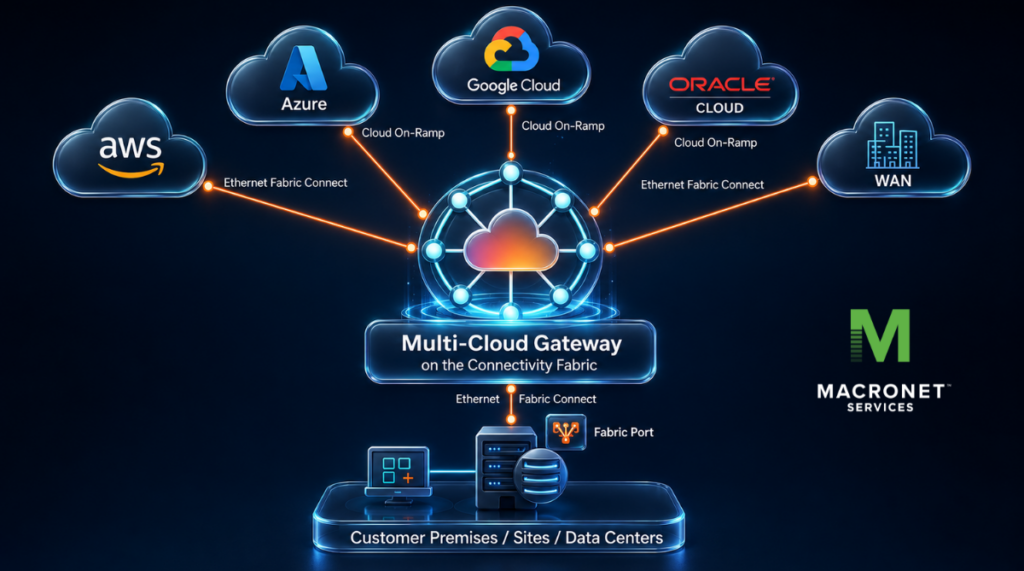
Modern businesses no longer operate in one cloud, one data center, or one network. Applications now span AWS, Microsoft Azure, Google Cloud, Oracle Cloud, private data centers, SaaS platforms, branch locations, remote offices, and edge environments. That creates a serious networking problem: the more cloud environments a company uses, the harder it becomes to connect them securely, predictably, and cost-effectively.
Macronet Services is an experienced Lumen partner and independent network advisory firm representing many of the world’s leading Tier 1 global service providers. The Macronet Services team brings more than 25 years of hands-on experience in complex global network design, carrier strategy, WAN transformation, cloud connectivity, and enterprise network architecture. That background gives Macronet Services a practical, vendor-aware perspective on solutions like Lumen Multi-Cloud Gateway and how they fit into a broader long-term WAN, cloud, and AI-ready network strategy.
Lumen® Multi-Cloud Gateway is designed to simplify one of the hardest parts of modern IT: connecting clouds, data centers, enterprise locations, and workloads through a centralized, private, software-defined routing architecture. Lumen describes the service as a secure platform to connect, control, and scale across cloud environments, with automated provisioning, private connectivity, and centralized visibility.
At its core, Lumen Multi-Cloud Gateway is not just another cloud circuit. It is a private multi-cloud routing platform that helps businesses connect cloud environments, data centers, and enterprise sites through a more centralized model. Lumen describes the solution as simplifying multicloud networking with one secure gateway to reduce complexity, cut costs, and accelerate innovation.
For organizations struggling with cloud sprawl, fragmented WAN design, rising data movement costs, and AI-driven bandwidth demand, Lumen Multi-Cloud Gateway offers a cleaner model: connect strategically, route centrally, scale on demand, and reduce unnecessary complexity.

Why Multi-Cloud Networking Has Become So Difficult
Most enterprise networks were not originally designed for today’s cloud reality. They were designed around branch-to-data-center traffic, private WAN circuits, internet breakout, centralized firewalls, and traditional application hosting. Over time, businesses added cloud services, SaaS applications, public cloud infrastructure, remote users, backup platforms, analytics systems, and now AI workloads.
The result is often a fragmented network architecture with too many connections, too many routing policies, too many providers, and too many operational handoffs.
A typical modern business may use:
- AWS for application hosting.
- Azure for Microsoft-integrated workloads.
- Google Cloud for analytics or AI.
- Oracle Cloud for database workloads.
- Private data centers for regulated or legacy systems.
- SaaS applications for CRM, ERP, collaboration, security, and contact center.
- Branch offices, warehouses, hospitals, stores, factories, or campuses connecting into all of it.
When every cloud and site is connected separately, complexity multiplies quickly. Cloud-to-cloud traffic may hairpin through a data center. Cloud egress exposure can become difficult to predict. Routing policy becomes harder to control. Security teams lose visibility. Network teams spend too much time troubleshooting instead of designing for the future.
Lumen’s public Multi-Cloud Gateway materials speak directly to this issue, positioning the service as a way to “untangle multicloud complexity” and reclaim control through private connectivity, centralized visibility, and automated provisioning.
What Is Lumen Multi-Cloud Gateway?
Lumen Multi-Cloud Gateway, often abbreviated as MCGW, is a private multi-cloud routing solution built on the Lumen Connectivity Fabric. It provides virtual Layer 3 routing between clouds, data centers, edge environments, and on-premises locations.
Lumen’s data sheet describes Multi-Cloud Gateway as virtual Layer 3 routing built on the Lumen Connectivity Fabric, enabling private, predictable networking between cloud providers and enterprise locations without hairpinning through on-premises hubs.
In plain English, Lumen Multi-Cloud Gateway gives businesses a way to privately connect multiple cloud environments and enterprise locations through one centralized routing model instead of building a separate private connection for every cloud, every data center, and every site.
It is designed to help customers:
- Connect AWS, Azure, Google Cloud, Oracle Cloud, private data centers, and enterprise locations.
- Route traffic privately between clouds without forcing that traffic back through a corporate data center.
- Use centralized routing policy and route control.
- Reduce reliance on public internet paths for critical cloud workloads.
- Support AI, analytics, disaster recovery, migration, replication, and real-time application workloads.
- Provision and manage services through Lumen Connect, portal, and APIs.
- Scale connectivity as business demand changes.
Lumen lists virtual Layer 3 routing between clouds, Hosted Cloud Ethernet, dedicated and virtual point-to-point connectivity, IP VPN, and internet services as connectivity options for Multi-Cloud Gateway.
The Big Idea: One Gateway, Many Clouds, Centralized Control
The easiest way to understand Lumen Multi-Cloud Gateway is to compare the old model with the new model.
In the old model, an enterprise might build separate private connectivity into AWS, Azure, Google Cloud, and Oracle Cloud. Each cloud may have its own connection, routing design, security policy, provider handoff, and operational workflow. If AWS needs to communicate with Azure, the traffic may be sent back through a data center, firewall stack, or colocation hub. That can introduce latency, consume unnecessary bandwidth, and create avoidable cloud egress exposure.
In the MCGW model, the enterprise connects clouds, data centers, and sites into Lumen’s connectivity fabric and uses Multi-Cloud Gateway as a centralized private routing point. The architecture is designed to simplify cloud-to-cloud, premises-to-cloud, and data center connectivity while giving customers more control over policy, visibility, and scale.
Lumen says Multi-Cloud Gateway is designed for consistent policy, visibility, and scale across complex cloud, data center, and edge architectures.
This is why MCGW is more than a circuit. It is a multi-cloud control point.
Core Capabilities of Lumen Multi-Cloud Gateway
- Centralized Layer 3 Routing
MCGW provides centralized Layer 3 routing across cloud, data center, and enterprise site environments. This allows customers to manage routing policy in a more coordinated way instead of stitching together multiple isolated cloud connectivity designs.
Lumen’s data sheet identifies centralized BGP peering, route control, and inbound and outbound IP prefix filtering as features of the virtual Layer 3 gateway.
This is especially important for organizations that rely on BGP, route filtering, segmentation, and controlled advertisement of IP prefixes between environments.
- Private Cloud-to-Cloud Connectivity
One of the most valuable use cases for Lumen Multi-Cloud Gateway is private cloud-to-cloud interconnect.
Many organizations use multiple clouds for different reasons. AWS may host production applications. Azure may support Microsoft-centric workloads. Google Cloud may support analytics and AI. Oracle Cloud may support enterprise databases. Without a centralized multi-cloud routing layer, moving data between those platforms can require public internet paths, VPNs, custom routing, or backhaul through a data center.
MCGW is designed to allow private cloud-to-cloud traffic flows, helping businesses avoid unnecessary hairpinning and reduce dependence on best-effort internet routing. Lumen describes this use case as routing traffic directly between major clouds over private paths to reduce latency and avoid backhauling through a data center.
- Corporate Edge-to-Cloud Connectivity
MCGW can also connect enterprise premises directly into cloud providers. That means branch offices, headquarters, campuses, warehouses, hospitals, stores, manufacturing sites, and other business locations can access cloud environments through private connectivity instead of relying only on public internet paths.
Lumen describes this use case as connecting on-premises locations, data centers, and multiple clouds through one secure gateway with centralized visibility and automated provisioning.
For distributed businesses, this can be a major operational improvement.
- Data Center Interconnect
Not every workload is moving fully to public cloud. Many businesses still operate private data centers, colocation environments, private cloud platforms, or specialized application hosting facilities.
MCGW can support data center interconnect use cases by connecting regional data centers for migration, disaster recovery, high-performance expansion, and private cloud integration. Lumen describes data center interconnection as securely linking multiple data centers and colocation facilities to create a unified, high-performance network fabric.
- Regional Mesh Networking
Some applications require low-latency connectivity across multiple locations in a region. Examples include analytics, replication, media workflows, distributed databases, financial applications, manufacturing systems, and real-time application environments.
Lumen’s data sheet identifies metro and regional mesh as a common use case for creating low-latency meshes across on-net facilities and clouds for replication, analytics, media workflows, and real-time applications.
- API-Driven Provisioning and Lumen Connect
Traditional telecom provisioning often depends on tickets, manual coordination, engineering reviews, and long lead times. MCGW is aligned with Lumen’s Network-as-a-Service direction, where customers can provision, manage, and scale services through portal and API-based workflows.
Lumen states that Lumen Connect allows customers to provision, scale, and manage services through API or portal, with full visibility, real-time action, and reduced operational friction.
This matters because cloud teams are used to moving quickly. If the network provisioning process takes weeks while cloud infrastructure can be deployed in minutes, the network becomes the bottleneck. MCGW helps bring the network operating model closer to the speed of cloud.
- Private Connectivity and Traffic Isolation
MCGW is designed around private connectivity, not public internet dependency. Lumen lists private IP backbone connectivity, segmentation, zero-trust architecture, and traffic isolation with no public internet as security characteristics of the service.
This does not mean MCGW replaces security architecture. Companies still need firewalls, identity controls, logging, ZTNA, SASE, segmentation, cloud-native security policies, and compliance governance. But private transport and centralized routing can improve the foundation on which those controls are built.
- Optimized Routing and Avoidance of Hairpinning
Hairpinning is one of the hidden problems in multi-cloud networking. If traffic between two clouds must travel back through a data center, it can add latency, consume additional bandwidth, increase cost exposure, and create unnecessary dependency on legacy infrastructure.
Lumen’s product page lists low-latency private paths, avoiding hairpinning, and enterprise-grade reliability as performance characteristics of MCGW.
For AI, analytics, backup, replication, and cloud-to-cloud application workflows, that design difference matters.
- Scalable, On-Demand Connectivity
MCGW is built for environments that change. Businesses can start with a narrower use case, such as cloud-to-cloud routing or branch-to-cloud connectivity, and expand over time as additional clouds, locations, and workloads are added.
Lumen describes Multi-Cloud Gateway as a digital, self-service, on-demand platform for cloud-native, software-defined connectivity with dynamic bandwidth allocation.
Why Lumen Multi-Cloud Gateway Matters for AI
AI is changing the cloud networking conversation.
Traditional cloud applications moved user requests, transactions, database queries, files, and application traffic. AI workloads can move massive data sets, embeddings, logs, video, images, documents, model outputs, training data, inference traffic, and vector database queries across multiple environments.
That creates new pressure on the network.
A business may store sensitive data in a private data center, use Azure OpenAI or Microsoft services for AI, use Google Cloud for analytics, run workloads in AWS, and maintain backup or disaster recovery in another region. Without private, scalable, centrally managed connectivity, the network can become the bottleneck.
Lumen publicly positions Multi-Cloud Gateway as “AI-ready networking” between clouds, data centers, and premises with one automated gateway.
Lumen also says its broader cloud connectivity portfolio supports hybrid workloads, distributed AI, and cloud-to-cloud transfers, with 125+ cloud on-ramps, private interconnects, and access to 2,200+ data centers.
For businesses building AI strategies, this matters because the AI roadmap is also a data movement roadmap. If the data cannot move securely, quickly, and economically, the AI strategy will be limited.
How Lumen Multi-Cloud Gateway Works with Ethernet Fabric Connect
Lumen Multi-Cloud Gateway works closely with Lumen Ethernet Fabric Connect. The simplest way to think about it is:
Lumen Multi-Cloud Gateway provides routing and control.
Ethernet Fabric Connect provides private connectivity paths into clouds, data centers, and enterprise sites.
Lumen’s data sheet identifies Ethernet Fabric Connect options including hosted cloud, dedicated cloud, virtual point-to-point EVPL, transparent point-to-point EPL, virtual multipoint EVPLAN, and transparent multipoint EPLAN.
This gives businesses flexibility. Some may need cloud-to-cloud routing. Others may need branch-to-cloud. Others may need data center-to-cloud, data center-to-data center, or a regional private mesh.
MCGW is valuable because it can sit above those connectivity options as a centralized routing and policy layer.
Supported Cloud and Site Connectivity
Lumen’s materials identify AWS, Azure, Google Cloud, Oracle, and other major cloud platforms as environments that can be connected through private on-ramp paths.
This is important because most organizations are not choosing one cloud forever. Multi-cloud is often a practical reality, not a theoretical strategy. Different business units choose different platforms. Mergers and acquisitions bring different cloud estates. Certain workloads perform better or cost less in specific clouds. Some AI, analytics, or database services are native to a particular provider.
MCGW gives organizations a way to connect that mixed environment more coherently.
Business Benefits of Lumen Multi-Cloud Gateway
Reduced Network Complexity
The biggest benefit of MCGW is simplification.
Instead of managing a growing web of separate cloud circuits, VPNs, routing policies, provider handoffs, and data center hairpins, businesses can centralize routing across a private multi-cloud architecture.
Lumen says the service helps eliminate integration headaches by combining automated provisioning, private connectivity, and centralized visibility.
Improved Performance
Private cloud connectivity can improve performance by reducing reliance on best-effort public internet routing and avoiding unnecessary backhaul.
Lumen’s data sheet says private, high-bandwidth cloud on-ramps can help cut latency, bypass public internet bottlenecks, and enhance application performance for AI, analytics, and real-time workloads.
Highly Cost-Effective Multi-Cloud Connectivity
The most important cost point is not a single monthly line item. It is total cost of ownership.
A fragmented cloud connectivity architecture can create hidden costs through duplicated cloud ports, separate circuits, unnecessary data center backhaul, excess cloud egress exposure, manual provisioning, operational complexity, and troubleshooting time.
Lumen positions MCGW as a cost-effective approach because it can consolidate cloud connectivity through a single gateway, help eliminate duplicated cloud service provider ports and per-site terminations, minimize backhaul costs, and simplify operations through a single pane of glass.
Specific pricing should always be validated based on customer location, architecture, bandwidth, cloud providers, and service design. But as an architectural strategy, MCGW is designed to reduce waste and simplify the cost model of multi-cloud connectivity.
Faster Provisioning
Traditional private cloud connectivity can take weeks or months, especially when it requires physical ports, cross-connects, carrier coordination, router configuration, and security review.
Lumen says MCGW supports provisioning and adapting connectivity in minutes through portal or APIs to support distributed AI and analytics workloads across clouds, data centers, and on-premises locations.
This is especially valuable for cloud migration, application modernization, disaster recovery testing, and AI projects where timelines are compressed.
Better Visibility and Control
A multi-cloud network is only useful if the network team can see it, control it, and govern it.
MCGW gives businesses a centralized place to view and manage routing, policy, and connectivity. Lumen lists route table views, routing statistics, and centralized policy control as management tools for the service.
Improved Security Foundation
MCGW can help improve the security foundation by moving critical cloud traffic over private paths and supporting segmentation and traffic isolation. Lumen’s public materials describe private IP backbone, segmentation, zero-trust architecture, and traffic isolation with no public internet as security characteristics.
Again, this does not remove the need for security inspection, identity, endpoint protection, logging, and policy enforcement. But it can reduce exposure and improve control at the network layer.
Lumen Multi-Cloud Gateway for Businesses of All Sizes
Small and Growing Businesses
A smaller business may not think of itself as “multi-cloud,” but many already are.
A small or growing company may use Microsoft 365, AWS-hosted applications, a cloud ERP, a SaaS contact center, a cloud-based security platform, and a third-party data warehouse. As these services become more critical, relying only on best-effort internet connectivity may become limiting.
For smaller companies with serious cloud dependency, MCGW can provide a more mature connectivity model without forcing them to build a large internal cloud networking team. The value is simplicity: private connectivity, centralized control, and a path to scale as the business grows.
Mid-Market Businesses
Mid-market companies often feel the most pain. They are large enough to have multiple locations, cloud applications, compliance requirements, acquisitions, and disaster recovery needs, but they may not have a large network engineering department.
For these organizations, MCGW can help standardize cloud access, simplify branch-to-cloud routing, reduce duplicated connectivity, and create a more predictable network architecture.
Common mid-market use cases include cloud migration, disaster recovery, private access to cloud-hosted applications, secure data movement for analytics, M&A network integration, data center consolidation, and branch-to-cloud transformation.
Large Enterprises and Public Sector Organizations
Large enterprises, healthcare networks, manufacturers, retailers, financial institutions, technology companies, and public sector organizations often have the most complex multi-cloud environments.
For these customers, MCGW can become a strategic routing and connectivity layer for cloud modernization, AI enablement, application performance, compliance, and network transformation.
Lumen identifies Multi-Cloud Gateway as relevant for large enterprises, businesses, and public sector organizations with complex multicloud and AI strategies, including routing and on-demand connectivity across clouds, data centers, and enterprise sites.
Best Use Cases for Lumen Multi-Cloud Gateway
- Cloud-to-Cloud Interconnect
Cloud-to-cloud interconnect is one of the strongest use cases for MCGW.
This is useful when a business needs to move data privately between AWS and Azure, Azure and Google Cloud, Google Cloud and Oracle, or other combinations of cloud environments.
Use cases include application migration, cross-cloud disaster recovery, data lake synchronization, AI data pipelines, analytics workloads, backup and replication, and multi-cloud application architecture.
Lumen describes this as routing traffic directly between major clouds over private paths to reduce latency and avoid backhauling through a data center.
- Cloud-to-Premises Connectivity
Many businesses still need private connectivity between cloud environments and enterprise locations. This can include headquarters, regional offices, factories, warehouses, healthcare facilities, retail stores, or private data centers.
MCGW can help simplify this model by centralizing routing between premises and clouds.
- Data Center Interconnect
Organizations with multiple data centers can use MCGW to support private data center interconnect, migration, disaster recovery, and high-performance expansion. Lumen describes data center interconnection as linking multiple data centers and colocation facilities into a unified high-performance network fabric.
- AI and Machine Learning Workloads
AI workloads often require high-bandwidth, low-latency, secure movement of large data sets. MCGW is particularly relevant when data, models, analytics platforms, and applications are spread across clouds and data centers.
Examples include moving training data from private data centers into cloud AI platforms, connecting AI inference environments to enterprise applications, supporting vector database replication, moving large media or document data sets, and supporting distributed analytics environments.
- Disaster Recovery and Business Continuity
Disaster recovery depends on predictable connectivity. MCGW can help connect data centers, clouds, and recovery environments through private routing.
This is useful for backup replication, warm standby environments, regional failover, and DR testing.
- Cloud Migration
During cloud migration, old and new environments often need to run in parallel. Applications, databases, identity systems, and users may need to communicate across both environments for months.
MCGW can provide private connectivity during migration and remain part of the long-term architecture after migration is complete.
- Regional Low-Latency Mesh
Regional mesh networking can support applications that need low-latency communication across multiple sites or platforms. Lumen identifies metro and regional mesh as a use case for replication, analytics, media workflows, and real-time applications.
Lumen Multi-Cloud Gateway vs. Public Internet Connectivity
The public internet is simple and widely available. For many applications, it is good enough. But it is not always predictable.
Internet routing can change. Congestion can happen. Performance can vary. Security exposure may increase. For mission-critical workloads, AI data movement, regulated data exchange, and high-performance cloud applications, best-effort internet may not be the right foundation.
Lumen positions MCGW around private paths, lower latency, avoiding hairpinning, and enterprise-grade reliability.
The practical takeaway is simple: internet connectivity is fine for many everyday workloads, but private multi-cloud connectivity becomes more valuable as traffic volume, latency sensitivity, compliance requirements, and cloud-to-cloud movement increase.
Lumen Multi-Cloud Gateway vs. DIY Multi-Cloud Networking
Some enterprises build multi-cloud connectivity themselves. A DIY architecture may include cloud-native routers, VPNs, AWS Direct Connect, Azure ExpressRoute, Google Cloud Interconnect, Oracle FastConnect, colocation routers, firewalls, NAT, route filters, BGP policies, and multiple carrier contracts.
DIY can work, especially for companies with advanced network engineering teams. But it can become expensive and complex as the environment grows.
MCGW reduces the need to stitch everything together manually by providing a centralized multi-cloud routing model across clouds, sites, and data centers.
For many companies, the value is not only technical. It is operational. Fewer moving parts mean faster changes, simpler troubleshooting, cleaner governance, and a more repeatable design.
Lumen Multi-Cloud Gateway vs. SD-WAN and SASE
MCGW should not be confused with SD-WAN or SASE.
SD-WAN focuses on application-aware WAN routing across underlays such as broadband, dedicated internet access, LTE/5G, MPLS, or Ethernet. SASE combines networking and security functions such as secure web gateway, ZTNA, CASB, firewall-as-a-service, and identity-based access.
MCGW focuses on private multi-cloud routing and connectivity.
The best architecture may use all of these together. SD-WAN and SASE can improve user and branch access, while MCGW can provide private cloud-to-cloud, data center, and high-performance workload connectivity.
Lumen Multi-Cloud Gateway vs. Traditional MPLS/IP VPN
Traditional MPLS and IP VPN services are proven, private, and stable. But they were not originally designed for dynamic multi-cloud architectures.
MCGW brings a more cloud-like operating model to private connectivity. It supports centralized routing, private cloud paths, portal/API provisioning, and on-demand scale.
For businesses that still use MPLS or IP VPN, MCGW does not necessarily replace those services overnight. Instead, it can become part of a broader WAN modernization plan that connects legacy private networking with cloud-first architecture.
Security Considerations
MCGW can improve the network security foundation, but it should be designed as part of a broader security architecture.
Key security planning areas include traffic segmentation, BGP route filtering, prefix advertisement control, firewall insertion points, cloud security policy, identity and access controls, logging and monitoring, compliance requirements, failover, redundancy, and separation of production, development, and third-party environments.
Lumen identifies private IP backbone, segmentation, zero-trust architecture, and traffic isolation with no public internet as security characteristics of MCGW.
The right design should make it clear which environments can communicate, which cannot, where traffic is inspected, and who has authority to make routing changes.
Cost Considerations
A proper cost analysis for multi-cloud networking should not focus only on circuit cost.
The better question is total cost of ownership.
Businesses should evaluate cloud egress exposure, duplicated cloud ports, duplicated circuits, backhaul costs, router and firewall infrastructure, colocation costs, provisioning time, troubleshooting time, engineering effort, change management, downtime risk, and application performance impact.
MCGW can be highly cost-effective because it is designed to consolidate connectivity, reduce duplicated cloud connectivity components, minimize backhaul, and simplify operations. Lumen’s data sheet specifically says MCGW can consolidate cloud connectivity through a single gateway, help eliminate duplicated CSP ports and per-site terminations, minimize backhaul costs, and simplify operations through a single pane of glass.
For the best outcome, businesses should model both the network cost and the operational cost.
Implementation Planning Checklist
Before deploying Lumen Multi-Cloud Gateway, organizations should complete a structured network and cloud connectivity assessment.
- Map the Current Environment
Document all clouds, regions, VPCs, VNETs, VCNs, data centers, colocation facilities, WAN sites, remote offices, internet circuits, VPNs, firewalls, and cloud interconnects.
- Identify Critical Traffic Flows
Separate ordinary internet access from mission-critical application traffic. Identify which workloads require private routing, low latency, high bandwidth, or compliance controls.
- Review Cloud Egress Patterns
Determine where data is moving today and where it will move over the next 12 to 24 months. This is especially important for AI, analytics, backup, replication, and cloud migration.
- Define Routing Policy
Decide which environments should communicate, which should remain isolated, which routes should be advertised, and how failover should work.
- Review IP Addressing
Overlapping IP address space is common in multi-cloud environments. Resolve overlap, NAT, segmentation, and route summarization issues before deployment.
- Design for Redundancy
Determine where redundancy is required. This may include redundant cloud on-ramps, redundant fabric ports, diverse paths, multiple regions, or multiple data centers.
- Integrate Security
Decide where firewalls, SASE, ZTNA, cloud-native security tools, logging, and monitoring will fit into the architecture.
- Start with a Pilot
Begin with one or two clouds and one data center or site. Validate routing, performance, failover, monitoring, and security before expanding.
- Create an Operating Model
Define who owns routing changes, cloud attachments, security policy, monitoring, vendor coordination, and incident response.
- Measure Business Outcomes
Track time to provision, latency, throughput, egress reduction, circuits eliminated, tickets reduced, and application performance improvements.
Questions to Ask Before Buying Lumen Multi-Cloud Gateway
- Which cloud providers and regions do we need to connect?
- Are our sites and data centers eligible for Lumen fabric connectivity?
- Do we need cloud-to-cloud, cloud-to-premises, data center interconnect, or all of the above?
- What traffic should remain private?
- What bandwidth do we need today, and how quickly will it grow?
- How will BGP, static routing, prefix filtering, and segmentation be handled?
- How will failover work?
- What visibility will we have through Lumen Connect?
- How will this integrate with SD-WAN, SASE, firewalls, and cloud-native security?
- What existing circuits, VPNs, or cloud ports can be retired or consolidated?
- What are the operational savings from faster provisioning and simpler management?
- How does MCGW fit into our AI, analytics, cloud migration, and disaster recovery roadmap?
Who Should Seriously Evaluate Lumen Multi-Cloud Gateway?
Lumen Multi-Cloud Gateway is worth evaluating if your organization:
- Uses two or more public clouds.
- Needs private connectivity between AWS, Azure, Google Cloud, Oracle, data centers, or enterprise sites.
- Is migrating workloads from data centers to cloud.
- Has AI, analytics, backup, replication, or media workflows moving large data sets.
- Has performance problems caused by internet routing or data center hairpinning.
- Has too many cloud circuits, VPNs, or provider handoffs.
- Wants centralized routing and policy control.
- Needs a cost-effective alternative to a complex DIY multi-cloud network.
- Wants faster provisioning through portal and API-based workflows.
- Needs better visibility across cloud, data center, and edge connectivity.
Industries That Can Benefit from Lumen Multi-Cloud Gateway
Financial Services
Banks, payment processors, fintech companies, and insurance firms need secure, predictable, low-latency data movement. MCGW can support private connectivity between cloud platforms, analytics environments, transaction systems, and disaster recovery locations.
Healthcare
Healthcare organizations rely on EHR systems, imaging platforms, telehealth, analytics, and secure data exchange. MCGW can support private routing between hospitals, clinics, data centers, and cloud environments.
Retail
Retailers need connectivity for e-commerce, inventory, point-of-sale systems, customer analytics, loyalty platforms, and AI-driven personalization. MCGW can help connect stores, data centers, and cloud services more efficiently.
Manufacturing
Manufacturers need connectivity between plants, cloud analytics platforms, ERP systems, IoT platforms, and supply chain systems. Private, low-latency paths can support real-time visibility and predictive maintenance.
Media and Entertainment
Media workflows require large file transfers, rendering, editing, distribution, and collaboration across regions and platforms. Private cloud-to-cloud and data center connectivity can reduce bottlenecks.
Technology and SaaS Providers
Technology companies often operate across multiple clouds and regions. MCGW can simplify routing, improve performance, and support multi-cloud resilience.
Public Sector
Government and education organizations often need secure, compliant, resilient connectivity between agencies, campuses, data centers, and cloud platforms. MCGW can help support modernization without losing control over routing and visibility.
Conclusion: Why Lumen Multi-Cloud Gateway Matters
Lumen Multi-Cloud Gateway is important because it addresses one of the biggest problems in modern IT: the network has not kept up with the cloud.
Companies have moved applications, data, users, and workflows into multiple clouds, but many still connect those clouds using fragmented, legacy, internet-based, or manually stitched-together architectures. That creates latency, security risk, high operational overhead, duplicated cost, and slow provisioning.
MCGW gives businesses a cleaner model: centralized Layer 3 routing, private cloud-to-cloud and cloud-to-premises connectivity, Lumen Connect portal and API control, support for major cloud providers, and a scalable foundation for AI-era workloads.
For small businesses with growing cloud dependency, it offers a path to more mature private connectivity without unnecessary complexity. For mid-market companies, it can simplify cloud migration, disaster recovery, and multi-cloud operations. For large enterprises and public sector organizations, it can become a strategic connectivity layer for AI, analytics, compliance, and global hybrid cloud architecture.
The bottom line: Lumen Multi-Cloud Gateway is not just a telecom product. It is a modern multi-cloud networking architecture that helps businesses connect, control, secure, and scale cloud environments more intelligently. Contact us at Macronet Services to learn more about options for multi-cloud gateway solutions from various providers and how to design solutions to meet the needs of your business in the AI era.
FAQ: Lumen Multi-Cloud Gateway
What is Lumen Multi-Cloud Gateway?
Lumen Multi-Cloud Gateway is a private multi-cloud routing solution that helps centralize connectivity across clouds, enterprise sites, edge environments, and data centers. Lumen describes it as virtual Layer 3 routing built on the Lumen Connectivity Fabric.
Is Lumen Multi-Cloud Gateway only for large enterprises?
No. It is especially valuable for large enterprises and public sector organizations with complex multicloud and AI strategies, but smaller and mid-market businesses can also benefit if they rely on multiple clouds, private data center connectivity, or predictable cloud application performance.
Which clouds can Lumen Multi-Cloud Gateway connect?
Lumen materials reference major cloud environments including AWS, Azure, Google Cloud, Oracle, and others as targets for private cloud connectivity paths.
Does MCGW replace AWS Direct Connect, Azure ExpressRoute, Google Cloud Interconnect, or Oracle FastConnect?
No. MCGW does not simply replace cloud on-ramp services. It works as a centralized Layer 3 routing and control platform that can integrate with private cloud connectivity paths to simplify routing between clouds, data centers, and enterprise locations.
Does MCGW use the public internet?
The value proposition is private connectivity. Lumen describes security characteristics that include private IP backbone, segmentation, and traffic isolation with no public internet.
Can MCGW help reduce cloud costs?
Yes, depending on the customer’s architecture. MCGW can help reduce total cost of ownership by consolidating cloud connectivity, reducing duplicated provider ports and per-site terminations, minimizing backhaul, and simplifying operations.
Is MCGW useful for AI?
Yes. AI workloads often require high-capacity, low-latency, secure data movement across clouds and data centers. Lumen positions Multi-Cloud Gateway as AI-ready networking between clouds, data centers, and premises with one automated gateway.
Does MCGW replace SD-WAN?
No. SD-WAN and MCGW solve different problems. SD-WAN manages application-aware WAN access, while MCGW centralizes private multi-cloud routing and connectivity. Many businesses may use both.
What is the biggest advantage of MCGW?
The biggest advantage is simplified, centralized control of private multi-cloud connectivity. Instead of building and operating many separate cloud connections, VPNs, and routing policies, customers can use one gateway model to connect clouds, sites, and data centers.
Why should a business work with Macronet Services on Lumen Multi-Cloud Gateway?
Macronet Services helps businesses evaluate Lumen Multi-Cloud Gateway in the context of their broader WAN, cloud, AI, and carrier strategy. Because Macronet Services represents leading global providers and brings decades of practical global network design experience, the team can help determine whether MCGW is the right fit, how it should be designed, and how it compares to other available network options. Please reach out anytime for a conversation – we’ve seen a lot.