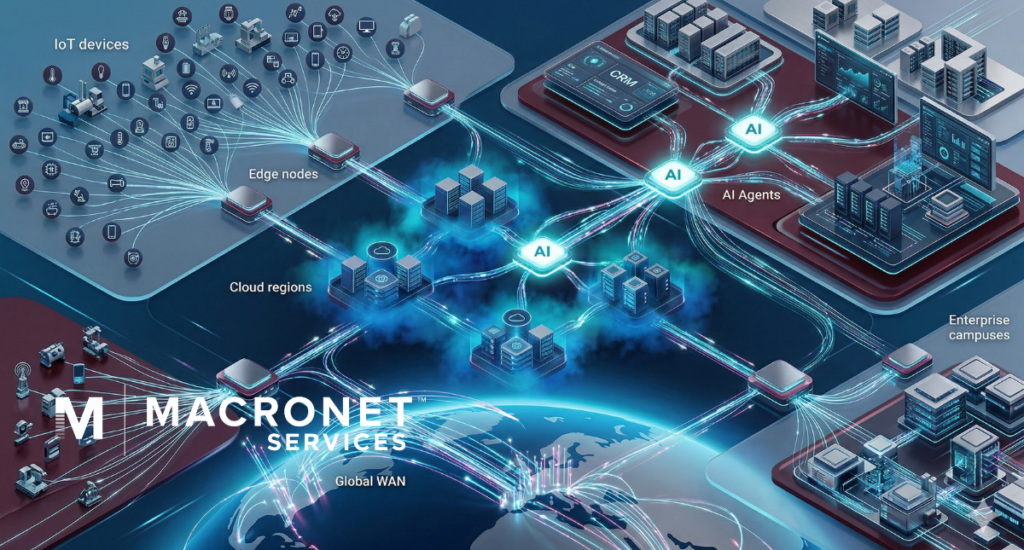
Network Infrastructure Consulting in 2026: How AI, CX, IoT, and Modern WAN Strategy Are Reshaping Business Networks
Artificial intelligence has changed the conversation around enterprise technology. For years, many organizations treated the network as background infrastructure: necessary, but secondary to applications, cloud strategy, and security tools. In 2026, that mindset no longer works. AI initiatives are now exposing a hard truth for business leaders: if the network is not designed for real-time data movement, distributed security, cloud access, edge computing, and resilient customer interactions, the AI strategy will underperform.
That is why network infrastructure consulting has become a board-level issue rather than a narrow IT project. Modern businesses need more than bandwidth. They need architecture. They need policy. They need interoperability. And they need a trusted Network Consultant company that understands how wide area networking, cloud, contact center, security, AI, and edge computing fit together in one operating model. Industry signals reinforce that shift: Gartner’s 2026 strategic technology trends highlight AI supercomputing platforms, multiagent systems, AI security platforms, and physical AI as defining priorities, while Cisco emphasizes that AI-era data centers must deliver more power, speed, security, and cost discipline to support throughput- and latency-intensive workloads.
For many companies, the challenge is not whether AI is valuable. It is whether the underlying infrastructure can support it. As AI moves from pilot projects to real workflows, data gravity, latency, observability, and segmentation become business issues. That is especially true as organizations adopt agentic AI and “digital assembly lines” that orchestrate workflows across applications, data stores, APIs, and human approval points. Google Cloud’s 2026 agent trends materials describe this transition clearly: enterprises are moving from isolated prompts to end-to-end workflow systems, which raises the bar for network reliability and architectural discipline.
This is where Macronet Services has a compelling position. The company’s public materials show a model built around AI, wide area network and WAN RFPs, contact center, data center and IaaS, security, FinOps, Telecom Expense Management, and technology sourcing. Macronet Services also states that it leverages a broad partner portfolio to bring forward the best network solutions, offers free assessments, and focuses on making IT teams more efficient and the businesses they support more competitive. That matters in 2026 because buyers increasingly want strategic guidance without being trapped in a single-vendor point of view.
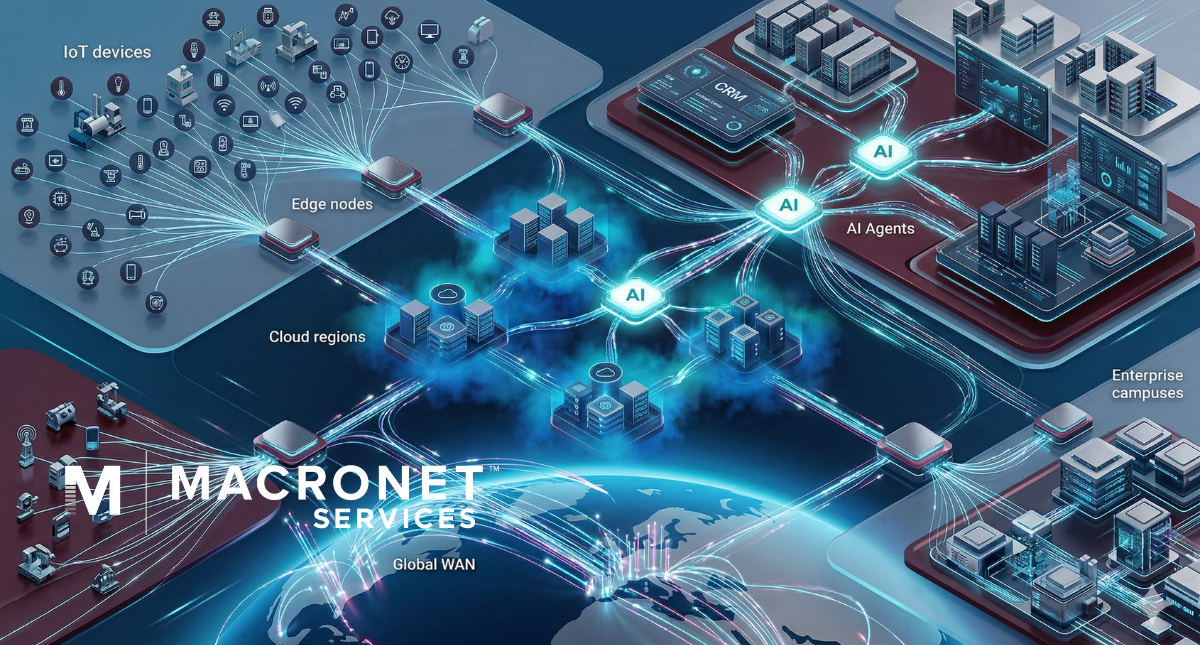
The old network model was built for branch access, SaaS, email, voice, and general application connectivity. The new model must also support AI inference, data pipelines, distributed sensors, intelligent automation, cloud-native security controls, and machine-to-machine interactions. Reuters reported on March 31, 2026 that Nvidia invested $2 billion in Marvell to expand AI networking and optical interconnect capabilities, with analysts pointing specifically to bandwidth and power efficiency as key bottlenecks in scaling AI systems. That is not just a hyperscaler story. It is a warning to enterprise buyers that networking is now central to AI economics.
Put simply, AI is no longer just a software layer. It is a traffic pattern.
When organizations begin using copilots, retrieval systems, AI-driven analytics, conversational bots, autonomous workflows, and edge-based intelligence, the network starts carrying:
- more east-west traffic inside data center and cloud environments,
- more API calls between platforms,
- more security inspection events,
- more latency-sensitive traffic between users and AI services,
- more branch-to-cloud and branch-to-edge flows,
- and more telemetry from devices, endpoints, and operational technology.
That changes what executives should expect from IT Network Consultants. In 2026, strong consultants are not simply evaluating circuits or comparing carriers. They are helping businesses answer bigger questions:
- Where should inference happen: cloud, edge, branch, or endpoint?
- Which workloads demand low latency and deterministic connectivity?
- How should zero trust and segmentation be applied to Secure AI systems?
- What is the best mix of MPLS, DIA, broadband, wireless, private connectivity, SASE, and cloud on-ramps?
- How should networking support contact center modernization and agentic customer service?
- Which IoT and operational technology environments need separate policy domains?
- How should network architecture evolve as AI usage grows from a department pilot to an enterprise platform?
That is the difference between routine procurement support and true network design consulting.
What a modern Network Consultant Company should deliver
A strong Network Consultant Company in 2026 should be able to connect business strategy with technical architecture. That means the engagement should start with business outcomes, not hardware catalogs.
For example, a manufacturer pursuing machine vision and predictive maintenance has a different network requirement than a professional services firm deploying enterprise copilots, and both are different from a retailer modernizing customer experience with AI-enabled contact center systems. The right consultant should design around the operating model, not around a generic product stack.
At a high level, a modern consulting engagement should cover six layers.
- Business and AI workload discovery
Before recommending connectivity or security changes, consultants should map the actual AI and digital transformation agenda:
- generative AI use cases,
- agentic AI use cases,
- branch modernization,
- customer experience initiatives,
- cloud migration priorities,
- edge and IoT deployment plans,
- compliance and governance constraints,
- and cost targets.
This is one reason Macronet Services’ positioning is relevant. The company publicly spans AI, WAN, Contact Center & CX, Data Center & IaaS, Security, and Technology Sourcing, which is exactly the cross-functional lens buyers need when network decisions now affect AI adoption and customer experience at the same time.
- Network architecture and transport strategy
The next step is to evaluate how traffic should move. Some organizations need a simpler internet-first strategy with SD-WAN and strong security overlays. Others need cloud-adjacent colocation, private interconnects, or more deterministic architecture for latency-sensitive or data-intensive workflows. Macronet Services’ own WAN and network design content reflects this shift, emphasizing global WAN design and evolving enterprise requirements. Further, Macronet Services is a channel partner for the leading global Tier 1 ISPs.
In practice, the transport strategy may include:
- Dedicated Internet Access and Network as a Service for branch and campus sites,
- business broadband for cost efficiency where appropriate,
- MPLS where legacy determinism still matters,
- private cloud connectivity for critical environments,
- colocation interconnection for hybrid architectures,
- LTE/5G failover for resilience,
- and edge processing for local decision speed.
- Security architecture for AI-ready operations
AI raises the value of security architecture because the attack surface becomes broader and more dynamic. NIST’s AI Risk Management Framework and its generative AI profile both emphasize structured risk management for AI systems, while CISA continues to position zero trust as the direction for modern enterprise security. In other words, AI projects should not be bolted onto a flat network with weak identity, broad trust zones, and inconsistent policy enforcement.
For network leaders, that means:
- segmenting AI workloads and sensitive data flows,
- applying identity-centric access policies,
- limiting lateral movement,
- inspecting encrypted traffic where appropriate,
- protecting APIs and data exchanges,
- and aligning AI traffic patterns with zero trust principles.
Cisco’s current AI-ready data center messaging also reinforces that security now has to be fused into the data center fabric rather than treated as a separate afterthought.
- Edge, branch, and operational connectivity
The AI era is also an edge era. Openreach’s March 2026 deployment with Google Cloud is a useful real-world example: the company is using AI to optimize routes, detect fault patterns, and accelerate fiber planning, with measurable operational and emissions benefits. The lesson for business leaders is straightforward. Networks are no longer static utility layers; they are active enablers of planning, automation, and operational intelligence.
For many organizations, this is where internet of things consulting services become essential. Sensors, gateways, mobile assets, cameras, industrial systems, and field endpoints all create new data sources and new design requirements. AWS, for example, positions its IoT services around secure device connectivity and management at massive scale, while AWS edge services focus on processing and storing data closer to endpoints for ultra-low latency and real-time responsiveness.
A mature consulting engagement should therefore address:
- device identity and onboarding,
- connectivity choices for remote assets,
- edge compute placement,
- data filtering and local inference,
- integration with cloud analytics,
- multi-cloud design and deployment
- and OT-aware monitoring and segmentation.
- Wireless modernization and campus experience
Many firms still underestimate how much wireless strategy affects digital operations. Wi-Fi 7 is now a serious conversation in enterprise and Industry 4.0 environments. The Wireless Broadband Alliance states that Wi-Fi 7, built on IEEE 802.11be, is designed to deliver double the bandwidth and three times the speed of Wi-Fi 6, with stronger support for latency-sensitive use cases and deterministic network behavior. That matters for modern collaboration, dense device environments, immersive applications, and local AI-enabled workloads.
For some use cases, the answer is not Wi-Fi alone. It may be a combination of Wi-Fi 7, private cellular, and edge processing. The role of IT Network Consultants is to determine where each model makes sense operationally and economically.
- Vendor strategy, sourcing, and lifecycle governance
This is where many internal teams need the most help. The modern network stack is fragmented across carriers, cloud providers, contact center vendors, security platforms, SD-WAN/SASE providers, wireless vendors, data center providers, and AI tooling ecosystems. A good consultant does not just recommend architecture; they help the client source, compare, negotiate, implement, and optimize.
Macronet Services’ published model is particularly relevant here because it combines consulting with technology sourcing, auditing and Telecom Expense Management, wide area networking, data center and IaaS, contact center, and AI. For buyers that want to avoid disconnected advisory and procurement processes, that combination can be powerful.
Network design consulting for AI: what changes in 2026
The phrase network design consulting used to imply topology, routing, resilience, and vendor selection. Those still matter, but in 2026 the scope is much broader.
Today, network design has to account for agentic workflows, AI traffic surges, observability needs, data locality, and trust boundaries. Gartner’s 2026 trends are useful here because they frame the environment business leaders are entering: AI supercomputing platforms, multiagent systems, physical AI, preemptive cybersecurity, and AI security platforms all push infrastructure toward higher complexity and tighter integration.
That means good network design consulting should include at least the following questions:
Where will AI run?
Not every workload belongs in a public cloud region. Some inference should run at the edge, in a branch, in a factory, in a contact center environment, or near a private dataset.
How much data has to move?
If every request crosses long distances or expensive egress boundaries, the business case for AI can erode quickly.
What is the acceptable delay?
A board report can tolerate seconds. A real-time fraud alert, autonomous warehouse action, or live voice interaction often cannot.
What level of resiliency is required?
If AI is being inserted into customer experience or revenue-critical operations, the network design has to reflect that.
Which policy domains should stay separated?
IoT, OT, employee traffic, guest traffic, cloud access, AI training pipelines, and conversational AI services should not all live in the same flat trust zone.
How will the business observe performance?
Without end-to-end visibility, organizations struggle to distinguish network issues from model issues, application issues, or data pipeline issues.
In other words, modern network design is now part of enterprise AI strategy.
AI Consulting for small business now starts with the network
A common mistake in the market is assuming that AI Consulting for small business is mostly about selecting a chatbot or buying licenses for a copilot. In reality, many smaller organizations run into network and data problems before they realize meaningful business value.
Small and midsize firms often operate with:
- aging firewalls,
- limited wireless capacity,
- inconsistent branch connectivity,
- no clear cloud connectivity strategy,
- unmanaged SaaS sprawl,
- poor visibility into performance,
- and little segmentation between business systems.
That creates friction for AI adoption.
A strong consulting approach for smaller firms should prioritize:
- business use case selection,
- identity and security cleanup,
- bandwidth and wireless readiness,
- branch and cloud application performance,
- data flow mapping,
- simple governance for AI usage,
- and pragmatic vendor choices that do not overcomplicate operations.
This is one area where Macronet Services can credibly differentiate. Its AI consulting page explicitly ties AI strategy to network modernization and highlights the company’s ability to guide clients through AI adoption while leveraging vendor benchmarks and free assessments. That is exactly the kind of practical support smaller companies often need.
For a small business, the right outcome is not “the most advanced architecture.” It is a right-sized architecture that supports secure AI adoption without overwhelming the team.
Conversational AI Consulting is now a network and CX discipline
One of the biggest mistakes companies make is treating Conversational AI Consulting as a pure software or contact center exercise. That is outdated.
In 2026, conversational AI spans:
- web and mobile chat,
- voice automation,
- agent assist,
- multilingual support,
- CRM and knowledge integrations,
- workflow automation,
- analytics,
- and increasingly, agentic orchestration across customer interactions.
That means the network matters. Voice quality, API responsiveness, knowledge retrieval speed, cloud path quality, branch routing, secure remote agent access, and contact center platform connectivity all shape customer experience.
Macronet Services already positions itself around Contact Center & CX and explicitly states that AI is revolutionizing contact centers and that it can help organizations harness AI to maximize impact and reduce cost. That creates a natural authority bridge between contact center modernization and broader infrastructure strategy.
For business leaders, effective conversational AI consulting should cover:
- CX workflow design,
- telephony and CCaaS architecture,
- AI bot and agent assist strategy,
- CRM and system integration,
- knowledge retrieval architecture,
- WAN and internet path resilience,
- secure remote access for agents,
- and measurable service-level outcomes.
This is especially important as agentic AI enters customer operations. Google Cloud’s 2026 materials describe a shift from one-off prompts to systems that run workflows. In a contact center context, that means conversational AI is evolving from scripted automation to orchestration across knowledge, systems, approvals, and next-best actions.
Why internet of things consulting services now overlap with AI strategy
The boundary between network infrastructure and digital operations keeps shrinking. That is why internet of things consulting services are no longer niche. They are becoming central to transformation strategies in manufacturing, logistics, utilities, healthcare, smart buildings, and distributed retail.
IoT creates a constant stream of telemetry. AI turns that telemetry into insight and action. But neither works well without the right network model.
This is where leadership teams need clarity on:
- which data should be processed locally,
- which data should be sent to the cloud,
- how to secure devices at scale,
- how to connect remote or mobile assets,
- how to isolate operational systems from enterprise traffic,
- and how to balance resiliency, cost, and performance.
AWS publicly emphasizes secure device connectivity and device management at scale, while its edge strategy centers on bringing processing and storage close to where data is generated. That is the architectural pattern many enterprises now need: distributed intelligence, centralized governance, and policy-driven connectivity.
For clients exploring IoT, a mature consulting partner should not just discuss sensors. They should help design the full path from endpoint to insight.
What business decision makers should demand from IT Network Consultants in 2026
By now, the pattern should be clear. The best IT Network Consultants in 2026 do not operate like circuit brokers or generic infrastructure generalists. They operate like transformation advisors who understand:
- business process redesign,
- AI adoption patterns,
- cloud networking,
- contact center architecture,
- edge and IoT connectivity,
- security frameworks,
- and sourcing strategy.
When evaluating consultants, decision makers should look for five things.
First, business fluency.
The consultant should be able to tie architecture decisions to revenue, productivity, customer experience, resilience, and cost control.
Second, AI awareness.
They should understand generative AI, inference, agentic workflows, data flows, and governance requirements.
Third, architecture depth.
They should be able to design for WAN, cloud, branch, wireless, data center, and edge environments together.
Fourth, security integration.
They should be able to align AI and network choices with zero trust, segmentation, and governance frameworks such as NIST’s AI RMF.
Fifth, sourcing neutrality and execution discipline.
They should help evaluate options and implement them, not just produce a slide deck.
Why Macronet Services fits the 2026 market
Macronet Services is well aligned with what the market now requires. Publicly, the company spans AI, WAN, Contact Center & CX, Data Center & IaaS, Security, Technology Sourcing, Audio Visual, and more. It also presents itself as leveraging a broad partner portfolio to bring forward the best network solutions, offering free assessments, and helping clients modernize both network infrastructure and AI capabilities.
That positioning matters because most clients do not need isolated advice. They need joined-up strategy across:
- network modernization,
- cloud and colocation options,
- AI deployment,
- CX modernization,
- security controls,
- and cost optimization.
Macronet Services’ existing content (resources) already supports that narrative, with pages and articles on WAN design, network design for the AI era, AI consulting, contact center AI, NaaS, edge computing, and global network architecture.
The strategic takeaway
In 2026, AI success is increasingly constrained by infrastructure maturity. The organizations that win will not necessarily be the ones that buy the most tools. They will be the ones that align network architecture, security policy, cloud access, edge strategy, contact center modernization, and data movement around real business priorities.
That is why network infrastructure consulting has become such a strategic category. The right advisor helps companies move from fragmented projects to an integrated operating model. The right Network Consultant Company helps leadership teams make decisions that support both current operations and future AI expansion. The right network design consulting engagement makes the network an accelerator for innovation instead of a hidden bottleneck.
For companies evaluating their next move, the question is no longer whether AI will change the business. It already is. The question is whether the network has been redesigned to support that future. Reach out to us anytime for a free consultation.
Frequently Asked Questions
What is network infrastructure consulting?
Network infrastructure consulting is the process of designing, optimizing, and managing enterprise networks to support business applications, cloud environments, AI workloads, and secure connectivity.
Why is network design consulting important for AI?
AI requires high-performance, low-latency, and secure data movement. Network design consulting ensures infrastructure can support AI workloads, real-time processing, and distributed systems.
What does a Network Consultant Company do?
A Network Consultant Company helps businesses design networks, select vendors, optimize costs, implement security, and align infrastructure with business goals.
How does AI impact enterprise networks?
AI increases data traffic, requires faster processing, and introduces new security challenges, making modern network architecture essential.
What is conversational AI consulting?
Conversational AI consulting focuses on implementing AI-driven customer interactions, including chatbots, voice AI, and contact center automation.
Why are IoT consulting services important?
IoT consulting services help businesses connect, secure, and manage devices while enabling real-time data processing and AI-driven insights.
Can small businesses benefit from network infrastructure consulting?
Yes. AI consulting for small business depends heavily on having reliable, secure, and scalable network infrastructure. Network consultants like Macronet Services are channel partners for over 500 network suppliers and can offset consulting fees by following a transparent process that offers design, unbiased sourcing, implementation, and ongoing governance.