
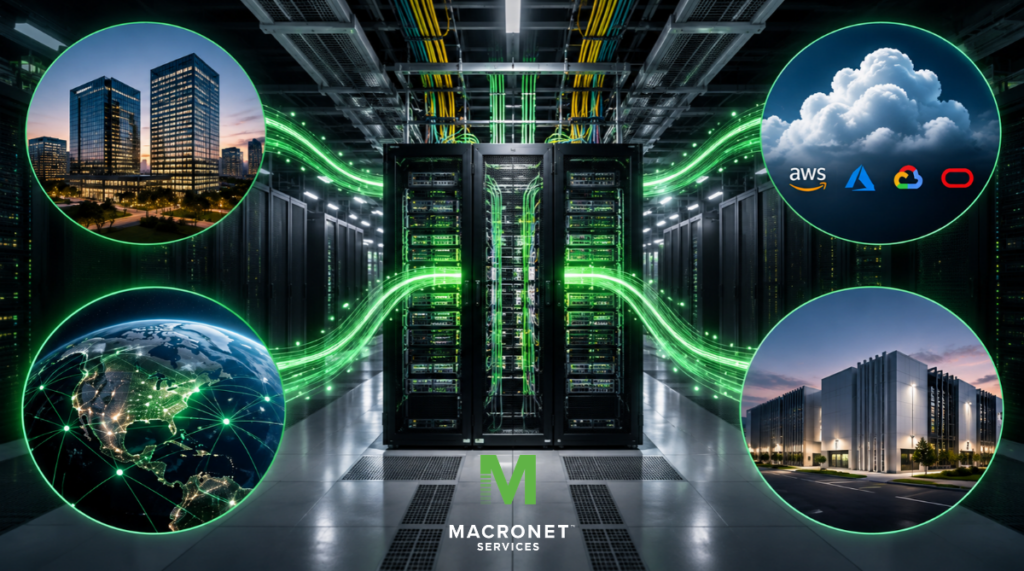
The Data Center Has Become an Interconnection Hub
For years, companies largely thought about data centers as places to house servers, storage systems and network equipment. Power, cooling, generators, UPS systems, physical security and facility resiliency dominated the decision. Those questions still matter, but they are no longer enough.
Modern enterprise infrastructure is distributed across colocation facilities, public clouds, SaaS platforms, corporate campuses, branch offices, manufacturing environments, edge locations and specialized AI infrastructure. Data moves continuously among these environments. As a result, the value of a modern data center is increasingly determined not only by what is inside the building, but by what the enterprise can efficiently connect to from that building.
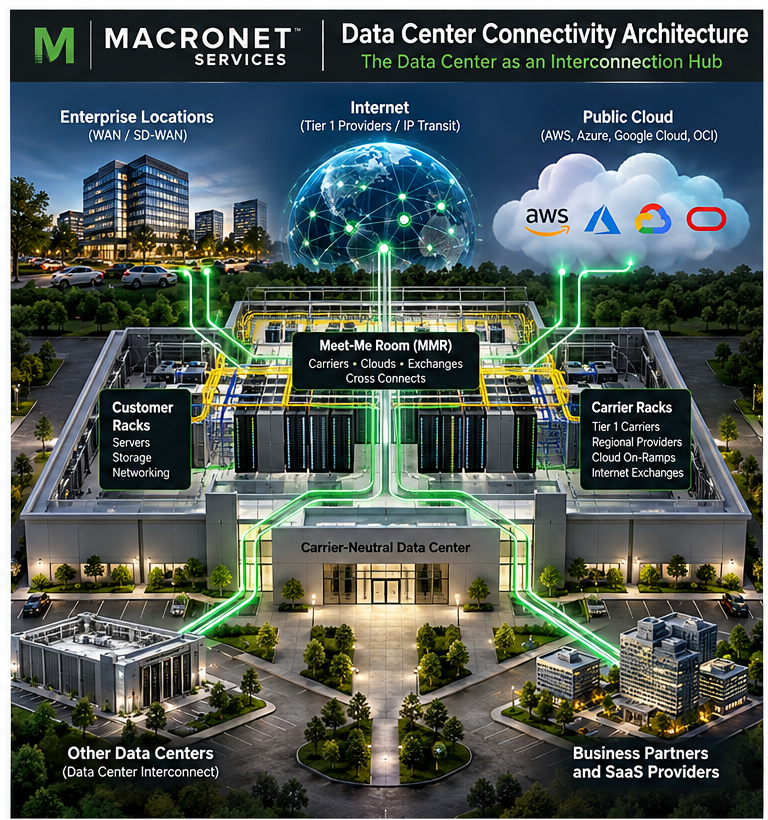
A well-connected colocation facility can act as a strategic interconnection hub between enterprise locations, telecommunications carriers, Internet providers, public clouds, business partners and other data centers. In many environments, the servers and storage housed in the facility are only one component of a much larger digital infrastructure architecture.
This is why data center selection and network design should no longer be treated as separate decisions. An organization may find a facility with attractive cabinet pricing, abundant power and excellent physical security, only to discover later that preferred carriers are unavailable, private cloud connectivity is expensive, cross-connect charges are unusually high, or supposedly redundant services share a common physical route.
The reverse can also be true. A data center with exceptional carrier density, cloud connectivity and interconnection options may allow an enterprise to simplify its WAN architecture, improve resilience, reduce latency and gain much greater flexibility in how it connects applications and infrastructure.
That shift is especially important as enterprises adopt hybrid cloud, multi-cloud architectures and AI workloads. Macronet Services explores the broader implications in its Network Infrastructure Assessment Services: A Complete Guide for AI-Ready Enterprises, which treats the network as the connective infrastructure linking distributed applications, security, cloud and AI.
| The strategic question is no longer only “Where should we place our equipment?” It is “Where should we place our infrastructure so it can connect efficiently, securely and resiliently to everything the business depends on?” |
What Is Data Center Connectivity?
Data center connectivity is the physical and logical network infrastructure that connects computing environments inside a data center to telecommunications carriers, Internet service providers, cloud platforms, enterprise locations, other data centers, business partners and digital services.
That definition is intentionally broader than simply having an Internet circuit in a colocation facility. A modern enterprise data center may use one path for public Internet access, another for a private WAN, one or more private cloud connections, and separate high-capacity paths for disaster recovery or data replication.
Data center connectivity should also be distinguished from data center networking. Data center networking generally describes the switching, routing, segmentation and east-west traffic inside the compute environment. Data center connectivity is primarily concerned with how that environment reaches resources beyond the rack or data hall.
The answers influence application performance, business continuity, cloud strategy, security, operating complexity and total infrastructure cost. This is one reason carrier-neutral facilities have become strategically important: they can provide access to multiple carriers, Internet providers, cloud connectivity services and interconnection platforms.
| Logical diversity and physical diversity are not always the same thing. |


How Data Center Connectivity Actually Works
At a high level, a typical connection follows a path such as: server → data center switch → enterprise router or firewall → patch panel → cross connect → Meet-Me Room → carrier or interconnection platform → external network. The exact implementation varies by facility and service, but this model captures the major components.
The Enterprise Rack and Demarcation Point
Connectivity begins with the enterprise equipment. Servers and storage connect to switches, which feed routers, firewalls or other edge devices. Larger environments frequently use paired devices so that a single hardware failure does not disconnect the environment.
Every service also has a point where operational responsibility changes from one party to another. This demarcation point may be a patch panel, port or other handoff inside the data center. Understanding the demarc is important for troubleshooting, ordering and assigning responsibility during an outage.
The Cross Connect
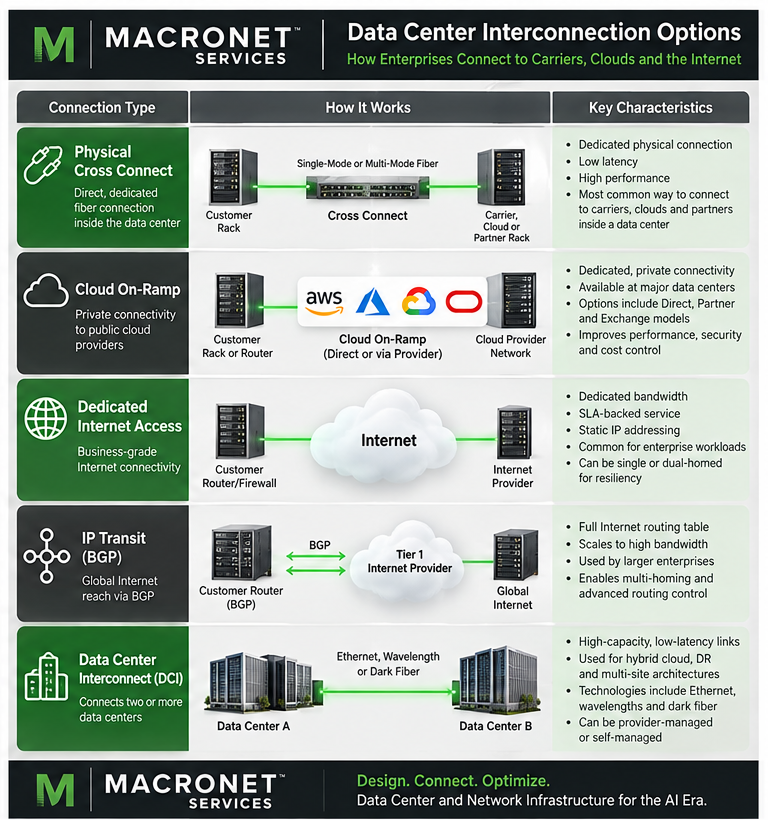
A cross connect is a dedicated physical connection between two endpoints within a data center. It may connect an enterprise router to a carrier, cloud provider, Internet exchange, interconnection platform or another customer. The cross connect is what turns a provider’s presence inside the facility into usable enterprise connectivity.
Macronet’s Data Center Cross Connects: Enterprise Guide provides a deeper treatment of Meet-Me Rooms, demarcation points, LOA/CFAs, diverse-path cross connects, MRC/NRC economics and Layer 1 implementation.
The Meet-Me Room
Many cross connects ultimately lead to a Meet-Me Room (MMR), where carrier and customer infrastructure can be interconnected. Instead of building an outside fiber route to every customer cage, providers establish infrastructure at defined interconnection points and the facility extends structured cabling to customer environments. This turns the data center into a marketplace for networks.
If multiple providers are already present, an enterprise may be able to establish new connectivity through an internal cross connect rather than a new outside-plant construction project. This can reduce provisioning time and create competition among carriers.
From the MMR to the External Network
Once traffic reaches the provider, it may traverse metro Ethernet, optical wavelength infrastructure, MPLS/IPVPN, dark fiber or a global Internet backbone. Two carriers may provide the same 10 Gbps Ethernet handoff while delivering very different underlying routes, peering relationships, geographic reach and failure domains.
For Internet connectivity, this is why the port speed tells only part of the story. Macronet Services’ The 8 Leading Global Tier 1 ISPs (Updated 2026) examines major global backbones, autonomous systems and peering considerations that affect enterprise Internet design.
The Meet-Me Room: Where Networks Meet
The MMR is one of the most important spaces in a carrier-neutral facility because it is where telecommunications networks physically converge. A single facility may expose customers to global Internet backbones, regional fiber operators, Ethernet carriers, wavelength providers, Internet exchanges, cloud-connectivity platforms and NaaS fabrics.
This network density can be strategically valuable. A facility with a strong ecosystem may make it easier to add providers, negotiate pricing, establish cloud connectivity or build a second path later. But a provider list should never be accepted at face value.
The more important questions are: How does the carrier reach the building? Where does it terminate? Does it operate its own fiber? Which building entrance does it use? Which underlying network carries the traffic beyond the facility?

Carrier-Neutral Does Not Automatically Mean Carrier-Diverse
Carrier neutrality means that customers can choose among multiple providers. It does not guarantee that those providers use independent infrastructure. Two different carriers may share the same conduit, building entrance, metro ring, carrier hotel or wholesale fiber network.
| Provider diversity is not the same as path diversity. |
A resilient design therefore has to be examined from the customer edge outward: router diversity, cross-connect diversity, Meet-Me Room diversity, building-entrance diversity, fiber-route diversity, carrier POP diversity and ultimately destination diversity.
For global Internet services, carrier topology also matters. Macronet’s Tier 1 ISP Global Latency Samples illustrate how provider POP locations and backbone routes can influence round-trip latency, while its Tier 1 ISP SLA guide explains common availability, packet-delivery, latency and restoration commitments.
Choosing Carriers Inside a Data Center
Carrier selection should begin with the destination and application requirement rather than the provider logo. An Internet provider solves a different problem from a wavelength carrier. A cloud-connectivity service solves a different problem from branch WAN transport. Even within the same category, providers can differ materially in reach, peering, route quality, local access, operational support and cloud adjacency.
Price per megabit is therefore a poor standalone selection metric. The network behind the Ethernet port is the product. A lower-cost provider may route traffic inefficiently to important SaaS platforms or rely on a distant POP, while another provider may have stronger direct peering and a better geographic fit.
The Major Types of Data Center Connectivity
| Connectivity Type | Primary Purpose | Typical Use Case |
| Cross connect | Physical in-facility connection | Customer rack to carrier, cloud provider, exchange or partner |
| Dedicated Internet Access | Enterprise Internet connectivity | Public applications, SaaS access and Internet egress |
| IP transit | Internet reachability for BGP networks | Multihomed Internet architectures |
| Carrier Ethernet | Private Layer 2 transport | Site-to-site connectivity and WAN access |
| Wavelength | Dedicated optical transport | High-capacity data center interconnect |
| Dark fiber | Dedicated fiber strands | Very high-capacity metro connectivity |
| MPLS/IPVPN | Managed private WAN | Branch and enterprise WAN connectivity |
| SD-WAN underlay | Transport supporting an SD-WAN overlay | Hybrid WAN architecture |
| Cloud on-ramp | Private cloud connectivity | AWS, Azure, Google Cloud and OCI |
| Internet exchange / peering | Direct network-to-network exchange | Content, SaaS and high-volume Internet traffic |
| NaaS / interconnection fabric | Software-defined connectivity | Multi-cloud, multi-site and dynamic interconnection |
The technologies overlap, but they solve different problems. The goal is not to choose one technology and use it everywhere. It is to match the connectivity method to the workload, business requirement and operating model.

Internet Access from the Data Center
For smaller environments, Internet access may be as simple as a single Dedicated Internet Access circuit. For enterprises operating public applications, centralized Internet gateways or globally distributed environments, Internet architecture can become one of the most important design decisions in the data center.
Single-Provider and Dual-Provider DIA
A single DIA provider is straightforward and may be appropriate when an outage is tolerable. Adding a second provider improves resiliency, but only if the secondary path does not share the same critical physical dependencies. Two carrier names are not enough.
BGP Multihoming and IP Transit
Organizations requiring provider-independent addressing and routing control may operate their own autonomous system and establish BGP sessions with multiple upstream networks. The enterprise can advertise its public prefixes through more than one provider and use routing policy to influence failover and path selection.
DIA and IP transit are related but not identical. DIA is typically packaged as a managed enterprise access service; IP transit is more common for organizations operating public BGP infrastructure.
Why Tier 1 ISP Selection Matters
Once traffic enters an ISP, it may travel across that provider’s backbone, through private peering, across Internet exchanges or through another upstream network before reaching the destination. The Macronet Tier 1 ISP guide explains why autonomous-system reach, global backbone design and peering depth can materially affect enterprise performance.
For global networks, latency is closely tied to geography and topology. Macronet Services’ global Tier 1 ISP latency samples demonstrate why POP placement and carrier routing matter when evaluating international application performance.
SLAs and DDoS Protection
Enterprise DIA services commonly include SLAs for availability, packet delivery, latency and restoration, but the scope and remedy matter. A backbone latency commitment is not the same thing as end-to-end application performance. Macronet Services’ Tier 1 ISP SLA guide provides a deeper explanation of how to interpret carrier commitments.
DDoS mitigation should also be evaluated as part of Internet architecture. Once an attack saturates the physical access circuit, an appliance inside the customer environment cannot recover the bandwidth already consumed. For high-risk public applications, upstream detection and scrubbing may be strategically important.
Peering and Internet Exchanges
The Internet is a collection of independent networks that exchange traffic using BGP. Peering is a relationship in which networks exchange traffic directly rather than relying exclusively on an upstream transit provider. Cloudflare’s overview of peering provides a useful explanation of the distinction between transit, public peering and private peering.
An Internet exchange provides shared Layer 2 infrastructure where multiple networks can establish BGP relationships. Private peering or a private network interconnect may be used when two networks exchange enough traffic to justify a dedicated connection.
Most conventional enterprises do not need to become active peering participants. But organizations operating large public-facing platforms may benefit from lower latency, reduced transit dependence and greater routing control. Internet-exchange access can also influence data center selection because dense network ecosystems create future optionality.
Private Cloud Connectivity and the Cloud On-Ramp
A cloud on-ramp is an interconnection point that allows enterprise infrastructure to enter a cloud provider’s private network. The enterprise usually does not build a dedicated circuit directly to the specific building where a workload resides. Instead, it connects to an approved interconnection location and the cloud provider carries traffic across its backbone toward the relevant services or region.
| Cloud Provider | Private Connectivity Service |
| Amazon Web Services | AWS Direct Connect |
| Microsoft Azure | ExpressRoute |
| Google Cloud | Cloud Interconnect |
| Oracle Cloud Infrastructure | FastConnect |
AWS Direct Connect
AWS documents both Dedicated and Hosted connection models for Direct Connect. AWS Direct Connect connection options currently describe dedicated physical port speeds of 1, 10, 100 and 400 Gbps, while hosted connectivity is delivered through Direct Connect Partners.
Microsoft Azure ExpressRoute
Microsoft documents four primary ExpressRoute access models: cloud-exchange colocation, point-to-point Ethernet, any-to-any IPVPN and ExpressRoute Direct. Microsoft’s ExpressRoute connectivity-model documentation is useful because it demonstrates that private cloud connectivity can be reached through several different access architectures.
Google Cloud Interconnect
Google provides Dedicated Interconnect, Partner Interconnect and Cross-Cloud Interconnect. Google Cloud Interconnect documentation describes direct, service-provider and cross-cloud options, reinforcing the point that cloud connectivity is increasingly a multi-cloud architecture problem rather than a simple data-center-to-cloud problem.
Oracle Cloud Infrastructure FastConnect
OCI FastConnect supports Oracle Partner, third-party provider and colocation models. Oracle’s FastConnect overview describes the physical and logical constructs, BGP requirements, cross connects and recommended redundancy. Macronet Services also provides a deeper Oracle FastConnect Architecture Guide for enterprises designing OCI connectivity.
For broader architecture across multiple hyperscalers, see Macronet Services Multi-Cloud Networking: The Complete Enterprise Guide.
Three Ways Enterprises Reach a Cloud On-Ramp
1. Direct Physical Interconnection
When enterprise equipment is in a facility that hosts the cloud provider edge, the path may be as direct as enterprise router → cross connect → cloud provider edge. This model provides excellent control but requires physical presence at the appropriate interconnection location.
2. Carrier-Provided Cloud Connectivity
A carrier can extend connectivity from another enterprise site or data center to the cloud on-ramp. Microsoft ExpressRoute, Google Partner Interconnect, OCI FastConnect partners and AWS Direct Connect partners all support variants of this access model. The benefit is reach; the tradeoff is that the carrier network becomes part of the dependency chain.
3. Software-Defined Interconnection
An interconnection fabric separates the physical port from the logical destination. Once the enterprise connects to the platform, it can create virtual connections to clouds, partners or other data centers. This can dramatically improve provisioning agility, but multiple logical connections may still share one physical port or platform.
| Software-defined does not mean infrastructure-free. Fiber, switching, routing and facility dependencies still exist underneath the abstraction. |
Designing Data Center Connectivity for Resiliency
Redundancy is one of the most overused words in network design. An architecture can contain two routers, two carriers and two cloud connections and still have a single point of failure hidden underneath them.
| A redundant architecture is only redundant if the backup path survives the same event that takes down the primary path. |
A serious resiliency review examines the entire failure chain: customer edge equipment, internal cabling, cross-connect path, Meet-Me Room, building entrance, outside fiber, carrier POP or backbone, cloud or Internet interconnection point, and the final application destination.
Cloud Connectivity Resiliency
AWS’s Direct Connect Resiliency Toolkit provides multiple resiliency models and a failover test that can intentionally bring down BGP peering to validate the redundant path. Microsoft’s ExpressRoute reliability guidance similarly recommends multiple paths and multiple peering locations for higher resiliency.
Google’s Cloud Interconnect SLA explicitly differentiates production-grade redundant designs from single connections or connections confined to one edge availability domain. Oracle’s FastConnect redundancy best practices address device, provider and location redundancy.
VPN as a Backup Path
A site-to-site VPN over the Internet can be a practical backup to a private cloud connection. The backup does not necessarily need the same bandwidth as the primary path if it can preserve critical applications during an outage. Routing policy, capacity and security must be tested before the backup is relied upon.
BGP and Failover Testing
Physical diversity alone does not determine where traffic flows. BGP policy determines path preference and failover behavior. A backup path that has never been tested is only a theory. Enterprises with meaningful availability requirements should periodically validate routing convergence, firewall behavior, application reachability and backup-path capacity.
Data Center Interconnect: Connecting Multiple Facilities
Data Center Interconnect (DCI) connects two or more facilities for disaster recovery, active-active applications, storage replication, backup or geographic availability. The correct transport depends on bandwidth, distance, latency, resiliency and cost.
Carrier Ethernet
Carrier Ethernet can provide straightforward Layer 2 or Layer 3 transport between sites and works well when the enterprise prefers the carrier to manage the transport infrastructure.
Wavelength Services
Dedicated optical wavelengths become attractive for large and predictable data movement, especially 10, 100 Gbps and higher replication requirements. The customer should still understand physical-route diversity and protection.
Dark Fiber
Dark fiber gives the enterprise dedicated fiber strands and the ability to control the optical layer. It can become economically attractive for very large metro requirements but shifts more engineering and operational responsibility to the customer.
As data centers and clouds become interconnected, DCI increasingly becomes part of a broader multi-cloud architecture. Macronet Services’ Multi-Cloud Networking Guide examines routing, cloud on-ramps, colocation hubs and cross-cloud patterns in more depth.
The Rise of Network-as-a-Service and Software-Defined Interconnection
Traditional enterprise networking has been provisioned one circuit at a time. Cloud infrastructure raised expectations for much faster change. Software-defined interconnection responds by building the physical access once and using software to create or modify multiple logical connections across it.
Equinix Fabric documentation is a useful current example: a Fabric port can establish multiple logical connections to service providers, cloud platforms, partners or distributed customer assets, while the underlying physical network remains the transport foundation.
This model can dramatically improve agility in hybrid and multi-cloud environments. But NaaS does not eliminate carrier infrastructure, physical failure domains or economics. A single port can become a concentration point if many logical cloud connections depend on it.
Data Center Connectivity in the AI Era
AI infrastructure introduces demanding traffic patterns both inside the GPU environment and between that environment and the rest of the enterprise. Those are different problems. East-west GPU fabrics may operate at extremely high speeds, while north-south connectivity must move data between storage, clouds, users and external systems.
NVIDIA’s data center architecture documentation distinguishes tenant-access north/south networking from GPU cluster east/west networking. That distinction matters for enterprise planning because a powerful GPU cluster can still be constrained by undersized connectivity to the data sources feeding it.
AI therefore raises the importance of carrier capacity, cloud on-ramps, 100G-class connectivity, data-center interconnect and data gravity. Before GPUs arrive, the enterprise should understand where training and inference data resides, how often it moves, what bandwidth is required and what cloud data-transfer charges the architecture may create.
Macronet Services’ AI-ready Network Infrastructure Assessment guide provides a broader framework for evaluating bandwidth, resiliency, carrier economics and infrastructure readiness before major AI initiatives.
Network Performance: Bandwidth Is Only One Metric
Bandwidth, throughput, latency, jitter and packet loss describe different characteristics of the network. A 100 Gbps circuit does not automatically make an application ten times faster than a 10 Gbps circuit.
| Workload | Most Important Connectivity Concerns |
| Large backup | Throughput and available bandwidth |
| Synchronous replication | Latency, packet loss and availability |
| SaaS applications | Latency, route quality and availability |
| Voice and video | Latency, jitter and packet loss |
| Public web applications | Availability, latency and Internet route quality |
| AI dataset movement | Very high throughput and data-transfer economics |
| Database transactions | Latency and consistency |
| Disaster recovery | Bandwidth, availability and recovery time |
| Private cloud connectivity | Latency, route stability and resiliency |
More bandwidth helps when capacity is the actual constraint. It does not fix inefficient routing, high propagation delay, packet loss or shared failure domains. This is why application requirements should drive network design.
The Hidden Cost of Data Center Connectivity
Connectivity costs are frequently underestimated because buyers focus on the carrier circuit. The full architecture may include provider MRC, cross-connect MRC and NRC, cloud port charges, NaaS virtual connections, data-transfer charges, equipment, remote hands, implementation, taxes and annual escalators.
| Carrier service + cross connects + cloud/interconnection charges + equipment + implementation + operations + data transfer = true connectivity cost. |
Long-term contract escalators matter because data-center deployments often remain in place longer than originally planned. A three-year decision can become a six- or eight-year relationship if migration is difficult. Buyers should model initial pricing, escalation, renewal provisions and termination rights.
The Cross-Connect Cost Trap
Cross connects are essential but can become a meaningful recurring expense in highly interconnected facilities. An environment with redundant Internet, multiple clouds, DCI, an IX and business-partner connectivity can accumulate many cross connects.
Cross connects can also outlive the services they support. When a carrier circuit or cloud connection is decommissioned but the physical cross connect remains on the bill, recurring charges continue. The Macronet Cross Connect Guide recommends maintaining accurate documentation and auditing for obsolete or “zombie” connections.
How to Evaluate Connectivity Before Selecting a Data Center
One of the most common colocation procurement mistakes is selecting the facility first and designing the network second. A stronger sequence is: understand applications → map traffic → define connectivity requirements → evaluate facilities → select providers → finalize colocation.
Start with the applications and users. Map major traffic flows. Determine which carriers and cloud on-ramps are required. Evaluate physical diversity and future scaling. Finally, model the complete cost of colocation, power, carriers, Internet, cloud connectivity, cross connects, interconnection platforms, equipment and operations.
| The best data center is not necessarily the closest facility or the one with the lowest cabinet price. It is the facility that best supports the complete infrastructure architecture. |
The Macronet Services Data Center Connectivity Framework
A structured process makes the connectivity problem manageable. Macronet Services recommends evaluating ten dimensions before final provider and facility selection.
- Applications: What is being hosted, who uses it, how critical is it and how much downtime is acceptable?
- Traffic: Where does the data move: branches, Internet users, clouds, partners, other data centers or SaaS?
- Performance: Which metrics matter most: latency, throughput, jitter, loss, route quality or global reach?
- Connectivity: Which service types are actually required: DIA, transit, Ethernet, wavelength, dark fiber, cloud on-ramp, IX or NaaS?
- Diversity: Which failures must the architecture survive: device, cross connect, MMR, building entrance, carrier, fiber route, POP, cloud edge or full site?
- Cloud: How should AWS, Azure, Google Cloud and OCI be reached, and which paths require private connectivity or VPN backup?
- Security: Where do firewalls, encryption, route controls, DDoS mitigation and inspection belong in the topology?
- Scalability: Can the environment grow from 10G to 100G, add new clouds, support AI and connect another facility without redesigning everything?
- Commercials: What is the true TCO after cross connects, port fees, escalators, cloud transfer and implementation costs?
- Operations: Who monitors, troubleshoots, manages BGP, maintains inventory, tests failover and validates billing?
Common Data Center Connectivity Mistakes
- Selecting the colocation facility before designing connectivity.
- Assuming two carrier names guarantee physical diversity.
- Buying more bandwidth when the real problem is routing, latency or packet loss.
- Relying on one private cloud connection for production workloads.
- Ignoring cross-connect MRCs and long-term escalators.
- Ignoring cloud data-transfer and egress economics.
- Building redundancy but never testing failover.
- Failing to decommission obsolete circuits and cross connects.
How Macronet Services Helps Enterprises Design Data Center Connectivity
Data center connectivity is difficult because no single provider owns the complete architecture. The colocation operator manages the facility, the carrier manages transport, the ISP manages its backbone, the hyperscaler manages the cloud network, and an interconnection platform may manage the fabric. The enterprise owns the business requirements tying them together.
Macronet Services helps enterprises evaluate the facility and the network as one infrastructure decision. That can include application and traffic analysis, colocation strategy, carrier selection, Tier 1 Internet, cloud on-ramps, WAN and DCI architecture, physical-diversity analysis, provider sourcing, commercial comparison, implementation and ongoing optimization.
For organizations approaching a broader network refresh, carrier renewal, cloud migration or AI initiative, Macronet Services Network Infrastructure Assessment Services guide provides a complementary framework for assessing the current environment before committing to a future architecture.
| Planning a data center or colocation deployment? Start with the connectivity architecture. Schedule a Data Center Connectivity Assessment with Macronet Services. |
Frequently Asked Questions About Data Center Connectivity
What is data center connectivity?
The physical and logical network infrastructure that connects systems inside a data center to carriers, Internet providers, clouds, enterprise sites, partners and other data centers.
What is a carrier-neutral data center?
A facility that allows customers to choose among multiple telecommunications and network providers rather than requiring one affiliated carrier.
What is a data center cross connect?
A dedicated physical connection between endpoints inside the same facility, often linking a customer rack to a carrier, cloud provider, exchange or partner.
What is a Meet-Me Room?
A secure interconnection area where carrier and customer infrastructure can be patched together.
What is a cloud on-ramp?
An approved interconnection point where enterprise traffic enters a cloud provider’s network for services such as Direct Connect, ExpressRoute, Cloud Interconnect or FastConnect.
Does a cloud on-ramp connect directly to a cloud region?
Not necessarily. The interconnection may occur at an edge location and then traverse the cloud provider’s backbone to the target region.
What is the difference between DIA and IP transit?
DIA is commonly packaged as a managed enterprise Internet service; IP transit is more typical for networks operating their own BGP and autonomous systems.
What is the difference between Internet transit and peering?
Transit is a paid relationship providing broader Internet reachability; peering is direct traffic exchange between networks.
What is a virtual cross connect?
A logical connection provisioned across an existing interconnection platform instead of installing a dedicated physical cable for every destination.
Does AWS Direct Connect use the public Internet?
The Direct Connect path is a dedicated connection into AWS rather than normal public-Internet transit, although Internet paths may still be used elsewhere in the overall architecture.
Does using two carriers guarantee redundancy?
No. The carriers may share building entrances, conduit, fiber routes, carrier hotels or wholesale infrastructure.
What is data center interconnect?
DCI is the network connecting multiple facilities, commonly using Ethernet, wavelengths or dark fiber.
Is private cloud connectivity encrypted?
Private does not automatically mean encrypted. Encryption requirements should be evaluated separately.
What is the best way to connect a data center to multiple clouds?
There is no universal best design. Enterprises may combine direct interconnects, carrier-provided access and software-defined fabrics based on traffic, resiliency and economics.
Data Center Connectivity Is Now a Strategic Infrastructure Decision
The modern data center is no longer simply a secure building for servers and storage. It is increasingly a strategic interconnection hub linking enterprise locations, carriers, Internet providers, public clouds, SaaS platforms, other data centers and AI infrastructure.
The strongest architectures begin with the application and the traffic. Understand what the business needs to connect, where the data moves, what performance and availability are required, and then design the network, evaluate facilities and select providers. Not the other way around.
The objective is not to eliminate every dependency. That would be impractical and unnecessarily expensive. The objective is to understand the dependencies well enough to make deliberate decisions about performance, resiliency, scalability and cost.
Hybrid cloud, multi-cloud, SaaS and AI are creating more destinations, more data movement and more dependence on the network connecting everything together. Organizations planning new colocation deployments, migrations or infrastructure modernization should account for that reality from the beginning.