

How to Read an ISP Network Map: POPs, Backbone Routes and Global Coverage
How to Read an ISP Network Map: POPs, Backbone Routes and Global Coverage is a comprehensive guide to understanding carrier network infrastructure and evaluating global Internet connectivity. Learn how to interpret Points of Presence (POPs), fiber backbone routes, submarine cable connections, and network coverage maps. Discover the differences between on-net, near-net, and off-net serviceability, how to assess network redundancy and latency, and what enterprises should verify when comparing global Internet service providers. Macronet Services explains how to turn ISP network maps into informed decisions about carrier selection, connectivity costs, performance, and resilience.

Carrier Diversity vs Path Diversity: Why Two ISPs May Not Be Redundant
Carrier Diversity vs Path Diversity: Why Two ISPs May Not Be Redundant explores why having two Internet service providers doesn’t always guarantee network redundancy. Discover how shared fiber infrastructure, hidden carrier dependencies, and common points of failure can put enterprise connectivity at risk. Learn how to evaluate physical path diversity, verify independent fiber routes, and select truly resilient Internet connectivity solutions.

IP Transit vs. Dedicated Internet Access (DIA): What’s the Difference?
IP Transit vs. Dedicated Internet Access (DIA): What’s the Difference? This comprehensive enterprise guide explains how IP transit and DIA compare in network architecture, BGP routing, performance, costs, redundancy, and operational responsibilities. Discover when managed Dedicated Internet Access is the better choice, when IP transit offers greater routing flexibility, and how to evaluate Tier 1 ISPs, multihoming, and cloud connectivity. Learn how Macronet Services helps enterprises design resilient networks, compare providers, and optimize Internet connectivity costs.

Dual ISP Redundancy: How to Design Truly Diverse Internet Connectivity
Dual ISP Redundancy: How to Design Truly Diverse Internet Connectivity explores why purchasing two Internet connections does not necessarily guarantee network resilience. Learn how to evaluate physical fiber route diversity, last-mile infrastructure, carrier independence, and shared failure risks. This comprehensive enterprise guide explains how to verify truly diverse Internet circuits, design reliable failover architectures, evaluate cloud connectivity, and source redundant ISP services that support business continuity. Discover how Macronet Services helps organizations design and procure resilient, cost-effective Internet connectivity.

Internet Backbone Explained: How the Global Internet Actually Works
Internet Backbone Explained: How the Global Internet Actually Works is a comprehensive guide to the infrastructure powering global connectivity. Discover how it works, from fiber-optic networks and submarine cables to Tier 1 ISPs, BGP routing, Internet exchange points, and cloud infrastructure. Learn who owns and operates the Internet backbone, how data travels across continents, and why this global network is essential for modern businesses, cloud computing, and AI.

Data Center Migration Guide: Moving Enterprise Infrastructure to Colocation
This Data Center Migration Guide explains how to move enterprise infrastructure to colocation with less risk, including discovery, dependency mapping, migration waves, network cutover, data replication, rollback planning, physical relocation, validation, decommissioning, and post-migration optimization.

Data Center Colocation Pricing: The Complete Enterprise Cost Guide for 2027
Data Center Colocation Pricing: The Complete Enterprise Cost Guide for 2027 explains how enterprises should evaluate colocation costs across major U.S. markets, including power, connectivity, cross connects, AI density, contract terms, and total cost of ownership. Use this guide to compare pricing models, understand market differences, and make better data center sourcing decisions.

Data Center Connectivity: Carriers, Cloud On-Ramps, Cross Connects & Internet Access
Data Center Connectivity: Carriers, Cloud On-Ramps, Cross Connects & Internet Access examines how enterprises connect colocation environments to carriers, Tier 1 Internet providers, public clouds, other data centers and business-critical applications. Learn how to evaluate cross connects, cloud on-ramps, network diversity, resiliency, performance and total connectivity cost.
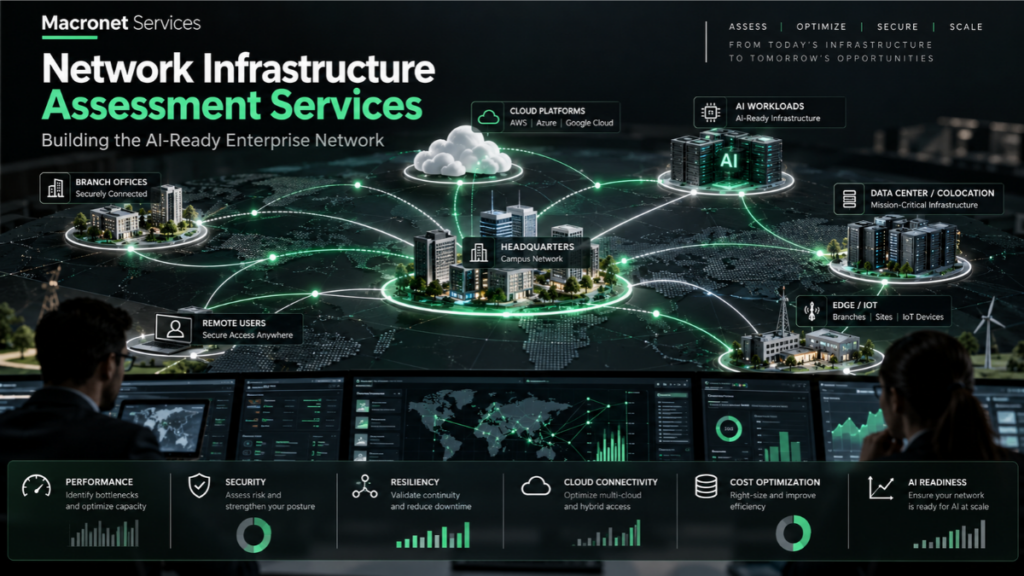
Network Infrastructure Assessment Services: A Complete Guide for AI-Ready Enterprises
Network Infrastructure Assessment Services: A Complete Guide for AI-Ready Enterprises explains how organizations can evaluate network architecture, performance, resiliency, security, cloud connectivity, carrier costs, and AI readiness. Learn what a comprehensive network infrastructure assessment includes, when to conduct one, and how Macronet Services can help identify risks, reduce costs, modernize infrastructure, and prepare the enterprise network for AI, cloud, IoT, and future business growth.

Data Center Power Explained: kW per Rack, A/B Power, Metered Power and AI Density
Data Center Power Explained: kW per Rack, A/B Power & AI. Learn how data center power is delivered, measured, protected, and scaled—from kW, kWh, kVA, three-phase power, A/B redundancy, and metered billing to PUE, rack density, liquid cooling, and the power requirements of high-density AI infrastructure.