

Network Infrastructure Assessment Services: A Complete Guide for AI-Ready Enterprises
Enterprise networks rarely become inefficient or overly complex all at once. The change usually happens gradually.
A new office needs internet service. A business acquisition introduces another carrier and another firewall platform. Applications move to the cloud, but some traffic continues to backhaul through corporate data centers. Employees become more distributed. SD-WAN is introduced at some locations but not others. Security architectures evolve. Bandwidth requirements increase. Contracts renew. New SaaS platforms appear. Voice migrates to Microsoft Teams or another cloud platform.
Over time, an enterprise can find itself operating a network that works, but no longer reflects how the business actually operates.
That is precisely where network infrastructure assessment services can create substantial value.
A network infrastructure assessment provides an objective evaluation of an organization’s connectivity, architecture, performance, resiliency, security, carrier environment, contracts, costs and readiness for future business requirements.
Increasingly, those future requirements include artificial intelligence.
Microsoft now includes Infrastructure for AI as one of the seven core pillars in its AI Readiness Assessment, alongside strategy, governance, data, organizational readiness and model management. AWS similarly emphasizes that network decisions involving latency, bandwidth, congestion, jitter, throughput and routing can materially affect application and workload performance in its Well-Architected Framework networking guidance.
Is your network designed for the business you have today, or the business you are building for tomorrow?
What Is a Network Infrastructure Assessment?
A network infrastructure assessment is a structured evaluation of an organization’s existing network environment to identify technical risks, performance limitations, resiliency gaps, unnecessary costs, architectural inefficiencies and opportunities for modernization.
Depending on the organization, an assessment may examine:
- LAN and WAN architecture
- Dedicated Internet Access and broadband
- MPLS and private networking
- SD-WAN
- SASE and Zero Trust architecture
- cloud connectivity
- Wi-Fi and wireless infrastructure
- routers, switches and firewalls
- carrier diversity
- data center and colocation connectivity
- voice and SIP infrastructure
- UCaaS and CCaaS connectivity
- IoT and edge networking
- circuit utilization
- contracts and carrier pricing
- network monitoring and operations
- disaster recovery and business continuity
- AI infrastructure readiness
The goal should not simply be to create a more accurate network diagram.
A strong network assessment answers a much more important question: What should the organization keep, change, consolidate, modernize or eliminate to better support the business?
An inventory tells you what you own. An assessment tells you what it means.
Why Do Companies Conduct Network Infrastructure Assessments?
There is rarely one universal trigger. In many cases, an assessment begins because several issues have accumulated simultaneously.
An enterprise may be experiencing network performance problems while also approaching major carrier renewals. Another may have completed several acquisitions and inherited a fragmented collection of network providers. A third may be moving applications into AWS, Azure or SaaS environments while continuing to route traffic through an architecture designed around a corporate data center.
Others are preparing for major initiatives involving AI, IoT, automation, cloud contact centers, real-time analytics or new facilities.
The network may still be functioning, but management has lost confidence that the current architecture is the right architecture.
Common assessment triggers include business growth, mergers and acquisitions, cloud migration, rising telecom expenses, network outages, poor application performance, aging equipment, security modernization, SD-WAN or SASE initiatives, major carrier contract renewals, data center changes and AI transformation programs.
Organizations preparing for significant modernization should also consider Macronet Services’ broader guide to network infrastructure consulting, which examines how AI, IoT, cloud services and changing application architectures are reshaping enterprise networking.
The important point is that a network assessment does not need to begin because something is broken. In many cases, the best time to assess the network is before something breaks—or before the organization commits millions of dollars to the next generation of infrastructure.
What Should Network Infrastructure Assessment Services Include?
No two enterprises are identical, but a comprehensive assessment should generally examine several interconnected dimensions. At Macronet Services, we believe the most useful assessments combine technical architecture, operational requirements, carrier economics and business strategy.
1. Business Requirements and Application Discovery
The assessment should begin with the business rather than the network.
What applications are critical? Where are employees located? Which facilities cannot tolerate an outage? What applications are moving to the cloud? Are customers interacting with the organization through digital platforms, voice, contact centers or APIs? Is the company expanding internationally? Are there acquisitions planned? What AI, IoT, automation or edge-computing initiatives are expected during the next several years?
Without this context, it is impossible to determine whether the current network is appropriate.
For example, two companies with 100 locations may require dramatically different architectures. A retailer processing transactions at every location has different resiliency requirements than a professional-services organization whose users primarily access Microsoft 365 and SaaS applications.
The objective is therefore not simply to ask: What network do we have? It is to ask: What does the business require the network to do?
2. Network Inventory and Technical Discovery
Once business requirements are understood, the organization needs an accurate view of its existing infrastructure.
Enterprise environments may contain dozens or hundreds of circuits, routers, switches, firewalls, wireless systems, carrier accounts, cloud connections and service contracts accumulated over many years.
One of the most common assessment challenges is that three versions of the network exist simultaneously: the network shown in the documentation, the network appearing on carrier invoices, and the network that actually exists.
Those versions do not always match.
A proper discovery process can examine site locations, carriers, circuit IDs, bandwidth, IP services, hardware, firewall platforms, WAN topology, routing, cloud connections, failover services, wireless infrastructure and critical dependencies. This process frequently identifies services that are undocumented, underutilized, duplicated or no longer necessary.
3. WAN and Internet Architecture
The wide area network remains one of the most important components of enterprise infrastructure.
An assessment should examine how locations reach applications, cloud services, corporate resources and the public internet.
Legacy architectures often routed nearly everything through a central data center because that was where applications and security controls resided. That architectural assumption has changed.
AWS identifies routing all traffic through existing data centers as a potential networking anti-pattern in modern cloud environments and recommends documenting workload characteristics including latency, bandwidth, protocols, locations, traffic patterns, throughput, encryption and routing requirements when designing network architecture. See AWS Well-Architected networking guidance.
An assessment should therefore determine whether traffic is following the most appropriate path. Questions may include whether internet traffic should return to a corporate data center, whether branch locations should use local internet breakout, whether SD-WAN would improve path selection, whether existing MPLS services are still necessary, whether NaaS would provide more flexibility, and whether private cloud connectivity should be introduced.
Macronet Services examines many of these evolving connectivity models in our guide to Network as a Service and AI-ready connectivity.
4. Network Performance and Capacity
More bandwidth does not automatically equal better network performance. A meaningful assessment examines the factors that actually influence application experience.
- bandwidth utilization
- latency
- jitter
- packet loss
- congestion
- routing
- throughput
- quality of service
- DNS performance
- application path
- geographic distance
AWS notes that the optimal network design depends on workload-specific requirements for latency, throughput, jitter and bandwidth. See AWS Well-Architected Framework: Network requirements.
This distinction becomes particularly important for voice, video, contact center platforms, virtual desktops, industrial systems and interactive AI applications.
For organizations modernizing voice infrastructure, Macronet Services’ guide to SIP trunking in the AI era explains how enterprise telephony is increasingly interconnected with cloud platforms, contact centers, analytics and conversational AI.
5. Network Resiliency and Carrier Diversity
Redundancy is one of the most misunderstood areas of network architecture.
An organization may believe that a site is protected because it has two circuits from two different carriers. But two different carrier logos do not necessarily create true infrastructure diversity.
- the same building entrance
- the same underground conduit
- the same utility pole route
- the same local fiber provider
- the same carrier hotel
- the same network aggregation point
- the same cloud connection
- the same power dependency
A proper infrastructure assessment therefore examines failure domains, not simply provider names. For critical locations, the organization should understand what would happen if a circuit fails, a carrier experiences an outage, fiber is cut, a data center becomes unavailable or a cloud region experiences a disruption.
It should also distinguish between network redundancy and business continuity. A secondary connection may restore new traffic after a failure but may not preserve active sessions. Similarly, redundant internet access does not necessarily protect an application if both paths ultimately depend on the same downstream infrastructure.
6. Cloud and Multi-Cloud Connectivity
Modern network assessments increasingly need to follow the applications. If workloads have moved away from corporate data centers, the network architecture should evolve accordingly.
- Corporate locations
- AWS
- Microsoft Azure
- Google Cloud
- Oracle Cloud Infrastructure
- SaaS platforms
- colocation facilities
- edge environments
- business partners
The right solution might involve public internet connectivity, private cloud on-ramps, direct cloud connections, carrier exchanges, colocation fabrics, SD-WAN, NaaS or combinations of these technologies. The objective is not necessarily to make every cloud connection private. It is to determine which workloads justify dedicated connectivity based on performance, security, cost, data-transfer requirements and business importance.
7. Security Architecture and Zero Trust Readiness
Network infrastructure and cybersecurity can no longer be evaluated completely independently. Traditional enterprise security often depended heavily on a network perimeter. Cloud computing, remote work, mobile devices and distributed applications have changed that model.
NIST describes Zero Trust as a shift away from static network-based perimeters toward protecting users, assets and resources. Its Zero Trust Architecture guidance notes that trust should not be granted solely because an asset or user exists in a particular network location.
A network infrastructure assessment does not need to replace a comprehensive cybersecurity assessment, but it should determine whether the architecture supports modern security requirements.
- segmentation
- internet breakout
- secure remote access
- firewall placement
- cloud security
- SASE
- Zero Trust Network Access
- DNS security
- secure web gateways
- identity-aware access
- east-west traffic controls
For organizations considering this transition, Macronet Services provides additional background in our overview of the evolution of network security with SASE.
8. Wireless, IoT and Edge Connectivity
In many businesses, the network is no longer primarily wired. Warehouses, hospitals, campuses, factories, construction sites, logistics facilities and field operations increasingly rely on a mixture of Wi-Fi, cellular, Private 5G, IoT networks and even satellite connectivity.
Macronet Services’ Enterprise Guide to Wireless Network Consulting examines how Wi-Fi, Private 5G, cellular connectivity and satellite are increasingly becoming complementary parts of enterprise architectures.
IoT introduces another layer of complexity because connectivity often extends beyond traditional corporate endpoints. Our complete guide to IoT solutions for business explores how connectivity, cloud platforms, devices, analytics, security and automation need to work together to create business value.
Carrier, Contract and Cost Analysis Should Be Part of the Assessment
This is an area where purely technical network assessments can fall short. An architecture can be technically excellent and still be commercially inefficient. That is why Macronet Services believes network infrastructure assessment services should also examine the economics surrounding the environment.
- Are circuit prices competitive?
- Are there services the company no longer needs?
- Are old circuits still being billed?
- Could bandwidth be increased without significantly increasing cost?
- Do carrier contracts expire at strategically useful times?
- Are locations under several different master agreements?
- Are renewal provisions creating unnecessary risk?
- Could suppliers be consolidated?
- Would introducing another carrier improve both pricing and resiliency?
- Should the organization conduct an RFP?
- Do current contracts align with the planned network transformation?
Carrier economics can also affect architectural decisions. Macronet Services explores that subject in detail in Enterprise Fiber Buildout: How to Get Fiber to an Off-Net Building.
The network should be assessed as both a technical system and a portfolio of commercial commitments.
Why Network Infrastructure Assessments Matter More in the Age of AI
Artificial intelligence adds another reason for enterprises to understand their network architecture before embarking on major transformation initiatives. This does not mean every company needs to rebuild its WAN because employees are using generative AI. It does mean AI introduces new workload patterns that should be considered when evaluating future infrastructure.
AI Is Becoming Distributed
Enterprise AI is unlikely to exist in one place. An employee may interact with an AI application hosted as SaaS. That application may retrieve corporate data from another cloud environment, invoke external APIs, communicate with a business system, use a model hosted elsewhere and trigger an automated workflow. The network connecting those systems matters.
Microsoft’s AI Readiness Assessment explicitly identifies Infrastructure for AI as a foundational pillar organizations should examine when evaluating preparedness for AI adoption.
AI Agents Change Traffic Patterns
Traditional enterprise applications were largely designed around human interaction. AI agents introduce a different operating model. An autonomous agent may interact with several systems, retrieve data, call APIs, query databases, invoke another agent and execute business processes without a human initiating every individual transaction.
The resulting architecture increasingly involves: machine-to-machine traffic, application-to-application traffic and agent-to-application traffic.
Macronet Services examines these emerging traffic patterns further in Securing AI Across a Global WAN.
Latency Can Become More Important
Not every AI application is particularly latency sensitive. Some are. Interactive AI assistants, voice agents, computer vision, industrial automation and real-time inference can place greater importance on response times.
In a conversational voice system, for example, several small delays can accumulate across speech recognition, networking, model inference, APIs and text-to-speech processing. The customer experiences the total delay.
AWS identifies latency, bandwidth, congestion, jitter, throughput and routing rules among the network factors affecting workload and user experience. See AWS Well-Architected networking guidance.
AI Can Increase Data Movement
Some AI use cases involve substantial datasets moving among enterprise locations, cloud services, data platforms and model environments. Others move relatively little data. The point of an assessment is not to assume that AI automatically requires enormous bandwidth. It is to understand which AI workloads the organization expects to deploy and what those workloads actually require.
Macronet Services’ broader AI Readiness Assessment guide provides additional context for organizations evaluating their overall ability to scale artificial intelligence.
What Does a Network Infrastructure Assessment Deliver?
A good assessment should not conclude with an overwhelming list of technical problems. It should produce a prioritized business roadmap. The output may include a current-state architecture, inventory findings, performance analysis, resiliency gaps, carrier analysis, contract findings, security observations, cloud-connectivity recommendations and future-state design.
Immediate risk reduction: Address single points of failure, unsupported infrastructure, severe performance issues, critical security gaps or services approaching problematic contract deadlines.
Near-term optimization: Improve carrier pricing, eliminate unnecessary services, increase bandwidth where justified, improve routing or consolidate vendors.
Strategic modernization: Evaluate SD-WAN, SASE, cloud connectivity, wireless modernization, NaaS or other architectural changes.
Future readiness: Prepare the infrastructure for increased AI adoption, automation, IoT, edge workloads, mergers, geographic expansion or new digital business models.
How Long Does a Network Infrastructure Assessment Take?
There is no universal duration. A relatively straightforward organization with several locations may be reviewed quickly. A multinational enterprise with hundreds of sites, several carriers, multiple cloud platforms and extensive legacy infrastructure requires a much deeper effort.
- number of locations
- complexity of the WAN
- quality of existing documentation
- number of carriers and contracts
- geographic scope
- availability of utilization data
- cloud architecture
- security complexity
- number of stakeholders
- depth of the desired future-state design
How Much Does a Network Infrastructure Assessment Cost?
Cost depends on scope. Some assessments are formal consulting projects requiring extensive engineering, documentation, traffic analysis, vendor interaction and architectural design. Others can begin as a relatively lightweight review.
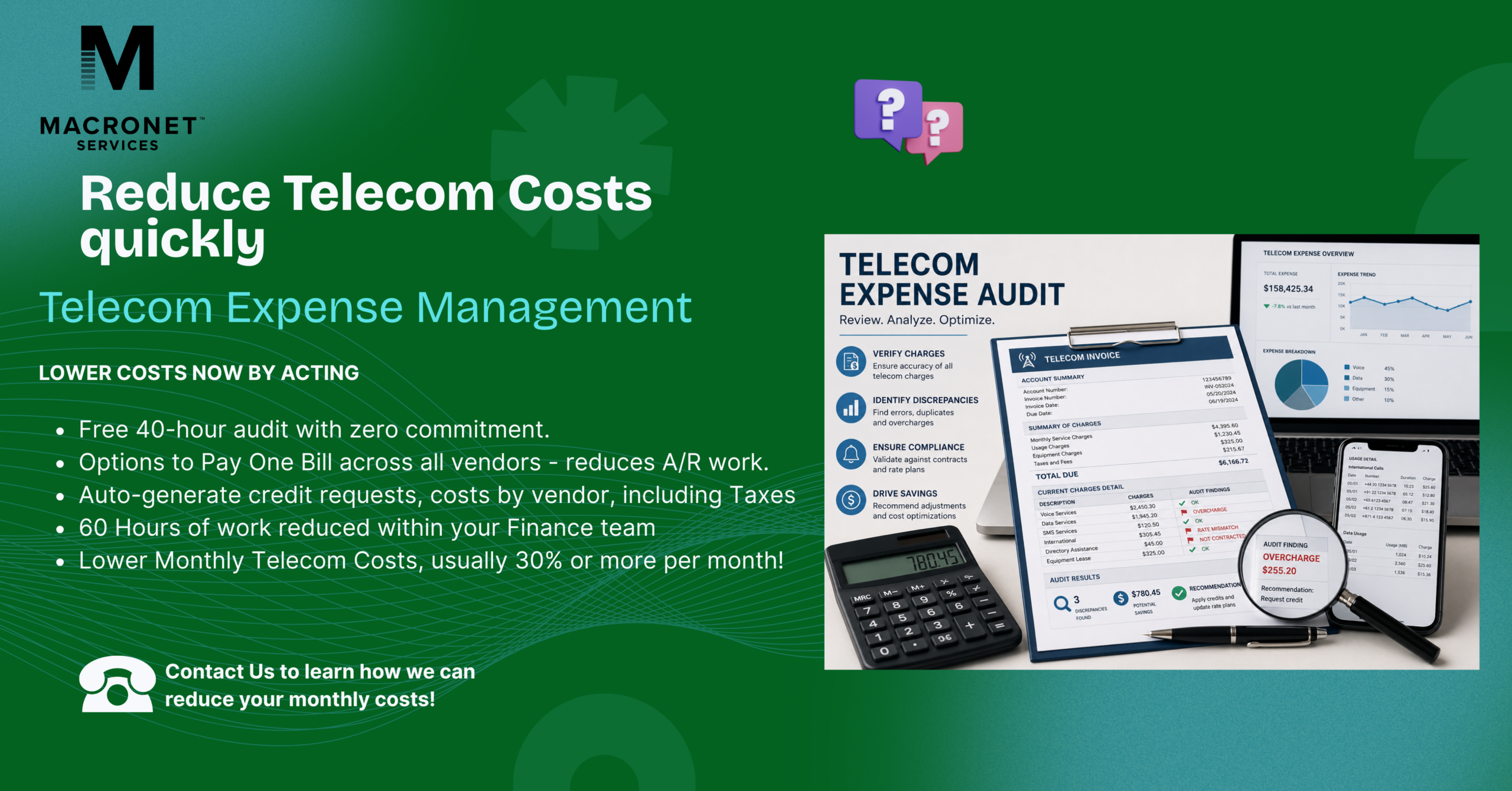
Macronet Services offers free assessments of customer environments to determine where we can help, according to our consulting model. Learn more at Macronet Services.
That creates a practical starting point for organizations that know they need an objective review but are not yet certain whether a large consulting engagement is justified. A complimentary initial assessment can help identify whether significant opportunities exist in architecture, cost, carrier strategy, resiliency or modernization before determining the appropriate next step.
Why Use an Independent Network Infrastructure Consultant?
Vendors can provide valuable expertise. But vendors also naturally view the environment through the lens of the products and services they sell. The enterprise has a different responsibility: determine what combination of technologies, carriers and architectures best serves the business.
Macronet Services works across a broad ecosystem of network providers and technology platforms rather than beginning with the assumption that one carrier or vendor is automatically the answer.
Our existing consulting methodology includes technical discovery, IT auditing, solution architecture, network design, RFP development, negotiation, transition management and ongoing vendor governance. See Macronet Services Consulting Services.
The Macronet Services Network Infrastructure Assessment Framework
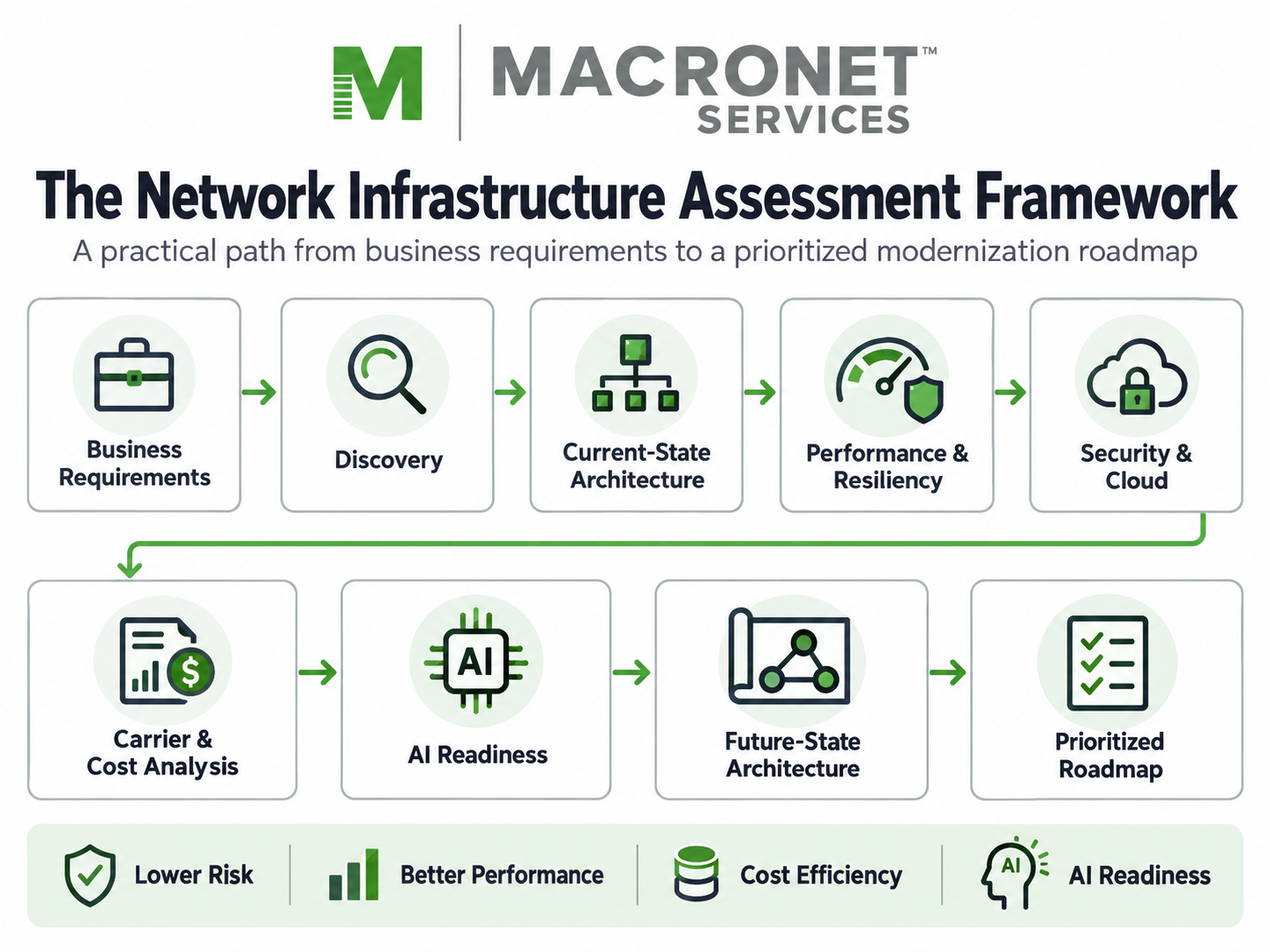
Each stage builds on the previous one.
The business requirements define what the network needs to accomplish. Discovery determines what actually exists. Technical assessment identifies weaknesses and constraints. Commercial analysis determines whether services are economically efficient. Future-state design identifies the desired architecture. The roadmap determines how to get there.
That is fundamentally different from simply performing an audit.
Common Network Assessment Findings
Every environment is different, but certain patterns appear repeatedly.
A company may discover that primary and backup circuits do not have true physical diversity. An MPLS network may still be routing SaaS traffic through a data center even though most applications have moved to the cloud. Sites may be paying premium prices for bandwidth levels that were negotiated years earlier. A carrier contract may renew automatically before a planned modernization. Cloud connections may have been added individually without an overall multi-cloud strategy. Firewall and WAN architectures may have evolved independently. Wireless infrastructure may not support increasing IoT density. Network documentation may contain services that no longer exist—or fail to contain services that are actively being billed.
None of these problems is unusual. That is precisely why periodic assessment is valuable.
When Should a Company Conduct a Network Infrastructure Assessment?
There is no requirement to wait for a major problem. An assessment can be particularly valuable when an organization is approaching a major carrier renewal, acquisition, cloud migration, SD-WAN deployment, SASE initiative, office consolidation, new facility, data center exit, UCaaS or CCaaS migration, AI program, IoT initiative or broad cost-reduction effort.
If the business is changing materially, the assumptions behind the network should be reexamined.
Network Infrastructure Assessment FAQ
What is a network infrastructure assessment?
A network infrastructure assessment is a structured review of an organization’s network architecture, connectivity, performance, resiliency, security, cloud integration, carriers, costs and future requirements. Its purpose is to identify risks and opportunities and develop a roadmap for improvement.
What is included in network infrastructure assessment services?
Services may include network discovery, circuit inventory, WAN analysis, internet connectivity, SD-WAN, cloud connectivity, wireless infrastructure, carrier diversity, performance, resiliency, security architecture, telecom expenses, contract analysis and future-state network design.
What is the difference between a network audit and a network assessment?
A network audit generally focuses on documenting or verifying the current environment. A network assessment goes further by evaluating whether that environment is effective and recommending changes based on business, performance, risk and cost considerations.
Can a network assessment reduce telecom costs?
Yes. Assessments frequently identify unused services, outdated pricing, unnecessary circuits, inefficient bandwidth allocations, unfavorable contracts or opportunities to consolidate suppliers. Cost optimization should, however, be balanced against resiliency, performance and future requirements.
Does a network assessment include cybersecurity?
Network security should be evaluated as part of the architecture, particularly segmentation, firewall placement, secure remote access, SASE, Zero Trust and cloud security. A network infrastructure assessment is not necessarily a substitute for a comprehensive cybersecurity assessment.
What is an AI-ready network?
An AI-ready network is an enterprise network designed to support the connectivity, performance, security, data movement, cloud integration and resiliency requirements of the organization’s anticipated AI workloads. There is no universal AI-ready architecture because requirements vary substantially by use case.
Does AI require more network bandwidth?
Sometimes, but not always. AI workloads vary widely. Some involve large datasets or real-time inference while others resemble conventional SaaS traffic. Organizations should assess the bandwidth, latency, location, traffic flow and security requirements of actual AI use cases rather than assuming every AI initiative requires major network upgrades.
When should a network infrastructure assessment be performed?
Organizations should consider an assessment before major contract renewals, network modernization, cloud migrations, mergers, new facilities, AI initiatives or significant changes in business operations. Periodic assessments are also useful for identifying technical debt and unnecessary expense before they become larger problems.
How much does a network infrastructure assessment cost?
Cost depends on the size and complexity of the environment and the depth of analysis required. Macronet Services can begin with a complimentary assessment to identify potential areas of opportunity and determine whether a deeper engagement is warranted.
The Network Is Becoming More Important, Not Less
Cloud computing once led some organizations to believe the enterprise network would become a commodity. The opposite has happened.
Applications moved to the cloud. Employees became distributed. Security moved closer to users and applications. Voice became software. IoT connected physical operations. Data became distributed. And now AI is beginning to connect people, applications, APIs, data and autonomous agents in entirely new ways.
The network is the infrastructure connecting all of it.
That does not mean every organization needs the newest technology. It means every organization should understand whether its existing network is aligned with its business strategy.
A network infrastructure assessment creates that visibility. And the most valuable assessment is not the one that produces the longest report. It is the one that helps leadership make better decisions.
Start With a Complimentary Network Infrastructure Assessment
If your organization is approaching a network refresh, carrier renewal, cloud migration, AI initiative, acquisition or cost-reduction program, Macronet Services can help you evaluate your current environment before you commit to the next architecture.
Our team can review your network, carrier services, contracts, resiliency, costs and business requirements to identify potential opportunities and determine whether a more comprehensive assessment is warranted.
In many cases, the initial assessment can be provided at no charge.
Understand what you have. Identify what is creating risk or unnecessary expense. Determine what the business will require next. Then build the right path forward.
Contact Macronet Services to request a complimentary network infrastructure assessment