

IP transit is one of the fundamental services that makes the global Internet work, yet it remains poorly understood outside of network engineering.
At its simplest, IP transit is a commercial service through which one network pays another network to provide reachability to destinations across the broader Internet. But that definition understates what an organization is actually buying.
A well-designed IP transit service combines physical connectivity, Internet reachability, BGP routing, public IP addressing, backbone capacity, interconnection with other networks and operational support. In more sophisticated environments, transit becomes part of a broader architecture involving multiple upstream providers, Internet peering, route engineering, DDoS protection, RPKI, geographic diversity and direct interconnection with clouds, content platforms and other networks.
Those distinctions matter because buying IP transit is very different from simply ordering an Internet circuit.
A business evaluating transit may need to decide which providers have the strongest routes to its customers, whether to accept a full Internet routing table or a default route, whether it needs its own Autonomous System Number (ASN), how much bandwidth to commit to, whether traffic should also be exchanged through Internet Exchange Points (IXPs), and how to ensure that two supposedly redundant providers do not share the same physical infrastructure.
The economics can be equally complicated. A low price per megabit may look attractive until cross connects, carrier ports, transport, IP addressing, DDoS protection, equipment and contractual commitments are included.
The real question for CIOs, infrastructure leaders and network architects is therefore not simply Who offers the cheapest IP transit? It is what combination of providers, routing architecture, physical connectivity, peering, capacity and commercial terms will give the organization the right balance of performance, resiliency, control and cost?
This guide explains the technology and the business decisions behind IP transit – from the fundamentals of BGP and Internet routing through providers, pricing, peering, multihoming, security, procurement and implementation.
Macronet Services works with enterprises evaluating Tier 1 ISPs, Dedicated Internet Access, IP transit, global WAN connectivity, data center interconnection and multi-provider Internet architectures. The objective here is not simply to explain IP transit, but to show how it should actually be evaluated and designed. With access to more than 400 service providers, Macronet Services helps clients design the right solution, identify the providers best suited to their requirements, and competitively source those services in an objective, provider-agnostic manner—typically at no direct cost to the client.


| What is IP transit? IP transit is a commercial Internet service through which one network pays another network to provide reachability to destinations across the global Internet. IP transit commonly uses BGP so a customer can advertise its public IP prefixes and receive routes from its upstream provider. |
IP Transit at a Glance
| Attribute | IP Transit |
| Primary purpose | Provide broad or global Internet reachability |
| Typical customers | ISPs, hosting providers, SaaS companies, content platforms, cloud providers, data center operators and sophisticated enterprises |
| Routing | Commonly BGP; implementation varies by provider and use case |
| Public addressing | Customer-controlled or provider-supported address space |
| Route options | Full Internet table, selected/partial routes or default route |
| Common interfaces | 1G, 10G, 100G and increasingly 400G |
| Common billing models | Flat rate, committed bandwidth and commit-plus-burst |
| Resiliency model | Frequently multihomed across two or more upstream networks |
| Complementary technology | Public or private Internet peering |
| Common enterprise alternative | Dedicated Internet Access |
1. What Is IP Transit?
IP transit is a service in which one network pays another network to provide reachability beyond the customer’s own network and direct interconnections.
The company purchasing transit is commonly considered a downstream or customer network. The transit provider is its upstream provider.
The customer sends traffic to the provider when it needs to reach destinations that are not available through its own internal networks, customers or direct peers. The transit provider uses its backbone, customer relationships, peering relationships and other interconnections to carry that traffic toward its destination.
The same relationship also helps other networks find a path back to the customer. This is important because Internet connectivity is fundamentally a routing problem, not merely a bandwidth problem.
Two providers can deliver identical 100 Gbps interfaces in the same data center and still create materially different application experiences. Their networks may exchange traffic with different destinations in different cities. One may hand traffic directly to an important cloud or access network, while another may carry the same traffic much farther before reaching the destination network.
The Ethernet port can be identical. The route is not.

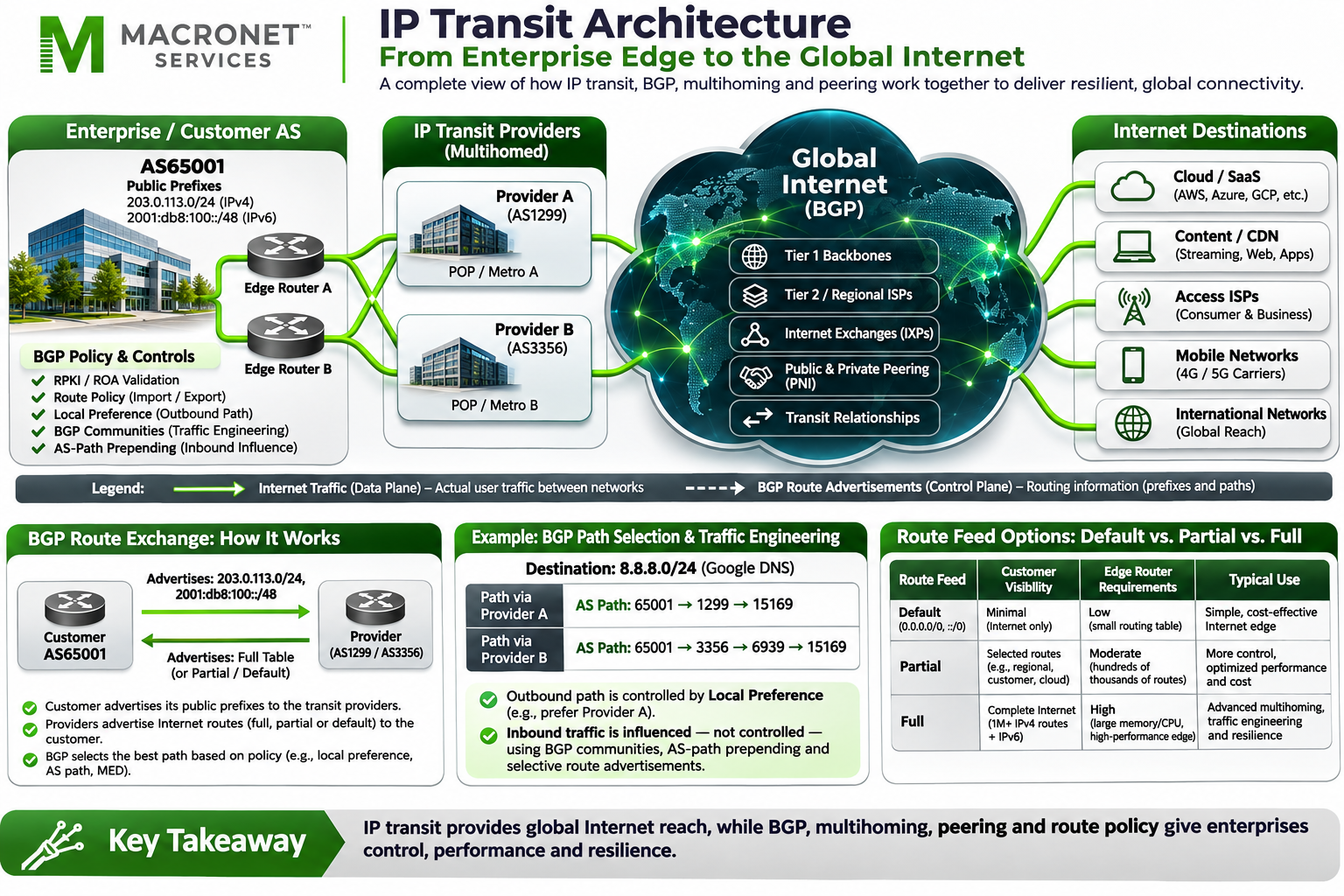
IP Transit Is Not Necessarily a Full BGP Table
A common misconception is that IP transit automatically means receiving every Internet route through BGP. It does not.
A provider can supply Internet reachability while delivering a default route, a selected or partial route set, or the full global routing table. The appropriate model depends on the architecture.
A single-homed customer may gain little benefit from storing more than a million IPv4 Internet routes. A sophisticated multihomed network may want full visibility because it can choose among paths learned from several providers.
The important principle is that routing information and Internet reachability are related but are not the same thing. An organization should request the routing information necessary to support its architecture – not the largest route set available simply because it sounds more sophisticated.
2. How the Internet Works: ASNs, Transit and Peering
The Internet is not one centrally operated network. It is a collection of independently managed networks that exchange traffic according to technical policy and commercial relationships.
These routing domains are called Autonomous Systems, or ASes. Public Autonomous Systems use Autonomous System Numbers to identify themselves when exchanging routing information.
The Internet Engineering Task Force’s foundational BGP specification describes BGP as an inter-Autonomous System routing protocol whose primary function is exchanging network reachability information, including information about the Autonomous Systems through which a route has passed. RFC 4271
That structure creates several important relationships. A network can have customers that pay it for connectivity. It can purchase transit from another network. It can also establish peering relationships that allow two networks to exchange eligible traffic directly.
CAIDA’s Internet-topology research models these customer-provider and peer relationships and uses observed BGP data to study how Autonomous Systems relate to one another. CAIDA AS Relationships
At the top of the traditional Internet hierarchy are networks commonly described as Tier 1 ISPs – networks that can reach the rest of the Internet without buying upstream transit.
Macronet Services examines those relationships in greater depth in its Tier 1 vs. Tier 2 vs. Tier 3 ISPs guide and its analysis of the leading global Tier 1 ISPs.
For an IP transit customer, the underlying principle is straightforward: if you do not have a direct route to a destination, another network needs to provide one. That is what transit delivers.
3. How IP Transit Works End to End
Consider a SaaS provider operating public infrastructure in a carrier-neutral data center. The company has its own ASN and public IP address space. It installs an edge router and orders a 100 Gbps IP transit service.
The first requirement is physical connectivity. If both networks are present in the same data center, that may be a fiber cross connect between the customer and carrier. If the provider is not in the same facility, additional metro Ethernet, wavelength, transport or software-defined interconnection may be required.
Macronet Services’ Data Center Cross Connects: Enterprise Guide explains this Layer 1 foundation in depth.
Once physical connectivity and Layer 3 addressing are established, the customer and transit provider can establish a BGP relationship.
Advertising the Customer’s Network
The customer advertises its public prefix toward the transit provider. Conceptually, the advertisement says: This network can be reached through my Autonomous System.
The provider applies its routing policy and can propagate that reachability to other networks. Over time, routing information spreads across interconnected Autonomous Systems so that networks elsewhere on the Internet know how to reach the customer’s address space.
Learning How to Reach the Internet
The provider also supplies the customer with routing information. That might be a default route, a partial route set or a full Internet routing table.
The customer’s router uses that information and its locally defined policies to decide where outbound traffic should go.
The result is a bidirectional reachability system: the customer needs routes toward the Internet, and the Internet needs routes back toward the customer. Those two paths do not necessarily match.
Internet routing is frequently asymmetric, which becomes particularly important once an organization uses several providers.
4. ASN, IP Addresses, BGP and Physical Connectivity
Four concepts form the foundation of a traditional transit architecture.
Autonomous System Number
An Autonomous System is a network or group of networks operating under a common routing policy. Its ASN provides a public routing identity. For a multihomed organization, that identity becomes especially important because the same customer AS can establish BGP relationships with several upstream networks.
Public IP Address Space
The second component is the public address space being advertised. Provider-assigned addresses can be convenient, particularly for conventional enterprise Internet access. Customer-controlled addresses can provide greater portability.
If an organization advertises the same portable prefix through two transit providers, it may be able to replace one upstream provider without renumbering all of the public infrastructure behind it. For public digital services, that can have enormous operational value.
BGP
BGP exchanges network reachability and the attributes networks use to apply routing policy. The IETF’s BGP specification defines important attributes such as AS_PATH, NEXT_HOP, MULTI_EXIT_DISC and LOCAL_PREF. RFC 4271
This policy-driven nature is what makes BGP particularly important in multihoming. An organization can prefer one upstream over another, maintain a backup route, or use more sophisticated policies to distribute traffic.
Physical Connectivity
Finally, the logical routing diagram must be supported by real infrastructure. A typical data center connection may involve customer router -> optic -> cross connect -> Meet-Me Room -> carrier edge -> provider backbone.
In another location, it may involve a local loop or third-party transport provider. This matters because logical carrier diversity is not the same as physical diversity.
Macronet Services’ Data Center Connectivity guide discusses these physical dependencies in more detail, including carrier paths, cloud on-ramps, cross connects and interconnection architecture.
5. IP Transit vs. Dedicated Internet Access (DIA)
IP transit and Dedicated Internet Access both provide Internet connectivity, but they generally serve different operating models.
DIA is usually designed to give an enterprise dependable Internet access. IP transit is usually designed for an organization that needs greater control over public Internet routing.
A corporate office using Microsoft 365, SaaS applications, VPNs and cloud services may need highly available Internet connectivity but have no reason to participate actively in global BGP routing. DIA is often the natural fit.
A SaaS company operating its own ASN, public IP space and several upstream providers has a different requirement. It may need to advertise prefixes, compare routes, use BGP communities and control how its Internet edge behaves. Transit may be much more appropriate.
The difference is not simply bandwidth. A company can buy very large DIA circuits. Nor is BGP alone the dividing line. DIA can use BGP.
The more useful question is: Does the organization primarily need Internet access, or does it need meaningful control over public Internet routing?
Macronet Services’ Dedicated Internet Access guide explores enterprise DIA architecture, pricing and provider selection in greater depth.
| Characteristic | IP Transit | Dedicated Internet Access |
| Primary goal | Internet reachability plus routing control | Reliable enterprise Internet access |
| Typical user | Network operator or sophisticated enterprise | Enterprise location or data center |
| BGP | Common | Optional |
| Customer ASN | Common in traditional designs | Usually unnecessary |
| Routing control | High | Generally lower |
| Multihoming | Common | Also possible |
| Operational complexity | Higher | Lower |
More sophisticated technology is not automatically better architecture. If an organization has no business reason to operate public routing, adding that complexity may provide very little value.
6. IP Transit vs. Peering
Transit and peering solve different problems. With transit, a customer pays a provider for broad Internet reachability. With peering, two networks exchange eligible traffic directly.
Suppose two networks exchange a significant amount of traffic through their respective transit providers. If they establish a direct peering relationship, they may be able to exchange that traffic without sending it through the normal transit path. That can potentially reduce cost, shorten the route and improve performance.
But peering generally does not provide universal Internet reachability. If Network A peers with Network B, Network B does not normally advertise the entire Internet to Network A. It advertises the routes covered by their peering relationship.
Network A still needs a way to reach everything else. That is why transit and peering are usually complementary.
Public Peering
Public peering typically takes place through an Internet Exchange Point. An IXP provides shared interconnection infrastructure through which participating networks can establish BGP relationships. A single IXP connection may provide access to many prospective peers, making public peering much more scalable than installing a dedicated physical circuit to every network.
Macronet Services’ guide to IXPs and Internet peering examines this model in greater depth.
Private Peering
When two networks exchange sufficiently large traffic volumes, they may establish a dedicated Private Network Interconnect, or PNI. This can provide dedicated capacity between the networks rather than relying on shared exchange infrastructure.
Settlement-Free and Paid Peering
Some peering relationships are settlement-free, meaning neither network pays the other for the exchanged traffic. That does not make the connection literally free. Routers, ports, transport, colocation and cross connects still cost money.
Other relationships involve paid peering, where one network pays for direct access to another network or its customers without purchasing traditional full transit.
The Internet is therefore not divided neatly into paid transit and free peering. Interconnection exists across a spectrum of technical and commercial models.
7. IP Transit vs. Peering vs. DIA
| Characteristic | IP Transit | Public Peering | Private Peering | DIA |
| Reachability | Broad/global | Peer routes | Peer routes | Global Internet |
| Commercial model | Paid transit | Often settlement-free plus infrastructure cost | Settlement-free or paid | Paid Internet access |
| BGP | Common | Yes | Yes | Optional |
| ASN usually needed | Common | Yes | Yes | Generally no |
| Routing control | High | High for peer routes | High for peer routes | Usually lower |
| Typical objective | Universal reachability | Optimize selected traffic | Optimize high-volume direct traffic | Enterprise Internet access |
A sophisticated network can use all four. For example, a SaaS platform might use two transit providers for universal reachability, public peering at several IXPs, PNIs with very large destinations and DIA for corporate offices.
The right question is not which technology is best. It is what job each connection is supposed to perform.
8. Who Needs IP Transit?
IP transit becomes compelling when an organization begins to operate like a network operator rather than simply a consumer of Internet connectivity.
Common candidates include ISPs, hosting companies, cloud platforms, content providers, SaaS companies, CDNs, gaming companies, data center operators and enterprises that maintain major public Internet gateways.
The organization may need provider-independent routing, multihoming, control over public prefixes, direct peering or sophisticated traffic engineering.
Size is not the deciding factor. A very large corporation may have no reason to manage Internet routes itself. A much smaller digital business may depend entirely on global Internet performance and therefore have a strong case for its own ASN, portable address space and multiple upstreams.
A useful rule is: Control has value only when the organization has a reason to exercise it.
Running public BGP creates operational responsibility. Someone needs to maintain routing policy, validate announcements, monitor providers and understand failure behavior. If the business does not benefit from that control, DIA may remain the better architecture.
9. Tier 1 vs. Tier 2 IP Transit Providers
Tier 1 networks occupy an important position within the Internet hierarchy, but Tier 1 status should not be treated as a universal quality rating.
A Tier 1 provider may have exceptional global reach while another network has more direct connectivity to the actual users, clouds or access networks that matter to a particular application.
A strong regional provider may also own better local fiber infrastructure or peer more extensively with important local networks. That means a Tier 2 or regional network can be an excellent transit provider for the right requirement.
CAIDA’s AS Rank is useful for understanding Internet topology. It ranks ASes primarily by customer-cone size and uses observed BGP data to infer network relationships. CAIDA AS Rank FAQ
But customer-cone size is not a provider-selection score. A large customer cone does not tell an enterprise which provider has the best route to a critical customer, whether the carrier is physically on-net in the correct building, whether its support is strong, whether its DDoS service is appropriate, or whether it complements another transit provider.
Topology data should inform the analysis, not replace it.
Macronet Services’ Tier-1 ISPs and Global Enterprise Networks analysis explores why provider position, routing structure and enterprise architecture need to be considered together.
10. Major Global IP Transit Providers
Enterprises evaluating global transit will frequently encounter networks such as Lumen, Arelion, GTT, NTT, Cogent and Tata Communications, along with other highly interconnected global or regional providers such as Hurricane Electric.
The objective of this guide is not to declare one of these companies best. Provider strength varies by geography, facility, peering, customer base, backbone topology, routing features, local access, pricing and the other upstreams in the customer’s architecture.
Current market research also shows that transit interfaces continue to scale, with 100G widely established and 400G sales increasing materially. TeleGeography reports that while 100 GigE remains the dominant level for global IP transit sales, carriers are seeing significant growth in 400 GigE, driven in part by hyperscalers and networks preparing for AI-related traffic. TeleGeography IP Transit Pricing Research
For a detailed discussion of the major global backbone providers, see Macronet Services’ 8 Leading Global Tier 1 ISPs.
11. How to Choose an IP Transit Provider: The Macronet Services Framework
The best transit provider is not determined by one metric. Macronet Services recommends evaluating providers across the complete end-to-end architecture.
Network Reach and Topology
Start with where the provider actually has network infrastructure relative to the customer’s locations. A global map showing hundreds of cities is less useful than knowing whether the provider has the right POP, router and physical presence in the required facility.
PeeringDB is particularly useful for preliminary interconnection research. The nonprofit database tracks tens of thousands of networks, more than a thousand exchanges and thousands of facilities. PeeringDB
Critical details should still be validated directly during provider design.
Destination Alignment and Peering
The next question is not simply how large the backbone is. It is: How well does that backbone reach the networks that matter to our business?
For one company, that might mean major consumer broadband networks. For another, it might mean AWS, Microsoft, Google or Oracle. For another, it may be access networks in Brazil, Germany or Japan.
Provider evaluation should examine actual destination alignment and interconnection – not just broad geographic coverage.
BGP Capability
The customer should determine what route sets the provider supports and what control it exposes through BGP communities and policy. A company using BGP only for failover has a very different requirement from an Internet platform actively managing inbound and outbound paths.
Physical Diversity
A spreadsheet can show two independent carriers while the fiber paths tell a different story. Both services may share a building entrance, conduit, local fiber provider, carrier hotel or metro route.
Macronet Services’ Colocation RFP Guide discusses why provider diversity and path diversity should be evaluated separately.
Real-World Route Performance
Carrier backbone averages are useful, but destination-specific testing is better. Macronet Services’ Tier 1 ISP Global Latency Samples illustrates how network latency varies materially between cities and routes.
A provider should be tested against the customer’s traffic, not against an abstract idea of the Internet.
Routing Security and DDoS
RPKI, prefix filtering, route validation, blackholing and DDoS mitigation should be part of provider evaluation rather than post-sale features added later.
SLA and Operations
The SLA should be evaluated alongside the quality of the provider’s operational organization. Macronet Services’ Tier 1 ISP SLA guide examines availability, latency, packet delivery, MTTR and service-credit structures in more depth.
Capacity and Scalability
The design should consider where traffic may be three years from now, not simply where it is today. If an organization expects significant growth, the ability to increase the commit without replacing the underlying interface can be valuable.
Total Commercial Economics
Finally, compare the complete solution rather than the advertised $/Mbps. That includes transit, ports, cross connects, local transport, DDoS, addressing, equipment, implementation and contractual terms.
The result should be an architecture score – not simply a carrier price list.
12. IP Transit Pricing in 2026: How Much Does IP Transit Cost?
IP transit pricing continues to decline, but there is no single meaningful global price. Geography matters enormously.
TeleGeography reports that across the cities in its current analysis, 100 GigE transit pricing fell at a 17% compound annual rate between Q2 2023 and Q2 2026. The lowest observed 100G offers in the most competitive markets remained around $0.03 per Mbps per month, while the lowest 10G offers were approximately $0.07 per Mbps. Its data excludes local access and installation fees. TeleGeography IP Transit Pricing Research
Those figures are valuable market benchmarks. They are not what every enterprise should expect to pay. They reflect highly competitive wholesale environments, often in major carrier hubs.
The same service in a market requiring local transport, limited carrier competition or international capacity can be much more expensive.
This leads to an important purchasing principle: IP transit is a global service sold through local markets. Where the customer connects can materially change the economics.
TeleGeography also reports growing 400G demand and a weighted median 400G price of approximately $0.08/Mbps in the key U.S. and European cities included in its Q2 2026 data. Again, these should be treated as market indicators rather than enterprise quotes. TeleGeography
13. IP Transit Billing: Port Speed, Commit and 95th-Percentile Billing
A buyer needs to distinguish between the physical interface and the amount of bandwidth being purchased commercially.
Consider: 100G port with a 20G commit. The customer has a 100G interface. Its committed bandwidth is 20G. Depending on the contract, the customer may be able to burst well above 20G and pay additional usage charges.
This can be much more flexible than sizing the physical interface exactly to current traffic.
How 95th-Percentile Billing Works
95th-percentile billing is commonly used for variable Internet traffic. The provider samples traffic throughout the month, often at five-minute intervals. The measurements are sorted, the highest 5% are discarded, and the highest remaining sample becomes the 95th-percentile utilization.
For a 30-day month with five-minute samples: 12 samples/hour x 24 hours x 30 days = 8,640 samples. Five percent is 432 samples. Those 432 highest measurements are ignored. The next-highest sample represents P95 usage.
This allows occasional short spikes without billing the customer based on the single highest traffic event. Sustained bursts are different. If usage remains high for enough of the month, it will still raise the 95th percentile.
Worked Example
Assume a 100G port, 20G commit, $0.08/Mbps illustrative committed rate, $0.10/Mbps illustrative burst rate and 31G 95th-percentile utilization. These numbers are deliberately hypothetical and should not be interpreted as current market pricing.
The committed charge would be 20,000 Mbps x $0.08 = $1,600. Usage above the commit is 31,000 – 20,000 = 11,000 Mbps. Burst charge is 11,000 x $0.10 = $1,100. Total bandwidth charge is therefore $2,700.
That calculation still excludes cross connects, transport, DDoS, addressing and other possible charges. This is why two carriers quoting the same committed $/Mbps may produce very different actual monthly costs.
14. Flat Rate vs. Commit-and-Burst vs. Aggregate Commit
A flat-rate service provides predictable monthly spending. For networks that consistently consume most of their capacity, this can be attractive.
A commit-and-burst structure provides more flexibility. The customer commits to a baseline level but can exceed it when traffic increases.
Some provider arrangements also allow bandwidth commitments to be aggregated across several connections. That can be useful for multinational environments where peaks occur at different times.
Instead of asking only What is your price per Mbps?, the buyer should ask Which billing structure best matches our traffic profile? The second question produces a much more meaningful commercial comparison.
15. The Hidden Costs of IP Transit
The transit rate is only one part of the total cost.
A useful TCO model is Transit bandwidth + carrier port + cross connect + local access or backhaul + equipment and optics + DDoS + public addressing + installation + facility charges + applicable taxes and surcharges = total IP transit cost.
This matters particularly in data centers. A provider with a slightly higher transit rate may be physically present in the customer’s Meet-Me Room and require only a cross connect. A cheaper provider may require a metro transport circuit costing thousands of dollars per month.
The apparently cheaper transit offer can therefore become the more expensive architecture.
Macronet Services’ guide to ISP taxes, fees and surcharges provides additional context on expenses that can be overlooked when evaluating carrier pricing.
16. When Does Peering Become More Economical Than IP Transit?
As traffic grows, organizations often ask whether direct peering can reduce transit costs. There is no universal break-even threshold. The answer depends on where traffic is going and what it costs to reach the peer.
A useful model compares transit expense avoided against IXP or private-port cost + cross connect + transport + router capacity + operational expense.
A 2026 Internet Society analysis of global IXP economics found a substantial structural cost advantage for peering over transit in its historical dataset. The study also found that IXP port fees represented only about 44% of total peering-related costs on average, with transport, colocation and cross-connect expense accounting for much of the remainder. Internet Society IXP Economics Study
The study’s absolute transit figures should not be compared directly with today’s lowest wholesale transit prices in New York, London or other competitive hubs because its dataset spans multiple years and very different geographies.
The broader conclusion remains valuable: direct interconnection can fundamentally change Internet economics when enough traffic is concentrated toward the right networks.
Traffic concentration matters more than total traffic. A network sending 100 Gbps across thousands of destinations may have fewer obvious peering opportunities than a 20 Gbps network sending 12 Gbps to one access provider.
That is why mature networks analyze traffic by destination ASN rather than simply looking at aggregate utilization.
17. BGP for IP Transit: Why Routing Matters
BGP is the routing mechanism that connects the transit architecture together. Its role is not simply to find the shortest network path.
BGP allows independently operated networks to exchange reachability while applying their own policy.
The IETF specification makes that policy-driven design explicit. BGP exchanges reachability and AS-path information from which loop prevention and AS-level policy decisions can be applied. RFC 4271
This becomes particularly valuable in a two-provider architecture. A customer can learn routes from Provider A and Provider B. Its internal policy can decide which provider to prefer. If a route disappears from one provider, another route may become available.
At the same time, the customer can advertise its own prefixes through both providers, giving other Internet networks more than one possible path toward the customer. That is the foundation of BGP multihoming.
18. Full BGP Routes vs. Partial Routes vs. Default Route
The amount of routing information a customer receives should reflect what it actually plans to do with the data.
Default Route
A default route effectively says: For everything you do not already know, send the traffic here. It is simple and efficient. For many single-provider environments, that may be entirely sufficient.
Partial Routes
A partial route set provides additional destination-specific visibility without the scale of the complete Internet table. This can be useful when a customer wants detailed routing information for a provider’s customers or selected networks while using a default route for everything else.
Full Internet Routes
Full routes provide the greatest visibility and traffic-engineering flexibility. They also require capable edge infrastructure.
On November 2, 2026, the CIDR Report observed roughly 1.088 million IPv4 prefixes and almost 80,000 ASes in its routing view. A current IPv6 view contained roughly 260,000 IPv6 prefixes and nearly 38,000 ASes. Counts vary by observation point and continually change. CIDR Report
A router receiving full routes from two transit providers may therefore have to manage multiple candidate paths across a very large routing table. That affects control-plane memory, forwarding-table scale, convergence and future hardware requirements.
The right question is not Can we receive full routes? It is What routing decisions require us to receive them?
| Route Model | Visibility | Complexity | Typical Fit |
| Default | Low | Low | Simple edge |
| Partial | Moderate | Moderate | Selective routing intelligence |
| Full | High | High | Sophisticated multihoming |
19. BGP Multihoming and Dual-Provider Internet Redundancy
A single transit connection contains several possible failure points. Adding a second connection can improve resilience, but the level of protection depends on what actually changed.
Two circuits to one provider can protect against some interface or equipment failures. Two different providers can protect against a broader class of failures. But even two providers may share physical infrastructure.
A resilient design should therefore examine carrier diversity, router diversity, building-entry diversity, conduit diversity, local-loop diversity, POP diversity and geographic diversity.
Macronet Services’ Designing a Global WAN Using Tier 1 ISPs explores similar principles at the wider enterprise-WAN level.
The central lesson is: Redundancy should be defined by the failures the architecture can survive – not by the number of circuits on a diagram.
BGP also should not be assumed to provide instantaneous failover. The network must detect a failure, withdraw or deprioritize the affected route, select an alternative and allow routing changes to propagate.
For applications with aggressive recovery objectives, BGP needs to be part of a broader high-availability architecture.
20. BGP Traffic Engineering: Local Preference, AS-Path Prepending, Communities and MED
Once a customer has several potential paths, it can influence how those paths are used.
Local Preference
LOCAL_PREF is particularly useful for choosing the preferred outbound route inside the customer’s Autonomous System. A customer can make routes learned through one provider more attractive than routes learned through another.
AS-Path Prepending
Influencing inbound traffic is harder because the routing decision is made by networks outside the customer’s control. AS-path prepending intentionally makes one advertised path appear longer by repeating the customer’s ASN.
Some external networks may then prefer the apparently shorter alternative. But prepending is only an influence. A remote network may apply higher-priority policies that cause it to ignore the apparent AS-path advantage.
BGP Communities
Communities can provide much more granular control. A transit provider may define communities that allow customers to request routing actions such as prepending toward particular networks, reducing preference, limiting propagation in certain regions, suppressing advertisements to certain peers, or triggering blackholing.
The important point is not memorizing community values. It is recognizing that BGP capability differs among transit providers and should be evaluated before the service is purchased.
MED
The Multi-Exit Discriminator can indicate a preferred entry point where two networks have multiple interconnections. It is useful in appropriate contexts but should not be portrayed as a universal tool for controlling inbound Internet traffic.
RFC 4271 defines MED as an optional attribute intended to discriminate among multiple entry or exit points to the same neighboring AS. RFC 4271
21. IPv4, IPv6 and IP Address Strategy
Public addressing can become a long-term architectural decision. Provider-assigned addresses can simplify deployment, but they also create dependency on the provider’s address space. Customer-controlled addresses can increase portability.
That matters during carrier changes, multihoming, data center migrations, acquisitions and disaster recovery.
IPv4 scarcity makes the decision more important. ARIN exhausted its general-purpose IPv4 free pool years ago and now relies on mechanisms including transfers and returned-address waiting lists for many IPv4 requirements. ARIN IPv4 Waiting List
IPv6 should therefore be considered part of the architecture rather than a future add-on. For most organizations today, that means designing for dual-stack operation while IPv4 remains necessary.
Address ownership may look like a low-level networking detail until a company needs to move a major public platform to another carrier. At that point, it becomes a business-continuity issue.
22. BGP Security: RPKI, ROAs and Route Validation
BGP was designed around reachability and policy, not around the security assumptions of today’s Internet. Routing mistakes or malicious announcements can cause traffic to follow unintended paths.
RPKI helps address part of this problem by allowing networks to validate whether an Autonomous System is authorized to originate a particular IP prefix.
A Route Origin Authorization, or ROA, identifies the authorized origin AS, prefix and applicable maximum prefix length. ARIN provides the RPKI infrastructure through which organizations in its region can create and manage ROAs. ARIN RPKI and ROAs
The IETF’s BGP Prefix Origin Validation standard defines how routing systems can use RPKI information to classify route origins. Importantly, origin validation does not validate the entire AS path. RFC 6811
A mature transit implementation should therefore align address ownership -> ASN -> routing registry information -> ROA -> carrier filters -> actual BGP advertisements.
Routing security should be included in implementation planning before new prefixes are announced.
23. DDoS Protection for IP Transit
DDoS protection deserves special attention because a saturated transit connection can make security controls behind that connection irrelevant.
If a customer has a 10 Gbps port and receives 50 Gbps of malicious traffic, an on-premises firewall cannot recover the bandwidth already consumed upstream.
That is why large volumetric attacks are often mitigated within or upstream of the transit provider’s network.
Blackholing
Blackholing discards traffic destined for an attacked prefix or address. It can protect the rest of the network, but the target becomes unavailable. Blackholing is therefore containment – not application availability.
Scrubbing
A scrubbing service diverts traffic into mitigation infrastructure, identifies malicious traffic and returns legitimate traffic toward the customer.
The organization should determine whether the service is always on or activated on demand, how diversion occurs, what capacity is available and what the service actually guarantees.
Macronet Services’ Data Center Connectivity guide also discusses why upstream DDoS mitigation is different from filtering traffic after the Internet circuit is already saturated.
24. IP Transit Performance and SLAs
Bandwidth does not equal performance. A 100G interface with low utilization can still deliver poor user experience if the route is congested, inefficient or unstable.
Transit performance should therefore be evaluated across latency, packet loss, path quality, availability and operational response.
Latency is particularly destination-specific. A generic carrier backbone average does not tell an enterprise how traffic will perform between its infrastructure and a specific access ISP, cloud platform or customer geography.
The same principle applies to SLAs. A 99.99% backbone SLA may not cover a data center cross connect, third-party local loop or customer router. The contract must be examined to understand exactly where the commitment begins and ends.
And a service credit is not business continuity. The value of a resilient architecture is usually much greater than the amount the carrier will credit after an outage.
25. How IP Transit Is Physically Delivered
The logical routing layer is only as resilient as the physical infrastructure beneath it.
A typical direct data center architecture may look like edge router -> optic -> cross connect -> Meet-Me Room -> carrier edge -> backbone.
The carrier and data center may use an LOA/CFA process to identify the authorized interconnection point.
If the carrier is not physically present in the facility, metro transport or another interconnection service may extend the service. That changes both economics and failure domains.
High-capacity services may also use Link Aggregation Groups. A LAG can provide capacity and some interface resiliency, but two links using the same router and fiber path should not be confused with full diversity.
Software-defined interconnection can also deliver transit virtually across a shared fabric. This can accelerate provisioning, but it introduces the fabric itself as another architectural dependency.
Virtual connectivity is still built on physical infrastructure.
26. How to Test and Monitor an IP Transit Provider
Transit should be evaluated using observable routing data, not only provider presentations. Several neutral industry resources are particularly useful.
PeeringDB
PeeringDB helps network operators identify where networks, exchanges and facilities interconnect. It is community maintained and nonprofit. PeeringDB
RouteViews
RouteViews collects and exposes global BGP information for network operators and researchers. Its current API allows users to examine BGP announcements and reachability independently of a particular transit provider. RouteViews API
RIPE RIS
The RIPE NCC Routing Information Service collects BGP data from globally distributed route collectors and can be used to investigate routing behavior, visibility and anomalies. RIPE RIS
Looking Glass Tools
Many transit providers also expose Looking Glass systems that provide routing, ping or traceroute visibility from points within their networks. Those tools are useful when comparing providers, but independent route collectors provide an important outside perspective.
Monitor the Routing Layer
Transit monitoring should extend beyond interface utilization. A production environment should understand BGP session state, route-count changes, prefixes advertised, prefixes received, traffic by upstream, latency to important destinations, packet loss and unexpected path changes.
A circuit can remain electrically up while Internet reachability is degraded. That distinction is fundamental to operating transit correctly.
27. How to Build an IP Transit RFP
An IP transit RFP should make every provider quote the same underlying requirement. Otherwise the buyer may receive prices that look comparable but represent very different architectures.
The RFP should clearly define the service locations, port requirements, initial bandwidth commitment, expected growth, routing model, ASN and prefixes, IPv4/IPv6 requirements, resiliency objectives, BGP functionality, security requirements, DDoS expectations, SLA requirements and implementation schedule.
Commercial responses should separately identify recurring and non-recurring costs, including any transport or cross-connect requirements.
Macronet Services’ existing guide to obtaining a global Tier 1 ISP quote, design and negotiated term provides additional detail on the network sourcing and negotiation process.
The purpose of an RFP is not simply to create competition. It is to make the proposals comparable.
28. How to Compare IP Transit Quotes
A provider comparison should answer three separate questions: What does the service cost? What architecture does that price buy? How well does it meet the requirement?
| Attribute | Provider A | Provider B | Provider C |
| Port | 100G | 100G | 100G |
| Commit | 20G | 20G | 25G |
| Billing | P95 | Flat | P95 |
| Transit MRC | $X | $Y | $Z |
| Cross connect | $X | $X | $X |
| Local transport | Included | $X | None |
| IPv4/IPv6 | Dual | Dual | Dual |
| DDoS | Optional | Included | Optional |
| Route options | Full/partial/default | Full/default | Full |
| BGP features | Extensive | Moderate | Extensive |
| Physical diversity | Validated? | Validated? | Validated? |
| Term | 36 months | 36 months | 36 months |
| Total monthly cost | $X | $Y | $Z |
For a dual-provider environment, the analysis should also evaluate the combination.
The two highest-scoring providers individually may not create the strongest pair. A slightly lower-ranked provider could offer a different fiber path, different peering strengths or stronger coverage in another region.
Network sourcing therefore becomes network architecture.
29. IP Transit Implementation: From Order to Production
Implementation should be managed as a coordinated physical, routing and security project.
The process typically moves through final design -> physical provisioning -> address/routing records -> BGP turn-up -> route validation -> application testing -> failover testing -> production monitoring.
Before activation, the team should confirm the ASN, neighbor addresses, prefixes, route set, BGP policy, communities, DDoS capabilities and addressing.
RPKI ROAs and routing records should be prepared before production announcements.
Once BGP is established, the team should validate more than the fact that the session is up. It should verify routes received, prefixes advertised, AS paths, external prefix visibility and expected failover behavior.
RouteViews and RIPE RIS can provide valuable independent validation.
A redundant network should also be tested by deliberately removing a path and confirming that traffic moves as designed. A diagram is not proof of resiliency.
30. Common IP Transit Mistakes
Several problems recur repeatedly in transit sourcing and design.
The first is buying primarily on price per Mbps. A lower transit rate may be offset by transport, poor routing, weak support or limited routing control.
The second is assuming that Tier 1 automatically means best. Tier position matters, but destination alignment matters too.
Another common mistake is buying two carriers without validating the underlying fiber paths. Two brands do not automatically create two failure domains.
Organizations also sometimes request full Internet routes because they appear to represent a more advanced design, even when the network has no reason to use that routing information.
Routing security is another frequent weak point. ROAs, routing registry data, carrier filters and actual announcements need to agree.
DDoS blackholing can also be mistaken for full mitigation. It is not. Blackholing intentionally sacrifices reachability to the target.
Finally, many networks optimize outbound routing while ignoring the return path. Internet routing is asymmetric. The entire architecture needs to be evaluated in both directions.
31. The Future of IP Transit: AI, 400G and Network as a Service
AI is creating substantial network demand, but it is important not to overstate the relationship between AI and public Internet transit.
Traffic inside a GPU training cluster may use specialized high-performance data center fabrics and never traverse IP transit. The broader AI ecosystem, however, is increasing the movement of large datasets between facilities, clouds and compute platforms. Inference is becoming more distributed, new GPU infrastructure is coming online, and data-center interconnection requirements are growing.
TeleGeography specifically cites hyperscalers and networks preparing for future AI traffic as contributors to the growth of 400G IP transit sales. TeleGeography
For enterprises, the takeaway is not AI means every network needs 400G. It is AI readiness increasingly requires evaluating whether the network between compute environments can scale with the compute itself.
This connects naturally to Macronet Services’ broader work around Multi-Cloud Networking and Network Infrastructure Assessment Services for AI-ready enterprises.
IP Transit and Network as a Service
Traditional carrier capacity has usually been ordered through relatively slow commercial and provisioning processes. That model is beginning to change.
Software-defined networking platforms, APIs and dynamic bandwidth models are increasingly allowing customers to change network services more quickly. Over time, IP transit and DIA are likely to incorporate more dynamic capacity, automated provisioning, API control, real-time telemetry and consumption-oriented commercial models.
This is part of the broader movement toward Network as a Service. Macronet Services’ Network as a Service enterprise guide explores the implications of this model for DIA, cloud connectivity and AI-ready networking.
Programmability does not eliminate network design. It makes infrastructure easier to change. The organization still needs to know what should change and why.
32. IP Transit FAQs
What is IP transit?
IP transit is a commercial service through which one network pays another network to provide reachability to destinations across the Internet. Traditional transit commonly uses BGP so the customer can advertise public IP prefixes and receive routing information from the provider.
What is an IP transit provider?
An IP transit provider is a network that carries traffic between the customer’s network and other Internet networks. Providers can include global Tier 1 carriers, Tier 2 networks and highly interconnected regional providers.
What is Tier 1 IP transit?
Tier 1 IP transit is transit supplied by a Tier 1 Internet network. Tier 1 networks occupy the top of the traditional Internet transit hierarchy and do not rely on a paid upstream transit provider for global reachability. Tier 1 status alone does not make a provider the best option for every customer.
What is the difference between IP transit and DIA?
DIA is generally designed to give an enterprise reliable Internet access. IP transit is generally designed for networks requiring greater public routing control, often involving BGP, public address space, an ASN and multiple upstream networks.
What is the difference between IP transit and peering?
Transit purchases broad Internet reachability from another network. Peering directly exchanges eligible traffic between specific networks. Peering normally complements transit rather than completely replacing it.
Do I need an ASN for IP transit?
Not in every commercial implementation, but a customer-controlled ASN is common in traditional BGP transit architectures, particularly when the organization is multihomed and advertises its own address space.
Do I need BGP for IP transit?
BGP is central to traditional IP transit between Autonomous Systems. Some simpler commercial services may use other routing models, but organizations seeking multihoming and sophisticated route control will normally use BGP.
What is a full BGP table?
A full BGP table provides detailed Internet prefix reachability rather than simply sending traffic toward a default route. In late 2026, the IPv4 table contains more than one million prefixes.
Do I need full Internet routes?
Not necessarily. A default route may be sufficient for a simple edge. Partial routes provide more visibility. Full routes are most valuable when multiple paths exist and the organization intends to make destination-specific routing decisions.
How much does IP transit cost?
Pricing varies significantly by provider, geography, facility, interface, commitment and contract structure. The lowest wholesale prices in major competitive hubs can be extremely low, but enterprise TCO may also include cross connects, transport, equipment, DDoS and other costs.
What is 95th-percentile billing?
95th-percentile billing samples bandwidth throughout the billing period, discards the highest 5% of measurements and uses the highest remaining sample as the billing reference. This allows short traffic bursts without automatically charging based on the single highest utilization peak.
What is an IP transit commit?
A commitment or CDR is the minimum bandwidth level the customer agrees to purchase. A 100G port might, for example, carry a 20G initial commit while retaining additional capacity for bursts and growth.
Is Tier 1 transit better than Tier 2 transit?
Not automatically. A Tier 2 or regional provider may have better local access, peering or routing to the networks most important to a particular customer.
Should I use two IP transit providers?
Organizations requiring high availability frequently use multiple upstreams. The effectiveness depends on whether the two providers also deliver meaningful route and physical diversity.
How does BGP multihoming work?
The customer establishes routing relationships with more than one upstream provider, advertises its prefixes through multiple paths and can learn Internet routes from each. BGP policy determines which routes are preferred during normal operation and what happens when a path becomes unavailable.
Does IP transit include DDoS protection?
It depends on the provider and service. Basic blackholing may be available, while full scrubbing and always-on mitigation are typically separate capabilities that need to be evaluated explicitly.
How do I choose the best IP transit provider?
Evaluate the provider against the actual architecture: destination alignment, network topology, BGP capabilities, peering, physical diversity, performance, routing security, DDoS, operational support, scalability and total cost. For a multihomed environment, the best combination of providers may be more important than identifying one supposedly best carrier.
33. Choosing the Right IP Transit Architecture
IP transit is frequently purchased like a commodity. The provider quotes a port. The customer negotiates a price per megabit. The contract is signed.
But the network behind that port determines how the organization actually reaches the Internet.
The provider’s backbone matters. Its peering relationships matter. The physical path into the building matters. BGP policy matters. Address ownership matters. Routing security matters. DDoS architecture matters. Commercial terms matter.
And when several providers are involved, how those networks complement one another can matter more than the characteristics of either provider independently.
The strongest IP transit architecture aligns reachability + routing + diversity + performance + security + scalability + economics with the actual requirements of the business.
For one organization, that may mean one highly reliable provider. For another, it may mean dual global carriers with BGP multihoming. A large digital platform may combine several transit providers with public peering at multiple IXPs and private interconnections with its largest traffic destinations.
And many conventional enterprises may conclude that they do not need IP transit at all and are better served by a thoughtfully designed DIA architecture.
That is the objective of good network architecture: not to deploy the most sophisticated technology, but to deploy the right technology for the business requirement.
| Macronet Services Perspective In real-world carrier sourcing, the lowest quoted transit rate does not always produce the lowest-cost or most resilient architecture. Physical carrier presence, local access, cross-connect expense, BGP functionality, path diversity and contract structure can materially change the result. Macronet Services recommends evaluating the end-to-end architecture before ranking providers by price per Mbps. |
How Macronet Services Helps
Macronet Services helps organizations evaluate and source enterprise Internet connectivity, including IP transit, Tier 1 ISPs, Dedicated Internet Access, global WAN connectivity, data center networking, cloud connectivity and multi-provider Internet architectures.
Engagements can include requirements development, provider evaluation, network and route analysis, RFP management, quote normalization, pricing and contract negotiation, physical-diversity analysis, implementation planning and ongoing optimization.
For organizations building sophisticated Internet architectures, Macronet Services can also help determine how transit providers, BGP, peering, data center connectivity and cloud infrastructure should fit together as a resilient end-to-end design.
The objective is not simply to obtain an Internet quote. It is to build the right network, select the right providers under competitive commercial terms, and identify risks that may not be obvious in a carrier proposal.
If your organization is evaluating IP transit, Tier 1 Internet providers or a broader redesign of its Internet architecture, contact Macronet Services to discuss the requirement.