

Dedicated Internet Access (DIA): What It Is, Pricing, Providers & Business Benefits (2026 Guide)
Introduction: Why Dedicated Internet Access Matters in the AI Era
As businesses become more dependent on cloud platforms, unified communications, SaaS applications, cybersecurity tooling, and AI-enabled workflows, the quality of internet connectivity is no longer a background utility. It is now a strategic infrastructure decision. That is why dedicated internet access has become such an important topic for CIOs, IT leaders, procurement teams, and network engineers alike.
For years, many organizations relied on traditional broadband connections because they were inexpensive and widely available. In some cases, that was enough. But as networks have become more critical to day-to-day operations, the limitations of shared, best-effort internet have become much harder to ignore. Video meetings fail at the wrong time. Contact center quality deteriorates. Cloud applications slow down. Upload-heavy workflows struggle. Security monitoring becomes less reliable. AI and analytics initiatives create larger and more constant traffic demands. In this environment, business dedicated internet access is no longer just for very large enterprises. It is increasingly relevant for mid-sized businesses, distributed organizations, healthcare providers, manufacturers, financial firms, technology companies, and any operation where network performance directly affects revenue, customer experience, or operational continuity.
At its core, dedicated internet access for business is about predictability. Instead of sharing bandwidth with neighboring customers on a congested access network, a company purchases a connection designed to deliver committed capacity, stronger performance guarantees, and service-level accountability. That distinction matters. The difference between a shared connection and internet dedicated access can mean the difference between a stable digital operation and one that is constantly reacting to avoidable issues.
This is especially true in the AI era. Modern AI adoption is increasing the amount of data moving between branches, headquarters, data centers, cloud platforms, SaaS ecosystems, and edge environments. Even organizations that are not training models internally are still consuming AI-driven platforms for productivity, security, customer engagement, analytics, and automation. Those tools often depend on stable, low-loss, low-latency connectivity. If the underlying WAN and internet edge are inconsistent, the user experience degrades and the business value of those platforms falls with it. In that sense, dedicated internet access for businesses is no longer just a network product. It is part of the foundation for digital transformation, cloud readiness, and AI readiness.
Another reason dedicated internet access services are gaining attention is that they align more closely with how modern IT teams think about risk. Technical buyers are no longer evaluating internet access solely on downstream speed. They are evaluating uptime commitments, mean time to repair, upload performance, path diversity, public IP availability, routing flexibility, and how a circuit fits into a larger architecture that may include SD-WAN, SASE, direct cloud connectivity, and redundant carriers. Procurement may start with dedicated internet access pricing, but engineering teams quickly move the discussion toward performance guarantees, access methods, and integration with the broader network design.
This is where the topic gets more interesting. Many articles answer only the most basic question of what is dedicated internet access, but they stop before the real value begins. They do not explain how DIA works in an enterprise environment, how providers engineer it, what technical tradeoffs matter, why costs vary so widely, or how to compare dedicated internet access providers intelligently. They also often fail to separate sales language from actual engineering considerations.
This guide is designed to do both. It will explain dia dedicated internet access in business terms for executive and procurement audiences while also going deeper into the architecture, performance characteristics, routing models, and design considerations that matter to network engineers. The goal is to make this a truly useful resource whether the reader is researching dedicated internet access cost, comparing a dedicated internet access provider, or building a more resilient network edge for cloud and AI workloads.
As discussed in our guide on Network Infrastructure Consulting in 2026, modern networks must be design for AI, cloud, and real-time performance.
2.0 What Is Dedicated Internet Access (DIA)?
So, what is dedicated internet access?
Dedicated internet access, often abbreviated as DIA, is a business-grade internet service that provides a customer with a committed amount of bandwidth that is not shared in the same way as traditional broadband services. It is typically delivered with symmetric speeds, formal service level agreements, performance guarantees, and support expectations designed for business-critical use cases. In simple terms, dedicated internet access service is internet connectivity built for organizations that need consistency, accountability, and higher operational confidence.
The word “dedicated” is the key. In a consumer or small-business broadband model, available bandwidth is often shared across multiple subscribers in a local serving area. Providers engineer those services assuming not every customer will use their full bandwidth at the same time. That oversubscription model works well enough for many everyday use cases, but it can create variability during periods of peak demand. By contrast, dedicated internet access is generally sold with a committed level of bandwidth that the customer can rely on. If a business purchases a 500 Mbps DIA circuit, the expectation is that the service is engineered to support that level of performance consistently, subject to the provider’s architecture and SLA terms.
Another defining feature of dedicated internet access for business is symmetry. Many broadband services offer faster download speeds than upload speeds, which may be acceptable for casual internet use but becomes a limitation in business environments. Modern organizations upload large files to cloud storage, replicate data, run video meetings, support VPN users, back up systems, move logs to security platforms, and power voice or contact center environments that require stable bidirectional performance. Business dedicated internet access is usually delivered as a symmetric service, meaning upload and download speeds are the same. That matters far more than many non-technical buyers initially realize.
DIA is also typically backed by a formal service level agreement. This is one of the biggest differences between dedicated internet access vs broadband. Broadband is usually delivered as a best-effort service. DIA, on the other hand, commonly includes measurable commitments around uptime, latency, jitter, packet loss, and time to repair. Those guarantees are especially important in environments where connectivity issues translate into lost sales, delayed operations, or poor customer experiences. For technical teams, these SLAs provide a clearer operating framework and a stronger basis for provider accountability.
From a delivery standpoint, dedicated internet access services are often provisioned over fiber Ethernet, though in some markets they may also be delivered using fixed wireless, coaxial Ethernet over HFC in certain enterprise configurations, or other access methods depending on location and provider capabilities. The physical medium matters, but what matters more is the commercial and technical model behind the service: committed bandwidth, business support, monitoring, and defined performance obligations.
A dedicated internet access provider may also offer additional features that are important in enterprise deployments. These can include routed handoff, BGP support, static IP space, IPv6 options, managed routers, path diversity, and integration with broader WAN or security solutions. These are part of what separates simple internet connectivity from a true enterprise internet edge. For many organizations, the choice of dedicated internet access provider is not just about who can turn up service at a location. It is about who can deliver the right access method, support model, footprint, and architecture for the business.
It is also worth clearing up a common area of confusion. Some people searching for DIA-related topics also search phrases like private internet access dedicated IP. That phrase usually refers to a dedicated IP address associated with a VPN or privacy service, which is different from enterprise DIA. In the enterprise networking world, DIA is about a dedicated commercial internet circuit for a business location, campus, branch, or data center. While DIA may include public IP addressing and routing options, it is not the same thing as a consumer privacy VPN with a dedicated IP add-on. The terms can overlap in search behavior, but they refer to different services.
In practical terms, dedicated internet access for businesses is best understood as premium internet connectivity built for operations that cannot afford unpredictability. It is used by organizations that depend heavily on cloud applications, support remote and hybrid workforces, run customer-facing digital platforms, operate latency-sensitive applications, or need stronger resilience at internet-connected sites. Some companies deploy DIA as their primary internet connection. Others use it at headquarters, data centers, contact centers, or critical branch locations while using lower-cost services at smaller sites. In more advanced architectures, dia dedicated internet access may be paired with SD-WAN, secondary carriers, private cloud interconnects, or security stacks such as SSE and SASE.
In short, dedicated internet access service is not simply “faster internet.” It is a different class of connectivity. It is designed for predictable performance, operational accountability, and architectural flexibility. That is why dedicated internet access for business continues to be such a core building block in modern network design.
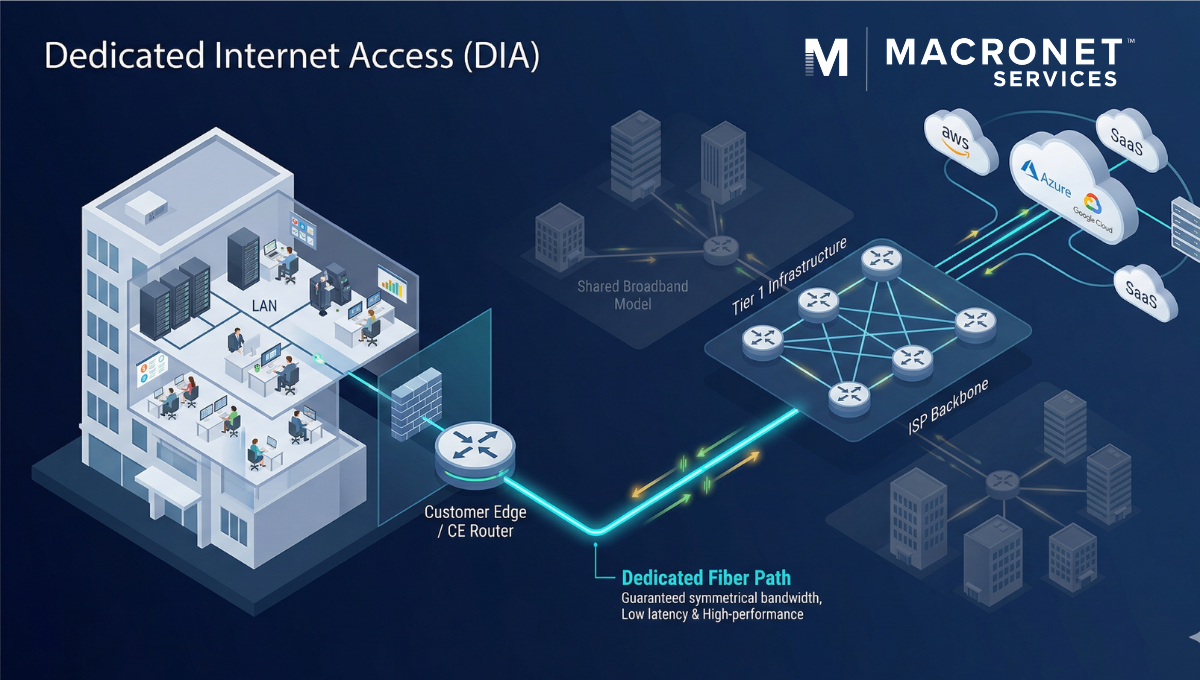
3.0 How Dedicated Internet Access Works (Technical Deep Dive)
To fully understand the value of dedicated internet access, it is important to look beyond marketing language and examine how the service is actually engineered. For network architects and engineers, dia dedicated internet access is not just a product—it is a specific design pattern within a broader carrier network that delivers predictable performance, routing flexibility, and service accountability.
At a high level, dedicated internet access service is built on a layered architecture that connects a customer site to the global internet through a combination of access infrastructure, aggregation networks, provider cores, and upstream transit or peering relationships.
3.1 The DIA Network Architecture
A typical dedicated internet access provider delivers service through the following components:
- Customer Premises (Demarcation Point)
This is where the provider hands off the service to the customer. It may be:
- An Ethernet handoff (most common)
- Fiber (single-mode or multi-mode)
- Copper (less common for modern DIA)
The customer typically connects this handoff to an edge router or firewall.
- Access Loop (Last Mile)
The access loop is the physical path between the customer site and the provider’s nearest point of presence (PoP). This is one of the most important variables in dedicated internet access cost and performance.
Common access methods include:
- Fiber (most preferred for DIA)
- Ethernet over fiber (E-Line / E-Access)
- Fixed wireless (in some scenarios)
- Coax-based enterprise Ethernet (less common but still used in certain markets)
The quality, distance, and construction requirements of this loop are major drivers of dedicated internet access pricing.
- Aggregation Network
Traffic from the access loop is delivered into the provider’s metro aggregation network. This layer:
- Concentrates traffic from multiple DIA customers
- Maintains QoS and traffic engineering policies
- Provides redundancy across metro paths
Even though traffic is aggregated here, DIA customers are still provisioned with committed bandwidth and are not subject to the same oversubscription models as broadband.
- Provider Core Network (IP/MPLS Backbone)
From aggregation, traffic enters the provider’s core network. This is typically:
- A high-capacity IP/MPLS backbone
- Designed with significant redundancy and capacity
- Engineered for low latency and high availability
This is where business dedicated internet access begins to differentiate itself from lower-tier services. Tier 1 and high-quality Tier 2 providers invest heavily in core network performance.
- Internet Transit and Peering
Finally, traffic exits the provider network to the broader internet via:
- Settlement-free peering (direct interconnection with other networks)
- Paid transit providers (global internet reachability)
The quality of these relationships directly impacts:
- Latency to cloud providers
- Route efficiency
- Overall application performance
This is why evaluating dedicated internet access providers based on backbone quality—not just last-mile availability—is critical.
3.2 Routing: BGP vs Static Routing in DIA
One of the defining characteristics of dedicated internet access services is routing flexibility.
Static Routing
- Simpler configuration
- Typically used in smaller deployments
- Provider assigns IP space and routes traffic to/from the customer
BGP (Border Gateway Protocol)
- Preferred for enterprise environments
- Enables dynamic route exchange between customer and provider
- Supports multi-homing (multiple DIA circuits from different providers)
- Allows traffic engineering and failover control
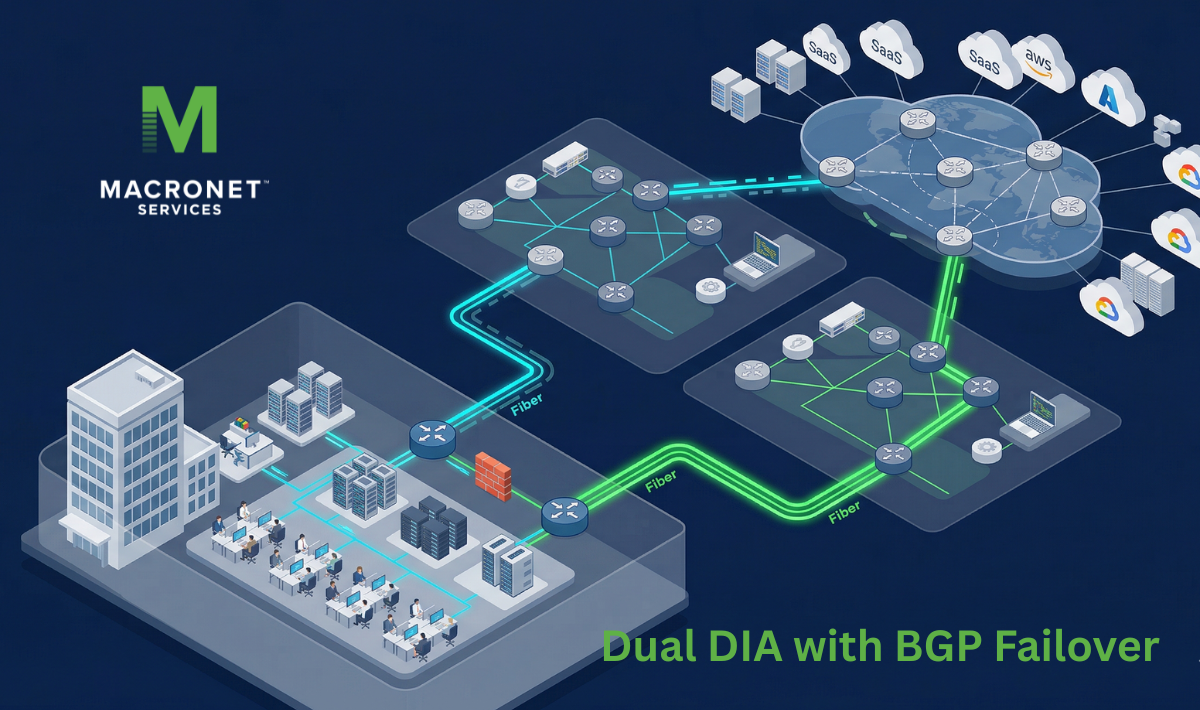
For organizations deploying redundant internet dedicated access, BGP becomes essential. It enables:
- Active/active or active/passive designs
- Automatic failover between circuits
- Control over inbound and outbound traffic paths
From an engineering standpoint, DIA without BGP is functional—but DIA with BGP is strategic.
3.3 IP Addressing and Public Presence
Most dedicated internet access for business deployments include public IP addressing. This can be:
- Provider-assigned IP blocks
- Customer-owned IP space (via ARIN or similar registries)
- Routed via BGP or statically assigned
This is where some confusion arises with search terms like private internet access dedicated IP.
In enterprise DIA:
- Public IPs are used for hosting services, NAT, VPNs, and application access
- They are routable on the global internet
- They are tied to the DIA circuit and routing configuration
This is fundamentally different from consumer VPN services offering a “dedicated IP.” In the context of dedicated internet access, IP addressing is part of a broader routing and network design strategy—not a privacy feature.
3.4 Redundancy and High Availability Designs
For many organizations, the real value of dedicated internet access for businesses comes from how it is integrated into a resilient architecture.
Single-Homed DIA
- One provider, one circuit
- Lowest cost option
- Single point of failure
Dual-Homed DIA (Same Provider)
- Two circuits from the same carrier
- May use diverse paths within the provider network
- Improved resilience, but still dependent on one provider
Multi-Homed DIA (Different Providers)
- Two or more dedicated internet access providers
- True carrier diversity
- Typically implemented with BGP
- Gold standard for enterprise resilience
Path Diversity
- Physically separate fiber routes
- Different conduits, entrances, and carrier paths
- Protects against construction cuts and localized outages
These designs are critical when evaluating dedicated internet access service for mission-critical environments such as:
- Data centers
- Headquarters
- Contact centers
- Healthcare facilities
- Financial trading environments
3.5 Performance Metrics: What Actually Matters
Unlike broadband, where performance is variable, dia dedicated internet access is engineered and measured against specific metrics.
Key metrics include:
- Time it takes for packets to travel between endpoints
- Critical for real-time applications and cloud access
Jitter
- Variation in packet delay
- Impacts voice, video, and real-time communications
Packet Loss
- Percentage of packets that fail to reach their destination
- Even small amounts can degrade application performance
Throughput
- Actual usable bandwidth
- Should align with the committed rate in DIA
Availability (Uptime)
- Often 99.9% to 99.99%+ depending on SLA
- Financial penalties may apply for SLA violations
These metrics are typically defined in the SLA, which is a key differentiator in dedicated internet access vs broadband comparisons.
3.6 Integrating DIA into Modern Network Architectures
In today’s enterprise environments, dedicated internet access services are rarely deployed in isolation. Instead, they are integrated into broader architectures such as:
- SD-WAN: DIA provides high-quality underlay connectivity
- SASE / SSE: DIA connects users to cloud-delivered security stacks
- Hybrid WAN: DIA complements MPLS or private WAN links
- Cloud Connectivity: DIA supports access to AWS, Azure, Google Cloud (often alongside private interconnects)
This is where dedicated internet access for business becomes more than just connectivity—it becomes a foundational component of a secure, cloud-first, and AI-ready network.
3.7 Why This Matters for Buyers and Engineers
For procurement teams evaluating dedicated internet access pricing, understanding this architecture explains why costs can vary so widely. A circuit delivered over existing on-net fiber with strong backbone connectivity is very different from one that requires new construction in a rural area.
For engineers, this section highlights what to validate when selecting a dedicated internet access provider:
- Backbone quality and peering relationships
- Access method and last-mile design
- Support for BGP and routing flexibility
- SLA guarantees and enforcement
- Options for redundancy and diversity
Ultimately, internet dedicated access is not a commodity in the same way broadband is. It is an engineered service with meaningful differences between providers, architectures, and implementations. Understanding how it works is the key to designing a network that delivers both performance and resilience.
-
Dedicated Internet Access vs Broadband (Critical Comparison)
One of the most important decisions organizations face when evaluating connectivity is whether to invest in dedicated internet access or continue relying on traditional broadband services. On the surface, both provide access to the internet. In practice, they are fundamentally different in how they are engineered, delivered, and experienced by the business.
Understanding the differences between dedicated internet access vs broadband is critical for both technical and non-technical buyers. This section breaks down those differences in a way that aligns with real-world business impact, not just product definitions.
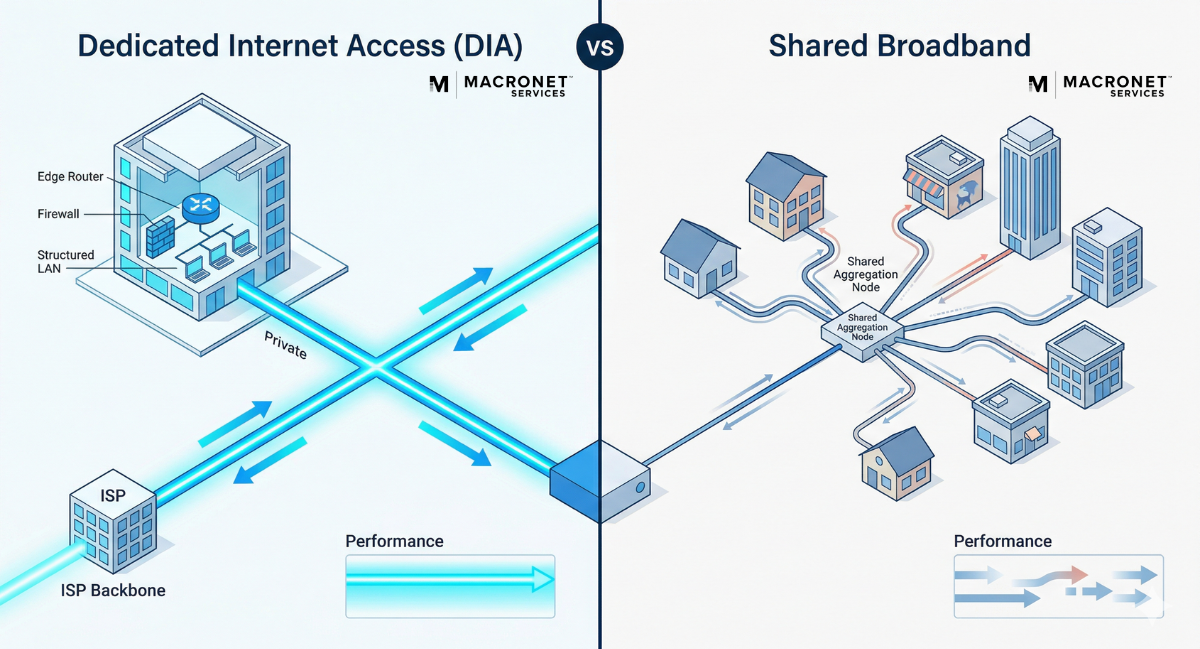
4.1 The Core Difference: Shared vs Dedicated Infrastructure
The most important distinction is how bandwidth is allocated.
Broadband services operate on a shared model. Multiple customers in a given area share the same access network capacity. Providers rely on oversubscription, meaning they assume not every customer will use their full bandwidth at the same time. This works well for general usage, but performance can degrade during peak periods.
By contrast, internet dedicated access is provisioned with committed bandwidth. When a business purchases a DIA circuit, that capacity is engineered to be available consistently, subject to SLA terms. This is why dedicated internet access for business is often selected for mission-critical environments where variability is unacceptable.
4.2 Performance and Consistency
Performance is where the gap between broadband and dia dedicated internet access becomes most visible.
Broadband connections can perform well under ideal conditions, but they are inherently variable. Congestion, neighborhood usage patterns, and provider oversubscription can all impact throughput and latency.
With dedicated internet access services, performance is designed to be predictable. Businesses benefit from:
- Consistent throughput aligned to purchased bandwidth
- Lower and more stable latency
- Reduced jitter for real-time applications
- Minimal packet loss under normal conditions
For applications like VoIP, video conferencing, cloud ERP, and AI-driven platforms, this consistency is often more important than raw speed.
4.3 Symmetrical vs Asymmetrical Speeds
Most broadband services are asymmetrical, offering higher download speeds than upload speeds. This reflects consumer usage patterns, where downloading content is more common than uploading.
However, modern businesses operate very differently. Upload-heavy activities include:
- Cloud backups and replication
- Video conferencing and collaboration tools
- SaaS application usage
- Data ingestion for analytics and AI systems
Business dedicated internet access is typically symmetrical, meaning upload and download speeds are equal. This is a major advantage for organizations with cloud-first or hybrid work environments.
4.4 Service Level Agreements (SLAs)
Another major differentiator in dedicated internet access vs broadband is accountability.
Broadband services are generally delivered as “best effort,” with limited guarantees around performance or uptime. When issues occur, resolution timelines may not be contractually enforced.
In contrast, dedicated internet access service is backed by SLAs that define:
- Uptime (often 99.9% to 99.99%+)
- Latency thresholds
- Jitter and packet loss targets
- Mean time to repair (MTTR)
For organizations evaluating dedicated internet access cost, these guarantees are a key part of the value equation. Downtime in a business environment can be far more expensive than the incremental cost of DIA.
4.5 Security and Network Control
While neither broadband nor DIA is inherently “secure” without additional controls, dedicated internet access for businesses provides a stronger foundation for enterprise security architectures.
With DIA, organizations typically have:
- Static public IP addressing
- Greater control over routing and firewall policies
- Better integration with security platforms (SASE, SSE, managed firewalls)
- Predictable traffic flows for monitoring and analysis
Broadband services, on the other hand, often rely on dynamic IP addressing and offer less control over routing behavior. This can complicate security design and visibility.
4.6 Scalability and Growth
As businesses grow, their connectivity needs evolve. Broadband services can be limited in terms of scalability, especially in areas where infrastructure is constrained.
Dedicated internet access providers typically offer a clear upgrade path:
- 100 Mbps → 1 Gbps → 10 Gbps → beyond
- Ability to scale without changing service type
- Support for high-capacity fiber-based delivery
For organizations planning for cloud expansion, AI workloads, or increased digital operations, dedicated internet access for business provides a more future-proof solution.
4.7 Cost: Upfront vs Long-Term Value
It is true that dedicated internet access pricing is higher than broadband on a per-Mbps basis. This is often the first thing procurement teams notice.
However, focusing only on monthly recurring cost can be misleading. The real comparison should include:
- Cost of downtime
- Impact of poor application performance
- Productivity loss from unstable connections
- Customer experience degradation
- Risk exposure in critical operations
In many cases, the higher dedicated internet access cost is justified by the operational stability it provides. For some organizations, a hybrid approach is used—deploying DIA at critical sites while using broadband at smaller or less critical locations.
4.8 Side-by-Side Comparison
| Feature | Dedicated Internet Access (DIA) | Broadband Internet |
| Bandwidth | Committed, non-shared | Shared, oversubscribed |
| Speed Type | Symmetrical | Asymmetrical |
| Performance | Predictable and consistent | Variable, especially during peak times |
| SLA | Yes (uptime, latency, MTTR) | Typically no formal SLA |
| Latency/Jitter | Low and stable | Variable |
| IP Addressing | Static/public IP options | Often dynamic IP |
| Routing | Supports BGP and advanced configs | Limited control |
| Scalability | High (up to multi-Gbps) | Limited by local infrastructure |
| Cost | Higher | Lower |
| Best Use Case | Mission-critical business operations | General internet usage |
4.9 When to Choose DIA vs Broadband
The decision between dedicated internet access services and broadband ultimately comes down to business requirements.
DIA is the right choice when:
- Network performance directly impacts revenue or operations
- Cloud, SaaS, or AI workloads are critical
- Real-time applications (voice, video, trading) are in use
- High availability and uptime guarantees are required
- Security and routing control are priorities
Broadband may be sufficient when:
- The site is non-critical
- Usage is light or non-essential
- Budget constraints outweigh performance needs
- Redundancy is provided by another primary connection
In many modern architectures, organizations use both. For example, a company may deploy dedicated internet access for business at headquarters and data centers while using broadband as a secondary failover connection or for smaller branch locations.
4.10 The Bottom Line
The comparison of dedicated internet access vs broadband is not just about speed—it is about reliability, control, and business risk.
Broadband is designed for affordability and general use.
Dedicated internet access is designed for performance, accountability, and mission-critical operations.
As organizations continue to adopt cloud platforms, distributed work models, and AI-driven applications, the need for stable and predictable connectivity will only increase. In that context, internet dedicated access is no longer a luxury—it is becoming a standard component of modern enterprise infrastructure.
- Dedicated Internet Access for Business: Use Cases That Justify DIA
While the technical advantages of dedicated internet access are clear, the real decision for most organizations comes down to business value. When does dedicated internet access for business move from “nice to have” to “essential infrastructure”?
The answer lies in how dependent the organization is on consistent, high-performance connectivity. In today’s environment—where cloud, AI, and real-time applications dominate—there are many scenarios where business dedicated internet access is not just justified, but required.
This section outlines the most common and compelling use cases where dedicated internet access services deliver measurable ROI.
5.1 Cloud-First and Multi-Cloud Environments
Most modern organizations are now cloud-first or hybrid-cloud by design. Critical applications are hosted in platforms such as AWS, Microsoft Azure, and Google Cloud. Employees, customers, and systems interact with these platforms continuously throughout the day.
In this model, the internet is effectively the new corporate backbone.
With broadband, performance to cloud environments can fluctuate based on congestion and routing inefficiencies. That variability introduces risk:
- Slower application response times
- Inconsistent user experiences
- Increased support tickets
- Reduced productivity
Dedicated internet access for businesses provides a more stable and predictable path to cloud services. When paired with optimized routing and strong provider peering relationships, DIA significantly improves application performance and reliability.
For organizations heavily reliant on SaaS, ERP, CRM, and cloud-native platforms, internet dedicated access becomes a foundational requirement.
5.2 AI, Data, and Analytics Workloads
AI adoption is one of the biggest drivers behind the growth of dia dedicated internet access.
Even organizations that are not building their own models are:
- Using AI-powered SaaS tools
- Running data pipelines to cloud platforms
- Moving large datasets for analytics
- Integrating real-time inference into workflows
These workloads generate sustained, high-volume, and often bidirectional traffic. Broadband connections—especially asymmetrical ones—struggle to support this efficiently.
Dedicated internet access service provides:
- Symmetrical bandwidth for data movement
- Consistent throughput for model inference and API calls
- Lower latency for real-time AI applications
In many cases, the success of AI initiatives depends as much on network performance as it does on the models themselves. That is why dedicated internet access for business is increasingly viewed as part of AI infrastructure—not just connectivity.
5.3 Unified Communications and Contact Centers (UCaaS / CCaaS)
Voice and video applications are extremely sensitive to network performance. Even small amounts of latency, jitter, or packet loss can degrade call quality and user experience.
Organizations deploying:
- Microsoft Teams
- Zoom
- Webex
- Cloud contact center platforms
often encounter performance issues on shared broadband connections, especially during peak usage times.
Dedicated internet access services provide the stability required for:
- High-quality voice calls
- Reliable video conferencing
- Consistent contact center performance
- Improved customer experience
For customer-facing operations, this is critical. Poor call quality directly impacts brand perception and revenue. This is one of the most common reasons companies upgrade to dedicated internet access for businesses.
5.4 Multi-Site Enterprises and SD-WAN Deployments
As organizations expand across multiple locations, network design becomes more complex. Many enterprises are replacing traditional MPLS networks with SD-WAN architectures that leverage internet connectivity as the primary transport.
In these environments, the quality of each site’s connection directly affects the entire network.
Using broadband alone can introduce variability across sites, making it difficult to maintain consistent performance.
By deploying business dedicated internet access at key locations—such as headquarters, regional hubs, or high-traffic branches—organizations can:
- Stabilize SD-WAN performance
- Improve application routing decisions
- Reduce packet loss and retransmissions
- Enhance overall network resilience
Many enterprises adopt a hybrid model, combining DIA with lower-cost connections for redundancy. This approach balances dedicated internet access cost with performance requirements.
5.5 Financial Services and Latency-Sensitive Applications
Certain industries require extremely low latency and high reliability. Financial services are a prime example.
Use cases include:
- Electronic trading platforms
- Real-time market data feeds
- Payment processing systems
- Risk and compliance monitoring
In these environments, even milliseconds of delay can have financial implications.
Dedicated internet access providers with strong backbone networks and optimized routing paths can deliver:
- Lower latency to key exchanges and platforms
- More predictable performance
- Reduced risk of packet loss
For these organizations, dedicated internet access pricing is secondary to performance and reliability.
5.6 Healthcare and Compliance-Driven Environments
Healthcare organizations rely on connectivity for:
- Electronic health records (EHR)
- Telemedicine
- Imaging and data transfer
- Real-time communication between facilities
Downtime or degraded performance can impact patient care and operational efficiency.
Additionally, healthcare environments must meet strict compliance and security requirements. Dedicated internet access service supports these needs by providing:
- More predictable network behavior
- Better integration with security controls
- Enhanced visibility for monitoring and auditing
For hospitals, clinics, and healthcare networks, dedicated internet access for business is often considered essential infrastructure.
5.7 Manufacturing, IoT, and Edge Environments
Industrial and manufacturing environments are increasingly connected. IoT devices, sensors, and edge systems generate continuous streams of data that must be processed, analyzed, and often transmitted to centralized platforms.
Use cases include:
- Predictive maintenance
- Supply chain optimization
- Real-time monitoring and control systems
- Edge AI deployments
These environments require reliable upstream and downstream connectivity. Internet dedicated access ensures that data flows consistently without the interruptions that can occur on shared networks.
5.8 High-Growth and Digital-First Companies
For fast-growing companies—especially in technology, SaaS, and digital services—network performance can become a bottleneck if not addressed early.
As usage scales:
- More users access cloud applications
- Data volumes increase
- Customer-facing platforms demand higher availability
Upgrading to dedicated internet access for businesses allows organizations to:
- Scale bandwidth predictably
- Maintain performance during growth
- Avoid reactive network upgrades
In many cases, investing in DIA early prevents larger issues later.
5.9 Data Centers, Headquarters, and Critical Sites
Certain locations within an organization’s footprint are simply too important to rely on shared connectivity.
These include:
- Corporate headquarters
- Data centers and colocation facilities
- Contact centers
- Regional hubs
At these sites, dedicated internet access services are often deployed as the primary connection, sometimes with multiple providers for redundancy.
This is where architecture becomes critical. Many organizations use:
- Dual or multi-provider DIA
- BGP routing for failover
- Diverse physical paths
In these environments, dedicated internet access provider selection is a strategic decision that impacts the entire business.
5.10 The ROI Case for Dedicated Internet Access
When evaluating dedicated internet access cost, the conversation should shift from price to impact.
Key ROI drivers include:
- Reduced downtime and outages
- Improved employee productivity
- Better customer experience
- Faster application performance
- Support for AI and cloud initiatives
- Lower operational risk
For many organizations, the cost of a single outage or prolonged performance issue can exceed the annual cost of DIA.
5.11 The Bottom Line
Dedicated internet access for business is not required everywhere—but it is critical in the right places.
Organizations should think strategically about where performance, reliability, and control matter most. In those locations, dia dedicated internet access provides a level of consistency and accountability that broadband simply cannot match.
As digital transformation accelerates and AI-driven workloads become more common, the number of use cases that justify dedicated internet access services will continue to grow.
- Dedicated Internet Access Pricing: What Drives Cost?
One of the most searched—and often misunderstood—topics in this space is dedicated internet access pricing. Buyers frequently ask: Why does DIA cost so much more than broadband? or What should we actually expect to pay?
The reality is that dedicated internet access cost is not arbitrary. It is driven by a combination of physical infrastructure, network design, service guarantees, and market dynamics. Understanding these factors is critical for both procurement teams and network engineers who want to evaluate a dedicated internet access provider intelligently.
This section breaks down how dedicated internet access services are priced, what variables matter most, and how to approach cost optimization without sacrificing performance.
6.1 The Core Pricing Model: More Than Just Bandwidth
At a high level, dedicated internet access service is priced based on a monthly recurring charge (MRC) plus any applicable non-recurring charges (NRC) for installation or construction.
The primary component of pricing is bandwidth:
- 100 Mbps
- 500 Mbps
- 1 Gbps
- 10 Gbps and beyond
However, unlike broadband, where pricing is often standardized, dedicated internet access pricing varies significantly based on how the service is delivered.
Two companies purchasing the same 1 Gbps business dedicated internet access service may see dramatically different pricing depending on location, infrastructure, and provider options.
6.2 Location: The Single Biggest Cost Driver
Location is the most important factor in dedicated internet access cost.
On-Net Buildings
- The provider already has fiber in the building
- Lowest cost scenario
- Fastest installation timelines
Near-Net Buildings
- Fiber is nearby but not in the building
- Moderate construction costs
- Pricing depends on distance and complexity
Off-Net Buildings
- No nearby provider infrastructure
- Requires new fiber construction
- Highest cost and longest lead times
For example, a 1 Gbps dedicated internet access for business circuit in a major metro data center may cost a fraction of the same circuit in a rural or suburban location requiring new construction.
This is why working with multiple dedicated internet access providers—or a broker with access to them—can significantly impact pricing outcomes.
6.3 Bandwidth and Scalability
Bandwidth is the most visible pricing variable, but the cost per Mbps typically decreases as bandwidth increases.
Typical pricing behavior:
- Higher cost per Mbps at lower bandwidth tiers (e.g., 100 Mbps)
- Lower cost per Mbps at higher tiers (e.g., 1 Gbps+)
This creates an important strategic consideration. In many cases, upgrading from 500 Mbps to 1 Gbps may be more cost-effective than expected, especially when factoring in future growth.
For organizations planning for cloud expansion or AI workloads, right-sizing bandwidth upfront can optimize long-term dedicated internet access pricing.
6.4 Contract Terms and Commercial Structure
The length of the agreement plays a major role in pricing.
Common contract terms:
- 12 months (highest monthly cost, most flexibility)
- 24 months
- 36 months (most common for best pricing)
- 60 months (lowest monthly cost, least flexibility)
Providers often subsidize construction costs in exchange for longer commitments. This can significantly reduce upfront expenses but requires careful evaluation of long-term needs.
For procurement teams evaluating dedicated internet access service, balancing flexibility and cost is key.
6.5 Installation and Construction Costs (NRC)
Non-recurring charges (NRC) can vary widely depending on the deployment.
Typical components include:
- Fiber construction (trenching, permitting, labor)
- Building entry and riser work
- Equipment installation
- Engineering and design
In on-net scenarios, NRC may be minimal or waived. In off-net deployments, construction costs can range from a few thousand dollars to six figures in extreme cases.
Many dedicated internet access providers offer incentives or amortization options to reduce upfront costs, particularly for multi-year contracts.
6.6 Access Type and Last-Mile Technology
The physical delivery method impacts both performance and cost.
Fiber-Based DIA
- Gold standard for dedicated internet access services
- Highest performance and scalability
- Typically higher cost, especially if construction is required
Fixed Wireless DIA
- Faster deployment
- Lower upfront costs in some cases
- Performance dependent on line-of-sight and environmental factors
Hybrid Fiber-Coax (Enterprise Ethernet)
- Available in certain markets
- Can be cost-effective
- May not match pure fiber performance
The choice of access type should align with business requirements, not just price. For mission-critical use cases, fiber-based internet dedicated access is typically preferred.
6.7 SLA and Support Levels
Not all DIA services are created equal. The strength of the SLA and support model can influence pricing.
Higher-tier dedicated internet access service offerings may include:
- Faster mean time to repair (MTTR)
- Proactive monitoring
- Priority support
- Performance guarantees across more metrics
These features add cost but also reduce operational risk. For organizations where uptime is critical, they are often worth the investment.
6.8 Provider Network Quality and Peering
The underlying network of the dedicated internet access provider plays a significant role in pricing.
Providers with:
- Extensive Tier 1 backbone networks
- Strong peering relationships
- Global reach
may command higher prices, but they often deliver better performance and reliability.
Lower-cost providers may rely more heavily on third-party transit, which can introduce variability in latency and routing.
For technical buyers, evaluating network quality is just as important as comparing dedicated internet access cost.
6.9 Market Competition and Provider Options
Pricing is also influenced by how many providers can serve a location.
Highly Competitive Markets
- Multiple fiber providers available
- Aggressive pricing and incentives
- Faster deployment options
Limited Competition Markets
- One or two providers
- Higher pricing
- Less flexibility
This is where leveraging multiple dedicated internet access providers—or working with a consultant who can source options—can drive significant savings.
6.10 Typical Pricing Ranges (Real-World Guidance)
While pricing varies widely, the following are general market ranges for dedicated internet access pricing in well-served metro areas:
- 100 Mbps DIA: ~$300 – $800/month
- 500 Mbps DIA: ~$500 – $1,500/month
- 1 Gbps DIA: ~$700 – $2,500/month
- 10 Gbps DIA: Highly variable, often $5,000+/month depending on location
In less competitive or off-net locations, prices can be significantly higher due to construction and limited provider options.
These ranges are not absolute, but they provide a useful baseline when evaluating dedicated internet access for business.
6.11 Hidden Costs and Considerations
Beyond monthly service fees, organizations should account for:
- Customer premises equipment (CPE)
Routers, firewalls, optics - Cross-connect fees (data centers)
Monthly charges for interconnections - Power and space requirements
Especially in colocation environments - Redundancy costs
Secondary circuits, diverse paths
These factors can influence the total cost of ownership for dedicated internet access services.
6.12 Cost Optimization Strategies
Organizations can reduce dedicated internet access cost without sacrificing performance by:
- Sourcing multiple providers for competitive quotes
- Evaluating on-net vs near-net options
- Leveraging longer contract terms where appropriate
- Bundling services (e.g., DIA + SD-WAN or security)
- Designing hybrid architectures (DIA + broadband failover)
Working with an experienced partner can uncover pricing options that are not always visible through a single provider.
6.13 The Bottom Line
Dedicated internet access pricing reflects the reality that DIA is an engineered, business-grade service—not a commodity.
The cost is driven by:
- Infrastructure availability
- Bandwidth and scalability
- Service guarantees
- Provider network quality
- Market competition
For organizations evaluating dedicated internet access for businesses, the goal should not be to find the lowest price—it should be to find the right balance of cost, performance, and reliability.
In many cases, the true value of business dedicated internet access is realized not in the monthly invoice, but in the stability and performance it brings to the entire organization.
7.0 Dedicated Internet Access Providers: Who Are the Key Players?
Selecting the right dedicated internet access provider is one of the most important decisions in the entire DIA process. While pricing, bandwidth, and contract terms are all critical, the underlying provider—and more specifically, their network—has a direct impact on performance, reliability, scalability, and long-term success.
Not all dedicated internet access providers are created equal. Some operate global Tier 1 backbones, others focus on regional fiber delivery, and some specialize in aggregation or niche enterprise services. Understanding the landscape is essential for both procurement teams and network engineers evaluating dedicated internet access for business.
7.1 Tier 1 ISPs: The Backbone of the Internet
At the top of the ecosystem are Tier 1 Internet Service Providers. These are global networks that can reach every other network on the internet without purchasing IP transit. They maintain extensive peering relationships and operate massive backbone infrastructures.
For organizations deploying business dedicated internet access, Tier 1 providers are often the gold standard and are ranked by organizations such as CAIDA —especially for latency-sensitive, global, or high-performance use cases.
Leading Tier 1 and Global Backbone Providers include:
- Lumen Technologies (formerly CenturyLink / Level 3)
One of the most widely used backbones in enterprise networking, with extensive North American and global reach. Strong in both DIA and long-haul transport. - Arelion (formerly Telia Carrier)
Known for one of the highest-performing global IP backbones, with strong peering and low-latency routes—especially valuable for international traffic. - GTT Communications
A major global IP transit provider with a strong enterprise DIA footprint, particularly in multinational deployments. - AT&T Business
A dominant provider in the U.S. with extensive fiber infrastructure and enterprise services. - Verizon Business
Strong global backbone with deep enterprise integration capabilities, including advanced networking and AI-ready infrastructure offerings. - NTT Communications
A major global Tier 1 provider with strong presence in Asia, Europe, and the Americas. - Tata Communications
Global backbone provider with extensive subsea cable systems and strong international reach.
These providers are often preferred for:
- Global enterprises
- Latency-sensitive applications
- Multi-region cloud connectivity
- High-performance internet dedicated access
However, Tier 1 does not always mean “best” in every scenario. Cost, local availability, and last-mile delivery can vary significantly.
7.2 Tier 2 and Regional Fiber Providers
Below Tier 1 providers are Tier 2 and regional carriers. These providers may not have full global reach without purchasing transit, but they often excel in metro and regional fiber deployments.
For many organizations, these providers offer the best balance of cost, performance, and availability for dedicated internet access services.
Key regional and fiber-focused providers include:
- Zayo
Extensive fiber footprint across North America and Europe, widely used for enterprise DIA and transport. - Crown Castle Fiber
Strong metro fiber presence in key U.S. markets, often competitive in enterprise environments. - Segra
Focused on the eastern U.S., with strong regional fiber capabilities. - Lightpath / Altice Business
Competitive in dense metro markets, particularly in the Northeast. - Frontier Business (Fiber markets)
Growing fiber footprint in select regions.
These providers are often ideal for:
- Metro-based enterprises
- Cost-sensitive deployments
- High-bandwidth DIA (1 Gbps and above)
- Locations where they are “on-net”
In many cases, a regional provider can deliver better pricing and faster deployment than a global Tier 1 carrier—especially for dedicated internet access for businesses operating within a specific geography.
7.3 Cable Providers Offering Enterprise DIA
Cable companies have expanded significantly into the enterprise space and now offer dedicated internet access service alongside their traditional broadband products.
Major cable-based DIA providers include:
- Comcast Business
- Spectrum Enterprise (Charter)
- Cox Business
These providers can offer:
- Competitive pricing
- Rapid deployment in on-net locations
- Fiber-based DIA in many markets
While historically associated with broadband, many cable providers now deliver true dia dedicated internet access with SLAs and enterprise features.
They are often a strong option for:
- Branch locations
- Mid-market enterprises
- Hybrid DIA + broadband architectures
7.4 Global Integrators and NaaS Providers
A newer category of providers includes Network-as-a-Service (NaaS) and global aggregators. These companies do not always own the physical network infrastructure but instead aggregate services across multiple carriers.
Examples include:
- Aryaka
- Cato Networks (SASE-focused)
- Megaport (connectivity platform)
These providers can simplify procurement and management of dedicated internet access services, especially in multi-location or global deployments. In addition to the above examples, Tier 1 ISPs like LUMEN have already deployed flexible NaaS solutions.
However, it is important for technical teams to understand:
- The underlying carriers being used (if applicable)
- Performance characteristics
- SLA ownership
7.5 How to Evaluate Dedicated Internet Access Providers
When comparing dedicated internet access providers, organizations should look beyond brand recognition and evaluate several key factors:
-
Network Backbone Quality
- Peering relationships
- Latency to key cloud providers
- Global reach
-
Last-Mile Infrastructure
- On-net vs near-net vs off-net
- Fiber availability
- Construction requirements
-
SLA and Support
- Uptime guarantees
- Mean time to repair
- Support responsiveness
-
Routing Capabilities
- BGP support
- IP addressing options
- Multi-homing capabilities
-
Scalability
- Ability to upgrade bandwidth
- Support for multi-Gbps connections
-
Pricing and Commercial Flexibility
- Competitive dedicated internet access pricing
- Contract terms
- Incentives or construction subsidies
For many organizations, no single dedicated internet access provider is the best fit everywhere. The optimal strategy often involves selecting different providers based on location, use case, and network design.
7.6 The Role of Multi-Provider Strategy
In enterprise environments, relying on a single provider can introduce risk. That is why many organizations adopt a multi-provider approach to dedicated internet access for business.
Benefits include:
- Carrier diversity
- Improved resilience and failover
- Better negotiating leverage
- Optimized performance across locations
This is especially important for:
- Headquarters and data centers
- Mission-critical applications
- High-availability environments
In these cases, combining multiple dedicated internet access services with BGP routing creates a more robust and flexible architecture.
7.7 Why Provider Selection Is a Strategic Decision
Choosing a dedicated internet access provider is not just a procurement exercise—it is a strategic infrastructure decision.
The provider’s network will influence:
- Application performance
- Cloud connectivity
- User experience
- Security architecture
- Long-term scalability
For organizations investing in AI, cloud, and digital transformation, the quality of business dedicated internet access becomes a competitive advantage.
7.8 The Bottom Line
The market for dedicated internet access providers is broad, ranging from global Tier 1 backbones like Lumen, Arelion, and GTT, to regional fiber carriers, cable providers, and modern NaaS platforms.
Each has strengths depending on the use case.
The key is not simply to choose a provider—but to design the right solution:
- The right provider in the right location
- The right architecture for performance and resilience
- The right balance of cost and capability
When approached strategically, dedicated internet access for businesses becomes more than connectivity—it becomes a core enabler of modern, high-performance, and AI-ready enterprise networks.
8.0 DIA Architecture Best Practices for Enterprise Networks
Deploying dedicated internet access is not just about selecting a provider and ordering a circuit. The real value is unlocked through architecture—how DIA is integrated into the broader enterprise network to deliver performance, resilience, security, and scalability.
For modern organizations, especially those adopting cloud, AI, and distributed work models, dedicated internet access for business should be treated as a foundational building block within a well-designed WAN and security architecture.
This section outlines best practices for designing and deploying dedicated internet access services in enterprise environments.
8.1 Single vs Multi-Carrier DIA Strategy
One of the first architectural decisions is whether to deploy DIA with a single provider or multiple providers.
Single-Carrier DIA
- One dedicated internet access provider
- Simpler to manage
- Lower cost
- Higher risk (single point of failure)
Multi-Carrier DIA
- Two or more providers delivering internet dedicated access
- Enables true redundancy and failover
- Supports diverse routing paths
- Reduces dependency on a single network
For mission-critical environments, multi-carrier design is considered best practice. It allows organizations to mitigate outages caused by:
- Fiber cuts
- Provider backbone issues
- Routing failures
In these architectures, dia dedicated internet access is typically combined with BGP to dynamically manage traffic across providers.
8.2 Active/Active vs Active/Passive Designs
When deploying multiple dedicated internet access services, traffic can be managed in different ways.
Active/Passive
- One circuit is primary, the other is standby
- Simpler configuration
- Lower operational complexity
- Failover occurs only during outages
Active/Active
- Both circuits carry traffic simultaneously
- Load balancing across providers
- Better utilization of purchased bandwidth
- Requires more advanced routing (typically BGP)
For larger enterprises, active/active designs maximize the value of business dedicated internet access while improving performance and resilience.
8.3 DIA and SD-WAN Integration
One of the most important trends in networking is the integration of dedicated internet access for businesses with SD-WAN.
SD-WAN platforms use multiple transport types (DIA, broadband, LTE/5G) and dynamically route traffic based on application requirements.
When paired with DIA, SD-WAN enables:
- Application-aware routing
- Real-time path optimization
- Improved performance for cloud and SaaS applications
- Automated failover between circuits
In this model:
- DIA provides a high-quality, stable underlay
- SD-WAN provides intelligence and control
This combination is now a standard architecture for many enterprises transitioning away from MPLS-only networks.
8.4 DIA + MPLS Hybrid Architectures
While many organizations are moving toward internet-based WANs, MPLS still plays a role in certain environments.
A hybrid architecture combines:
- MPLS for private, latency-sensitive traffic
- Dedicated internet access service for cloud and internet-bound traffic
This approach allows organizations to:
- Maintain deterministic performance for critical applications
- Leverage DIA for scalability and cost efficiency
- Gradually transition to internet-based architectures
Over time, many enterprises reduce MPLS reliance as DIA and SD-WAN capabilities mature.
8.5 DIA and SASE / Zero Trust Security
Security architecture is a critical consideration when deploying dedicated internet access services.
Traditional models routed all traffic back to a central data center for inspection. This approach does not scale well in cloud-first environments.
Modern architectures use:
- SASE (Secure Access Service Edge)
- SSE (Security Service Edge)
- Zero Trust Network Access (ZTNA)
In these models:
- DIA connects users and sites directly to cloud-delivered security platforms
- Traffic is inspected closer to the user or application
- Backhauling is minimized
This improves:
- Performance
- Security posture
- User experience
For organizations adopting Zero Trust, dedicated internet access for business becomes a critical on-ramp to cloud-based security services.
8.6 Cloud Connectivity: DIA vs Private Interconnects
While DIA provides access to cloud platforms over the public internet, many enterprises also use private connectivity options such as:
- AWS Direct Connect
- Microsoft Azure ExpressRoute
- Google Cloud Interconnect
- Oracle Cloud Infrastructure (OCI)
Best practice is often a hybrid approach:
- Dedicated internet access for general cloud access and SaaS
- Private interconnects for predictable, high-throughput workloads
DIA remains essential even in these environments because:
- Not all traffic goes over private links
- SaaS applications still rely on internet connectivity
- Redundancy is required
For most organizations, internet dedicated access is the foundation, with private connectivity layered on top.
8.7 Designing for Path Diversity
One of the most overlooked aspects of dedicated internet access for businesses is physical path diversity.
Logical redundancy (multiple circuits) is not enough if both circuits share the same physical path.
Best practices include:
- Diverse fiber routes from different providers
- Separate building entry points
- Different conduits and risers
- Validation of true physical diversity
Without this, a single construction event or fiber cut can impact multiple circuits simultaneously.
For high-availability environments, path diversity is just as important as provider diversity.
8.8 Edge Design: Routers, Firewalls, and Segmentation
At the customer edge, dedicated internet access service integrates with networking and security equipment.
Key considerations include:
- Enterprise-grade edge routers with BGP support
- Firewalls for traffic inspection and policy enforcement
- Network segmentation for security and performance
- High availability (HA) configurations for edge devices
The design should align with:
- Security requirements
- Application needs
- Traffic patterns
For many organizations, the edge becomes the control point for how business dedicated internet access is consumed and managed.
8.9 Bandwidth Planning and Capacity Management
Proper sizing is critical when deploying dedicated internet access services.
Best practices include:
- Analyzing current traffic patterns
- Accounting for peak usage and growth
- Planning for AI, cloud, and data workloads
- Avoiding under-provisioning
Because DIA is scalable, organizations can upgrade over time. However, starting with insufficient bandwidth can lead to performance issues that undermine the value of the investment.
8.10 Monitoring and Performance Management
Once deployed, dedicated internet access for business should be continuously monitored.
Key capabilities include:
- Real-time performance monitoring (latency, jitter, packet loss)
- SLA tracking and reporting
- Traffic analysis and capacity planning
- Alerting for outages or degradation
Modern tools—often integrated with SD-WAN or network observability platforms—provide visibility into how DIA circuits are performing.
This is essential for maintaining service quality and holding dedicated internet access providers accountable.
8.11 Designing for AI-Ready Networks
As AI adoption accelerates, network architecture must evolve.
Dedicated internet access plays a key role in:
- Supporting high-throughput data pipelines
- Enabling real-time inference and API calls
- Connecting edge environments to centralized AI platforms
- Maintaining consistent performance for AI-driven applications
Architectures that combine DIA with:
- SD-WAN
- Cloud interconnects
- SASE security
are best positioned to support AI at scale.
8.12 The Bottom Line
Deploying dedicated internet access services without a thoughtful architecture limits its value. When designed correctly, DIA becomes a powerful enabler of:
- High-performance networking
- Resilient and redundant connectivity
- Secure, cloud-first architectures
- Scalable infrastructure for AI and digital transformation
For enterprises, the question is no longer just whether to deploy dedicated internet access for businesses—it is how to design it properly.
9.0 Security Considerations with Dedicated Internet Access
While dedicated internet access is often selected for performance and reliability, it also plays a critical role in an organization’s overall security architecture. However, it is important to be clear: dedicated internet access service is not inherently secure. It is a high-performance, predictable connection to the public internet—and like any internet connection, it must be properly secured.
The advantage of dedicated internet access for business is that it provides a more controlled, stable, and observable environment in which to implement modern security frameworks. This section outlines how DIA fits into enterprise security strategies and what organizations should consider when deploying dedicated internet access services securely.
9.1 DIA as the Foundation for Secure Connectivity
At a high level, internet dedicated access provides:
- Predictable traffic flows
- Consistent performance for inspection and enforcement
- Greater control over routing and IP addressing
These characteristics make it easier to implement security controls compared to highly variable broadband environments.
For example:
- Static IP addressing simplifies firewall rules and allowlists
- Consistent latency improves inline inspection performance
- Predictable throughput ensures security tools are not overwhelmed
This is why dedicated internet access for businesses is often preferred at sites where security is a top priority, such as headquarters, data centers, and contact centers.
9.2 DDoS Protection and Mitigation
One of the primary risks of any public internet connection is exposure to distributed denial-of-service (DDoS) attacks.
Many dedicated internet access providers offer optional or integrated DDoS protection services, which may include:
- Traffic scrubbing centers
- Anomaly detection and mitigation
- Rate limiting and filtering
For organizations with public-facing applications, APIs, or services, DDoS protection should be a core consideration when selecting a dedicated internet access provider.
In higher-risk environments, organizations may also deploy:
- Third-party DDoS mitigation services
- Cloud-based protection platforms
- Anycast-based architectures
DIA provides the stable connectivity required to integrate these protections effectively.
9.3 Firewall Architecture: Managed vs Customer-Controlled
A key decision when deploying business dedicated internet access is how to handle firewall and perimeter security.
Customer-Managed Firewalls
- Full control over policies and configurations
- Greater flexibility for complex environments
- Requires in-house expertise
Provider-Managed Firewalls
- Offered as part of dedicated internet access services
- Simplifies deployment and management
- May be limited in customization
In many enterprise environments, organizations deploy their own next-generation firewalls (NGFW) at the edge of the DIA circuit. These devices provide:
- Deep packet inspection
- Application-level controls
- Threat detection and prevention
- VPN termination
The choice depends on the organization’s security maturity and operational model.
9.4 Segmentation and Traffic Isolation
Modern security strategies emphasize segmentation—limiting lateral movement and isolating workloads.
With dedicated internet access service, segmentation can be implemented at multiple levels:
- VLANs and network segmentation at the edge
- Firewall zones and policies
- SD-WAN segmentation for application-aware routing
- Integration with Zero Trust frameworks
Because DIA provides consistent and predictable connectivity, segmentation policies can be enforced more reliably than in variable broadband environments.
9.5 DIA and SASE / SSE Security Models
As discussed in the architecture section, many organizations are moving toward cloud-delivered security models such as:
- SASE (Secure Access Service Edge)
- SSE (Security Service Edge)
In these architectures:
- DIA acts as the on-ramp to cloud-based security platforms
- Traffic is inspected in distributed points of presence (PoPs)
- Security policies are applied closer to users and applications
This approach reduces the need for backhauling traffic to a central data center and improves both performance and security.
For organizations adopting Zero Trust principles, dedicated internet access for business is a critical enabler of these modern security models.
9.6 Visibility and Monitoring
Effective security depends on visibility. One of the advantages of dedicated internet access services is that they provide a more stable and observable traffic environment.
Organizations can implement:
- Network traffic monitoring (NetFlow, sFlow)
- Intrusion detection and prevention systems (IDS/IPS)
- Security information and event management (SIEM) integration
- Real-time analytics and anomaly detection
Because DIA traffic is less impacted by unpredictable congestion, it is easier to:
- Establish baselines
- Detect anomalies
- Respond to threats
This is particularly important for organizations with advanced security operations.
9.7 Secure Remote Access and VPNs
Many organizations use DIA as the termination point for remote access solutions, including:
- Site-to-site VPNs
- Remote user VPNs
- Zero Trust Network Access (ZTNA)
The symmetrical bandwidth and consistent performance of dedicated internet access for businesses improve:
- VPN throughput
- User experience
- Reliability of remote connections
In hybrid work environments, this is a major advantage over broadband-based solutions.
9.8 Public Exposure and Risk Management
Because internet dedicated access provides direct connectivity to the public internet, it also increases exposure if not properly secured.
Key risks include:
- Open ports and misconfigured services
- Unpatched systems exposed to the internet
- Unauthorized access attempts
Mitigation strategies include:
- Strict firewall policies
- Regular vulnerability assessments
- Patch management
- Least-privilege access controls
Organizations should treat DIA-connected environments as part of their external attack surface and secure them accordingly.
9.9 Compliance and Regulatory Considerations
For industries such as healthcare, finance, and government, compliance is a critical factor.
Dedicated internet access service supports compliance efforts by providing:
- Reliable connectivity for security controls
- Better auditability and logging
- Integration with compliant security platforms
However, compliance is not achieved through DIA alone. It requires a combination of:
- Network design
- Security controls
- Policies and procedures
DIA simply provides a stronger foundation on which to build these capabilities.
9.10 Shared vs Dedicated Risk Profiles
When comparing dedicated internet access vs broadband from a security perspective, the differences are subtle but important.
Broadband:
- Shared infrastructure
- Less predictable traffic patterns
- Limited control over routing
DIA:
- More controlled environment
- Predictable performance for inspection
- Greater flexibility for security architecture
While both require proper security controls, dedicated internet access for business enables a more robust and scalable approach to security.
9.11 The Bottom Line
Dedicated internet access services do not replace security—but they enable it.
By providing:
- Predictable performance
- Stable connectivity
- Greater control and visibility
DIA creates the conditions necessary for modern security architectures to function effectively.
For organizations investing in cloud, AI, and digital transformation, securing the network edge is more important than ever. In that context, dedicated internet access for businesses is not just a connectivity decision—it is a critical component of a comprehensive cybersecurity strategy.
10.0 DIA and AI Infrastructure: Why It’s Becoming Mandatory
As artificial intelligence moves from experimentation to core business capability, one truth is becoming increasingly clear: network infrastructure is now a limiting factor in AI success. While much of the conversation focuses on models, GPUs, and data platforms, the reality is that none of these systems deliver value without fast, reliable, and predictable connectivity.
This is where dedicated internet access enters the picture—not as a supporting utility, but as a foundational component of AI infrastructure. These trends are explored in more detail on the Macro AI Podcast, where the hosts break down how AI is reshaping enterprise infrastructure decisions. The Rise of AI-Native Global Networks and Securing AI Across the Global Enterprise WAN
For organizations investing in AI, dedicated internet access for business is quickly shifting from optional to essential.
10.1 The Hidden Dependency: AI Runs on Networks
AI systems are inherently distributed. Even when models are hosted in centralized environments, they rely on constant data movement between:
- Edge devices and sensors
- Enterprise applications (CRM, ERP, data warehouses)
- Cloud platforms (AWS, Azure, Google Cloud)
- APIs and external data sources
- End users and applications
Every one of these interactions depends on network performance. Solutions such as Verizon AI Connect infrastructure highlight how carriers are evolving networks specifically for AI-driven workloads.
Inconsistent connectivity leads to:
- Slower inference times
- Failed API calls
- Delayed data pipelines
- Poor user experiences
Broadband’s variability becomes a bottleneck. In contrast, internet dedicated access provides the consistency required for AI systems to function reliably at scale.
10.2 AI Workloads Are Bandwidth-Intensive and Bidirectional
Traditional enterprise traffic patterns were often download-heavy. AI changes that dynamic.
Modern AI workloads require:
- Continuous data ingestion (upload-heavy)
- Model inference requests and responses (bidirectional)
- Real-time streaming of events and telemetry
- Synchronization between distributed systems
This makes symmetrical bandwidth a necessity—not a luxury.
Business dedicated internet access delivers:
- Equal upload and download capacity
- Consistent throughput for large datasets
- Reliable performance under sustained load
For organizations scaling AI initiatives, this is one of the most compelling reasons to adopt dedicated internet access services.
10.3 Real-Time AI Requires Low Latency and Stability
Many AI applications operate in real time or near real time, including:
- Conversational AI and chatbots
- Voice assistants and contact center AI
- Fraud detection systems
- Predictive analytics in operations
- Autonomous and edge-based decision systems
These use cases depend on:
- Low latency
- Minimal jitter
- Reliable packet delivery
Even small fluctuations can degrade performance.
DIA dedicated internet access is engineered to deliver consistent latency and low packet loss, making it far better suited for real-time AI applications than shared broadband connections.
10.4 The Rise of Edge AI and Distributed Intelligence
AI is no longer confined to centralized cloud environments. Increasingly, intelligence is being pushed to the edge—closer to where data is generated.
Examples include:
- Manufacturing and industrial IoT
- Retail analytics and in-store systems
- Healthcare monitoring devices
- Smart buildings and infrastructure
In these environments:
- Edge systems generate large volumes of data
- Data must be transmitted to centralized platforms for aggregation and analysis
- Models may be updated or synchronized across locations
Dedicated internet access for businesses ensures that these distributed systems remain connected with the reliability required for continuous operation.
10.5 AI-Driven Applications Are Always On
Unlike traditional batch processes, AI-driven systems are often always active.
They continuously:
- Monitor data streams
- Trigger automated actions
- Interact with users
- Feed insights back into operations
This creates a constant demand on network infrastructure.
With broadband, performance may degrade during peak periods—exactly when systems are under the most load.
With dedicated internet access service, organizations gain:
- Predictable performance at all times
- Capacity aligned with operational needs
- Reduced risk of performance degradation
For AI-driven businesses, this consistency is critical.
10.6 Data Gravity and the Movement of Information
AI amplifies the concept of data gravity—the idea that data attracts applications and services.
As organizations accumulate more data:
- Data lakes and warehouses grow
- More systems need access to that data
- Data must move between environments
This increases network demand exponentially.
Dedicated internet access pricing may initially seem higher than broadband, but when viewed in the context of data movement and AI enablement, it becomes clear that DIA is an investment in the organization’s ability to leverage its data effectively.
10.7 Supporting AI Ecosystems and Integrations
AI does not operate in isolation. It integrates with:
- SaaS platforms
- APIs
- Third-party data providers
- Internal systems
These integrations create complex, interdependent traffic patterns.
Dedicated internet access providers with strong peering and backbone networks can significantly improve:
- API response times
- Integration reliability
- Overall system performance
This is particularly important for organizations building AI-driven workflows that span multiple platforms.
10.8 DIA as a Prerequisite for AI-Ready Networks
An AI-ready network is one that can:
- Handle high volumes of data
- Deliver consistent performance
- Support real-time applications
- Scale as workloads grow
- Integrate with cloud and edge environments
Dedicated internet access for business is a core component of this architecture.
When combined with:
- SD-WAN for intelligent routing
- SASE for security
- Cloud interconnects for private connectivity
DIA enables a network that is capable of supporting AI at scale.
10.9 The Cost of Not Upgrading Connectivity
Organizations that attempt to run AI workloads on insufficient network infrastructure often encounter:
- Performance bottlenecks
- Unreliable application behavior
- Increased troubleshooting and support costs
- Reduced ROI from AI investments
In these cases, the savings from avoiding dedicated internet access cost are quickly offset by operational inefficiencies and missed opportunities.
10.10 Executive Perspective: DIA as Strategic Infrastructure
For executive decision-makers, the conversation should shift from:
- “How much does DIA cost?”
to:
- “What does unreliable connectivity cost the business?”
- “Can our network support our AI strategy?”
- “Are we building infrastructure that scales with our ambitions?”
In this context, dedicated internet access services are not just an IT expense—they are an enabler of innovation, efficiency, and competitive advantage.
10.11 The Bottom Line
AI is redefining how businesses operate—and in doing so, it is redefining the requirements for network infrastructure.
Dedicated internet access provides:
- The bandwidth required for data-intensive workloads
- The consistency needed for real-time applications
- The reliability required for always-on systems
- The foundation for cloud, edge, and distributed AI architectures
As AI adoption accelerates, dedicated internet access for businesses is becoming less of a premium option and more of a standard requirement.
Organizations that recognize this early will be better positioned to scale their AI initiatives, deliver better user experiences, and operate with greater efficiency.
11.0 How to Choose the Right Dedicated Internet Access Service
Selecting the right dedicated internet access service is not simply a matter of comparing speeds and prices. It is a strategic decision that impacts network performance, application reliability, security posture, and long-term scalability.
For organizations evaluating dedicated internet access for business, the challenge is not a lack of options—it is navigating those options intelligently. DIA is an engineered service with meaningful differences between providers, architectures, and implementations. Choosing correctly requires both technical expertise and deep visibility into the provider ecosystem.
This section provides a practical framework for selecting the right dedicated internet access provider—and explains why many organizations partner with Macronet Services to design, source, and implement their DIA strategy.
11.1 Start with Business Requirements, Not Bandwidth
A common mistake is starting with “How much bandwidth do we need?” Instead, organizations should begin with:
- What applications are critical to the business?
- How sensitive are those applications to latency and packet loss?
- What is the cost of downtime or degraded performance?
- What role will the internet play in cloud, AI, and remote work strategies?
For example:
- A contact center prioritizes low jitter and reliability
- A data-driven organization prioritizes throughput and symmetry
- A financial firm prioritizes latency and route efficiency
This ensures that business dedicated internet access is aligned with real operational needs—not just assumptions about speed.
Translating these requirements into the right architecture is where experience matters. This is often the first place organizations benefit from working with experts who design enterprise networks every day.
11.2 Evaluate SLA Strength and Real-World Accountability
Not all SLAs are equal. When comparing dedicated internet access services, organizations should evaluate:
- Uptime guarantees (e.g., 99.9% vs 99.99%)
- Latency commitments
- Packet loss and jitter thresholds
- Mean time to repair (MTTR)
- Service credits and enforcement mechanisms
Equally important:
- How responsive is the provider’s support organization?
- What is their real-world performance track record?
For mission-critical environments, SLA quality often outweighs small differences in dedicated internet access pricing.
11.3 Assess Provider Network Quality
The underlying network of the dedicated internet access provider directly impacts performance.
Key factors include:
- Backbone architecture and capacity
- Peering relationships with cloud providers
- Latency to key destinations (AWS, Azure, SaaS platforms)
- Geographic coverage
Tier 1 providers such as Lumen, Arelion, and GTT offer global reach and strong performance, while regional providers may offer cost-effective, high-performance options in specific markets.
The key insight: no single provider is best everywhere.
11.4 Understand Last-Mile Delivery and Building Status
The last mile is often the biggest driver of both performance and dedicated internet access cost.
Organizations should determine:
- Is the building on-net, near-net, or off-net?
- What construction is required?
- Which providers already have infrastructure at the location?
These factors directly impact:
- Installation timelines
- Monthly pricing
- Service reliability
This is an area where many projects run into delays or unexpected costs due to lack of visibility.
11.5 Design for Redundancy from Day One
A best practice for dedicated internet access for businesses is to design redundancy upfront.
This may include:
- Dual circuits from different dedicated internet access providers
- Diverse physical fiber paths
- BGP routing for failover
- Integration with SD-WAN
Even if only one circuit is deployed initially, the architecture should support future redundancy.
For critical environments, a single internet dedicated access circuit represents unnecessary risk.
11.6 Align DIA with Your Broader Network Architecture
DIA should be part of a larger strategy—not a standalone purchase.
Key considerations:
- SD-WAN integration
- SASE / Zero Trust security
- Cloud connectivity
- Application performance requirements
For example:
- DIA should align with traffic routing and security models
- It should support SaaS and cloud access patterns
- It should integrate with existing infrastructure
The right circuit in the wrong design still leads to poor outcomes.
11.7 Compare Pricing the Right Way
When evaluating dedicated internet access pricing, organizations should focus on value—not just cost.
Consider:
- Total cost of ownership (TCO)
- Installation and construction costs
- SLA strength and support
- Scalability
- Risk of downtime
A lower-cost option may result in higher long-term costs if performance or reliability is compromised.
11.8 Validate Scalability and Future Growth
Organizations should ensure their chosen dedicated internet access provider can scale with future needs.
Key questions:
- How quickly can bandwidth be upgraded?
- What capacity exists at the location?
- Are multi-gig and 10G options available?
As AI and cloud adoption accelerate, bandwidth demands increase rapidly. A scalable dedicated internet access service ensures the network keeps pace.
11.9 Conduct a Competitive Sourcing Process
One of the most effective ways to optimize dedicated internet access cost is to evaluate multiple providers.
This enables:
- Competitive pricing
- Better architectural options
- Improved redundancy planning
- Greater negotiating leverage
However, sourcing across multiple dedicated internet access providers is complex. Each provider has:
- Different pricing models
- Different infrastructure footprints
- Different delivery methods
Without the right tools and experience, it is difficult to fully understand the available options.
11.10 Why Many Organizations Work with Macronet Services
This is where working with a specialized partner like Macronet Services provides a significant advantage.
Macronet Services is a leading authority in designing, sourcing, and implementing dedicated internet access for businesses. As a channel partner representing all major global ISPs, Macronet offers a level of visibility and expertise that is difficult to achieve when working directly with a single carrier. Take a look at our vast online resources here.
Key advantages include:
- Unbiased Multi-Provider Access
Macronet represents all major dedicated internet access providers, including Tier 1, regional fiber, and specialized carriers. This ensures clients receive multiple options tailored to their specific locations and requirements. - Advanced Network Intelligence and Fiber Visibility
Macronet has tools that identify:
- Which carriers are on-net and near-net at each location
- Available infrastructure across providers
- Fiber routes and proximity
They also maintain detailed fiber maps, allowing for more accurate planning and better-informed decisions—especially for multi-site enterprises.
- Custom RFP Development and Templates
Macronet has developed multiple proven RFP templates specifically for dedicated internet access services. These can be customized for any business, simplifying the sourcing process and ensuring:
- Consistent evaluation criteria
- Clear technical requirements
- Apples-to-apples provider comparisons
This eliminates much of the complexity that organizations face when trying to build RFPs from scratch.
- Deep Network Design Expertise
With experience across thousands of deployments, Macronet understands how to design business dedicated internet access solutions that align with real-world enterprise architectures, including SD-WAN, SASE, and hybrid cloud environments. - Proven Implementation Experience
DIA installations can involve construction, coordination, and multiple stakeholders. Macronet has been through thousands of implementations and understands:
- Where projects typically fail
- How to avoid delays
- How to ensure successful turn-ups
- Cost Optimization Without Compromise
By working across multiple providers, Macronet can optimize dedicated internet access pricing while maintaining performance and reliability—something that is difficult to achieve when working with a single ISP. - No Cost to the Customer
As a channel partner, Macronet is compensated by the ISPs. This means organizations can leverage their expertise at no additional cost. This reflects a broader industry shift, where ISPs rely on channel partners to add value in design, sourcing, and implementation. - End-to-End Support
From initial design through sourcing, contracting, and deployment, Macronet supports the full lifecycle of dedicated internet access services.
11.11 Create a Structured Evaluation Process
For larger deployments, a structured approach ensures consistency.
A strong process includes:
Technical Requirements
- Bandwidth and scalability
- Access method
- Routing capabilities (BGP, IP addressing)
Performance Requirements
- SLA metrics
- Monitoring and reporting
Commercial Requirements
- Pricing structure
- Contract terms
- Installation timelines
Operational Requirements
- Support model
- Escalation procedures
Using a proven framework—such as those provided by Macronet Services—ensures that dedicated internet access services are evaluated thoroughly and consistently.
11.12 Common Red Flags to Watch For
Organizations should be cautious of:
- Weak or unclear SLAs
- Limited visibility into last-mile delivery
- Lack of scalability
- Opaque pricing structures
- Solutions that seem unusually inexpensive without explanation
These issues often lead to problems after deployment.
11.13 The Bottom Line
Choosing the right dedicated internet access service requires balancing:
- Technical requirements
- Business priorities
- Cost optimization
- Long-term scalability
For many organizations, the most effective approach is not to navigate this process alone.
By working with a partner like Macronet Services, businesses can:
- Access multiple dedicated internet access providers
- Leverage advanced tools and fiber intelligence
- Simplify sourcing with proven RFP templates
- Design optimized, resilient architectures
- Ensure successful implementations
As networks become more critical to cloud, AI, and digital transformation, selecting and deploying dedicated internet access for business is a decision that benefits from experience, visibility, and the right partnerships.
12.0 Common Mistakes Businesses Make When Buying Dedicated Internet Access
Investing in dedicated internet access is a strategic decision—but it is also one where many organizations make avoidable mistakes. These mistakes can lead to higher costs, poor performance, delayed implementations, or architectures that fail to support long-term business needs.
For organizations evaluating dedicated internet access for business, understanding these common pitfalls can significantly improve outcomes. This section highlights the most frequent mistakes—and how to avoid them.
12.1 Focusing Only on Price Instead of Value
One of the most common mistakes is treating DIA as a commodity and selecting the lowest-cost option.
While dedicated internet access pricing is important, focusing solely on cost can lead to:
- Inferior network performance
- Weak SLAs
- Poor support
- Limited scalability
A lower-cost provider may rely on less optimal routing, weaker peering relationships, or constrained infrastructure.
The better approach is to evaluate:
- Performance characteristics
- SLA guarantees
- Network quality
- Long-term reliability
Dedicated internet access cost should be considered in the context of business impact—not just monthly spend.
12.2 Not Understanding On-Net vs Near-Net vs Off-Net
Many organizations underestimate the importance of building connectivity status.
Failing to understand whether a location is:
- On-net
- Near-net
- Off-net
can result in:
- Unexpected construction costs
- Delayed installations
- Limited provider options
This is one of the most common sources of frustration in DIA deployments.
Organizations should always validate infrastructure availability across multiple dedicated internet access providers before making decisions.
12.3 Ignoring Redundancy and Single Points of Failure
Deploying a single dedicated internet access service at a critical location is a major risk.
Common issues include:
- Fiber cuts
- Provider outages
- Equipment failures
Without redundancy, these events can cause complete loss of connectivity.
Best practice is to:
- Use multiple dedicated internet access providers
- Ensure physical path diversity
- Implement BGP or SD-WAN for failover
Failing to design redundancy upfront often leads to reactive, more expensive fixes later.
12.4 Overlooking Last-Mile Design and Physical Path Diversity
Even when organizations deploy multiple circuits, they often overlook physical diversity.
Two circuits from different providers may:
- Share the same conduit
- Enter the building through the same path
- Depend on the same underlying infrastructure
This creates a hidden single point of failure.
True resilience requires:
- Diverse fiber routes
- Separate building entry points
- Validation of physical path separation
For dedicated internet access for businesses, logical redundancy is not enough—physical diversity is critical.
12.5 Underestimating Bandwidth Requirements
Another common mistake is under-sizing bandwidth.
Organizations often base decisions on:
- Current usage
- Average traffic levels
Instead of considering:
- Peak demand
- Future growth
- Cloud and AI workloads
This leads to:
- Congestion
- Poor application performance
- Frequent upgrades
With business dedicated internet access, it is often more cost-effective to provision slightly higher bandwidth upfront than to continuously upgrade.
12.6 Not Aligning DIA with Overall Network Architecture
DIA should not be deployed in isolation.
Common mistakes include:
- Deploying DIA without considering SD-WAN
- Ignoring integration with SASE or security platforms
- Misaligning DIA with cloud connectivity strategy
This results in:
- Inefficient traffic routing
- Suboptimal performance
- Increased complexity
Dedicated internet access services should be part of a cohesive network design that includes routing, security, and application strategy.
12.7 Choosing a Provider Based on Brand Alone
Well-known providers are not always the best choice for every location or use case.
A common mistake is selecting a dedicated internet access provider based solely on brand recognition, without evaluating:
- Local infrastructure
- Performance in specific markets
- Pricing competitiveness
In many cases:
- A regional provider may offer better performance and pricing
- A different Tier 1 provider may have better routing to key applications
The right provider depends on the specific scenario—not just reputation.
12.8 Failing to Evaluate SLA Details
Many organizations accept SLAs at face value without fully understanding them.
Common oversights include:
- Not reviewing latency and packet loss guarantees
- Ignoring MTTR commitments
- Not understanding how SLA credits are calculated
This can lead to:
- Misaligned expectations
- Limited recourse during outages
For dedicated internet access service, SLA details are a critical part of the value proposition.
12.9 Overlooking Implementation Complexity
DIA deployments often involve:
- Construction
- Permitting
- Coordination between multiple parties
- Equipment installation
Organizations that underestimate this complexity may experience:
- Delays in deployment
- Miscommunication between stakeholders
- Unexpected costs
Working with experienced teams that understand the implementation process can significantly reduce these risks.
12.10 Not Running a Competitive Sourcing Process
Relying on a single provider quote is a missed opportunity.
Without competition:
- Pricing may not be optimized
- Better options may be overlooked
- Architectural flexibility may be limited
Evaluating multiple dedicated internet access providers allows organizations to:
- Compare pricing and performance
- Identify the best fit for each location
- Improve negotiating leverage
12.11 Confusing DIA with Other Services
Another common issue is misunderstanding what DIA actually is.
For example:
- Confusing DIA with broadband fiber services
- Misinterpreting terms like private internet access dedicated IP
- Assuming all “fiber internet” is the same
This can lead to:
- Incorrect expectations
- Suboptimal purchasing decisions
Understanding what is dedicated internet access—and how it differs from other services—is essential.
12.12 Trying to Navigate the Process Alone
Perhaps the most common mistake is attempting to manage the entire DIA sourcing and design process without sufficient expertise or market visibility.
Challenges include:
- Limited insight into provider options
- Difficulty comparing architectures
- Lack of visibility into on-net and near-net availability
- Complexity in RFP creation and evaluation
- Risk during implementation
This is where many organizations encounter avoidable issues.
12.13 The Bottom Line
Buying dedicated internet access for business is not just a procurement exercise—it is an architectural decision with long-term implications.
The most common mistakes—focusing on price, ignoring redundancy, underestimating complexity, and lacking visibility into provider options—can all be avoided with the right approach.
Organizations that take a strategic view of dedicated internet access services—and leverage the right expertise—are far more likely to achieve:
- Better performance
- Higher reliability
- Optimized costs
- Successful implementations
As connectivity becomes more critical to cloud, AI, and digital operations, avoiding these mistakes is essential to building a network that supports the business both today and in the future.
13.0 The Future of Dedicated Internet Access
The role of dedicated internet access is evolving rapidly. What was once considered a premium connectivity option for large enterprises is now becoming a foundational element of modern digital infrastructure. As cloud adoption accelerates, AI workloads expand, and network architectures become more distributed, the expectations placed on dedicated internet access for business are changing. As highlighted in broader enterprise networking trends, connectivity is evolving into a strategic platform for digital transformation.
The future of DIA is not just about faster speeds—it is about intelligence, automation, integration, and adaptability.
13.1 From Connectivity to Intelligent Infrastructure
Historically, dedicated internet access services were evaluated based on:
- Bandwidth
- Uptime
- SLA guarantees
While these factors remain important, the future of internet dedicated access is shifting toward intelligent infrastructure.
This includes:
- Real-time performance optimization
- Dynamic traffic routing
- Integration with application-aware networking
- Automated issue detection and remediation
In this model, DIA is no longer a static pipe—it becomes an active participant in how the network operates.
13.2 The Rise of Network as a Service (NaaS)
One of the most significant trends shaping the future of dedicated internet access providers is the emergence of Network as a Service (NaaS).
NaaS models allow organizations to:
- Provision bandwidth on demand
- Scale up or down dynamically
- Consume network services in a cloud-like, subscription-based model
This represents a shift away from rigid, long-term contracts toward more flexible consumption.
For dedicated internet access for businesses, this means:
- Greater agility
- Faster deployment
- Alignment with cloud and SaaS consumption models
While traditional DIA contracts will continue to exist, NaaS is introducing a new level of flexibility into how connectivity is delivered and consumed.
13.3 AI-Driven Network Optimization
AI is not only driving demand for DIA—it is also transforming how networks are managed.
Emerging capabilities include:
- Predictive analytics for network performance
- Automated traffic engineering
- Anomaly detection and self-healing networks
- Intelligent routing based on application behavior
In the future, dia dedicated internet access will increasingly integrate with AI-driven platforms that:
- Continuously monitor network conditions
- Adjust routing in real time
- Optimize performance without manual intervention
This will reduce operational overhead while improving reliability and user experience.
13.4 Deeper Integration with SD-WAN and SASE
The convergence of networking and security will continue to shape the future of dedicated internet access services.
DIA will increasingly serve as the high-performance underlay for:
- SD-WAN platforms
- SASE and SSE security architectures
- Zero Trust frameworks
In these environments:
- Connectivity, routing, and security are tightly integrated
- Policies are enforced dynamically across the network
- Users and applications are connected more efficiently
For organizations adopting these models, dedicated internet access for business becomes a critical enabler of both performance and security.
13.5 Edge Computing and Distributed Architectures
As computing moves closer to the edge, network requirements become more complex.
Future architectures will include:
- Edge data centers
- Distributed AI inference nodes
- IoT and real-time processing environments
These environments require:
- High-performance, low-latency connectivity
- Reliable upstream and downstream data flow
- Integration with centralized cloud platforms
Dedicated internet access services will play a key role in connecting these distributed systems, ensuring that data moves efficiently between edge and core environments.
13.6 Increasing Demand for High-Capacity Connectivity
Bandwidth demands are growing rapidly, driven by:
- AI and machine learning workloads
- High-resolution video and collaboration tools
- Data replication and backup
- Cloud-native applications
As a result, organizations are moving beyond 1 Gbps to:
- 10 Gbps
- 40 Gbps
- 100 Gbps and beyond
Dedicated internet access providers are expanding their networks to support these higher capacities, particularly in metro and data center environments.
For businesses, this means that dedicated internet access cost must be evaluated in the context of long-term scalability—not just current needs.
13.7 Greater Transparency and Visibility
The future of DIA will also include improved visibility into network performance.
Organizations will have access to:
- Real-time performance metrics
- End-to-end path visibility
- Detailed analytics and reporting
- SLA tracking and enforcement tools
This increased transparency allows businesses to:
- Hold providers accountable
- Optimize network performance
- Make data-driven decisions
For dedicated internet access for businesses, this represents a significant improvement over traditional “black box” connectivity models.
13.8 The Continued Importance of Multi-Provider Strategies
As networks become more critical, reliance on a single provider becomes increasingly risky.
Future best practices will continue to emphasize:
- Multi-carrier architectures
- Diverse physical paths
- Intelligent traffic distribution
Organizations will increasingly design networks that leverage multiple dedicated internet access providers to achieve:
- Higher availability
- Better performance
- Greater resilience
This trend reinforces the importance of strategic sourcing and architecture.
13.9 The Evolving Role of Channel Partners
Another important trend is the shift toward channel-driven sales models.
Many ISPs are increasingly relying on partners to:
- Design solutions
- Source across multiple providers
- Manage implementations
This reflects the growing complexity of dedicated internet access services.
Channel partners bring:
- Multi-provider visibility
- Design expertise
- Implementation experience
For organizations, this model simplifies the process of selecting and deploying dedicated internet access for business.
13.10 DIA as a Strategic Business Asset
Perhaps the most important shift is how organizations view DIA.
In the past, connectivity was often treated as a commodity expense.
In the future, business dedicated internet access will be viewed as:
- A strategic enabler of digital transformation
- A foundation for AI and data-driven operations
- A critical component of user experience
- A driver of operational efficiency
Organizations that recognize this shift will be better positioned to:
- Scale their technology initiatives
- Improve performance and reliability
- Gain competitive advantage
13.11 The Bottom Line
The future of dedicated internet access is defined by:
- Intelligence (AI-driven optimization)
- Flexibility (NaaS and on-demand provisioning)
- Integration (SD-WAN, SASE, cloud)
- Scale (multi-gig and beyond)
- Visibility (real-time analytics and control)
As these trends converge, dedicated internet access for businesses will continue to evolve from a connectivity solution into a critical platform for innovation.
For organizations investing in cloud, AI, and digital transformation, DIA is not just part of the network—it is part of the strategy.
Final Thoughts: Make the Right Dedicated Internet Access Decision with Expert Guidance
Choosing the right dedicated internet access solution is one of the most important infrastructure decisions your business will make. It impacts everything—from application performance and user experience to security, cloud adoption, and AI readiness.
As this guide has shown, dedicated internet access for business is not a simple commodity purchase. It requires thoughtful design, deep understanding of provider networks, visibility into on-net and near-net availability, and careful evaluation of pricing, SLAs, and long-term scalability. The difference between a well-designed DIA solution and a poorly sourced one can be significant—not just in cost, but in performance and reliability.
This is where working with an experienced partner can make all the difference.
Macronet Services specializes in helping organizations design, source, and implement dedicated internet access services that are aligned with real-world business and technical requirements. Because Macronet represents all leading global and regional dedicated internet access providers, they can deliver multiple options tailored to your specific locations and use cases—ensuring you are not limited to a single carrier’s perspective.
With experience across thousands of deployments, Macronet understands:
- How to architect resilient, high-performance DIA solutions
- Which providers are on-net and near-net at your locations
- How to leverage fiber maps and network intelligence for better decisions
- How to simplify sourcing with proven RFP templates
- Where implementations typically encounter issues—and how to avoid them
Perhaps most importantly, Macronet Services operates as a channel partner to the ISPs. That means you gain access to this expertise, design guidance, and sourcing support at no additional cost. The providers compensate Macronet Services, not you.
If your organization is evaluating dedicated internet access for businesses, planning a network upgrade, or preparing for cloud and AI-driven growth, now is the time to approach it strategically.
Contact Macronet Services to:
- Compare multiple dedicated internet access providers
- Optimize dedicated internet access pricing
- Design a resilient, future-ready network architecture
- Ensure a smooth and successful implementation
Making the right DIA decision upfront can save time, reduce risk, and significantly improve long-term performance.
Engage Macronet Services and get it right the first time—without consulting fees.
Frequently Asked Questions (FAQs) About Dedicated Internet Access
- What is dedicated internet access (DIA)?
Dedicated internet access (DIA) is a business-grade internet service that provides a fixed amount of bandwidth exclusively for a single customer. Unlike broadband, which is shared, DIA delivers symmetrical speeds, consistent performance, and service level agreements (SLAs) for uptime, latency, and reliability.
- What is the difference between dedicated internet access vs broadband?
The main difference between dedicated internet access vs broadband is performance and reliability. Broadband is shared and can fluctuate during peak usage, while DIA provides committed bandwidth, symmetrical speeds, and guaranteed performance backed by SLAs.
- How much does dedicated internet access cost?
Dedicated internet access pricing varies based on location, bandwidth, and provider. Typical ranges include:
- 100 Mbps: $300–$800/month
- 1 Gbps: $700–$2,500/month
However, dedicated internet access cost can be higher in areas requiring new fiber construction or with limited provider competition.
- Why is dedicated internet access more expensive than broadband?
Business dedicated internet access costs more because it includes:
- Guaranteed bandwidth (not shared)
- Symmetrical speeds
- SLA-backed performance
- Enterprise-grade support
You are paying for reliability, consistency, and accountability—not just speed.
- Is dedicated internet access worth it for small or mid-sized businesses?
Yes, dedicated internet access for business is worth it when:
- Network downtime impacts revenue
- Cloud or SaaS applications are critical
- Voice, video, or contact center quality matters
- AI or data workloads require consistent performance
Many mid-sized businesses deploy DIA at key locations while using broadband elsewhere.
- Who are the best dedicated internet access providers?
Leading dedicated internet access providers include:
- Tier 1: Lumen, Arelion, GTT, AT&T, Verizon, NTT
- Regional fiber: Zayo, Crown Castle, Segra
- Cable enterprise: Comcast Business, Spectrum Enterprise
The best provider depends on your location, use case, and network design—not just brand.
- What is a dedicated IP in dedicated internet access?
In dedicated internet access service, a dedicated IP typically refers to static public IP addresses assigned to your business. This is different from a “private internet access dedicated IP” used in VPN services. In DIA, IP addressing is part of enterprise routing and network design.
- What bandwidth do I need for dedicated internet access?
Bandwidth requirements depend on:
- Number of users
- Cloud and SaaS usage
- Video and voice traffic
- Data and AI workloads
Most businesses start between 100 Mbps and 1 Gbps, but high-growth or AI-driven organizations often require multi-gigabit dedicated internet access services.
- Can dedicated internet access be used with SD-WAN?
Yes. Dedicated internet access for businesses is commonly used as the primary transport in SD-WAN architectures. DIA provides a high-quality, stable underlay, while SD-WAN adds intelligent routing, failover, and application optimization.
- How long does it take to install dedicated internet access?
Installation timelines for dedicated internet access service vary:
- On-net buildings: 30–60 days
- Near-net: 60–90 days
- Off-net (construction required): 90–180+ days
Delays often occur due to permitting, construction, or lack of infrastructure visibility.
- What is the difference between DIA and fiber internet?
Not all fiber internet is DIA. While DIA is often delivered over fiber, it includes:
- Dedicated bandwidth
- SLAs
- Enterprise support
Some “fiber internet” offerings are still shared services, similar to broadband.
- Do I need more than one dedicated internet access circuit?
For critical locations, yes. Best practice is to deploy:
- Two dedicated internet access providers
- Diverse physical paths
- BGP or SD-WAN for failover
This ensures high availability and minimizes downtime risk.
- How do I choose the right dedicated internet access provider?
To select the right dedicated internet access provider, evaluate:
- Network quality and peering
- SLA guarantees
- On-net vs off-net availability
- Pricing and contract terms
- Scalability
Many organizations work with partners like Macronet Services to compare multiple providers and design the best solution.
- Can dedicated internet access support AI workloads?
Yes. DIA dedicated internet access is ideal for AI because it provides:
- Symmetrical bandwidth for data movement
- Low latency for real-time inference
- Consistent performance for cloud-based AI platforms
As AI adoption grows, DIA is becoming a foundational requirement.
- How can I get the best pricing for dedicated internet access?
To optimize dedicated internet access pricing:
- Compare multiple providers
- Evaluate on-net options
- Consider longer contract terms
- Use a sourcing partner
Working with a channel partner like Macronet Services allows businesses to access multiple quotes and expert guidance at no additional cost.
- What is the difference between internet dedicated access and MPLS?
Internet dedicated access provides connectivity to the public internet, while MPLS is a private network service. Many organizations now use DIA with SD-WAN to replace or complement MPLS for greater flexibility and cost efficiency.
- Is dedicated internet access secure?
Dedicated internet access services are not inherently secure, but they provide a strong foundation for security. When combined with firewalls, SASE, and Zero Trust architectures, DIA enables a highly secure and scalable network environment.
- Why should I work with a partner like Macronet Services?
Macronet Services helps businesses:
- Compare all major dedicated internet access providers
- Identify on-net and near-net options using fiber maps
- Simplify sourcing with proven RFP templates
- Design resilient, enterprise-grade architectures
- Ensure successful implementations
Because Macronet is a channel partner, these services are provided at no cost to the customer.