
Colocation RFP Guide: Build, Evaluate & Negotiate a Data Center RFP
A complete enterprise guide to defining requirements, comparing providers, validating data center architecture, normalizing pricing and converting the winning proposal into an enforceable agreement.
Selecting a colocation provider is one of the more consequential infrastructure decisions an enterprise can make. The immediate purchase may look straightforward—space, power, cooling, connectivity and operational support—but the decision can shape application availability, network architecture, cloud access, disaster recovery, cybersecurity, operating cost and infrastructure flexibility for years.
Unlike many technology purchases, a poor colocation decision is difficult to reverse. Moving production infrastructure may require new carrier circuits, cloud connections, cross connects, parallel environments, hardware moves, application cutovers and months of planning. That makes the Request for Proposal process unusually important.
A well-designed colocation RFP does more than ask several providers for prices. It forces the enterprise to define what it actually needs, requires bidders to respond on a comparable basis, exposes technical and commercial differences before the contract is signed, and creates a record of the commitments that should ultimately survive into the agreement. A weak RFP tends to produce the opposite: glossy brochures, inconsistent pricing, vague redundancy claims, carrier lists that do not prove path diversity, compliance logos with unclear scope and promises that disappear during contract negotiation.
The objective is not to create the longest questionnaire possible. It is to create a procurement process that converts business requirements into comparable, verifiable and contract-ready proposals.
This guide follows that process from requirements definition through contract execution. It is intended for CIOs, CTOs, infrastructure leaders, network architects, procurement teams, finance executives and other decision makers planning enterprise colocation, private cages, wholesale capacity or high-density AI infrastructure.
What Is a Data Center Colocation RFP?
A data center colocation RFP is a structured procurement document that defines an organization’s space, power, cooling, connectivity, resiliency, security, operational, implementation and commercial requirements so qualified providers can submit directly comparable proposals.
The phrase directly comparable is critical. If five providers are allowed to interpret the requirement differently, the enterprise may receive five proposals that cannot meaningfully be compared. One provider may quote 100 kW of committed IT load with electricity included. Another may quote breakered power with electricity passed through separately. A third may price cabinets instead of kilowatts. Cross connects, remote hands, construction, taxes and annual escalators may be included by one bidder and excluded by another.
Every proposal can appear responsive while the economics and technical scope remain materially different. A strong RFP establishes enough structure to determine not merely which bidder submitted the lowest number, but which provider offers the best combination of technical capability, resiliency, connectivity, operating model, commercial flexibility and total cost of ownership. As a useful procurement reference, FAR 15.203 similarly frames an RFP around the requirement, anticipated contract terms, required proposal information and the factors used to evaluate responses. Commercial enterprises are not bound by federal acquisition rules, but the discipline is directly relevant.
For organizations that need broader background on the service model before beginning procurement, Macronet Services’ colocation data center guide explains how colocation facilities provide space, power, cooling, physical security and network interconnection for customer-owned infrastructure.
RFI vs. RFP vs. RFQ: Start With the Right Procurement Tool
One of the first decisions is whether the organization is actually ready to issue an RFP. Enterprises sometimes begin a formal procurement before they understand the available markets, provider landscape, power availability or technical alternatives. In that situation, a Request for Information can be more useful than immediately issuing a detailed RFP. Acquisition.gov’s RFI guidance describes RFIs as a tool for obtaining market, capability, price or delivery information for planning when an award is not yet intended—a useful distinction for commercial sourcing as well.
| Tool | Best used when | Primary objective |
| RFI | The market or solution is still being explored | Understand providers, markets, capacity and feasible architectures |
| RFP | The business outcome is known but bidders may propose different solutions | Compare technical, operational and commercial proposals |
| RFQ | The requirement is already highly standardized | Obtain competitive pricing for a defined specification |
For a significant colocation project, an RFI followed by a narrower RFP can produce a better result than sending a 100-page document to every operator in a metro. The RFI can eliminate facilities that lack the necessary power, density, geography, connectivity or delivery timing before both sides invest heavily in the formal response. An RFQ belongs later in the spectrum, when the architecture and specification are already sufficiently fixed that bidders are primarily being asked to quote the same defined solution.
The enterprise does not need every implementation detail resolved before releasing an RFP. It does need to understand the factors that determine whether a provider can realistically support the project: approximate IT load, growth, rack density, acceptable geography, target Ready-for-Service date, major network dependencies and critical availability requirements. If those elements remain uncertain, more discovery should occur first. Macronet Services’ Network Infrastructure Assessment Services guide provides a useful framework for understanding current-state infrastructure, carrier dependencies, resiliency gaps and future requirements before a major sourcing event.
Build the Internal Buying Team Before Writing the RFP
A colocation RFP may be administered by procurement or infrastructure engineering, but neither function should develop it in isolation. The facility will sit underneath applications, networks, cloud services, security controls and business-continuity plans. A seemingly minor assumption in one discipline can create a major consequence in another.
A facilities team may view two data centers as equivalent because both provide the required floor space and redundant power. The network team may discover that one facility contains the enterprise’s preferred Tier 1 carriers and cloud on-ramps while the other requires expensive backhaul. Security may learn that a provider’s certification does not include the proposed building. Finance may discover that the cheaper proposal contains a 5% annual escalator and a large minimum power commitment. Legal may identify relocation or termination language with operational consequences that engineering never considered.
The internal team will usually need infrastructure, network engineering, security, cloud architecture, procurement, finance, legal and business-continuity input, with facilities or real-estate specialists added for larger requirements. The objective is not to create a large committee. It is to identify who owns each material requirement and who has authority to resolve conflicts.
One person should act as RFP lead and own the document, timeline, approved bidder communications, question log, response repository and evaluation process. Material clarifications should be documented and shared consistently across bidders rather than distributed through side conversations that create unequal assumptions.
Define what matters before learning who is best at it.
The team should also agree on pass/fail requirements, weighted criteria and commercial assumptions before proposals arrive. If power scalability is critical, establish that importance in advance. If a specific regulatory control is genuinely mandatory, classify it as pass/fail rather than deciding later whether a low price can compensate for its absence.
Start the RFP With an Executive Requirements Summary
Many RFPs make providers read dozens of pages before they discover whether they can actually support the requirement. A stronger document begins with an Executive Requirements Summary that communicates the handful of facts determining whether a facility should proceed into detailed evaluation.
The summary should explain the business use case, initial IT load, expected growth, average and maximum rack density, required cooling approach, target geography, Ready-for-Service date, resiliency objective and expected contract term. It should also identify any critical network or cloud dependencies that could eliminate a facility before detailed scoring.
Power should generally be expressed as critical IT load rather than rack count alone. Twenty racks might represent 100 kW of conventional enterprise equipment or well over a megawatt of dense accelerated computing. Rack count still matters for footprint and layout, but power and thermal density are what determine whether the environment is technically feasible.
| Executive requirement | Illustrative requirement |
| Project | Enterprise production colocation and network hub |
| Target geography | Greater Boston / Southern New Hampshire |
| Initial IT load | 150 kW |
| 36-month forecast | 250 kW |
| Required expansion path | Up to 400 kW |
| Rack density | 8-15 kW average; 25 kW maximum |
| Space | Private cage |
| Power | Redundant A+B distribution |
| Connectivity | At least two Tier 1 Internet options plus private AWS and Azure connectivity |
| Target RFS | September 1, 2027 |
| Initial term | Five years with renewal options |
Immediately after the summary, require bidders to identify any item they cannot meet as stated. That simple control prevents a provider from submitting a polished 80-page response while burying a fundamental exception in an appendix.
Define the Workload, Space and Expansion Requirements
The RFP should describe what the enterprise intends to operate before dictating how the provider should design the space. That means explaining the workload, hardware footprint, expected power ramp, network equipment, storage, migration requirements and any high-density or specialized infrastructure. The objective is to provide enough information for a credible design without preventing a bidder from proposing a better implementation.
Physical requirements still matter. The provider should know expected cabinet dimensions, cage or suite requirements, unusually heavy or oversized equipment, staging needs, shipping and receiving expectations, loading-dock requirements, freight-elevator limits and secure spare-parts storage. These details often determine whether the deployment is operationally easy or frustrating once production begins.
Future growth deserves more scrutiny than a generic question asking whether the provider can scale. The RFP should define the expected power ramp and require the bidder to state how much contiguous capacity can be reserved, where it will be located, how long it can be held, what reservation charges apply and what notice is required to exercise the option.
Available capacity is not the same as contiguous, contractually accessible expansion capacity.
A provider may have another 200 kW somewhere on campus while offering no practical way to expand the customer’s cage without duplicating network equipment, cross connects and security controls. For larger deployments, the enterprise should request an expansion plan or floor map under NDA and make any capacity right that influenced the award part of the final agreement.
The economics of reserved capacity are explored in depth in Macronet Services’ Data Center Colocation Pricing: The Complete Enterprise Cost Guide for 2027. The important procurement principle is that space, power, timing and contract structure must be evaluated together.
Power Requirements: The Most Important Part of a Modern Colocation RFP
For most significant data center procurements, power deserves more scrutiny than almost any other section. The enterprise is not simply buying kilowatt-hours. It is buying access to an electrical architecture designed to deliver power continuously, remain maintainable, support defined failures and scale with the deployment.
Start with initial and future IT load, average and maximum rack density, expected voltage and phase requirements, and the desired A+B topology. Then require the bidder to explain how that service is delivered upstream. Two rack-level power cords do not prove two independent end-to-end electrical paths. The RFP should ask where the feeds originate, how far upstream they remain independent and which components are shared.
For serious enterprise requirements, request a relevant electrical one-line diagram under appropriate confidentiality controls. The objective is not to collect engineering drawings for their own sake. The one-line helps qualified reviewers understand utility service, switchgear, UPS systems, generators, transfer equipment and distribution paths. It allows the team to see what happens when equipment is removed for maintenance and where common failure points exist.
Utility questions should focus on usable capacity, not nameplate capacity. Ask how many utility feeds serve the site, whether they originate from separate substations, how routes enter the property, how much contracted capacity remains uncommitted and what future customer commitments have already consumed planned expansion. A facility can advertise substantial utility capacity while having little deliverable power available on the enterprise’s schedule.
Generator diligence should address topology, fuel type, on-site capacity, runtime assumptions, refueling arrangements, testing and maintenance. A statement such as “72 hours of fuel” is incomplete unless the enterprise understands the design load behind the estimate and how the facility will replenish fuel during a prolonged regional disruption.
Power pricing must also be defined consistently. The RFP should identify whether bidders are pricing committed IT load, breakered capacity or metered consumption; whether electricity is included; whether PUE is applied; whether take-or-pay floors exist; and how future capacity will be priced. Otherwise, several proposals can use the same $/kW terminology while describing materially different services.
Tier III, Tier IV and “Tier-Equivalent”: Do Not Let Labels Replace Due Diligence
Few data center terms are used as casually as Tier III. A facility may be described as Tier III, Tier III certified, Tier III designed, Tier III equivalent or built to Tier III standards. Those phrases are not interchangeable.
Under the Uptime Institute Tier Classification System, Tier III is based on concurrent maintainability: critical capacity components and distribution paths can be removed on a planned basis for maintenance or replacement without interrupting IT operations. Tier IV adds fault tolerance for defined unplanned failures. Those are architectural outcomes, not marketing adjectives.
Uptime also distinguishes among stages of certification. Tier Certification of Design Documents validates the intended design, while Tier Certification of Constructed Facility verifies the constructed facility against the Tier objective. A bidder should therefore identify the exact certification held by the specific facility and the portion of the facility proposed—not merely say that the company operates Tier-certified data centers somewhere in its portfolio.
ANSI/TIA-942-C is a separate and broader data center infrastructure standard covering telecommunications, electrical, mechanical, architectural, fire-protection, safety, physical-security and other requirements. TIA’s Rated-3 designation also represents concurrently maintainable infrastructure, while Rated-4 adds fault-tolerant characteristics. The standards overlap conceptually but should not be treated as interchangeable certification programs.
A strong RFP asks the bidder to identify the standard, version, certification type, rating, issuing organization, date, current status and scope. If the provider uses “Tier III equivalent” without formal certification, require an explanation of how the proposed environment achieves concurrent maintainability and disclose any exceptions. A facility without formal certification can still be excellent; it simply requires evidence rather than shorthand.
Ask for the outcome, require the evidence, and make the exception visible.
Cooling and Environmental Requirements
Cooling can no longer be treated as a generic facility checkbox. For conventional enterprise IT, the RFP may primarily need to confirm that the proposed data hall can maintain required temperature and humidity conditions at the intended densities. For AI and HPC, thermal architecture becomes a first-order design constraint.
The ASHRAE/PNNL/NEMA AI Data Center Energy Performance Framework recommends treating power, cooling and physical architecture as an integrated system. ASHRAE’s current energy and thermal guidance describes liquid or liquid-assisted cooling for high-density AI environments and notes that purpose-built AI deployments can reach roughly 50-120 kW per rack and above.
The RFP should define both average and maximum rack density because concentrated hot spots can matter more than the data-hall average. A room that can support an average of 15 kW per rack may not automatically accommodate a cluster of 60-kW racks in one row.
For high-density requirements, ask what capability exists in the proposed facility today rather than accepting a general statement that the provider “supports liquid cooling.” If modifications are required, the bidder should identify design, cost, lead time and RFS impact. For direct-to-chip environments, define the interface between facility and IT: CDU ownership, primary and secondary loops, fluid requirements, supply and return temperatures, pressure, flow, leak detection, redundancy and maintenance responsibility.
Cooling redundancy should be evaluated the same way as electrical redundancy. Ask whether critical components supporting the customer environment can be removed for planned maintenance without exceeding equipment requirements. Environmental monitoring should also be explicit: what telemetry the customer can see, how frequently it updates and how alarms are communicated.
Carrier, Cloud and Network Connectivity Requirements
Connectivity should be evaluated as part of the colocation architecture rather than added after the facility is selected. A building can have excellent power, cooling and security and still be the wrong choice if the enterprise cannot efficiently reach its preferred carriers, cloud platforms, SaaS environments, partners or other data centers.
Macronet Services’ Data Center Connectivity: Carriers, Cloud On-Ramps, Cross Connects & Internet Access guide explains why the facility and network should be treated as one infrastructure decision. The RFP should follow the same principle.
A carrier list is only the beginning. Ask which carriers are physically on-net in the specific building, where they terminate, whether service requires a campus extension and how the customer reaches each carrier. Require standardized cross-connect NRC and MRC pricing, installation intervals and escalation terms. Macronet Services’ Data Center Cross Connects: Enterprise Guide provides additional detail on Meet-Me Rooms, LOA/CFA workflows, physical cross connects and recurring cost.
Provider diversity is not the same as path diversity.
Two carrier services can share the same riser, Meet-Me Room, building entrance, conduit, local fiber operator or metro route. The RFP should therefore require the bidder to explain available physically diverse pathways from the proposed cage to carrier rooms and external entrances, including common infrastructure that remains shared.
For Internet-heavy environments, bandwidth alone is not enough. The enterprise may care about independent upstream networks, BGP, IP addressing, DDoS mitigation and backbone quality. Macronet Services’ Tier-1 ISPs and Global Enterprise Networks guide explains why similar-looking Internet services can sit on very different global routing and peering architectures.
Private cloud connectivity should be evaluated end to end. Ask how the proposed facility reaches AWS Direct Connect, Azure ExpressRoute, Google Cloud Interconnect and OCI FastConnect; whether the on-ramp is local or remote; which carriers or interconnection fabrics are in the path; and how redundant designs can be implemented. Official cloud guidance reinforces the need for end-to-end diversity. AWS Direct Connect recommends separate devices and locations for maximum resiliency. Microsoft ExpressRoute recommends multiple circuits, diverse paths and multiple peering locations for critical workloads. Google Cloud Interconnect uses prescriptive redundant topologies for production SLAs. Oracle FastConnect likewise emphasizes redundant physical connections and end-to-end design.
If network-as-a-service or virtual interconnection platforms are used, the RFP should expose the physical dependencies beneath them. Three logical cloud connections that all ride one physical fabric port do not create three independent failure domains. For distributed enterprise environments, Macronet Services’ Multi-Cloud Networking: The Complete Enterprise Guide provides a broader architecture framework.
Physical Security and Compliance: Ask for Scope, Evidence and Applicability
Physical-security responses often sound similar because nearly every provider can describe guards, cameras, badges, biometrics and mantraps. The RFP should instead evaluate how those controls work as layers from the property perimeter to the customer cabinet.
NIST SP 800-53 Rev. 5 provides a useful control framework for physical and environmental protection, including authorization, entry controls, visitor management, access logging and monitoring. A commercial colocation RFP does not need to adopt every NIST control, but the framework illustrates the level of specificity required to distinguish a mature physical-security program from a list of features.
Ask how site access is controlled, how customers and contractors are authorized, how quickly access can be revoked, whether visitors are escorted, where cameras are located, how long video is retained, who can enter a private cage, and what happens during emergency access. If dedicated cage cameras or other controls influence the award, preserve them contractually rather than relying on policies that can later change.
Compliance requires the same discipline. Do not award points for logos. A SOC 2 report is an independent CPA attestation over defined controls and scope; it is not a generic “SOC 2 certification.” If a SOC 2 Type II report is required, ask for the current report under appropriate confidentiality and confirm that the proposed facility and relevant services are included.
ISO/IEC 27001:2022 defines requirements for an information-security management system. The RFP should request the current certificate and scope statement rather than assuming a provider-level certificate automatically covers every facility and service. The same principle applies to PCI DSS, FedRAMP, GovRAMP, CJIS or other industry-specific requirements: identify the actual enterprise obligation and require evidence applicable to the proposed service.
Healthcare buyers should be especially careful with “HIPAA compliant data center” language. HHS states that the HIPAA Security Rule’s physical safeguards apply to electronic information systems whether they are housed on the covered entity’s premises or at another location. HHS guidance on physical safeguards is therefore more useful than a marketing badge. The enterprise should evaluate the provider’s safeguards, service scope and willingness to enter an appropriate Business Associate Agreement where legally required.
Operations, Remote Hands and Incident Management
Excellent engineering can still be undermined by weak operating discipline. Once equipment is installed, the enterprise becomes dependent on the provider for facility maintenance, incident response, access management, environmental control and often physical assistance with customer hardware.
Uptime Institute’s current operational research reinforces the importance of procedure. Its 2026 Annual Outage Analysis reports that failures to follow established procedures remain the leading driver of human-error-related outages. That makes staffing, training, maintenance practices and escalation more than secondary due-diligence topics.
The RFP should describe the staffing model for the specific facility. Determine which technical roles are physically present overnight and on weekends, which resources are on call, how maintenance is approved and how incidents escalate from the first responder to engineering and facility leadership. Ask how SOPs, MOPs and EOPs are developed, reviewed and executed, particularly for work that temporarily reduces redundancy.
Remote hands should be evaluated as an operational service rather than an hourly price. Define which tasks provider personnel are authorized to perform, then compare acknowledgement time, technician engagement time and escalation targets for normal, urgent and emergency requests. Also normalize billing increments and after-hours rates because a one-hour minimum can produce very different economics from 15-minute billing.
Incident communication should be defined before the first incident. The provider should state how quickly it will notify customers of a material event, which channels are used, how frequently updates are issued and when a written root-cause analysis will be delivered for serious incidents. A useful RCA should describe the timeline, root cause, contributing factors, corrective actions and preventive actions—not simply state that a component failed.
Service-Level Agreements: Look Beyond the Number of Nines
An uptime percentage is only as meaningful as its definition. The RFP should separate service levels for power, environmental conditions, facility availability, remote hands, cross-connect delivery and incident communication where those commitments matter. For each SLA, define the measurement point, exclusions, calculation method and remedy.
A 99.999% power SLA measured at one point in the electrical chain can mean something very different from a rack-level commitment. Likewise, a cooling SLA needs a defined sensor location, temperature range and duration threshold. Broad maintenance or force-majeure exclusions can also weaken an apparently strong numerical promise.
Service credits rarely compensate for the real business cost of a significant outage, so the SLA should not be viewed simply as financial insurance. Its greater value is establishing measurable performance and remedies for repeated failure. For mission-critical environments, consider negotiating a chronic-failure threshold that creates enhanced remedies or termination rights after repeated material misses.
Sustainability and Site Risk
Sustainability may be a primary corporate requirement for one enterprise and a secondary factor for another, but the RFP should still collect comparable operating metrics. The U.S. Department of Energy’s Best Practices Guide for Energy-Efficient Data Center Design discusses metrics including Power Usage Effectiveness, Water Usage Effectiveness and Carbon Usage Effectiveness as part of a broader efficiency framework.
PUE should never be accepted without context. Ask whether the number is design or measured, what period it covers, what facility boundary is used and at what approximate load the facility was operating. WUE can be equally important in water-constrained markets, particularly where cooling architecture depends on evaporation. Energy sourcing should distinguish utility grid mix, direct renewable procurement, power-purchase agreements, renewable-energy certificates and on-site generation rather than collapsing them into a generic “green” claim.
Site risk should cover both natural hazards and practical access. The enterprise should review flood, seismic, wind, wildfire, extreme heat, water availability, regional grid capacity and transportation dependencies. FEMA’s Flood Map Service Center provides official U.S. flood-hazard mapping, while the USGS National Seismic Hazard Model provides current seismic-hazard information.
The RFP should go beyond asking whether the building itself is in a flood zone. Where are generators, fuel pumps, switchgear and network entrances located? Can employees and fuel trucks reach the site if one road or bridge is unavailable? Does the facility share regional exposure with the primary data center or critical carrier infrastructure? Site selection is ultimately about correlated failure domains, not simply distance on a map.
Implementation and Ready for Service: Define When the Data Center Is Actually Ready
Selecting the right facility does not create business value until the environment is operational. Implementation can depend on cage construction, electrical distribution, cooling modifications, cabinets, access controls, cross connects, carrier circuits, cloud connectivity, hardware delivery, testing and migration. These dependencies should be exposed before award rather than discovered during deployment.
Require each bidder to submit a preliminary implementation plan identifying major milestones, owner, dependency and schedule risk. Ask which components or third parties are most likely to threaten the proposed Ready-for-Service date. Utility work, transformers, switchgear, cooling equipment, cage construction and carrier provisioning can all become critical-path items.
Ready for Service should then be defined contractually. The enterprise may consider a cage unusable if contracted power is not energized or provider-controlled cross connects remain incomplete, even though the provider considers construction finished. A useful RFS definition identifies the provider-controlled conditions required for acceptance: completed customer space, energized and tested power, required cooling capability, security access, monitoring and other agreed facility dependencies.
Waiting until a project is late is the worst time to negotiate what “late” means.
The RFP should also establish when recurring billing begins and what happens if a provider-controlled milestone is missed. Depending on the project, remedies may include delayed billing, credits, specific incremental costs or termination after a material delay. Legal counsel should negotiate enforceability, but the business and technical teams need to define the operational requirement first.
Force Comparable Pricing With a Mandatory Colocation Pricing Workbook
One of the most common failures in colocation sourcing is allowing bidders to submit pricing in whatever structure they prefer. That almost guarantees difficult normalization later. The RFP should require every bidder to complete the same pricing workbook using the same deployment assumptions.
| Pricing component | Required bidder input |
| Space / cage / cabinet | MRC and included scope |
| Reserved or committed power | MRC and billing basis |
| Electricity | Included, metered or pass-through formula |
| Cross connects | NRC, MRC, media and escalation |
| Cloud connectivity | Port, fabric, carrier and other charges |
| Internet connectivity | Port, commit, IP and DDoS charges if applicable |
| Remote hands | Standard/emergency rates and billing increment |
| Construction / installation | All NRCs |
| Capacity reservation | Reservation or option fees |
| Taxes / pass-throughs | Methodology and exclusions |
| Annual escalation | Rate and components to which it applies |
| Renewal | Pricing methodology and notice |
| Expansion | Rate or formula for future capacity |
| Exit / decommissioning | Known charges and restoration obligations |
The workbook should also force the same ramp assumptions. If the enterprise expects 150 kW at service commencement, 200 kW in year two and 250 kW in year three, every provider should model that scenario. If the enterprise expects 12 cross connects initially and 20 later, include those assumptions as well. This turns rate cards into comparable operating economics.
At minimum, calculate Year 1 cost, 36-month TCO and 60-month TCO. Larger wholesale and AI commitments may warrant a longer horizon. Keep NRCs visible even when including them in TCO, because a provider may offer lower recurring pricing while requiring substantial construction charges. Macronet Services’ colocation pricing guide provides a more detailed framework for comparing space, power, electricity, network, operations and contract economics together.
Require a Consolidated Assumptions and Exceptions Register
Every provider makes assumptions while preparing a complex proposal. The problem is not that assumptions exist; it is that material exceptions are often scattered across technical narratives, pricing notes and legal appendices. By the time the enterprise discovers them, the bidder may already be the preferred provider.
Require a single consolidated register in which each material requirement is classified as Comply, Partially Comply, Does Not Comply or Alternative Proposed. For every exception, require the bidder to identify the requirement, explain the exception or assumption, describe the proposed alternative and state any technical, schedule or commercial impact.
This is particularly important for path diversity, cooling capability, RFS, future capacity, compliance scope and pricing assumptions. “Carrier diverse—yes” provides almost no useful information if two paths share a building entrance. “Partially complies—two Meet-Me Rooms are available but both external routes share the same duct bank for 200 feet” gives the enterprise something it can actually evaluate.
Where practical, the RFP should also require early identification of material contract exceptions. The goal is not to fully negotiate several agreements simultaneously; it is to prevent a provider from winning on apparent compliance and then introducing deal-changing exceptions after competitive leverage has disappeared.
How to Score Colocation RFP Responses
The scoring model should exist before proposals arrive. That prevents the organization from changing what matters after learning which provider is strongest in each category. This is also consistent with the broader procurement discipline reflected in FAR 15.305, which evaluates competitive proposals against factors specified in the solicitation. For a significant commercial colocation procurement, a three-stage evaluation works well: mandatory requirements, weighted scoring and a final risk-adjusted decision.
Stage 1 should contain true pass/fail requirements only. Examples could include an absolute geography constraint, minimum deliverable power, latest acceptable RFS, a mandatory regulatory requirement or a cooling capability without which the workload cannot operate. Use pass/fail criteria sparingly; if everything is mandatory, the RFP has not actually prioritized anything.
| Evaluation category | Illustrative weight |
| Power, cooling and scalability | 20% |
| Resiliency and facility architecture | 15% |
| Connectivity and cloud access | 15% |
| Security and compliance | 10% |
| Operations and SLA | 10% |
| Total cost of ownership | 20% |
| Commercial flexibility | 5% |
| Site risk and sustainability | 5% |
These weights are illustrative rather than universal. An AI project might assign substantially more weight to power, cooling and scalability. A network hub may elevate connectivity. A highly regulated environment may place greater emphasis on security and compliance. The scorecard should reflect the business case, not a generic template.
A five-point rating scale can work well if evaluators are given anchors defining what constitutes materially exceeding, fully meeting, partially meeting or failing a requirement. The team should also distinguish between narrative quality and evidence. A polished answer stating “world-class redundancy” deserves less credit than a clear architecture diagram, certification, maintenance process and documented exception set.
Claims receive consideration. Evidence receives credit.
The final stage is risk-adjusted judgment. A provider scoring 91 instead of 89 is not automatically the better choice if its weakness is limited expansion capacity while the slightly lower-scoring provider’s weakness is higher cross-connect pricing. Ask what happens to the business if each provider’s weakest assumption proves wrong. Running out of power in year three may be far harder to manage than paying more for cross connects.
The scorecard should illuminate tradeoffs, not manufacture false precision. Treat a result such as 87.4 versus 86.9 as a prompt for deeper judgment, not proof that one solution is objectively superior.
Site Visits: Verify the Proposal Before You Negotiate the Deal
Site visits are most valuable after initial scoring has narrowed the field. Touring ten facilities before evaluating proposals consumes time and allows presentation quality to shape impressions before the enterprise has identified which claims actually need validation. For most significant procurements, visit the top two or three candidates and build each visit around that bidder’s RFP response.
Ask to see the actual proposed customer environment, relevant power distribution, cooling systems, Meet-Me Rooms, carrier pathways, security controls, receiving/staging areas and future expansion space. If the provider promised contiguous growth capacity, inspect where it will be. If it described dual Meet-Me Rooms, validate how traffic reaches them. If high-density equipment is involved, confirm rack-delivery paths, floor loading and the location of cooling distribution equipment.
Meet the local operations team rather than touring only with sales personnel. Ask how maintenance is approved, how incidents are escalated, how many technical staff are typically on site overnight and how remote-hands tickets are prioritized. The objective is not to interrogate staff but to determine whether the operating culture matches the process described on paper.
During the tour, keep asking one question: what happens when this component fails or is taken out of service? That turns the visit from an equipment inspection into an examination of failure domains. Document findings immediately and send written clarifications afterward so material verbal statements become part of the procurement record.
Reference Checks: Ask About Real Operating Experience
References are useful only if the enterprise asks questions that expose operating behavior over time. Rather than asking whether a customer is “happy,” ask about the most significant incident they experienced, the quality of communication, remote-hands performance, billing accuracy, delivery dates, expansion negotiations and renewal pricing. An excellent reference question is: “What do you know now that you wish you knew before signing the contract?”
A reference describing a well-managed incident can be more valuable than one claiming never to have had a problem. Infrastructure eventually encounters failures, maintenance events and unexpected conditions. The provider’s behavior under stress is often the better predictor of a long-term relationship.
Best and Final Offer: Preserve Competition Through the Final Negotiation
After technical evaluation, site visits, clarifications and reference checks, the field should be small. This is where many enterprises surrender leverage by selecting a preferred provider first and negotiating second. A stronger approach is to keep at least two credible alternatives through the material commercial and contractual negotiation when practical, then request a Best and Final Offer. The commercial practice is analogous to the final-proposal-revision stage described in FAR 15.307: remaining bidders receive an opportunity to submit a final revision after discussions.
The BAFO should address the entire remaining deal, not just monthly price. That can include base recurring rate, annual escalation, power ramp, reservation terms, cross-connect rates, remote hands, construction charges, renewal pricing, expansion rights, RFS commitment, service levels and important contract exceptions.
If a provider will not reduce the $/kW rate, it may still improve the overall economics by waiving installation charges, capping escalators, fixing cross-connect pricing, including remote-hands hours, delaying billing until RFS or improving expansion and renewal terms. The negotiation target is the risk-adjusted value of the relationship—not one headline number.
The enterprise usually has its greatest leverage before the provider knows it has won.
Turn the Winning Proposal Into the Contract
A technically excellent RFP can lose most of its value during contract negotiation if the promises that drove the award never make it into the signed agreement. A sales team may promise physically diverse network paths, expansion capacity, a specific RFS date or fixed cross-connect pricing. Those statements are useful during evaluation only if material commitments are preserved appropriately in the contractual package.
Anything important enough to influence the award should be important enough to appear in the contract.
Depending on the transaction, the agreement may consist of a Master Services Agreement, service order, SLA, pricing schedule, technical design, security exhibit and implementation schedule. Relevant parts of the RFP, bidder response, clarifications and BAFO can also be incorporated or translated into contractual exhibits. The exact legal structure should be determined by qualified counsel.
An order-of-precedence clause becomes important when several documents govern the service. The technical team must make sure the hierarchy does not accidentally subordinate the specific design or commercial commitments that drove selection. Likewise, an entire-agreement clause may supersede sales presentations, emails or proposal statements, reinforcing the need to transfer material promises into signed documents.
Several terms deserve technical as well as legal review: service commencement, annual escalation, electricity and utility pass-throughs, cross-connect pricing, remote-hands rates, expansion rights, maintenance notices, SLA remedies, renewal economics, decommissioning, provider relocation rights and force majeure. A clause that looks routine to someone reading only the legal language can materially change the infrastructure deal.
Before signature, perform an award-to-contract reconciliation. Take every material factor that contributed to the winning score and identify where it appears in the final agreement. If the team cannot point to the document that preserves a commitment, resolve the gap before execution.
| Winning commitment | Where it should appear |
| 250 kW available at RFS | Service order / technical exhibit |
| Expansion to 400 kW | Capacity or option exhibit |
| Physically diverse cross-connect paths | Technical design |
| September 1 RFS | Implementation schedule |
| 2.5% annual escalator | Pricing schedule |
| Fixed cross-connect pricing | Pricing schedule |
| Emergency remote-hands response target | SLA |
| Required SOC 2 scope | Security/compliance exhibit |
| RCA after Severity 1 incident | SLA / operations exhibit |
Special RFP Requirements for AI and High-Density Colocation
AI is changing data center procurement, but buyers should avoid assuming that every modern deployment requires 100-kW racks and liquid cooling. Uptime Institute’s 2026 Global Data Center Survey reports that average modal rack densities continue to rise gradually and that more operators are now reporting peak densities of 30 kW or higher. At the same time, ASHRAE’s AI guidance addresses purpose-built environments in the 50-100+ kW range and beyond. The practical lesson is to build the RFP around the actual hardware roadmap rather than generic “AI-ready” marketing.
For GPU clusters and other accelerated computing, the enterprise should identify the likely platform, rack configuration, day-one and future density, rack weight, electrical characteristics, cooling technology, network requirements and expected power ramp. A facility that can support today’s cluster may not necessarily support the next hardware generation two years into a five-year term.
Require evidence of current high-density capability. If the bidder claims to support 100-kW racks, ask how many, in which data hall, using what power distribution and cooling architecture, and whether the capacity is available for a contiguous cluster today. If modifications are required, the bidder should identify the design, schedule, cost and dependencies.
Power and cooling must be evaluated as one system because a 100-kW rack produces roughly the same order of heat that must be removed. ASHRAE’s current AI guidance explicitly recommends integrated power-and-cooling design and liquid or liquid-assisted architectures for high-density environments. The RFP should therefore require an end-to-end description from utility capacity through rack power and heat capture to the facility heat-rejection system.
Structural and logistics requirements also change. Fully integrated AI racks can be much heavier than conventional enterprise racks, making floor loading, loading docks, freight elevators, doorway clearances and delivery routes part of technical feasibility. AI networking may add 100G, 400G or 800G requirements, low-latency fabrics, dark fiber, wavelengths and high-capacity cloud connectivity.
Finally, AI contracts need adaptability. Accelerator roadmaps, cooling interfaces, voltage architectures and network requirements are evolving faster than traditional colocation terms. The RFP should not attempt to predict every future platform, but it should test whether the facility has a credible path to higher density, additional power, evolving liquid-cooling interfaces and substantially greater network capacity.
Common Colocation RFP Mistakes
Most procurement failures are not caused by forgetting one obscure question. They happen because an important assumption remains vague. Several patterns recur often enough to deserve explicit attention.
Writing the RFP around rack count instead of power is one. Another is accepting “we can support your growth” without defining contiguous capacity and contractual rights. Carrier diversity is frequently mistaken for path diversity. “Tier III equivalent” is accepted without evidence. AI capability is reduced to a yes/no question. Corporate compliance statements are accepted without checking facility scope. Bidders are allowed to price different scenarios. The evaluation model is created after proposals arrive. The winner is announced before the major negotiation is complete. And finally, the enterprise signs a contract that no longer contains the commitments that made the provider win.
The common thread is comparability and evidence. A strong RFP defines what matters, forces bidders to answer it consistently, validates the important claims and carries the winning commitments into the agreement.
The Macronet Services Colocation RFP Framework
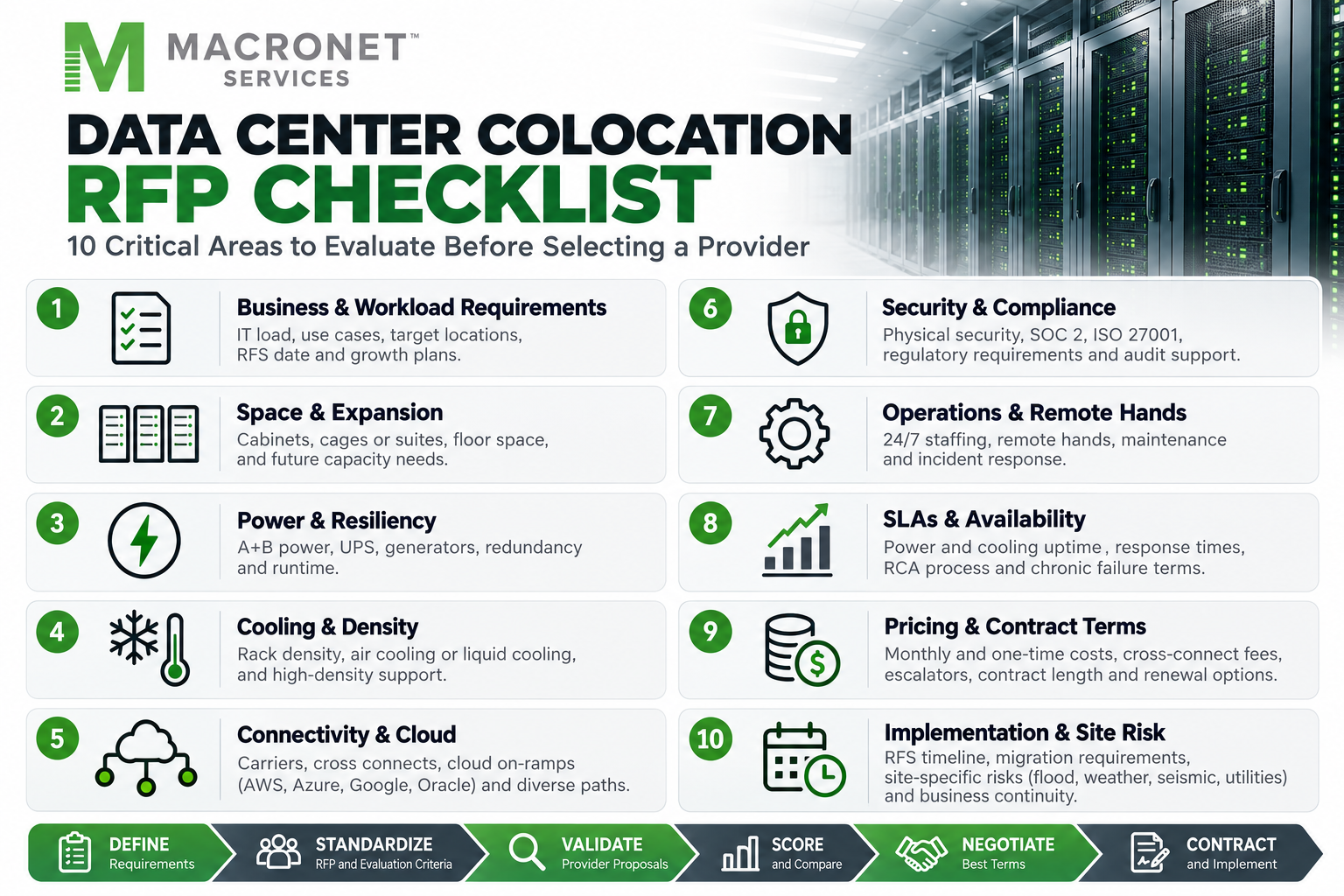
DEFINE → STANDARDIZE → VALIDATE → SCORE → NEGOTIATE → CONTRACT
DEFINE means starting with the business and workload: geography, power, density, cooling, network, security, timing and growth. The central question is what must be true for the data center strategy to succeed.
STANDARDIZE means creating response tables, pricing assumptions, exceptions registers and common commercial scenarios so providers compete on the quality of their solutions rather than on incompatible proposal formats.
VALIDATE means checking certifications, architecture, carrier paths, facility conditions, operating practices and references instead of accepting material claims at face value.
SCORE means applying the methodology established before bids arrived, separating pass/fail requirements from preferences, normalizing TCO and then applying risk-adjusted business judgment.
NEGOTIATE means preserving credible alternatives through the important technical, commercial and contractual discussions and using the BAFO process to improve the whole deal—not merely the opening monthly rate.
CONTRACT means reconciling the signed agreement with the procurement record so the solution the enterprise signs is the same solution it evaluated.
A Practical Colocation RFP Timeline
There is no universal schedule. A straightforward retail deployment in a market with available capacity may move relatively quickly, while a multi-megawatt AI project involving utility work, construction and liquid cooling can take far longer. Still, the following sequence provides a practical starting point for an enterprise procurement.
| Phase | Illustrative timing | Primary activity |
| Requirements and discovery | Weeks 1-2 | Business, workload, power, network and commercial requirements |
| Market analysis / optional RFI | Weeks 2-3 | Identify viable markets, facilities and capacity |
| RFP development and release | Weeks 3-4 | Finalize requirements, scorecard and pricing workbook |
| Bidder questions | Weeks 4-5 | Written clarifications and controlled communications |
| Proposal preparation | Weeks 5-7 | Provider responses |
| Initial evaluation | Weeks 8-9 | Pass/fail, weighted scoring, TCO and exceptions |
| Clarifications and shortlist | Weeks 9-10 | Resolve gaps and identify finalists |
| Site visits and references | Weeks 10-11 | Validate proposals |
| BAFO and negotiation | Weeks 11-13 | Final technical, commercial and contractual positions |
| Award and contract | Weeks 13+ | Reconciliation and execution |
| Implementation | Project-specific | Build, provision, test and migrate |
The timeline should not become the objective. A rushed three-month process that produces a poor five-year agreement is not efficient. The challenge is to move quickly enough to preserve scarce capacity while leaving enough time to expose technical and commercial risk before commitment.
Frequently Asked Questions About Colocation RFPs
What is a colocation RFP?
A colocation RFP is a structured procurement document used to define data center requirements and solicit comparable technical, operational and commercial proposals from qualified providers. A strong RFP covers power, cooling, resiliency, connectivity, security, operations, implementation, pricing, scalability and contract terms—not just space.
What should a data center RFP include?
It should define the business requirement, geography, IT load, growth, rack density, space, electrical architecture, cooling, resiliency, connectivity, security, compliance, operating model, SLAs, implementation schedule and commercial structure. It should also include a standardized pricing workbook, assumptions-and-exceptions process and evaluation methodology.
What is the difference between an RFI, RFP and RFQ?
An RFI is primarily for market discovery, an RFP compares proposed solutions to a defined business requirement, and an RFQ is most useful when the specification is already standardized and price is the main remaining variable.
How many providers should receive a colocation RFP?
Enough qualified providers to create meaningful competition, but not so many that obviously unsuitable facilities consume evaluation time. Initial market research or an RFI can narrow the field before the formal RFP.
How long does a colocation RFP take?
A straightforward enterprise procurement may take roughly three to four months, while complex migrations, large wholesale requirements and AI deployments can take longer. Capacity constraints, construction and contract negotiation are major variables.
How should power be specified?
Specify critical IT load in kW or MW, initial and future demand, average and maximum rack density, expected voltage/phase and redundancy requirements. Do not rely on rack count alone.
What does A+B power mean?
A+B generally refers to redundant feeds serving dual-corded IT equipment, but the enterprise should verify how far upstream those feeds remain independent and what infrastructure is shared.
What is Tier III?
Under Uptime Institute’s framework, Tier III describes concurrently maintainable infrastructure. Buyers should distinguish formal certification from phrases such as “Tier III designed” or “Tier III equivalent.”
Does a data center need Tier III certification?
Not necessarily. A well-designed facility can provide strong resilience without formal certification, but the buyer then needs clear engineering evidence of the architecture and operating outcome.
How should colocation pricing be compared?
Require every bidder to price the same deployment assumptions and compare total cost of ownership rather than only year-one MRC or $/kW. Include electricity, cross connects, network services, remote hands, NRCs, escalators, expansion and renewal economics.
What should a colocation SLA include?
Define the service being measured, measurement point, performance commitment, exclusions, calculation and remedy. Depending on the deployment, this may include power, environment, facility availability, remote hands, cross-connect delivery and incident communication.
What should be checked during a data center site visit?
Validate the actual proposed customer environment, power and cooling architecture, security, Meet-Me Rooms, carrier pathways, receiving/staging, operations and expansion capacity. Build the visit around claims made in the proposal.
How should RFP responses be scored?
Use pass/fail criteria for true non-negotiables, then a weighted technical/commercial score and a final risk-adjusted review. The model should be established before bids arrive.
Should the lowest-price provider win?
Not necessarily. The correct comparison is risk-adjusted TCO. A lower facility rate can be offset by more expensive network backhaul, weak scalability, high cross-connect costs, unfavorable escalators or greater migration and outage risk.
What should be negotiated in a colocation contract?
Important terms can include recurring price, annual escalation, electricity methodology, capacity commitments, cross-connect rates, remote hands, construction, expansion rights, RFS, SLAs, renewal, relocation and decommissioning. Material technical commitments should also be preserved.
What belongs in an AI colocation RFP?
Define current and future rack density, total IT load, cooling architecture, facility-to-IT liquid-cooling interfaces where applicable, rack weight, structural limits, network capacity, expansion requirements and hardware roadmap. Require providers to distinguish existing capability from planned capability.
The Bottom Line
A colocation RFP should not be viewed as a long questionnaire sent to several data center companies. It is a structured decision process. The enterprise defines what the business and applications require, forces competing providers to respond on a common basis, validates material claims, normalizes commercial terms, preserves competition through negotiation and then converts the winning commitments into the contract.
Done correctly, the process produces something more valuable than several data center quotes. It gives leadership a defensible answer to the real question: which data center architecture, provider and commercial structure best support the business over the full life of the deployment?
That question is becoming more important as power availability tightens, AI changes density and cooling, cloud and network interconnection become more central to application architecture, and large capacity commitments extend farther into the future. The best time to discover a limitation in power, connectivity, cooling, scalability or contract language is during the RFP—not after the equipment has been installed.
How Macronet Services Helps Enterprises Run a Better Colocation RFP
Data center selection increasingly sits at the intersection of infrastructure, networks, cloud, finance and procurement. Macronet Services helps organizations define colocation requirements, identify qualified facilities and providers, structure and manage RFPs, evaluate technical architecture, analyze connectivity, normalize commercial proposals, model total cost of ownership and support provider negotiations.
Because the process also considers carrier services, Internet architecture, cloud connectivity and cross connects, enterprises can evaluate the complete infrastructure solution instead of treating the facility as an isolated real-estate decision. That is particularly important when a slightly more expensive facility can create a lower overall architecture cost because the required carriers, cloud on-ramps and interconnection options are already present.
Whether the requirement involves a few enterprise cabinets, a private cage, hundreds of kilowatts or a multi-megawatt AI deployment, the objective is the same: define the requirement correctly, create real competition, expose risk before commitment and negotiate an architecture that can support the business for years to come.
Planning a Data Center Colocation RFP?
Macronet Services can help your organization develop requirements, identify the right providers, build and manage the RFP, evaluate technical and commercial responses, analyze connectivity and total cost, and negotiate the final solution.