
Telecom Expense Management (TEM): The Definitive Guide for Mid-Large Enterprises
In This Guide: Telecom Expense Management (TEM) for Mid-Large Enterprises
- Why Telecom Expense Management Still Matters in 2025
- What Is Telecom Expense Management (TEM)?
- What TEM Includes: Network, Mobility, UCaaS, CCaaS, Cloud Connectivity, IoT
- Why TEM Is Hard: Billing Complexity, Contracts, and Silos
- The Real Cost of Poor TEM: Overspend, Leakage, and Financial Risk
- Core TEM Functions: Inventory, Invoice Validation, Allocation, Optimization
- Telecom Contract Management and Negotiation in TEM
- TEM and Network Strategy: Planning Rollouts with Contract Expirations
- Mobility Expense Management (MEM): Policies, Pools, Roaming, and Risk
- UCaaS and CCaaS Expense Management: Subscription Sprawl and Usage Pricing
- Global Telecom Expense Management: Carriers, Currency, Tax, Compliance
- AI in TEM: Automation, Anomaly Detection, and GenAI Insights
- TEM Data as a Strategic Asset: ERP/ITFM Integration and Executive Reporting
- Build vs Buy TEM: Platform, Managed Services, or Hybrid
- How to Evaluate a TEM Provider (and Avoid Common Pitfalls)
- TEM Governance and Operating Model: Ownership, RACI, CoE
- TEM Security, Compliance, and Audit Readiness
- TEM KPIs That Matter to CFOs and CIOs
- TEM for M&A and Divestitures: Due Diligence, Integration, Carve-outs
- Future of TEM: Predictive Cost Management and Autonomous Optimization
-
Executive Introduction: Why Telecom Expense Management Still Matters in 2025
For many mid-large enterprises, telecom expense management (TEM) feels like a solved problem. Voice lines were consolidated years ago. Mobility plans were rationalized. MPLS networks were replaced or augmented with SD-WAN. Cloud adoption shifted capital expense to operating expense. On the surface, telecom appears “under control.”
In reality, telecom expense management has never been more complex—or more strategically important—than it is today.
The modern enterprise no longer consumes “telecom” as a single category. Connectivity now underpins nearly every critical business function: cloud access, customer engagement, collaboration, cybersecurity, remote work, artificial intelligence, and global operations. What used to be a discrete set of carrier invoices has become a sprawling ecosystem of networks, subscriptions, usage-based services, and embedded connectivity costs distributed across IT, finance, procurement, and business units.
As a result, telecom expense has quietly become one of the least transparent and least governed operating expenses inside many organizations.
This is why leading enterprises are re-framing telecom expense management—not as an accounting or bill-pay function, but as a strategic discipline that sits at the intersection of finance, IT architecture, sourcing, and digital transformation.
In 2025, effective TEM enables enterprises to:
- Reduce structural telecom and connectivity costs by 10–30%
- Eliminate billing errors, ghost services, and contract leakage
- Support cloud, UCaaS, CCaaS, and AI initiatives without runaway spend
- Improve agility during mergers, acquisitions, and global expansion
- Provide executives with defensible, data-driven visibility into connectivity spend
This guide is written for CIOs, CFOs, IT leaders, network architects, procurement professionals, and finance executives who need a comprehensive, modern understanding of telecom expense management—and how it must evolve to support the enterprise of today and tomorrow.
-
What Is Telecom Expense Management (TEM)?
2.1 A Formal Definition of Telecom Expense Management
Telecom Expense Management (TEM) is the process, technology, and governance framework used to:
- Inventory telecom and connectivity assets
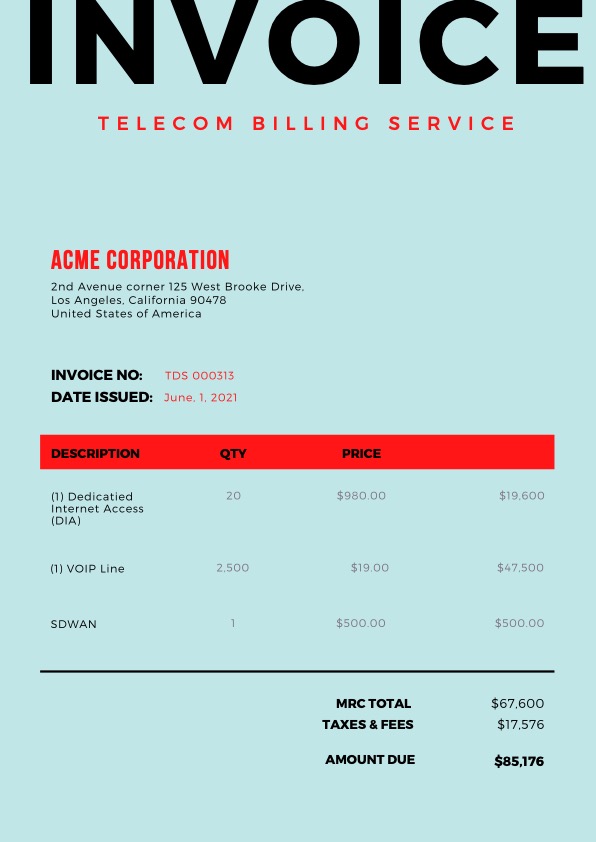
- Collect and normalize carrier invoices
- Validate charges against contracts and usage
- Allocate costs across the organization
- Optimize services, contracts, and spending over time
At its core, TEM answers three fundamental questions:
- What services do we have?
- What are we paying for them?
- Are those services and costs aligned with business needs?
Historically, TEM focused on wireline voice and data services. Today, that definition must expand dramatically.
Modern TEM encompasses not only traditional carrier services, but also cloud connectivity, UCaaS and CCaaS subscriptions, mobility, IoT connectivity, satellite services, and emerging edge networks. In many organizations, these costs now rival or exceed traditional WAN spend.
2.2 The Evolution of Telecom Expense Management
Understanding TEM requires understanding how enterprise connectivity itself has evolved.
Early TEM (Pre-2010)
- Focused on landlines, long-distance voice, and basic data circuits
- Highly manual invoice processing
- Limited visibility beyond cost totals
- Primarily finance-driven
Mobility and Globalization Era (2010–2015)
- Explosion of corporate mobile devices
- International roaming complexity
- Early attempts at centralized inventory
- Introduction of managed TEM vendors
Cloud and SD-WAN Era (2015–2020)
- MPLS networks augmented or replaced
- Multiple carriers per site
- Cloud on-ramps added new cost categories
- UCaaS subscriptions proliferated
AI, Usage-Based, and Subscription Era (2020–Present)
- Connectivity embedded into applications
- Consumption-based pricing models
- Shadow IT and decentralized buying
- Telecom costs fragmented across systems
In this latest phase, TEM can no longer function as a back-office utility. It must become data-driven, automated, and deeply integrated with IT and finance strategy.
2.3 TEM vs. Related Disciplines
Telecom Expense Management is often confused with adjacent disciplines. The distinctions matter.
TEM vs. Telecom Asset Management
- Asset management focuses on what exists
- TEM focuses on what exists, what it costs, and whether it’s correct
TEM vs. IT Financial Management (ITFM)
- ITFM aggregates high-level IT costs
- TEM provides line-item, contract-level validation
TEM vs. FinOps
- FinOps focuses on cloud compute and storage
- TEM addresses the connectivity that enables cloud itself
The most mature enterprises integrate all three—but TEM remains the foundation layer for connectivity economics.
-
What TEM Includes: Network, Mobility, UCaaS, CCaaS, Cloud Connectivity, IoT
One of the most common reasons TEM programs fail is an outdated definition of “telecom.”
In reality, modern telecom expense spans multiple domains, each with unique cost structures, contracts, and optimization levers.
3.1 Network Services
Traditional network services remain a major cost center, particularly for global enterprises.
This includes:
- MPLS networks
- Dedicated Internet Access (DIA)
- Ethernet services (EPL, EVPL, E-Line, E-LAN)
- Broadband and hybrid WAN connectivity
Each service type introduces billing complexity through:
- Bandwidth tiers and burstable pricing
- Distance-based charges
- Port and access fees
- Service-level agreements (SLAs)
Without accurate inventory and contract alignment, enterprises routinely pay for:
- Circuits that are no longer in use
- Bandwidth far exceeding actual utilization
- Redundant services added during past initiatives
3.2 Cloud and Data Center Connectivity
Cloud connectivity has quietly become one of the fastest-growing telecom expenses.
Examples include:
- AWS Direct Connect
- Azure ExpressRoute
- Google Cloud Interconnect
- Cross-connects in colocation facilities
These services are often purchased outside traditional telecom procurement processes, leading to:
- Inconsistent ownership
- Poor cost allocation
- Duplicate connections
- Underutilized ports and links
In many enterprises, cloud connectivity costs are visible only after invoices arrive—long after architectural decisions have been made.
3.3 Unified Communications and Collaboration
UCaaS platforms such as Microsoft Teams, Zoom, Webex, and RingCentral blur the line between telecom and SaaS.
Challenges include:
- Per-user licensing sprawl
- Inactive or duplicate accounts
- Voice add-ons layered onto collaboration licenses
- International calling and toll charges
Without TEM oversight, organizations frequently pay for thousands of licenses that no longer align with active users or roles.
3.4 Contact Center (CCaaS)
Contact center platforms introduce usage-based pricing, which creates volatility and forecasting risk.
Key cost drivers include:
- Agent minutes
- Concurrent sessions
- AI and analytics add-ons
- Seasonal demand spikes
Traditional TEM tools struggle here unless adapted to handle real-time usage data and contract thresholds.
3.5 Mobility and Wireless
Enterprise mobility remains one of the most fragmented and politically sensitive expense categories.
Complexity stems from:
- Corporate-liable vs BYOD policies
- Pooled plans and shared data
- International roaming
- eSIM and global mobility platforms
Mobility costs are often distributed across HR, IT, finance, and business units—making governance difficult without a unified TEM framework.
3.6 IoT, Edge, and Emerging Connectivity
The fastest-growing and least controlled category is IoT connectivity.
Examples include:
- Sensors and smart facilities
- Fleet and vehicle connectivity
- Industrial and healthcare devices
- Satellite services and private wireless
IoT introduces high volume, low visibility spend—thousands of small connections that quietly accumulate into significant cost exposure.
-
Why TEM Is Hard: Billing Complexity, Contracts, and Silos
If telecom expense management is so valuable, why do so many organizations struggle with it?
The answer lies in structural complexity, not lack of effort.
4.1 Fragmented Vendors and Invoices
Most enterprises work with:
- Dozens of carriers
- Hundreds of invoices
- Thousands of billing formats
There is no industry standard for telecom billing, making normalization a prerequisite for any meaningful analysis.
4.2 Contract Complexity and Opacity
Telecom contracts are intentionally complex.
Common challenges include:
- Auto-renewal clauses
- Early termination liability (ETL)
- Bundled pricing structures
- Unclear service descriptions
Without disciplined contract management, enterprises routinely lose leverage and incur avoidable costs.
4.3 Organizational Silos
Telecom touches multiple teams:
- IT designs the network
- Procurement negotiates contracts
- Finance pays invoices
- Business units consume services
When ownership is unclear, no one owns optimization.
4.4 Constant Change
Telecom environments change continuously due to:
- Cloud migrations
- Site openings and closures
- Mergers and acquisitions
- Workforce mobility
Static spreadsheets cannot keep pace with dynamic connectivity environments.
-
The Real Cost of Poor TEM: Overspend, Leakage, and Financial Risk
For CFOs and finance leaders, telecom expense management is rarely viewed as a strategic initiative. Connectivity costs are often perceived as relatively stable, operationally necessary, and already “negotiated.” As a result, telecom tends to receive far less scrutiny than other large operating expense categories such as cloud compute, labor, or facilities.
That perception is increasingly disconnected from reality.
Across mid-large enterprises, telecom and connectivity expenses now represent one of the largest unmanaged operating expense categories on the balance sheet, particularly when cloud connectivity, UCaaS, CCaaS, mobility, and embedded network services are included. What makes this category uniquely problematic is not its size alone, but the systemic lack of financial controls, validation, and accountability.
Independent audits and enterprise benchmarking studies consistently show that organizations overspend on telecom and connectivity by 10% to 30% annually, even in environments where contracts were recently renegotiated. This overspend is not the result of poor negotiation—it is the result of structural leakage.
The most common source of leakage is billing inaccuracy. Telecom invoices are among the most complex vendor bills enterprises receive, often containing thousands of line items spread across multiple services, locations, and contracts. Error rates in carrier billing—ranging from incorrect rates to duplicate charges, misapplied taxes, and failure to remove disconnected services—are widely documented. In enterprises without systematic invoice validation, these errors persist month after month, compounding over time.
A second major driver of cost leakage is service sprawl. As organizations migrate applications to the cloud, deploy SD-WAN, expand globally, or undergo mergers and acquisitions, new circuits, ports, licenses, and mobile lines are added quickly to meet business timelines. However, the corresponding disconnects and right-sizing actions rarely occur with the same urgency. The result is a growing population of “ghost services”—assets that exist on invoices but no longer deliver business value.
From a financial perspective, these ghost services behave like annuities in reverse. A single unused circuit or license may seem immaterial in isolation, but when multiplied across hundreds of sites, thousands of users, and dozens of vendors, the annualized waste becomes significant. In many enterprises, these stranded costs persist for years, silently eroding margins.
Contracts themselves introduce another layer of financial risk. Telecom agreements frequently include auto-renewal clauses, early termination liabilities, and pricing structures that assume active management. When these terms are not actively monitored, enterprises lose the ability to renegotiate from a position of strength. Services roll over at legacy rates, market price reductions are never realized, and organizations remain locked into suboptimal commercial structures long after the original business case has expired.
For CFOs, this creates a governance problem. Telecom expense is one of the few large operating cost categories where spend authorization, service delivery, and invoice approval are often disconnected from one another. Finance teams approve invoices without visibility into whether services are still required. IT teams design networks without full transparency into long-term cost implications. Procurement teams negotiate contracts without accurate historical usage data. Each function performs its role competently, yet the enterprise as a whole lacks financial control.
The downstream impact extends beyond cost. Poor telecom expense management introduces financial reporting and compliance risk. Inaccurate cost allocation across cost centers, regions, or subsidiaries can distort profitability analysis. In regulated or publicly traded organizations, this lack of traceability complicates audit readiness and internal controls. For private equity–backed firms, unmanaged telecom expense reduces EBITDA and obscures the true cost structure of the business, directly impacting valuation.
Perhaps most critically, weak TEM undermines forecasting and planning. As telecom pricing models shift toward usage-based and consumption-driven constructs, variability increases. Without reliable inventory, contract alignment, and usage data, finance leaders lose the ability to predict spend with confidence. This volatility makes budgeting less accurate and forces organizations into reactive cost-cutting rather than proactive optimization.
In contrast, enterprises that implement disciplined telecom expense management consistently achieve measurable, defensible financial outcomes. Cost reductions achieved through TEM are typically structural rather than one-time, improving margins year over year. Savings are auditable, repeatable, and sustainable because they result from eliminating waste, enforcing contracts, and aligning services with actual demand.
For CFOs, this is the key distinction: telecom expense management is not about chasing discounts. It is about restoring financial governance to a category that quietly escaped it.
-
Core TEM Functions: Inventory, Invoice Validation, Allocation, Optimization
A common misconception among enterprises is that telecom expense management is primarily about paying invoices correctly. In reality, invoice processing is only one component—and not the most valuable one.
A mature TEM program functions as a closed-loop financial and operational control system. Each function feeds the next, creating a continuous cycle of visibility, validation, and optimization. When any of these functions are missing or poorly implemented, cost leakage and risk re-enter the system.
6.1 Inventory Management: Establishing a Single Source of Truth
At the foundation of every successful TEM program is a comprehensive, continuously maintained inventory of telecom assets. Without this, no downstream activity—billing validation, optimization, or forecasting—can be performed reliably.
A modern telecom inventory must extend far beyond a list of circuits or phone numbers. For mid-large enterprises, it typically includes:
- Physical network services (circuits, ports, access loops)
- Logical services (SD-WAN overlays, virtual connections)
- Cloud connectivity (direct connects, interconnects, cross-connects)
- UCaaS and CCaaS subscriptions
- Mobility lines, plans, and devices
- IoT and embedded connectivity endpoints
- Contract associations for each service
- Location, cost center, and business owner metadata
The financial value of inventory accuracy cannot be overstated. In many enterprises, the act of building a true inventory alone uncovers 5–10% of total telecom spend tied to services that are no longer in use or cannot be clearly justified.
From a governance perspective, inventory also creates accountability. When each service is tied to a business owner and cost center, telecom expense stops being an abstract overhead item and becomes a managed operational input.
6.2 Invoice Processing and Normalization
Telecom invoices are structurally different from most other vendor bills. They are often:
- Extremely detailed
- Poorly standardized
- Delivered in inconsistent formats
- Difficult to reconcile to services
Invoice normalization is the process of converting raw carrier bills into a consistent, machine-readable format that allows meaningful analysis.
This step is essential for three reasons. First, it enables accurate comparison of charges across vendors and geographies. Second, it supports automated validation against contracts and inventory. Third, it creates a historical data set that finance and procurement teams can actually use.
Without normalization, enterprises are limited to high-level totals and trends, which mask underlying errors and inefficiencies.
6.3 Billing Validation and Error Detection
Billing validation is where TEM delivers its most immediate and defensible financial returns.
Validation involves systematically comparing each invoice line item against:
- Contracted rates
- Approved services in inventory
- Actual usage, where applicable
- Applicable taxes and surcharges
Errors commonly identified through validation include:
- Charges for disconnected services
- Incorrect rates applied post-contract
- Duplicate billing across accounts
- Misapplied one-time charges
- Improper taxes and fees
In organizations without automated validation, these errors frequently go unnoticed—not because they are rare, but because they are too time-consuming to detect manually.
For CFOs, validated recoveries represent high-confidence savings. Unlike sourcing initiatives that depend on future behavior, billing recoveries are based on documented overcharges and typically result in direct credits or refunds.
6.4 Cost Allocation, Chargeback, and Transparency
As enterprises grow more distributed, cost allocation becomes both more difficult and more important.
A modern TEM program enables accurate allocation of telecom costs by:
- Business unit
- Department
- Location
- Project
- Customer or product line (in advanced models)
This level of transparency supports better decision-making across the organization. Business leaders see the true cost of connectivity. IT teams can evaluate architecture choices with financial clarity. Finance teams gain confidence that telecom costs are being reported and managed appropriately.
Chargeback, when implemented carefully, also changes behavior. When business units are accountable for the services they consume, demand becomes more disciplined and waste naturally declines.
6.5 Usage Analysis and Continuous Optimization
The most advanced TEM programs do not stop at validation—they actively drive optimization.
Usage analysis identifies mismatches between:
- Provisioned capacity and actual demand
- Licensed users and active users
- Geographic coverage and business footprint
Over time, this analysis supports:
- Bandwidth right-sizing
- License rationalization
- Circuit consolidation
- Technology migration decisions
From a financial perspective, optimization is where structural savings are realized. These savings recur year after year, compounding their impact on margins and cash flow.
-
Telecom Contract Management and Negotiation in TEM
Telecom contracts are often treated as static legal documents. In reality, they are financial instruments that require active management to deliver their intended value.
7.1 Why Telecom Contracts Represent Financial Risk
Telecom agreements frequently span three to five years and include complex commercial terms. When contracts are not actively monitored, enterprises face several risks:
- Auto-renewals at above-market rates
- Inability to disconnect services without penalty
- Misalignment between contract terms and actual usage
- Loss of negotiating leverage due to poor data
For CFOs, unmanaged contracts represent contingent liabilities that rarely appear on the balance sheet but directly affect operating expense.
7.2 Key Contract Terms Enterprises Commonly Miss
Certain contract provisions consistently drive avoidable cost:
- Auto-renewal windows that lock in unfavorable pricing
- Early termination liability (ETL) that discourages optimization
- Minimum spend commitments misaligned with actual demand
- Ambiguous service definitions that complicate validation
A disciplined TEM program ensures these terms are visible, tracked, and factored into decision-making long before they become problems.
7.3 Using TEM Data to Strengthen Negotiations
Data changes the balance of power in telecom negotiations.
With accurate historical usage, inventory, and performance data, enterprises can:
- Challenge vendor pricing assumptions
- Benchmark rates across regions and providers
- Align contract terms with real business needs
- Avoid over-committing to future demand
This transforms negotiations from reactive events into planned financial exercises that align sourcing strategy with enterprise architecture.

- TEM and Network Strategy: Planning Rollouts with Contract Expirations
Network architecture decisions are often presented as technical exercises focused on performance, resilience, and scalability. In practice, however, the success or failure of a network strategy is just as dependent on financial timing as it is on design.
This is where telecom expense management becomes a critical, and often overlooked, strategic enabler.
Modern enterprises rarely have the luxury of designing networks on a blank slate. Most environments consist of layered generations of connectivity—legacy MPLS circuits, newer DIA links, SD-WAN overlays, cloud on-ramps, and regional access services—all governed by contracts signed at different times, under different commercial assumptions. Each of these services carries its own term length, renewal date, and termination liability.
Without clear visibility into those contract timelines, network planning becomes reactive and inefficient.
One of the most common failure modes in enterprise network transformation initiatives is attempting to modernize connectivity without understanding when existing circuits can be exited economically. Projects stall, timelines slip, or costs spike—not because the architecture is flawed, but because the organization discovers too late that critical circuits are still locked into long-term contracts with significant early termination penalties.
A mature TEM program fundamentally changes this dynamic by providing a clear, authoritative view of circuit and service expirations across the entire enterprise.
When inventory and contract data are properly integrated, TEM allows organizations to see:
- Which circuits are nearing term expiration
- Which services are on auto-renewal timelines
- Where early termination liability would materially impact ROI
- How contract timing aligns—or conflicts—with planned initiatives
This visibility transforms network strategy from a theoretical exercise into a sequenced, financially optimized roadmap.
For example, instead of attempting a global MPLS-to-SD-WAN migration in a single phase, enterprises can use TEM data to stage the rollout in alignment with natural contract expirations. Sites with expiring circuits become early candidates for redesign, while locations with long remaining terms are deferred or re-architected using interim solutions. This approach preserves flexibility, reduces stranded costs, and smooths capital and operating expense over time.
From a CFO perspective, this sequencing is critical. It allows network investments to be justified not only on technical merit, but on clean financial logic. Projects can be evaluated based on when savings actually begin to accrue, rather than when invoices spike due to overlapping services. Forecasts become more accurate, and the risk of surprise termination costs is dramatically reduced.
TEM also enables more intelligent redundancy and resiliency planning. Enterprises often deploy redundant circuits for availability without fully understanding the long-term cost implications of maintaining parallel services beyond their useful life. By aligning redundancy decisions with contract terms, organizations can maintain resilience while avoiding unnecessary overlap.
Perhaps most importantly, integrating TEM into network planning restores cross-functional alignment. Network architects gain the financial context they need to design pragmatically. Finance leaders gain confidence that architectural decisions are grounded in contractual reality. Procurement teams gain foresight into when renegotiations should occur. The result is a network strategy that is not only technically sound, but operationally and financially executable.
In this way, telecom expense management becomes more than a retrospective control mechanism. It becomes a forward-looking planning tool—one that allows enterprises to design, deploy, and evolve their networks with precision, confidence, and fiscal discipline.
-
Mobility Expense Management (MEM): Policies, Pools, Roaming, and Risk
Mobility is often treated as a solved problem. Most enterprises believe they have rationalized plans, negotiated competitive rates, and established acceptable use policies. Yet mobility remains one of the most persistent sources of unmanaged telecom spend.
The root issue is not pricing—it is fragmentation.
Enterprise mobility spans multiple stakeholders, usage patterns, and policy models. Unlike fixed networks, mobile services follow employees, change frequently, and intersect with HR, security, and compliance functions. Without a disciplined mobility expense management (MEM) framework embedded within TEM, cost and risk accumulate quietly.
9.1 Corporate-Liable vs. BYOD vs. Stipend Models
Most enterprises operate a mix of mobility models:
- Corporate-liable devices, fully owned and managed
- Bring Your Own Device (BYOD) programs with partial reimbursement
- Stipend-based models that shift responsibility to employees
Each model introduces different financial and governance challenges.
Corporate-liable programs provide the most control but require continuous lifecycle management. BYOD programs reduce device ownership but often obscure actual usage patterns. Stipend models simplify administration but remove visibility altogether.
From a CFO perspective, the risk is not the model itself—it is operating multiple models without centralized visibility. A mature MEM capability consolidates these approaches into a unified financial view, allowing leaders to understand total mobility cost regardless of policy variation.
9.2 Pooled Plans, Roaming, and International Exposure
Modern mobile plans rely heavily on pooled data structures. While pools reduce overage risk, they also make underutilization harder to detect. Enterprises routinely pay for capacity sized to peak demand that occurs only briefly, if at all.
International roaming introduces further volatility. Without real-time controls, roaming charges can escalate rapidly, particularly in regions where employees travel infrequently but unexpectedly.
A well-integrated TEM program addresses this by:
- Tracking usage trends over time
- Flagging anomalous roaming behavior
- Identifying opportunities to right-size pools
- Aligning plans with actual travel and role requirements
9.3 Security and Compliance Implications of Mobility Spend
Mobility expense is inseparable from security risk. Untracked devices and unmanaged lines create exposure to data leakage, regulatory violations, and unauthorized access.
For enterprises subject to data protection regulations, the inability to account for all active mobile endpoints represents a material governance gap. Integrating MEM into TEM ensures that financial inventory aligns with security and compliance controls, closing a risk loop that is often overlooked.
-
UCaaS and CCaaS Expense Management: Subscription Sprawl and Usage Pricing
Unified communications and contact center platforms have transformed enterprise collaboration and customer engagement. They have also introduced subscription sprawl, a phenomenon that mirrors early cloud adoption but with less financial discipline.
10.1 The Shift from Fixed Services to Variable Spend
Traditional telecom services were largely fixed-cost. UCaaS and CCaaS platforms are not.
Pricing models typically include:
- Per-user or per-agent licenses
- Feature-based add-ons
- Usage-based calling charges
- AI and analytics surcharges
This shift creates variability that many finance organizations are unprepared to manage. Without TEM oversight, licenses accumulate faster than they are retired, and usage-based charges introduce unexpected volatility.
10.2 License Sprawl and Shadow Adoption
One of the most common findings in UCaaS and CCaaS assessments is a significant gap between licensed users and active users.
Drivers include:
- Role changes not reflected in licensing
- Seasonal staffing fluctuations
- Redundant platforms adopted by different teams
- Mergers introducing overlapping systems
TEM provides the usage and inventory correlation necessary to identify these gaps. For CFOs, this represents low-risk savings achieved through rationalization rather than renegotiation.
10.3 Integrating TEM with SaaS and IT Financial Management
While UCaaS and CCaaS are technically SaaS platforms, they differ from traditional applications because they embed telecom services and regulatory constructs.
Leading enterprises integrate TEM with:
- SaaS management platforms
- IT financial management (ITFM) systems
- ERP and general ledger systems
This integration ensures that communications spend is governed with the same rigor as other strategic technology investments, without losing the domain-specific validation that telecom requires.
-
Global Telecom Expense Management: Carriers, Currency, Tax, Compliance
Global enterprises face an order of magnitude more complexity in managing telecom expense. Scale amplifies every weakness in process, data, and governance.
11.1 Regional Carriers vs. Global Providers
Most multinational organizations operate a hybrid carrier model, combining:
- Global Tier-1 providers
- Regional and in-country carriers
- Local access partners
Each vendor introduces unique billing formats, regulatory requirements, and commercial practices. Without TEM normalization, comparing costs across regions becomes nearly impossible.
11.2 Currency, Taxation, and Regulatory Complexity
Global telecom spend is affected by:
- Currency fluctuations
- Value-added taxes and surcharges
- Country-specific regulatory fees
- Data sovereignty requirements
Finance teams often see these costs only at an aggregated level, obscuring regional inefficiencies and compliance risks. A global TEM framework provides visibility into true cost drivers, enabling informed regional strategy decisions.
11.3 Managing Growth, M&A, and Divestitures Globally
Telecom is one of the first and last systems touched during corporate change.
During acquisitions, telecom assets are often poorly documented, leading to:
- Duplicate services
- Prolonged parallel contracts
- Delayed integration
During divestitures, the inability to separate shared services creates stranded costs and legal risk.
A mature TEM capability enables rapid inventory discovery, supports clean separation, and accelerates value realization—outcomes that directly impact deal economics.

-
AI in TEM: Automation, Anomaly Detection, and GenAI Insights
As telecom environments have grown more complex, manual processes have reached their limits. Spreadsheets, static databases, and periodic audits cannot keep pace with the volume, velocity, and variability of modern telecom spend. Automation and artificial intelligence are no longer optional enhancements to TEM—they are foundational capabilities.
12.1 Rule-Based Automation vs. AI-Driven TEM
Early-generation TEM platforms relied heavily on deterministic, rule-based logic. While effective for basic validation—such as matching invoice line items to contracted rates—these systems struggle in environments characterized by frequent change, inconsistent data, and emerging service models.
AI-driven TEM platforms extend beyond static rules by applying machine learning to identify patterns, anomalies, and risks that were not explicitly defined in advance. This distinction is critical for enterprises managing:
- Usage-based services
- Multi-vendor global environments
- Rapid organizational change
- Complex contract structures
For CFOs and CIOs, AI does not replace financial controls—it amplifies them, allowing organizations to detect issues that would otherwise remain invisible.
12.2 Machine Learning for Invoice, Usage, and Contract Analysis
Machine learning enhances TEM across several key dimensions.
First, it improves anomaly detection. By analyzing historical billing and usage patterns, ML models can flag deviations that may indicate errors, fraud, or operational issues. This is particularly valuable in high-volume environments where manual review is impractical.
Second, ML supports predictive cost analysis. Rather than reacting to overages after they occur, enterprises can anticipate spend spikes driven by seasonal usage, growth trends, or upcoming contract changes. This enables proactive budget management and reduces financial surprises.
Third, machine learning improves contract compliance monitoring. Complex pricing structures and tiered discounts are difficult to validate using static logic alone. ML models can learn expected billing behavior over time and identify discrepancies that warrant investigation.
12.3 Generative AI Use Cases in TEM
Generative AI introduces a new interaction layer between telecom data and business users.
Practical use cases include:
- Natural language queries such as “Why did mobility costs increase in EMEA last quarter?”
- Automated executive summaries of telecom spend and risk
- Plain-language explanations of complex invoices and contracts
- Scenario modeling for network and sourcing decisions
For finance leaders, generative AI reduces reliance on specialized analysts and accelerates decision-making. For IT leaders, it improves transparency and cross-functional communication.
-
TEM Data as a Strategic Asset: ERP/ITFM Integration and Executive Reporting
In many organizations, telecom data is underutilized because it is fragmented, poorly structured, or inaccessible. When properly managed, TEM data becomes a strategic asset that informs decisions well beyond telecom itself.
13.1 Integrating TEM with Enterprise Systems
Leading enterprises integrate TEM data into:
- ERP and general ledger systems
- IT financial management (ITFM) platforms
- Procurement and sourcing tools
- Executive dashboards
This integration ensures that connectivity costs are visible, auditable, and aligned with enterprise financial reporting standards.
13.2 Supporting Executive and Board-Level Reporting
Connectivity is now mission-critical infrastructure. As such, executives and boards increasingly expect:
- Clear visibility into spend trends
- Evidence of financial governance
- Confidence that risks are being managed
TEM data supports these expectations by translating operational complexity into financial narratives that senior leaders understand.
13.3 Benchmarking and Strategic Insight
With normalized data, enterprises can benchmark:
- Cost per site
- Cost per user
- Cost per application
- Regional cost efficiency
These benchmarks inform strategic questions such as whether to consolidate vendors, redesign networks, or shift operating models.
-
Build vs Buy TEM: Platform, Managed Services, or Hybrid
One of the most consequential decisions enterprises face is how to operationalize TEM.
14.1 TEM Software Platforms
TEM platforms provide automation, data normalization, and reporting capabilities. They are well-suited for organizations with:
- Dedicated internal telecom teams
- Stable environments
- Desire for direct control
However, platforms alone do not guarantee success. Without strong governance and expertise, technology becomes underutilized. The TEM software industry has undergone several rounds of consolidation and the focus on “service” and service layers has suffered, leading many organizations to look to outsourced teams.
14.2 Fully Managed TEM Services
Managed TEM services combine technology with operational execution. These models are attractive for enterprises that:
- Lack depth in specialized telecom expertise
- Operate in highly complex environments
- Want predictable outcomes and the potential for economies of scale offered from a third party team
The tradeoff is reduced internal control and reliance on third-party execution.
14.3 Hybrid TEM Operating Models
Many leading organizations adopt hybrid models, combining:
- TEM platforms for visibility and data
- External experts for audits, optimization, and strategy
This approach balances control with expertise and is increasingly common in mid-large enterprises.
-
How to Evaluate a TEM Provider (and Avoid Common Pitfalls)
Selecting a TEM partner is not a procurement exercise—it is a strategic decision that impacts financial governance, network agility, and operational resilience. The highly experienced team at Macronet Services can quickly assess your organization’s tech and talent and make recommendations for the best options for your business – at no cost.
15.1 Questions Enterprises Should Ask
Key evaluation criteria include:
- Depth of telecom and network expertise, including in emerging network technologies (important)
- Ability to support global environments
- Integration with finance and IT systems
- AI and automation capabilities
- Governance and reporting maturity
- Onshore vs Offshore employees and contractors
- Years of experience and client support model
15.2 Common Pitfalls in TEM Selection
Enterprises often underestimate:
- The effort required to maintain accurate inventory
- The importance of contract expertise
- The need for cross-functional alignment, including with financial processes
Avoiding these pitfalls requires clear ownership, executive sponsorship, and realistic expectations.
-
TEM Governance and Operating Model: Ownership, RACI, CoE
Telecom expense management fails most often not because of technology limitations, but because of unclear ownership and weak governance. Telecom spans IT, finance, procurement, and business operations, and without an explicit operating model, accountability fragments.
A mature TEM program establishes governance that is both centralized in oversight and distributed in execution.
16.1 Who Owns Telecom Expense Management?
In high-performing enterprises, TEM ownership is explicitly defined rather than assumed. While responsibility often resides within IT or finance, effective programs are characterized by cross-functional sponsorship.
- Finance provides financial controls, audit discipline, and budget alignment
- IT ensures architectural alignment and operational accuracy
- Procurement manages vendor relationships and sourcing strategy
What matters most is not which function owns TEM, but that ownership is unambiguous and empowered.
16.2 RACI Models and Cross-Functional Alignment
Clear RACI (Responsible, Accountable, Consulted, Informed) models eliminate ambiguity and reduce friction.
For example:
- IT may be responsible for inventory accuracy
- Finance may be accountable for invoice approval and reporting
- Procurement may be consulted on contract changes
- Business units may be informed of chargebacks and optimization initiatives
This clarity enables TEM to operate as a repeatable business process, not an ad hoc activity.
16.3 Global vs. Regional TEM Governance
Global enterprises must balance standardization with local realities. Centralized governance ensures consistency, while regional execution accounts for regulatory, cultural, and operational differences.
Leading organizations establish a global TEM framework with regional adaptations, supported by shared tools, standards, and reporting.
16.4 Telecom Centers of Excellence (CoE)
Some enterprises formalize TEM through a Telecom Center of Excellence. This model consolidates expertise, data, and decision-making, enabling faster optimization and stronger vendor leverage.
For CFOs and CIOs, a CoE provides a focal point for accountability and continuous improvement. Telecom COEs will become more critical as AI driven network transformation becomes a concern of the CIO and, once again, the network becomes a critical component of the business and less of a “static” transport layer.
-
TEM Security, Compliance, and Audit Readiness
Telecom expense management is tightly linked to enterprise risk, even though it is rarely framed that way.
17.1 Data Security and Access Control
TEM systems contain sensitive information, including:
- Network topology
- Vendor contracts
- Location data
- User and device identifiers
Strong access controls, audit logs, and role-based permissions are essential to prevent misuse or exposure.
17.2 Regulatory and Privacy Considerations
Global telecom data intersects with regulatory regimes such as GDPR and sector-specific compliance requirements. Inaccurate inventory or uncontrolled access can lead to compliance failures.
A disciplined TEM program ensures that financial visibility aligns with regulatory obligations.
17.3 Audit Readiness and Internal Controls
From a finance perspective, TEM strengthens internal controls by:
- Providing traceable cost allocation
- Supporting invoice validation
- Reducing reliance on manual approvals
This improves audit readiness and reduces the burden on finance teams during reporting cycles.
-
TEM KPIs That Matter to CFOs and CIOs
Executives care less about activity and more about outcomes. Effective TEM programs define metrics that connect operational actions to financial results.
18.1 Financial Metrics
Common executive-level metrics include:
- Year-over-year telecom spend reduction
- Percentage of validated invoices
- Recovered billing errors
- Structural savings realized
These metrics resonate with CFOs because they are quantifiable and auditable.
18.2 Operational Metrics
Operational KPIs include:
- Time to disconnect services
- Inventory accuracy rates
- Contract compliance levels
- Percentage of services with assigned owners
These metrics indicate process maturity and operational discipline.
18.3 Strategic Metrics
At the strategic level, TEM supports:
- Cost per site or user
- Connectivity cost as a percentage of revenue
- Variability of spend versus forecast
These measures inform long-term planning and investment decisions.
-
Telecom Expense Management for M&A and Divestitures: Due Diligence, Integration, Carve-outs
Few events expose weaknesses in telecom expense management as clearly as corporate transactions.
19.1 TEM in Due Diligence
During acquisitions, telecom assets are often poorly documented. This creates risk in valuation and integration planning.
TEM accelerates due diligence by:
- Rapidly identifying active services
- Estimating run-rate costs
- Highlighting contract obligations
For private equity firms, this visibility protects returns and reduces post-close surprises. Some managed TEM offerings also have extensive talent and resources specific to Finance Assessment and Transformation, Pre-Close Diligence, and Deal Driven IT Strategy. Be certain to understand the full capabilities of potential TEM partners when sourcing for TEM services.
19.2 Post-Merger Integration
After close, overlapping networks and contracts are common. Without TEM, rationalization is slow and expensive.
A mature TEM program supports:
- Vendor consolidation
- Network optimization
- Elimination of redundant services
These actions directly impact EBITDA in the first 12–24 months post-acquisition. A TEM partner with expertise in Diligence and IT Strategy can quickly provide accurate insight into financial impacts and detail specific to potential technology strategies.
19.3 Divestitures and Carve-Outs
Divestitures are often more complex than acquisitions. Shared services must be disentangled, and contracts renegotiated.
TEM provides the data foundation necessary to quickly execute clean separations while minimizing stranded costs.
-
Future of TEM: Predictive Cost Management and Autonomous Optimization
Telecom expense management is entering a new phase—one defined by intelligence, integration, and autonomy.
20.1 From Reactive to Predictive TEM
Future TEM platforms will shift from detecting errors after the fact to predicting cost drivers before they materialize. This transition mirrors trends in AIOps and FinOps.
20.2 TEM and Autonomous Networks
As networks become more software-defined and automated, TEM will integrate more closely with network management systems, enabling dynamic optimization of both performance and cost.
20.3 TEM as a Strategic Advantage
Enterprises that treat TEM as a strategic capability—not a back-office function—will gain:
- Better financial control
- Faster execution of network initiatives
- Stronger negotiating leverage
- Greater resilience in times of change
For CFOs and CIOs alike, TEM is evolving into a core enabler of digital strategy.
Conclusion: Telecom Expense Management Requires Experience, Not Just Tools
Telecom expense management has evolved far beyond invoice processing and cost recovery. In today’s enterprise, it sits at the intersection of network architecture, financial governance, sourcing strategy, cloud adoption, and organizational change. Managing it effectively requires more than software—it requires experience, context, and an understanding of how connectivity decisions ripple across the business.
This is where many TEM initiatives fall short. Enterprises are often presented with tools or services in isolation, without the strategic perspective needed to align those offerings with their actual network environments, contracts, growth plans, and financial objectives. As a result, organizations may implement a TEM solution that functions technically, but fails to deliver its full strategic and financial potential.
Macronet Services can help you address this gap.
With decades of experience in global telecom network design, implementation, and optimization, our team has worked directly with mid-large enterprises across industries, geographies, and operating models. We understand how networks are really built, how carrier contracts actually work, and how financial and architectural decisions intersect over time. That perspective allows us to evaluate telecom expense management not as a standalone function, but as part of a broader enterprise strategy.
Importantly, Macronet Services is vendor-neutral. We are not a TEM software provider. Our role is to help enterprises identify the TEM approach and partners that best fit their business, their network complexity, their internal capabilities, and their financial goals. In many cases, that guidance alone saves organizations from costly misalignment.
We believe strongly that the best outcomes come from informed conversations. Our team genuinely enjoys talking with business leaders about their environments—whether that conversation leads to a formal engagement or simply provides clarity and direction. There is no cost, no obligation, and no pressure.
If your organization is evaluating telecom expense management, struggling with cost visibility, planning a network transformation, or preparing for growth, consolidation, or change, we encourage you to contact Macronet Services for a free consultation. We are always happy to share what we’re seeing in the market and help you determine the right next step.
In a domain as complex and consequential as telecom expense management, experience matters. And that experience is what we bring to every conversation.
FAQs: Telecom Expense Management for Enterprises
- What is Telecom Expense Management (TEM)?
Telecom Expense Management (TEM) is the discipline of tracking, validating, allocating, and optimizing enterprise telecom and connectivity costs across networks, mobility, cloud communications, and contracts.
TEM helps organizations gain visibility into what services they have, what they are paying, and whether those costs align with contracts and business needs. Modern TEM extends beyond traditional telecom to include cloud connectivity, UCaaS, CCaaS, mobility, and IoT services.
- Why is Telecom Expense Management important for enterprises?
TEM is important because enterprises typically overspend on telecom by 10–30% due to billing errors, unused services, and unmanaged contracts.
Without structured TEM, organizations lack financial controls over one of their largest operating expenses. Effective TEM reduces cost, improves governance, and supports accurate forecasting and strategic planning.
- How much can a company save with Telecom Expense Management?
Most mid-large enterprises save between 10% and 30% of annual telecom spend through effective TEM.
Savings come from billing error recovery, elimination of unused services, contract optimization, and ongoing usage right-sizing. Unlike one-time sourcing events, TEM-driven savings are often structural and recurring.
- What types of expenses are included in Telecom Expense Management?
TEM includes network circuits, cloud connectivity, UCaaS, CCaaS, mobility, IoT connectivity, and telecom-related subscriptions.
Modern TEM covers far more than traditional voice and data services. It also includes SD-WAN, direct cloud connections, collaboration licenses, contact center usage, mobile plans, and emerging connectivity such as satellite and private wireless.
- Is Telecom Expense Management still relevant with cloud and UCaaS?
Yes. Cloud and UCaaS make TEM more important, not less, due to subscription sprawl and usage-based pricing.
As telecom shifts toward variable consumption models, cost volatility increases. TEM provides the controls needed to manage this complexity and prevent runaway operating expense.
- What is the difference between TEM and FinOps?
FinOps focuses on cloud compute and storage, while TEM focuses on connectivity, communications, and telecom-related services.
Both disciplines are complementary. TEM governs the networks and services that enable cloud access, while FinOps governs cloud resource consumption itself.
- Who should own Telecom Expense Management in an organization?
TEM should be jointly governed by IT, Finance, and Procurement, with clear ownership and executive sponsorship.
Successful TEM programs define accountability across functions, ensuring technical accuracy, financial control, and sourcing alignment without silos.
- How does TEM help with network transformation projects?
TEM provides visibility into circuit contracts and expirations, allowing network projects to be planned and sequenced cost-effectively.
Without contract visibility, enterprises risk early termination penalties and stranded costs. TEM enables phased rollouts aligned to contract timelines, reducing financial risk.
- What role does AI play in modern Telecom Expense Management?
AI helps detect billing anomalies, predict cost trends, and simplify analysis through automation and natural language insights.
Machine learning and generative AI enhance traditional TEM by identifying patterns humans miss and making telecom data accessible to executives without technical expertise.
- Can TEM support mergers and acquisitions?
Yes. TEM accelerates telecom due diligence, integration, and cost rationalization during M&A.
By rapidly identifying active services and contract obligations, TEM reduces post-close surprises and improves EBITDA realization in the first year after acquisition.
- What are common mistakes companies make with Telecom Expense Management?
Common mistakes include relying on spreadsheets, lacking contract visibility, and treating TEM as a one-time project.
TEM must be continuous, governed, and integrated with IT and finance processes. Tools alone do not deliver results without ownership and expertise.
- Is it better to buy a TEM platform or use a managed service?
The best approach depends on internal expertise, scale, and complexity; many enterprises use a hybrid model.
Platforms offer control and transparency, while managed services provide execution and expertise. Hybrid models balance both.
- How does TEM improve financial reporting and audit readiness?
TEM improves cost traceability, invoice validation, and internal controls.
Accurate allocation and documentation reduce audit risk and strengthen compliance with financial governance requirements.
- How do enterprises evaluate the right TEM solution?
Enterprises should evaluate TEM solutions based on expertise, vendor neutrality, automation, and alignment with business strategy.
The best TEM approach fits the organization’s network complexity, growth plans, and internal operating model—not just pricing.
- Why work with an independent telecom advisory like Macronet Services?
Independent advisors help enterprises select the right TEM approach without vendor bias.
With decades of experience in global telecom network design and implementation, Macronet Services helps organizations align TEM decisions with real-world network, contract, and financial realities—ensuring better long-term outcomes.
- Who are the top Telecom Expense Management (TEM) providers?
The best TEM provider depends on an organization’s size, network complexity, global footprint, and internal capabilities.
There is no single “best” Telecom Expense Management provider for every enterprise. Some organizations benefit from TEM software platforms, others from fully managed services, and many from hybrid models that integrate TEM with FinOps, IT financial management, and network strategy.
Rather than starting with a vendor list, leading enterprises work with an independent advisory firm to assess their environment and requirements first. Macronet Services brings decades of experience in global telecom network design, carrier sourcing, and financial optimization, and regularly guides enterprises to the TEM, FinOps, and related solutions that best fit their business. Organizations can contact Macronet Services at any time for a free consultation to discuss options and receive objective guidance.
- How do I cut my telecom costs?
The fastest and most effective way to cut telecom costs is to work with an experienced, independent telecom advisory that can evaluate your environment and guide you to the right telecom expense management approach.
Cutting telecom costs requires more than renegotiating rates. It starts with understanding what services you have, what contracts you are bound by, and where waste and inefficiency exist. An experienced advisory firm like Macronet Services helps enterprises identify the most effective telecom expense management, FinOps, and optimization solutions for their specific business, without vendor bias. Executives can contact Macronet Services at any time for a free consultation to quickly assess savings opportunities and next steps.
- Can the same approach used to reduce telecom costs be applied to: how do I cut costs on my utilities and other operating expenses?
Yes. The same principles used in telecom expense management—visibility, contract analysis, validation, and optimization—can be applied to utilities and other recurring operating expenses.
While this guide focuses on telecom expense management, many enterprises face similar challenges with utilities, energy, and other recurring vendor costs, including limited visibility, complex contracts, and unmanaged renewals. Firms like Macronet Services apply the same disciplined, data-driven approach used in telecom to help organizations identify savings opportunities across utilities and other expense categories. Executives can contact Macronet Services for a free consultation to explore broader cost-reduction strategies beyond telecom.
- How can IT organizations reduce software license sprawl and improve visibility into software costs?
IT organizations can reduce software license sprawl by consolidating all licenses into a single management portal that provides visibility, usage insight, and centralized control.
As enterprises adopt more SaaS and subscription-based software, license sprawl becomes a major source of hidden cost and operational complexity. Consolidating software licenses into a single, centralized portal allows IT and finance teams to see what applications are in use, how licenses are allocated, and where waste exists. This approach simplifies license management, improves cost transparency, supports compliance, and enables ongoing optimization. In addition to telecom expense management, firms like Macronet Services help organizations evaluate and implement the right tools and strategies to consolidate software licensing and gain better control over total technology spend. Contact us anytime for a free consultation.