
Why Kore.ai Leads the 2026 Gartner Magic Quadrant
The “Copilot Plateau” and the Rise of the Agentic Enterprise
In the early 2020s, the enterprise AI story was dominated by the “Copilot.” We marveled at the ability of LLMs to summarize meetings, draft emails, and suggest code snippets. But as we entered 2025 and moved into 2026, a hard truth emerged: Assistants aren’t enough. While Copilots increased individual productivity, they didn’t solve for organizational velocity. Humans remained the ultimate bottleneck, responsible for every “click,” every approval, and every cross-system handoff. This realization led to the “Copilot Plateau”—a point where incremental gains in chat-based AI no longer moved the needle for the bottom line.
Enter the Agentic Enterprise.
What is an Agentic Enterprise?
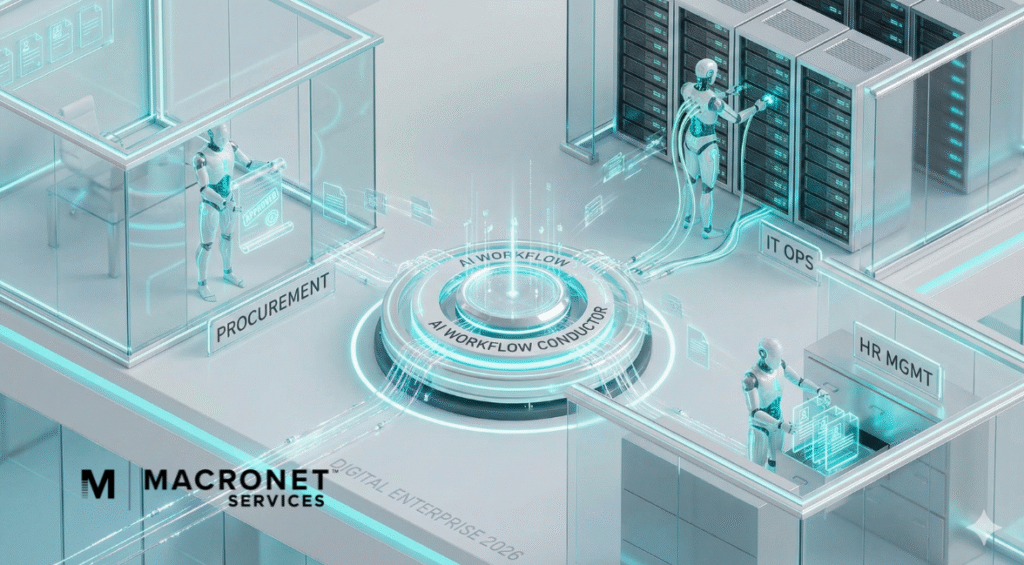
In 2026, the vanguard of the Fortune 500 has shifted from conversational AI to agentic AI. An Agentic Enterprise is an organization where AI doesn’t just “talk” about work—it executes it.
Unlike the reactive chatbots of the past, today’s AI agents are autonomous digital coworkers. They possess:
- Reasoning: The ability to decompose a complex goal (e.g., “Onboard this new supplier”) into a dozen sub-tasks.
- Memory: Contextual awareness of past interactions across email, Slack, and ERP systems.
- Action: The authority to call APIs, navigate legacy UI, and negotiate with other agents to finish a workflow end-to-end.
Kore.ai: The Orchestrator of the New Era
In this landscape, Kore.ai has solidified its position not merely as a tool provider, but it can be the central nervous system of the modern corporation. While competitors were focused on building the best “chatbot interface,” Kore.ai spent a decade building the plumbing required for massive-scale automation.
Why is Kore.ai a leading platform for 2026?
- Market Leadership: Named a Leader in the 2025 Gartner® Magic Quadrant™ for Conversational AI Platforms (for the third consecutive year) and the Forrester Wave™: Cognitive Search Platforms, Kore.ai holds the highest rating for “Ability to Execute.”
- Unmatched Scale: Trusted by over 400 of the Global 2000—including giants like Pfizer, who has deployed over 60 AI agents across research, manufacturing, and commercial markets.
- Strategic Momentum: In January 2026, Kore.ai secured a massive growth investment led by AllianceBernstein, specifically to accelerate the deployment of “agent-first” solutions globally.
As we peel back the layers of the Kore.ai ecosystem, it becomes clear that “solving for AI” in the enterprise isn’t about finding the smartest model; it’s about building the most robust orchestration layer.
The Kore.ai Ecosystem—A Triad of Enterprise Intelligence
To understand why Kore.ai has become a top choice for the 2026 enterprise, one must look past the “chat box.” The XO Platform (v11.5) is not a single application; it is a holistic orchestration environment designed to solve the three most expensive friction points in any corporation: Customer Experience (CX), Employee Experience (EX), and Business Operations (Ops).
Kore.ai categorizes these solutions into three distinct pillars, all powered by the same underlying “Agentic” engine.
- AI for Service: The End of the Support Ticket
In 2026, “deflection” is a dirty word. Enterprises no longer want to just avoid customer calls; they want to resolve them. AI for Service replaces traditional IVR and basic chatbots with autonomous AI Agents that handle end-to-end service requests.
- The “Zero-Wait” Contact Center: Leveraging real-time voice models, Kore.ai agents now handle complex banking or healthcare inquiries with sub-second latency, often outperforming human peers in accuracy.
- Smart Hand-offs: When a case does require a human, the AI doesn’t just transfer the call; it provides a full summary, intent analysis, and “next best action” to the live agent, reducing average handle time (AHT) by up to 40%.
- AI for Work: The Universal Employee Assistant
If AI for Service is the “outer” face of the company, AI for Work is its internal heartbeat. It aims to eliminate “app fatigue” by giving every employee a single conversational interface to interact with the entire corporate tech stack (Slack, Jira, Workday, SAP).
- Search AI & Agentic RAG: This is the “killer app” of 2026. Instead of hunting through SharePoint for a policy, an employee asks, “What is our 2026 travel policy for the EMEA region?” The agent uses Retrieval-Augmented Generation (RAG) to find the document, verify the employee’s role-based access, and summarize the answer instantly.
- Proactive HR/IT: From resetting passwords to managing benefits enrollment, these agents act as a Tier-1 support layer that never sleeps.
- AI for Process: Automating the “Un-automatable”
This is where Kore.ai separates itself from the competition. AI for Process focuses on high-value, multi-step business workflows—like procurement, supply chain logistics, or legal contract reviews.
- Inception (G42) Case Study: By partnering with G42’s Inception, Kore.ai has deployed “Procurement Agents” that can autonomously negotiate minor contract terms, verify vendor compliance, and trigger payments across different ERP systems.
- Human-in-the-Loop (HITL): For high-stakes decisions, the platform builds in mandatory “checkpoints” where the AI prepares the work, but a human supervisor provides the final “okay.”
At a Glance: The Three Pillars of Kore.ai
| Pillar | Focus Area | Primary Users | Key Benefit |
| AI for Service | Customer Support / CX | End Customers | 80%+ autonomous resolution rates |
| AI for Work | Productivity / EX | Employees | Centralized access to all internal apps |
| AI for Process | Operations / Ops | Business Units | Automation of cross-functional workflows |
The Technology “Glue”: Search AI
Underpinning these pillars is Kore.ai Search AI. In 2026, data is no longer just “indexed”; it is “understood.” By using Knowledge Graphs and Multi-Vector Embeddings, the platform ensures that agents don’t just guess—they ground every answer in your company’s proprietary data. This “Agentic Retrieval” means the AI can look at a spreadsheet, a PDF manual, and a Slack thread simultaneously to give one cohesive answer.
Technical Moats—Why Architects Choose Kore.ai
In the enterprise, the “cool factor” of an AI demo evaporates the moment it hits production reality. Architects don’t choose Kore.ai because it has the flashiest UI; they choose it because of its technical defensibility. In 2026, Kore.ai has established a “moat” built on three foundational technologies: DialogGPT, Agentic Guardrails, and Model Agnosticism.
- DialogGPT: The Brain of Multi-Agent Orchestration
While most platforms struggle to manage a single conversation without getting “lost,” Kore.ai utilizes DialogGPT—an agentic orchestration engine that acts as the “Air Traffic Controller” for enterprise tasks.
In 2026, workflows are too complex for a single bot. DialogGPT allows for three distinct Orchestration Patterns:
- The Supervisor Pattern: A central “brain” agent that decomposes a request (e.g., “Fix my payroll and update my tax forms”) and delegates sub-tasks to specialized HR and Finance agents.
- The Adaptive Network: A decentralized model where agents “hand off” tasks to one another based on real-time expertise—ideal for fluid, unpredictable customer service environments.
- Custom Pattern: For highly regulated industries (Banking/Defense), developers can programmatically define exactly how context is shared and when a human must intervene.
- The Evaluation Studio: Solving the Hallucination Problem
The biggest barrier to enterprise AI has always been trust. Kore.ai’s Evaluation Studio is the industry-standard response to AI hallucinations. It uses a GKD (Generate, Knowledge-Check, Decide) cycle:
- Generate: The agent drafts a response based on the prompt.
- Knowledge-Check: The system automatically cross-references the response against the “Ground Truth” (your company’s verified PDFs, manuals, and databases).
- Decide: If the factual “groundedness” score is low, the response is blocked or sent for human review before the user ever sees it.
Technical Insight: Kore.ai also incorporates PII Redaction at the edge. Sensitive data like CVVs or Social Security numbers are “masked” before they ever reach the LLM, ensuring compliance with GDPR, HIPAA, and SOC2.
- Model Agnosticism: Future-Proofing the Stack
The “Model Wars” of 2025-2026 have proven that today’s best LLM might be tomorrow’s second-best. Kore.ai’s Model Hub allows enterprises to swap the underlying “brain” without rebuilding the entire “body.”
- Plug-and-Play LLMs: Seamlessly switch between OpenAI (GPT-5 family), Anthropic (Claude 4.5), Google (Gemini 2.5), or open-source titans like Llama 3.2.
- Small Language Models (SLMs): For simple tasks like data extraction, Kore.ai allows the use of smaller, cheaper models to save on token costs and reduce latency.
- No-Code to Pro-Code: The Infinite Canvas
Kore.ai’s XO Platform v11.5 introduces the Infinite Canvas. This is a visual, drag-and-drop environment that allows business analysts to map out complex flows. However, unlike “no-code only” tools, it provides Pro-Code Script Nodes.
A developer can drop into a node and write custom JavaScript or Python to handle a legacy mainframe integration, giving the enterprise the speed of low-code with the unlimited ceiling of custom engineering.
Summary Table: The Technical Edge
| Feature | The Kore.ai Moat | Business Value |
| Orchestration | DialogGPT & Multi-Agent Logic | Handles complex, multi-step tasks autonomously. |
| Guardrails | GKD Cycle & Evaluation Studio | Eliminates hallucinations and protects brand reputation. |
| Flexibility | Model Agnostic & Hub | Prevents vendor lock-in; optimizes for cost/speed. |
| Integration | 250+ Pre-built Connectors | Reduces “Time-to-Value” from months to weeks. |
Real-World Impact—The 2026 Success Stories
By 2026, the market has moved beyond experimental pilots. Enterprise leaders are now judged by a single metric: Return on AI (ROAI). Kore.ai has become the primary engine behind these returns by shifting the focus from “chat volume” to “autonomous task completion.”
Here is how three disparate sectors are utilizing Kore.ai to redefine their operations.
- High-Performance Computing: AMD’s Universal HR Agent
For a global leader like AMD, supporting over 30,000 employees with a lean HR contact center of just 15 people was a scaling nightmare. In 2025-2026, they partnered with Kore.ai to build a generative AI-powered HR Agent that acts as a single point of entry for all employee needs.
- The Orchestration: The agent doesn’t just answer questions; it is integrated deeply into SAP SuccessFactors, ServiceNow, and SharePoint.
- The Result: AMD achieved an 80% reduction in HR resolution time within the first 90 days. Managers now approve travel expenses and headcount changes directly within Microsoft Teams via the AI agent, bypassing legacy UI entirely.
- Human Impact: By automating 50% of routine queries (deflection), human HR professionals now focus exclusively on “moments that matter”—complex employee relations and strategic talent development.
- Global Banking: Mashreq & Vanguard’s Journey to 85% Containment
Banking remains the most rigorous testing ground for AI due to extreme regulatory and security requirements. Mashreq Bank and Vanguard have both utilized Kore.ai to bridge the gap between “security” and “speed.”
- Mashreq Bank: Their Kore.ai-powered platform now handles upwards of 2 million conversations annually. By using the BankAssist pre-built framework, they achieved a 95% intent recognition rate and an 85% containment rate (meaning 8.5 out of 10 customers never needed to speak to a human).
- Vanguard: Focused on the “Employee-to-Customer” loop. Their agents summarize thousands of calls in real-time and provide frontline staff with instant policy lookups. One employee famously noted: “I didn’t realize I needed this until I had it—now I can’t imagine doing my job without it.”
- Healthcare & Life Sciences: Beyond Administrative Support
In 2026, healthcare providers like Eli Lilly and major hospital systems are moving Kore.ai agents into specialized vertical workflows.
- Clinical Productivity: Instead of just “scheduling appointments,” agents are now used for discharge prediction and risk modeling. By analyzing patient data through secure RAG (Retrieval-Augmented Generation) pipelines, the AI suggests follow-up care steps to doctors, reducing readmission rates.
- Revenue Cycle Management: Kore.ai agents now autonomously handle medical coding and billing disputes, areas that were previously prone to human error and multi-week delays.
Summary of 2026 Enterprise Benchmarks
| Industry | Primary Use Case | Key ROI Metric |
| Tech (AMD) | Universal Employee Support | 80% Faster HR Resolution |
| Banking (Mashreq) | Autonomous CX & IVR | 85% Full Case Containment |
| E-Commerce | Multi-Agent Coordination | 70% Reduction in Support Costs |
| Logistics (G42) | Agentic Procurement | 30% Operational Cost Reduction |
The “G42/Inception” Special Case: The Procurement Assistant
A standout example of 2026 innovation is the work done by Inception (a G42 company). Using Kore.ai, they built a Procurement Assistant that manages the entire vendor lifecycle. The agent triages sourcing requests, validates contracts against legal playbooks, and guides users through policy-compliant spend decisions. This represents the pinnacle of AI for Process, where the AI isn’t just a “help desk” but a core business operator.
Comparative Analysis—Kore.ai vs. The Field
In 2026, the market is no longer wondering if they should use AI, but which platform will serve as their long-term foundation. While dozens of “AI wrappers” emerged in the wake of the LLM boom, the enterprise landscape has consolidated into a few major players. Understanding where Kore.ai sits relative to Microsoft Copilot, Moveworks, and Sierra is critical for any CTO making a multi-year bet.
- Kore.ai vs. Microsoft Copilot: Orchestration vs. Productivity
Microsoft Copilot is the undisputed king of “Personal Productivity.” It is the best tool for drafting an email in Outlook or summarizing a spreadsheet in Excel. However, enterprises often find a “Copilot Gap” when they try to automate a complex, multi-system process.
- The Difference: Copilot is designed to assist a human within the Microsoft ecosystem. Kore.ai is designed to act as an independent agent that can bridge Microsoft, SAP, Salesforce, and legacy mainframes.
- The Verdict: Most 2026 enterprises use both—Copilot for individual office work and Kore.ai as the “Operational Brain” for customer-facing and cross-departmental automation.
- Kore.ai vs. Moveworks: Platform vs. Point Solution
Moveworks has long been the gold standard for Employee Experience (EX), specifically in IT and HR support. It is a “plug-and-play” solution that is excellent at what it does.
- The Difference: Moveworks is a specialized solution. Kore.ai is a Converged Platform. While Moveworks focuses on internal support, Kore.ai allows an enterprise to use the same governance, the same guardrails, and the same training data for both an internal HR bot and an external-facing customer support agent.
- The Verdict: If you only need to solve IT tickets, Moveworks is a strong contender. If you want a unified AI strategy across the entire business, Kore.ai’s breadth is the winner.
- Kore.ai vs. Sierra: Breadth vs. CX Depth
Sierra (co-founded by Bret Taylor) emerged as a powerful force in Agentic Customer Experience (CX). It is highly regarded for its ability to hold natural, “human-like” brand conversations.
- The Difference: Sierra is heavily focused on the customer-facing side. Kore.ai provides a more mature Visual Builder (Infinite Canvas) and a broader Agent Marketplace (300+ pre-built agents) that includes supply chain, procurement, and complex back-office operations that Sierra is not currently targeting.
- The Verdict: Sierra is a formidable challenger in high-end retail CX, but Kore.ai remains the more “versatile” choice for the diversified global enterprise.
2026 Comparison Matrix: Enterprise AI Platforms
| Capability | Kore.ai (XO Platform) | Microsoft Copilot | Moveworks | Sierra |
| Primary Strength | Multi-Agent Orchestration | Personal Productivity | Internal IT/HR Support | Brand-Conscious CX |
| Model Strategy | Model Agnostic (Swap any LLM) | Locked to OpenAI/Azure | Proprietary / Mixed | Specialized LLMs |
| Integration Depth | 250+ Enterprise Connectors | Deep (but M365-centric) | 100+ (Support-focused) | High (CX-focused) |
| Governance | Evaluation Studio / GKD | Standard Microsoft Purview | Built-in (EX focused) | High (CX focused) |
| User Persona | IT, Ops, & CX Leads | Individual Knowledge Worker | HR & IT Managers | Marketing & CX VPs |
The “Anti-Lock-In” Advantage
Perhaps the most significant differentiator for Kore.ai in 2026 is its independence. As Microsoft, Google, and Amazon race to lock enterprises into their respective clouds, Kore.ai offers a “Switzerland” approach.
- Cloud Agnostic: Can be deployed on AWS, Azure, GCP, or On-Premise.
- Model Agnostic: If a new model (e.g., Llama 4 or GPT-6) comes out tomorrow and is 50% cheaper, Kore.ai users can pivot in the Model Hub with a single click, whereas those tied to specific ecosystems may be stuck with legacy pricing or performance.
Section 6: Implementation Strategy—Solving the “Talent Gap”
The greatest hurdle for AI adoption in 2026 isn’t the technology—it’s the people. According to recent 2026 industry research, 44% of enterprise leaders cite a “Lack of AI Talent” as their primary barrier to scaling. In the “Agentic Era,” companies no longer just need prompt engineers; they need Agent Architects—professionals who understand business logic, data governance, and the nuances of multi-agent coordination.
Kore.ai addresses this deficit through a three-pronged strategy designed to accelerate “Time-to-Value” from months to days.
- The Agent Marketplace: One-Button Intelligence
In 2026, the “Build from Scratch” model is dead for standard business functions. Why spend six months building an IT Support bot when you can install a pre-trained agent in six minutes?
- 300+ Pre-Built Agents: The Kore.ai Agent Marketplace offers enterprise-ready templates for specific industries (Banking, Healthcare, Retail) and functions (HR, IT, Procurement).
- Plug-and-Play Connectors: These agents come “pre-wired” with 250+ connectors to the most common enterprise software, from Workday and ServiceNow to Jira and SAP SuccessFactors.
- Risk-Managed Readiness: Unlike open-source templates, Marketplace agents are governed by Kore.ai’s enterprise security standards, ensuring they are SOC2 and HIPAA compliant the moment they are deployed.
- Kore.ai Academy: Upskilling the Workforce
To bridge the skills gap, Kore.ai has institutionalized its learning through the Kore.ai Academy. In 2026, a new class of professional certifications has emerged:
- Certified Agent Architect: Focuses on multi-agent orchestration, high-level workflow design, and system integration.
- Conversation Designer: Specializes in the “human-to-agent” interface, focusing on empathy, tone, and cognitive load reduction.
- AI Evaluation Specialist: A technical role dedicated to using the Evaluation Studio to minimize hallucinations and optimize model performance.
- The “No-Code” Safety Net
Kore.ai’s XO Platform v11.5 democratizes AI creation. By using a visual, drag-and-drop “Infinite Canvas,” business analysts—who understand the problem but can’t code the solution—can build the initial logic of an agent.
- Low Barrier, High Ceiling: Non-technical managers can define the “Happy Path” of a conversation, while developers can drop into Pro-Code Script Nodes to handle complex API calls or custom encryption. This hybrid approach allows for rapid prototyping without sacrificing technical depth.
The 2026 Implementation Roadmap: From Pilot to Agentic
| Phase | Timeline | Key Milestone | Goal |
| Phase 1: Foundation | 2–4 Weeks | Deploy 1-2 Marketplace Agents (e.g., IT Support). | Immediate “Low-Hanging Fruit” ROI. |
| Phase 2: Integration | 1–2 Months | Connect to 3+ core systems (CRM, ERP, Knowledge Base). | Establish “Single Source of Truth.” |
| Phase 3: Orchestration | 3–6 Months | Deploy Multi-Agent DialogGPT logic. | Automate cross-departmental workflows. |
| Phase 4: Optimization | Ongoing | Continuous feedback via Evaluation Studio. | Reach 85%+ autonomous resolution. |
Strategic Investment: What it Costs
Scaling Kore.ai is an enterprise-grade commitment. While “Essential” plans exist for mid-market players, most Fortune 2000 contracts in 2026 range from $50,000 to $300,000+ annually, depending on transaction volume and the number of active agents. Forward-thinking CEOs now factor in an additional 50% of the licensing cost for “Change Management”—the critical work of training humans to work alongside their new digital coworkers.
Conclusion: The Agentic Future is Now
In 2026, the question is no longer “Will AI change my business?” but “How fast can my business adapt to an Agentic workforce?” Kore.ai has provided the definitive answer by offering a platform that is model-agnostic, architecturally secure, and functionally diverse.
By moving from simple “chat” to “autonomous execution,” enterprises are finally realizing the multi-trillion-dollar promise of AI. Whether you are automating a contact center or re-engineering your entire supply chain, the path to the future runs through the orchestration layer.
The team at Macronet Services represents the leaders in network technologies, including all of the Tier 1 ISPs. If you are building a global WAN or seeking to deploy and agentic workforce, our highly technical team can guide you in the right direction. Please reach out to us anytime for a conversation about how we can help.