AI Infrastructure News 2026 – The Macro AI Podcast
Artificial intelligence is no longer constrained by algorithms alone. It is constrained by infrastructure.
If you are searching for reliable AI infrastructure news, you are likely trying to understand something deeper than model releases or product announcements. Some of the topics you are trying to understand might include:
- Where compute capacity is heading
- How AI data centers are scaling
- Whether your Wide Area Network can secure and support distributed AI workloads
- How much power AI will consume
- What cloud vs. edge economics really look like
- The development of AI related protocols
- How geopolitics may impact silicon supply chains
This is precisely the focus of the Macro AI Podcast — a show built for executives who understand that the future of AI will be determined not only by models, but by compute, networking, energy, and infrastructure architecture. In each episode the hosts explore how AI is reshaping the business landscape, from startups to Fortune 500 companies.
In this article, we will define what AI infrastructure news really means, explore the key pillars shaping the AI economy, and explain why the Macro AI Podcast has become a trusted source for infrastructure-first AI intelligence.
What Is AI Infrastructure News?
AI infrastructure news refers to developments in the physical, network, and compute foundations that enable artificial intelligence systems to function at scale.
It includes:
- AI chips and accelerators
- Hyperscale cloud expansion and multicloud connectivity
- AI data center construction and colocation
- Data Commons and shared datasets, tools, and compute resources
- WAN architecture for distributed AI
- AI power consumption and energy partnerships
- Edge AI and AI PCs
- Regulatory and geopolitical infrastructure strategy
While mainstream media often focuses on large language model releases, funding rounds, or consumer AI applications, infrastructure-focused intelligence examines what actually enables AI to operate — and what may limit its growth.
The Macro AI Podcast was built around this core premise:
AI innovation is increasingly infrastructure-bound. Executives who understand infrastructure will understand the trajectory of AI. The hosts balance the content to provide executives with a full perspective on topics that impact executive decision making in the age of AI, including the details they need to know about AI infrastructure.
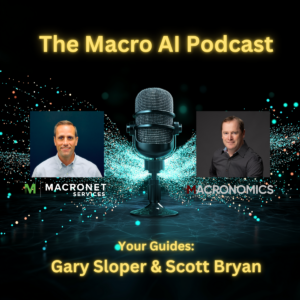
About the Hosts: Gary Sloper and Scott Bryan
The Macro AI Podcast is hosted by Gary Sloper and Scott Bryan — two seasoned technology leaders who bring decades of enterprise infrastructure, networking, and AI-driven business transformation experience to every discussion.
Both hosts share a similar foundation: deep backgrounds in global network architecture, enterprise IT strategy, and large-scale infrastructure modernization. Over the course of their careers, they have worked across telecom, cloud, data center strategy, and digital transformation initiatives, giving them a rare ability to connect emerging AI trends directly to operational reality.
Gary Sloper is the Co-founder and Managing Partner at Macronet Services, where he advises enterprise organizations on telecom strategy, WAN modernization, cloud connectivity, and infrastructure optimization. His experience spans complex IT environments, carrier negotiations, multi-site global deployments, and cost governance — providing a grounded, execution-focused perspective on AI infrastructure.
Scott Bryan is the CEO of Macronomics and an Advisor for E78 Partners, where he focuses on AI-driven business transformation, infrastructure strategy, and the economic modeling of emerging technologies. With nearly 30 years of experience in global network design and enterprise connectivity, Scott works at the intersection of AI, cloud, telecom, and data center architecture — translating technical innovation into measurable business outcomes.
Together, Gary and Scott combine:
- Executive IT leadership experience
- Global WAN and network architecture expertise
- AI infrastructure strategy
- Telecom and cloud economics
- Data center and colocation insight
- Practical implementation experience inside enterprise environments
Their shared background enables the Macro AI Podcast to go beyond surface-level AI news. Instead of focusing solely on model releases or product announcements, they examine the infrastructure layer that determines whether AI initiatives succeed or stall.
They explore questions such as:
- Can enterprise WAN architectures support distributed AI workloads?
- How do token economics influence cloud vs. on-prem decisions?
- What role does colocation play in AI scalability?
- How will power constraints impact AI data center growth?
- What does sovereign AI mean for multinational enterprises?
Because both hosts have spent their careers designing, modernizing, and governing enterprise infrastructure, their conversations are rooted in real-world execution — not theoretical speculation. Further, both hosts have spent years deep diving into AI/ML technology for business.
The Macro AI Podcast reflects that shared DNA: technically informed, economically grounded, and strategically focused on the infrastructure decisions that will shape the future of artificial intelligence.
The Pillars of AI Infrastructure Covered on the Macro AI Podcast
The Macro AI Podcast approaches AI infrastructure news through several strategic pillars. Each reflects a structural shift in the global technology landscape.
- AI Compute and the Silicon Arms Race
The modern AI era is defined by the acceleration of specialized silicon.
Companies such as NVIDIA, Advanced Micro Devices, Amazon Web Services, Microsoft, and Google are engaged in a global race to control AI compute supply.
This is not simply about faster chips. It is about:
- Memory bandwidth
- Interconnect architecture
- Cluster scalability
- Token generation cost
- Energy efficiency per inference
- Sovereign AI independence
The Macro AI Podcast regularly explores:
- GPU supply constraints and capacity expansion
- Custom silicon initiatives by hyperscalers
- Vertical integration strategies
- Model size versus compute tradeoffs
- The economics of token pricing
For CIOs and Chief AI Officers, this is not abstract technology news. It directly impacts:
- Procurement timelines
- Budget forecasting
- AI ROI modeling
- Build-versus-buy decisions
- On-prem versus cloud strategy
Understanding silicon trends is understanding the supply chain of intelligence itself.
- AI Data Centers: Density, Cooling, and Colocation Expansion
AI data center design has shifted dramatically in just a few years.
Traditional enterprise racks once consumed 5–10kW. Today, AI racks may demand 80kW, 100kW, or even 150kW.
The Macro AI Podcast covers:
- Liquid cooling adoption
- Direct-to-chip cooling systems
- Immersion cooling technologies
- Power distribution redesign
- AI colocation demand
- Secondary market expansion (Midwest, Texas, Nordics)
AI infrastructure news increasingly includes announcements about:
- Hyperscale campus expansions
- Multi-gigawatt power procurement
- AI-optimized colocation facilities
- Real estate repositioning for AI clusters
For enterprises, this has several implications:
- Capacity constraints may limit deployment flexibility.
- Power availability may dictate geographic strategy.
- Colocation demand is reshaping pricing models.
- AI clusters are changing data gravity patterns.
The podcast analyzes these shifts through an executive lens. Not just what is being built — but why it matters.
- AI Networking: The Hidden Bottleneck
One of the most underreported areas in AI infrastructure news is networking.
AI clusters generate massive east-west traffic. Model training requires low-latency, high-bandwidth interconnects. Distributed inference environments stress WAN architecture in new ways.
Networking hardware companies such as Cisco, Arista Networks, Ciena, and Broadcom are central players in this transformation. Additionally, Tier 1 ISPs and NaaS providers like Megaport are discussed in the show, as well as SDWAN providers like CATO Networks and others.
The Macro AI Podcast dives into:
- 800G and emerging 1.6T optical transport
- InfiniBand versus Ethernet architectures
- RDMA over Converged Ethernet (RoCE)
- AI fabric design
- Metro AI interconnect
- Private fiber for AI clusters
- Network as a Service (NaaS) models
Why does this matter?
Because AI ROI is often constrained by networking design.
A poorly designed WAN can:
- Increase inference latency
- Inflate cloud egress costs
- Create data replication inefficiencies
- Introduce security exposure
- Reduce model performance consistency
The infrastructure-first perspective emphasizes that networking is not plumbing. It is a performance multiplier.
- Energy and Sustainability: The Power Crisis Behind AI
AI infrastructure is power-intensive.
Training large models consumes significant energy. Hyperscale data centers now require multi-gigawatt capacity planning. Grid infrastructure is being stress-tested.
AI infrastructure news now regularly includes:
- Nuclear partnerships
- Renewable energy contracts
- On-site generation projects
- Substation expansions
- Grid modernization investments
The Macro AI Podcast explores:
- AI electricity demand projections
- Energy cost modeling
- Sustainability commitments versus operational reality
- Liquid cooling efficiency gains
- Regulatory implications
For CFOs and CIOs, power consumption directly influences:
- Operational expenditure
- Site selection
- ESG reporting
- Long-term capacity planning
Infrastructure leaders who ignore energy trends risk underestimating the true cost of AI deployment.
- Cloud vs. Edge AI Economics
One of the most strategic discussions in AI infrastructure news involves deployment architecture.
Should enterprises rely on hyperscaler cloud platforms?
Should they build private AI clusters?
Should inference run at the edge?
Are AI PCs economically viable?
The Macro AI Podcast frequently examines:
- Token-based pricing models
- Cloud inference cost structure
- On-prem GPU cluster economics
- AI PCs and small model deployment
- Hybrid AI architectures
- Data gravity and compliance constraints
Token cost is increasingly part of ROI analysis. Executives must model:
- Cost per inference
- Cost per user
- Cost per department
- Latency tolerance
- Data residency requirements
AI infrastructure decisions are no longer purely technical. They are economic architecture decisions.
- Telecom, WAN, and Private Connectivity for AI
AI workloads are distributed.
Data may originate in branch offices, IoT systems, edge environments, or partner networks. AI inference may occur in cloud regions or private clusters.
AI infrastructure news must therefore include telecom strategy.
The Macro AI Podcast explores:
- Direct cloud connectivity
- Secure AI WAN architecture
- Metro fiber strategy
- Multi-cloud interconnect
- Latency-sensitive application routing
- Sovereign AI network isolation
Distributed AI changes WAN design assumptions.
Traditional hub-and-spoke architectures may not support:
- Real-time inference
- Large dataset replication
- Cross-cloud model access
- Federated learning frameworks
Infrastructure intelligence must bridge cloud, telecom, and compute domains.
- AI Regulation and Geopolitical Infrastructure Strategy
AI infrastructure is now geopolitical.
Export controls impact semiconductor availability. National compute strategies influence domestic capacity investment. Sovereign AI initiatives are reshaping hyperscale deployment.
AI infrastructure news includes:
- Semiconductor export restrictions
- Domestic manufacturing incentives
- Cross-border data flow regulation
- Sovereign cloud initiatives
- AI chip supply chain diversification
The Macro AI Podcast approaches these issues factually and strategically — focusing on business impact rather than political positioning.
For multinational enterprises, regulatory developments influence:
- Procurement strategy
- Regional deployment
- Risk modeling
- Data localization architecture
Infrastructure awareness becomes risk awareness.
Why Most AI News Misses the Infrastructure Layer
Mainstream AI coverage often centers on:
- New chatbot capabilities
- Model size announcements
- Consumer AI features
- Venture capital funding
But infrastructure tells a different story.
Without sufficient:
- Compute
- Memory
- Networking
- Power
- Cooling
- Secure connectivity
AI innovation slows.
The Macro AI Podcast deliberately focuses on this infrastructure-first perspective. It asks:
- Where are the bottlenecks?
- What is the true cost of scale?
- What are the hidden constraints?
- How should enterprises architect for durability?
This is why infrastructure-centric AI news matters to executives.
Who Should Follow the Macro AI Podcast for AI Infrastructure News?
The show is designed for:
CEOs
Seeking to stay up to date on key topics in AI that impact decision making for global enterprises.
CIOs
Evaluating capital allocation and infrastructure modernization.
Chief AI Officers
Planning scalable AI deployment.
Network Architects
Designing WAN and data center connectivity for AI workloads.
Infrastructure VPs
Balancing power, compute, and performance.
Private Equity Technology Leaders
Assessing infrastructure exposure across portfolios.
Telecom and Cloud Strategists
Aligning connectivity with AI performance requirements.
If your role touches infrastructure decisions, AI infrastructure news is no longer optional intelligence. It is strategic insight.
How the Macro AI Podcast Delivers Infrastructure Intelligence
The format is intentionally executive-focused.
- Conversational but technically rigorous
- Infrastructure-first analysis
- Business translation of complex technology
- Neutral, fact-based discussion
- ROI-oriented perspective
The podcast bridges multiple domains:
- AI trends impacting global business
- Silicon and compute
- Data centers and colocation
- WAN and networking
- Energy and sustainability
- Cloud and edge economics
- Regulatory developments
Rather than isolated headlines, the Macro AI Podcast synthesizes infrastructure trends into strategic narratives.
Frequently Asked Questions About AI Infrastructure News
What is AI infrastructure?
AI infrastructure refers to the compute, networking, storage, and energy systems that enable artificial intelligence workloads to operate at scale.
Why is AI infrastructure important?
Because AI performance, cost, and scalability depend on underlying infrastructure design.
What is driving AI data center growth?
Increased demand for GPU clusters, model training capacity, and inference scaling.
How much power do AI data centers use?
Large AI campuses may require gigawatt-scale energy planning.
What is AI WAN architecture?
A network architecture optimized for distributed AI workloads, low latency, and secure data transfer.
What is sovereign AI infrastructure?
National or regionally controlled AI compute capacity designed to reduce dependence on foreign silicon or cloud providers.
Where can executives get reliable AI infrastructure news?
Executive-focused platforms like the Macro AI Podcast provide infrastructure-first AI analysis.
The Future of AI Infrastructure
AI will continue to evolve.
But its growth trajectory will be shaped by:
- Compute supply chains
- Networking performance
- Power availability
- Regulatory constraints
- Economic efficiency
Organizations that treat infrastructure as a strategic differentiator will outperform those that treat it as a cost center.
AI innovation will not be limited by imagination. It will be limited by architecture.
Stay Ahead of the AI Infrastructure Curve
If you are searching for AI infrastructure news, you are already ahead of many organizations.
The next step is consistency.
Infrastructure trends evolve monthly. Silicon roadmaps shift. Data center announcements accelerate. Energy contracts reshape regional deployment.
The Macro AI Podcast provides ongoing, executive-level AI infrastructure intelligence — connecting compute, networking, power, cloud, and telecom into a cohesive strategic narrative.
AI is no longer just software.
It is infrastructure.
And understanding infrastructure is understanding the future of AI.