
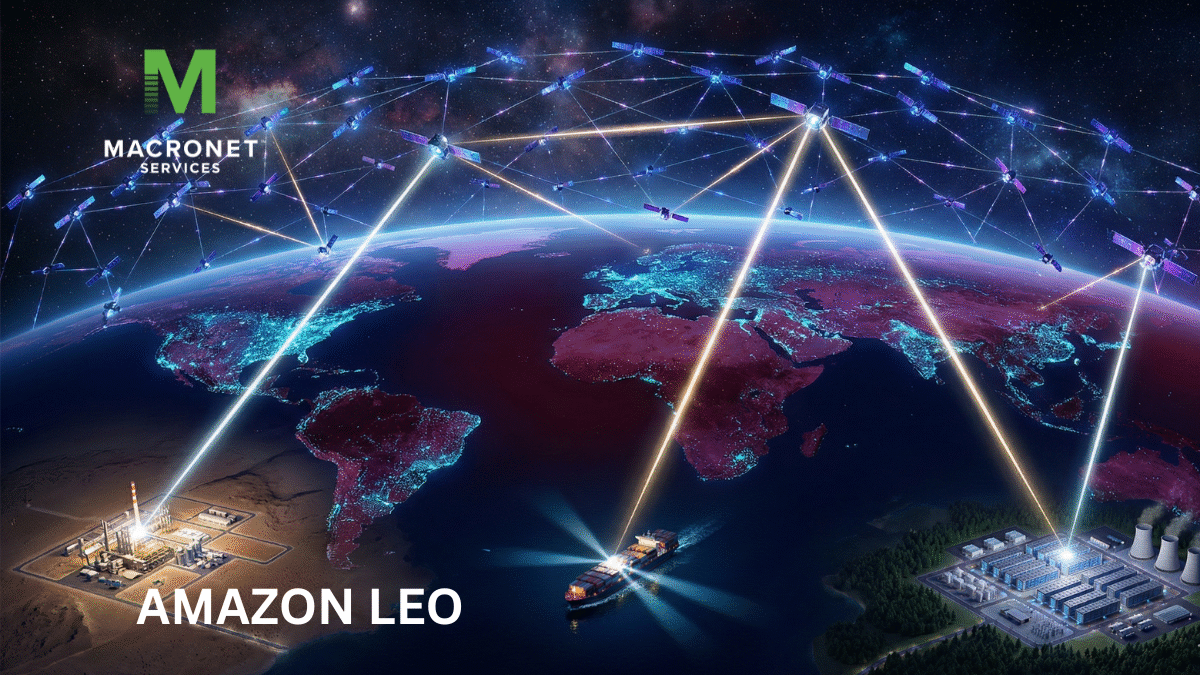
Amazon LEO (Project Kuiper): Enterprise Guide to Satellite WAN Performance & Latency
Low Earth Orbit (LEO) satellite connectivity has moved from experimental to enterprise-ready in just a few short years. What was once considered a last-resort option for remote outposts is now being evaluated by CIOs and network architects as a strategic component of the modern WAN.
Amazon LEO, powered by Amazon’s Project Kuiper, represents a major evolution in satellite connectivity. Designed as a large-scale LEO constellation operating hundreds of kilometers above Earth, the service is engineered to deliver broadband-class performance with cloud-native alignment. Amazon’s Project Kuiper — its Low Earth Orbit (LEO) satellite network — has been rebranded as “Amazon LEO” and is now a competitive offering to Starlink and OneWeb.
For enterprise decision makers, the real opportunity is not simply faster satellite internet. It is the ability to introduce a physically diverse, low-latency, globally available access layer that integrates with cloud, AI, and SD-WAN architectures. Amazon LEO has the potential to reshape how global networks are designed — particularly for organizations operating in distributed, high-growth, or mission-critical environments.
Macronet Services works with all leading satellite providers and global Tier 1 ISPs, ensuring that enterprises evaluate Amazon LEO within the broader context of resilience, performance, and total cost of ownership.
What Is Amazon LEO?
Amazon LEO refers to enterprise-grade satellite connectivity delivered via Project Kuiper’s planned constellation of more than 3,000 Low Earth Orbit satellites. These satellites operate at roughly 590–630 kilometers above the Earth’s surface — dramatically closer than traditional geostationary satellites positioned nearly 36,000 kilometers away.
This orbital difference is not just technical trivia. It fundamentally alters network behavior.
Because LEO satellites are closer to Earth, signal travel time is significantly reduced. This lowers latency, improves interactive performance, and allows satellite broadband to behave much more like terrestrial fiber or fixed wireless services. Additionally, LEO systems use dynamic satellite handoffs and advanced phased-array antennas, enabling consistent connectivity even as satellites move rapidly across the sky.
Unlike legacy satellite systems with fixed beams and limited scalability, LEO constellations increase aggregate capacity as more satellites are launched. For enterprise buyers, this translates into improved bandwidth availability and long-term scalability.
Performance and Latency: What Enterprises Can Expect
Performance is the primary concern for any CIO evaluating satellite connectivity. Historically, satellite was synonymous with high latency and unpredictable performance. LEO changes that equation.
Traditional GEO satellite connections often exhibit round-trip latency between 600 and 700 milliseconds. In contrast, LEO systems such as Amazon LEO are expected to operate in the 20–40 millisecond range under normal conditions. That performance tier places LEO within striking distance of many terrestrial broadband connections and makes it viable for real-time collaboration, cloud application access, VoIP, and even edge-based AI inference.
Throughput expectations are similarly enterprise-focused. Amazon LEO user terminals are designed to support 100 Mbps-class service tiers, with higher-capacity offerings anticipated as the constellation scales. Because satellites continuously hand off traffic between nodes, performance stability and jitter control are significantly improved over earlier satellite technologies.
For organizations deploying SD-WAN, this means LEO is no longer confined to “backup only.” It can operate as a primary underlay, an active-active link, or a fully integrated path within performance-based routing policies.
Enterprise Use Cases for Amazon LEO
The most immediate use case for Amazon LEO is connectivity in remote or underserved locations. Industries such as energy, mining, maritime, construction, agriculture, and disaster recovery often face long fiber deployment timelines or limited terrestrial options. LEO enables rapid site activation without waiting months — or years — for infrastructure builds.
Beyond remote connectivity, LEO is increasingly being adopted as part of enterprise resilience strategies. Modern WAN architectures (Wide Area Network) prioritize path diversity. Fiber cuts, regional outages, and carrier failures remain common risks. LEO provides a physically diverse path that bypasses terrestrial bottlenecks entirely, dramatically improving business continuity posture.
Another compelling use case is multi-cloud integration. Because Amazon LEO sits within the broader Amazon ecosystem, there is strategic alignment with Amazon Web Services. For enterprises standardizing on AWS, this creates the potential for seamless integration between edge sites and cloud environments. Distributed AI workloads, telemetry backhaul, and edge inference applications benefit from lower-latency satellite connectivity that can securely integrate with cloud-native architectures.
As AI becomes more embedded into field operations, retail locations, manufacturing floors, and energy facilities, reliable high-performance connectivity becomes foundational. LEO is increasingly part of that AI-ready network design.
Amazon LEO Compared to GEO and MEO Satellite Systems
To fully appreciate Amazon LEO’s impact, it is important to understand how it differs from traditional satellite architectures.
Geostationary satellites orbit at approximately 35,786 kilometers, which introduces unavoidable latency due to signal travel distance. Medium Earth Orbit (MEO) satellites improve on this, operating closer to Earth and reducing latency to the 100–150 millisecond range. LEO satellites, by contrast, orbit at roughly 600 kilometers, enabling latency comparable to terrestrial broadband.
The operational model also differs. GEO satellites remain fixed relative to Earth’s surface, while LEO constellations involve continuous satellite handoffs. This allows LEO networks to dynamically route traffic and distribute capacity more efficiently. As constellation density increases, so does total network capacity.
For enterprises evaluating modernization, LEO represents a distinct performance class rather than a marginal improvement.
Security Architecture and Integration
Security remains a central consideration for any WAN design decision. Amazon LEO is expected to support enterprise-grade encryption and secure provisioning models consistent with modern cloud architectures. However, satellite connectivity must always be evaluated within the broader security framework.
In practice, LEO should be integrated into SD-WAN, SASE, and Zero Trust architectures. Traffic encryption, identity-based access control, and centralized policy enforcement remain critical regardless of transport medium. When architected properly, LEO becomes simply another secure underlay path within a unified global network strategy.
Macronet Services works with enterprises to ensure that satellite connectivity is not deployed in isolation but rather fully integrated into global security and routing frameworks.
Economics: Understanding the Business Case
The economic analysis of Amazon LEO extends beyond simple cost-per-megabit comparisons. While pricing is expected to be competitive with other enterprise LEO providers, the strategic value often lies elsewhere.
Organizations must evaluate deployment speed, avoided infrastructure construction costs, improved uptime, and revenue protection enabled by resilient connectivity. In some scenarios, LEO reduces time-to-market for new sites dramatically. In others, it acts as insurance against costly downtime.
For AI-driven operations, connectivity becomes directly tied to productivity and data flow. When edge analytics, automation systems, and real-time telemetry depend on reliable bandwidth, the value of low-latency satellite connectivity increases substantially.
How Amazon LEO Fits into the Modern WAN
The contemporary enterprise WAN is no longer a simple MPLS network. It is a hybrid architecture composed of dedicated internet access, SD-WAN overlays, cloud on-ramps, private interconnects, 5G, and fixed wireless.
Amazon LEO now enters that ecosystem as an additional underlay option. In many cases, it will not replace terrestrial circuits but rather complement them. The most effective designs often combine fiber, wireless, and satellite paths within intelligent SD-WAN policies.
The strategic advantage comes from architectural diversity. By incorporating LEO, enterprises reduce single points of failure and gain deployment flexibility across geographies.
Why Macronet Services
Amazon LEO is an important new entrant in the satellite market, but it is not the only option. Enterprises must evaluate multiple LEO, MEO, and GEO providers to determine the best performance, economics, and geographic fit.
Macronet Services represents all leading satellite connectivity providers as well as Tier 1 global carriers and SD-WAN leaders. Our role is not to sell a single platform but to design the right architecture for each client’s business objectives.
With decades of experience in global network design, AI-ready WAN architecture, and carrier sourcing, we help enterprises compare options, model performance impacts, negotiate contracts, and deploy globally. Because we are carrier-agnostic, our recommendations are aligned with business outcomes — not vendor incentives.
The Strategic Impact of Amazon LEO
Amazon LEO represents a new connectivity tier that aligns satellite broadband with cloud-first and AI-driven enterprise strategies. Its low-latency profile, scalable architecture, and ecosystem integration make it a serious consideration for CIOs designing next-generation global networks.
For organizations expanding into remote regions, modernizing resilience strategies, or deploying distributed AI workloads, LEO is no longer optional to evaluate. It is a foundational architectural decision.
If your enterprise is assessing Amazon LEO or any satellite connectivity strategy, the team at Macronet Services can help you design, source, and implement the optimal solution for performance, resilience, and long-term value. Please reach out for a conversation anytime.
Frequently Asked Questions
- What is Amazon LEO and how does it relate to Project Kuiper?
Amazon LEO refers to enterprise-grade satellite connectivity delivered through Amazon’s Project Kuiper, a planned constellation of more than 3,000 Low Earth Orbit satellites. Operating at roughly 600 km above Earth, Project Kuiper is designed to provide low-latency broadband connectivity globally. For enterprises, Amazon LEO represents a new WAN underlay option that can complement fiber, 5G, and SD-WAN architectures. Macronet Services helps organizations evaluate how Amazon LEO compares to other LEO, MEO, and GEO satellite providers.
- What latency can enterprises expect from Amazon LEO?
Amazon LEO is expected to deliver latency in the 20–40 millisecond range, significantly lower than traditional geostationary satellite services, which often exceed 600 milliseconds. This makes Amazon LEO viable for real-time applications, cloud workloads, VoIP, and AI inference. Macronet Services models real-world latency performance within a client’s global WAN to determine optimal deployment scenarios.
- Is Amazon LEO suitable for enterprise WAN architecture?
Yes. Amazon LEO can function as a primary, backup, or active-active underlay within modern SD-WAN deployments. It provides physical path diversity that enhances resilience and business continuity. Macronet Services designs hybrid WAN architectures that integrate Amazon LEO alongside DIA, MPLS, private cloud interconnects, and 5G to create AI-ready, resilient networks.
- How does Amazon LEO compare to traditional satellite internet?
Traditional GEO satellite operates at approximately 35,786 km above Earth, resulting in high latency and limited scalability. Amazon LEO’s low orbit dramatically reduces latency and increases throughput potential. Unlike fixed-beam legacy systems, LEO constellations dynamically hand off traffic between satellites. Macronet Services helps enterprises compare Amazon LEO with alternative satellite technologies to determine the best fit.
- Can Amazon LEO support AI and edge computing workloads?
Yes. With low latency and broadband-class throughput, Amazon LEO can support distributed AI use cases such as edge inference, video analytics, robotics telemetry, and secure data backhaul. For organizations deploying AI across remote or distributed sites, connectivity becomes mission-critical. Macronet Services specializes in AI-ready WAN architecture and ensures satellite integration supports enterprise AI roadmaps.
- Does Amazon LEO integrate with AWS cloud environments?
Amazon LEO is strategically aligned with Amazon Web Services (AWS), enabling potential seamless connectivity between remote sites and AWS Regions, Local Zones, and edge deployments. For enterprises standardizing on AWS, this alignment may simplify architecture and improve performance. Macronet Services evaluates cloud integration requirements across AWS, Azure, and multi-cloud environments.
- What industries benefit most from Amazon LEO?
Industries with remote, mobile, or rapidly expanding operations benefit significantly. This includes energy, mining, maritime, construction, agriculture, retail expansion, and disaster recovery operations. However, even urban enterprises use Amazon LEO for resilience and failover. Macronet Services works across industries to determine where LEO provides strategic value.
- Is Amazon LEO secure for enterprise use?
Amazon LEO is expected to support enterprise-grade encryption and secure provisioning. However, satellite connectivity should always be integrated into broader security architectures such as SASE and Zero Trust frameworks. Macronet Services ensures Amazon LEO deployments align with enterprise security policies and compliance requirements.
- How fast can Amazon LEO be deployed at a new site?
One of LEO’s key advantages is rapid deployment. Unlike fiber builds that may take months, satellite terminals can often be activated in days or weeks depending on logistics and coverage availability. Macronet Services manages deployment coordination and ensures integration with SD-WAN and security policies.
- Should Amazon LEO replace fiber or MPLS?
In most enterprise environments, Amazon LEO complements rather than replaces terrestrial connectivity. It provides resilience, geographic flexibility, and rapid deployment advantages. Macronet Services evaluates whether LEO should operate as primary access, failover, or part of an active-active strategy.
- What throughput can Amazon LEO deliver for enterprise customers?
Amazon LEO is expected to offer 100 Mbps-class services initially, with higher bandwidth tiers emerging as the constellation expands. Actual throughput depends on geography, service tier, and network design. Macronet Services conducts bandwidth modeling to align connectivity with business performance requirements.
- How does Amazon LEO improve business continuity?
Because LEO connectivity bypasses terrestrial infrastructure, it provides a physically diverse path. This protects against fiber cuts, regional outages, and local loop failures. In resilience-focused WAN design, Amazon LEO acts as a strategic continuity layer. Macronet Services integrates satellite into comprehensive business continuity planning.
- What is the ROI of deploying Amazon LEO?
ROI should be evaluated beyond cost per Mbps. Enterprises must consider avoided downtime, faster site activation, reduced construction costs, improved AI workload performance, and revenue preservation. Macronet Services provides TCO and ROI modeling to help CIOs justify satellite investment strategically.
- How does Amazon LEO compare to other LEO providers?
The LEO market includes multiple providers with varying coverage maps, performance characteristics, and enterprise capabilities. Amazon LEO’s differentiator is its integration potential within the Amazon ecosystem. However, optimal provider selection depends on geographic footprint, workload requirements, and resilience goals. Macronet Services represents all leading satellite connectivity providers and conducts unbiased comparisons.
- Who are channel partners for Amazon LEO?
Satellite connectivity decisions impact performance, security, and long-term cost structures. Macronet Services is carrier-agnostic and represents all major satellite and Tier 1 network providers. We design AI-ready global WAN architectures, model performance and latency impacts, negotiate contracts, and manage global deployments. Our goal is not to push a single solution but to architect the right solution for your business objectives.
- Is “Amazon LEO” the official product name, or is it called Project Kuiper?
“Amazon LEO” is commonly used in enterprise discussions and branding to describe Amazon’s Low Earth Orbit satellite broadband initiative. The formal name of the satellite constellation program is Project Kuiper, developed by Amazon.
In practice, “Amazon LEO” refers to Project Kuiper’s LEO-based satellite network and its enterprise connectivity services. For CIOs and network architects, the terms are often used interchangeably, but Project Kuiper is the official program name behind the Amazon LEO service.