
Top 5 Colocation Data Center Providers in 2026
As organizations scale digital services, artificial intelligence workloads, and cloud infrastructure, the need for reliable colocation data center infrastructure continues to grow. One of the most widely used models for deploying enterprise IT infrastructure is the colocation data center providers, which have served enterprises for decades.
But what exactly is colocation, how does it work, and why do so many enterprises rely on it?
This guide explains everything you need to know about colocation data centers, how they differ from traditional data centers, and why they are a critical component of modern hybrid and AI-ready infrastructure.

What Is a Colocation Data Center?
A colocation data center is a facility where organizations can rent physical space to house their own servers, storage systems, and networking equipment. Instead of building and operating their own data center, businesses install their hardware inside a third-party facility designed specifically to support IT infrastructure.
In a colocation environment:
- The data center provider supplies the building, power, cooling, physical security, and network connectivity.
- The customer owns and manages the hardware installed in the space.
This model allows companies to deploy enterprise-grade infrastructure without the high capital cost of constructing and operating their own data center.
How Colocation Data Centers Work
Colocation providers build facilities optimized for uptime, performance, and connectivity. Businesses lease space inside these facilities and install their equipment.
Typical infrastructure provided by a colocation provider includes:
- Power Infrastructure
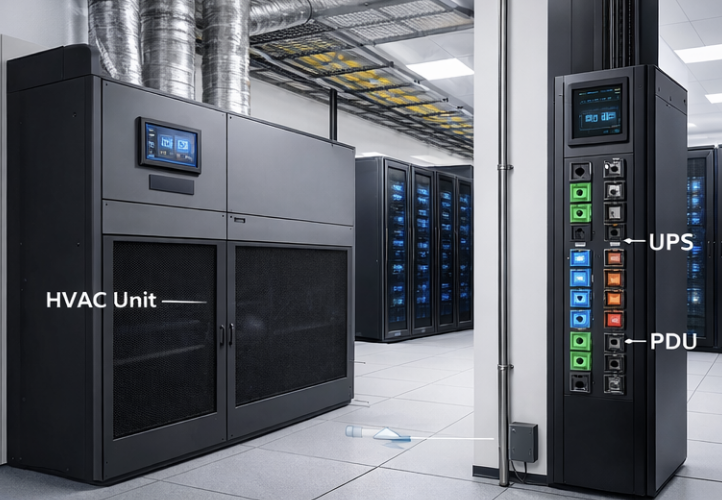
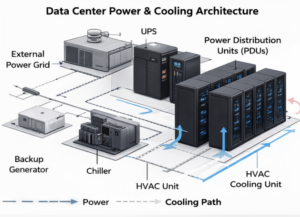
Reliable electricity with redundant feeds, UPS systems, and backup generators to ensure continuous operation. Often, many datacenter providers offer electricity from multiple power grids in their specific metro/city for additional redundancy. This is very difficult to achieve on your own if attempting to build this on your own.
- Cooling Systems
Advanced HVAC and liquid cooling systems keep servers operating within safe temperature ranges. CRAC (Computer Room Air Conditioner) and CRAH (Computer Room Air Handler) systems are the traditional precision cooling technologies used in most enterprise and colocation data centers. They maintain temperature and humidity within tight tolerances to protect servers and networking equipment. Top manufacturers with a deep history in cooling datacenters include Liebert, APC, Stulz, Johnson Controls and Daikin.

CRAC vs CRAH (Quick Difference)
| Feature | CRAC | CRAH |
| Cooling method | Refrigerant compressor | Chilled water |
| Energy efficiency | Lower | Higher |
| Infrastructure | Standalone | Requires chiller plant |
| Typical usage | Small/enterprise DCs | Large hyperscale DCs |
- Physical Security
Security controls such as biometric access, cameras, and guarded facilities protect hardware and sensitive data.
- Network Connectivity
High-capacity fiber connections allow organizations to connect to multiple carriers, cloud providers, and internet exchanges. Careful consideration when designing a colo rack environment to your WAN should be evaluated extensively. Areas such as latency, capacity, peering and costs all play into a successful network topology.

- Environmental Monitoring
Sensors track humidity, temperature, and power conditions to protect mission-critical infrastructure.
Together, these capabilities provide an environment designed for high availability and resilience.
Colocation vs Traditional Data Centers
Understanding the difference between a data center and colocation is essential.
| Feature | Traditional Enterprise Data Center | Colocation Data Center |
| Ownership | Owned and operated by the company | Owned by a third-party provider |
| Hardware | Company owned | Company owned |
| Facility | Company responsible | Provider responsible |
| Power/Cooling | Managed internally | Provided by colocation operator |
| Cost | High capital expenditure | Lower upfront cost |
A data center is a physical facility, while colocation is a service that lets organizations place infrastructure inside a third-party data center.
This distinction is critical when comparing colocation with cloud computing or on-premises infrastructure.
What Is the Data Center Tier Classification System?
The data center tier system categorizes facilities into four levels of reliability and redundancy. Each tier represents a higher level of infrastructure resilience and operational capability.
The tiers evaluate factors such as:
- Power infrastructure
- Cooling systems
- Redundancy models
- Fault tolerance
- Maintenance capabilities
- Expected downtime
As organizations move up the tier scale, infrastructure becomes more complex and expensive—but also significantly more reliable.
To standardize how reliability is measured, the Uptime Institute developed the Data Center Tier Classification System. This framework ranks facilities from Tier 1 to Tier 4 based on their infrastructure redundancy, fault tolerance, and expected uptime.
Understanding these tiers helps organizations evaluate colocation providers, design their own facilities, and choose the right infrastructure for mission-critical workloads.
What is Hybrid Cloud Colocation
Hybrid models combine:
- On-premises infrastructure which might consist of enterprise owned datacenter(s), WAN and other network/SaaS services.
- Public cloud – think AWS, GCP, OCI, etc., where the enterprise has a virtual compute environment.
- Colocation facilities – A contracted space, power, bandwidth (minimum) environment with a commercial global datacenter colocation provider.
This architecture enables organizations to run workloads across multiple environments and leverages a variety of workloads. For example, if you have an application which is not cloud enabled such as a legacy application, this would be hosted in a colocation facility. Likewise, if you have a test AI infrastructure which is too costly to place with a Hyperscaler GPUaaS, it may also run in a datacenter. This hybrid approach affords an organization to leverage the economies of scale depending on the compute requirements, thus not forcing an infrastructure lock-in.
Benefits of Colocation in Data Centers
Colocation has become a popular infrastructure strategy for enterprises because it offers significant operational and financial advantages.
Reduced Infrastructure Costs
Building a private data center requires major capital investment. Colocation allows companies to share infrastructure and reduce upfront costs.
High Reliability and Uptime
Colocation facilities are designed with redundancy for:
- Power
- Cooling
- Network connectivity
This helps ensure applications remain available even during outages.
Scalability
Businesses can expand their infrastructure by leasing additional racks or space without constructing new facilities.
Global Reach
Large colocation providers operate facilities across multiple regions, allowing enterprises to deploy infrastructure closer to customers.
Improved Security
Professional facilities implement physical security and monitoring systems designed specifically for mission-critical environments.
Why Enterprises Use Colocation Today
The rise of cloud computing, AI workloads, and hybrid infrastructure has made colocation increasingly important.
Many organizations use colocation facilities to:
- Deploy hybrid cloud architectures
- Connect directly to cloud providers
- Support AI and high-performance computing
- Reduce latency by locating infrastructure closer to users
- Improve disaster recovery and redundancy
As digital services expand globally, colocated infrastructure helps organizations deliver applications reliably at scale.
Colocation in the Modern Data Center Ecosystem
Today’s IT infrastructure rarely exists in a single environment.
Most organizations operate across multiple platforms, including:
- On-premises data centers
- Public cloud
- Edge computing locations
- Colocation facilities
Colocation acts as a central interconnection point that links these environments together.
This role is especially important for:
- AI infrastructure
- Multi-cloud connectivity
- Global network architectures
- High-bandwidth enterprise applications
Top 5 Colocation Providers
Listed below is a summary list of the Top 5 Global Colocation Datacenter providers listed by revenue. For a complete list of global options, we have compiled a downloadable guide
Equinix, Ranked #1
Equinix is widely considered the world’s largest colocation and interconnection provider. Founded in 1998 and headquartered in Redwood City, California, Equinix operates a global platform of more than 260 data centers across over 70 metropolitan markets on five continents. These facilities, known as International Business Exchange (IBX®) data centers, serve enterprises, cloud providers, financial institutions, network carriers, and digital service companies that require highly reliable infrastructure and direct connectivity to partners and customers.
A defining characteristic of Equinix is its powerful interconnection ecosystem. Thousands of networks, cloud platforms, and enterprises connect within Equinix facilities, creating dense digital marketplaces where organizations can exchange traffic and data with low latency. Through services such as Equinix Fabric®, customers can establish private connections to major cloud providers and partners without relying on the public internet.
Equinix also provides a broad portfolio of digital infrastructure services including colocation, edge infrastructure, network interconnection, and hybrid cloud connectivity. Its globally distributed platform enables organizations to deploy applications closer to users, improve performance, and support modern architectures such as multi-cloud, edge computing, and artificial intelligence workloads. This combination of global reach and interconnection density has made Equinix a foundational provider of modern digital infrastructure.
What makes them unique is their massive interconnection ecosystem (IX fabric, cloud on-ramps), strong presence in financial, SaaS, and network ecosystems leading a coverage across 70+ metros. Equinix placement in the industry is often competitively challenged not just in this top 5 but many others globally.
Digital Realty, Ranked #2
Digital Realty is one of the world’s largest global providers of colocation, interconnection, and data center infrastructure. Founded in 2004 and headquartered in Austin, Texas, the company operates a global platform of more than 300 data centers across North America, Europe, Asia-Pacific, Latin America, and Africa. Digital Realty serves a wide range of customers including cloud providers, enterprises, financial institutions, and hyperscale technology companies.
The company’s global architecture is built around its PlatformDIGITAL® framework, which enables customers to deploy and scale digital infrastructure across interconnected campuses and metropolitan regions. Digital Realty facilities are designed to support high-density computing environments, advanced cooling systems, and large-scale power capacity required for cloud computing, artificial intelligence workloads, and enterprise applications.
A key differentiator for Digital Realty is its emphasis on connectivity and hybrid infrastructure. Through its ServiceFabric™ interconnection platform, customers can connect directly to carriers, cloud providers, and partners within the same ecosystem. This enables enterprises to build distributed, multi-cloud architectures with low latency and high performance.
With a strong presence in major digital hubs such as Northern Virginia, Dallas, London, Frankfurt, and Singapore, Digital Realty continues to play a central role in powering global digital infrastructure and next-generation data-driven services.
Top of Form
Bottom of Form
NTT Global Data Centers (NTT DATA), Ranked #3
As a division of NTT DATA and ultimately part of Nippon Telegraph and Telephone Corporation, NTT is one of the largest data center providers in the world. The company operates a vast global platform of hyperscale and enterprise data centers across North America, Europe, and Asia-Pacific, supporting cloud providers, large enterprises, and high-performance computing environments.
NTT’s data center portfolio includes dozens of facilities located in key digital infrastructure hubs such as Northern Virginia, London, Frankfurt, Tokyo, Singapore, and Sydney. These campuses are designed to deliver highly reliable colocation services with scalable power capacity, advanced cooling systems, and robust network connectivity to major carriers and cloud platforms.
A distinguishing feature of NTT Global Data Centers is its focus on large-scale hyperscale campuses capable of supporting cloud infrastructure, artificial intelligence workloads, and other high-density computing environments. Many of these facilities are built with sustainability in mind, incorporating energy-efficient cooling systems, renewable energy strategies, and advanced environmental monitoring.
Through integration with the broader NTT technology ecosystem, the company also provides managed infrastructure services, hybrid cloud connectivity, and network solutions. This combination of global scale, engineering expertise, and strong carrier relationships has positioned NTT Global Data Centers as a key infrastructure provider for modern digital services and next-generation computing platforms.
QTS Realty Trust (Blackstone-owned), Ranked #4
QTS Headquartered in Overland Park, Kansas focuses on colocation datacenter services and Hyperscaler and enterprise campus builds at large scale. This design has enhanced the ability for hyperscalers and AI infrastructure to support the boom in this tech sector. Some of the major highlights QTS boast include large campus in Virgina, Atlanta and Phoenix, AI read power density which helps with the power needs of GPUs. The company is owned by Blackstone.
KDDI / Telehouse, Ranked #5
KDDI / Telehouse is one of the longest-established global colocation and interconnection providers. Telehouse was founded in 1989 in London and later became part of the Japanese telecommunications company KDDI Corporation. The company operates major carrier-neutral data center campuses in key global connectivity hubs including London, Tokyo, Paris, New York, and Frankfurt. Telehouse facilities are particularly known for their dense network ecosystems, hosting hundreds of carriers, internet exchanges, and cloud on-ramps. Through its parent company KDDI, Telehouse provides enterprises with colocation, interconnection, cloud connectivity, and managed infrastructure services supporting global digital infrastructure and high-performance networking environments. Headquartered in Japan, it has a solid carrier neutral approach to connectivity.
Frequently Asked Questions
What is the main purpose of a colocation data center?
The primary purpose is to allow organizations to host their own servers in a professionally managed data center facility without building their own infrastructure.
Who owns the equipment in a colocation facility?
The customer typically owns the servers and networking hardware, while the provider operates the facility and all the necessary power, cooling and networking components.
Is colocation the same as cloud computing?
No. In colocation, the customer manages their own hardware, or the datacenter providers offers management services. In cloud computing, the provider manages the infrastructure and delivers virtual resources, and the customer typically manages their compute instances.
Is colocation secure?
Yes. Colocation facilities are designed with advanced physical security systems and operational controls to protect infrastructure. Only authorized individuals set by the enterprise and datacenter colocation company are allowed access into the building.
What network providers can connect to a global datacenter for AI workloads?
Each datacenter region has carrier-neutral Tier-1 ISPs who connect to other facilities or to a company WAN. Additionally, most global datacenters have native connectivity to AWS DirectConnect, Azure Express Route and Oracle FastConnect.
How do I find the best colocation datacenter provider for my business?
Selecting the right colo provider requires evaluating far more than price—enterprises must assess, facilities, electrical grid, cooling/HVAC, Fire suppression, backbone quality, regional performance, peering depth, cloud on-ramps, SLA reliability, BGP policies, last-mile diversity, and the provider’s long-term investment strategy. Because no single datacenter performs best in every region or use case, the smartest approach is to work with an unbiased expert who understands the global ISP landscape.
Macronet Services represents all the leading global datacenter colocation companies and brings 25+ years of deep technical hosting experience. Our team has access to real-time pricing, global availability data, and backbone performance insights across every major Tier 1 through Tier 4 provider. We help enterprises objectively compare colo providers, engineer the right underlay architecture, and secure competitive pricing—without bias toward any single provider.
If you want to ensure your business selects the optimal datacenter for performance, resiliency, and cost, contact Macronet Services. We’ll analyze your requirements, map them to the global carrier ecosystem, and present unbiased options with full pricing transparency.