

Data Center Colocation in New York and New Jersey: Pricing, Connectivity, Power & Provider Guide
Enterprise IT infrastructure is evolving rapidly as organizations adopt hybrid cloud architectures, artificial intelligence workloads, and global application platforms. As infrastructure demands grow, many companies are turning to data center colocation as a strategic alternative to building and operating their own data centers.
Data center colocation allows organizations to deploy their own servers, storage systems, and networking equipment inside professionally managed facilities that provide power, cooling, security, and Tier 1 ISP network connectivity. Rather than investing millions of dollars in building private data centers, companies colocate infrastructure in enterprise-grade facilities designed for continuous uptime and high-performance computing.
For CIOs, CTOs, and infrastructure leaders evaluating modern infrastructure strategies, colocation offers a powerful balance between control, performance, scalability, and cost efficiency.
This comprehensive guide explains:
- What data center colocation services are
- How colocation providers operate
- Typical colocation pricing models
- Data center power and cooling architecture
- Network connectivity and carrier-neutral facilities
- How to choose the best colocation provider in New York and New Jersey
It also explains how organizations can simplify the process of evaluating colocation providers by working with experienced infrastructure advisors such as Macronet Services, who help businesses identify the best facilities, connectivity options, and infrastructure strategies available in each market.

What Is Data Center Colocation?
A colocation data center is a facility where organizations rent space, power, cooling, and network connectivity to host their own servers and IT infrastructure.
Instead of operating their own facilities, companies place equipment inside specialized colocation facilities that provide enterprise-grade infrastructure and operational support.
Typical colocation services include:
- Secure rack space or cabinets
- Redundant electrical power systems
- Industrial cooling infrastructure
- Telecommunications connectivity
- Physical security systems
- Remote technical support
Businesses maintain control over their hardware and applications while the colocation provider manages the facility infrastructure.
This model allows organizations to deploy mission-critical infrastructure with far greater reliability than most private data centers can provide.
Why Businesses Choose Colocation
Organizations across industries use enterprise colocation services to support mission-critical workloads. Several factors drive the adoption of data center colocation services.
Lower Capital Investment
Building a private data center requires significant capital investment in real estate, electrical infrastructure, cooling systems, generators, and security systems. Colocation eliminates most of these costs.
Enterprise-Grade Reliability
Professional colocation data centers are designed with multiple layers of redundancy in electrical and mechanical systems, ensuring high uptime for mission-critical applications. Tier Certification certifies data centers to one of four Tier Classifications, ranging from Tier I through Tier IV data centers, Tier 4 data centers being “fault tolerant”.
Flexible Network Connectivity
Many carrier-neutral data centers host dozens of telecommunications providers, enabling businesses to build resilient multi-carrier network architectures.
Hybrid Cloud Integration
Colocation facilities frequently serve as connectivity hubs linking private infrastructure to public cloud platforms such as AWS, Microsoft Azure, and Google Cloud. Some data centers also host Internet Exchange Points (IXPs) or are in close proximity to IXPs.
Operational Efficiency
Instead of managing facility infrastructure, IT teams can focus on applications, automation, and digital innovation.
Types of Colocation Deployments
Colocation services support organizations of all sizes, from small deployments to large enterprise environments.
Single Server Colocation
Small deployments may host individual servers or small groups of equipment within shared racks.
Partial Cabinets
Quarter-rack and half-rack configurations support moderate workloads without requiring a full cabinet.
Full Rack Colocation
Most enterprise deployments involve a full rack cabinet, typically around 42 rack units (42U) in height.
Cage Colocation
Organizations requiring additional security or larger deployments often lease dedicated caged environments.
Private Data Center Suites
Large enterprises may occupy dedicated suites or private data center rooms.
Core Services Offered by Colocation Providers
Modern colocation providers deliver a comprehensive set of infrastructure services.
Rack Space and Physical Infrastructure
Secure cabinets house servers, storage systems, and networking equipment. Cabinets include structured cabling and integrated power distribution.
Data Center Power Infrastructure
Facilities deliver reliable electrical power through redundant electrical systems, UPS systems, and backup generators.
Cooling Infrastructure
Specialized cooling systems maintain stable temperatures for dense computing environments.
Data Center Network Connectivity
Facilities host multiple telecommunications carriers and internet providers.
Remote Hands Support
Technicians can assist with installations, troubleshooting, or maintenance tasks.
Data Center Power Architecture
Power infrastructure is the most critical component of any enterprise data center colocation facility.
Modern data centers rely on layered electrical systems designed to maintain continuous operation.
Typical data center power architecture includes:
- Utility power feeds from the electrical grid
- Uninterruptible Power Supply (UPS) systems
- Diesel backup generators
- Power distribution units (PDUs)
- Redundant electrical circuits
A/B Power Redundancy
Most enterprise facilities offer A/B power feeds, allowing servers to connect to two independent electrical circuits.
If one power path fails, the second path continues operating.
Rack Power Density
Power consumption is measured in kilowatts per rack.
Typical ranges include:
| Rack Density | Typical Workload |
| 3–5 kW | Basic enterprise servers |
| 6–10 kW | High-performance enterprise workloads |
| 10–20 kW | Dense computing clusters |
| 20–40 kW | AI and GPU infrastructure |
AI workloads are driving rapid increases in rack power density across the industry.
Data Center Cooling Systems
Servers generate significant heat, and effective cooling systems are critical for uptime.
Most colocation facilities use a combination of cooling technologies:
- Computer Room Air Conditioning (CRAC)
- Computer Room Air Handlers (CRAH)
- Chilled water systems
- Hot aisle / cold aisle containment
High-density facilities supporting AI infrastructure may also incorporate liquid cooling technologies.
Data Center Network Connectivity
One of the most valuable advantages of data center colocation is access to rich connectivity ecosystems.
Many large data centers operate as carrier hotels, hosting dozens of telecommunications providers in a single facility.
This enables enterprises to build redundant network architectures using multiple carriers.
Carrier-Neutral Data Centers
A carrier-neutral data centre allows customers to choose network providers independently rather than relying on a single telecommunications carrier.
Meet-Me Rooms
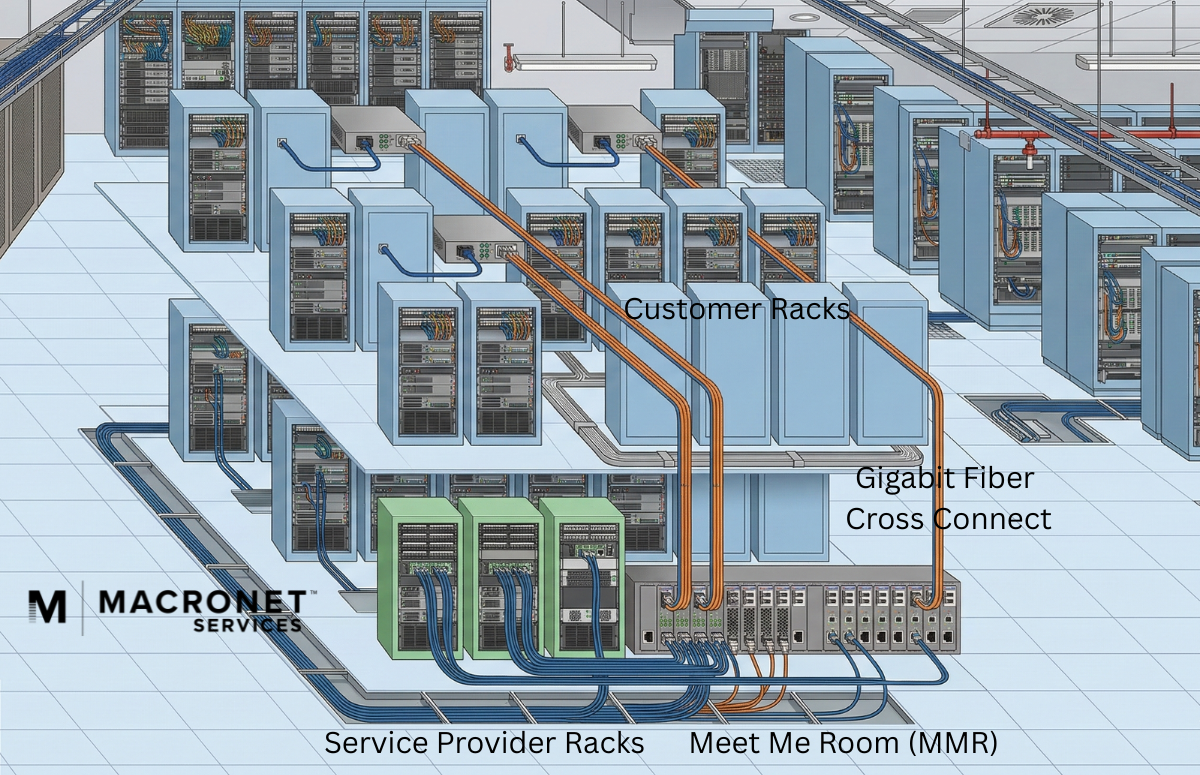
A meet-me room (MMR) is a central interconnection hub where network providers exchange traffic.
Cross Connects
A cross connect is a dedicated network connection between two parties inside a data center. The team at Macronet Services is very experienced in navigating the potential complexities of processing CFA/LOA to ensure proper and timely delivery of network connectivity.
Cross connects provide:
- Low latency
- High reliability
- Dedicated bandwidth
- Improved security
Understanding Colocation Pricing
Colocation pricing varies based on location, power density, and service levels.
Most contracts involve monthly recurring fees under multi-year agreements.
Typical Rack Pricing
Common ranges include:
- Quarter rack: $350 – $600 per month
- Half rack: $600 – $1,000 per month
- Full rack: $1,000 – $2,500+ per month
In major markets, enterprise colocation pricing often exceeds $2,000 per cabinet depending on power consumption.
Power-Based Pricing
Large deployments may be priced per kilowatt.
Typical pricing ranges:
$120–$250 per kW per month
Additional Costs
Organizations should also consider:
- Cross-connect fees
- Remote hands services
- Network connectivity costs
- Installation fees
Because pricing models vary widely between providers, many organizations rely on experienced advisors to compare options.
Choosing the Best Colocation Provider
Selecting the right colocation provider requires evaluating several factors.
Reliability
Facilities should demonstrate redundant electrical systems and well-designed cooling infrastructure.
Power Availability
Some markets face power constraints, making available capacity an important consideration.
Carrier Ecosystem
Facilities with strong network ecosystems provide greater flexibility for enterprise connectivity. Macronet Services has detailed knowledge of Tier 1 ISPs and NaaS (Network as a Service) provider availability in every global market.
Security and Compliance
Leading facilities maintain certifications such as:
Scalability
Organizations should ensure that facilities can support future growth.
Why Enterprises Work With Colocation Advisors
The colocation market includes hundreds of providers across the United States.
Each facility differs in:
- power capacity
- network connectivity options including Dedicated Internet Access and NaaS availability details in each market
- pricing models
- operational maturity
Evaluating these variables across multiple providers can be complex.
This is why many organizations work with independent infrastructure advisors such as Macronet Services.
Macronet Services helps enterprises:
- Evaluate colocation providers across major data center markets
- Compare colocation pricing and contract structures
- Identify facilities with the best network connectivity ecosystems
- Design enterprise WAN for AI and hybrid cloud architectures
- Source connectivity from leading telecommunications carriers
Because Macronet Services works with many providers and carriers, they can recommend the best solution for each organization rather than promoting a single vendor.
This advisory approach helps businesses simplify infrastructure decisions and avoid costly mistakes.
Data Center Colocation in New York and New Jersey
New York and New Jersey has become an important market for enterprise data center colocation due to its connectivity ecosystem, enterprise demand, and regional infrastructure.
Organizations deploying infrastructure in New York and New Jersey often benefit from:
- Access to major telecommunications carriers
- Dense regional fiber networks
- Strategic positioning for disaster recovery
- Proximity to enterprise technology ecosystems
Companies colocating infrastructure in New York and New Jersey often use the region to support:
- hybrid cloud environments
- disaster recovery infrastructure
- regional application performance
Depending on the market, businesses may find a mix of:
- carrier-neutral data centers
- wholesale data center facilities
- interconnection-focused carrier hotels
Because facilities vary significantly in power capacity, connectivity, and pricing, many organizations work with infrastructure advisors such as Macronet Services to evaluate the best colocation providers available in New York and New Jersey.
Macronet Services helps enterprises compare facilities across the New York and New Jersey data center market, evaluate network connectivity options, and design the optimal infrastructure architecture for each deployment.
Macronet Services also helps organizations evaluate the connectivity ecosystem surrounding each data center market. Using detailed fiber network maps and carrier intelligence, Macronet can identify facilities in NY and NJ that provide direct proximity to hyperscale cloud platforms such as AWS, Microsoft Azure, Google Cloud (GCP) and Oracle Cloud Infrastructure (OCI). This allows enterprises to design high-performance architectures that combine colocation infrastructure with dedicated cloud connectivity and multicloud strategies. By analyzing available carriers, cloud on-ramps, and network routes, Macronet Services helps businesses deploy colocation environments that optimize latency, resilience, and hybrid cloud performance.
Designing Hybrid and Multicloud Connectivity in New York and New Jersey
Many leading colocation facilities also function as cloud interconnection hubs, offering direct access to major hyperscale platforms through private connectivity services such as AWS Direct Connect, Microsoft Azure ExpressRoute, Oracle FastConnect, and Google Cloud Interconnect. Macronet Services helps organizations identify carrier-neutral data centers in New York and New Jersey that host these cloud on-ramps and provide access to diverse network carriers. By mapping fiber routes, evaluating cloud interconnection ecosystems, and comparing available providers, Macronet helps enterprises design secure, low-latency connectivity between their colocation infrastructure and public cloud environments. This enables organizations to build scalable hybrid and multicloud architectures that deliver high performance, predictable network costs, and resilient connectivity across multiple cloud platforms using cloud connect offerings.
Designing the Right Colocation Architecture
Successful colocation deployments require careful planning.
Organizations should evaluate several infrastructure components.
Network Architecture
Enterprises often deploy redundant carriers and diverse network paths to ensure high availability.
Power Planning
IT teams should plan for both current workloads and future rack density requirements.
Disaster Recovery Strategy
Many enterprises deploy infrastructure across multiple regions to improve resilience.
Hybrid Cloud Integration
Colocation facilities often serve as connectivity hubs linking private infrastructure with public cloud platforms.
Macronet Services helps organizations design these architectures by aligning colocation infrastructure, network connectivity, and cloud platforms into a unified strategy.
Conclusion: Simplifying Colocation Strategy
Data center colocation has become a foundational component of modern enterprise infrastructure.
By combining enterprise-grade facilities, resilient power systems, advanced cooling technologies, and rich connectivity ecosystems, colocation enables organizations to deploy mission-critical infrastructure with exceptional reliability.
However, evaluating colocation providers, carrier hotels, connectivity options, and pricing structures across multiple facilities can be complex.
This is why many enterprises work with independent advisors such as Macronet Services.
Macronet Services helps organizations:
- Identify the best colocation providers in New York and New Jersey
- Design optimal network connectivity architectures
- Compare pricing across multiple facilities
- Integrate colocation with hybrid cloud and WAN infrastructure
If your organization is evaluating data center colocation services in New York and New Jersey, Macronet Services can help simplify the process and ensure you select the best infrastructure solution.
Contact Macronet Services today to explore colocation and connectivity options in New York and New Jersey.
Frequently Asked Questions About Data Center Colocation
What is data center colocation?
Data center colocation is a service where businesses place their own servers and networking equipment in third-party facilities that provide power, cooling, and connectivity.
How much does colocation cost?
Typical pricing ranges from $1,000 to $3,000 per rack per month, depending on location and power requirements.
What is a carrier-neutral data center?
Carrier-neutral facilities allow customers to choose between multiple telecommunications providers rather than relying on a single carrier.
What is a meet-me room?
A meet-me room is a central interconnection hub inside a data center where network providers exchange traffic.
What is a cross connect?
A cross connect is a dedicated network connection between two parties inside a data center facility.
Is colocation cheaper than cloud?
Colocation can be more cost-effective for predictable workloads that require high performance and consistent compute usage.
How can businesses find the best data center colocation providers in New York and New Jersey?
The New York City and Northern New Jersey data center market is one of the most strategically important infrastructure hubs in the world. While Manhattan historically served as a major telecommunications and carrier-hotel center, much of today’s large-scale colocation infrastructure is located across the Hudson River in Northern New Jersey cities such as Secaucus, Newark, Weehawken, and Piscataway.
This region offers an exceptional concentration of fiber routes, carrier-neutral data centers, and network interconnection hubs, providing enterprises with access to dozens of telecommunications carriers and Internet exchanges. The market is also a critical connectivity hub for the financial services industry, supporting ultra-low-latency connections to trading venues and major financial institutions. As a result, organizations colocating infrastructure in the New York / Northern New Jersey metro area benefit from one of the densest network ecosystems in the world, with extensive cloud connectivity options, diverse fiber pathways, and direct access to global telecommunications networks.
Choosing the best data center colocation provider in NY and New Jersey requires evaluating multiple factors including power availability, carrier connectivity, facility reliability, and pricing. Macronet Services helps organizations compare colocation providers across the New York and New Jersey market, analyze available network carriers, and identify facilities that best support enterprise infrastructure requirements. By reviewing technical capabilities, connectivity ecosystems, and contract terms, Macronet Services helps businesses select the right colocation provider for their applications and long-term growth.
Who can help design network connectivity for colocation deployments?
Designing network connectivity for a colocation deployment often involves evaluating fiber routes, selecting telecommunications carriers, and building resilient WAN architectures. Macronet Services works with organizations to design enterprise network connectivity strategies for colocation environments, helping businesses deploy infrastructure with optimal redundancy, performance, and scalability.
How can companies connect colocation infrastructure to public cloud platforms?
Many colocation facilities offer direct connectivity to hyperscale cloud providers such as AWS, Microsoft Azure, and Google Cloud through private interconnection services. Macronet Services helps organizations identify facilities that support cloud on-ramps like AWS Direct Connect, Microsoft Azure ExpressRoute, and Google Cloud Interconnect, enabling secure, low-latency connections between private infrastructure and cloud environments.
Do colocation facilities offer access to multiple telecommunications carriers?
Many enterprise data centers operate as carrier-neutral facilities that host multiple telecommunications providers and fiber networks. This allows organizations to deploy diverse network architectures and improve redundancy. Macronet Services helps businesses evaluate the carrier ecosystems within each facility and identify the best connectivity options available in the New York and New Jersey data center market.
Why do organizations work with advisors when sourcing colocation services?
The colocation market includes hundreds of facilities with different power capacities, connectivity ecosystems, and pricing structures. Evaluating these options can be complex for internal IT teams. Macronet Services helps organizations simplify the process by comparing providers, evaluating infrastructure capabilities, and identifying facilities that best support enterprise requirements.
How can companies design hybrid cloud or multicloud architectures using colocation?
Many enterprises deploy infrastructure in colocation facilities that provide direct connectivity to public cloud platforms. Macronet Services helps organizations design hybrid and multicloud architectures that integrate colocation infrastructure with hyperscale cloud providers, enabling secure, high-performance connectivity between private infrastructure and cloud environments.
How can businesses identify the best data center markets for infrastructure deployments?
Choosing the right location for colocation infrastructure involves evaluating connectivity ecosystems, proximity to users, disaster recovery considerations, and access to cloud providers. Macronet Services helps organizations analyze major global data center markets and identify the best locations for enterprise infrastructure deployments.
How can organizations evaluate connectivity options inside a data center?
Connectivity options within a colocation facility can vary significantly depending on the number of available carriers, fiber routes, and cloud interconnection services. Macronet Services helps businesses analyze these connectivity ecosystems and design network architectures that maximize performance, resilience, and scalability.