

Greenfield Telecom Provisioning: The CIO’s Address Validation Guide
For a Chief Information Officer, VP of Global Infrastructure or a member of the team, few milestones match the high-stakes pressure of launching a greenfield manufacturing plant, logistics hub, or corporate campus. You are tasked with architecting the digital foundation for Industry 4.0 technologies—IoT sensor arrays, automated guided vehicles (AGVs), real-time MES (Manufacturing Execution Systems), and cloud-native ERPs.
Yet, an expensive, invisible obstacle frequently stalls these multi-million-dollar deployments before construction even begins: The Telecom Serviceability Gap.

Project Management Offices (PMOs) routinely task IT leaders with ordering high-capacity fiber optic backhaul, redundant global Tier 1 ISP circuits, or a/k/a dedicated internet access (DIA) before the first foundation stone is laid. However, when you submit these requests to tier-1 global carriers the automation engines instantly kick back an error: “Address Unserviceable / Location Not Found.” Address validation is key.
You cannot route packets through a dirt pile, and global telecom databases cannot quote to a location that lacks a validated postal record. This comprehensive guide outlines the technical, bureaucratic, and engineering workflows required to transform a raw building lot into a telco-validated address, ensuring your SD-WAN underlay or Dark Fiber infrastructure is active on day one.
1. The Root Cause: Why Telco Databases Reject Greenfield Sites
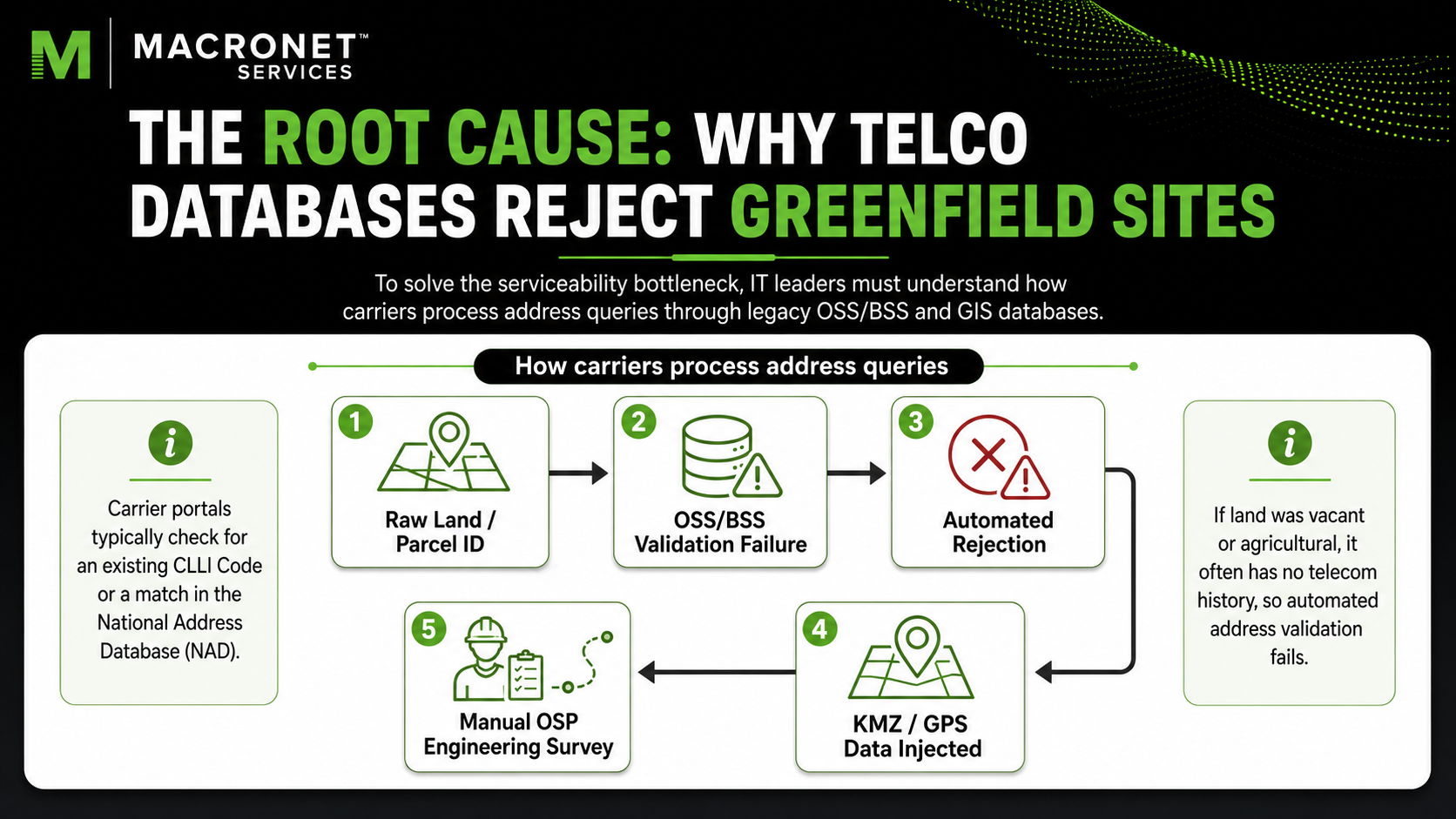
To solve the serviceability bottleneck, IT leaders must understand how carriers process address queries. Telecom providers manage their service footprints using legacy OSS/BSS (Operations Support Systems / Business Support Systems) integrated with GIS (Geographic Information Systems) databases like Esri or MapInfo.
When an address is entered into a carrier portal, the system checks for an existing CLLI Code (Common Language Location Identifier) or matches it against a National Address Database (NAD). If a plot of land has historically been used for agriculture or sat vacant, it has no telecom history.
Furthermore:
- The Parcel ID Fallacy: Tax parcel numbers or cadastral plot data from local land registries mean nothing to a telecom router or automated quoting tool.
- The Demarcation Disconnect: Automated systems look for existing copper or fiber entry points (Network Interface Devices, or NIDs). If no physical drop exists within a certain distance (typically 500 feet for standard builds), the system defaults to “No Service Available” rather than initiating a provisioning workflow.
2. Phase 1: Establishing the Logical Address (The Bureaucratic Workflow)
Before engaging telecom account teams, IT must partner with the onsite civil engineering team and local municipal authorities to establish a Situs Address (the official, legal physical address of the facility).
Step A: Securing the Municipal Address Assignment
During the early permitting and zoning phase, the local municipality’s planning commission or E-911 coordinator assigns a street number to the lot. IT must obtain the official Address Assignment Letter. Do not wait for the postal service to index the address; the official local government documentation is your leverage for manual overrides with the carriers.
Step B: Differentiating Address Types
Ensure the assigned address explicitly references the exact location of the MPOE (Minimum Point of Entry) or main telecom equipment room (MDF), rather than a distant security gate or secondary shipping warehouse. In massive industrial complexes, a mismatch between the front-gate mailbox address and the actual building where fiber terminates can delay circuit handoffs by months.
3. Phase 2: Bypassing Automation with Geospatial Data (KMZ/KML)
If the street address is too new to pass automated database checks, your primary tool for securing a quote is geospatial data. You must convert your civil engineering blueprints into KMZ or KML files (Keyhole Markup Language).
Technical Insight: A KMZ file allows Outside Plant (OSP) engineers to manually plot your site relative to their existing fiber optic splice points, manholes, and utility poles, completely bypassing automated portal rejections.
How to Build a Telco-Ready KMZ Payload:
- Define the Demarcation Point: Drop a pin exactly where the proposed building’s MPOE will sit.
- Plot the Property Line Access: Mark the specific point where the municipal road meets your property line (the “Meet-Me Point”).
- Include Latitude/Longitude in Decimal Degrees: Always format coordinates to at least four decimal places (e.g., Lat: 44.9778, Long: -93.2650) to prevent conversion errors within international carrier engineering divisions.
Sample Telco-Ready GPS Data Payload:
Site Name: Project Greenfield – Plant 4
MPOE Coordinates: 44.977812, -93.265011
Property Entry Point: 44.977501, -93.264850
Requested Handoff: Single-Mode Fiber (SMF) OS2
4. Phase 3: Outside Plant (OSP) & Inside Plant (ISP) Engineering Requirements
A validated address only solves the logical problem; the physical problem requires concrete infrastructure. If the site developer does not construct the underground pathways to carrier standards, the telecom installation will stall at the property line.
Underground Conduit Specifications
Carriers typically do not trench across private property at no cost. For greenfield sites, the developer or customer is usually expected to provide carrier-compliant conduit from the property edge or meet-me point to the MPOE, or the carrier will price the work as special construction, which may be charged upfront, amortized into the contract, or negotiated as part of a larger deal.:
- Conduit Sizing: Install a minimum of two 4-inch Schedule 40 or Schedule 80 PVC conduits. One is for the primary provider; the second provides a redundant path for a secondary carrier to ensure true diverse routing.
- Bend Radii: All conduit bends must be sweeping bends with a minimum radius of 36 inches. Never allow the use of hard 90-degree elbows, as fiber optic pulling teams will reject the path due to cable tension limits.
- Pull Strings & Innerduct: Ensure every conduit run includes a high-tensile pull string (minimum 200 lb. test) or, ideally, multi-cell fabric innerduct to maximize future fiber capacity.
The MPOE (Minimum Point of Entry) Environment
The room where the carrier terminates their Last-Mile Fiber must meet strict ANSI/BISCI and the hardware must meet NEMA/Telcordia standards before a technician will hand over a circuit:
- Backing: A dedicated $4’\times8’\times3/4”$ fire-retardant plywood backboard.
- Power: Dedicated, grounded AC circuits, backed up by an enterprise UPS or facility generator.
- Grounding: A Master Ground Bar (MGB) bonded directly to the building’s main electrical grounding system.
5. Navigating International Telecom Regimes
Provisioning a greenfield site across international borders introduces localized regulatory and database nuances that US-centric IT teams often overlook.
United Kingdom & Europe
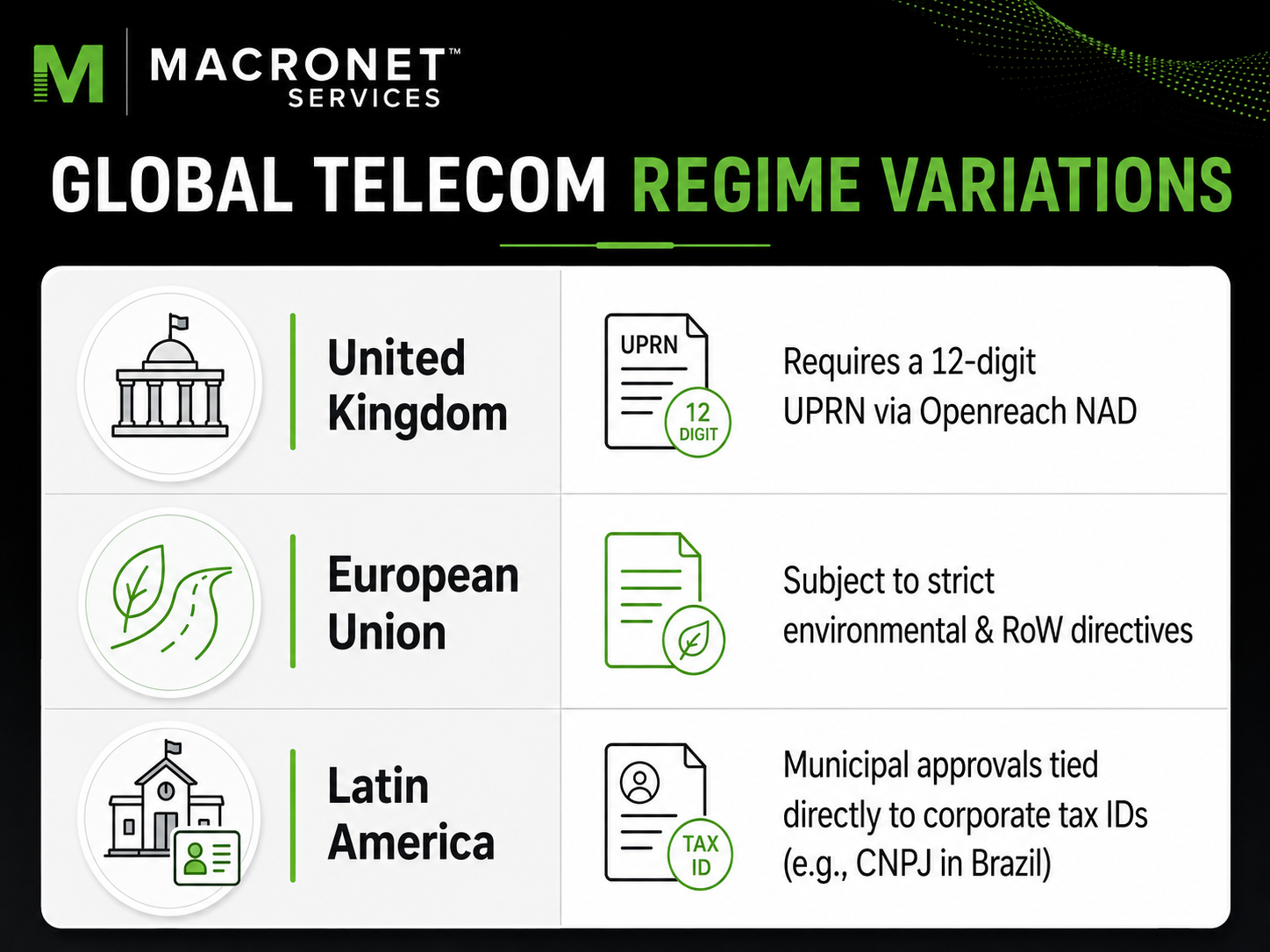
In the UK, street names are secondary to the UPRN (Unique Property Reference Number). Managed by Ordnance Survey, the UPRN is a 12-digit identifier for every parcel of land. Carriers like Openreach rely heavily on the National Address Database (NAD). If your site lacks a UPRN, quotes will be rejected.
Across continental Europe, Right of Way (RoW) permits to cross public roads can take up to 9 months, particularly if historical zones or environmental protections are triggered.
Latin America (LATAM) & Asia-Pacific (APAC)
In regions like Mexico, Brazil, or Vietnam, utility infrastructure often lags behind industrial park development. Local carriers frequently demand a Special Construction Charge (SCC) upfront to extend their fiber backhaul backbone to the new industrial zone.
Furthermore, address validation in these regions is frequently tied directly to corporate tax registration numbers (e.g., CNPJ in Brazil). You cannot get an address validated by a local carrier until the local subsidiary corporation is legally registered at that location.
6. Managing Special Construction Charges (SCC) and Feasibility Studies
When you force a carrier to manually quote a greenfield site via GPS/KMZ, they will initiate a Desktop Feasibility Study, followed by a physical site survey. This process determines whether the circuit can be delivered under standard terms or if it requires an SCC.
- What is an SCC? Special Construction Charges cover the cost of pole placements, subterranean boring, manhole construction, and extended fiber splicing required to bring the infrastructure to your property line. Below is an excerpt from a Tier 1 ISP service schedule. Specifically, is it from the “Customer Responsibilities” section:
“Construction charges apply if special construction is required to extend Service to the demarcation point. If Customer does not approve of the Construction charges after the customer is notified of the charges, the Service ordered will be deemed cancelled.”
- Amortization vs. CapEx: CIOs must decide whether to pay SCCs as an upfront capital expenditure or negotiate with the carrier to amortize the build cost over a 36- or 60-month contract term.
- The “Dummy Address” Benchmarking Tactic: If you need ballpark budgetary numbers 12 months before groundbreaking, identify an established business within a 1-mile radius of your site. Run a serviceability check on that “A-End” address to determine which carriers have physical infrastructure nearby, giving you leverage during eventual negotiations.
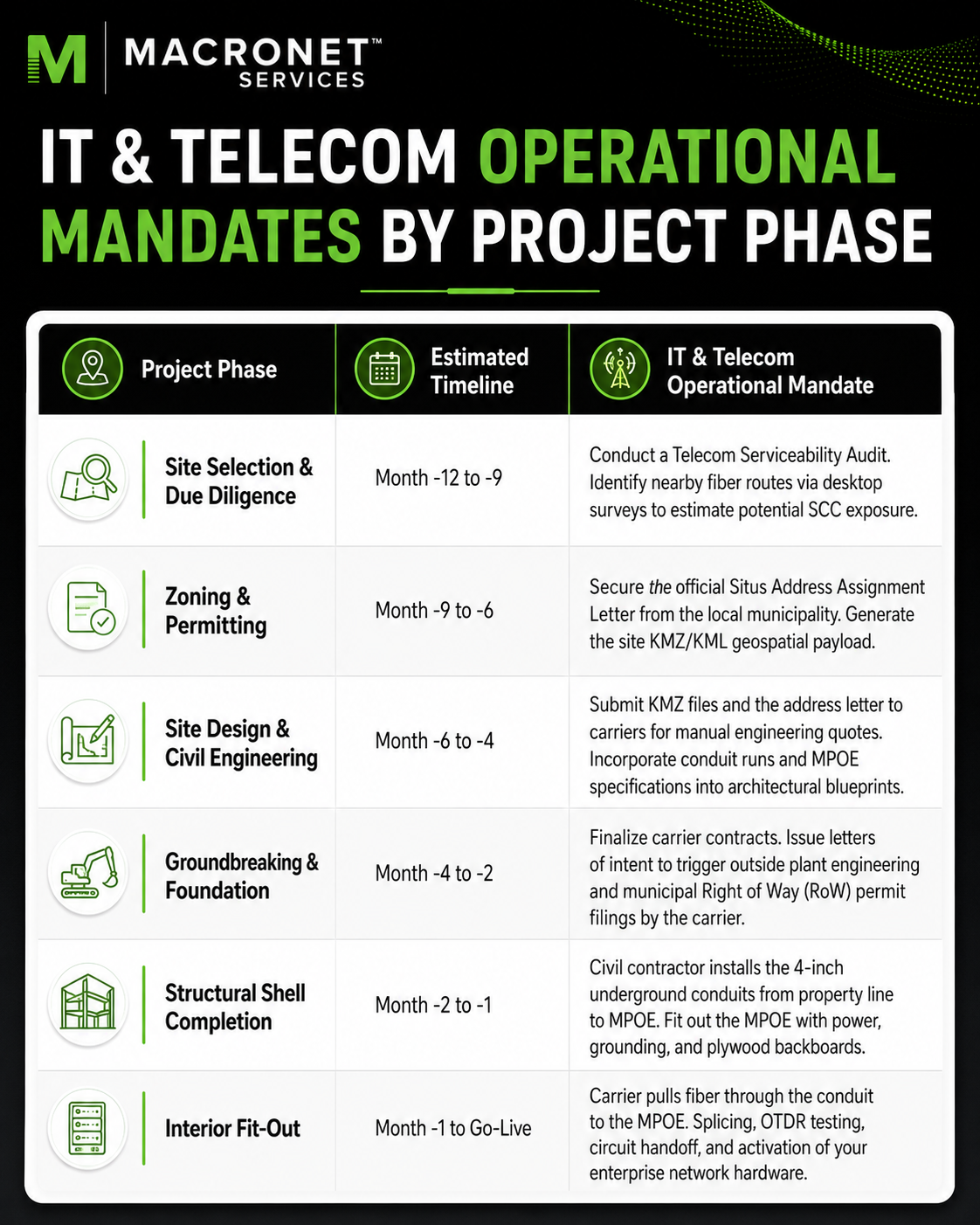
7. The Comprehensive Greenfield Telecom Provisioning Timeline
To ensure your factory, warehouse, or office isn’t relying on cellular hotspots on opening day, integrate this timeline directly into the master construction schedule:
Conclusion: Take Control of Your Physical Layer
For the modern enterprise CIO, network architecture cannot be decoupled from civil engineering. Waiting for a greenfield site to appear naturally in a telecom database is a recipe for operational delays, missed launch windows, and escalating project costs. By taking command of the logical address creation, leveraging geospatial payloads, and enforcing rigid physical plant standards, IT leaders transform connectivity from a critical bottleneck into a competitive advantage.
How Macronet Services Eliminates the Greenfield Headache
Navigating multi-carrier engineering divisions, international regulatory bodies, and complex OSP requirements demands dedicated focus and exceptional resources. At Macronet Services, we act as an extension of your global infrastructure team.
We bypass automated carrier portals, engaging directly with localized outside plant engineering teams worldwide. From initial geospatial feasibility studies and SCC negotiations to physical route diversity planning, we ensure your greenfield facilities are fully quoted, provisioned, and connected on schedule.
Planning an international expansion or greenfield build? Contact Macronet Services today to initiate a comprehensive Telecom Serviceability Audit for your upcoming project site.
Frequently Asked Questions
- What is greenfield telecom provisioning?
Greenfield telecom provisioning is the process of designing, quoting, engineering, and installing network connectivity for a new building, manufacturing plant, warehouse, logistics hub, or corporate campus that does not yet exist in carrier serviceability databases. Unlike an existing office or data center, a greenfield site may lack a validated address, existing fiber entrance, telecom demarcation point, or historical carrier record.
- Why do carriers reject new construction addresses?
Carriers often reject new construction addresses because their automated quoting systems rely on existing telecom, postal, GIS, and serviceability databases. If the site is still raw land, recently subdivided, or not yet indexed in a national address database, the carrier portal may return “Address Unserviceable” or “Location Not Found.” This does not always mean service is impossible; it often means the request must be manually reviewed by carrier engineering.
- What is the telecom serviceability gap?
The telecom serviceability gap is the disconnect between when a business needs to order network services and when a new site becomes visible in carrier systems. For greenfield facilities, IT teams may need dedicated internet access, fiber backhaul, SD-WAN underlay, or dark fiber months before the site has a fully validated postal and telecom record.
- What is a situs address?
A situs address is the official physical address assigned to a property by the local municipality or addressing authority. For telecom provisioning, a situs address is often more useful than a parcel ID because it gives carriers a formal location reference that can be used to begin manual validation and engineering workflows.
- Is a parcel ID enough for telecom carriers to quote service?
Usually, no. A parcel ID may be useful for real estate, tax, zoning, or civil engineering purposes, but most telecom carrier systems are not designed to quote network service based on parcel data alone. Carriers typically need a validated street address, GPS coordinates, KMZ/KML file, demarcation location, or manual engineering review.
- What is a KMZ or KML file in telecom provisioning?
A KMZ or KML file is a geospatial mapping file that shows the physical location of a site using coordinates and map overlays. In telecom provisioning, KMZ/KML files help outside plant engineers identify the proposed building location, property boundary, meet-me point, MPOE, and proximity to existing fiber routes, splice points, manholes, poles, and conduits.
- Why are GPS coordinates important for new fiber installations?
GPS coordinates are important because they allow carriers to manually evaluate a site even when the address is not yet available in their quoting system. Accurate latitude and longitude coordinates help outside plant engineers locate the proposed MPOE, property entrance, and nearby carrier infrastructure.
- What is an MPOE in telecom?
MPOE stands for Minimum Point of Entry. It is the location where the carrier’s outside network enters the customer’s building and transitions into the customer-controlled telecom environment. For greenfield projects, the MPOE should be planned early so conduit paths, power, grounding, rack space, and fiber entrance facilities are ready before the carrier installation date.
- What is the difference between OSP and ISP engineering?
OSP, or Outside Plant, refers to telecom infrastructure outside the building, including fiber routes, poles, ducts, handholes, manholes, underground conduit, and splicing. ISP, or Inside Plant, refers to the telecom environment inside the building, including the MPOE, MDF, racks, backboards, grounding, power, cable trays, and equipment rooms. Both must be coordinated for a successful greenfield telecom deployment.
- Do carriers trench across private property for free?
Typically, no. For greenfield sites, the developer or customer is usually responsible for providing carrier-compliant conduit from the property edge or meet-me point to the MPOE. If the carrier must perform additional construction, trenching, boring, pole work, or fiber extension, those costs may be quoted as special construction charges.
- What are Special Construction Charges in telecom?
Special Construction Charges, often called SCCs, are non-recurring charges associated with extending telecom infrastructure to a customer site. These charges may include trenching, boring, pole placement, manhole construction, fiber splicing, conduit installation, engineering work, permitting, or other outside plant costs required to make the location serviceable.
- Can Special Construction Charges be negotiated?
Yes. Special Construction Charges can often be negotiated depending on the size of the opportunity, contract term, bandwidth, carrier strategy, competitive options, and whether the provider sees long-term revenue potential at the location. In some cases, SCCs are paid upfront. In other cases, they may be amortized into a 36-month or 60-month contract.
- How early should IT start planning telecom for a greenfield site?
IT should begin telecom planning as early as possible, ideally during site selection, permitting, and civil engineering design. Waiting until the building is nearly complete can create major delays because address validation, carrier feasibility studies, special construction approvals, right-of-way permits, conduit installation, and circuit delivery can take months.
- Why does telecom need to be part of the construction schedule?
Telecom must be part of the construction schedule because network availability depends on physical infrastructure, not just service orders. Conduit paths, equipment rooms, power, grounding, permits, carrier access, and outside plant construction all need to align with the project timeline. If telecom is treated as a late-stage IT task, the business may open a new facility without production-grade connectivity.
- How can Macronet Services help with greenfield telecom deployment?
Macronet Services can help enterprises validate new site addresses, engage carrier engineering teams, prepare geospatial data, source diverse network providers, analyze fiber availability, negotiate special construction charges, and coordinate provisioning timelines. For companies building new plants, warehouses, logistics hubs, or international facilities, Macronet Services acts as an extension of the infrastructure team to reduce delays and improve carrier options.