MIP vs MSP: Why Businesses Need a Managed Intelligence Partner in the AI Era
For decades, businesses have relied on Managed Service Providers, or MSPs, to keep their technology environments operating. MSPs have played a critical role in business technology by supporting networks, users, devices, cloud platforms, cybersecurity tools, help desks, backup systems, and day-to-day IT operations.
That role remains important. Reliable infrastructure, secure networks, responsive support, and properly managed systems are still essential to every modern business.
But artificial intelligence is creating a new category of business need.
Companies are no longer asking only, “Who can manage our IT?” They are now asking a much bigger question: “Who can help us use technology, data, automation, and AI to make the business smarter?”
That is where the idea of the Managed Intelligence Partner, or MIP, becomes important and MIP vs MSP becomes a common question.
A Managed Intelligence Partner is not simply a traditional MSP with AI added to the website. A true MIP helps organizations evaluate, deploy, govern, integrate, and continuously improve AI-enabled business capabilities. This includes artificial intelligence, automation, AI agents, data governance, workflow design, ecosystem readiness, analytics, knowledge management, and measurable business outcomes.
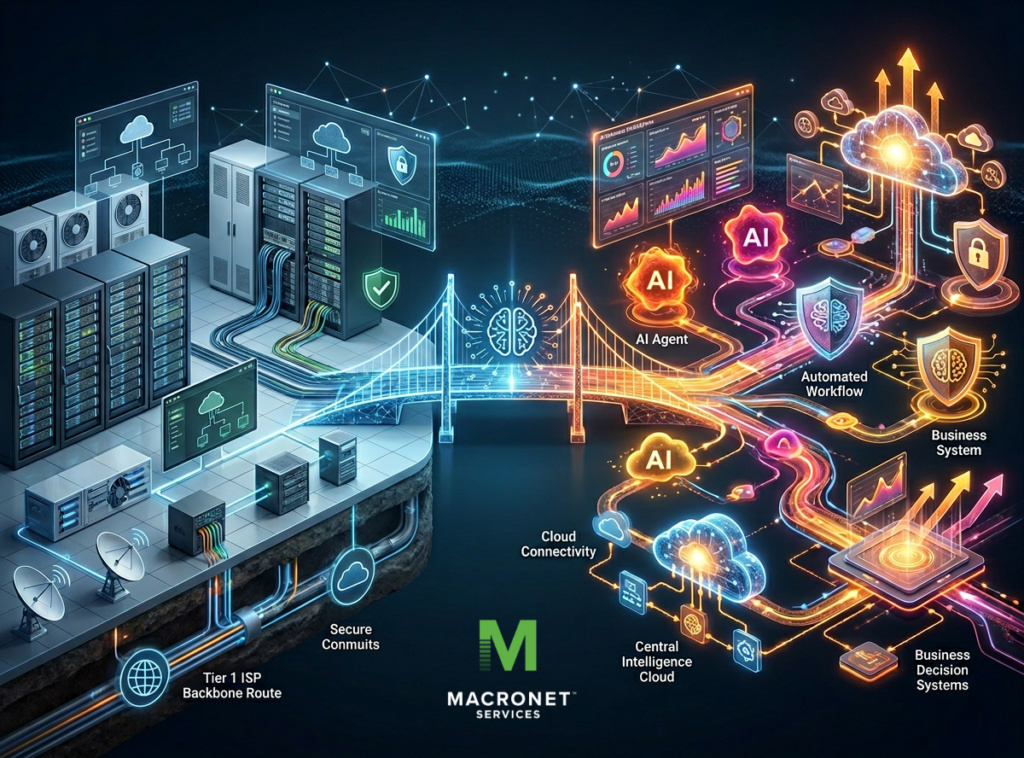
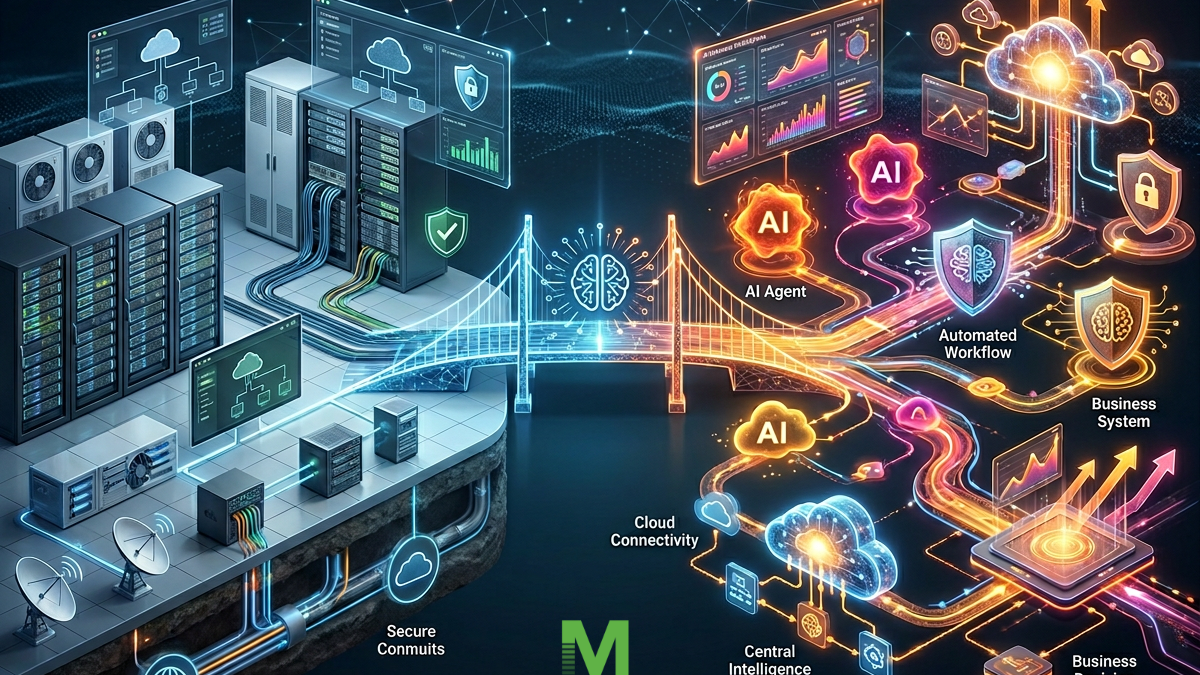
In other words, the MSP keeps the technology running. The MIP helps the business become more intelligent.
What Is a Managed Intelligence Partner?
A Managed Intelligence Partner is a strategic technology and AI partner that helps a business turn information, data, applications, and workflows into operational advantage.
While a traditional MSP focuses primarily on the management of IT systems, a Managed Intelligence Partner focuses on the management of intelligence across the organization. That intelligence may come from AI models, enterprise data, automated workflows, AI agents, business applications, analytics platforms, or knowledge repositories.
The difference is subtle but important.
A traditional MSP may manage the systems a company already uses. A MIP helps the company rethink how work should be done in the AI era.
That may include helping the business decide where AI should be used, which workflows should be automated, which employees should have access to certain tools, how sensitive data should be protected, how Microsoft Copilot should be deployed, how AI agents should be governed, and how the organization should measure return on investment.
This is not just an IT conversation. It is a business transformation conversation.
Why the MSP Model Is No Longer Enough by Itself
The traditional MSP model was built around stability, support, security, and uptime. Those capabilities are still necessary, but they do not fully address the complexity of AI adoption.
A company can have excellent IT support and still be unprepared for AI.
It may have a reliable network, a secure firewall, managed endpoints, cloud backups, and a responsive help desk. But that does not mean its data is ready for Microsoft Copilot. It does not mean its SharePoint permissions are clean. It does not mean its employees understand how to use generative AI safely. It does not mean its workflows are ready for automation. It does not mean leadership knows which AI use cases are worth funding.
AI introduces a new layer of complexity above traditional IT.
That layer includes data quality, permissions, governance, business process redesign, AI policy, employee training, vendor selection, automation strategy, compliance risk, and outcome measurement. These areas sit at the intersection of technology, operations, finance, security, legal, sales, marketing, and executive leadership.
That is why many organizations will need a partner that goes beyond infrastructure management.
MSP vs. MIP: The Key Difference
The difference between an MSP and a MIP is not that one is useful and the other is not. Businesses often need both. The difference is the level at which each partner operates.
| Traditional MSP | Managed Intelligence Partner |
| Manages IT systems and support | Manages AI-enabled business capability |
| Focuses on uptime, tickets, devices, networks, cloud, and security | Focuses on AI readiness, automation, agents, data, governance, and business outcomes |
| Supports existing technology | Helps redesign workflows around intelligent technology |
| Measures service levels and response times | Measures productivity, efficiency, cost reduction, revenue impact, and risk reduction |
| Primarily IT-led | Business-led, with IT deeply involved |
A strong MSP helps the business operate. A strong MIP helps the business evolve.
Why Businesses Are Moving Toward Managed Intelligence
AI adoption is no longer limited to experimental innovation teams. Business users are already using generative AI to write, summarize, research, analyze, code, sell, support customers, create marketing materials, and make decisions.
This creates opportunity, but it also creates risk.
Employees may be using unsanctioned AI tools. Sensitive information may be copied into public platforms. AI-generated content may be inaccurate. Business processes may become inconsistent. Different departments may purchase overlapping tools. Leaders may struggle to separate real productivity gains from hype.
At the same time, the technology is advancing quickly. Microsoft Copilot, Copilot Studio, ChatGPT Enterprise, Google Gemini, Salesforce AI, ServiceNow AI, contact center AI platforms, business intelligence tools, and vertical AI applications are all becoming part of the business technology landscape.
This creates a practical problem for executives: the market is moving faster than most organizations can evaluate, govern, and implement on their own.
A Managed Intelligence Partner helps bring structure to that transition.
What a Managed Intelligence Partner Provides
A true MIP provides a combination of advisory, technical, governance, and operational services. The best MIPs do not begin by selling tools. They begin by understanding how the business works.
The first major function of a MIP is AI readiness assessment. Before a company deploys AI broadly, it needs to understand its current environment. That includes its applications, data sources, security posture, user permissions, collaboration platforms, business workflows, and organizational maturity. Many AI initiatives fail not because the model is weak, but because the business environment is not ready.
A MIP should help identify whether the company’s data is accessible, trustworthy, and properly secured. It should evaluate whether platforms such as Microsoft 365, SharePoint, Teams, OneDrive, CRM, ERP, document management, and business intelligence systems are ready to support AI-enabled workflows. It should also assess whether the organization has the right governance, policies, training, and executive alignment in place.
The second function is AI use case discovery and prioritization. Most businesses have many potential AI use cases, but not every use case should be pursued first. A MIP helps determine which opportunities are likely to produce the greatest business value with the right balance of complexity, risk, cost, and speed to implementation.
For example, one company may benefit most from AI-assisted customer service. Another may need automated proposal generation. Another may need invoice processing, sales intelligence, contract review, executive reporting, knowledge base search, call summarization, or operational analytics. The role of the MIP is to connect AI strategy to business reality.
The third function is AI governance and risk management within the NIST AI Risk Management Framework. This is where many organizations underestimate the challenge. AI needs rules, controls, oversight, and accountability. Businesses need to define which tools are approved, which data can be used, who can access AI systems, when human review is required, how outputs should be validated, and how sensitive information should be protected.
Without governance, AI can quickly become another form of shadow IT. Employees may adopt tools faster than leadership can manage them. A MIP helps prevent that by creating a practical governance model that supports innovation while reducing risk.
The fourth function is workflow automation and integration. AI becomes more valuable when it is connected to real business processes. A chatbot or AI assistant may be useful, but the larger opportunity comes when AI is integrated into workflows across CRM, finance, service, operations, HR, marketing, and executive reporting.
A MIP helps businesses move beyond isolated AI experiments. The goal is not to create disconnected tools. The goal is to improve how work gets done.
The fifth function is continuous optimization. AI is not a one-time deployment. Models change, platforms change, business needs change, and employees learn new ways to work. A MIP should help monitor adoption, measure results, refine workflows, manage cost, reduce risk, and expand successful use cases over time.
Microsoft Copilot and the MIP Opportunity
For many businesses, Microsoft Copilot will be the first major step into enterprise AI. Because Copilot is connected to Microsoft 365, it can potentially interact with email, documents, meetings, Teams, SharePoint, OneDrive, and other business information.
That creates tremendous productivity potential. It also creates important readiness questions.
If permissions are poorly managed, Copilot may surface information to users who should not have access to it. If SharePoint sites are disorganized, Copilot may produce incomplete or confusing answers. If sensitive data is not labeled or protected, the organization may increase its compliance risk. If employees are not trained, they may use Copilot inefficiently or inappropriately.
A Managed Intelligence Partner can help companies prepare for Copilot by reviewing the Microsoft 365 environment, cleaning up permissions, improving information architecture, establishing governance policies, designing pilot programs, training users, and measuring adoption. A well managed Microsoft Purview can help manage risks and governance controls for Copilots, agents, and generative AI applications.
This is a perfect example of why the MIP model is different from the traditional MSP model. Deploying a license is not the same as transforming the business process around the technology.
AI Agents Will Increase the Need for Managed Intelligence
AI agents are another major reason the MIP category is becoming more relevant.
Unlike basic chat tools, AI agents can be designed to perform tasks, access information, trigger workflows, summarize activity, generate recommendations, and support business processes. In the future, companies may use AI agents to assist with customer support, sales follow-up, project management, invoice review, document generation, compliance research, employee onboarding, and operational reporting.
But agents need to be managed carefully.
A business must understand what each agent can access, what actions it can take, when it should escalate to a human, how its outputs are reviewed, how performance is measured, and how errors are handled. As AI agents become more capable, the need for governance and oversight becomes more important, not less. Microsoft’s Copilot Studio guidance specifically references data loss prevention and governance controls.
This is one of the clearest examples of the difference between managing technology and managing intelligence.
A traditional IT support model may not be enough to govern AI agents that participate in business workflows. Companies will need partners who understand both the technology and the business process.
Data Readiness Is the Foundation of AI Success
AI depends on data. If the data is fragmented, outdated, inconsistent, inaccessible, or poorly governed, the AI results will suffer.
Many organizations discover this only after they begin deploying AI tools. They realize that important information is spread across email, shared drives, SharePoint sites, CRM systems, spreadsheets, finance platforms, PDFs, and legacy applications. They also discover that employees have different versions of the truth depending on which system they use.
A Managed Intelligence Partner helps businesses address this problem by improving the data foundation that AI depends on.
That may include data source mapping, permissions review, knowledge base design, document organization, reporting strategy, data quality improvement, and integration planning. For more advanced environments, it may include retrieval-augmented generation, data warehouse strategy, analytics modernization, or AI-ready knowledge architecture.
This is where AI becomes more than a productivity tool. It becomes part of the company’s decision-making infrastructure.
Security and Compliance Cannot Be an Afterthought
AI introduces new security and compliance questions that businesses cannot ignore.
Where does company data go when employees use an AI tool? Is that data retained? Is it used for model training? Can the vendor access it? Does the platform support audit logging? Can the company enforce data loss prevention policies? What happens if regulated or confidential information is entered into the system? CISA’s AI resources are a strong government-backed authority link for AI security, especially for risk-conscious executives.
These questions matter for every business, but they are especially important in healthcare, financial services, legal, insurance, manufacturing, education, and government contracting.
A MIP should help evaluate AI vendors, review security controls, align AI usage with internal policies, and ensure that AI adoption does not create unnecessary exposure.
Responsible AI is not just about ethics. It is about operational risk, legal risk, reputational risk, and business continuity. For another perspective, IBM’s 2025 CEO study is useful because it supports the point that CEOs are investing in AI while still struggling to understand value and risk
Employee Training and Change Management
Even the best AI platform will fail if employees do not understand how to use it.
AI adoption requires training, communication, and change management. Employees need to understand when AI is appropriate, when it is not, how to write effective prompts, how to validate outputs, how to protect sensitive data, and how AI fits into their actual job responsibilities.
Managers also need training. They must understand how AI changes workflows, productivity expectations, review processes, and team structure. Executives need a different level of education focused on investment decisions, governance, risk, and measurable business impact.
A Managed Intelligence Partner helps bridge these audiences. The goal is not simply to teach people how to use a tool. The goal is to help the organization build confidence and competence around AI-enabled work.
Why Businesses Should Not Choose a MIP Based on Hype
The market for AI services is becoming crowded. Many providers now claim to offer AI strategy, AI automation, AI transformation, or AI consulting. Some have real experience. Others are simply repositioning existing services with new language.
That makes MIP selection important.
The right Managed Intelligence Partner should have a practical understanding of business operations, technology architecture, cybersecurity, data governance, workflow automation, AI platforms, integration, and change management. Just as important, the partner should be able to communicate clearly with both technical teams and executive leadership.
This is not a decision that should be made based only on a demo or a software partnership. It should be based on fit.
A manufacturing company, a healthcare organization, a financial services firm, a construction company, a professional services firm, and a nonprofit may all need different types of Managed Intelligence Partners. Some may need deep Microsoft expertise. Others may need contact center AI experience. Others may need workflow automation, data engineering, cybersecurity, compliance, or industry-specific AI capabilities.
There is no single MIP that is right for every client.
How Macronet Services Helps Clients Select the Right Managed Intelligence Partner
Macronet Services helps organizations evaluate their needs and select the right partner model for AI, automation, infrastructure, and business transformation.
This is important because many companies are not ready to choose a Managed Intelligence Partner on their own. They may know they need help with AI, but they may not know whether they need a Microsoft-focused partner, an AI automation firm, a data and analytics specialist, a cybersecurity-led provider, a traditional MSP evolving into AI services, or a combination of several partners.
Macronet Services brings deep experience in complex technology environments, network design, cloud connectivity, vendor evaluation, and AI-driven business transformation. That perspective allows us to help clients clarify what they actually need before they commit to a provider.
Our role is not to force every client into the same model. Our role is to help the client make the right decision.
For some organizations, the right answer may be a next-generation MSP with strong AI and automation capability. For others, it may be a specialized MIP focused on Microsoft Copilot, agent development, workflow automation, data governance, or industry-specific AI solutions. In more complex environments, the right model may involve multiple providers working together under a clear roadmap.
Macronet Services helps clients evaluate those options and select from multiple Managed Intelligence Partner candidates based on business goals, technical requirements, security needs, budget, industry, and long-term strategy.
Why Infrastructure Still Matters in the AI Era
Although MIP discussions often focus on AI applications and business workflows, the underlying infrastructure still matters.
AI depends on secure, reliable, high-performance technology foundations. Connectivity, cloud access, colocation, data center architecture, identity management, endpoint security, backup, disaster recovery, and network visibility all affect the success of AI-enabled business operations.
As companies increase their use of AI, they may also need to rethink bandwidth, latency, cloud connectivity, data protection, vendor architecture, and application performance. A company using more cloud-based AI tools, real-time analytics, contact center AI, or data-intensive workflows may require a different infrastructure strategy than it used in the past.
For organizations supporting AI workloads, real-time analytics, cloud-based applications, or multi-cloud architectures, internet connectivity should not be treated as a commodity. The selection of Tier 1 ISPs, cloud on-ramps, Network as a Service, colocation facilities, and diverse access circuits can directly affect latency, resiliency, application performance, and user experience. This is why AI readiness must include a serious review of the network underlay, not just the AI tools themselves.
This is where Macronet Services is especially well positioned.
The AI conversation should not be separated from the network, cloud, data center, cybersecurity, and vendor ecosystem that supports it. A strong AI strategy requires a strong technology foundation.
The Future of Managed Services
The managed services market is entering a major transition.
The best MSPs will continue to provide critical IT support. Many will also evolve by adding AI readiness, automation, Copilot services, governance, and business process consulting. But not every MSP will become a true Managed Intelligence Partner.
The MIP model requires a broader skill set. It requires business acumen, AI knowledge, workflow expertise, data governance, security awareness, integration capability, change management, and the ability to measure business outcomes.
The future will not be defined only by who manages servers, tickets, endpoints, and firewalls. It will be defined by who helps businesses use intelligence more effectively.
That is the opportunity.
Companies that approach AI as a tool purchase may see limited results. Companies that approach AI as a managed business capability will be better positioned to improve productivity, reduce cost, serve customers faster, make better decisions, and create new competitive advantages.
Conclusion: Businesses Need More Than Managed IT
The MSP model is not going away. Businesses still need strong IT operations, secure networks, responsive support, reliable connectivity, and well-managed cloud environments.
But AI is creating a new requirement.
Businesses now need partners who can help them evaluate AI opportunities, prepare their data, govern usage, automate workflows, manage AI agents, train employees, measure outcomes, and continuously improve performance.
That is the role of the Managed Intelligence Partner.
For business leaders, the challenge is not simply deciding whether to use AI. The challenge is deciding how to use AI responsibly, securely, and effectively across the organization.
Macronet Services helps clients navigate that decision. We help organizations understand their needs, evaluate the market, and select the right Managed Intelligence Partner or combination of partners based on their business goals, technology environment, and long-term roadmap.
In the AI era, the question is no longer just, “Who manages your IT?”
The better question is, “Who helps your business become more intelligent?”
Call to Action
If your organization is evaluating AI, automation, managed services, or a Managed Intelligence Partner, Macronet Services can help you make the right decision. Contact Macronet Services to assess your current environment, clarify your AI roadmap, and identify the right partner model for your business.
Frequently Asked Questions About MIPs, MSPs, and Managed Intelligence Partners
- What is a MIP in business technology?
A MIP, or Managed Intelligence Partner, is a strategic technology partner that helps businesses plan, govern, deploy, and optimize AI-enabled workflows, automation, data strategy, analytics, and AI agents. Unlike a traditional Managed Service Provider, or MSP, a MIP focuses on helping the business become more intelligent, efficient, and data-driven. Macronet Services helps organizations evaluate whether they need a traditional MSP, a Managed Intelligence Partner, or a combination of both.
- What is the difference between a MIP and an MSP?
The difference between a MIP and an MSP is that an MSP typically manages IT systems, users, networks, cloud platforms, cybersecurity tools, and help desk support, while a MIP helps manage AI-enabled business capabilities. A Managed Intelligence Partner focuses on AI readiness, workflow automation, data governance, Microsoft Copilot readiness, AI agents, and measurable business outcomes. Macronet Services helps clients compare MSP and MIP options based on their business goals, technical environment, security requirements, and long-term AI strategy.
- Why do businesses need a Managed Intelligence Partner in the AI era?
Businesses need a Managed Intelligence Partner because AI adoption requires more than simply buying software. Companies must understand their data, govern AI usage, protect sensitive information, train employees, redesign workflows, and measure results. A MIP helps bring structure to that process. Macronet Services works with clients to assess their current environment and identify the right Managed Intelligence Partner model for AI, automation, infrastructure, and business transformation.
- Can an MSP become a MIP?
Yes, some MSPs can evolve into MIPs, but not every MSP will have the right capabilities. Becoming a true Managed Intelligence Partner requires expertise in AI strategy, automation, data governance, workflow design, cybersecurity, integration, change management, and business process improvement. Macronet Services helps organizations evaluate whether an existing MSP is ready to support AI transformation or whether the business should consider additional MIP, AI consulting, cloud, data, or cybersecurity partners.
- What services does a Managed Intelligence Partner provide?
A Managed Intelligence Partner may provide AI readiness assessments, Microsoft Copilot planning, AI governance, workflow automation, AI agent strategy, data readiness, vendor evaluation, employee training, security review, and ongoing optimization. The goal is to help the business move from AI experimentation to measurable business value. Macronet Services helps clients identify which MIP services are most important based on their industry, technology stack, data environment, and operational priorities.
- How does a MIP help with Microsoft Copilot readiness?
A MIP helps with Microsoft Copilot readiness by reviewing Microsoft 365, SharePoint, Teams, OneDrive, identity, permissions, data exposure, governance policies, and employee adoption plans. This is important because Copilot can surface information from across the Microsoft environment, making data security and information architecture critical. Macronet Services can help clients determine whether they need a Copilot-focused MIP, a Microsoft partner, a cybersecurity provider, or a broader AI transformation partner.
- How do AI agents increase the need for a Managed Intelligence Partner?
AI agents increase the need for a Managed Intelligence Partner because they can access information, perform tasks, trigger workflows, summarize activity, and support business decisions. As agents become more capable, businesses need clear rules for what agents can access, what actions they can take, when humans must review outputs, and how performance should be measured. Macronet Services helps clients evaluate MIP candidates that can responsibly design, govern, and manage AI agents across business workflows.
- Why does network infrastructure matter for MIP and AI strategy?
Network infrastructure matters because AI-enabled businesses depend on secure, reliable, high-performance connectivity. Cloud-based AI tools, contact center AI, real-time analytics, Microsoft Copilot, multi-cloud platforms, and data-intensive workflows all rely on strong network, internet, cloud, and data center architecture. Macronet Services helps clients evaluate AI-ready connectivity, Tier 1 ISPs, colocation, cloud access, WAN design, cybersecurity, and infrastructure partners that support long-term AI transformation.
- How should a business choose the right Managed Intelligence Partner?
A business should choose a Managed Intelligence Partner based on business fit, technical capability, AI experience, data governance expertise, cybersecurity maturity, workflow automation skills, integration capability, industry knowledge, and the ability to measure outcomes. The right MIP for one company may not be right for another. Macronet Services helps clients compare multiple MIP options and select the partner or combination of partners that best aligns with their business goals, budget, risk profile, and technology roadmap.
- How can Macronet Services help with MIP selection?
Macronet Services helps businesses clarify their AI, automation, infrastructure, and managed services needs before selecting a Managed Intelligence Partner. Instead of pushing a single provider, Macronet Services helps clients evaluate multiple MIP, MSP, cloud, cybersecurity, connectivity, colocation, and AI service options. This advisory approach helps organizations make better decisions, avoid vendor lock-in, strengthen their technology foundation, and build a practical roadmap for AI-enabled business transformation.