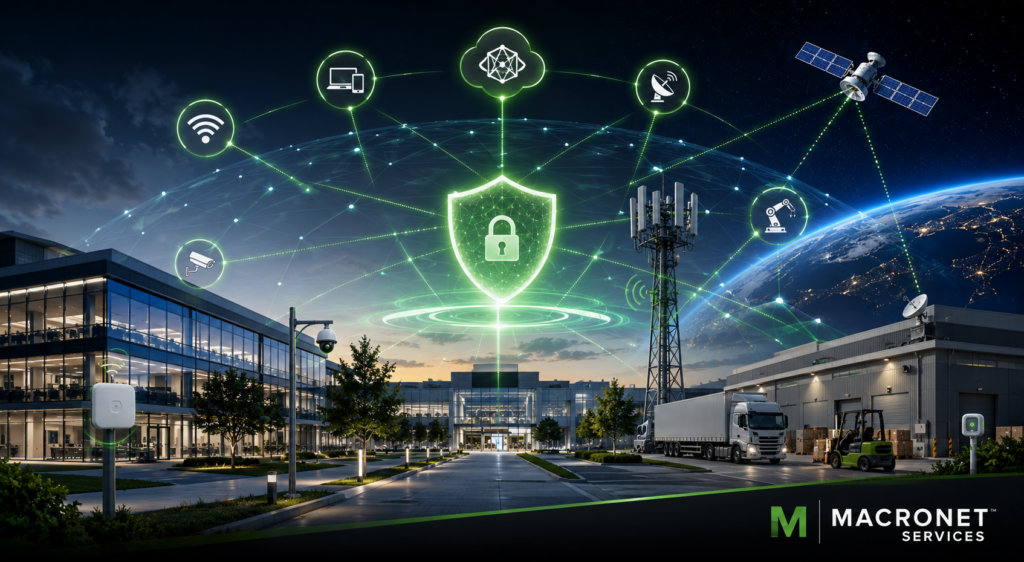

Sourcing and Architecting Next-Gen Connectivity: The Enterprise Guide to Wireless Network Consulting
In an era dominated by autonomous infrastructure, dense IoT tracking systems, and distributed real-time AI workloads, your wireless environment is mission-critical digital infrastructure. For modern organizations, connectivity has shifted to a “wireless-first” reality. If the network drops or suffers from jitter, operations do not just slow down—they stop completely.
However, designing and managing this architecture has grown incredibly complex. Internal IT teams are frequently overwhelmed by technical debt, mounting cybersecurity threats, and the operational nightmare of coordinating multiple vendors. Keeping up with rapidly changing enterprise standards like Wi-Fi 7, Private 5G/LTE, low-Earth orbit (LEO) satellite integrations, and the massive expansion of enterprise IoT architecture can feel impossible.
This is exactly why IT leadership is moving away from generic managed service models and relying on specialized wireless network consulting. Working with a dedicated wireless network consultant helps bridge the gap between highly technical engineering and real-world business results.
The Technology Paradigm Shift: Convergence and AI-Native Architectures
Modern enterprise wireless design is no longer about choosing between one technology or another. Success depends on cross-architecture convergence—building a unified, intelligent system where different access technologies work together seamlessly.
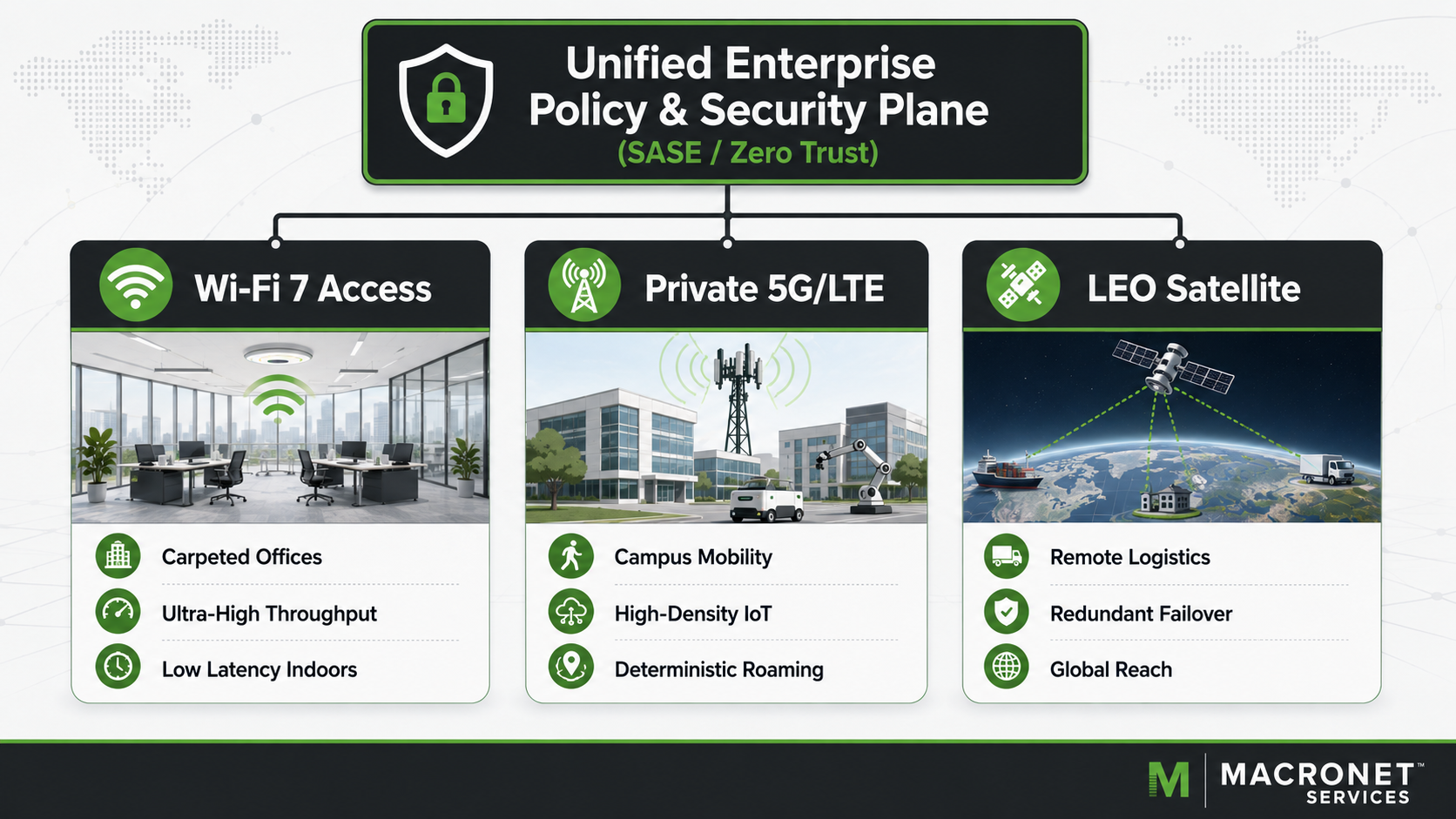
A unified SASE and Zero Trust security plane enables enterprises to govern Wi-Fi 7, Private 5G/LTE, and LEO satellite connectivity through one secure architecture.
- The Intersection of Wi-Fi 7 and Private 5G
The traditional boundaries between public, private, terrestrial, and cellular architectures have dissolved. A professional wireless network consultant does not look at Wi-Fi 7 and Private 5G as competitors; they treat them as complementary layers of a singular fabric.
- Wi-Fi 7 Migration Strategy: Delivering massive multi-gigabit throughput via the 6 GHz spectrum, Wi-Fi 7 introduces Multi-Link Operation (MLO). This allows devices to transmit and receive data across different bands simultaneously, drastically lowering latency in crowded corporate offices.
- Private 5G Deployment: For environments that require deterministic roaming, wide-area outdoor coverage, and massive machine-type communications (mMTC), private cellular networks provide dedicated spectrum, absolute data localization, and ironclad quality of service (QoS).
- The Rise of Agentic, Self-Healing Networks
We have moved past basic dashboard analytics. Modern wireless network consulting focuses on deploying AI-native network operations (AIOps). These systems use autonomous software agents to handle real-time configuration adjustments, predictive fault detection, and automated security isolation without requiring manual human oversight.
The Enterprise IoT Explosion: Navigating 5G RedCap and Mass Endpoint Scaling
The explosive growth of the Internet of Things (IoT) has fundamentally altered the density and scale requirements of the enterprise network. Organizations are no longer just connecting laptops and phones; they are managing tens of thousands of automated, distributed endpoints. Managing this massive footprint requires specialized wireless network consulting to deploy next-generation IoT architectures.
- 5G RedCap (Reduced Capability): The New IoT Sweet Spot
Historically, enterprise IoT deployments forced architects into a difficult compromise: accept the low data rates and latency of legacy LPWAN (like NB-IoT or LTE-M), or absorb the high hardware costs and power drain of full-scale 5G New Radio (NR).
5G RedCap (standardized via 3GPP Release 17) bridges this gap as the “Goldilocks” solution for mid-tier enterprise IoT:
- Lower Total Cost of Ownership (TCO): By reducing modem complexity (fewer antennas, narrower bandwidth), RedCap modules cost 20% to 40% less than standard 5G modems, making mass deployments financially viable.
- Extreme Energy Efficiency: RedCap slashes power consumption by up to 65% compared to full 5G, allowing battery-operated sensors and remote assets to remain operational for years without maintenance.
- Native 5G Integration: Unlike legacy LTE, RedCap connects directly to 5G Standalone (SA) core networks, inheriting advanced capabilities like network slicing, edge compute proximity, and ultra-reliable low-latency communication (URLLC) attributes.
- Virtualizing Identity with eSIM and iSIM (SGP.32 Specification)
The old “connect and forget” model of using physical plastic SIM cards for cellular IoT is dead. Modern enterprise IoT architecture relies heavily on eSIM and iSIM virtualization, governed by the GSMA SGP.32 specification.
A qualified wireless network consultant designs remote provisioning architecture that allows your IoT fleets to automatically switch carrier profiles over-the-air based on coverage quality, localized cost benchmarking, or international regulatory borders—all without manual swap-outs.
Vertical Deep Dives: Mission-Critical Wireless in Action
While a modernized, IoT-dense wireless infrastructure benefits every corporate environment, three capital-intensive sectors face the most urgent pressure to upgrade.
- Smart Manufacturing (IIoT): Eliminating Downtime on the Factory Floor
On an automated production floor, even a few milliseconds of jitter can cause a safety system to trip or a robotic assembly line to halt.
- The Mission-Critical Challenge: Automated Guided Vehicles (AGVs) and Autonomous Mobile Robots (AMRs) require seamless, uninterrupted roaming. Traditional Wi-Fi often drops packets during handoffs between access points, causing robots to stall. At the same time, thousands of industrial wireless sensors continuously stream vibration and thermal data for predictive maintenance.
- The Consultative Solution: An experienced consultant can design a hybrid network that pairs Private 5G RedCap for predictable, low-latency robot mobility and widespread sensor telemetry with Wi-Fi 7 for bandwidth-heavy machine-vision quality inspections.
- High-Velocity Logistics: Continuous End-to-End Visibility
Distribution centers, expansive yards, and global supply chains require highly precise data synchronization across thousands of moving parts.
- The Mission-Critical Challenge: Tracking inventory as it moves across maritime ports, onto railcars, through sorting facilities, and out for final delivery. Physical infrastructure constraints often lead to dead zones in massive, metal-dense warehouses.
- The Consultative Solution: Implementing wireless network consulting strategies that merge localized Private 5G or LoRaWAN networks within the warehouse with global cellular eSIM profiles and LEO satellite failover. This ensures an unbroken data stream for ruggedized scanners, smart forklifts, and asset trackers worldwide.
- Next-Gen Healthcare (IoMT): Ultra-Reliable, Compliant Connectivity
Hospital networks handle a chaotic mix of life-saving medical telemetry, administrative tasks, and patient entertainment.
- The Mission-Critical Challenge: Guarding against network congestion that could delay vital biometric alerts from the Internet of Medical Things (IoMT), while strictly maintaining HIPAA and HITRUST data privacy compliance. Wearable patient monitors must maintain a constant connection even as patients move across different wings of a campus.
- The Consultative Solution: Utilizing software-defined network slicing to create isolated, cryptographically secure wireless channels dedicated exclusively to clinical IoMT devices, separated entirely from guest and administrative traffic.
Navigating the Sourcing and Procurement Trap
Designing a next-gen wireless and IoT architecture is only half the battle. The hidden trap that derails many enterprise modernization projects lies in procurement and multi-vendor coordination.
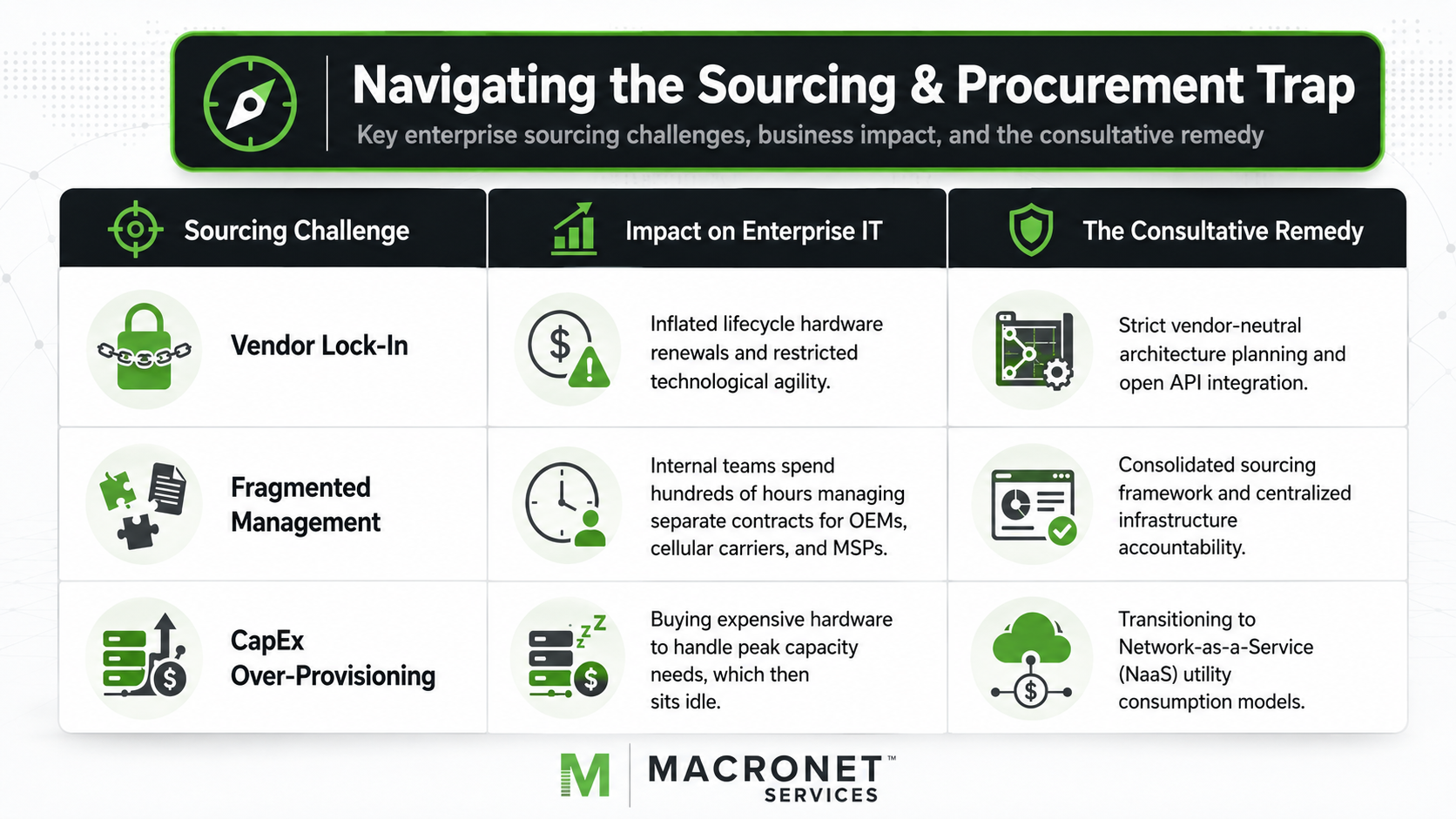
Working with a wireless network consultant allows your organization to treat networking and enterprise IoT as flexible, software-orchestrated resources. This shifts financial risk away from heavy upfront capital investments and provides a predictable, stabilized operational spend.
Zero Trust for IoT: Securing the Borderless Enterprise Fabric
With the rapid expansion of enterprise IoT devices, the traditional network perimeter no longer exists. Every connected water meter, security camera, or industrial sensor represents a potential entry point for lateral cyber threats. Security cannot be a secondary add-on; it must be built directly into your wireless access layer.
The Zero Trust Reality: You can no longer rely on device certificates alone. Modern wireless network architecture uses Secure Access Service Edge (SASE) and continuous behavioral verification to analyze every single data stream.
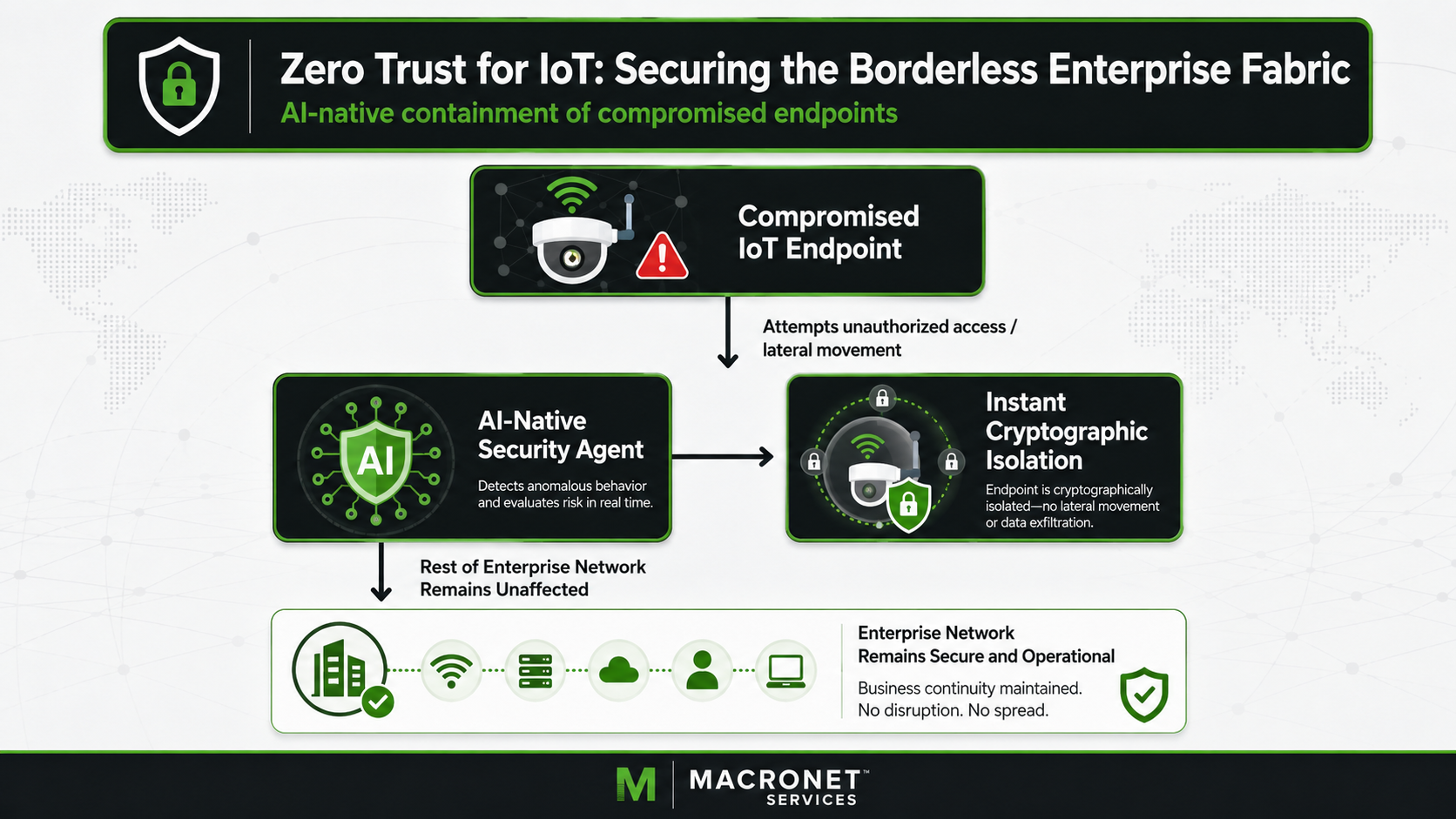
By transitioning to SIM- and iSIM-based identity frameworks, the cellular connection itself becomes the root of trust. If an IoT endpoint is compromised and suddenly alters its behavior—such as attempting to communicate with an unauthorized external IP address—autonomous AI security agents instantly flag, quarantine, and rotate the cryptographic profile of that specific device without disrupting the rest of your operations.
Future-Proof Your Infrastructure with Macronet Services
Building a reliable, secure, and future-proof wireless and IoT environment requires deep engineering expertise, comprehensive financial benchmarking, and global vendor connections. Enterprise leaders cannot afford to waste internal engineering hours attempting to navigate this highly specialized landscape alone.
Macronet Services acts as the ultimate advisor for enterprise IT organizations. As an agile consulting partner, Macronet Services simplifies complex global infrastructure projects by helping your team design, source, and integrate advanced network architectures.
By leveraging an extensive portfolio of over 300 global service providers, Tier-1 ISPs, NaaS providers, and cutting-edge wireless platforms, Macronet Services ensures your business lowers overhead, eliminates vendor conflict, and deploys high-performance connectivity tailored to your exact operational requirements.
Stop fighting legacy infrastructure constraints and contract negotiation headaches. Elevate your organizational agility, protect your digital assets, and optimize your technology spend today.
Visit www.macronetservices.com to book a strategic, data-driven network assessment with an expert consulting architect.