

IoT Solutions for Business: Complete 2026 Guide
IoT Solutions for Business: The Definitive Guide to Connected Operations, AI, Security and ROI
The Internet of Things has been discussed for years as a market of connected devices. That description is technically correct, but it misses what matters to a business.
A company does not create value simply by connecting a machine, vehicle, building, camera, meter or shipping container to a network. Value is created when information from the physical world produces a faster decision, a better workflow, a lower operating cost, a reduced risk or a new source of revenue.
That distinction is becoming more important in the AI era. Sensors are becoming more capable, cellular and low-power networks are expanding, satellite service is becoming more accessible, and edge computers can interpret video, sound, vibration and other signals close to where they are generated. Artificial intelligence can identify patterns, explain anomalies, predict failures and coordinate responses across business systems.
The result is not merely a larger collection of connected objects. It is a new operational layer through which businesses can observe, understand and increasingly optimize what is happening in the physical world.
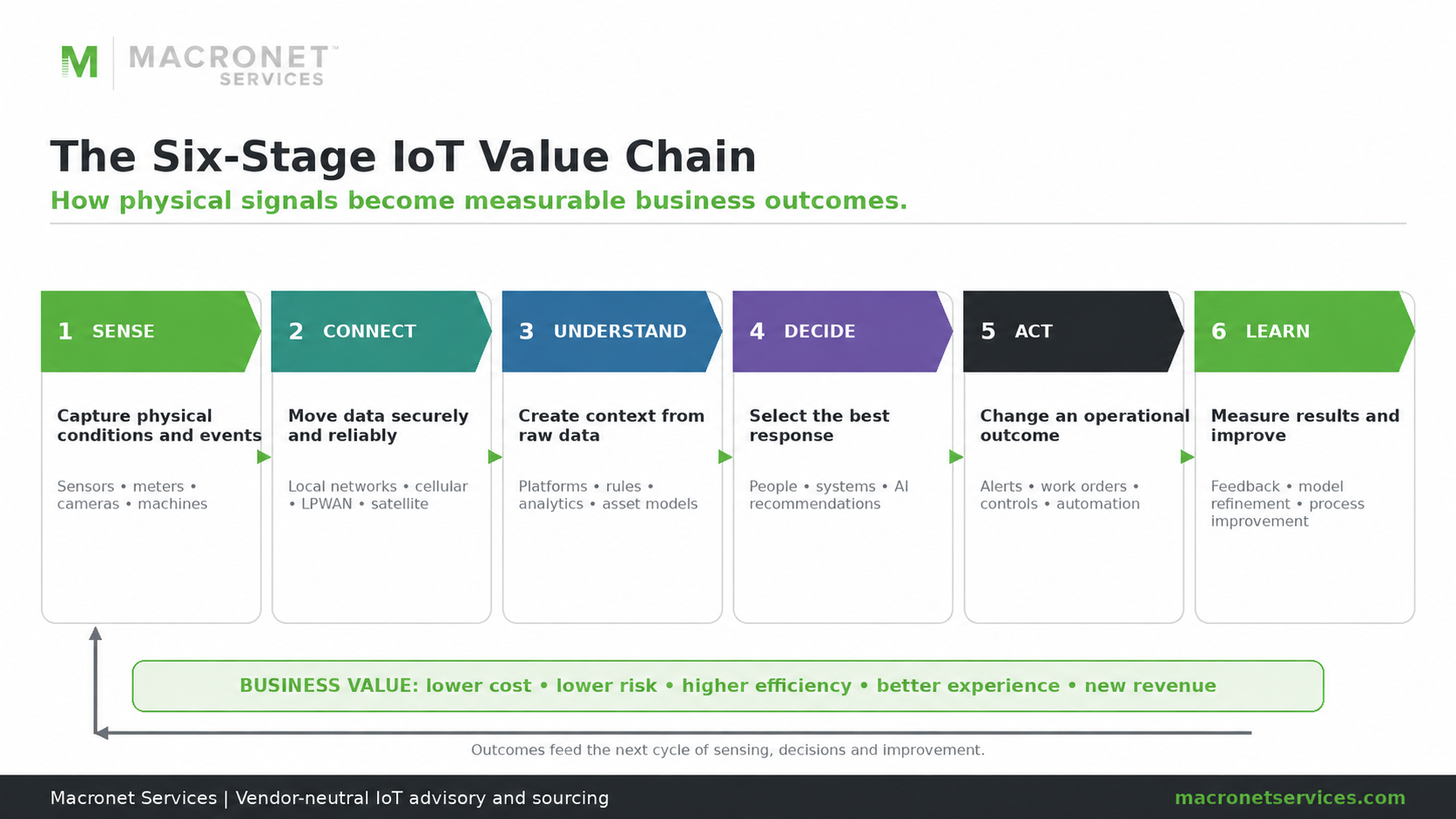
A sensor, camera, meter or connected machine observes a physical condition. A network carries the relevant information to an edge or cloud platform. Software interprets the data and determines whether it matters. A person or business system decides what to do. An alert, work order, adjustment or automated action follows. The organization then measures the outcome and improves the process.
Every component matters, but none creates sufficient value on its own. This is why enterprise IoT projects frequently become more complicated than expected. A functioning solution may require devices, power, installation, local wireless, cellular or satellite service, gateways, device management, cloud infrastructure, data integration, cybersecurity, applications, analytics, field support and a plan for maintaining equipment that may remain in service for a decade.
This guide explains the complete business IoT system: what IoT is, where it creates value, how the architecture works, which connectivity technologies fit different applications, how AI is changing the market, what security and operating risks must be addressed, and how to move from an attractive demonstration to a scalable production deployment.
The executive answer: What is IoT for business?
The Internet of Things, or IoT, is the use of connected physical devices to measure, communicate, analyze or influence conditions in the real world. In business, those devices may include sensors, meters, cameras, vehicles, machines, trackers, gateways, access-control systems, building equipment, environmental monitors and connected products sold to customers.
A complete business IoT solution ordinarily performs four functions: it observes a physical asset or condition; transports the information to a system that can use it; turns the data into a decision, prediction or event; and connects that result to a person, workflow or automated action.
Consider a commercial refrigeration system. A temperature sensor may report that a cooler is operating at 42 degrees. That reading alone has limited value. A useful solution determines whether the temperature is outside the permitted range, considers how long it has remained there, checks whether a door was left open, estimates the risk to inventory, alerts the correct employee and creates a service request if the condition persists. An AI-enabled system may also distinguish normal loading activity from a developing compressor problem.
The difference between the sensor and the complete solution is the difference between collecting data and improving an outcome.
1. What is the Internet of Things in business?
Business IoT connects physical operations to digital systems. Traditional enterprise applications primarily work with information that people or other software systems have already entered. IoT adds data originating directly from buildings, equipment, products, vehicles and environments.
It can tell a business where an asset is located, whether a machine is vibrating abnormally, how much energy a building is consuming, whether a freezer has exceeded a temperature limit, whether a vehicle is idling, whether a pipe is leaking or whether an unauthorized person has entered a controlled area.
That information can support several levels of capability. A monitoring system displays conditions. An alerting system notifies someone when a rule is triggered. An analytical system identifies patterns. A predictive system estimates what is likely to happen. A prescriptive system recommends an action. A more advanced system may initiate an action automatically within defined operational and safety boundaries.
A business IoT solution is a system, not a device
The phrase “IoT device” often receives too much attention. Devices are necessary, but the endpoint is only one part of a larger system. A production solution may include a sensor or camera, an embedded processor or gateway, local and wide-area connectivity, connectivity and device management, an edge or cloud data platform, an application, integration with enterprise systems, cybersecurity controls, installation and lifecycle support.
A battery-powered soil sensor sending a few readings per day has fundamentally different requirements from a high-resolution camera analyzing activity at a remote industrial site. The soil sensor may need to operate for years with minimal power and very low bandwidth. The camera may require continuous power, local AI inference and substantially greater network capacity. Both are IoT devices, but nearly every surrounding design decision differs.
What qualifies as an IoT device?
An IoT device is generally a physical object that can sense, communicate, compute, identify or control something within a connected system. Sensors measure conditions such as temperature, vibration, pressure, moisture, light, sound, air quality, position or current. Meters measure consumption or flow. Trackers and telematics devices identify the location and status of vehicles, equipment and containers. Cameras observe environments and may use computer vision. Gateways aggregate data or translate protocols. Actuators affect the physical environment by changing a setting, opening a valve or controlling equipment.
Many existing assets can become part of an IoT system without being replaced. A gateway or supplementary sensor can sometimes be added to a legacy machine, building-control system or utility meter. In industrial environments, data may also be collected from programmable logic controllers, data historians and supervisory systems already operating the equipment.
Monitoring is not the same as managing
One of the most common mistakes is confusing visibility with operational improvement. A dashboard may reveal that a condition is undesirable, but someone must still determine what the information means, whether it is trustworthy and what should happen next. Without a defined response, the system can create more alerts without improving the business.
Every meaningful use case should answer five questions: What physical condition are we trying to understand? What decision should the data improve? Who or what should receive the information? What action should follow? How will the organization know whether the action worked?
2. IoT, M2M, IIoT, OT and AIoT: What is the difference?
| Term | Primary meaning | Typical example |
| M2M | Direct communication between machines or devices, often for one narrow function | A vending machine reports inventory to a central system |
| IoT | Connected physical devices integrated with applications, data and workflows | A leak sensor creates a facilities work order |
| Enterprise IoT | IoT deployed and governed across a business estate | A retailer monitors refrigeration, energy and security across hundreds of sites |
| IIoT | IoT applied to industrial assets and production processes | Vibration monitoring predicts a production-machine failure |
| OT | Technology that monitors or controls physical processes | A control system operates pumps, valves or a production line |
| AIoT | IoT combined with artificial intelligence | Edge AI identifies a safety event in live video |
Machine-to-machine communication predates the modern IoT market and remains useful for narrow device communications. Enterprise IoT generally places those communications inside a broader environment containing cloud services, APIs, analytics, identity, lifecycle management and business integration.
Industrial IoT applies sensing, communication and analytics to production equipment and other industrial systems. These environments require greater attention to safety, reliability, specialized protocols and formal change control. Operational technology refers to the systems that monitor or control physical processes; IoT may augment or collect information from OT, but the terms are not interchangeable.
AIoT combines the physical awareness of IoT with the interpretation and prediction capabilities of AI. The appropriate level of autonomy depends on the consequences of error. A system that recommends an inspection should not be governed like a system capable of stopping a production line or closing a valve.
3. Why business IoT matters now
IoT is not a new idea, but the market is entering a different stage. IoT Analytics estimated that connected IoT devices reached 21.1 billion at the end of 2025 and that enterprise IoT spending reached approximately $324 billion during the year. The important point is not that every company should connect more objects; it is that devices, networks, software and operating models are becoming more mature.
Connectivity is becoming more flexible
IoT no longer depends on one dominant network technology. Businesses can choose among Ethernet, Wi-Fi, Bluetooth, mesh networks, LoRaWAN, low-power cellular, conventional 4G, 5G RedCap, private cellular, satellite and hybrid designs. More choice allows the network to be matched to the use case, but it also increases the risk of selecting a technology that does not fit the power, coverage, mobility or lifetime requirement.
Computing is moving closer to the physical process
A camera can analyze video locally and transmit only important events. An industrial gateway can detect an abnormal pattern even when its cloud connection is unavailable. Edge processing can reduce latency, bandwidth and privacy exposure while preserving local operation during outages.
AI is making operational data more valuable
The physical world produces large volumes of information that simple thresholds cannot always interpret. AI can find patterns across video, vibration, acoustic signals, equipment behavior and historical outcomes. It can also let operations leaders ask natural-language questions such as which assets are most likely to fail, which sites are consuming unusual energy or which alerts create real business risk.
Security and lifecycle responsibility are increasing
As devices become more numerous and operationally important, they create longer-term obligations. A compromised endpoint may provide a path into the enterprise, falsify a physical reading or interrupt an operational process. An endpoint remaining in service for ten years creates a ten-year responsibility for identity, firmware, credentials, monitoring, support and eventual retirement.
4. The business case for IoT
The best IoT opportunities begin with a business problem that can be measured. They do not begin with a desire to deploy a particular sensor, carrier or platform.
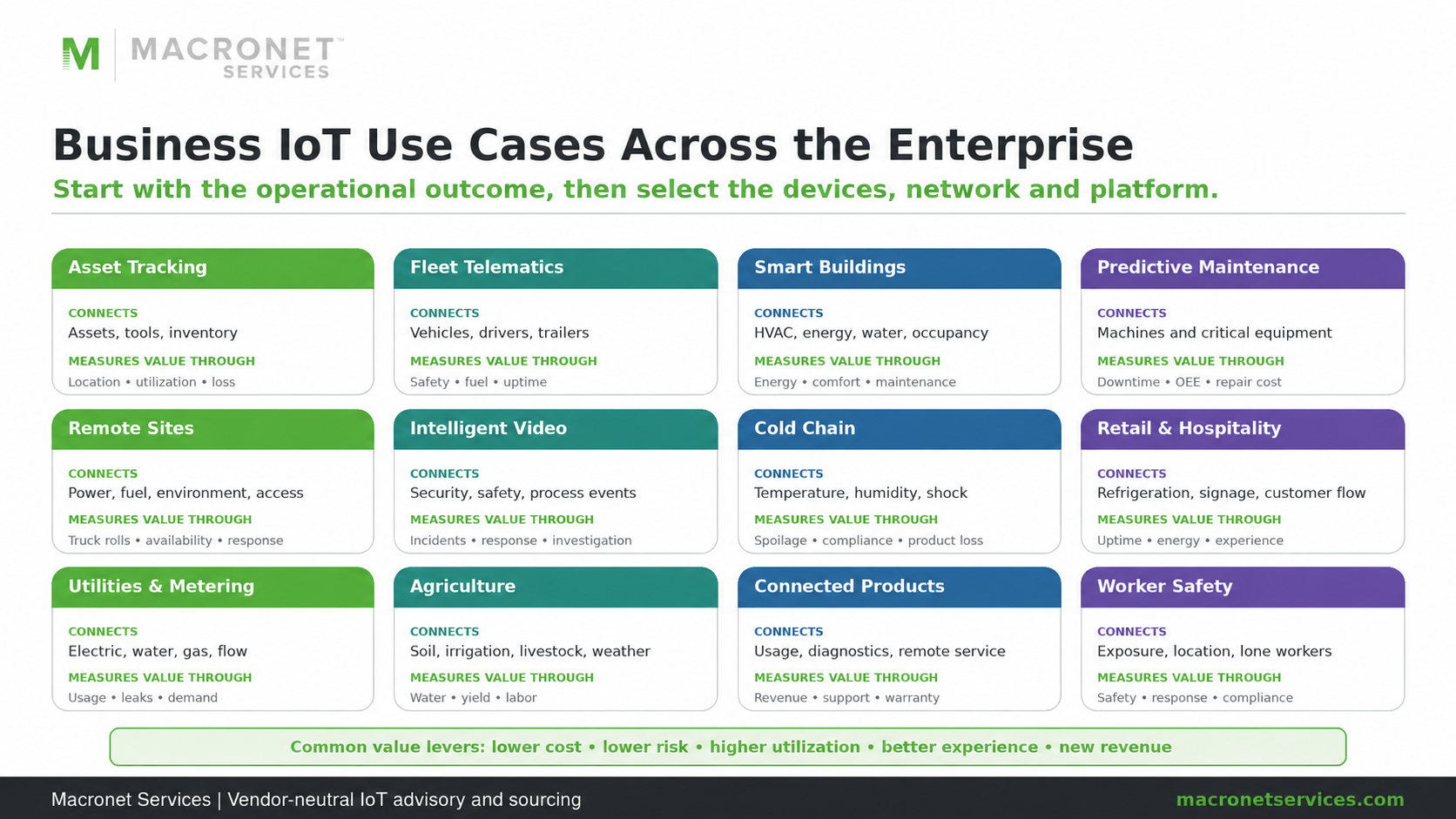
Most business IoT initiatives create value through five mechanisms: reducing operating cost, reducing risk and loss, increasing asset productivity, improving employee or customer experience, and creating new revenue or service models.Cost reduction can come from fewer inspections, reduced truck rolls, lower energy use, more efficient routing and earlier fault detection. Risk reduction can come from leak detection, cold-chain monitoring, worker safety and physical-security intelligence. Asset productivity can improve through better location, utilization and maintenance. Connected products can support remote service, usage-based pricing and equipment-as-a-service.
Express the use case as a decision statement
A useful IoT opportunity can usually be written as follows: When a specified physical condition occurs, the organization needs reliable information within a defined period so that a person or system can take a defined action and produce a measurable result.
For example: “When vibration patterns indicate a developing bearing problem, the maintenance team needs a sufficiently accurate warning at least seven days before likely failure so it can schedule service without stopping production unexpectedly.” That statement provides useful requirements for sensor selection, sampling, analytics, connectivity, workflow and pilot success criteria.
Establish the baseline before the pilot
A credible business case requires a measured current state. Depending on the use case, the baseline may include failure frequency, downtime, energy consumption, fuel, service visits, product loss, manual inspection time, asset utilization, incidents, customer complaints and existing technology expense. The baseline must cover enough time to reflect ordinary variation and seasonality.
5. The most valuable IoT solutions for business
The most valuable IoT applications solve problems that are physical, distributed, difficult to observe or expensive to manage manually. The following solution categories represent the strongest recurring opportunities for businesses.
5.1 Asset tracking and inventory visibility
Asset tracking helps a business identify where an asset is, whether it is moving, how it is being used and, in some cases, what condition it is in. Assets can include tools, medical equipment, trailers, shipping containers, reusable packaging, production materials, rental equipment and high-value inventory.
The business question is rarely limited to location. A company may need to know which assets are available, who has custody, how long equipment remains idle, whether an item left an approved area, or whether it experienced damaging temperature, shock or moisture. The correct technology may combine outdoor GPS and cellular service with indoor Bluetooth, RFID, ultra-wideband or LoRaWAN.
Important measures include inventory accuracy, search time, utilization, idle time, loss, recovery and dwell time. AI can identify unusual movement, predict demand and recommend where equipment should be repositioned. The most common mistake is choosing a tracking radio before understanding every environment through which the asset travels.
5.2 Fleet telematics and mobile asset management
Fleet systems collect vehicle location, speed, idling, engine condition, diagnostic codes, driver behavior, route activity and camera events. The operational value comes from changing behavior and improving maintenance, dispatch and safety decisions—not simply displaying dots on a map.
Useful measures include collision frequency, insurance claims, fuel use, idling, preventive-maintenance compliance, vehicle downtime, route completion and asset utilization. Video telematics can provide context around driving events, but organizations should establish clear privacy, retention and coaching policies before deployment.
5.3 Smart buildings, energy and indoor environmental quality
Smart-building solutions connect or augment HVAC, lighting, meters, refrigeration, access control and environmental sensors. The goal is often to extend existing building-management systems with portfolio-level analytics, fault detection and coordinated workflows rather than replace every control system.
Applications include submetering, HVAC optimization, demand management, occupancy, indoor air quality, leak detection, equipment runtime and predictive maintenance. Performance should be measured through energy and demand reduction, utility cost, comfort complaints, equipment runtime, maintenance response and portfolio coverage.
5.4 Industrial monitoring and predictive maintenance
Industrial IoT uses vibration, temperature, pressure, flow, electrical current, images and machine data to improve reliability, quality and production. A typical design collects information from supplementary sensors, controllers or historians, performs selected processing at an industrial gateway and connects important events to a maintenance-management system.
The useful output is not an anomaly score. It is a recommendation supported by the affected asset, likely failure mode, confidence, warning horizon, production impact and appropriate inspection. Important measures include unplanned downtime, overall equipment effectiveness, mean time between failures, maintenance cost, scrap and prediction accuracy.
Industrial changes must follow plant safety and change-control procedures. Passive observation should usually precede any automated control of production equipment.
5.5 Remote-site and unattended-infrastructure monitoring
Remote monitoring is valuable for utility equipment, pumps, tanks, generators, telecommunications shelters, construction sites, agriculture, solar installations and other locations that are expensive or unsafe to inspect manually. A system may report power, battery, fuel, door status, water intrusion, environmental conditions and equipment state.
Remote sites require special attention to power, ruggedization, antennas, local storage and failure behavior. Store-and-forward operation should preserve data during an outage, and critical local controls should continue safely without the cloud. Measures include avoided visits, detection time, service restoration, first-time repair and equipment availability.
5.6 Physical security and intelligent video
Connected physical-security systems combine cameras, access control and environmental sensors. AI video can turn visual activity into structured events such as perimeter intrusion, unauthorized entry, unsafe behavior, vehicle identification, occupancy or process verification.
The same infrastructure may support security and operations, but combined use increases governance requirements around privacy, retention, employee monitoring, accuracy and access. Models should be tested under actual lighting, weather, camera angle and site conditions—not only in a controlled demonstration.
5.7 Cold-chain and environmental monitoring
Cold-chain solutions monitor temperature-sensitive food, pharmaceuticals, laboratory materials and other products during storage and transportation. Temperature is only part of the context; humidity, shock, light, door activity, sensor placement and duration outside an approved range may also matter.
A useful system determines where an excursion occurred, how long it lasted, which product was affected and what workflow should follow. Measures include excursions, spoilage, rejected shipments, investigation time, data completeness and corrective-action response.
5.8 Connected retail, restaurants and hospitality
Distributed retail and hospitality environments can combine refrigeration monitoring, energy, water leaks, kitchen equipment, physical security, occupancy, digital signage and network resilience. The primary advantage is centralized exception management across many locations.
Alerts should be translated into operational instructions that site employees can understand. The system should prioritize conditions by likely revenue, safety or product impact rather than expose raw equipment codes.
5.9 Utilities, metering and resource management
Connected meters and sensors help organizations understand electricity, water, gas, fuel, pressure, flow and tank levels. Submetering can reveal consumption by site, tenant, process or asset when the primary utility bill provides insufficient detail. AI can identify abnormal consumption, forecast demand and distinguish likely leaks from legitimate operational changes.
5.10 Connected products and servitization
Manufacturers can embed communications and sensing into products to provide remote diagnostics, proactive maintenance, feature activation, automatic replenishment, product improvement and usage-based services. This can shift revenue from one-time equipment sales toward ongoing service relationships.
The recurring revenue opportunity creates recurring obligations for connectivity, cloud applications, software updates, security, data rights and customer support. Connected-product architecture should therefore be designed into the product from the beginning rather than added shortly before launch.
5.11 Employee safety and connected workforce systems
Connected safety systems can monitor gas, heat, noise, falls, lone workers, restricted zones, equipment proximity and emergency mustering. The device is only one element of the safety process. It must be worn or installed correctly, calibrated, connected, monitored and tied to a response process with clear escalation.
Privacy governance is especially important when the system collects continuous location, video or biometric information. The data should be limited to a legitimate safety or operational purpose.
6. IoT solutions by industry
Industries do not usually deploy one isolated form of IoT. They combine capabilities around their facilities, assets, employees, customers and operating processes.
| Industry | High-value IoT combinations |
| Manufacturing | Machine monitoring, predictive maintenance, quality inspection, energy, material tracking, safety and private wireless |
| Transportation and logistics | Fleet, trailers, containers, cold chain, yard visibility, route performance and shipment condition |
| Retail, restaurants and hospitality | Refrigeration, energy, security, occupancy, equipment uptime, signage and wireless resilience |
| Healthcare and life sciences | Equipment location, environmental compliance, cold chain, facilities, access control and regulated records |
| Commercial real estate | Energy, HVAC, water, occupancy, indoor environment, maintenance, security and tenant experience |
| Construction | Equipment, temporary connectivity, site security, environmental conditions, fuel and worker safety |
| Energy and utilities | Remote assets, metering, leak detection, predictive maintenance, environmental compliance and satellite connectivity |
| Agriculture and food | Irrigation, livestock, field equipment, processing, refrigeration, traceability and waste reduction |
| Public sector and education | Facilities, fleet, campus safety, environmental monitoring, transportation and public infrastructure |
The highest value often appears when several use cases share context. A quality problem in a factory may correlate with a machine condition, material lot, environmental change or recent maintenance. A building-energy anomaly may be caused by equipment behavior, controls or occupancy. An isolated dashboard cannot easily reveal these relationships.
Choosing the first business IoT use case
The best first use case is not necessarily the most technologically advanced. A strong starting point has an important and measurable problem, a physical condition that can be observed reliably, a defined response, a controlled pilot scope and a credible path to scale. A straightforward leak-detection, equipment-monitoring or asset-tracking project can establish the data, connectivity, security and operating disciplines required for more advanced AIoT later.
7. The complete enterprise IoT architecture
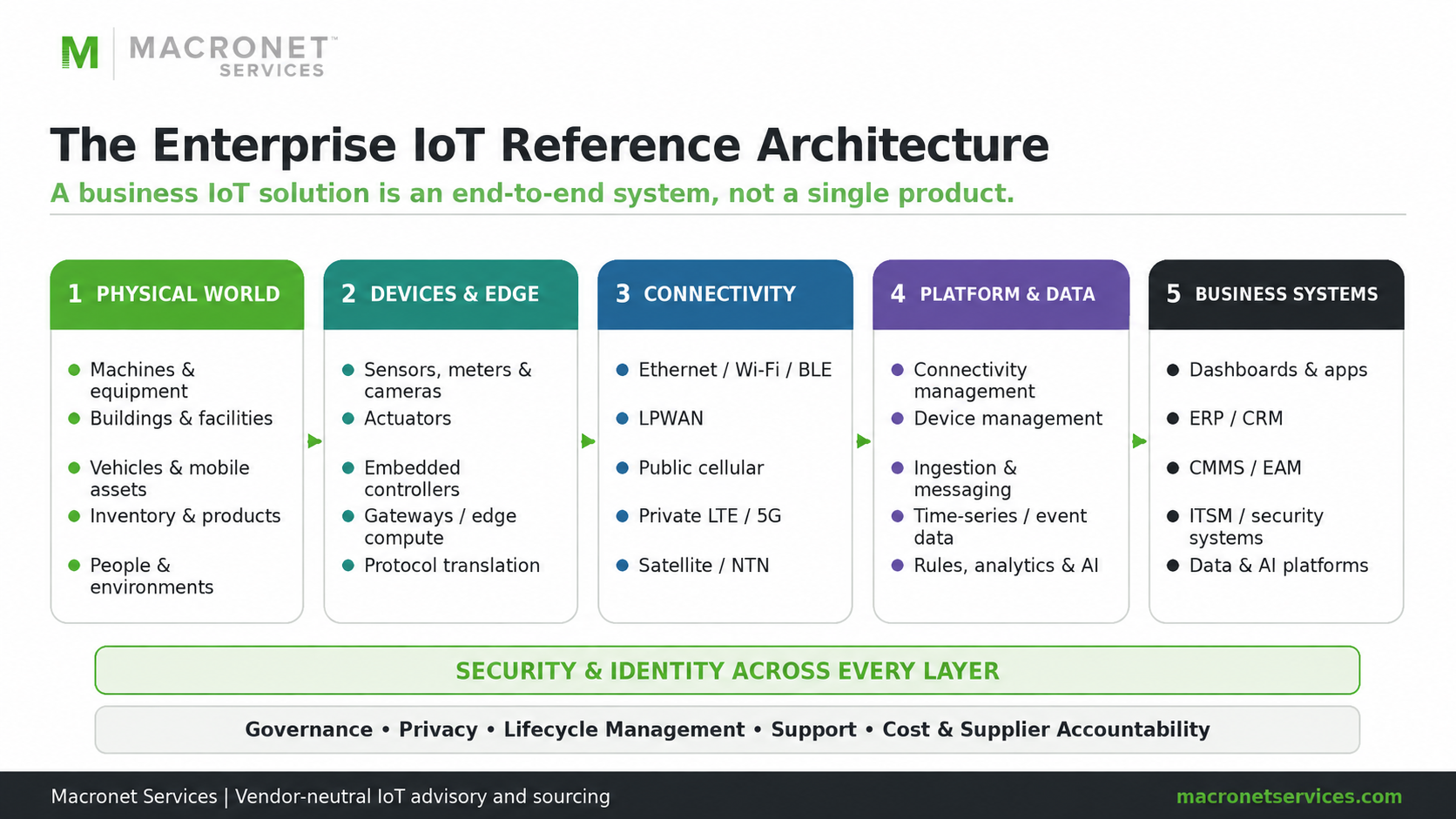
An enterprise IoT architecture connects a physical asset, environment or process to the people and systems responsible for acting on it. Most solutions can be understood through ten layers.
- Physical outcome and process. The asset, environment, employee or workflow being measured or controlled.
- Sensor, meter, camera or actuator. The physical endpoint that observes or changes a condition.
- Embedded device or gateway. Local processing, protocol translation, aggregation, storage and device coordination.
- Local connectivity. Ethernet, industrial networks, Wi-Fi, Bluetooth, mesh, RFID, LoRaWAN or private cellular.
- Wide-area connectivity. Broadband, Tier 1 ISP, managed WAN, public cellular, satellite or hybrid service.
- Connectivity and device management. SIM, profile, endpoint, firmware, certificate and configuration operations.
- Edge, cloud and data platform. Message ingestion, rules, time-series storage, asset models, APIs and analytics.
- Application, analytics and AI. Dashboards, alerts, mobile applications, predictions and operational interfaces.
- Business-system integration. ERP, CRM, CMMS, EAM, ITSM, WMS, TMS, BMS and enterprise data platforms.
- Security, support and lifecycle governance. Identity, segmentation, monitoring, incident response, service ownership and retirement.
The architecture begins with the physical environment
The first questions are not technical. What physical event matters? How quickly must the organization respond? What is the consequence of missing or misinterpreting it? Equipment may vibrate, become wet, generate electromagnetic interference or operate at extreme temperatures. Devices may be behind concrete, below ground, inside metal enclosures or on moving assets. These realities determine device, antenna, power and installation design.
Management functions must be separated clearly
Connectivity management controls network subscriptions and data use. Device management controls endpoint identity, configuration, health and firmware. Certificate management governs cryptographic identity. Application management may deploy software or AI models to gateways. Buyers should not assume that a carrier portal manages firmware or that a device platform controls network profiles.
Business-system integration closes the loop
An accurate alert has limited value if it remains inside a specialist dashboard. An equipment event should create or enrich a maintenance work order. A shipment excursion should enter the transportation workflow. A leak should create a facilities incident. The operational outcome should return to the IoT data environment so the organization can learn whether the detection and response were correct.
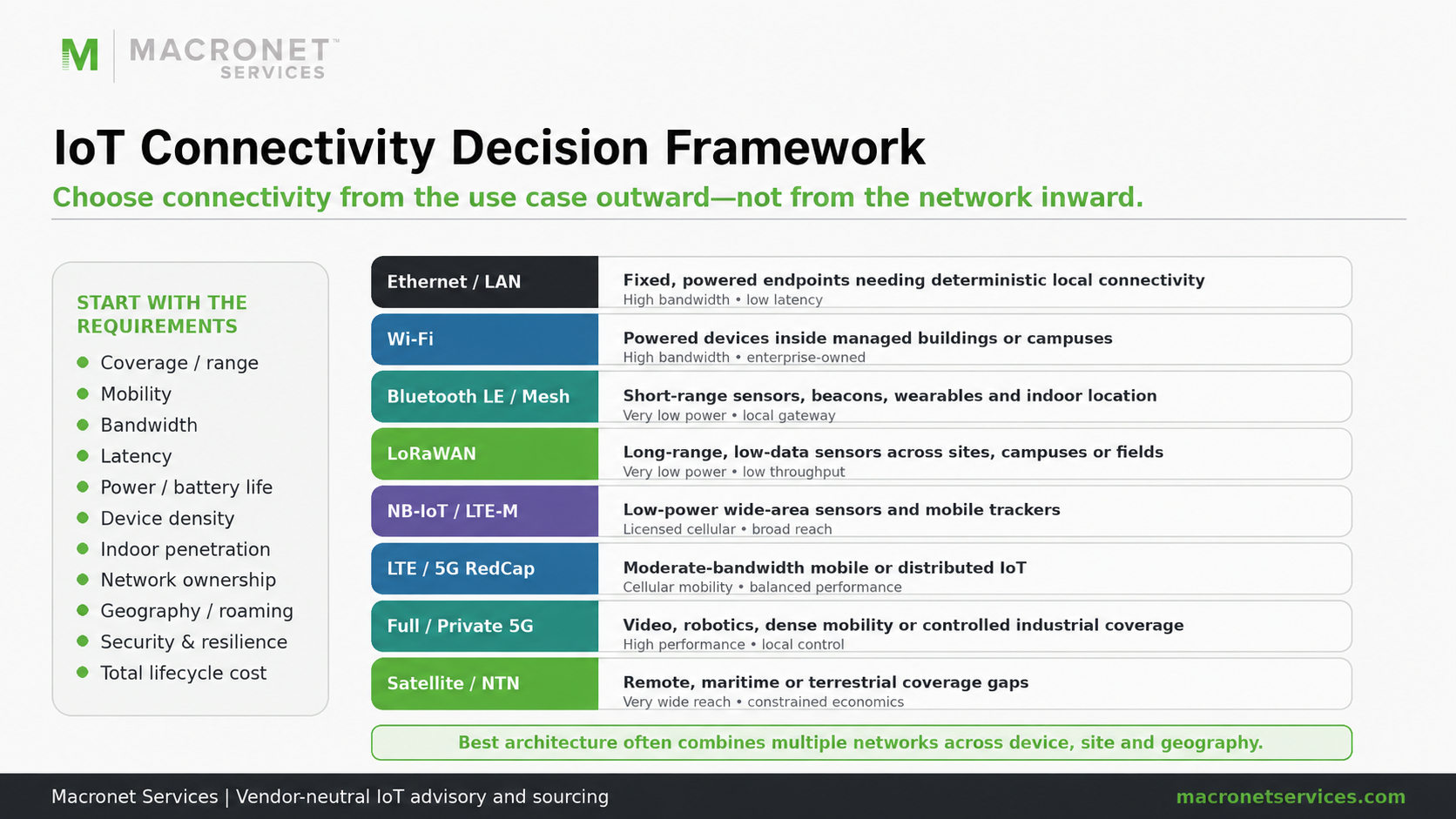
8. Choosing the right IoT connectivity
The best IoT network is the one that meets the operational requirement at an acceptable lifecycle cost. The decision should consider range, coverage, bandwidth, latency, power, mobility, device density, geographic reach, network control and expected device life.
| Technology | Relative profile | Best business uses | Primary limitation |
| Ethernet | Local, high capacity, powered | Machines, gateways and cameras where cabling is available | Installation and lack of mobility |
| Wi-Fi | Building or campus, high capacity | Powered devices, gateways, video and mobile equipment | Power, onboarding and inconsistent coverage in device locations |
| Bluetooth LE | Short range, very low power | Beacons, wearables, proximity and indoor sensors | Requires gateway or locator infrastructure |
| Zigbee / Thread | Local low-power mesh | Building controls and dense sensor networks | Mesh design and ecosystem compatibility |
| LoRaWAN | Long range, small payloads, very low power | Meters, buildings, utilities, agriculture and campuses | Not suitable for high bandwidth or frequent downlink |
| NB-IoT | Wide area, very low power | Fixed meters and small infrequent messages | Mobility, roaming and carrier availability vary |
| LTE-M | Wide area, low power, mobile | Trackers, wearables and mobile low-power devices | Coverage and roaming consistency vary |
| LTE Cat-1 bis / 4G | Wide area, moderate capacity | Telematics, routers, signage, kiosks and general IoT | Higher power than LPWA |
| 5G RedCap | Moderate-capability 5G | Cameras, wearables and industrial endpoints | Emerging device and carrier ecosystem |
| Full 5G | High capacity and advanced mobility | Video, robotics and demanding industrial use cases | Cost, power and unnecessary complexity for small sensors |
| Satellite / NTN | Remote and regional reach | Agriculture, maritime, logistics and remote infrastructure | Power, antenna visibility, capacity and service cost |
Wired, Wi-Fi and local radio
Ethernet remains appropriate for fixed equipment requiring reliable high capacity. Wi-Fi works well for powered devices inside facilities with properly designed coverage, but ordinary employee Wi-Fi may not be suitable for thousands of unattended endpoints. Bluetooth supports beacons, wearables and indoor location. Thread and Zigbee provide low-power mesh connectivity for control and sensor environments. LoRaWAN provides long-range, low-power communication for modest payloads through private, public or hybrid networks.
Low-power and conventional cellular
NB-IoT and LTE-M are complementary low-power cellular technologies. NB-IoT generally fits fixed devices sending small, infrequent messages, while LTE-M supports greater mobility and more flexible data behavior. LTE Cat-1 bis and conventional 4G remain relevant for telematics, signage, kiosks, security equipment and other moderate-bandwidth applications.
5G RedCap and full 5G
5G Reduced Capability fills part of the gap between low-power narrowband technologies and full-performance 5G. 3GPP introduced RedCap in Release 17 to reduce endpoint complexity while retaining useful 5G functions. Ericsson’s June 2026 mobility outlook reported commercial RedCap launches by 14 service providers. Availability, roaming, modules and pricing must still be verified for the actual deployment markets.
Full 5G is appropriate where high-resolution video, robotics, mobility, density or latency justify it. It should not be selected merely because it is the newest technology.
Private LTE and private 5G
Private cellular can provide enterprise-controlled coverage, mobility, device identity and traffic policy across factories, warehouses, ports, campuses and large outdoor properties. It is not simply a replacement for Wi-Fi; the design must include spectrum, radios, a mobile core, SIM provisioning, compatible devices, backhaul, monitoring, security and operating support.
Satellite and hybrid connectivity
Satellite can extend service to remote energy assets, farms, vessels, infrastructure and mobile equipment outside reliable terrestrial coverage. New non-terrestrial network models are becoming more aligned with cellular standards, but antenna visibility, power, message frequency, latency and cost remain important. Many enterprise deployments should use multiple network technologies rather than force every endpoint onto one standard.
9. SIM, eSIM, iSIM and global IoT connectivity
The SIM provides the secure identity a cellular device uses to authenticate to a mobile network. A removable physical SIM remains appropriate where the device is accessible, but it becomes difficult to replace across large, sealed or remotely installed fleets.
An embedded SIM can be soldered into the device. The term eSIM, however, primarily refers to the ability to download and manage network profiles securely on an eUICC rather than to the physical form factor alone.
Why SGP.32 matters
Consumer eSIM often assumes that a person is present to scan a code or choose a carrier. Many IoT devices have no screen, camera or regular human interaction. The GSMA developed an IoT eSIM architecture for network-constrained or user-interface-constrained endpoints. SGP.32 version 1.3 was published in May 2026 and defines remote provisioning and management for these devices.
The practical potential includes a common manufacturing design, later selection of regional operator profiles, reduced physical SIM handling and greater flexibility across large international fleets. SGP.32 does not guarantee effortless carrier switching. Compatible devices, profile-management systems, operator agreements, testing and regulatory compliance are still required.
Questions every enterprise should ask
- Who owns the physical SIM, eUICC and profiles?
- Can the device move to another connectivity provider in practice, not merely in theory?
- Which networks and radio technologies are available in every target country?
- Where does traffic exit the mobile network, and how does that affect latency and data sovereignty?
- Are permanent-roaming restrictions relevant?
- Who manages incidents and inactive devices?
- What happens to profiles, data and management access when the contract ends?
10. How artificial intelligence is changing IoT
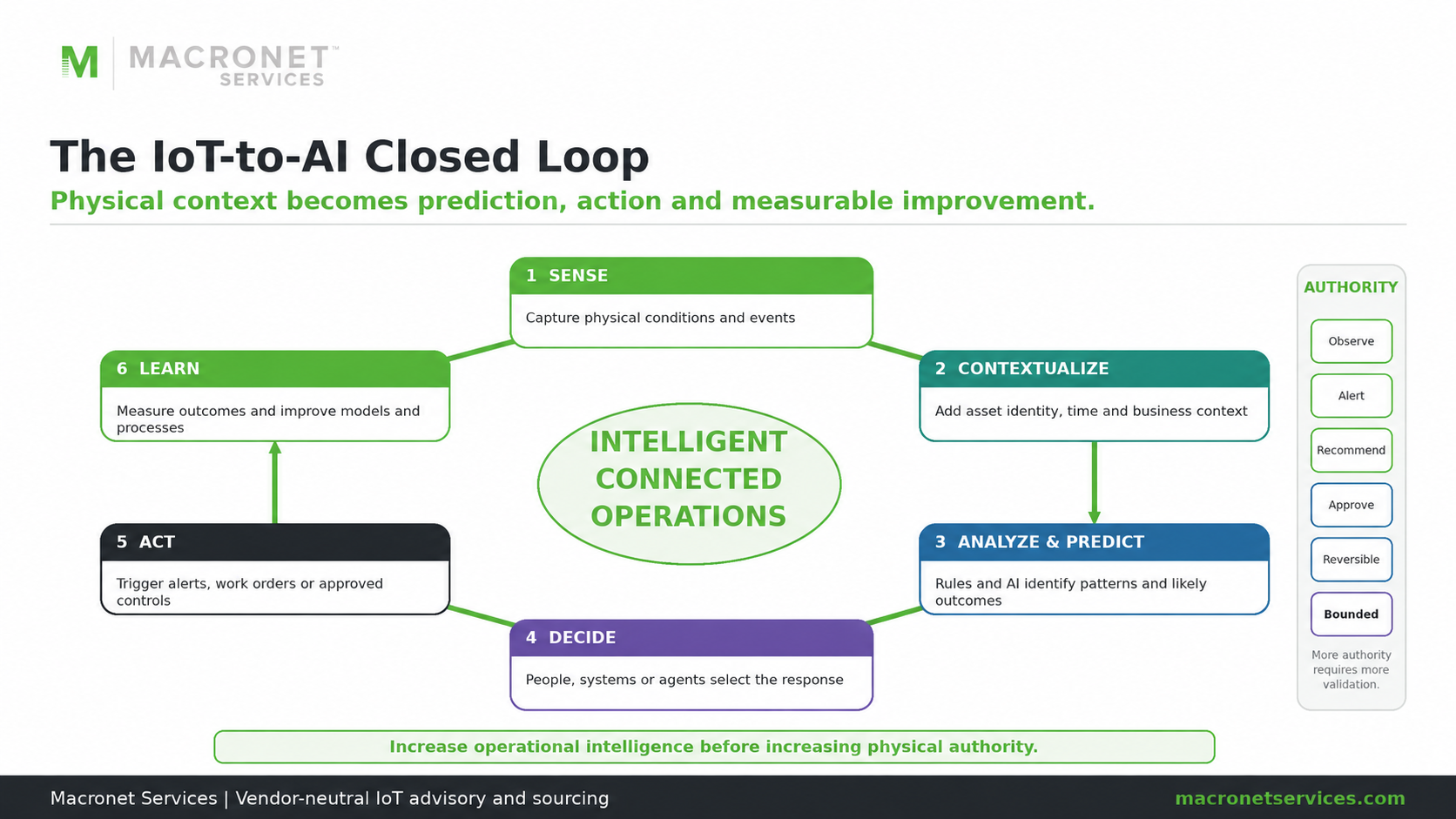
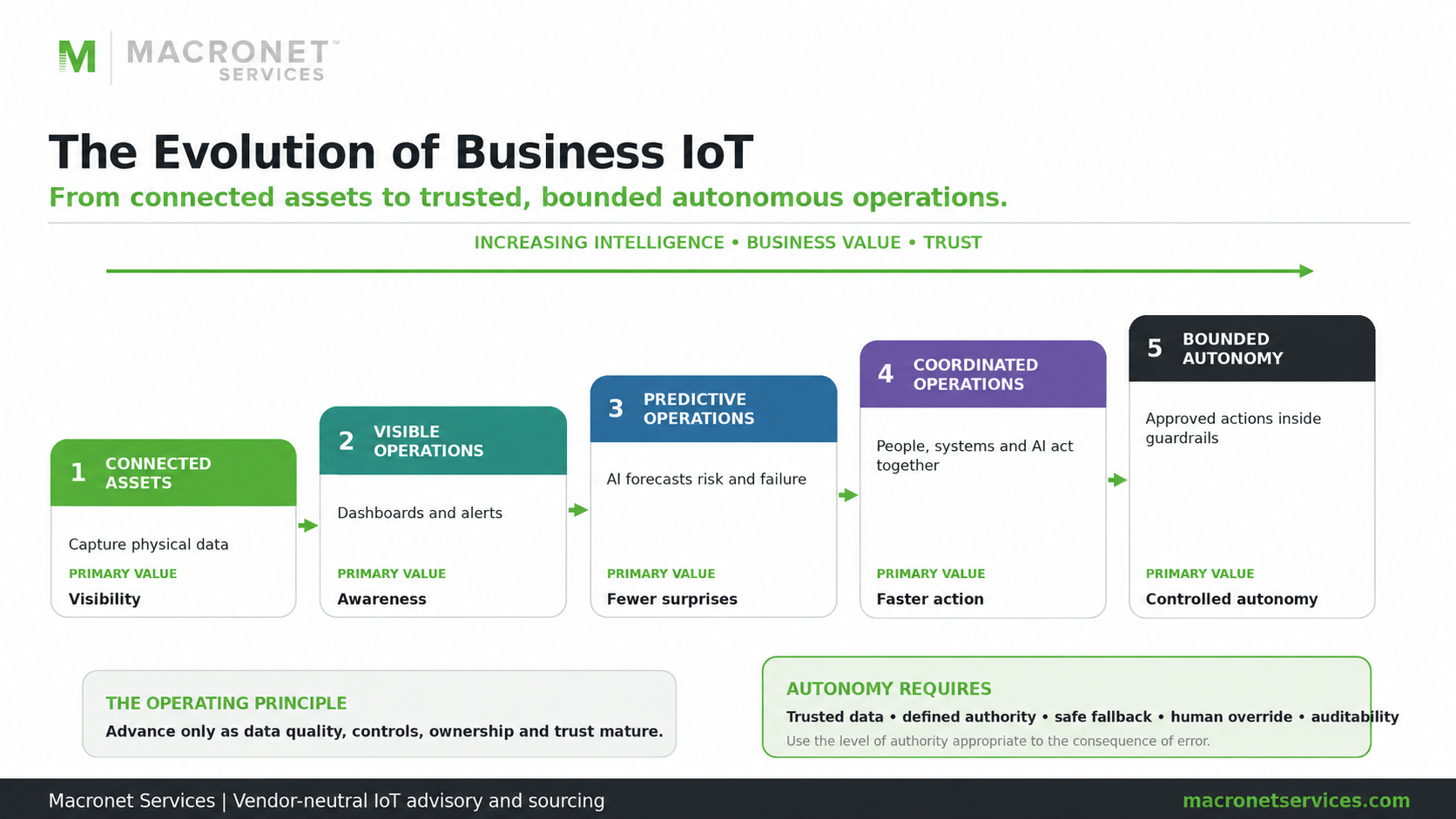
IoT gives AI access to the physical world. AI gives IoT a more sophisticated ability to interpret what it observes. The progression is moving from connected and visible systems toward predictive, prescriptive and selectively autonomous operations.
Computer vision and signal intelligence
Computer vision can identify safety events, product defects, unauthorized entry, occupancy, queue length, equipment state and process deviations. Vibration, acoustic and electrical models can identify patterns associated with equipment degradation. Edge processing can classify events locally and transmit only selected metadata or clips.
Generative AI as the operational interface
Generative AI can translate IoT data, maintenance history and documentation into natural-language answers. An operations leader may ask why energy increased, which refrigeration alerts create real product risk, or what happened before a machine alarm. The language model should retrieve from governed systems and distinguish confirmed records from inference.
AI agents and operational workflows
An AI agent can receive an alert, collect context, review recent maintenance, estimate business impact, identify an available technician, prepare a work order and monitor resolution. The first value will often come from investigation and administration rather than direct control of physical systems.
Authority should be introduced gradually: observe, alert, recommend, prepare an action for approval, execute a reversible action, and only then execute automatically within defined limits. Safety-critical controls should retain independent local safeguards and human override.
Digital twins
A digital twin is a synchronized digital representation of a physical asset, process or system built for a defined analytical or operational purpose. It is more than a 3D model or dashboard. A meaningful twin combines a model, current physical data, context, analytical capability and a decision use case.
Digital twins can support monitoring, simulation, diagnosis, predictive maintenance and optimization. Their value depends on the quality of the underlying data, model validation and appropriate uncertainty. The most common mistake is creating an impressive visual representation without defining the decision it should improve.
Data quality becomes an AI safety issue
AI cannot correct fundamentally unreliable physical data. Failed sensors, calibration drift, incorrect asset associations, duplicate messages, missing timestamps and changes in machine configuration can produce persuasive but incorrect recommendations. The organization must monitor both the physical asset and the health of the sensing system.
11. Edge computing for IoT
Edge computing places selected storage, processing or application functions closer to the device. The edge may be inside a sensor, camera, vehicle, gateway, industrial computer or on-premises server.
Processing data locally can reduce response time, bandwidth, cloud cost and privacy exposure. It can also preserve operation during a network outage. Most enterprise architectures should use both edge and cloud: the edge for immediate response, local protocol integration and filtering; the cloud for centralized management, long-term data, cross-site analysis and enterprise integration.
Store-and-forward operation
An IoT system should assume that connectivity will occasionally fail. The design should specify which data is retained locally, how long it can be stored, what actions continue without the cloud, how information is synchronized after recovery and how users are notified when visibility is incomplete.
Managing edge AI
Deploying models across distributed devices creates a lifecycle for model versions, hardware compatibility, secure rollout, rollback, drift, logs and failed updates. A model should be associated with the asset types and operating conditions for which it was validated.
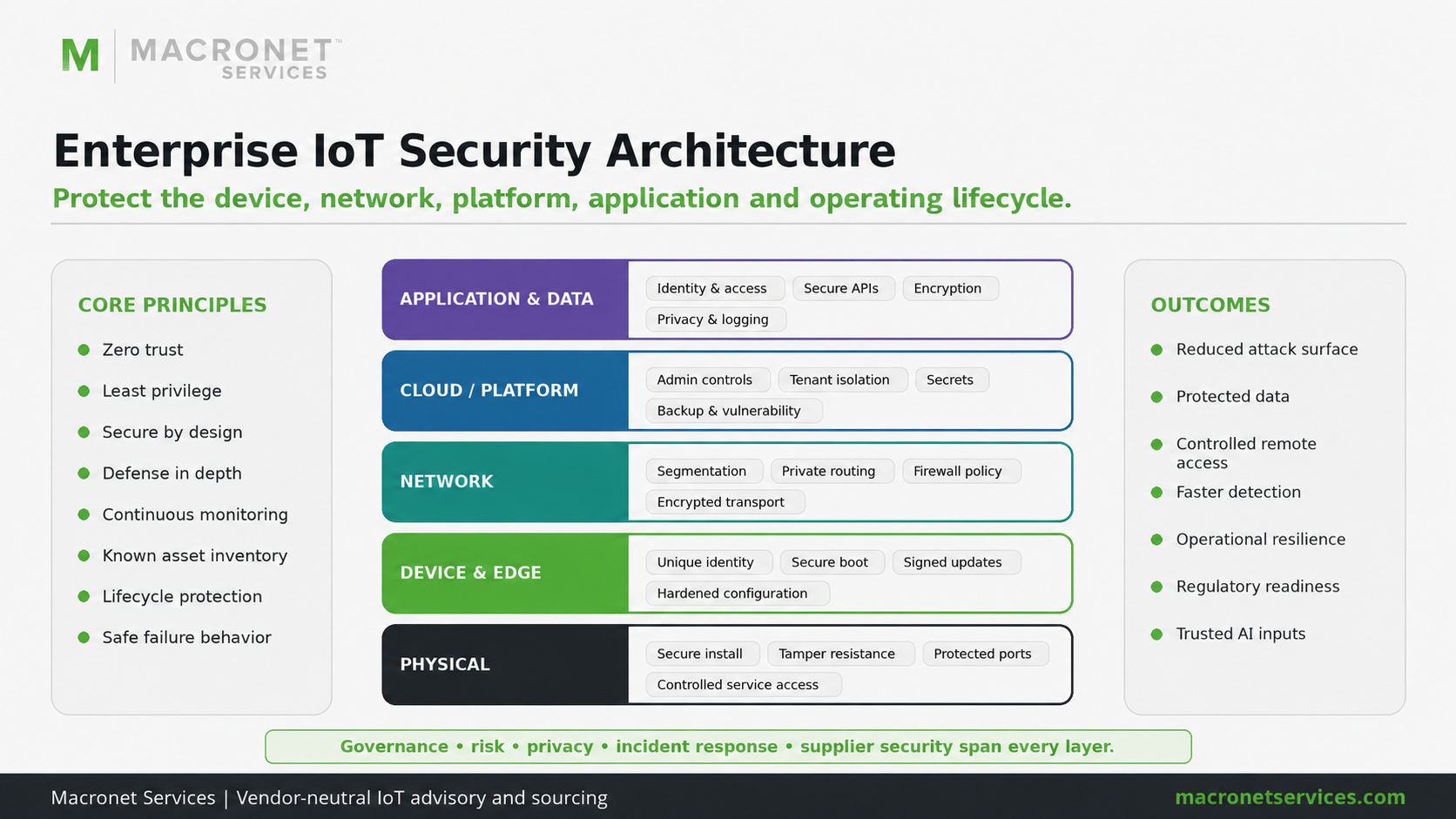
12. Why enterprise IoT security is different
IoT security extends cybersecurity into the physical world. A compromised endpoint may expose information, provide a path into the enterprise, falsify a physical reading, disable monitoring or influence equipment. The risk depends on the business and safety impact of the use case.
The NIST Cybersecurity for IoT Program emphasizes that IoT security is risk-based, outcome-oriented and dependent on the wider ecosystem in which a device operates. A practical lifecycle is: Approve → Procure → Provision → Authenticate → Operate → Monitor → Update → Repair → Deactivate → Retire.
Know every connected asset
The inventory should identify device model, serial number, firmware, physical location, business owner, network connection, SIM or eSIM, certificate, associated asset, data collected, expected behavior, support status and last communication. The record must remain current as devices move or are replaced.
Give every device a trustworthy identity
Devices should use unique credentials, certificates, hardware-backed keys, secure elements or controlled enrollment rather than shared passwords. Secure onboarding should establish whether the device is authentic, approved and permitted to join the relevant network and platform.
Restrict device behavior
Many devices have narrow, predictable communication needs. A temperature sensor may need to contact one gateway or cloud service; it should not have broad access to user or server networks. Define permitted destinations, protocols, data volume, update servers and administrative paths. Unexpected behavior can then be blocked or investigated.
Segment IoT and OT environments
Connected devices should not receive unrestricted access simply because they are inside the corporate perimeter. Segmentation may use dedicated wired or wireless networks, firewalls, private APNs, zero-trust access, microsegmentation and industrial zones. Building sensors, cameras, kiosks and production equipment should not automatically share one enormous “IoT network.”
Secure firmware and lifecycle support
Before purchase, determine whether firmware is signed, remotely updateable and recoverable after a failed update; how long the supplier provides security support; and how vulnerabilities are communicated. Roll updates through controlled groups with health checks and rollback.
Monitor behavior and design safe failure
Monitoring may rely on device health, connectivity platforms, network flows, authentication, cloud logs and physical alarms. The architecture should define what happens when a sensor, gateway, network, certificate, cloud service or AI process fails. Critical local functions should enter a predictable and safe state.
Prepare IoT-specific incident response
An IoT incident may require coordination among cybersecurity, facilities, plant operations, safety, legal, carriers, device suppliers, cloud platforms and field technicians. The response plan should preserve evidence, verify the actual physical condition, contain access, maintain essential operations and restore service in a controlled manner.
13. IoT privacy, data rights and regulation
IoT can observe employee location, customer movement, vehicle behavior, video, access history, occupancy, environmental exposure and product usage. Privacy should be designed into the use case before devices are installed.
The organization should define a legitimate purpose, collect the minimum precision and duration required, determine whether individuals must be identifiable, control access and enforce retention. Processing at the edge may reduce the movement of raw video, audio or other sensitive information.
The EU Cyber Resilience Act
The EU Cyber Resilience Act places cybersecurity requirements on products with digital elements made available in the European Union. The Act entered into force on December 10, 2024. Reporting obligations apply from September 11, 2026, and the principal obligations apply from December 11, 2027. Manufacturers and connected-product companies should address secure design, vulnerability handling, updates, documentation and support lifetime well before those dates.
The EU Data Act
The EU Data Act became applicable on September 12, 2025. It gives users of connected products greater rights over data generated through their use and creates mechanisms for making that data available to third parties. This reinforces the importance of usable APIs, data portability and clear contractual rights.
Contractual protections
IoT agreements should address data ownership and use, APIs, device and SIM ownership, security, vulnerability notification, updates, support period, product end of life, service levels, subprocessors, incident cooperation, data deletion and transition assistance. The contract should explain what happens to devices, profiles, data and management access when the relationship ends.
14. Packaged solution, horizontal platform or custom development?
| Model | Best fit | Strength | Primary tradeoff |
| Packaged vertical solution | A common workflow such as fleet, refrigeration, building energy or physical security | Fastest time to value and clearer service ownership | Less customization and potential provider dependence |
| Horizontal IoT platform | Several device types or use cases sharing common infrastructure | Reusable management, data and integration foundation | Requires architecture, integration and internal operating skills |
| Custom application | A connected product or workflow that creates strategic differentiation | Maximum control and business-specific experience | Highest engineering and lifecycle responsibility |
| Hybrid | Most enterprise environments | Customize only where it creates value while using commercial components elsewhere | Requires clear accountability across components |
A packaged solution is usually appropriate for an established workflow. A horizontal platform becomes attractive when several use cases need shared device, data and integration capabilities. Custom development is justified where the connected experience or operational intelligence is strategically differentiating. Many successful deployments use a hybrid model.
15. How to select IoT devices, platforms and providers
Provider selection should begin with an accountability map rather than a feature list. Identify who owns sensor accuracy, firmware, installation, connectivity, gateway, cloud, application, integration, security monitoring, user support, field replacement, incident coordination and retirement.
Evaluate devices in the physical environment
Assess measurement accuracy, environmental rating, battery life under the intended reporting pattern, calibration, bands and protocols, mounting, security architecture, firmware support, expected failure rate and replacement availability. A low-cost endpoint becomes expensive if it creates false alerts or frequent site visits.
Evaluate connectivity as an operating service
Compare coverage in actual locations, carrier diversity, local profiles, roaming restrictions, private networking, data routing, APIs, alerts, rate plans, SIM ownership, support and portability. A provider with excellent branch wireless may not offer the best low-power or international IoT capability.
Evaluate the actual platform scope
Determine whether the platform manages connectivity, endpoints, firmware, certificates, ingestion, rules, asset models, digital twins, dashboards, AI, billing and support. Ask to see bulk enrollment, firmware rollout, failed-device recovery, data export, user administration, alert escalation and device retirement—not only the front-page dashboard.
Use a weighted scorecard
| Evaluation category | Illustrative weight |
| Functional fit and measurable business value | 18% |
| Architecture and integration | 14% |
| Device and field suitability | 12% |
| Security and privacy | 14% |
| Connectivity and geographic coverage | 10% |
| Operations and support | 10% |
| Data access and portability | 8% |
| Supplier viability and roadmap | 6% |
| Commercial model and total cost | 8% |
Weights should change according to the use case. Convert important claims into measurable pilot criteria. “Five-year battery life,” “global coverage” and “AI-powered predictive maintenance” should each be tested through explicit conditions, not accepted as marketing descriptions.
| Where independent guidance creates value Macronet Services can help define requirements, evaluate providers across layers, coordinate competitive sourcing and build an end-to-end accountability model before the client commits to a platform or large deployment. |
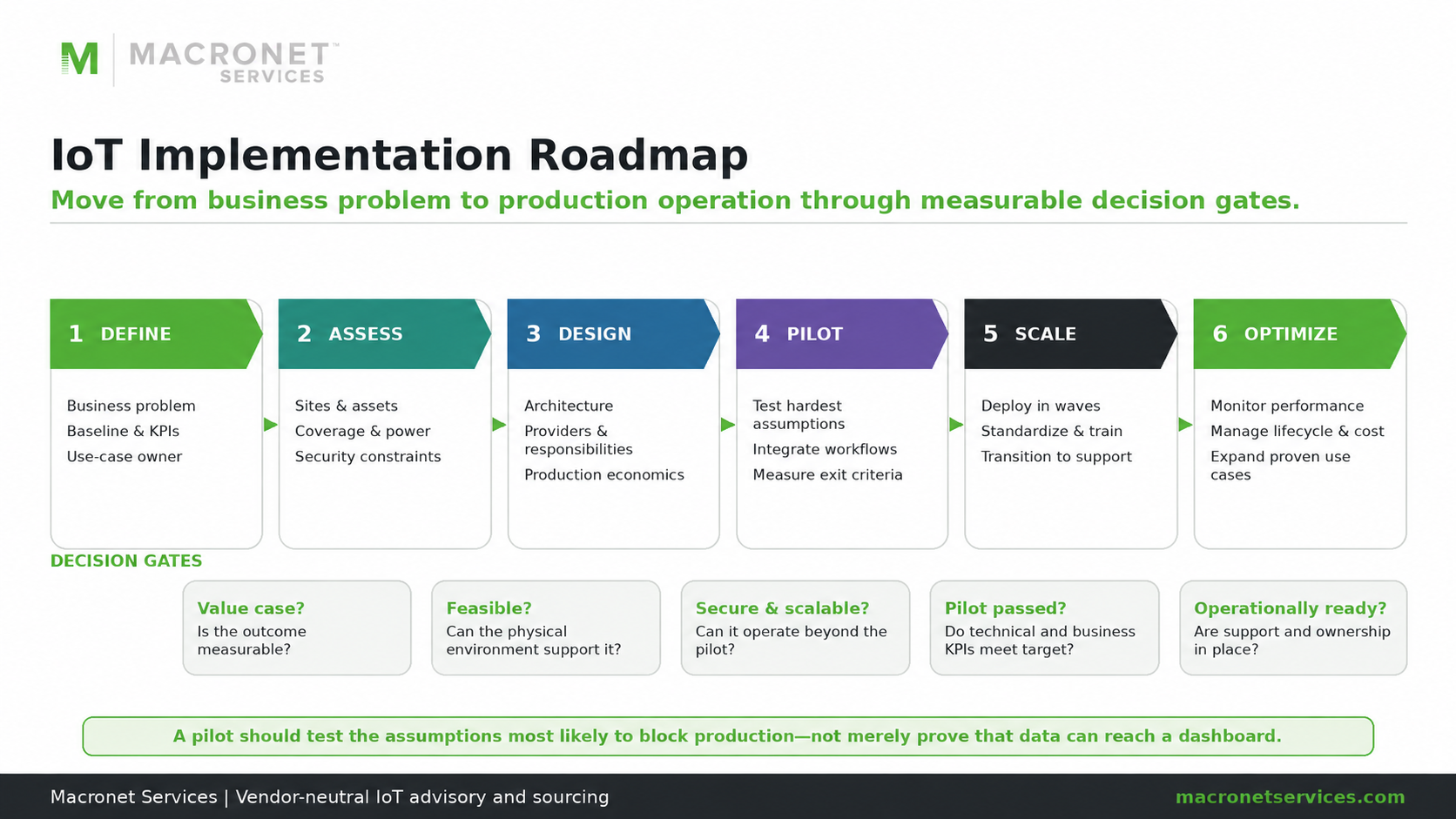
16. The IoT implementation roadmap
- Define the business problem. Document the current process, baseline, owner, required decision, action and response time.
- Assess the physical environment. Inspect sites, power, mounting, environmental conditions, coverage, existing networks, safety restrictions and installation access.
- Create the value hypothesis. Quantify hard savings, avoided loss, productivity, revenue and assumptions.
- Design the target architecture. Define devices, connectivity, management, data, application, integration, security, support and responsibility boundaries.
- Validate coverage, security and installation. Test in difficult representative locations before ordering a large volume.
- Design the pilot around risk. Test the assumptions most likely to prevent production success, not merely whether a device can send data.
- Approve pilot exit criteria. Set quantitative thresholds for accuracy, availability, latency, false alerts, installation time, battery, integration, adoption, support, economics and security.
- Build the production economic model. Include volume pricing, logistics, installation, platform, cloud, support, replacement and security.
- Scale in controlled waves. Organize rollout by geography, site type, asset class or operational readiness and improve the design after each wave.
- Transition to operations. Activate inventory, monitoring, support, firmware, certificates, field service, supplier governance and retirement processes.
- Optimize continuously. Improve thresholds, models, rate plans, battery settings, placement, workflows and supplier performance.
What a pilot should prove
A pilot should prove that the physical data is accurate, the network works in representative conditions, alerts reach the right people, integrations create usable work, users respond, security requirements can be met and production economics remain attractive. A technically successful demonstration is not sufficient.
17. Why IoT projects fail
IoT failures are often blamed on technology, but many begin with business design and operating governance. Common causes include starting with a product rather than a measurable problem; stopping at a dashboard; testing only convenient locations; postponing integration and security; underestimating installation; failing to establish an owner; ignoring batteries, firmware and retirement; and scaling before the organization has learned from the pilot.
The client can also become the unpaid integrator when the device provider blames the network, the network provider blames the gateway and the gateway provider blames the cloud. End-to-end incident ownership should be established before production.
Finally, scale economics can differ from pilot economics. Production introduces logistics, warehousing, international regulations, service desks, replacement inventory, cloud consumption and inactive subscriptions. The business case must be rebuilt using production assumptions before a broad rollout.
18. What does a business IoT solution cost?
There is no useful universal average cost for enterprise IoT. A battery-powered leak sensor, an AI video platform and a private 5G manufacturing network belong to the same broad market but have entirely different economics.
A complete cost model should include devices and gateways, site survey, installation, connectivity, platform subscriptions, cloud consumption, application development, enterprise integration, cybersecurity, support, field service, battery replacement, calibration, spare inventory and decommissioning.
| Total cost of ownership IoT TCO = Initial deployment + Recurring services + Operating labor + Maintenance and replacement + Security and compliance + Retirement |
A useful operating measure is annual cost per productive asset: total annual operating cost divided by the number of active assets producing usable business value. Devices that are inactive, incorrectly installed or generating unusable data create cost but should not be counted as productive endpoints.
19. How to calculate IoT ROI
IoT ROI should compare realized business benefit with the complete lifecycle cost required to produce it. Begin with a measured baseline, separate benefit categories and state assumptions transparently.
Benefits may include direct cost reduction, avoided loss, productivity, new revenue and strategic value. Strategic value can be important, but it should not be used to conceal a weak financial case.
| Avoid overstating ROI Realized benefit = Identified opportunity × Technical effectiveness × Operational adoption |
If analytics identify $1 million of theoretically avoidable loss, the system detects 90 percent of relevant events and the organization acts successfully on 70 percent of alerts, the expected realized benefit is $630,000—not $1 million.
Annual net benefit equals annual realized benefit minus annual recurring cost. Simple payback equals initial implementation cost divided by monthly net benefit. Longer investments should also be evaluated through net present value, internal rate of return and sensitivity analysis.
Use sensitivity analysis
Test the business case against changes in installation cost, device failure, battery life, support volume, data consumption, alert accuracy, user adoption, energy rates and incident frequency. A strong investment should remain attractive under reasonable downside conditions.
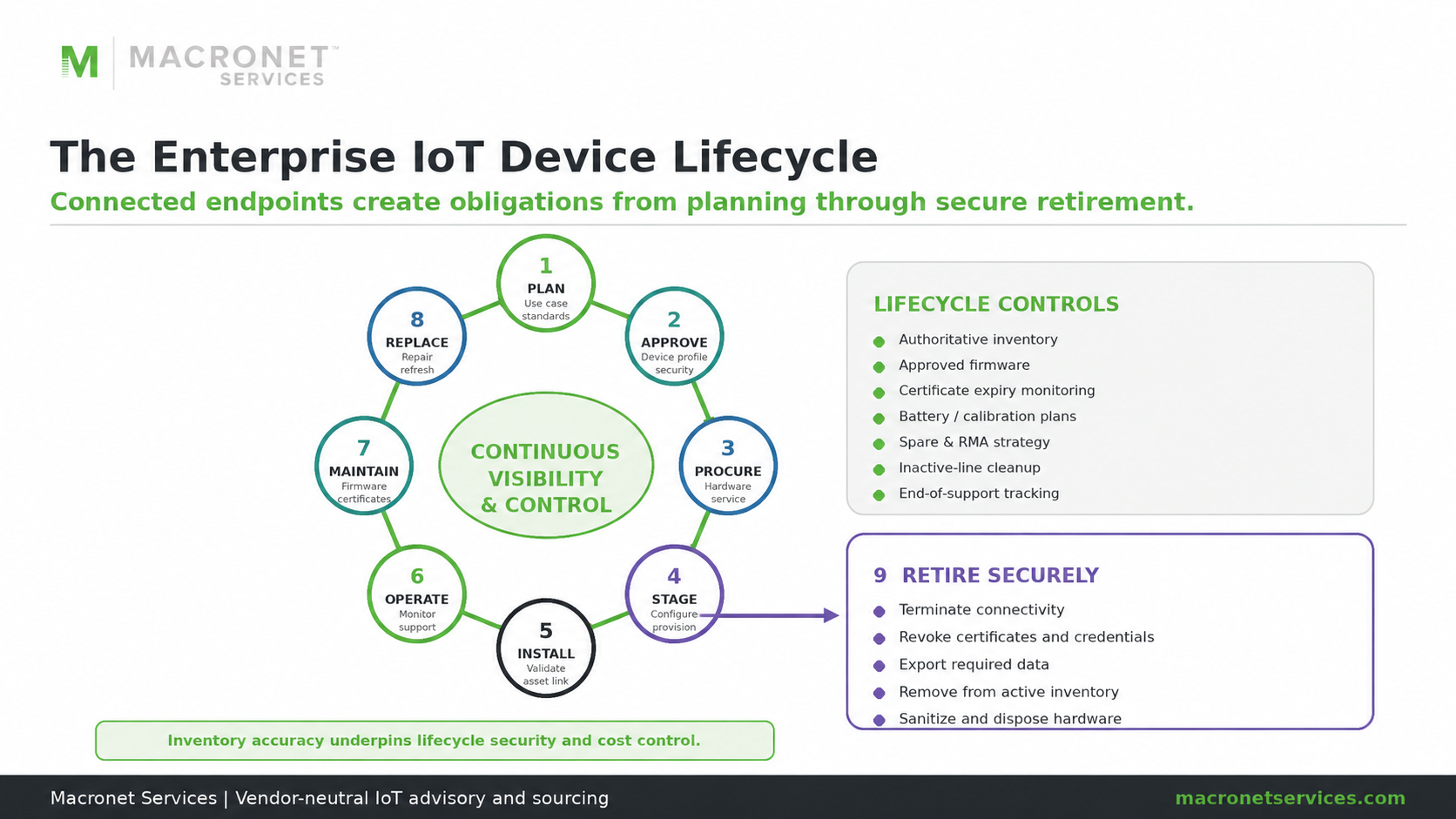
20. IoT device lifecycle management
The lifecycle begins before procurement. Define expected service life, security-support period, power and battery assumptions, firmware method, calibration, spare strategy, connectivity transition and end-of-support treatment. These requirements influence product selection.
Every production endpoint should be recorded in an authoritative system that connects the device identifier with the physical asset, location, business owner, firmware, network subscription, credential, warranty, last communication and retirement status.
Devices should be staged before field installation, and installation validation should confirm physical placement, asset association, signal, measurements, mounting, data flow and security policy—not merely that the endpoint appears online.
Firmware and configuration changes should use controlled rollout groups with health checks and rollback. Certificates and credentials should be monitored well before expiration. Field-service processes should define diagnosis, dispatch, spare inventory, replacement, returned equipment and restoration of historical continuity.
Inactive and orphaned endpoints should be identified routinely. A SIM or platform subscription can continue generating cost long after the asset or site is no longer active. Secure retirement must revoke credentials, terminate connectivity, remove the endpoint from active applications, preserve required data and dispose of hardware appropriately.
21. IoT data management and integration
IoT data does not become business-ready simply because it reaches a cloud platform. It must be associated with the correct physical asset, placed in context, transformed into meaningful events and delivered to the people and systems that can act on it.
The architecture should distinguish telemetry, current state, business events, commands, master data and outcomes. Outcome data—such as the technician’s actual diagnosis or whether an alert was false—is particularly important for validating and improving AI models.
Convert telemetry into business events
A freezer may report one temperature value every minute. The business does not need 1,440 alerts per day. Rules or AI should consider the approved range, duration, door status, defrost cycle, product present and rate of change, then create one meaningful event with a severity and required response.
Create a semantic model
A semantic layer describes entities and relationships such as building, room, air-handling unit, sensor, work order and owner. In manufacturing, it may connect plants, lines, machines, components, production orders and maintenance records. Standards such as OPC UA and GS1 EPCIS can reduce proprietary translation across industrial and supply-chain environments.
Integrate with the system that owns the workflow
The IoT application should not become the system of record for every operational process. Maintenance events should enter the CMMS or EAM. Service incidents should enter ITSM. Shipment exceptions should enter the transportation system. The operational outcome should return to the data environment to close the learning loop.
Retain data intentionally and prepare it for AI
Not every data point needs to remain at full resolution forever. A tiered policy may retain high-frequency raw data briefly, summarized trends longer and confirmed business events according to operational or regulatory requirements. AI data also requires correct identity, consistent units, synchronized timestamps, operating context and validated outcome labels.
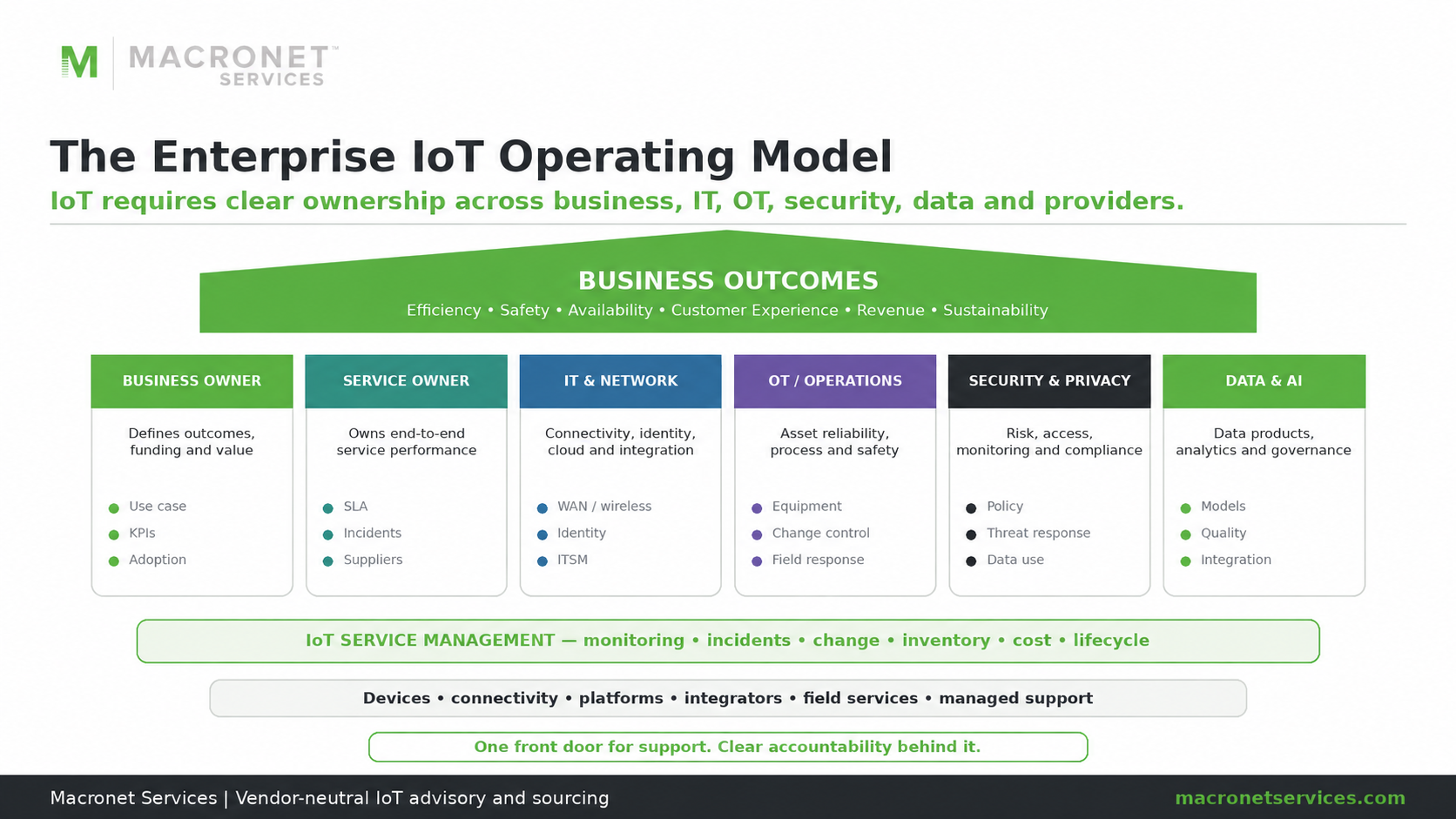
22. The enterprise operating model for IoT
IoT crosses business, operations, IT, cybersecurity, data, procurement and external-provider boundaries. Without an operating model, each group may assume another group owns the problem.
Every use case should have a business owner accountable for the outcome and a service owner accountable for end-to-end operation. A federated model can combine central architecture and standards with business-unit ownership of use cases, OT ownership of physical safety, IT ownership of enterprise connectivity, cybersecurity oversight and data-team responsibility for analytics and AI.
Users should have one front door for support rather than deciding whether a problem belongs to the sensor, network, gateway, platform or integration. Incident priority should reflect business impact, not endpoint count alone. One failed sensor protecting a multimillion-dollar process may be more important than 100 failed occupancy sensors in an unused area.
Measure the complete service
A mature scorecard combines technical measures such as availability, data completeness, latency and firmware compliance; operational measures such as alert acknowledgment and resolution; business measures such as avoided downtime and savings; risk measures such as unsupported devices and expired credentials; and financial measures such as cost per productive asset and ROI.
23. The future of business IoT
The next stage of IoT will not be defined only by connected-device counts. It will be shaped by intelligence at the edge, more flexible connectivity, stronger product security, better data rights and a gradual move from passive monitoring toward controlled operational autonomy.
Smaller models will move closer to devices
AI inference will increasingly occur in cameras, machines, vehicles, gateways and specialized sensors. The edge can respond quickly, preserve privacy and reduce bandwidth, while the cloud trains models, compares sites and integrates enterprise data.
Agents will coordinate physical operations
AI agents will increasingly investigate events, retrieve documentation, prepare work orders and coordinate people and systems. Direct physical authority should remain bounded by permitted actions, confidence, human approval, local safeguards, audit trails and emergency override.
Ambient IoT may expand very-low-power sensing
3GPP Release 19 includes work on Ambient IoT: extremely low-complexity devices that may use harvested energy or limited stored energy. Potential applications include inventory, packages, retail goods and industrial components. It remains an emerging commercial ecosystem rather than a universal current deployment option.
Indoor location will become more precise
Bluetooth Channel Sounding combines phase-based ranging and round-trip time to support secure, high-accuracy distance measurement between compatible devices. It may improve asset finding, digital keys, equipment proximity and industrial safety applications as products mature.
Connectivity will become more programmable
SGP.32 eSIM, 5G RedCap, evolving satellite-terrestrial integration and private wireless will give architects a broader set of connectivity profiles. The goal is not one universal network, but an operational layer that can remain consistent across different physical access technologies.
Interoperability will become a buying requirement
Enterprises will increasingly reject isolated dashboards and proprietary data silos. Open protocols, semantic models, complete APIs and usable export will become more important as IoT data feeds enterprise AI. Providers that make devices and data easier to integrate will create more durable value.
The destination is intelligent connected operations
| Where the market is going Connected assets → Visible operations → Predictive operations → Coordinated operations → Bounded autonomous operations |
Each stage requires stronger identity, better data, clearer ownership and greater trust. The future will not belong to the company with the most sensors. It will belong to the company that can convert physical information into better decisions and controlled action.
24. How Macronet Services helps businesses with IoT
IoT is a fragmented market. One provider may supply devices, another global cellular connectivity, another the business application, and additional specialists may be required for cloud integration, cybersecurity, field installation and lifecycle support.
Macronet Services helps clients turn those separate capabilities into one coordinated solution. We work with many established leaders across the IoT ecosystem while maintaining a vendor-neutral perspective, allowing the engagement to begin with the client’s business requirement rather than a predetermined product.
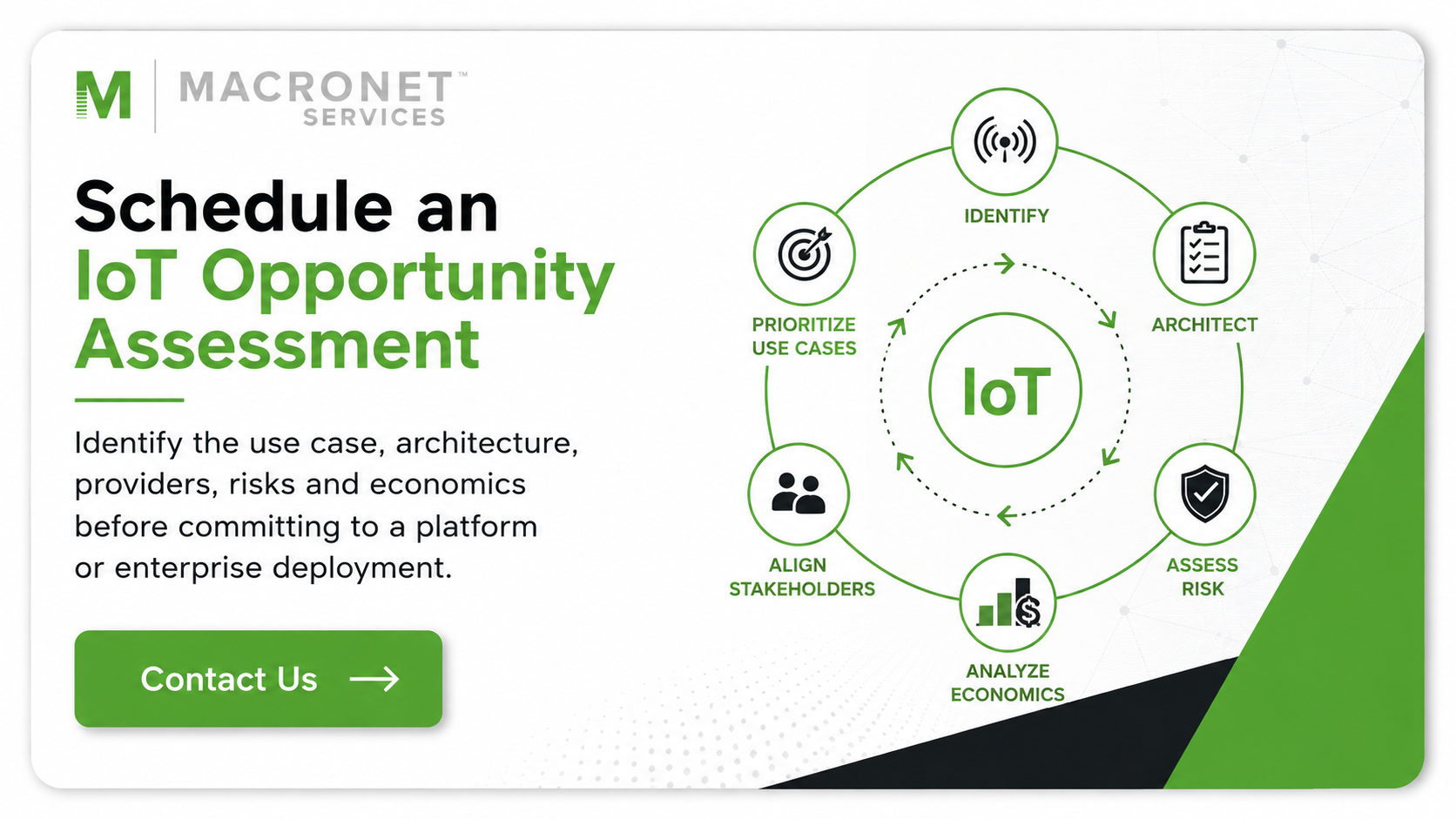
IoT opportunity assessment
An engagement can begin with a structured assessment of the business problem, current process, physical assets, missing information, response workflow, financial value, security and privacy risk, existing systems, candidate architecture and pilot recommendation. The objective is to determine whether the initiative is viable before the company commits to a platform or large rollout.
Architecture, connectivity and provider selection
Macronet Services can help define the complete design across sensors, gateways, local networks, cellular, satellite, managed wireless, private networks, device management, edge, cloud, data integration, AI, security and support. We can also develop requirements, compare providers, coordinate competitive sourcing, validate responsibilities and examine contracts for portability and lifecycle risk.
Pilot, deployment and lifecycle governance
We can help build a pilot around the assumptions most likely to prevent production success, establish measurable exit criteria, create deployment waves and design the operating processes for inventory, security, support, firmware, certificates, field service, cost control and retirement.
Why a vendor-neutral approach matters
No provider is the best choice for every layer, country, use case and physical environment. A provider with strong global connectivity may not offer the best application. A sophisticated application may depend on devices inappropriate for the site. A device manufacturer may offer an impressive dashboard but limited integration or data portability.
Macronet Services helps clients determine what should be connected, what information matters, which network fits the requirement, which provider should own each layer, how data enters the business workflow, how the solution is secured and whether the economics remain attractive.
Conclusion: IoT is becoming the operational data layer for enterprise AI
The Internet of Things is often described as a network of connected objects. For businesses, its greater significance is the creation of a trusted information layer between physical operations and digital intelligence.
IoT allows a company to know where assets are, how equipment is behaving, what conditions exist inside buildings and vehicles, and whether physical processes are operating as intended. AI can interpret that information, predict what may happen and coordinate a response.
The opportunity is substantial, but technology does not create value by itself. A successful program requires a measurable problem, reliable physical sensing, appropriate connectivity, secure identity, a supportable architecture, contextualized data, integration with business workflows, lifecycle ownership and financial measurement.
The best IoT solution is not the one with the newest sensor, fastest network or most impressive dashboard. It is the one that creates a reliable path from a physical event to a better business decision—and can continue doing so securely and economically at scale. Macronet Services helps businesses create that path. Reach out anytime for a conversation about how IoT can accelerate your business.
Frequently Asked Questions About Business IoT
What is IoT in business?
IoT in business is the use of connected physical devices to measure, communicate, analyze or influence real-world conditions. The information is connected to applications and workflows that help the organization make decisions or take action.
What is an example of a business IoT solution?
A refrigeration-monitoring system is a common example. Sensors measure temperature, a network sends the data to an application, software identifies sustained risk and the system alerts an employee or creates a service request before product is lost.
How does IoT help businesses?
IoT can reduce manual work, improve asset visibility, lower energy and fuel use, predict equipment problems, improve safety, reduce loss and support connected services. The value comes from improving a decision or process, not merely collecting data.
What are the main components of an IoT solution?
A complete solution may include devices, gateways, local and wide-area connectivity, management platforms, edge or cloud computing, applications, analytics, enterprise integration, cybersecurity and lifecycle support.
What is the difference between IoT and IIoT?
IoT is the broad category of connected physical systems. IIoT applies these capabilities to industrial equipment and processes, where reliability, safety, operational technology and specialized protocols are especially important.
What is AIoT?
AIoT is the combination of artificial intelligence and the Internet of Things. IoT supplies data from physical operations, while AI interprets patterns, predicts events, explains conditions or recommends actions.
What is edge AI in IoT?
Edge AI runs an AI model on or near the connected device rather than sending all raw data to a distant cloud. It can reduce latency, bandwidth and privacy exposure and preserve selected functions during an outage.
What is a digital twin?
A digital twin is a synchronized digital representation of a physical asset, process or system built for a defined analytical or operational purpose such as monitoring, simulation, prediction or optimization.
Does every IoT solution require a cloud platform?
No. Some systems operate locally, especially when response speed, privacy or resilience requires edge processing. Many enterprise solutions use a hybrid design combining local operation with centralized cloud management and analytics.
What is the best connectivity for IoT?
There is no universal best technology. The choice depends on range, coverage, power, bandwidth, latency, mobility, device density, geography, network control, cost and expected device life.
What is the difference between NB-IoT and LTE-M?
Both are licensed low-power cellular technologies. NB-IoT generally fits small, infrequent messages from fixed devices, while LTE-M supports greater mobility and more flexible data behavior.
What is 5G RedCap?
5G RedCap is a reduced-complexity 5G device category intended for endpoints that need more capability than narrowband IoT but less complexity, bandwidth and power than full-performance 5G.
When should a company consider private 5G?
Private 5G may make sense when a plant, warehouse or campus requires controlled coverage, mobility, security or capacity that existing Wi-Fi and public cellular cannot meet economically or reliably.
Can IoT devices use satellite connectivity?
Yes. Satellite can connect remote assets, farms, vessels and infrastructure outside reliable terrestrial coverage. Power, antenna visibility, message size, latency and cost must be considered.
What is an IoT eSIM?
An IoT eSIM uses an eUICC to support remotely managed cellular profiles. It can reduce physical SIM handling and make large or international deployments more flexible.
What is SGP.32?
SGP.32 is the GSMA technical specification defining an eSIM architecture for remotely provisioning and managing network-constrained or user-interface-constrained IoT devices.
How secure are IoT devices?
Security varies widely. Businesses should evaluate identity, configuration, encryption, updates, vulnerability handling, support lifetime, network behavior and the supplier’s product-security practices.
Should IoT devices be placed on a separate network?
They should generally be segmented according to function and risk rather than receiving unrestricted access to employee or server networks. Different device classes may require separate policies and zones.
Who owns data generated by an IoT device?
Ownership and usage rights depend on contracts, products and applicable law. Buyers should obtain clear rights to access, export and use operational data and understand how providers use aggregated or derived information.
How much does a business IoT solution cost?
Cost depends on hardware, installation, connectivity, platforms, cloud, integration, security, support and lifecycle requirements. The correct measure is total lifecycle cost, not the price of the sensor.
How is IoT ROI calculated?
IoT ROI compares realized benefit with total implementation and operating cost. A credible model begins with a measured baseline and adjusts expected benefit for technical effectiveness and operational adoption.
What should an IoT pilot test?
A pilot should test accuracy, coverage, installation, battery, data quality, alert response, integration, support, security and production-scale economics.
Why do IoT pilots fail to scale?
Common causes include an unclear business case, weak integration, unrealistic coverage assumptions, unmanaged security, underestimated installation, low user adoption and the absence of an operating owner.
Should a business build or buy an IoT platform?
A packaged solution is usually best for a common workflow, a horizontal platform for several shared use cases, and custom development where the connected capability creates strategic differentiation.
How are thousands of IoT devices managed?
Large fleets require automated provisioning, authoritative inventory, health monitoring, firmware and certificate management, bulk configuration, support workflows and secure retirement.
Can IoT integrate with ERP and maintenance systems?
Yes. IoT events can create work orders, update asset records, trigger inventory actions and support billing or customer workflows. Integration is often what turns device data into measurable business value.
Can small and midsized businesses use IoT?
Yes. Packaged smart-building, fleet, security, monitoring and asset-tracking solutions can provide value without requiring a large internal development team. The company should still begin with a measurable use case and complete cost model.
How does Macronet Services help with IoT?
Macronet Services helps clients define opportunities, design architectures, choose connectivity, evaluate providers, plan pilots, coordinate deployments and establish security, support and lifecycle governance.
Business IoT Glossary
| Term | Definition |
| Actuator | A device that changes a physical state, such as opening a valve, adjusting equipment or locking a door. |
| AI agent | Software that uses AI to pursue a defined objective through several steps, such as investigating an alert and preparing a work order. |
| AIoT | The combination of artificial intelligence and IoT. |
| Ambient IoT | An emerging category of extremely low-complexity and low-power connected devices, potentially using harvested environmental energy. |
| API | An application programming interface that allows software systems to exchange data or commands. |
| Asset model | A digital representation of an asset’s identity, properties, relationships and current state. |
| Attestation | A method through which a device provides evidence about its identity, software or security state. |
| BACnet | A communications protocol commonly used for building automation and control systems. |
| Bluetooth Low Energy | A short-range wireless technology designed for low-power sensors, beacons and wearables. |
| Bluetooth Channel Sounding | A Bluetooth capability using phase and timing information to estimate distance accurately between compatible devices. |
| CBRS | Citizens Broadband Radio Service, shared U.S. spectrum that can support private LTE and private 5G. |
| Connectivity management platform | Software used to activate, monitor, suspend and optimize cellular subscriptions. |
| Device management | Processes and software used to register, configure, monitor, update and retire connected endpoints. |
| Digital twin | A synchronized digital representation of a physical asset, process or system. |
| Edge AI | AI inference performed on or near the connected device. |
| Edge computing | Storage or processing placed near the physical source of data. |
| eSIM | A SIM capability supporting securely downloaded and managed mobile-network profiles. |
| eUICC | The secure environment that stores and manages eSIM profiles. |
| Firmware | Software embedded in a device that controls its hardware and core behavior. |
| Gateway | A device or system that connects local endpoints to wider networks and may aggregate, translate, store or process data. |
| IIoT | Industrial Internet of Things. |
| iSIM | SIM functionality integrated into a device’s system-on-chip or secure processor. |
| LTE-M | A low-power cellular technology supporting mobility and moderate data requirements. |
| LoRaWAN | A low-power wide-area protocol suited to long-range devices sending relatively small messages. |
| LPWAN | Low-power wide-area network. |
| M2M | Machine-to-machine communication. |
| MQTT | A lightweight publish-and-subscribe messaging protocol commonly used for IoT. |
| NB-IoT | A licensed low-power cellular technology commonly used for fixed devices sending small, infrequent messages. |
| Non-terrestrial network | A communications network using satellite or airborne infrastructure. |
| OPC UA | An interoperability standard for secure information exchange and semantic modeling across industrial and enterprise systems. |
| OT | Operational technology used to monitor or control physical equipment and processes. |
| Private APN | A cellular configuration that separates device traffic from ordinary public internet routing. |
| Private 5G | A 5G network deployed for the controlled use of one organization or location. |
| RedCap | Reduced Capability 5G, a lower-complexity device class between LPWA and full-performance 5G. |
| RFID | Radio-frequency identification using tags and readers to identify objects. |
| Sensor | A device that measures a physical condition. |
| SGP.32 | The GSMA technical specification for remotely provisioning and managing eSIM profiles in constrained IoT devices. |
| Store and forward | A design in which a device or gateway retains data during an outage and transmits it after connectivity returns. |
| Telemetry | Measurements reported remotely from devices or equipment over time. |
| Thread | A low-power, IPv6-based mesh-networking protocol. |
| Time-series data | A sequence of measurements associated with timestamps. |
| Zero-touch provisioning | Automated enrollment through which a device receives identity, configuration and access with little manual setup. |
| ZTNA | Zero-trust network access, granting controlled access based on identity, policy and context. |