
Tier 1 ISP Pricing: Dedicated Internet and IP Transit Costs Explained
Tier 1 ISP Pricing: Dedicated Internet and IP Transit Costs Explained is a comprehensive 2026 guide to enterprise Internet pricing, including Dedicated Internet Access (DIA), wholesale IP transit, and global Tier 1 ISP costs. Explore current pricing benchmarks for 100 Mbps, 1 Gbps, 10 Gbps, and 100 Gbps connectivity, understand 95th-percentile billing, and learn how local access, bandwidth commitments, and contract terms affect total costs. Discover how Macronet Services helps enterprises compare providers, negotiate competitive rates, and optimize network performance and connectivity spending.

Dual ISP Redundancy: How to Design Truly Diverse Internet Connectivity
Dual ISP Redundancy: How to Design Truly Diverse Internet Connectivity explores why purchasing two Internet connections does not necessarily guarantee network resilience. Learn how to evaluate physical fiber route diversity, last-mile infrastructure, carrier independence, and shared failure risks. This comprehensive enterprise guide explains how to verify truly diverse Internet circuits, design reliable failover architectures, evaluate cloud connectivity, and source redundant ISP services that support business continuity. Discover how Macronet Services helps organizations design and procure resilient, cost-effective Internet connectivity.
BGP Multihoming: The Complete Enterprise Guide to Dual ISP Connectivity
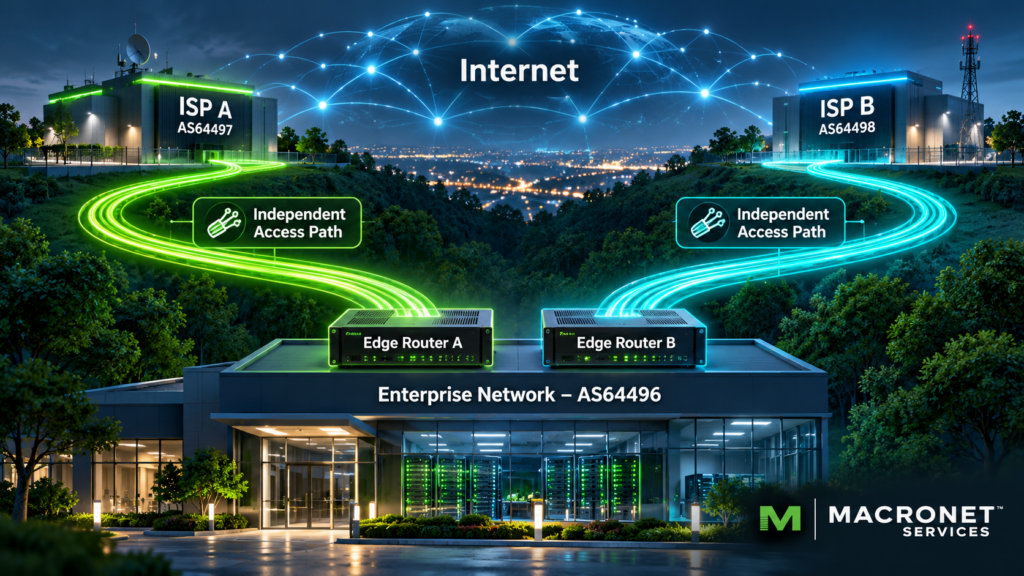
BGP Multihoming: The Complete Enterprise Guide to Dual ISP Connectivity explains how businesses can design resilient Internet networks using multiple ISPs, Border Gateway Protocol (BGP), and redundant network infrastructure. Explore dual ISP architecture, active-active vs. active-standby configurations, BGP failover, routing policies, public IP addressing, and physical carrier diversity. Learn how to evaluate providers, prevent single points of failure, optimize costs, and maintain reliable connectivity for mission-critical enterprise applications.

How to Read and Compare a Data Center Colocation Quote
How to Read and Compare a Data Center Colocation Quote: learn how to evaluate power pricing, MRC, NRC, PUE, cross connects, escalators, TCO, and contract risks. This guide explains how to normalize competing colocation proposals, uncover unmodeled costs, compare power and connectivity structures, calculate total contract value, and identify the provider offering the best risk-adjusted economics.

AI Colocation: How to Choose a Data Center for GPU and High-Density AI Infrastructure
AI Colocation: How to Choose a Data Center for GPU and High-Density AI Infrastructure. Learn how to evaluate power, liquid cooling, networking, scalability, resiliency and cost when selecting a facility for enterprise AI workloads. This guide explains the technical and commercial requirements behind GPU colocation, from rack density and high-speed networking to commissioning, expansion planning, and long-term infrastructure strategy.

Colocation RFP Guide: Build, Evaluate & Negotiate a Data Center RFP
This Colocation RFP Guide explains how to build, evaluate and negotiate a Data Center RFP, including technical requirements, power and cooling, connectivity, security, pricing, vendor scoring, site visits, contract terms and AI-ready infrastructure considerations. Use it to create more comparable proposals, reduce risk and make better colocation sourcing decisions.