AI Colocation: How to Choose a Data Center for GPU and High-Density AI Infrastructure
Artificial intelligence is changing what it means for a data center to have usable capacity.
For decades, enterprise colocation decisions were built around familiar variables: space, power, cooling, connectivity, resiliency, security and cost. Those considerations still matter, but high-density GPU infrastructure is changing their relative importance—and exposing the limitations of evaluating a data center primarily by square footage or cabinet count.
A modern AI environment can concentrate extraordinary electrical demand, heat output, network traffic and capital into a relatively small number of racks. A data hall may therefore have considerable unused floor space while being unable to support another meaningful AI deployment because its electrical or thermal capacity has already been consumed.
“AI-ready” should not be treated as a technical specification.
A facility capable of supporting several conventional GPU servers is not necessarily capable of supporting a liquid-cooled rack-scale system. A campus may advertise hundreds of megawatts of planned capacity while only a fraction of that power is energized today. A provider may say that liquid cooling is supported even though the proposed data hall still requires months of mechanical work before a customer can connect equipment.
Can this facility deliver the power, cooling, network, physical infrastructure and operating environment required by the AI system we intend to deploy—and continue doing so as that infrastructure evolves?
That distinction should drive the entire colocation evaluation. The current ASHRAE/PNNL/NEMA AI Data Center Energy Performance Framework describes how rapidly the infrastructure model is changing. AI and high-performance computing are concentrating far more power and heat into each rack, with current high-density systems moving well beyond the traditional enterprise baseline and future architectures expected to push significantly higher. ASHRAE consequently recommends treating power, cooling and physical architecture as an integrated system rather than as independent design disciplines. ASHRAE AI Data Center Energy Performance Framework ASHRAE Integrated Design Principles
For enterprises, usable AI capacity is increasingly defined by deliverable power, thermal capacity and network capability—not empty floor space.
What Is AI Colocation?
AI colocation is data center capacity designed to support GPU-accelerated and other high-density computing infrastructure used for artificial intelligence, machine learning and high-performance computing.
The colocation provider typically supplies the facility, power, cooling, physical security and connectivity ecosystem, while the enterprise owns or controls its compute, network and storage infrastructure.
AI colocation is not necessarily a separate class of building. Many conventional carrier-neutral facilities can support selected GPU workloads. Others have purpose-built high-density halls or have retrofitted portions of existing facilities for liquid cooling.
The key is matching the facility to the workload.
Consider two NVIDIA platforms. A DGX B200 system has a maximum system power specification of 14.3 kW. At the rack-scale end of the spectrum, a GB200 NVL72 combines 72 Blackwell GPUs and 36 Grace CPUs in a liquid-cooled system with approximately 120 kW of designed rack power and a 130 TB/s NVLink domain. NVIDIA DGX B200 power specifications NVIDIA GB200 NVL72 specifications
Both legitimately qualify as GPU infrastructure. They do not create the same data-center requirement.
A facility that comfortably supports one or two 14 kW GPU servers may be completely unsuitable for a 120 kW rack-scale system. Likewise, proving that a building can operate one 120 kW rack does not demonstrate that it can support twenty of them side by side.
AI colocation therefore needs to be evaluated from the compute outward.
The compute architecture determines electrical demand. Electrical demand influences thermal design. The GPU and storage architecture drive network requirements. Those technical requirements influence the building, location, operations model and contract.
Starting with a facility and asking what AI equipment might fit inside reverses that logic.
For enterprises still evaluating the broader role of colocation, Macronet Services’ colocation resources provide useful background on the facility and provider landscape. Data Center Colocation — Macronet Services

Not All AI Workloads Need the Same Data Center
The term “AI infrastructure” covers environments with very different operating characteristics.
A private inference platform supporting internal copilots, document analysis, RAG, analytics or computer vision may consist of only a few GPU systems. Depending on the hardware, that environment may operate at moderate density and remain primarily air cooled.
Development and fine-tuning environments generally place greater demands on network and storage as additional accelerators work in parallel and datasets become larger.
Large-scale model training changes the infrastructure problem more fundamentally. Many accelerators may need to exchange information continuously, making GPU utilization dependent on the performance of the network and storage systems around them.
Rack-scale systems take that integration further. A platform such as GB200 NVL72 is better understood as one very large parallel computer packaged within a rack than as a conventional cabinet containing unrelated servers. NVIDIA describes the platform as a 72-GPU NVLink domain capable of 130 TB/s of aggregate GPU communication. NVIDIA GB200 NVL72
This distinction matters because AI facility requirements should not be set using a generic “GPU-ready” profile.
An enterprise should first determine whether it is primarily building inference infrastructure, development capacity, a tightly coupled training cluster, or some combination.
The workload drives the facility.
Start With the GPU Hardware Roadmap
Before entering the market for AI colocation, the enterprise should develop a credible hardware roadmap.
It does not need to predict every server purchase several years into the future. It does need to understand enough about the intended architecture to avoid choosing a facility that becomes obsolete halfway through the contract.
The initial design should establish the likely accelerator platform, rack configuration, day-one IT load, expected expansion, rack density, cooling interface, network architecture, storage requirements and deployment schedule.
Two numbers are particularly important: day-one IT load and ultimate expected IT load.
If the enterprise needs 400 kW initially but expects to grow toward 2 MW, both numbers belong in the sourcing process.
The same applies to density. One megawatt distributed across fifty 20 kW racks presents a very different engineering problem from approximately eight or nine racks operating around 120 kW each. Aggregate load may be similar, but the concentration of electrical current and heat is not.
AI hardware roadmaps also evolve faster than traditional colocation contracts. A five-year agreement can span several accelerator generations. The facility should therefore be evaluated not only against the equipment being purchased today but against a reasonable range of future requirements.
This is especially important given the direction of the industry. ASHRAE notes that AI rack densities have moved rapidly from approximately 120 kW toward several hundred kilowatts, while higher-voltage power distribution and increasingly capable liquid-cooling architectures are being developed to support the trajectory. ASHRAE Integrated Design Principles
The objective is not to buy infrastructure for a hypothetical one-megawatt rack that may never be deployed. It is to avoid building the AI strategy into a facility with no credible path to the next generation of hardware.
Power Availability Is the First Facility Filter
For most significant AI colocation projects, power availability should eliminate unsuitable facilities early.
A data center can have excellent security, multiple carriers, attractive pricing and impressive sustainability credentials. If it cannot deliver the required electrical capacity on the required date, those benefits may be irrelevant.
The constraint often begins outside the building. ASHRAE recommends evaluating grid capacity, substation proximity, utility expansion plans, interconnection schedules and long-lead electrical equipment early in site planning, noting that utility interconnection timelines can exceed the construction schedule of the data center itself. ASHRAE AI data center site-planning guidance
The buyer therefore needs to distinguish among several different meanings of “available power.”
A provider may describe the ultimate capacity of a campus, the utility allocation for the site, the capacity installed in a particular building, or the power currently available in the proposed hall. These numbers are not interchangeable.
The capacity that matters is the amount the enterprise can actually reserve and energize when the GPU infrastructure arrives.
Current market conditions make this distinction particularly important. CBRE reported 10.9 GW of supply across primary North American data-center markets in H1 2026, yet vacancy fell to just 1.4%. More than 80% of capacity already under construction was committed, leaving less than 1.5 GW available for preleasing across the major markets. CBRE identifies power availability and infrastructure delivery timelines as the dominant site-selection constraints. CBRE North America Data Center Trends H1 2026
For AI buyers, a megawatt expected three years from now is not the same product as a megawatt that can be energized when the equipment is delivered.
Nameplate Power Is Not Deliverable Power
A campus may advertise 100 MW of planned capacity while only a portion is energized. Some of the energized capacity may already be leased. Future phases may depend on utility construction, transformers, switchgear, transmission upgrades or permits that are not complete.
The enterprise should therefore trace capacity progressively from the utility connection to the building, the proposed hall, the row and ultimately the rack.
Future capacity can still be valuable. The issue is knowing what must happen before it becomes real.
If expansion depends on another substation, that dependency belongs in the risk analysis. If the utility allocation is already secured but the switchgear is still being manufactured, that is a different risk. If the future capacity exists only on a campus master plan, it should not be valued as though it were energized infrastructure.
The Megawatts Have to Reach the GPU Rack
Once sufficient site power has been established, the next question is how that capacity reaches the IT equipment.
The electrical path may include substations, switchgear, transformers, generators, UPS systems, busway, panels, rack power shelves and internal DC distribution. Every component has limits.
High-density AI adds a new challenge to traditional reliability engineering: enormous concentration of load.
A building with several available megawatts may still lack the distribution architecture required to deliver 100 kW or more to a single rack repeatedly across an entire cluster. NVIDIA’s GB200 architecture illustrates the shift. The 120 kW reference rack incorporates dedicated power shelves and rack-level DC distribution as part of the system. NVIDIA Mission Control power guidance
At still higher density, the industry is beginning to rethink the distribution voltage itself. ASHRAE now recommends evaluating higher-voltage architectures such as 800 VDC for extreme densities because moving the same amount of power at higher voltage reduces current, conductor size and copper requirements. ASHRAE Resilient Design
That does not mean an enterprise should make 800 VDC a universal RFP requirement today. It means the power architecture is changing fast enough that the facility’s future design path matters.
AI Loads Can Also Be Dynamic
Total kW tells only part of the electrical story.
Large groups of GPUs can act synchronously. When a training workload changes computational state, many accelerators may ramp power together.
NVIDIA’s current power-management documentation explicitly preserves operating headroom for runtime power fluctuations, and ASHRAE describes synchronized AI load swings as a design consideration for electrical infrastructure. NVIDIA Mission Control power guidance ASHRAE Retrofit and Modernization Strategies
A facility designed around relatively steady enterprise loads therefore should not automatically be assumed capable of supporting a high-density training cluster simply because the arithmetic says enough kW exists.
How has the proposed electrical environment been engineered or tested for the actual load behavior of the GPU platform?
Rack Density: Ask What Can Be Supported Repeatedly
Another weak diligence question is: “Can you support a 100 kW rack?”
A provider may truthfully say yes even if only one or two positions in the building can support that density.
The enterprise needs to know how many racks can operate at the required density simultaneously in the proposed hall. This is the difference between peak rack capability and repeatable cluster capability.
Industry context matters here. Uptime Institute’s 2026 survey found increasing deployment of high-density racks, but the broader installed base remains far less dense than leading-edge AI facilities. More operators now report peak densities of 30 kW or above, yet the most extreme GPU designs remain concentrated in specialized environments. Uptime Institute Global Data Center Survey 2026
That is why provider-wide statements are not enough. The enterprise should evaluate the exact hall being proposed.
Cooling Becomes Part of the Compute Architecture
Almost all electrical energy consumed by IT equipment ultimately becomes heat that the facility must remove.
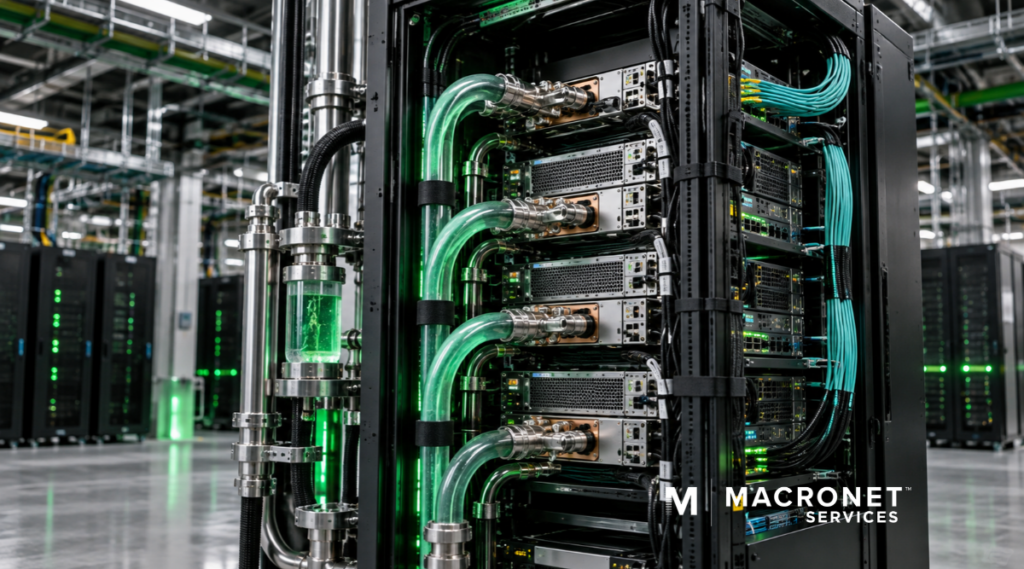
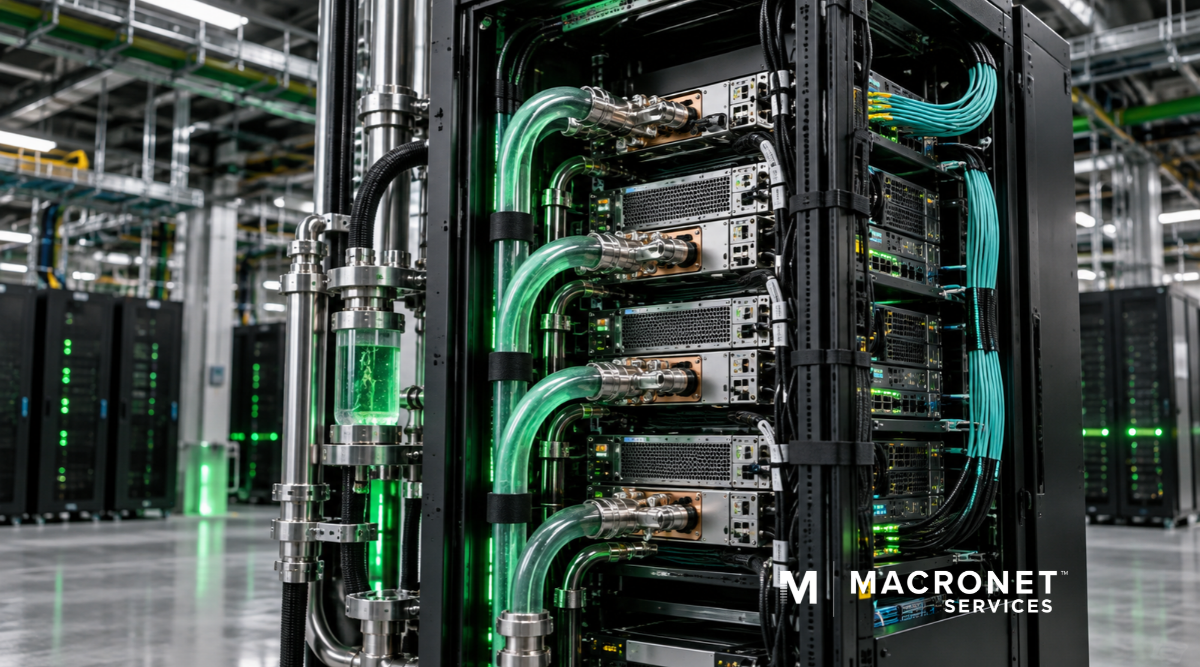
At traditional rack densities, air can perform that job effectively. As rack density rises, the amount of air that must be moved through a confined space becomes increasingly difficult and inefficient. This is driving the rapid adoption of direct liquid cooling for the highest-density AI systems.
ASHRAE’s current framework recommends matching cooling topology to the density of the AI workload rather than to historical enterprise baselines. For purpose-built high-density AI and HPC, direct-to-chip liquid cooling has become the predominant architecture. ASHRAE Energy and Thermal Efficiency guidance ASHRAE Integrated Design Principles
It is equally important not to overstate the transition. Not every GPU deployment needs liquid cooling. Many inference, development and smaller AI environments can still operate effectively with air cooling. Uptime Institute likewise cautions that direct liquid cooling remains concentrated in high-density applications rather than becoming a universal replacement for air cooling across all enterprise IT. Uptime Institute on liquid cooling adoption
The cooling technology should follow the hardware.
How Direct-to-Chip Cooling Works
Direct-to-chip liquid cooling removes heat close to where it is created.
A cold plate attached to the GPU or CPU transfers heat into a liquid. That coolant flows through a rack manifold into the technology cooling system. A Coolant Distribution Unit, or CDU, typically provides hydraulic separation and heat exchange between the IT-side loop and the facility-side cooling system. The facility then rejects that heat through dry coolers, chillers, cooling towers or another mechanical architecture.
GPU / CPU → Cold Plate → Rack Manifold → CDU → Facility Water → Heat Rejection
That chain introduces an important commercial and operational question: where does responsibility change hands?
The colocation provider may own the facility-water system while the customer owns the rack manifold. The provider may operate centralized CDUs. The customer may supply its own. The hardware manufacturer may specify the coolant chemistry while facility technicians maintain it. Those boundaries should never be assumed.
Uptime Institute’s 2026 research found that direct-liquid-cooling operations are beginning to converge around larger redundant CDUs serving groups of racks, but coolant chemistry, resiliency and maintenance responsibilities remain areas of industry variation. Uptime Institute: Consensus and Confusion in Liquid Cooling Maintenance
The Open Compute Project is also actively developing specifications and reference guidance around cold plates, CDUs, coolant distribution, quick disconnects and facility interfaces, reinforcing how much standardization work is still underway. Open Compute Project Cooling Environments
Liquid-Cooling Capacity Is Not Unlimited
Liquid cooling solves a heat-transfer problem. It does not create infinite capacity.
The technology cooling system still has finite pumping capacity, flow, heat-exchanger capacity and facility-side heat rejection.
The buyer should therefore evaluate thermal capacity with the same discipline applied to electrical capacity.
If the proposed AI environment will consume 3 MW, the facility needs to deliver roughly 3 MW of appropriate IT power and remove the resulting heat under the specified conditions. If the enterprise later grows to 5 MW, both systems need a path to 5 MW.
Available electrical MW + available thermal MW = potentially deployable AI capacity
The lower of the two often becomes the practical constraint.
Hybrid Cooling Still Matters
A liquid-cooled AI rack is not necessarily 100% liquid cooled.
Processors and the highest-heat components may use cold plates while power supplies, memory, storage or networking continue to reject some heat into the room. The surrounding air-cooling system therefore remains part of the design.
This is another reason that asking whether a provider has “liquid cooling” is too simplistic. The correct evaluation includes the fraction of heat captured by liquid, the residual room load, facility-water conditions and how those values behave as additional racks are installed.
Operational Experience Matters as Much as Piping
Installing a liquid loop is one thing. Operating it as mission-critical infrastructure is another.
Direct liquid cooling introduces new concerns around coolant quality, filtration, flushing, corrosion control, leak detection, pressure management, maintenance and spare components.
Uptime Institute notes that large-scale deployment has moved faster than some industry operating standards and practices. Its more recent research on IT-agnostic DLC systems emphasizes fluid compatibility, filtration, variable flow and maintainability as facilities attempt to support successive generations of liquid-cooled equipment. Uptime Institute: IT-Agnostic DLC Systems
For a customer, this creates an important distinction between a facility that has liquid-cooling infrastructure and a provider that knows how to operate liquid-cooled AI environments.
Commissioning Is Critical
Commissioning has always mattered in mission-critical infrastructure, but high-density AI makes it even more important because power and thermal systems are increasingly coupled.
Direct liquid cooling can physically connect facility infrastructure to the IT equipment in ways that conventional air cooling did not.
Uptime Institute notes that CDU integration complicates commissioning and recommends rigorous factory and site testing because best practices are still maturing. Uptime Institute: Coolant Distribution Units Can Complicate Commissioning
The enterprise should determine what has actually been tested. Was the original building commissioned years ago as an air-cooled facility? Was the new liquid loop subsequently tested? Were the CDUs tested under realistic load? Has the integrated electrical and cooling architecture been tested at or near the density the enterprise plans to operate?
A general statement that the building is “commissioned” may not answer any of those questions.
The Network Is Part of the AI Compute System
Power and cooling determine whether the GPU infrastructure can operate. The network helps determine whether the GPUs are productive.
In conventional enterprise architecture, the network is often described as the infrastructure connecting computing systems. In large AI environments, the distinction becomes less useful because distributed workloads depend directly on communication among accelerators.
When GPUs wait on the network, expensive compute capacity sits idle.
GPU utilization matters more than GPU count.
A company can purchase exceptional accelerators and still generate poor economics if the network or storage system cannot keep them supplied with data and synchronized.
For enterprises evaluating the broader network architecture around the data center, Macronet Services’ Data Center Connectivity guide provides a deeper treatment of external connectivity, while the Data Center Cross Connects guide explains the physical Layer 1 infrastructure behind carrier and cloud interconnection. Data Center Connectivity — Macronet Services Data Center Cross Connects — Macronet Services
Scale-Up, Scale-Out and Scale-Across
AI networking becomes easier to understand when separated into different communication domains.
Scale-up networking tightly connects accelerators operating as one compute domain. NVIDIA NVLink is an example. In a GB200 NVL72, 72 GPUs operate inside one rack-level NVLink domain. NVIDIA NVLink information
Scale-out networking connects GPU systems or racks into a larger cluster. This is where InfiniBand and AI-optimized Ethernet become especially important.
Scale-across networking connects AI infrastructure beyond a single cluster or facility. This can involve data-center interconnect, optical transport or other wide-area architectures.
The distinctions matter because each layer has different latency, throughput and physical constraints. A data center does not generally control the scale-up fabric inside an integrated rack, but it absolutely influences whether scale-out and external connectivity can be implemented successfully.
InfiniBand vs. Ethernet for AI
The question of InfiniBand versus Ethernet is frequently oversimplified.
InfiniBand has deep roots in HPC and remains a prominent choice for highly synchronized AI training environments. Current NVIDIA Quantum-X800 architectures provide 800 Gb/s connectivity for large accelerator clusters. NVIDIA Quantum-X800
Ethernet, however, is evolving rapidly. AI-optimized Ethernet architectures combine RDMA, congestion management, high-speed switching and telemetry specifically to support distributed accelerator workloads. NVIDIA’s current Spectrum-X portfolio includes 800G-class switching, and broader industry efforts are pushing Ethernet further into scale-up and scale-out AI. NVIDIA Spectrum-X
The Ultra Ethernet Consortium provides particularly strong evidence that this is no longer ordinary enterprise Ethernet running at higher speed. Its current Specification 1.1 adds enhancements for AI/HPC transport, congestion signaling, programmable congestion management, in-network collective operations and scale-up networking. Ultra Ethernet Specification history Ultra Ethernet Specification 1.1 announcement
The correct decision depends on the workload, accelerator platform, scale, operations model and economics.
Can the proposed data hall physically support the fabric we choose?
That means evaluating switch racks, optics, cable pathways, fiber density, rack layout and expansion—not simply confirming that the building has “400G or 800G.”
High-Speed Networking Becomes a Physical Infrastructure Issue
Large GPU clusters can involve enormous quantities of fiber. A conventional enterprise cabinet may have only a handful of network uplinks. An AI rack may participate in a topology involving many high-speed optical connections between compute, network and storage systems.
Pathway capacity therefore matters. Fiber trays matter. Patch-panel density matters. Bend radius matters. Switch placement and serviceability matter.
The Telecommunications Industry Association is explicitly updating its ANSI/TIA-942 data-center standard to address AI/HPC infrastructure, including high-density high-speed cabling, cooling and electrical requirements. TIA AI addendum to ANSI/TIA-942
At AI scale, the network fabric is not merely a logical architecture. It has substantial physical consequences for the building.
East-West Traffic Changes the Design
Traditional enterprise data centers often emphasize north-south traffic between users and applications or applications and external services. Large training environments generate enormous east-west traffic among accelerators.
Distributed operations may require many GPUs to exchange information repeatedly before the next phase of computation can proceed. A congested link can therefore delay far more than one server.
This changes the economics of oversubscription. A highly oversubscribed architecture that works well for conventional business applications may reduce the productivity of a training cluster enough that the savings in network equipment are dwarfed by the cost of idle GPUs.
The goal is not necessarily zero oversubscription everywhere. It is to engineer the network around the communication pattern of the workload.
Storage Can Starve the GPUs Too
The same principle applies to storage.
AI systems need to ingest large datasets and periodically write model checkpoints. If the storage subsystem cannot provide the required throughput, GPU resources wait.
Storage architecture should therefore be evaluated by its ability to feed the compute environment, not simply by total capacity. This can involve high-performance shared storage, NVMe tiers, object storage, local caching and carefully designed data pipelines.
The location of the data matters as well. If petabytes of training data already reside in a particular cloud or data center, repeatedly moving them to a remote GPU environment can create substantial bandwidth, latency and egress costs.
This is data gravity applied to AI.
External Connectivity Still Matters
Even a highly specialized GPU cluster rarely exists in isolation.
Training data may come from AWS, Azure, Google Cloud or OCI. Enterprises may need high-capacity WAN access from corporate environments. Models may need to interact with applications in another data center. Inference services may need Internet reachability or private connectivity to customers and partners.
The internal GPU fabric and the external network therefore solve different problems.
A facility with exceptional carrier connectivity does not automatically have a good GPU fabric. A facility capable of supporting an excellent GPU fabric may still be a poor location if external data movement is difficult or expensive.
For distributed enterprise architectures, Macronet Services’ Multi-Cloud Networking guide explains how colocation hubs, cloud on-ramps, carriers and private connectivity can be combined across cloud platforms. Multi-Cloud Networking — Macronet Services
For Internet-heavy AI environments, backbone quality and routing architecture also matter. Macronet Services’ Tier-1 ISP guide examines the difference between simply buying bandwidth and deliberately engineering Internet reachability and resilience. Tier-1 ISPs and Global Enterprise Networks — Macronet Services
Physical Diversity Must Be Real
Two carriers do not automatically create two independent paths. They may enter through the same conduit, share the same meet-me room, use the same metro fiber or depend on the same wholesale infrastructure.
The same issue applies to cross connects. For AI environments that depend heavily on DCI, cloud access or external data ingestion, physical path diversity should be verified rather than inferred from the provider names on an invoice.
This is one area where data-center selection and network sourcing should be performed together.
Training and Inference May Belong in Different Places
The optimal site for training may not be the optimal site for inference.
Large training environments often prioritize abundant power, energy economics, scalable cooling and large contiguous capacity. They can sometimes tolerate being farther from end users.
Inference can have a different geographic profile. Real-time applications may benefit from proximity to users, applications, cloud regions or major interconnection hubs.
CBRE expects increasing demand for 25-to-75-MW facilities supporting enterprise AI, inference and latency-sensitive workloads closer to business and population centers, even as enormous training developments continue to expand in power-rich regions. CBRE North America Data Center Trends H1 2026
For some organizations, the long-term architecture may therefore involve a centralized training environment and more distributed inference capacity. There does not have to be one universal “AI data center.”
AI Rack Weight and Logistics Matter
High-density racks can also be physically heavy.
ASHRAE notes that modern AI racks can weigh well over 2,000 pounds and provides design examples around 3,300 pounds per rack, driving greater attention to slab loading, seismic anchoring and facility structure. ASHRAE Integrated Design Principles
The equipment also has to reach the data hall. Loading-dock capacity, door width, freight elevators, corridors, turning radius and final rack position all need to accommodate the actual hardware.
This becomes especially important as more rack-scale systems are pre-integrated off-site rather than assembled one lightweight server at a time.
The Open Compute Project’s current AI-cluster work reflects the same trend, treating network topology, cabling, cooling, power distribution and physical infrastructure as one integrated deployment problem. Open Cluster Designs for Artificial Intelligence — OCP
Resiliency Should Match the Workload
Expensive AI infrastructure naturally encourages buyers to pursue maximum redundancy. Maximum redundancy is not automatically the best architecture.
A customer-facing inference system supporting a critical business process may justify very high availability. A large training cluster that checkpoints frequently may tolerate interruptions differently.
At megawatt scale, duplicating every facility component also becomes expensive.
Which failures must this workload survive, and where should that resilience be engineered?
Some resilience may reside in the data center. Some may reside in the GPU cluster. Some may be provided by software, checkpointing or geographic redundancy. The correct design evaluates them together.
Uptime’s 2026 research reinforces that redundancy still affects outage risk, but the enterprise should determine what level of facility redundancy actually produces business value for the AI workload rather than purchasing the highest possible classification reflexively. Uptime Institute Intelligence
Utility Strategy Has Become Part of Facility Strategy
At larger AI scales, the power source itself becomes relevant.
Grid interconnection can take years in constrained markets, which is driving some developers toward on-site generation, battery storage, microgrids and temporary bridging-power approaches.
CBRE reports growing interest in behind-the-meter and “bring your own power” solutions where utility delivery cannot match deployment schedules. CBRE North America Data Center Trends H1 2026
These approaches can accelerate access to compute, but they also introduce additional dependencies. A buyer should understand whether the proposed capacity is permanent utility power or an interim arrangement, how long the interim design is expected to operate, what permits and fuel dependencies exist, and what happens if the planned utility date slips.
Again, the issue is not whether an unconventional power strategy is inherently good or bad. It is whether the enterprise understands what it is buying.
Speed to Power Has Economic Value
GPU infrastructure has a rapid technology cycle. A delayed deployment can therefore be unusually expensive.
Hardware that sits idle for six months loses six months of productive economic life while newer accelerator generations continue to arrive. For organizations developing AI products or using AI infrastructure to generate business value, the cost of delay can be even larger than the infrastructure carrying cost.
Cost of capacity + cost of delay + probability of delay
A slightly more expensive facility with commissioned power available on time can be economically superior to a cheaper proposal dependent on an uncertain utility project.
Sustainability Requires More Than PUE
Power Usage Effectiveness remains useful, but it measures facility overhead—not whether the AI compute itself is being used productively.
Uptime Institute reported an industry-average annual PUE of approximately 1.52 in its 2026 survey. When the calculation is weighted by IT capacity, reflecting the greater efficiency of many newer large facilities, the figure falls to approximately 1.36. Uptime Institute: The Growing PUE Advantage of Larger Data Centers
These are meaningful metrics, but a facility can have an excellent PUE while hosting poorly utilized GPUs.
For AI, efficiency should therefore be considered more broadly. ASHRAE recommends evaluating PUE alongside water, carbon and IT-level performance metrics rather than allowing one facility-efficiency ratio to stand in for total environmental or computational efficiency. ASHRAE Energy and Thermal Efficiency
For enterprises, the most useful perspective is ultimately useful compute produced per unit of capital and resource consumption.
Water and Carbon Can Influence Site Selection
Cooling architecture can create a tradeoff between electricity and water. Evaporative systems may reduce some mechanical-energy requirements while consuming significant water. Warm-water direct liquid cooling can enable greater use of dry coolers in appropriate climates, potentially reducing water demand.
The local generation mix can also cause two otherwise identical GPU environments to have very different carbon profiles.
For companies with sustainability commitments, the facility evaluation can therefore include water availability, Water Usage Effectiveness, power-source characteristics and carbon reporting.
These factors should inform the decision without obscuring the primary objective: deploying reliable, economically viable compute.
Community and Permitting Risk Is Delivery Risk
Large AI projects are increasingly visible to surrounding communities. Power demand, transmission infrastructure, water use, generator emissions, noise, land use and tax arrangements can all become public issues.
CBRE reports that community resistance and zoning delays are now material constraints in North American development, in some markets becoming as consequential as power and fiber availability. CBRE North America Data Center Trends H1 2026
The colocation tenant may not control those approvals. It can still suffer the delay.
When evaluating capacity that is still being developed, enterprises should understand which approvals remain outstanding and how those milestones affect the promised service date.
The AI Colocation Market Is Tight
The market context entering 2027 is important because technically suitable AI capacity can be difficult to replace.
CBRE reported record primary-market supply of approximately 10.9 GW in H1 2026, yet vacancy remained only 1.4%. Approximately 7.48 GW was under construction, but 80.4% of that pipeline was already committed. CBRE North America Data Center Trends H1 2026
Pricing increased across every requirement-size category studied by CBRE. The largest gain was for 3-to-10-MW requirements, which rose 8.3%, followed by 500 kW-to-3 MW requirements at 7.9%. CBRE North America Data Center Trends H1 2026
Those numbers do not mean every AI customer should sign capacity as quickly as possible. They mean capacity planning should start earlier than traditional enterprise procurement cycles might suggest.
For a deeper discussion of current pricing models, power commitments and market economics, see Macronet Services’ Data Center Colocation Pricing guide. Data Center Colocation Pricing: The Complete Enterprise Cost Guide for 2027
AI Colocation Is Increasingly Priced Around Power
Cabinet count becomes less meaningful as density rises. When eight or ten racks can consume roughly a megawatt, the scarce resources are no longer primarily cabinets or square feet.
Electrical capacity, thermal capacity and the right to use them.
This is why empty floor space can coexist with sold-out capacity. It is also why AI transactions increasingly involve committed kW or MW, utility passthroughs, cooling infrastructure and capacity reservations rather than simple cabinet pricing.
Understand Take-or-Pay Power
Current U.S. data-center agreements increasingly include minimum-power commitments.
CBRE reports take-or-pay floors ranging from roughly 60% to 85% of allocated power in some transactions. CBRE North America Data Center Trends H1 2026
For a customer reserving 4 MW, an 80% floor could mean paying for 3.2 MW even while the actual deployment is still ramping. That may still be economically rational if the reserved capacity is strategically valuable, but it needs to be modeled.
A useful financial model should therefore compare contracted capacity, minimum billable capacity and expected actual consumption over time. Otherwise, a seemingly attractive $/kW rate can mask a substantial period of paying for unused infrastructure.
Ready for Service Must Mean Usable AI Capacity
Traditional Ready-for-Service language can be too vague for AI infrastructure.
A liquid-cooled GPU cluster cannot operate merely because the cage is complete. The required power distribution needs to be energized. The technology cooling loop must be operational. CDUs need to be available. Controls and monitoring need to function. Facility-water conditions must fall within the hardware requirements. Physical pathways and structural conditions must be complete.
CBRE reports that converting existing air-cooled capacity to liquid cooling can extend RFS schedules by more than six months. CBRE North America Data Center Trends H1 2026
For AI deployments, the contractual RFS definition should represent the point when the intended infrastructure can actually be installed and commissioned—not simply when the room is available.
Expansion Rights Can Be More Valuable Than Expansion Space
A 1 MW AI deployment that cannot grow may become a poor decision even if it performs perfectly on day one.
The enterprise needs to understand where the next megawatt will come from. Will it be in the same hall? Will cooling scale with it? Can the network topology expand? Is future utility capacity secured? And perhaps most importantly: does the customer have a contractual right to obtain it?
Without an option, reservation or another appropriate commercial mechanism, future capacity remains available to the market. The provider may have room to grow today and no room when the customer actually needs it.
Verify “AI-Ready” With Evidence
At this stage, the term “AI-ready” should disappear from the evaluation unless it is followed by engineering evidence.
If a provider says it supports 120 kW racks, determine how many can operate simultaneously in the proposed hall. If liquid cooling is advertised, determine whether it is installed and commissioned today. If 10 MW is described as available, determine whether it is energized, utility-committed, under construction or merely planned. If 800G networking is supported, validate the rack space, pathways and fiber environment required to deploy it. If the provider promises future capacity, identify where it will physically reside and what contractual right the customer has to obtain it.
Important AI capabilities should be physical, measurable, documented or contractually enforceable.
Installed Is Different From Installable
One of the most important words in AI colocation diligence is today.
Can the hall support liquid cooling today? How many high-density racks can run today? How much capacity is energized today? What has been commissioned today?
Providers often use phrases such as “can support,” “designed for,” “planned for” or “AI-ready.” Those statements may be completely legitimate. They are not equivalent to installed capacity.
A disciplined sourcing process distinguishes operational, under construction, contractually committed, planned and technically possible capacity. Those states carry very different execution risk.
AI Colocation Red Flags
Some provider responses warrant additional diligence.
A facility that claims 100+ kW rack support but cannot say how many such racks can operate together may be describing a technical maximum rather than cluster capability. A provider describing liquid cooling as “available” may still require months of construction. Future power may depend on a utility upgrade that has not been secured. The RFS date may exclude cooling or network infrastructure. An expansion promise may have no reservation rights behind it. A carrier-rich facility may have significant shared-path dependencies. A provider may have excellent conventional data-center operating experience but little practical experience maintaining CDUs and liquid-cooling systems.
None of these conditions automatically disqualifies a facility. They change the risk profile. That is precisely what diligence is supposed to uncover.
The Macronet Services AI Colocation Evaluation Framework
A complex sourcing exercise becomes easier to manage when the requirements are organized consistently.
For AI colocation, Macronet Services uses a seven-part framework:
COMPUTE → POWER → COOL → CONNECT → PROTECT → SCALE → CONTRACT
COMPUTE begins with the workload and hardware architecture. Define what is being deployed now and what is likely to be deployed over the contract term.
POWER validates both total capacity and the electrical path required to deliver that capacity at the necessary rack density.
COOL ensures the thermal architecture matches the hardware, including liquid-cooling interfaces, residual air load, CDU capacity and future expansion.
CONNECT evaluates the internal GPU fabric, storage network, carrier connectivity, cloud access, DCI and physical network pathways.
PROTECT evaluates resiliency, security, operating procedures and meaningful failure domains.
SCALE determines whether power, cooling, network and space can grow with the AI roadmap.
CONTRACT converts critical engineering assumptions into enforceable commercial commitments.
This final step is often underestimated. If the business case depends on a technical capability, the enterprise should determine whether that capability is actually being promised.
A Practical AI Colocation Scorecard
Once providers that fail mandatory requirements have been eliminated, a weighted model can help compare viable alternatives.
| Evaluation Category | Illustrative Weight |
| Power availability and scalability | 20% |
| Cooling and thermal architecture | 20% |
| AI network and connectivity capability | 15% |
| Delivery and RFS certainty | 10% |
| Resiliency and infrastructure risk | 10% |
| Expansion capability | 10% |
| Operations and commissioning | 5% |
| Total cost of ownership | 5% |
| Site, sustainability and regulatory risk | 5% |
The weights should reflect the actual workload. A large training cluster may place even more emphasis on power, cooling and GPU fabric. A customer-facing inference environment may increase the importance of location, latency and availability.
The scorecard is useful because it forces the organization to decide what matters before vendor presentations begin influencing the criteria.
Pass/fail requirements should remain separate. A facility that cannot provide the required cooling architecture should not compensate with a low price.
The AI Colocation RFP Must Be More Specific
A conventional colocation RFP is still the right foundation, but AI requires more technical specificity.
The enterprise should provide enough information for the provider to understand the intended GPU architecture, rack density, initial load, future load, cooling interface, network topology, delivery schedule and expansion plan.
Responses should clearly distinguish what is operational from what is planned. That one requirement can eliminate a remarkable amount of ambiguity.
Macronet Services’ Colocation RFP Guide provides the broader sourcing methodology, including requirements definition, normalized pricing, pass/fail criteria, site validation, scoring, negotiation and contracting. Colocation RFP Guide: How to Build, Evaluate and Negotiate a Data Center RFP
For an AI RFP, those principles should be extended with detailed requirements around high-density power, liquid cooling, CDUs, commissioning, GPU networking and future capacity.
The Site Visit Should Follow the Infrastructure
An AI data-center site visit should not be a generic building tour.
The enterprise should follow the path its deployment will actually use. Start at the loading dock. Can the integrated racks be received and moved safely? Inspect the route to the proposed data hall. Validate floor loading and rack clearances. Visit the exact proposed hall—not a showcase space elsewhere in the building.
Understand where the power distribution originates and how it reaches the racks. For liquid-cooled environments, inspect the relevant cooling plant, piping, CDU locations and manifolds. Then examine network pathways, meet-me rooms and building entrances.
Finally, meet the operations team.
A useful question is not simply whether the provider has experience with liquid cooling. Ask what happens when a CDU alarm occurs at 2:00 a.m.
The answer will reveal considerably more about operational maturity.
AI Colocation vs. Public-Cloud GPUs
A final strategic question sits above the facility decision: Should the enterprise own dedicated GPU infrastructure at all?
The public cloud has significant advantages. It allows organizations to experiment without purchasing hardware, securing power or operating a cluster. Capacity can be expanded or released more dynamically, and the GPU infrastructure sits next to a large ecosystem of storage, databases, AI services, security tools and application platforms.
That flexibility is particularly valuable when demand is uncertain.
Dedicated infrastructure becomes more compelling as workloads become large, stable and predictable. When an enterprise knows it can keep GPUs productively utilized, ownership or dedicated leasing can create attractive long-term economics while giving the organization greater control over hardware, network, storage, security and refresh cycles.
The critical word is utilization.
A privately owned GPU that sits idle can be extraordinarily expensive. Cloud transfers much of that utilization risk to the provider. Dedicated infrastructure transfers it back to the enterprise in exchange for greater control and potentially better economics at sustained load.
Do Not Compare Cloud GPU Rates With Rack Rent
A fair comparison must include the entire private infrastructure stack: hardware acquisition, GPU networking, storage, software, support, power, cooling, colocation, external connectivity, operations, financing and hardware depreciation.
Cloud pricing bundles many of these layers into consumption charges while also providing elasticity and managed services.
The relevant metric is the total cost per unit of useful AI compute.
Hybrid AI Infrastructure May Be the Natural Enterprise Model
For many enterprises, the answer will not be cloud or colocation. It will be both.
An organization may experiment in public cloud, move predictable high-utilization workloads onto dedicated GPUs, retain cloud capacity for bursts, and place latency-sensitive inference closer to users.
Another may run training in a power-rich colocation environment while connecting privately to cloud-based application services.
The right architecture can also change over time. Early in an AI program, flexibility may dominate. As demand stabilizes, dedicated infrastructure economics can become more attractive.
Place each AI workload where the combination of performance, economics, control, availability and flexibility is strongest.
AI Colocation Checklist
Before selecting a facility, the enterprise should be able to validate the following:
| Area | What Should Be Proven |
| Compute | Current GPU architecture, rack configuration, workload and future roadmap are sufficiently defined. |
| Power | Required capacity can be delivered in the proposed hall at the required rack density and date. |
| Cooling | Thermal architecture matches the equipment, including liquid and residual air cooling where required. |
| Liquid infrastructure | CDU responsibility, capacity, redundancy, coolant requirements and maintenance model are defined. |
| Commissioning | Relevant power and cooling systems have been or will be tested under representative conditions. |
| GPU network | Rack layout, switches, fiber pathways and optical density can support the intended fabric. |
| Storage | Data throughput and checkpoint performance are sufficient to avoid starving GPUs. |
| External connectivity | Required carrier, cloud, Internet and DCI services are available with appropriate diversity. |
| Physical infrastructure | Rack weight, receiving, delivery path and structural capacity are validated. |
| Resiliency | Failure domains and redundancy align with the business impact of the workload. |
| RFS | Service readiness means usable AI infrastructure—not merely available space. |
| Expansion | Future power, cooling and network capacity are credible and appropriately protected. |
| Economics | TCO includes power ramp, cooling, connectivity, construction and minimum commitments. |
| Contract | Critical engineering assumptions are reflected in binding documents where appropriate. |
The value of this checklist is not the number of boxes. It is the interaction among them.
Power that cannot be cooled is not usable capacity. Cooling without enough power is not usable capacity. A GPU cluster with inadequate networking is not productive capacity. And future capacity that cannot be obtained when needed may have very little strategic value.
Frequently Asked Questions About AI Colocation
What is AI colocation?
AI colocation is third-party data-center capacity engineered to support GPU-accelerated and other high-density AI infrastructure, including the power, cooling, connectivity and physical environment required to operate the equipment.
What is GPU colocation?
GPU colocation generally refers to placing customer-owned or dedicated GPU servers in a third-party colocation facility. The provider supplies the facility infrastructure while the enterprise retains control over the GPU environment.
How much power does an AI rack use?
There is no standard answer. Some GPU environments operate at conventional high-density levels, while rack-scale systems now exceed 100 kW. NVIDIA documents approximately 120 kW of designed rack power for GB200 NVL72 and approximately 135 kW for GB300 NVL72 in its current power-management guidance.
NVIDIA Mission Control power guidance
Does every GPU rack require liquid cooling?
No. Air remains practical for many moderate-density systems. Direct liquid cooling becomes increasingly important as rack densities move into ranges that are difficult or inefficient to cool with air alone.
What is direct-to-chip cooling?
Direct-to-chip cooling uses liquid-cooled cold plates mounted against high-heat components such as GPUs and CPUs. The liquid carries heat away from the processors and transfers it into the facility cooling system.
What is a CDU?
A Coolant Distribution Unit manages the interface between the IT-side liquid loop and facility cooling infrastructure. Depending on the design, it can provide heat exchange, pumping, pressure management, temperature control and monitoring.
What does “AI-ready data center” mean?
There is no universal technical definition. For practical purposes, a facility is AI-ready only for a specific workload when it can support the workload’s power, density, cooling, network, physical and operational requirements on the required schedule.
How do you choose an AI colocation facility?
Begin with the GPU architecture rather than the building. Define compute, power density, cooling, networking, storage, resilience and growth requirements, then evaluate facilities against those specifications.
What networking does AI training require?
Large distributed training environments generally require extremely high-bandwidth, low-latency GPU communication. InfiniBand and AI-optimized Ethernet/RoCE are major scale-out approaches, but the appropriate network depends on the hardware and application architecture.
Is InfiniBand better than Ethernet for AI?
Not universally. InfiniBand remains a strong choice for tightly coupled HPC and AI clusters, while AI-optimized Ethernet has evolved rapidly and benefits from a broad ecosystem and emerging standards such as Ultra Ethernet.
Why is storage important to AI performance?
GPUs need data fast enough to remain productive. Slow dataset access or checkpoint writes can leave accelerators idle, reducing the return on expensive compute infrastructure.
Are training and inference data-center requirements different?
Often. Training tends to prioritize scalable power, cooling, east-west networking and storage. Inference may place greater emphasis on latency, user proximity, availability and enterprise connectivity.
Does an AI data center need Tier IV infrastructure?
Not necessarily. Facility redundancy should match the business impact and recovery model of the workload. Some workloads can tolerate interruptions or recover from checkpoints; others require very high availability.
How should Ready for Service be defined for AI colocation?
RFS should represent the point when the necessary power, cooling, controls, network pathways and physical infrastructure are operational enough to deploy the intended AI equipment—not merely when floor space becomes accessible.
How far in advance should AI colocation be sourced?
It depends on market and scale, but significant high-density requirements should be sourced early. Current North American capacity is heavily preleased, particularly where large contiguous power blocks are required.
CBRE North America Data Center Trends H1 2026
How much does AI colocation cost?
Pricing depends on location, committed power, density, cooling architecture, construction, network services and commercial terms. High-density requirements increasingly need to be modeled on a total-cost basis rather than per cabinet.
Is AI colocation cheaper than public-cloud GPUs?
It can be when demand is substantial, stable and highly utilized. Cloud can be more attractive for variable or experimental demand. The correct comparison is total cost per unit of useful compute.
What should be included in an AI colocation RFP?
The RFP should define the GPU architecture, initial and future power, rack density, cooling interface, cluster network, external connectivity, commissioning requirements, RFS conditions and expansion expectations, while requiring providers to distinguish existing capability from future capability.
The Bottom Line
AI is changing the fundamental unit of data-center capacity.
The enterprise is no longer simply buying cabinets or square feet.
It is securing access to an infrastructure system capable of delivering enormous amounts of power, removing the resulting heat, interconnecting expensive accelerators at very high speed, supplying those accelerators with data and supporting future generations of hardware.
That system has to work as a whole.
An empty hall with no available power is not AI capacity. Power without adequate cooling is not AI capacity. A liquid-cooled rack with an inadequate network can strand GPU performance. A facility that meets today’s requirements but has no growth path can create an expensive future migration. And a technical capability that exists only in a sales presentation may not provide enough protection for a multimillion-dollar AI deployment.
This is why the best AI colocation facility is not necessarily the newest building, the largest campus or the provider making the strongest “AI-ready” claim.
It is the facility that can demonstrate that its power, cooling, network, physical infrastructure, operations and commercial commitments align with the AI system the enterprise actually intends to run.
For business leaders, that is the larger strategic point.
AI infrastructure is no longer simply an IT purchasing decision. It increasingly connects compute strategy with energy, networks, facilities, capital planning and enterprise growth.
Organizations that evaluate those disciplines together will be better positioned not only to deploy GPUs, but to turn those GPUs into productive business infrastructure.
Planning an AI or GPU Colocation Deployment?
Macronet Services helps organizations evaluate colocation, power, carrier connectivity, cloud access and enterprise network architecture as one connected infrastructure strategy.
Our team can help enterprises identify and compare AI-capable colocation facilities, evaluate high-density power and liquid-cooling requirements, design and source network connectivity, structure provider RFPs, normalize proposals and negotiate the infrastructure needed to support GPU environments.
For organizations moving existing infrastructure into a new facility, Macronet Services’ Data Center Migration Guide provides a complementary framework for planning and executing the transition. Data Center Migration Guide: Moving Enterprise Infrastructure to Colocation
Organizations that are still determining whether their current network is prepared for growing AI requirements can also use our Network Infrastructure Assessment Services guide as a starting point. Network Infrastructure Assessment Services: A Complete Guide for AI-Ready Enterprises
The objective is not simply to find a data center that can hold the hardware. It is to build an infrastructure platform capable of supporting the business value that hardware is intended to create.