
IP Transit vs. Dedicated Internet Access (DIA): What’s the Difference?
An enterprise receives two proposals for 10 Gbps Internet connectivity. One offers Dedicated Internet Access (DIA) delivered to its headquarters. The other offers IP transit at a nearby carrier-neutral data center. Both promise access to the global Internet, potentially over the same carrier backbone. Yet the services may impose very different requirements for transport, routing, equipment, support, and network operations.
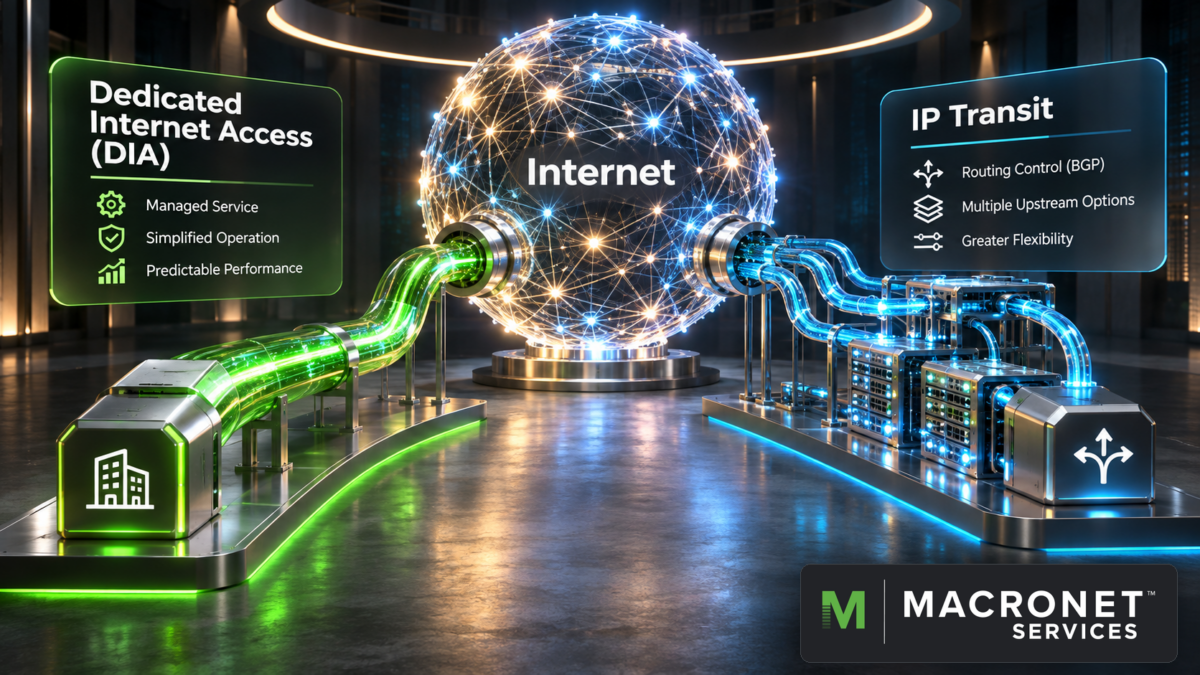
The fundamental difference between IP transit and Dedicated Internet Access is usually the service and operating model. DIA is typically purchased as managed Internet connectivity delivered to a business location. IP transit provides broad Internet reachability to a customer network, commonly with greater autonomy over interdomain routing and upstream relationships. Neither definition is absolute: DIA can support BGP, and transit can be delivered to an office rather than only to a data center.
That distinction matters because enterprise Internet design is not merely a bandwidth purchase. The service choice affects how public-facing applications remain reachable, who troubleshoots outages, how much carrier independence is possible, and what the organization must operate itself. This guide compares the two models from an engineering, operational, and commercial perspective and explains when each is appropriate.

Macronet Services provides free global network design and unbiased circuit sourcing to help organizations select the right architecture and providers.
IP Transit vs. DIA: At-a-Glance Comparison
| Dimension | Dedicated Internet Access (DIA) | IP transit |
| Primary purpose | Managed Internet access delivered to a customer location | Broad Internet reachability supplied to a customer network |
| Typical deployment | Headquarters, branch, campus, data center | ISP, hosting platform, SaaS infrastructure, data center, network-intensive enterprise |
| Delivery | Often includes local access to an agreed demarcation | Often handed off at a carrier POP or interconnection facility; delivered options exist |
| Routing model | Frequently static/default routing; BGP may be supported | Frequently BGP; default-route options may also be available |
| Customer-owned ASN | Usually unnecessary | Common for independently operated or multihomed networks, but not universal |
| Public addressing | Often provider-assigned | Often customer-controlled or provider-supported |
| Operations | Provider handles contracted access and core routing; customer manages its network | Customer often manages Internet-edge routing, equipment, monitoring, and security |
| Pricing | Access plus Internet service commonly bundled | Ports, cross connects, transport, and operations may be separate |
| Best fit | Buyers favoring simple service delivery and clear support ownership | Buyers needing routing autonomy, network-scale capacity, or upstream flexibility |
These are typical characteristics, not universal technical rules. Actual carrier products, service schedules, and demarcations take precedence over the label on a quote.
1. What Is Dedicated Internet Access (DIA)?
Dedicated Internet Access is an enterprise Internet service with a contracted bandwidth rate and a defined handoff. It is commonly delivered through dedicated access infrastructure connecting a business location to an ISP point of presence, after which traffic traverses the provider’s backbone and its interconnections to the rest of the Internet. The Macronet Services DIA guide covers access technologies and enterprise deployment options in greater depth.
In a conventional deployment, the customer connects its firewall or router to the carrier’s Ethernet handoff. The business may use provider-assigned public addresses and a default route toward the ISP. The carrier maintains the routing infrastructure that connects the customer to remote Internet networks, while the enterprise remains responsible for its own applications, LAN, security policies, and customer-managed equipment.
The word dedicated describes the contracted access service, not a private end-to-end path across the whole Internet. Backbone capacity, peering, destination networks, congestion, and routing can all affect application performance after traffic leaves the access circuit. A nominally uncongested 1 Gbps DIA connection therefore cannot guarantee that every public cloud or SaaS application will respond quickly.
The delivered-service model is DIA’s principal operational advantage. The carrier may provide or coordinate access fiber, its network handoff, and support under one agreement. Some elements—special construction, premises equipment, managed security, inside wiring, and extra public addresses—may nevertheless be separately priced. Buyers must confirm exactly what the order includes. The service commitment also needs careful reading: a network SLA does not guarantee every application on the Internet. See the Macronet Services guide to Tier 1 ISP SLAs for the contractual details.
DIA is frequently the most sensible starting point for offices, campuses, branches, and enterprises whose principal requirement is dependable access to cloud applications, employees, and partners without independently operating global Internet routing.
2. What Is IP Transit?
IP transit is a service in which one network purchases broad Internet reachability from another. The Internet is not a single centrally managed system; it is a collection of independently operated Autonomous Systems (ASes) that exchange routing information and traffic. A transit provider carries its customer’s traffic toward destinations reached through its own network, customers, peers, and any other upstream arrangements it uses. TeleGeography’s explanation of IP transit provides useful industry context.
A conventional transit customer operates its own Internet-facing network. A hosting company, for example, may place edge routers in a carrier-neutral data center, establish a BGP session with an upstream carrier, and announce public IP prefixes it is authorized to originate. It can use the same approach with additional carriers, creating greater freedom to change upstreams or influence outbound paths. The customer may receive a default route, selected routes, or the full Internet routing table, depending on what its design actually requires.
Transit is often purchased at a provider point of presence or inside a data center where carriers already have equipment. A cross connect may be enough to reach the provider’s port. But the quoted transit rate may not include the cross connect, an Ethernet port, transport to another facility, the customer’s routers, or the team required to maintain the edge. In some arrangements a carrier packages transport and transit into a delivered service. The location and handoff—not the word transit—determine how much additional infrastructure is necessary.
For many businesses, the attraction of transit is not simply a low per-Mbps rate. It is the ability to participate directly in Internet routing, maintain upstream relationships, and integrate Internet reachability into a larger public network. That autonomy creates real responsibilities in routing security, availability monitoring, failure handling, and change control. Organizations without such needs may find the simpler DIA model more appropriate. For a deeper technical treatment, see the Macronet Services IP Transit Guide.
3. The Most Important Difference Is the Operating Model
The same carrier can supply DIA to an office and transit to a hosting operator using essentially the same backbone, optical transport, and router infrastructure. Neither service is necessarily faster merely because of its product name. The meaningful differences tend to lie in what the provider delivers, how public addressing and routing are controlled, what is included in the price, and who owns each operational task.
In a typical DIA agreement, the customer buys a usable Internet service at a named location. The carrier handles global routing and, where contracted, coordinates delivery of the local access circuit. The customer focuses on its network edge and applications. With conventional customer-managed transit, the organization may maintain its own BGP policy, prefix announcements, and upstream relationships. This offers more autonomy but can create a more complicated incident response model when cross connects, transport, routers, and transit are contracted separately.
Three popular rules of thumb are misleading. DIA can support BGP when the carrier offers the feature. A single IP transit provider is not a redundant design just because it uses BGP. And transit is not inherently higher-performance Internet: the physical path and interconnections matter much more than the product label.
These observations suggest a better buying question than “Which product is superior?”: Does the business need a carrier-managed Internet connection, or does it need to operate an independently routed Internet network? The rest of the decision follows from the answer, the existing infrastructure, and the service-level and commercial terms.
4. How DIA and IP Transit Are Architected
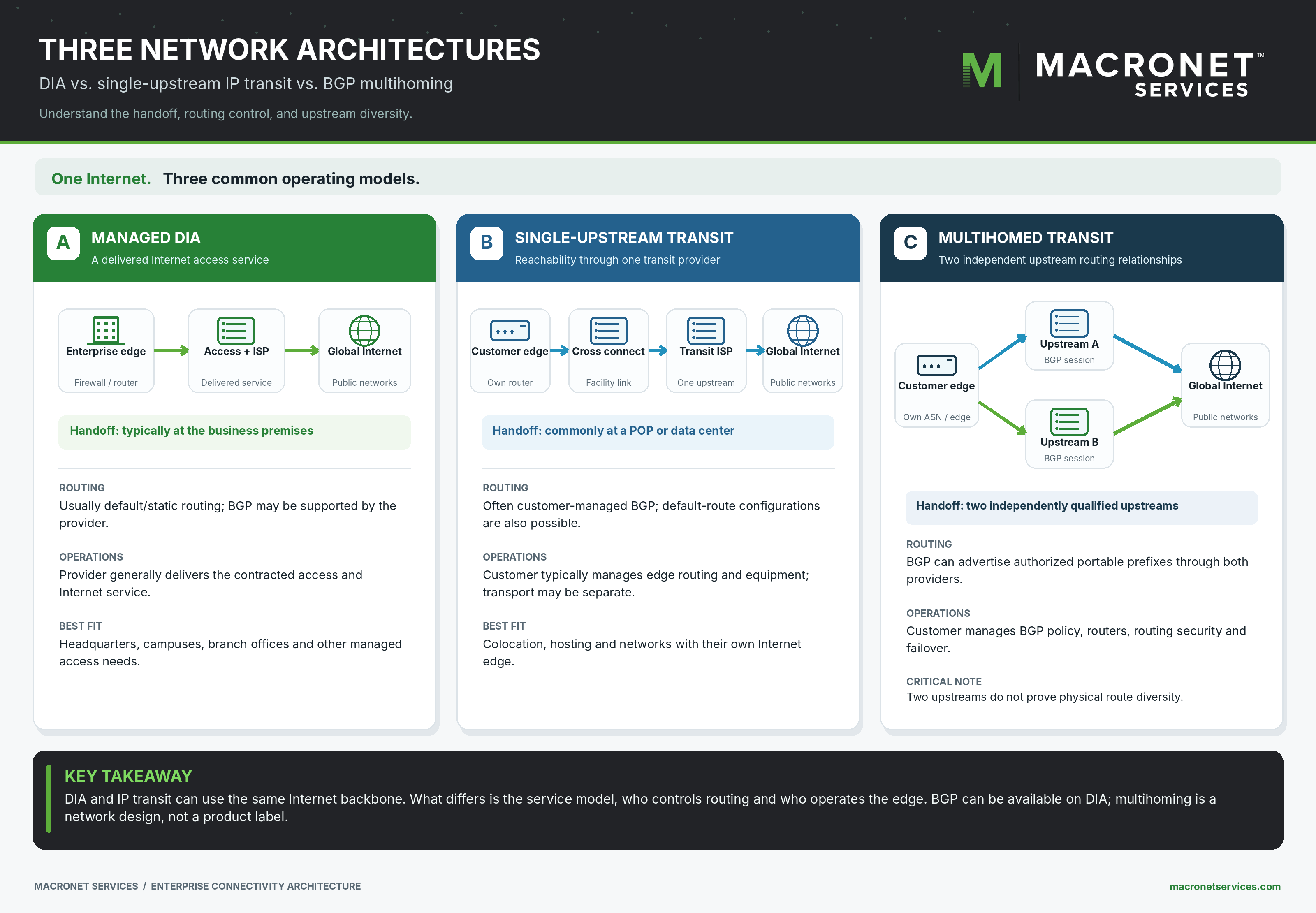
Three architectures expose the essential differences. The first is conventional enterprise DIA: users and applications connect through an enterprise firewall or router, then through a provider-delivered access service to the ISP’s backbone. A default route is often sufficient. The enterprise owns its internal network and security configuration; the carrier operates the contracted external connectivity.
The second is single-upstream transit: customer routers connect through a data center cross connect or transport circuit to a transit provider. The customer can operate BGP, announce authorized prefixes, and receive the route information appropriate for its requirements. Yet the network still depends on one upstream. Calling this architecture IP transit does not make it multihomed.
The third is multihomed transit: the customer maintains separate routing relationships with two or more upstream providers, frequently using a public ASN and portable prefixes. This can preserve public address reachability when one upstream fails, subject to routing convergence, physical diversity, and correct customer-edge operation. It also introduces choices about route filtering, outbound preferences, redundant routers, and the protection of stateful applications. Similar BGP capabilities may be available from suitable DIA products.
A critical design principle applies to all three: physical transport is not the same service as Internet reachability. A 10G Ethernet circuit between an office and a data center moves traffic between those endpoints; by itself, it does not provide global Internet routes. Conversely, a 10G transit port at a carrier POP is not necessarily a delivered 10G office Internet service. A cross connect, metro transport, or fiber build may still be needed. Our Data Center Cross Connect Guide explains the physical interconnection layer behind many such designs.
The demarcation point should be unmistakable on the design and in the contract. For every segment, an enterprise should know which party owns the equipment, who monitors the connection, who opens a ticket, and who coordinates restoration. The architecture is only complete when those responsibilities are clear.
5. How BGP Changes Routing Control
Border Gateway Protocol (BGP) exchanges reachability information among independently operated networks. A traditional DIA customer may send all Internet-bound traffic to the carrier using a default route, while a network operating BGP can choose from additional routing information and advertise the prefixes it is authorized to originate. The IETF’s BGP-4 specification, RFC 4271, defines the protocol; the Macronet Services BGP guide explains the enterprise implications.
With multiple upstreams, an organization can apply policy to outbound traffic by preferring particular routes. BGP local preference, for example, is used within an autonomous system to express relative preference among available paths. The same organization can try to influence inbound traffic with provider-specific BGP communities or AS-path prepending, but it cannot dictate how all other networks make routing choices. Remote providers ultimately apply their own policies.
A transit customer need not download and maintain every Internet route. Default-only, partial-route, and full-table arrangements each have legitimate uses. Full routes may offer flexibility to a sophisticated network operator, but demand equipment capacity and operational skills; a business that simply needs failover may require much less.
BGP also is not a substitute for application monitoring. A session can remain established while packets are lost beyond the neighboring router, while a path becomes congested, or while the application itself fails. Route changes also do not necessarily preserve existing TCP or firewall state. Resilience must be measured at the application level, not inferred from a green BGP session indicator.
A customer operating public BGP needs appropriate route filtering, prefix authorization, change control, and protection against route leaks. The IETF’s BGP Operations and Security guidance, RFC 7454, is a useful authoritative reference. These obligations are a real part of the operating cost of customer-managed transit. They may also apply to a BGP-enabled DIA deployment, illustrating again why routing design and service label should not be conflated.
6. Do You Need Your Own ASN and Public IP Addresses?
A conventional enterprise buying a single DIA service usually does not need a public Autonomous System Number (ASN). Provider-assigned addresses and ordinary routing often suffice. An organization that wants to originate independently assigned public prefixes across multiple upstream providers has a stronger reason to obtain and maintain its own public ASN and portable address space. The ARIN resource-request guide explains eligibility and administration in its service region.
This distinction becomes commercially important when changing carriers. An organization using addresses assigned from Provider A’s allocation may need to renumber VPN endpoints, allowlists, customer integrations, and public application addresses when it leaves that provider. Properly registered provider-independent resources can reduce that dependency, provided each chosen upstream accepts the prefixes and the announcements satisfy routing policies.
Portable addresses are not magic. Internet route acceptance is subject to filtering policies and prefix-length conventions; overly specific announcements may not propagate broadly. Operators also need accurate registry information, Internet Routing Registry records where used, and Route Origin Authorizations that identify the authorized originating ASN. RPKI helps validate route origins but does not prove every hop in an AS path is secure.
IPv6 deserves the same attention as IPv4. A business may have two functioning IPv4 paths but only one IPv6 upstream, creating an overlooked single point of failure for dual-stack applications. Addressing, BGP policy, monitoring, and failover must be assessed for both protocols.
The practical decision is not whether every sophisticated enterprise should own an ASN. It is whether public address portability and independent routing deliver material value. For organizations that mainly consume SaaS services, diverse managed DIA often provides resilience without the burden of operating an independent public network.
7. Is IP Transit Faster Than DIA? Performance, Peering, and Latency
Neither product is inherently faster. A 10 Gbps transit service and a 10 Gbps DIA service may enter the same global backbone and traverse identical interconnections. Bandwidth determines the contracted capacity; it does not guarantee a short path to a cloud region or a low-latency experience for every application.
The relevant measures are latency, packet loss, jitter, path stability, and sustained throughput to important destinations. A carrier with a direct, well-provisioned interconnection to an application provider may deliver a better path than a competitor that reaches the same application through a more circuitous network. Yet a direct peering relationship is not itself a performance guarantee: geography, routing policy, capacity, and the destination network all matter.
For an office accessing Microsoft 365 or a cloud contact center, a well-engineered DIA service can be excellent. A transit customer with multiple upstreams may have greater freedom to select outbound paths, but BGP does not automatically choose whichever path has the least congestion. Remote networks decide how inbound traffic reaches the customer; changes may take time to propagate and may not preserve active application sessions.
Providers should be compared using real traffic and representative destinations. Tests should include application-level measurements, multiple times of day, latency and loss analysis, routing views, and planned failure scenarios. RIPE Atlas provides a platform for distributed Internet measurements, while the Macronet Services global latency examples help illustrate what carrier performance data can—and cannot—tell enterprise buyers.
A global Tier 1 carrier can offer substantial backbone reach, but its category does not independently guarantee the best application path from every enterprise building. A regional provider with strong local access and interconnections may be preferable for certain locations. The Macronet Services comparison of leading global Tier 1 ISPs provides context for evaluating backbone and geographic characteristics.
The performance decision should follow the application, not the product label. Ask which networks the business needs to reach, from which locations, and under what acceptable latency, loss, and availability thresholds.
8. SLAs, Support, and Who Owns an Outage
Both DIA and IP transit can include serious service-level commitments. An IP transit SLA is not inherently weaker, and a managed DIA SLA is not an assurance of continuous application availability. The decisive questions are where the SLA begins and ends, which service components it covers, and who must act when a failure occurs.
Consider an office whose fiber lateral is cut during roadwork. Under a fully delivered DIA agreement, the selling ISP will often serve as the primary restoration contact even if it obtains the underlying access from a local carrier. That simplifies coordination, although it cannot eliminate the practical repair dependencies. By contrast, a self-managed transit design may involve a data center cross connect, separate transport, customer routers, and the transit carrier, each potentially governed by a different agreement.
If Internet traffic stops flowing, the customer must determine whether the failure is at the physical port, in the transport, within its own routing policy, or beyond the provider’s backbone. That task is routine for an experienced network operations center but may create avoidable delays for an enterprise without the appropriate skills and monitoring. The converse is also true: an experienced network operator may prefer direct access to multiple upstream providers and its own diagnostic tools.
SLAs should distinguish backbone latency commitments from end-to-end application experience, and network availability from actual business continuity. A credit against monthly recurring charges is typically much smaller than the cost of a major customer-facing outage. For this reason, enterprises must design failover and restoration around business recovery objectives, not solely around the advertised availability percentage. The Macronet Services Tier 1 ISP SLA guide explains what to examine in service schedules.
An operational responsibility matrix is useful in either model. Name the owner of access circuits, cross connects, customer routers, BGP policy, security, monitoring, and escalation. If a component is separately contracted, record which party will coordinate a multi-provider incident. The most resilient technical design can fail operationally when the handoffs between teams are ambiguous.

9. IP Transit vs. DIA Costs: Compare the Whole Solution
Wholesale IP transit can be exceptionally competitive at carrier-dense facilities, particularly when the customer already operates routers, security systems, and network support. DIA frequently appears more expensive per Mbps because the quotation may include delivery to a business premises, local access, and a broader managed-service scope. These are different commercial packages, not just different rates for identical products.
Transit buyers should determine whether the quoted price includes physical ports, cross connects, metropolitan transport, public address allocations, setup charges, and any burstable bandwidth. They must also account for their own equipment and the cost of operating it. DIA buyers should examine construction charges, local-loop delivery, equipment, upgrade provisions, and renewal terms. A fair comparison measures the total cost of two technically equivalent solutions over the same contract term.
The following hypothetical 10 Gbps scenario illustrates the issue. It assumes a company already has suitable network infrastructure available at a carrier-neutral data center. The figures are deliberately illustrative, not market quotations or a promise of achievable pricing.
| Cost component | Managed DIA | Customer-operated transit |
| Internet service | $2,350/month | $1,400/month |
| Separate port | Included | $300/month |
| Cross connect | $250/month | $250/month |
| Incremental equipment and operations | $150/month | $450/month |
| Total recurring charges | $2,750/month | $2,400/month |
| One-time implementation | $1,500 | $2,500 |
| Total over 36 months | $100,500 | $88,900 |
The headline bandwidth difference is $950 a month, but once the other recurring components are counted, the monthly gap is $350. The modeled transit solution saves $11,600 over 36 months. An additional $350 a month in previously excluded transport or management costs would reverse that result: $101,500 for transit versus $100,500 for DIA.
The point is not that either model always wins. The cost of existing infrastructure, network expertise, and the service demarcation can dominate the result. Multihoming and physical diversity may also increase both designs’ costs, so resilience specifications must be identical before making a financial decision. Our published Tier 1 ISP Pricing: Dedicated Internet and IP Transit Costs Explained contains detailed DIA and transit benchmarks, contract guidance, and bandwidth-billing examples; this article focuses on which service model to purchase.
10. Where Can Enterprises Buy DIA or IP Transit?
DIA is commonly delivered to headquarters, campuses, factories, and branch offices. Whether a carrier is on-net at a particular building can have a major effect on cost and installation time. If the selling ISP lacks direct access, it may arrange third-party local loops or fiber construction and incorporate those costs into the delivered service.
IP transit is commonly handed off at data centers and carrier POPs, where a customer can connect to multiple upstream networks over cross connects. That geography can make it easier to add bandwidth or change providers, but it does not remove the need for a physical path from the customer’s equipment to the transit port. A remote campus can purchase transit through separately contracted transport or a bundled delivery arrangement if the carrier supports it. Equally, a colocation tenant with straightforward routing needs can buy DIA rather than operating BGP transit.
Carrier-neutral facilities offer a practical advantage for network-intensive organizations: competing carriers may already be present, making provider choice and interconnection relatively efficient. Still, carriers can share meet-me rooms, entrances, or metropolitan fiber dependencies. For high-availability deployments, physical route review should be part of service qualification, not an afterthought. The Data Center Connectivity guide explains how carrier ecosystems and interconnection arrangements influence the design.
Geography remains fundamental. A service readily available in a dense metropolitan carrier hotel may require construction or costly backhaul at another location. Consequently, a global enterprise should resist imposing an identical Internet product across every building. It may be better served by managed DIA in some markets, transit at strategic regional hubs, and regional access providers where they offer superior local infrastructure.
11. Dual DIA, BGP Multihoming, and True Internet Resilience
Two DIA circuits can provide useful enterprise redundancy without an independently operated public ASN. A firewall or SD-WAN platform can monitor reachability and shift outbound traffic to a backup provider. For employees consuming SaaS applications, this is often an effective and operationally manageable model. But the public source address may change when traffic switches carriers; active sessions or partners that enforce IP allowlists can require reconnection or reconfiguration.
An organization operating portable public prefixes can pursue a different model: advertise its authorized addresses through multiple BGP-capable upstreams. That architecture, often implemented with IP transit, may allow external users to continue reaching the same public IP space after one provider fails. BGP-enabled DIA can also support such an arrangement when the relevant carriers accept the prefixes and routing design. Neither architecture guarantees zero interruption: route convergence, load balancer behavior, firewall state, and the application itself affect recovery.
Physical risk must be assessed independently of routing. Two carrier logos do not ensure separate building entrances, ducts, poles, aggregation facilities, or power dependencies. Nor do two upstream links remove a single customer-edge router or firewall as a point of failure. For critical applications, the design should include appropriate equipment redundancy, verified or documented diversity assumptions, and realistic failover tests.
There is also a difference between surviving a circuit failure and surviving a site failure. Multihoming cannot restore a service hosted entirely in a destroyed or unreachable data center. Geographic application redundancy may require replicated infrastructure, DNS or load-balancing controls, and additional operational procedures. The BGP Multihoming Guide and Dual ISP Redundancy Guide address these complementary routing and physical-design concerns.
The buying question should be phrased in business terms: Which failures must the organization survive, how quickly must it restore service, and must customers retain the same public addresses? Those answers identify whether simple dual access, BGP multihoming, or a broader application-resilience strategy is justified.
12. IP Transit vs. Peering, Internet Exchanges, and Cloud Interconnects
Transit, peering, an Internet exchange connection, and a private cloud interconnect are related but not interchangeable products. The distinction is which networks become reachable and which routing relationship makes that reachability possible.
Transit generally provides broad Internet reachability through an upstream network. Peering exchanges traffic for destinations permitted under an agreement between specific networks; it ordinarily does not grant unrestricted access to every Internet destination. An Internet Exchange Point (IXP) provides shared interconnection infrastructure through which operators can establish peering. Route servers may simplify route exchange, but the route server itself does not carry participants’ user data. The IETF’s RFC 7948 explains route-server operation and its limits.
Larger ISPs, hosting providers, and content networks commonly combine paid transit with direct or exchange-based peering. This can improve path efficiency and reduce transit carried for selected destinations, but peering entails port, transport, operations, and sometimes commercial charges. An ordinary enterprise consuming SaaS services generally benefits from its carrier’s interconnections without needing to operate its own peering program.
Private cloud connectivity serves a different role. Services such as AWS Direct Connect, Azure ExpressRoute, Google Cloud Interconnect, and OCI FastConnect connect organizations to supported cloud resources or public cloud services according to the provider’s specific routing model. For example, AWS distinguishes private, public, and transit virtual interfaces; the Direct Connect transit virtual interface is an AWS Transit Gateway mechanism, not wholesale global IP transit. AWS states that its public virtual interface does not provide reachability to non-Amazon public prefixes. See the AWS virtual-interface documentation and Google Cloud Interconnect FAQ.
| Service | Reachability purpose | Typical buyer |
| DIA | Managed access to the public Internet | Enterprise offices, campuses, facilities |
| IP transit | Broad Internet reachability for a customer network | ISP, hosting provider, enterprise Internet edge |
| Peering | Routes exchanged under a specific interconnection relationship | Networks with traffic worth interconnecting directly |
| IXP port | Access to shared infrastructure for establishing peering | ISPs, content networks, network-intensive operators |
| Private cloud interconnect | Connectivity to supported cloud networking resources | Hybrid and multi-cloud enterprises |
A single enterprise may use all of these when workloads justify them. An office can use DIA for employees, a data center can buy transit for public applications, and private cloud circuits can carry data between particular cloud and enterprise networks. The Macronet Services Multi-Cloud Networking Guide explores how to integrate these components without creating unnecessary backhaul, cost, or routing complexity.
13. Which Service Is Best? Five Enterprise Scenarios
The best way to understand the choice is to follow the applications and operating responsibilities. Organizations with the same number of employees or the same bandwidth requirement can reasonably select different Internet architectures.
Corporate headquarters: favor managed DIA
A financial services company with 1,000 employees relies on Microsoft 365, CRM, video, secure remote access, and hosted financial applications. It operates internal firewalls and SD-WAN, but has no business reason to originate independent public prefixes. Its most important goals are predictable access, clear carrier support, and continuity through a local circuit failure. Managed DIA, usually with a physically diverse secondary connection where justified, is the logical starting point. Buying transit and operating public BGP would add responsibility without automatically improving the performance of its SaaS applications.
SaaS platform in colocation: evaluate multihomed transit
A software company serves paying customers from two carrier-neutral data centers and operates its own Internet-edge routers. It values portable public addresses, independence from any one upstream, and the ability to engineer outbound traffic. Here, BGP-capable IP transit from multiple qualified providers can be a strong fit. But the network plan must also address DDoS mitigation, firewall redundancy, load balancing, application replication, and how customers are steered between facilities. A robust Internet edge cannot compensate for an application with one underlying failure domain.
Multinational manufacturer: use a hybrid architecture
An international manufacturer has offices, plants, distribution centers, and regional hosting facilities. Most sites need locally delivered access to SaaS applications; a few data centers support public services and specialized routing. A blanket policy of buying transit everywhere would be inefficient. A more rational model uses competitive local DIA at distributed facilities, with transit or BGP-enabled access only where public routing autonomy creates value. Regional provider availability, network architecture, and the degree of physical diversity may have more effect on outcomes than standardizing on one carrier brand.
AI and data-intensive enterprise: separate the traffic classes
A healthcare technology company consumes cloud AI APIs, exchanges datasets with cloud platforms, and plans to operate an inference service in colocation. Employees consuming AI services may need only high-quality DIA. Bulk data transfers may justify private cloud connectivity or other high-capacity transport. The public inference platform may use transit if the company operates its own autonomous Internet edge; alternatively, a managed cloud delivery architecture may be preferable. Treating every AI workload as a reason to buy Internet transit would confuse distinct network requirements.
Regional ISP: transit is a core input
A regional ISP delivers Internet service to downstream subscribers. It needs broad Internet reachability, capacity planning, its own routing policy, and often multiple upstream choices. Wholesale transit is a natural network input, potentially supplemented by direct peering and IXP participation as traffic grows. In this case, managing upstream relationships is part of the business rather than an unnecessary IT burden.
These scenarios point to one practical principle: buy only as much routing autonomy as the business can use effectively, and place it only where the application and operational model justify it.
14. Cloud Computing and AI: New Network Requirements, Different Answers
Cloud and AI adoption are increasing the consequences of connectivity decisions, but they do not erase the distinctions among Internet access, public application delivery, private cloud transport, and internal compute fabrics. A company adopting a cloud-hosted AI assistant may need dependable Internet access and sound security policy; it does not suddenly become an ISP or need an ASN.
AI API consumption generally resembles other SaaS traffic: applications send requests to provider endpoints and receive responses. Network latency and reachability matter, but model compute time, payload design, and cloud-side behavior may contribute more to user experience than the difference between DIA and transit. The appropriate first step is to measure actual requirements rather than presume that higher-capacity transit will make every AI workload faster.
Public inference hosting creates different needs. A business serving customers from its own colocation infrastructure may need scalable inbound connectivity, DDoS protection, consistent public addressing, and multiple upstreams. If the company operates independent public routes, transit may become attractive. If inference runs inside a hyperscaler, the cloud provider’s own Internet edge and managed application delivery services can make customer-operated transit unnecessary.
Large transfers between data centers and clouds are yet another category. Their economics depend on data volume, transfer frequency, cloud egress charges, security, geography, and available private interconnection options. A private cloud circuit may be better for some flows, while well-designed Internet access suffices for others. Public and private connectivity should be compared as a complete architecture rather than assumed to be interchangeable.
Finally, GPU-to-GPU training communication inside a cluster is a specialized east-west fabric problem. NVIDIA’s enterprise AI networking architecture guidance distinguishes internal compute, storage, and external network domains. A 100G transit port is not a substitute for the cluster’s required high-performance network.
The result is a more disciplined design model. Identify user-to-application access, public customer traffic, cloud-to-cloud data movement, and cluster-internal traffic separately. Then choose DIA, transit, private interconnect, and specialized network fabrics according to the needs of each flow. AI increases the importance of network architecture; it does not create a universal need for IP transit.
15. A Decision Framework for CIOs and Network Architects
Five questions can narrow the options before an enterprise requests carrier quotations. First, does the organization primarily consume online applications or operate its own independently routed public-facing network? Second, does it need portable prefixes and customer-directed BGP policy? Third, where is its infrastructure, and can it reach multiple qualified providers economically? Fourth, who will manage routing, security, monitoring, and incident response? Finally, which architecture satisfies application and resilience requirements at the lowest complete cost?
| Business requirement | More natural starting point | Important qualification |
| Employees and branch locations consuming SaaS | Managed DIA | Consider diverse backup access and real application-path performance |
| Customer-owned public prefixes and multihomed BGP | Transit or BGP-enabled DIA | Confirm ASN, prefixes, route support, and operational skills |
| High-capacity Internet in carrier-neutral colocation | Transit often attractive | Compare port, cross-connect, equipment, transport, and staff costs |
| Numerous distributed offices | Managed DIA at most sites | Regional availability and local access economics can vary widely |
| Public application platform requiring carrier independence | Multihomed transit often appropriate | Application and physical redundancy remain separate requirements |
| Large transfers to cloud resources | Evaluate private cloud interconnect as well | Check cloud charges, geography, and traffic patterns |
| Specialized AI training fabric | Neither DIA nor transit is a substitute | Design compute fabric separately from external uplinks |
The service decision should follow a documented set of network outcomes. For example, an enterprise operating a headquarters and a nearby data center should not automatically backhaul public customer traffic through headquarters simply because that site already has Internet access. It should determine where applications run, what public addressing they require, whether customer traffic benefits from localized interconnection, and whether the business has staff to manage an independent edge.
The framework also suggests when not to add complexity. A second independent DIA circuit may solve the actual resilience problem for a cloud-dependent office. A full-table BGP transit architecture might contribute little beyond operational overhead. Conversely, a SaaS platform needing portable addresses across upstreams should not be forced into a provider-assigned addressing plan merely because the initial circuit quotation is cheaper.
Where multiple technologies are justified, a hybrid model is often best: managed DIA for employees and distributed facilities; carefully engineered transit at selected network hubs; and private cloud connectivity for traffic that warrants it. The Macronet Services Network Infrastructure Assessment Guide explains how a business-first inventory and application assessment lead to a more defensible future-state architecture.

16. What to Ask Carriers Before Buying DIA or IP Transit
A competitive carrier proposal is useful only when its scope is unambiguous. Two bids advertising the same port speed can differ fundamentally in local access, routing, IP addressing, fault ownership, installation costs, and expansion flexibility. Enterprises should qualify the service before comparing the price.
Start with physical delivery. Require the exact address, provider handoff, demarcation, port specification, and a clear statement of whether local transport, construction, cross connects, and premises equipment are included. Establish who owns the physical infrastructure and who coordinates restoration across subcontracted access carriers. For diverse services, seek available route evidence and document any shared risks that cannot be independently verified.
Next, specify bandwidth and routing. Port speed is not the same as a committed information rate. Where bursting is supported, the provider must state the sampling period, measurement direction, usage calculation, and overage price. For BGP, confirm permitted customer ASNs, accepted prefixes, offered route views, supported communities, prefix limits, and any IRR or RPKI requirements. Ask whether the proposed product handles both IPv4 and IPv6 under the intended routing and failover model. Equinix’s Internet Access billing documentation illustrates why fixed and burstable contracts must be evaluated differently.
The third dimension is service operations and protection. Define which party manages the edge router, BGP configuration, security policies, monitoring, and outage escalation. Determine whether DDoS mitigation is included, optional, or provided by another vendor, and how it is activated. Compare actual SLA terms, not headline availability percentages; an SLA covering a carrier POP is not identical to a fully delivered access SLA at the building.
Finally, normalize commercial and implementation terms: recurring charges, one-time fees, any special construction, renewal and escalator provisions, contract flexibility, bandwidth upgrades, termination exposure, and expected acceptance testing. A carrier should demonstrate the delivered interface, intended routing, public reachability, service performance, and failover behavior where applicable before the project is accepted.
| Qualification area | Minimum required clarification |
| Demarcation and access | Exact handoff, local loop, transport, construction, responsibility |
| Port and bandwidth | Physical speed, committed rate, burst rules, usage billing |
| Internet routing | Default/full routes, BGP options, ASN and prefix support |
| Addresses and security | IPv4/IPv6, prefix authorization, DDoS and filtering scope |
| Resiliency | Carrier routes, shared infrastructure, customer equipment, failover tests |
| SLA and support | Covered components, measurements, credits, ticket ownership |
| Commercial terms | MRC, NRC, upgrades, renewal, escalation, and termination |
| Acceptance | Physical, routing, performance, and application-level test plan |
The goal is not to require every technical feature from every branch connection. It is to make sure that mandatory capabilities are stated clearly, that optional complexity is not inadvertently purchased, and that proposals can be compared on an equivalent basis. The Macronet Services guide to obtaining a global Tier 1 ISP quote provides additional sourcing context.
17. How Macronet Services Helps Enterprises Design and Source the Right Connectivity
Choosing between DIA and transit is rarely a stand-alone bandwidth decision. An enterprise may need managed access at offices, independent routing at data centers, cloud interconnection for particular workloads, and physically diverse carriers at critical facilities. Those components should be designed together before selecting a provider.
Macronet Services has designed hundreds of network topologies globally and works across relationships with more than 400 telecommunications service providers. We help enterprises evaluate carrier availability, routing and public IP requirements, backbone reach, access infrastructure, resiliency, SLAs, operational ownership, and total commercial cost. The objective is a technically appropriate network at competitive terms—not forcing every location into one carrier or product category.
Once requirements are established, Macronet Services can coordinate competitive carrier sourcing and normalize proposals against the same architecture. For qualifying sourcing engagements, network design and carrier sourcing assistance is typically available at no direct cost to the client, subject to the engagement scope and commercial arrangements.
Whether the requirement is a single DIA circuit, multihomed IP transit, a global Internet refresh, or a combined carrier and cloud connectivity project, we help organizations understand what they are buying, how the network will work, and who will be responsible for operating it.
Request an Enterprise Internet Design and Carrier Pricing Review from Macronet Services.
Conclusion: Choose an Architecture, Not a Product Label
DIA and IP transit both deliver access to the global Internet. The difference is most often how the service is delivered and operated: a managed, location-based access model versus a customer-operated network buying Internet reachability and potentially exercising greater routing independence. Their boundaries overlap, and either can be the correct choice in a well-designed enterprise network.
The decision should begin with the applications. A cloud-dependent office usually needs dependable managed access and suitable backup connectivity. A hosting platform with independent public routing needs may benefit from multihomed transit. A multinational business can use both models where they fit, alongside private cloud circuits and other transport services.
The best Internet solution is not the one with the most sophisticated routing or the lowest advertised cost per Mbps. It is the architecture that delivers the necessary application performance, support, resilience, and flexibility at a competitive total cost.
Frequently Asked Questions About IP Transit vs. DIA
What is the main difference between IP transit and DIA?
DIA is commonly a managed Internet service delivered to a business location. IP transit commonly supplies broad Internet reachability to a network that manages more of its own routing. The distinction is mainly contractual and operational, not a completely different physical Internet technology.
Is IP transit the same as Dedicated Internet Access?
No, although the services can share the same backbone and Ethernet infrastructure. DIA often bundles local access and carrier support, while transit may be handed off at a carrier POP and require additional interconnection and customer operations.
Is IP transit cheaper than DIA?
It can be cheaper per Mbps, particularly where a buyer already has routers and access to multiple carriers. Once transport, ports, cross connects, equipment, and support are counted, the total cost may be higher or lower. Compare equivalent delivered architectures.
Is IP transit faster than DIA?
Not inherently. The real path to an application, its interconnections, congestion, distance, and packet loss matter more than the service label. BGP can provide additional route choices, but it does not guarantee the lowest-latency path.
Can DIA support BGP?
Yes. Some DIA products permit customer BGP sessions and authorized public prefix advertisements. Confirm the carrier’s routing options in writing; BGP support should not be assumed or rejected solely based on the product name.
Do I need a public ASN for IP transit?
Not in every transit arrangement. A public ASN is common when a customer independently originates portable prefixes and connects to multiple upstream providers. Simpler provider-supported routing models may not require one.
Does IP transit include a local access circuit?
Not always. Transit is frequently quoted at a POP or data center and may need separately purchased transport or cross connects. Some carriers also offer delivered transit packages. The order must identify the handoff and included infrastructure.
Can IP transit be delivered to an office rather than a data center?
Yes, where suitable transport and provider delivery arrangements are available. A customer router can connect to an upstream transit service from an office, but the extra access infrastructure must be included in the design and price.
Does IP transit include an SLA?
Many providers offer transit SLAs. Their scope may cover backbone and interconnection performance but exclude separately contracted transport, cross connects, or customer equipment. Read the actual service schedule and fault boundaries.
Can enterprises use two DIA carriers without BGP?
Yes. Firewalls and SD-WAN platforms can redirect outbound access to a backup DIA circuit. The public IP address may change during failover, which can interrupt sessions or affect partners using static IP allowlists.
Do I need IP transit for BGP multihoming?
No. BGP multihoming is a routing architecture. Some providers support the required BGP configuration over products called DIA. The important conditions are routing capabilities, accepted public prefixes, suitable equipment, and correct redundancy design.
Do I need provider-independent public IP space?
Not for ordinary Internet access. Portable addresses are especially valuable when an organization wants to advertise the same public prefixes through multiple upstreams or change carriers without renumbering critical public-facing systems.
What is the difference between IP transit and peering?
Transit provides broad Internet reachability through an upstream. Peering exchanges traffic for routes permitted by a specific relationship; it usually does not provide unrestricted connectivity to all Internet networks. Large operators may use both.
Is an Internet exchange port the same as IP transit?
No. An Internet exchange enables interconnection and peering among participating networks. A connection to the exchange does not automatically provide global Internet reachability or peering with every participant.
Is private cloud interconnect the same as IP transit?
No. Services such as Direct Connect, ExpressRoute, Cloud Interconnect, and FastConnect provide defined access to supported cloud resources and services. They do not inherently substitute for global public Internet transit.
Which is better for enterprise AI workloads: DIA or transit?
It depends on the traffic. Cloud AI API use may need ordinary reliable DIA. Public inference hosted in colocation may justify transit. Large cloud data transfers may benefit from private transport, while GPU training fabrics are a separate internal networking requirement.