Agentic CCaaS: 2026 Guide to AI Contact Centers
Agentic CCaaS: The 2026 Guide to AI Contact Centers, Autonomous Agents and Leading Platforms
Executive Summary: The Contact Center Is Becoming a Resolution Engine
For decades, contact center technology has largely been designed around one fundamental task: connecting customers with people who can help them.
Automatic call distributors routed calls. Interactive voice response systems collected information. CRM systems gave agents context. Omnichannel platforms expanded customer interactions into chat, messaging, email and social channels. More recently, artificial intelligence began summarizing calls, retrieving knowledge, recommending answers and helping human agents work faster.
Agentic AI represents a much more consequential shift.
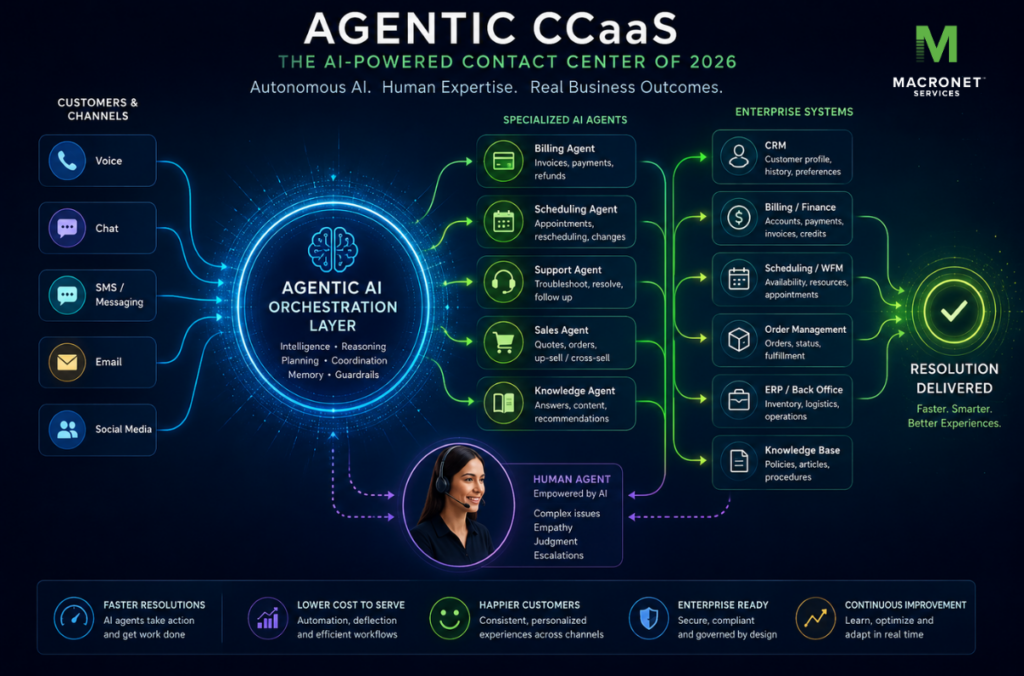
An agentic contact center does not merely answer a customer’s question or help a human agent handle an interaction. It can understand what the customer is trying to accomplish, retrieve relevant information, determine what steps are required, access enterprise systems, take authorized actions, coordinate multiple tasks and potentially resolve the customer’s need from beginning to end.
The contact center is therefore beginning to evolve from an interaction-management platform into a resolution and execution platform.
Gartner predicts that by 2029 agentic AI could autonomously resolve 80% of common customer-service issues without human intervention and reduce operational costs by 30%. Yet Gartner’s May 2026 assessment also cautions that production deployment and demonstrated financial returns remain limited across much of the market.
That combination—extraordinary potential but uneven maturity—makes 2026 an important year for business leaders evaluating contact center technology.
The question is no longer simply:
Does this contact center platform have AI?
Almost every major provider does.
The more important questions are:
What work can the AI actually perform? How autonomously can it perform that work? Which enterprise systems can it access? What controls limit its authority? How reliably can it operate in production? How does it collaborate with human employees? And can the business prove that the customer’s underlying need was successfully resolved?
Those questions form the basis for evaluating Agentic Contact Center as a Service, or Agentic CCaaS.
What Is Agentic CCaaS?
Agentic Contact Center as a Service is a cloud contact center architecture that uses autonomous AI agents to understand customer goals, access enterprise information and applications, determine what actions are required, execute authorized work and resolve customer requests across voice and digital channels.
The important word is action.
A traditional chatbot can tell a customer how to change an airline reservation.
A generative AI chatbot can explain the airline’s change policy more naturally and personalize the answer using information from a knowledge base.
An AI copilot can tell a human customer-service representative which flights are available and recommend what to do next.
An agentic AI system can potentially authenticate the traveler, retrieve the reservation, identify acceptable alternatives, apply fare rules, change the itinerary, calculate the price difference, update the reservation system, send a new itinerary and escalate to a human if the transaction exceeds its authority.
The customer did not simply receive an answer. If you like podcasts, this episode of The Macro AI Podcast: The New CCaaS Stack is a great listen.
The work was completed.
That is the fundamental difference between conversational AI and agentic AI.
Agentic AI does not mean unlimited autonomy. In enterprise environments, unrestricted autonomy is generally undesirable.
A business might allow an AI agent to issue refunds below $100 when predefined conditions are met, require human approval for larger credits and prohibit the AI entirely from certain high-risk transactions.
The goal is therefore not maximum autonomy.
It is controlled autonomy aligned with business policy.
Agentic AI vs. Chatbots, Generative AI and Agent Assist
The terminology surrounding contact center AI has become increasingly confusing.
A useful way to distinguish the technologies is to ask a simple question:
What is the system actually authorized and capable of doing?
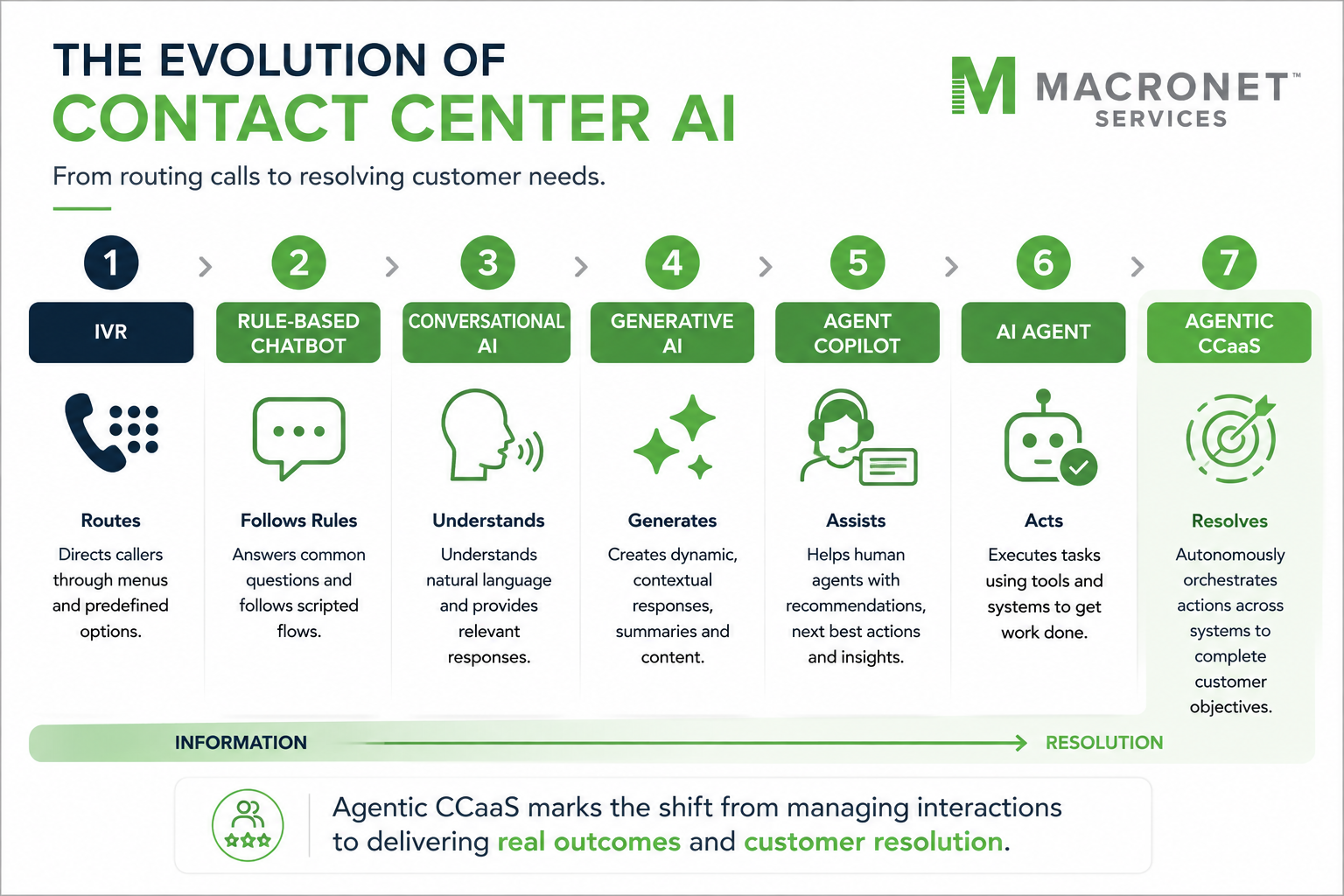
A useful shorthand is:
Generative AI creates. Agentic AI acts.
That distinction will become increasingly important as the term AI agent is applied to products with very different levels of autonomy.
The Agentic CCaaS Maturity Model
One of the largest challenges facing buyers in 2026 is determining whether a product marketed as “agentic” is actually capable of autonomous enterprise execution.
A useful maturity model looks like this:
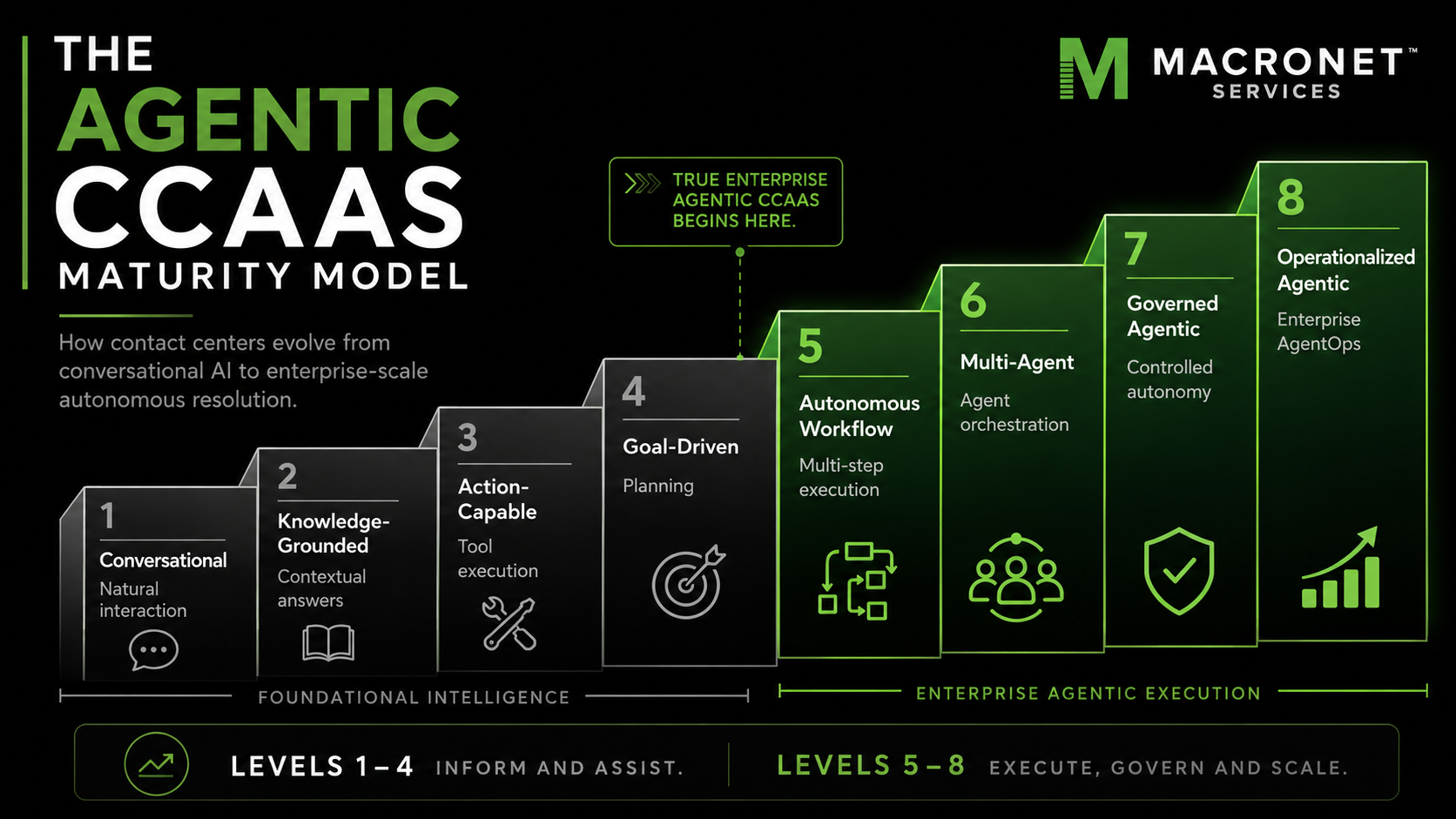
The first two levels describe capabilities that sophisticated chatbots and virtual agents have provided for years.
The transition toward genuine Agentic CCaaS begins when the system moves from providing information to executing work.
But enterprise-grade agentic AI requires more than intelligence and autonomy. It requires governance and operational discipline.
An AI agent capable of processing transactions but lacking reliable testing, permissions, monitoring and auditability may be technically impressive while remaining unsuitable for production.
Why Businesses Are Moving Toward Agentic CCaaS
The most obvious attraction is automation.
But lowering labor expense is only part of the opportunity.
A well-designed agentic contact center can potentially alter the economics, scalability and accessibility of customer service.
Traditional service capacity is constrained largely by human availability. Increased demand generally requires more agents, overtime, outsourcing or longer wait times.
AI agents introduce a different capacity model.
Once properly deployed, autonomous agents can potentially operate around the clock, support large numbers of simultaneous interactions and absorb volume spikes without proportionate increases in frontline headcount.
That can be valuable during product launches, weather events, airline disruptions, billing cycles, seasonal retail peaks and other periods in which demand changes rapidly.
Agentic AI can also reduce one of the most inefficient aspects of customer service: the work between systems.
Human agents frequently spend significant portions of an interaction opening applications, looking up accounts, copying information, updating fields and completing after-call documentation.
An agentic system can potentially perform many of those tasks programmatically.
The result can be a broad mix of operational and customer-experience improvements. Average handle time and after-call work may decline, first-contact resolution and process consistency can improve, and the organization can extend service availability without adding proportional staffing. Agentic AI can also help absorb volume spikes, support multilingual service, reduce some outsourcing requirements and enable more proactive engagement, while creating opportunities in sales, retention and renewals.
The larger opportunity, however, is not merely making today’s contact center cheaper.
It is changing what customer service can accomplish.
Instead of waiting for a customer to report a shipment delay, an AI agent could identify that the shipment is likely to miss its commitment, find an alternative, initiate the appropriate workflow and contact the customer with a proposed resolution.
Customer service moves from reactive interaction handling toward proactive resolution.
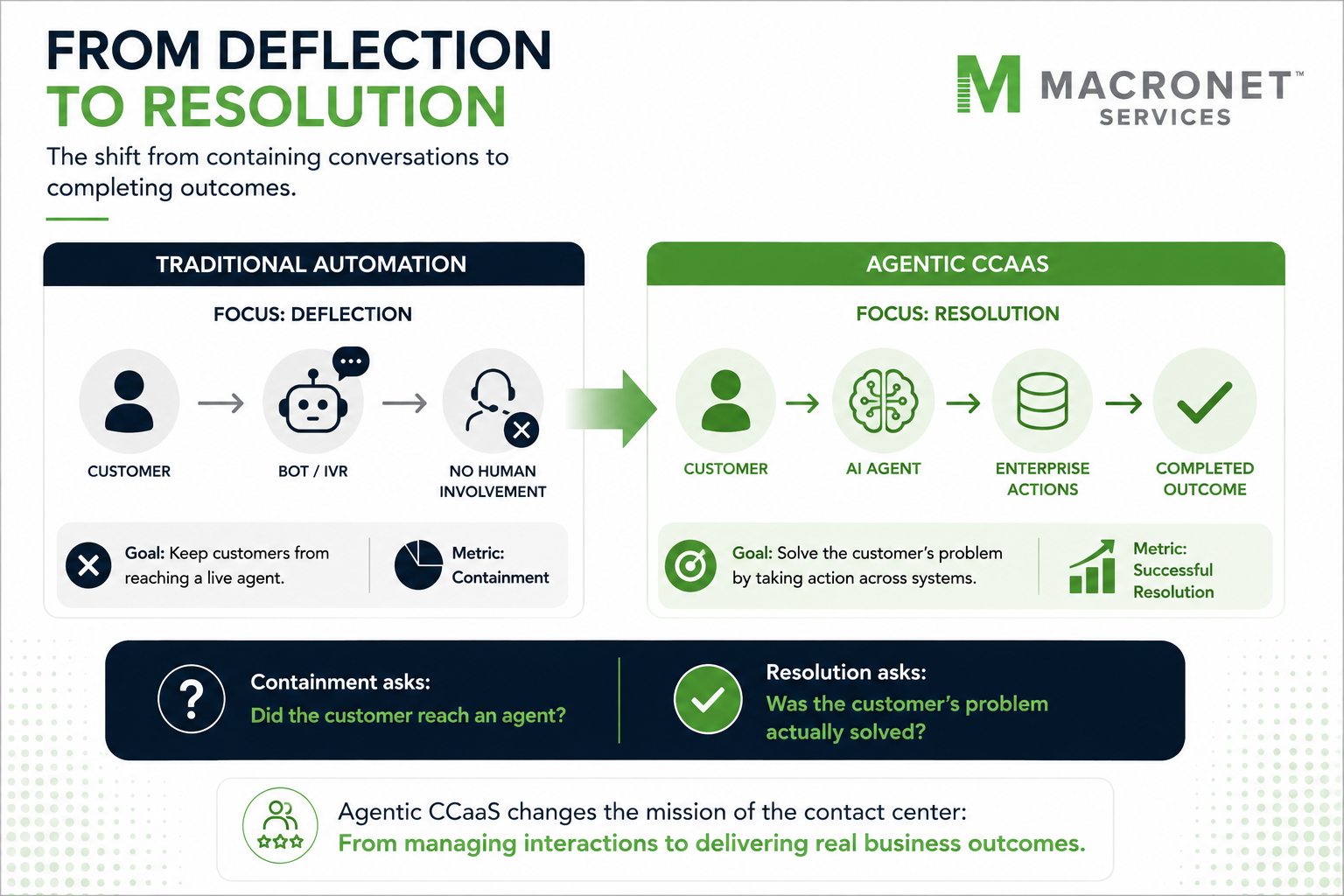
From Deflection to Resolution
Agentic AI should also change how businesses measure automation.
Historically, virtual-agent programs have frequently emphasized containment or deflection.
If a customer interacts with a bot and never reaches an employee, the interaction may be counted as contained.
But containment does not prove the customer’s problem was solved.
The customer may abandon the bot, call later, search elsewhere or simply give up.
This distinction is becoming increasingly important.
A Gartner survey of 3,566 B2B and B2C customers conducted in February and March 2026 found customers were approximately three times more likely to use third-party generative AI tools than company-provided chatbots when resolving service issues. Gartner also found 58% of customers using GenAI had used it to complete a task on their behalf, rising to 74% among B2B users. Separately, only 24% of service and support leaders surveyed reported positive financial returns across their AI use cases.
Customers increasingly expect AI to do something, not merely explain something.
Businesses should therefore measure whether the customer’s objective was completed, whether another contact was required, whether human intervention became necessary, whether the appropriate enterprise systems were updated correctly and how much the successful resolution ultimately cost.
Cost per Successful Resolution
Cost per Successful Resolution = Total service-delivery cost ÷ Successfully resolved customer issues
The numerator can include the appropriate share of human labor, outsourcing, CCaaS, telecom, AI consumption, model usage, integrations, AgentOps and support costs.
The organization can then compare AI-only resolutions with AI-plus-human and human-only resolutions to understand where automation is actually improving economics and where human involvement remains the better operating model.
This is substantially more useful than simply comparing the nominal cost of an AI interaction with an employee’s hourly cost.
Gartner has even forecast that generative AI customer-service cost per resolution could exceed $3 by 2030 as model, infrastructure and implementation expenses increase. The lesson is not that AI is uneconomic, but that successful outcomes—not cheap interactions—should drive the business case.
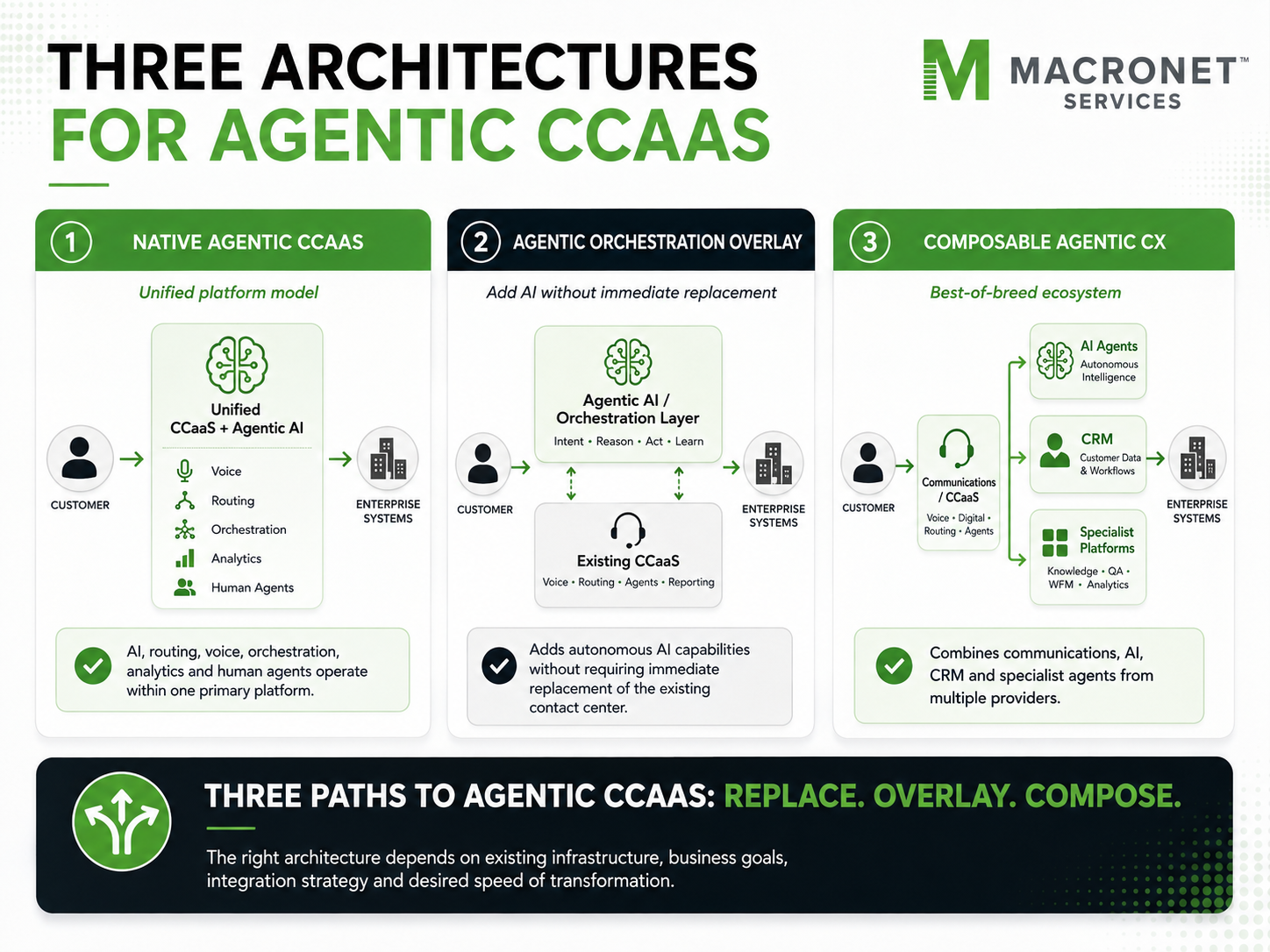
Three Architectures for Agentic CCaaS
Agentic contact centers are not all being built the same way.
Three broad models are emerging.
Native Agentic CCaaS
In a native architecture, autonomous AI operates deeply inside the CCaaS platform.
Routing, telephony, conversation history, workflow, analytics, knowledge, human-agent assistance and autonomous AI share a relatively unified environment.
This can simplify management, analytics and contextual AI-to-human handoffs.
The tradeoff can be greater dependence on one provider’s architecture.
Agentic Orchestration Overlay
A second model introduces an agentic layer over existing contact center and enterprise systems.
The organization may keep substantial portions of its current telephony or CCaaS environment while adding AI agents capable of handling interactions and coordinating work across applications.
Talkdesk is explicitly pursuing this model through CXA for any contact center, which is designed to operate over cloud, hybrid or on-premises contact center environments without requiring immediate infrastructure replacement.
This creates an important strategic principle:
Agentic transformation does not necessarily require CCaaS replacement.
Composable Agentic CX
A third architecture combines intelligence, communications and enterprise applications from multiple providers.
The CCaaS vendor might provide voice, messaging and routing while another platform provides autonomous agents and a third system owns the business transaction.
Vonage’s integration of specialist AI agents from Avaamo and Syndeo illustrates this more composable approach.
Over time, these categories are likely to overlap.
The critical buyer question becomes:
Which platform owns customer context, orchestration, permissions and execution?
The Agentic CCaaS Technology Stack
An enterprise agentic contact center requires considerably more than an LLM connected to a telephone number.
At the edge are the interaction channels:
PSTN voice, SIP, web chat, SMS, WhatsApp, email, social messaging and application-based communications.
Voice requires speech processing or realtime multimodal models capable of producing natural conversation with extremely low perceived latency.
The next layer provides language understanding and reasoning.
Foundation models help interpret customer intent and determine how an interaction should proceed.
The knowledge and context layer gives the AI access to information beyond the model itself:
CRM records, customer profiles, interaction history, policies, knowledge bases, product documentation and RAG systems.
The critical transition occurs at the action layer.
Here, agents gain access to tools capable of retrieving information or changing enterprise systems.
Examples include major systems such as Salesforce, ServiceNow, Microsoft Dynamics, SAP, Oracle, Workday, Zendesk and Epic, as well as billing, scheduling, order-management, payment, logistics and proprietary applications.
The orchestration layer determines which information is needed, which actions should occur, whether another AI agent should participate and when human approval or escalation is required.
Surrounding everything must be a control plane for identity, authorization, policies, logging, security, testing, observability and governance.
This surrounding infrastructure is what turns an impressive AI demonstration into an enterprise system.
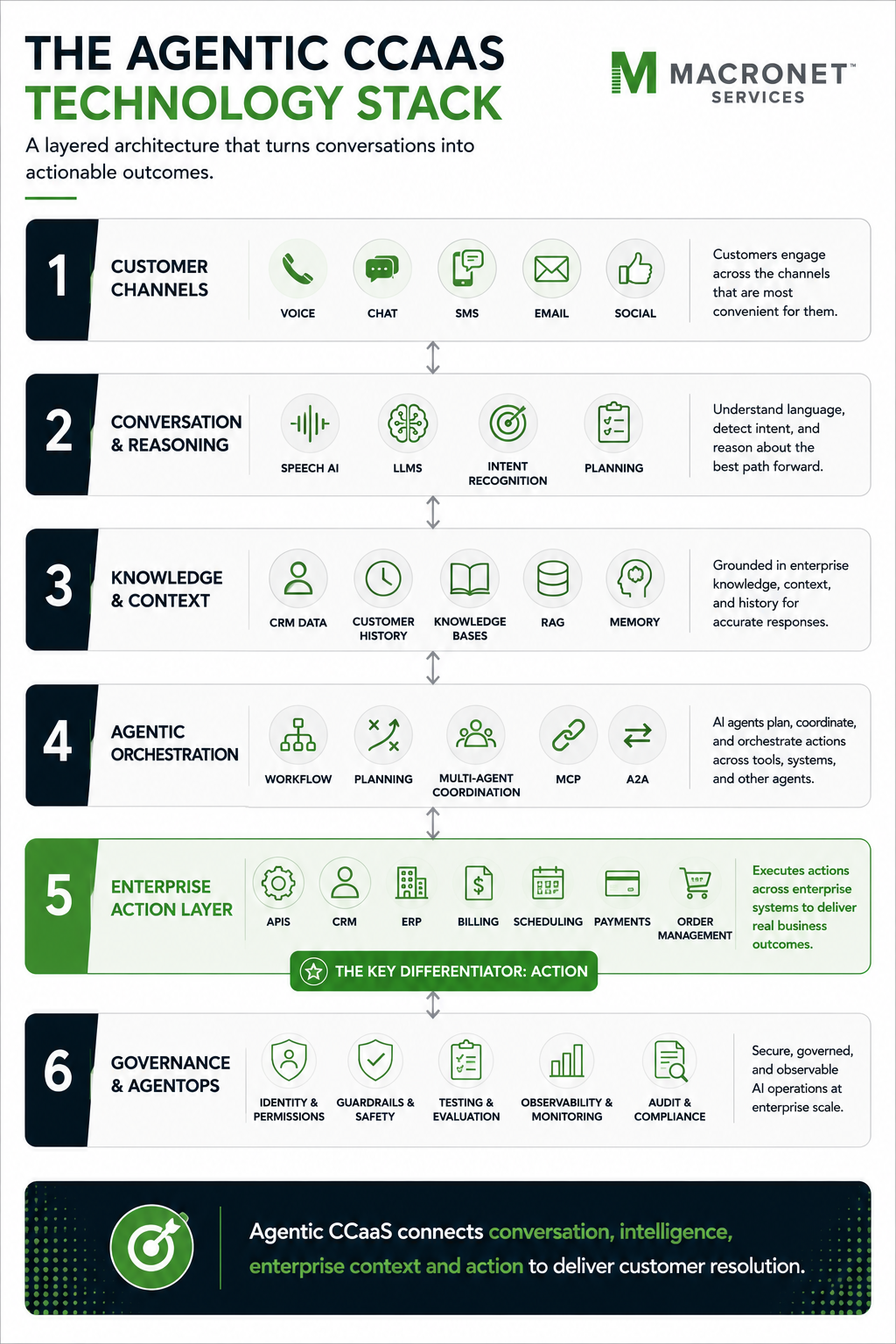
The Enterprise Action Layer: Where Agentic AI Creates Value
Consider a customer saying:
“My package was supposed to arrive yesterday. I need the equipment for a meeting tomorrow.”
A chatbot can tell the customer the shipment is delayed.
An agentic system could potentially:
- authenticate the customer;
- retrieve the order;
- query logistics;
- determine the shipment will probably not arrive;
- check replacement policy;
- verify inventory;
- create a replacement order;
- upgrade delivery;
- redirect or cancel the original package;
- update CRM;
- notify the customer;
- confirm that the replacement process completed successfully.
The business value resides mainly in steps four through twelve.
But those actions also create additional risk.
An AI system that can read an account poses one level of risk.
An AI system that can change an address, issue a refund, modify a reservation or move money poses another.
Enterprises should therefore define an autonomy envelope for each agent: the specific activities the AI is authorized to perform, the conditions under which it can perform them and the thresholds that trigger human approval.
The critical question is not:
Is the agent autonomous?
It is:
Autonomous to do what, under which conditions, using whose authority?
Why MCP Matters
The Model Context Protocol, or MCP, is becoming increasingly important to agentic architectures because it provides a standardized way for AI applications to access external tools, capabilities and contextual information.
The July 28, 2026 MCP specification introduced major changes aimed at enterprise scalability and security, including a stateless core, improved authorization, header-based routing and Multi Round-Trip Requests.
For a contact center, MCP can provide a standardized mechanism through which enterprise applications expose approved capabilities.
An order-management MCP server might expose approved capabilities such as looking up an order, checking a shipment, changing an address or canceling an unshipped order. A billing server could separately provide tools for retrieving an invoice, verifying a payment or creating a payment arrangement.
The AI does not necessarily need direct proprietary integration logic for every underlying application.
MCP does not eliminate the need for security. Enterprises still require identity, authorization, policy, logging and business controls.
But it can make the action ecosystem substantially more modular.
MCP vs. A2A
MCP and Agent2Agent, or A2A, solve related but different interoperability problems.
Google originally introduced A2A as an open protocol enabling independently developed AI agents to communicate and coordinate. A2A was subsequently placed under Linux Foundation governance. Google described A2A as complementary to MCP: MCP provides tools and context to agents, while A2A enables agents to work with other agents. See Google Developers Blog.
A useful shorthand is that MCP connects agents to tools and data, whereas A2A connects agents to other agents.
Imagine a traveler saying:
“My flight was canceled. Get me to Chicago tonight and make sure my hotel knows I’m arriving late.”
An airline agent might use tools to rebook the flight.
It could then delegate the hotel notification to another specialized travel agent.
The customer experiences one interaction.
Behind the scenes, several autonomous systems may participate.
Multi-Agent Orchestration
One giant AI agent with access to every enterprise system may not be the safest or most effective architecture.
Specialized agents can provide better separation of responsibilities. A billing agent can be limited to billing permissions, a scheduling agent to calendars, a retention agent to approved offers, and a refund agent to clearly defined financial authority.
An orchestrator determines which agent should handle each part of the customer objective.
Talkdesk has made this model central to its CXA architecture, describing specialized AI agents that coordinate across systems to complete complex workflows.
Multi-agent design may improve specialization and governance, but it introduces new requirements around context transfer, delegated identity, conflicting recommendations, shared state, permissions, execution tracing and error recovery. Those coordination problems become more important as the number of autonomous participants grows.
The more powerful the agent network becomes, the more important the orchestration and control planes become.
Why Voice AI Is Harder Than Chat
Voice deserves its own evaluation category.
A text agent can sometimes take a second or two to reason without destroying the experience.
Voice is far less forgiving because customers interrupt, hesitate, use incomplete sentences, change direction, speak with different accents and call from noisy environments. Telephone audio can also be imperfect, so the system has to interpret ambiguous speech while maintaining the conversational rhythm people expect from a live call.
The voice AI architecture has to coordinate call routing and media processing with speech interpretation, reasoning, enterprise tool execution, response generation and speech output, all while preserving natural conversational timing.
The underlying telecommunications environment also does not disappear because AI answers the phone. Network connectivity also matters. Large or globally distributed Agentic CCaaS deployments may depend on a Tier 1 ISP, redundant internet access, private connectivity, or optimized cloud interconnection to provide reliable access between contact center platforms, AI services, enterprise applications, and users. Latency, packet loss, routing quality, and geographic diversity can directly affect both voice quality and the responsiveness of AI-driven customer interactions. Enterprises still need to consider telephone numbers, SIP and PSTN carrier connectivity, media routing, codecs, session border controllers, recording, latency, geographic coverage, redundancy, call transfer and security. Those elements remain part of the customer experience even when the conversational endpoint is an AI agent.
That makes voice AI an area in which traditional telephony and CCaaS engineering remain strategically important.
For additional background, Macronet Services’ enterprise SIP architecture guide explains how SIP signaling, media, SBCs, carrier connectivity and AI voice applications increasingly intersect: SIP Trunking in the AI Era: The CIO’s Guide to Enterprise Voice.
The Human + AI Contact Center
Agentic AI is likely to automate large amounts of routine work.
That does not necessarily mean the future contact center is human-free.
Gartner reported in April 2026 that 85% of surveyed service and support leaders were expanding human-agent responsibilities as AI shifted work toward higher-value activities. Only 31% had implemented or planned AI-related frontline layoffs through the first quarter of 2027.
Customers also continue to want access to people.
An August 2026 Gartner survey found 87% of customers considered access to a human agent essential when companies use generative AI in customer service.
The likely operating model is therefore not human versus AI. AI will increasingly handle predictable work, while people concentrate on judgment, empathy, negotiation, exceptions and high-risk decisions.
Paradoxically, the average human interaction may become more difficult as AI removes simpler contacts.
That makes AI-to-human handoff extremely important.
When escalation occurs, the human should ideally receive the customer’s identity and intent, the conversation history, actions already performed, tool results, outstanding work and the reason the AI escalated. The customer should not have to restart the process simply because responsibility moved from an AI agent to a person.
Agentic AI Governance: The Risk Changes When AI Can Act
Generative AI introduced concerns about inaccurate answers, hallucinations and sensitive information.
Agentic AI adds execution risk.
An incorrect answer is problematic.
An incorrect transaction can be materially worse.
The risk surface can include unauthorized or incorrect transactions, excessive permissions, prompt injection, fraudulent instructions, identity failures, data exposure, tool misuse, policy violations, model drift and inappropriate delegation between agents. These risks become more consequential as the AI gains authority to change enterprise systems rather than simply retrieve information.
Organizations should therefore implement controls such as least-privilege access, strong authentication, financial and transactional thresholds, human approval where appropriate, detailed logging, data masking, prompt-injection defenses, version control, emergency kill switches and a defined incident-response process.
The AI conversation is only part of the audit record.
The execution trail matters just as much.
AgentOps: Operating an AI Workforce
Building an AI agent is relatively easy.
Operating one reliably at enterprise scale is harder.
Production AI agents require a lifecycle that spans design, connection to tools and data, permissions, testing, simulation, approval, deployment, monitoring, evaluation, updates, versioning and rollback.
This emerging discipline is increasingly called AgentOps.
Testing is especially difficult because generative systems are probabilistic.
The same customer request may not always produce exactly the same reasoning path.
Enterprises therefore need to answer two questions at the same time: can the agent succeed, and can it succeed consistently across repeated and varied interactions?
A refund agent, for example, should be tested against normal requests as well as missing information, fraud attempts, policy exceptions, API timeouts, system outages, ambiguous requests, prompt injection, unauthorized actions and customers who change intent midway through the conversation. A mature test program should deliberately cover situations in which the correct behavior is to stop, refuse or escalate.
AgentOps is becoming a meaningful competitive differentiator. NICE Cognigy, for example, launched Simulator in January 2026 specifically to enable enterprise-scale AI-agent evaluation and comparison before and during deployment.
Agentic CCaaS Without Rip-and-Replace
Agentic AI changes an important assumption about contact center modernization.
Historically, accessing the newest CCaaS capabilities often meant migrating the underlying contact center.
For large enterprises, that can be difficult.
An existing enterprise environment may include thousands of agents, hundreds or thousands of telephone numbers, carrier contracts, custom routing, legacy PBXs, workforce systems, recording, CRM integrations, compliance workflows and international voice services. Replacing that entire foundation simply to obtain stronger AI may not make economic or operational sense.
Agentic orchestration introduces three broad transformation paths:
Replace
Move to a new Agentic CCaaS platform.
Overlay
Introduce agentic automation while retaining the existing contact center.
Hybridize
Gradually shift selected journeys and workloads to a new environment.
The right approach depends on the existing architecture, contract position, technical debt, migration risk, business urgency and desired level of autonomy. Those factors can matter as much as the AI feature set itself.
The best AI platform is not automatically the best transformation strategy.
From Seats to Outcomes: Agentic CCaaS Economics
Traditional CCaaS pricing has revolved primarily around human users.
Agentic AI changes the units enterprises may be purchasing.
Commercial models increasingly combine human seats with AI conversations, voice minutes, AI sessions, tokens or credits, workflow consumption, model usage and, in some cases, successful outcomes or resolutions. Buyers therefore need to understand not only the unit price of each component but also how those units accumulate across a complete customer journey.
Genesys uses AI Experience tokens for Agentic Virtual Agent interaction sessions. See Genesys documentation.
Dialpad uses AI Agent Credits and conversation-based pricing, with sessions becoming billable under documented conditions when the AI retrieves information or performs a task. See Dialpad pricing.
Five9’s published CCaaS bundles include AI-minute allowances with additional usage-based pricing. See Five9 pricing.
Zoom now offers an optional outcome-based model tied to resolved or successfully routed Virtual Agent interactions. See Zoom’s Agent Architect and Agent Performance Suite announcement.
The result is a more complicated financial model that combines a human workforce with an AI workforce, communications, applications, orchestration, integration and ongoing operations.
Organizations should model the total cost per successful resolution, rather than assume fewer human interactions automatically means lower total cost.
Leading Agentic CCaaS Platforms in 2026
The providers below represent nine leading platforms covered in this guide. This is not intended to suggest that they are the only significant players in the broader market.
Salesforce, Amazon Connect, Microsoft, Cisco, Twilio, Zendesk and specialist AI providers are also relevant to the evolving agentic CX ecosystem.
In August 2026, IDC published its first Worldwide Agentic Contact Center-as-a-Service Platforms Vendor Assessment, evaluating providers combining traditional CCaaS with autonomous agents capable of understanding customer intent, accessing disconnected systems, making decisions within guardrails and executing end-to-end service workflows. Talkdesk and Zoom have publicly announced Leader positions in that assessment. See Talkdesk.
The analysis below focuses on strategic differentiation rather than producing a generic numerical ranking.
NICE: Enterprise Scale and Strong Production Evidence
NICE significantly strengthened its agentic position through Cognigy.
The combination brings together the broad CXone portfolio with advanced autonomous and conversational AI, proactive engagement, orchestration and increasingly sophisticated AgentOps capabilities.
One of NICE’s most compelling differentiators is production evidence.
Openreach now orchestrates more than 1.1 million proactive AI customer journeys per month through NICE technology. NICE reports 95% end-to-end AI containment across those automated journeys and 90,000 avoided engineer visits annually. Importantly, the system performs closed-loop execution, including updating operational systems and triggering engineer visits when appropriate. See the Openreach case study.
NICE Cognigy also introduced Simulator in 2026 for large-scale agent testing, including third-party API error simulations and comparisons among models, prompts and guardrails. See NICE Cognigy Simulator.
Where NICE stands out
- Production-scale agentic automation
- Conversational and voice AI depth
- AgentOps
- Broader WEM/CCaaS environment
- Proactive customer journeys
Best-fit profile
Large enterprises wanting an extensive CCaaS, WEM and autonomous-AI platform with strong public evidence of large-scale automation.
Buyer diligence
Buyers should verify how Cognigy components are packaged, licensed, administered and supported within the broader CXone environment and distinguish production evidence for proactive orchestration from newer free-form generative voice use cases.
Genesys: Governed Execution Through Large Action Models
Genesys has developed one of the most technically distinctive architectures in the market through its Large Action Model, or LAM, approach.
Genesys argues that conventional LLMs are optimized primarily for language generation rather than reliable enterprise transaction execution.
Its LAM-powered Agentic Virtual Agents are designed to understand customer goals, choose actions and execute multi-step work through approved tools and guardrails. Genesys says autonomous actions can be planned, validated and logged. See Genesys Virtual Agents.
AI Studio provides a no-code environment for configuring tools, knowledge and controls. Current Genesys documentation also supports A2A delegation, although external A2A server integration is still identified as forthcoming.
Where Genesys stands out
- Controlled action execution
- Mature enterprise CCaaS foundation
- Journey orchestration
- Governance
- Human + AI integration
Best-fit profile
Complex enterprises that value mature CCaaS and want a highly structured approach to autonomous execution.
Buyer diligence
Organizations should test whether the LAM approach measurably improves task reliability in their actual workflows and understand where LAM-based reasoning intersects with conventional Architect workflow logic.
Talkdesk: Multi-Agent Orchestration and the Agentic Overlay
Talkdesk has made multi-agent automation central to its Customer Experience Automation strategy.
CXA coordinates specialized AI agents across systems and processes rather than relying on a single universal virtual agent. See Talkdesk multi-agent orchestration.
Talkdesk’s most strategically distinctive capability may be CXA for any contact center, designed to extend its AI capabilities over existing cloud, hybrid or on-premises environments without requiring immediate replacement. See Talkdesk CXA release notes.
The company also has meaningful customer evidence. Talkdesk reports Rocky Brands autonomously handling approximately 40% of chat interactions and Quadient increasing containment in France from 10% to 44%, while eliminating certain seasonal staffing needs. See Talkdesk customer results.
Its Agent Evaluation capabilities are sophisticated but, importantly, remain Preview for select customers as of August 2026. See Talkdesk Agent Evaluation Preview.
Where Talkdesk stands out
- Multi-agent orchestration
- Cross-system workflow automation
- Agentic overlay strategy
- Vertical-specific CX automation
- Open integration
Best-fit profile
Organizations prioritizing multi-agent workflows or wanting to introduce agentic automation without immediately replacing an existing contact center.
Buyer diligence
Distinguish GA CXA functionality from Preview AgentOps capabilities, and carefully design reporting, routing, telephony and failure-domain ownership when implementing CXA as an overlay.
Five9: Voice-Native Agentic Execution
Five9’s June 2026 release of its new Voice AI Agents significantly strengthened its agentic position.
The architecture includes coordinated multi-agent orchestration, secure tool calling, enterprise transactions, context-rich human handoff, workflow verification, post-call evaluation and LLM blinding. See Five9 Voice AI Agents.
Five9 has also developed an Agentic Voice Switch natively inside its carrier-grade telephony platform, combining speech, reasoning and voice generation with low-latency streaming, turn-taking and interruption management.
Its broader AI Trust & Governance layer provides guardrails, autonomy controls, hallucination monitoring and prompt-injection threat detection. See Five9 AI Trust and Governance.
PODS is an early production reference for the newest architecture and expects the agents to handle more than 100,000 service calls during 2026.
Where Five9 stands out
- Agentic voice architecture
- Telephony integration
- Governance
- AI + human handoffs
- Contact center maturity
Best-fit profile
Voice-intensive enterprise contact centers where real-time conversational quality and carrier-grade telephony are particularly important.
Buyer diligence
Because the newest Voice AI Agents architecture launched in June 2026, buyers should request production references using the new stack at comparable volumes and test actual voice performance under noisy and unpredictable real-world conditions.
Zoom: Resolution-Oriented Agent Lifecycle and Economics
Zoom has advanced rapidly into the agentic contact center market.
Zoom Virtual Agent 3.0 introduced an execution architecture designed to orchestrate multi-step workflows across CRM, billing, order-management and other enterprise systems. Zoom’s warranty example includes customer authentication, serial-number extraction, eligibility checking, pickup scheduling, replacement ordering and shipping confirmation inside one workflow. See Zoom Virtual Agent 3.0.
Zoom’s current Virtual Agent tools can retrieve and update external systems, including creating or updating CRM records. See Zoom Virtual Agent tools.
In June 2026, Zoom introduced Agent Architect and Agent Performance Suite, creating a lifecycle spanning prompt-based agent development, predeployment testing and postdeployment measurement of metrics including resolution rate and cost per resolution. Zoom also introduced optional outcome-based pricing. See Zoom’s announcement.
IDC named Zoom a Leader in its August 2026 Agentic CCaaS assessment. See Zoom’s IDC MarketScape announcement.
Where Zoom stands out
- Resolution-oriented architecture
- Agent lifecycle management
- Unified Zoom CX ecosystem
- Outcome-based economics
- Rapid product innovation
Best-fit profile
Organizations already invested in Zoom as well as businesses seeking a relatively unified communications and CX environment with an explicit focus on resolution outcomes.
Buyer diligence
Confirm availability and contractual treatment of the newest capabilities and precisely define what constitutes a billable successful outcome if outcome-based pricing is used.
Dialpad: AI-Native Communications and Conversation Economics
Dialpad has integrated AI deeply into its communications architecture for years and is now extending that foundation into autonomous agents.
Its agentic positioning emphasizes systems that understand goals, reason through tasks and execute work rather than simply delivering answers. See Dialpad on agentic AI contact centers.
Dialpad has also developed a broader operational framework around discovery, validation, governance and handoff, including newer tools designed to evaluate agent performance before production and supervise safety afterward. See Dialpad on moving agentic AI from pilot to production.
Its commercial approach is noteworthy. Dialpad prices AI Agents through conversation-based credits, with sessions becoming billable under documented conditions when the AI actually looks up information or performs work. See Dialpad pricing.
Where Dialpad stands out
- AI-native communications architecture
- Voice and digital convergence
- Conversation intelligence
- Outcome-oriented philosophy
- Conversation-based AI economics
Best-fit profile
AI-forward organizations wanting contact center, communications, conversational intelligence and autonomous agents operating on a relatively unified foundation.
Buyer diligence
Ask for references using autonomous agents at comparable production scale and evaluate actual resolution rate, handoff performance, tool reliability and cost per resolved workflow.
Avaya: Open Agentic Orchestration for the Hybrid Enterprise
Avaya’s position becomes much more compelling when it is evaluated as a hybrid-enterprise modernization platform rather than simply compared with cloud-native CCaaS vendors.
Avaya Infinity emphasizes open orchestration, model flexibility, MCP and deployment across cloud, hybrid and on-premises environments. See Avaya on MCP for contact centers.
The platform also incorporates Databricks into its broader enterprise data and governance strategy and uses what Avaya calls Tandem Care to coordinate AI and human employees. See Avaya Infinity announcement.
This approach may be particularly valuable to enterprises with extensive Avaya infrastructure and substantial migration risk.
Where Avaya stands out
- Hybrid modernization
- MCP/open orchestration
- Model flexibility
- Existing Avaya investment protection
- Human + AI operating model
Best-fit profile
Large regulated or complex enterprises—particularly those with substantial existing Avaya estates—that want to introduce agentic capabilities without forcing an immediate infrastructure replacement.
Buyer diligence
Require production evidence for the specific autonomous-resolution workflow under consideration and ensure end-to-end observability when interactions span legacy systems, Infinity, external models and enterprise tools.
Vonage: A Composable Agentic CX Strategy
Vonage is taking a more ecosystem-oriented approach.
In June 2026, Vonage embedded industry-specific AI agents from Avaamo for healthcare and Syndeo for financial services and retail into Vonage Contact Center. These agents can support workflows such as appointment scheduling, care navigation, billing assistance and other industry-specific use cases. See Vonage’s announcement.
This approach combines:
- CCaaS
- CPaaS
- carrier connectivity
- communications APIs
- network intelligence
- partner AI
That composability may become increasingly valuable as customer-service AI expands beyond the contact center.
Where Vonage stands out
- Communications APIs
- Salesforce alignment
- Vertical AI ecosystem
- Network and identity capabilities
- Composable architecture
Best-fit profile
Salesforce-centric organizations and enterprises that prefer combining best-of-breed intelligence with a global communications/API environment.
Buyer diligence
Clearly identify which vendor owns each layer:
conversation → reasoning → orchestration → voice → transaction → governance → support.
Composable architectures can be powerful, but operational accountability must remain clear.
8×8: Broad Capabilities but Earlier Maturity
8×8 AI Studio is one of the more interesting emerging platforms in this analysis.
Its capabilities include voice and messaging agents, custom tools, external APIs, MCP connectors, knowledge stores, workflows, execution logs and configuration versioning. See 8×8 tool configuration documentation.
8×8 also supports direct voice integration through phone-number connectors and allows calls to move between Contact Center and AI Studio in supported configurations. See 8×8 AI Studio deployment documentation.
In June 2026, 8×8 announced selectable models across providers including Claude, Gemini, Grok and ChatGPT. See 8×8’s AI Studio announcement.
But the maturity qualification is important.
8×8’s current July 28, 2026 documentation explicitly states:
AI Studio is an Early Access Program product. See 8×8 AI Studio getting started.
Where 8×8 stands out
- Accessible AI-agent creation
- Native voice connectivity
- Multi-model flexibility
- MCP and custom tooling
- Broad communications integration
Best-fit profile
Existing 8×8 customers and organizations interested in experimenting with an emerging agentic platform while maintaining close integration with their communications environment.
Buyer diligence
Treat EAP status as a significant procurement consideration. Validate support commitments, production SLAs, geographic availability, contractual treatment and relevant production references before using AI Studio for mission-critical workflows.
How the Nine Platforms Differ
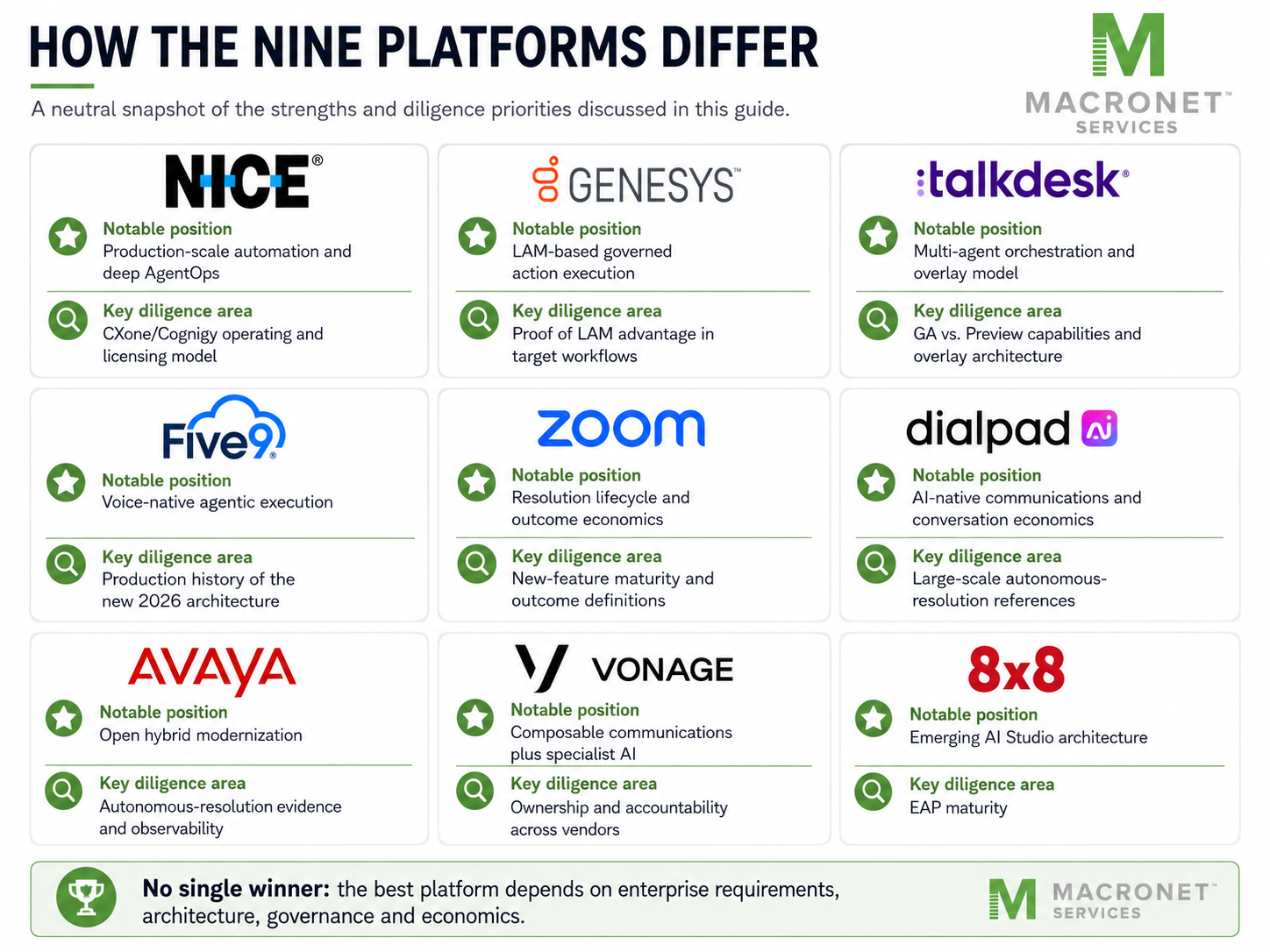
This is why a single generic ranking can be misleading.
The best provider depends on the enterprise.
The Macronet Services Agentic CCaaS Evaluation Framework
A rigorous Agentic CCaaS evaluation should examine at least 12 dimensions:
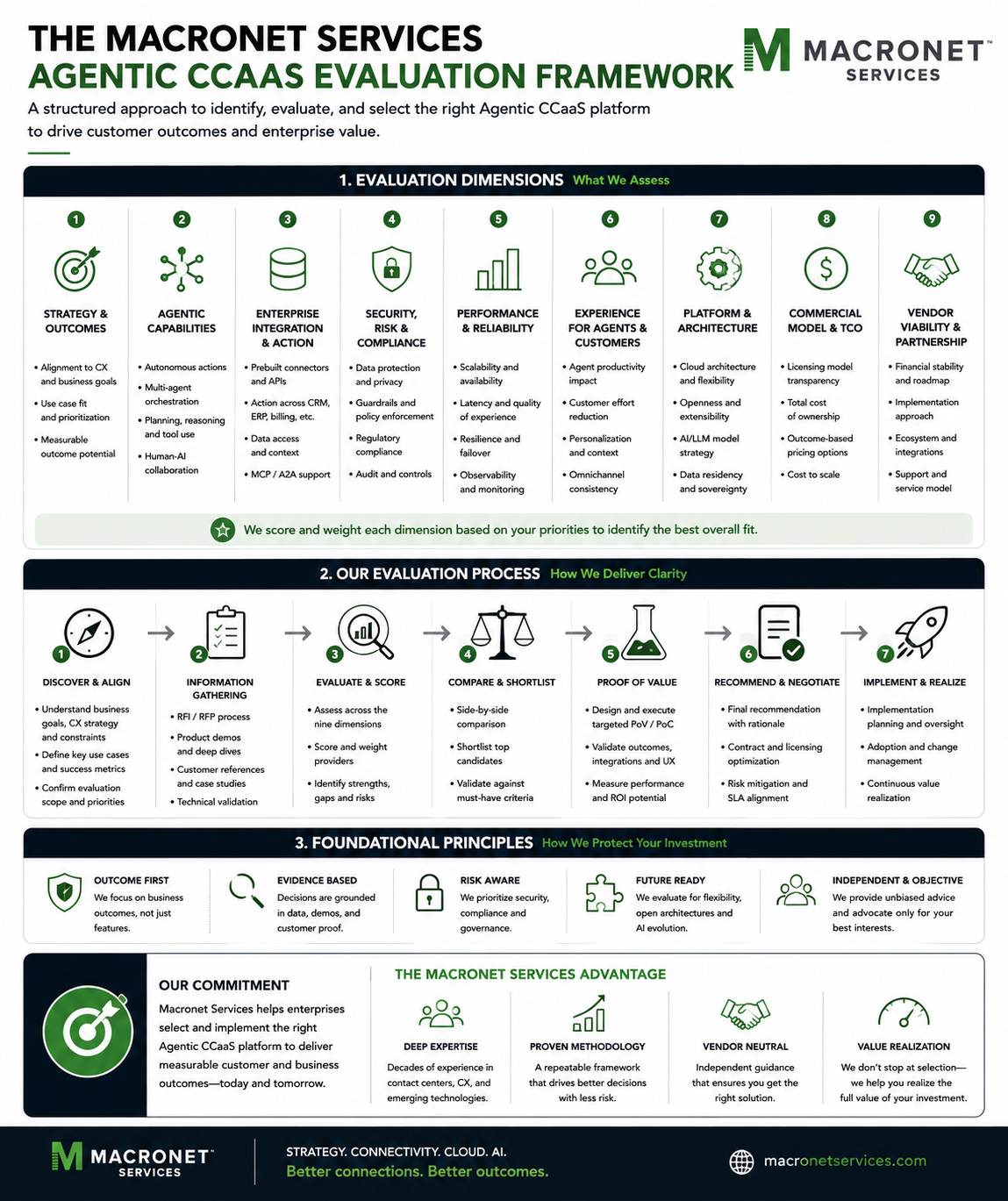
Capability
What can the platform do?
Evidence and Maturity
How much confidence should an enterprise have that it can do it reliably at production scale today?
A GA capability running millions of production journeys should not receive the same maturity assessment as a compelling feature available only through Preview or EAP.
Request the Complete Agentic CCaaS Vendor Scorecard..
Macronet Services has developed a deeper weighted evaluation model for:
- Zoom
- Talkdesk
- Five9
- Genesys
- NICE
- Dialpad
- Vonage
- Avaya
- 8×8
The complete 2026 Agentic CCaaS Vendor Scorecard includes:
- weighted capability scores
- Evidence & Maturity Index
- vendor heat map
- availability matrix
- best-fit profiles
- detailed scoring rationale
- scenario-specific recommendations
A generic scorecard is useful. A requirements-weighted scorecard is even more valuable.
A healthcare provider should not weight these vendors the same way as a retailer, global bank or enterprise operating thousands of legacy Avaya seats.
25 Questions to Ask in an Agentic CCaaS RFP or Proof of Concept
A conventional CCaaS RFP is no longer sufficient.
Macronet Services’ existing guidance on AI-enabled CCaaS RFPs provides a useful starting point for broader procurement requirements: AI in CCaaS RFPs: Essential Features for Next-Gen Contact Centers.
For an agentic evaluation, add questions such as:
- Which customer requests can your AI resolve completely without human intervention today?
- How do you define a successful autonomous resolution?
- Can the AI independently determine the steps required to accomplish an objective?
- What happens if the customer’s intent changes during execution?
- How do you measure failed, partial and repeated resolutions?
- Which applications can agents read from and write to?
- How are enterprise actions exposed—native integrations, APIs, MCP, workflows or another method?
- What happens if an API fails halfway through a transaction?
- How do you prevent duplicate transactions?
- How does the system verify that a tool action actually succeeded?
- Does the platform support specialized multi-agent architectures?
- How is context and authorization preserved between agents?
- What happens if two agents produce conflicting recommendations?
- Does the platform operate as an MCP client, server or both?
- Can we use third-party AI agents and foundation models?
- How does voice perform over poor cellular connections, noise and interruptions?
- What is the carrier-to-AI voice architecture?
- How does the voice agent handle slow backend tools?
- What context transfers to a human employee?
- Can a customer easily request a human?
- How do we define transaction and autonomy limits?
- How do you defend against prompt injection?
- Can we reconstruct the execution trace for every transaction?
- How do we simulate and regression-test agents before deployment?
- Which model, prompt, tool or policy changes automatically trigger retesting?
The strongest demonstrations should show the platform completing real work across representative enterprise systems rather than simply producing impressive conversation.
How to Run an Agentic CCaaS Proof of Concept
Choose three to five real customer journeys.
Use a mix of real customer journeys rather than one showcase scenario. A sensible POC might include a high-volume, low-risk use case such as appointment scheduling; a multi-system workflow such as a replacement shipment plus CRM update; a transactional use case involving a credit, return or service modification; an exception-heavy journey such as complicated billing or travel disruption; and a case in which the AI investigates and recommends an action but a human must authorize the final step.
Whenever possible, connect representative versions of real enterprise systems.
Then deliberately create failures. Disable an API, force a timeout, return conflicting data, request an unauthorized transaction, change the customer’s intent midway through the conversation, attempt prompt injection and require a transfer to a person. These scenarios often reveal more about an agentic platform than a flawless happy-path demonstration.
Score the POC against measures established before the demonstrations begin. At minimum, evaluate successful resolution, tool and workflow accuracy, transaction correctness, policy adherence, escalation accuracy, context transfer, voice responsiveness, recovery from failure, repeatability, observability and cost per successful resolution.
Run the scenarios more than once.
A single successful demonstration is weak evidence for a probabilistic system.
Building the Agentic CCaaS Business Case
Start with the current operating baseline. Document annual interaction volume, major contact reasons and channel mix, along with average handle time, after-call work, first-contact resolution, repeat-contact rate and abandonment. The financial baseline should also include labor, outsourcing, CCaaS and telecom costs, while the customer and business baseline should capture satisfaction as well as any measurable revenue or retention impact. Then segment interactions by automation potential.
High-volume, low-complexity, low-risk
Excellent early candidates.
Moderate-complexity transactional workflows
Often attractive when enterprise APIs are strong.
High-complexity or judgment-intensive interactions
More likely to remain human-led.
High-risk interactions
May be technically automatable but require human approval.
Model several scenarios rather than one optimistic forecast:
| Scenario | Autonomous resolution assumption |
| Conservative | 10% |
| Moderate | 25% |
| Advanced | 40% |
| Transformational | 60% |
Then evaluate how each scenario changes human workload, staffing and outsourcing requirements, average handle time, after-call work, repeat contacts, customer experience, AI usage and overall platform cost. This makes the financial model much more realistic than applying a single automation percentage to current labor expense.
Do not ignore revenue. Agentic AI may influence retention, collections, sales conversion, renewals, appointment utilization, abandoned-cart recovery and service recovery. In some cases, preserving a valuable customer relationship can create more value than avoiding the labor associated with a phone call.
The Agentic CCaaS Adoption Roadmap
Phase 1: Discover
Inventory customer journeys, contact reasons, volumes, enterprise applications, voice architecture, existing AI, APIs, data and compliance requirements.
Phase 2: Prioritize
Identify use cases that combine high business value and repeatability with accessible data, executable systems and manageable risk. The best first use cases are usually not the most futuristic; they are the ones that can demonstrate measurable value without exposing the organization to unnecessary complexity.
Phase 3: Establish the Foundation
Improve the foundations the agents will depend on, including knowledge, APIs, identity, permissions, customer data, logging and workflow documentation. Agentic AI cannot reliably automate a business process the organization itself cannot clearly define.
Phase 4: Define the Autonomy Envelope
For every action, define the systems and data the agent may access, its financial authority, required authentication, approval thresholds, prohibited behavior and escalation rules. These boundaries should be explicit enough that business, security and compliance teams can understand exactly where autonomous authority begins and ends.
Phase 5: Build and Simulate
Test both happy paths and failures, create regression datasets and evaluate the actual tool execution rather than judging only the final conversational response.
Phase 6: Deploy With Limited Autonomy
Begin conservatively. An early workflow might have the AI investigate the issue and recommend an action for human approval. As the organization establishes reliable performance, the same workflow can be expanded so the AI executes automatically below defined thresholds while humans handle exceptions. Autonomy should be earned through evidence.
Phase 7: Expand From Tasks to Journeys
Move from automating narrow questions such as “Where is my order?” toward broader objectives such as “My order won’t arrive in time. Fix it.” That shift from task automation to journey resolution is where agentic architecture begins to change the operating model.
Phase 8: Introduce Multi-Agent Orchestration
Specialize AI workers around domains such as billing, identity, scheduling, logistics, retention and claims, then use orchestration to coordinate them around the customer’s broader objective.
Phase 9: Establish Continuous AgentOps
Manage the AI workforce through continuous measurement of resolution, transaction accuracy, policy compliance, latency, cost, tool failures, customer satisfaction and escalation patterns. Over time, these operational measures should become part of the same management cadence used for human service performance.
The Future: The Contact Center Becomes an Enterprise Resolution Layer
The most important implication of agentic AI may be that the traditional boundaries of the contact center begin to disappear.
Customers do not care which internal department owns a process. They simply want the organization to fix the invoice, replace the product, get them home tonight or reschedule the appointment without making them navigate the enterprise’s internal structure.
The enterprise may require several departments and applications to accomplish that objective.
Agentic orchestration can abstract much of that internal complexity away from the customer.
The customer provides the goal.
The enterprise resolution layer determines how the work gets done.
That creates a strategic competition among CCaaS, CRM, workflow automation, CPaaS, enterprise AI platforms and ERP systems. Each owns a different portion of the customer journey today, and agentic AI is beginning to connect those layers.
The platform that becomes the trusted orchestrator of customer objectives may eventually become significantly more strategic than the traditional contact center itself.
Frequently Asked Questions
What is Agentic CCaaS?
Agentic CCaaS is a cloud contact center architecture using autonomous AI agents to understand customer objectives, access enterprise systems, determine appropriate actions, execute authorized workflows and resolve requests across voice and digital channels.
How is agentic AI different from conversational AI?
Conversational AI primarily understands and responds to language. Agentic AI can plan and execute work using enterprise tools and systems.
How is agentic AI different from generative AI?
Generative AI primarily creates content and responses. Agentic AI uses AI models as part of a larger system capable of reasoning, planning, tool use and action execution.
Can AI agents handle telephone calls?
Yes. Modern AI agents can handle voice interactions, invoke enterprise tools and transfer calls to humans. Voice implementations, however, must also address telephony, media, latency, interruption handling and resilience.
What is autonomous resolution?
Autonomous resolution occurs when AI completes the customer’s underlying objective without requiring a human to finish the task.
Is containment the same as resolution?
No. Containment means the customer did not reach an employee. It does not prove the customer actually achieved the desired outcome.
What is multi-agent orchestration?
Multi-agent orchestration coordinates several specialized AI agents around a broader objective or workflow.
Why is MCP important?
MCP provides an increasingly standardized way for AI agents to access external enterprise tools and context.
What is A2A?
A2A is an open protocol designed to enable independently built AI agents to communicate and collaborate.
Will Agentic AI replace contact center agents?
It will likely automate significant amounts of routine work, while humans increasingly handle complex judgment, empathy, negotiation and exceptions. Current Gartner research shows organizations are more commonly redesigning human roles than eliminating them entirely. See Gartner.
Does deploying agentic AI require replacing an existing contact center?
No. Organizations may replace the platform, introduce an agentic overlay or pursue a hybrid modernization strategy.
What is AgentOps?
AgentOps is the discipline of testing, deploying, monitoring, evaluating, versioning and continuously improving AI agents.
What are the leading Agentic CCaaS platforms in 2026?
Leading platforms covered in this guide include NICE, Genesys, Talkdesk, Five9, Zoom, Dialpad, Avaya, Vonage and 8×8. Other significant market participants include Salesforce, Amazon, Microsoft, Cisco, Twilio, Zendesk and specialist AI-agent providers.
What is the best Agentic CCaaS platform?
There is no universally best platform. The right provider depends on customer journeys, applications, voice requirements, existing infrastructure, compliance, desired autonomy and economics.
How should businesses measure Agentic CCaaS ROI?
Measure successful resolution, first-contact resolution, repeat contacts, customer experience, cost per successful resolution, labor impact, revenue impact and retention—not containment alone.
Conclusion: Buy for Resolution, Not for AI Features
By 2026, asking whether a contact center provider offers AI is no longer particularly useful.
They all do.
The meaningful differentiation lies deeper. Buyers need to determine whether the platform can understand what the customer actually wants, access the necessary enterprise context, decide what needs to happen and execute the work safely. They should also examine whether multiple agents can collaborate, whether voice interactions feel natural, whether a human can intervene without forcing the customer to start over, and whether the enterprise can tightly control what the AI is authorized to do.
Just as important, the organization should be able to simulate, test and audit its agents, demand production evidence from the provider, and prove that the economics improve when measured against successful outcomes rather than activity alone.
Those questions define the Agentic CCaaS buying decision.
The transition underway is bigger than a new generation of chatbots.
Contact centers are moving from systems that manage customer interactions toward platforms that execute customer resolutions.
Over time, the strategic competition may become larger still.
The platform that orchestrates customer goals across autonomous AI agents, human employees, communications networks and enterprise applications may become something more important than a conventional contact center.
It may become the enterprise resolution layer.
Need Help Evaluating Agentic CCaaS?
Macronet Services has developed a detailed Agentic CCaaS evaluation framework covering autonomous resolution, enterprise actions, multi-agent orchestration, voice AI, core CCaaS capabilities, governance, AgentOps, human + AI collaboration, data and knowledge, openness, enterprise fit and economics.
The complete 2026 Agentic CCaaS Vendor Scorecard evaluates Zoom, Talkdesk, Five9, Genesys, NICE, Dialpad, Vonage, Avaya and 8×8 while separating platform capability from evidence of production maturity.
Organizations conducting an active evaluation can also have the framework weighted around their own customer journeys, existing infrastructure, compliance requirements and business objectives.