
CCaaS Pricing 2026: Costs, AI Fees, Hidden Charges & ROI
CCaaS Pricing in 2026: The Complete Guide to Contact Center Costs, AI Pricing and ROI
How to compare named, concurrent, hourly and consumption-based pricing; understand AI, telecom and implementation charges; calculate three-year TCO; and negotiate a better enterprise CCaaS agreement.
| Executive thesis
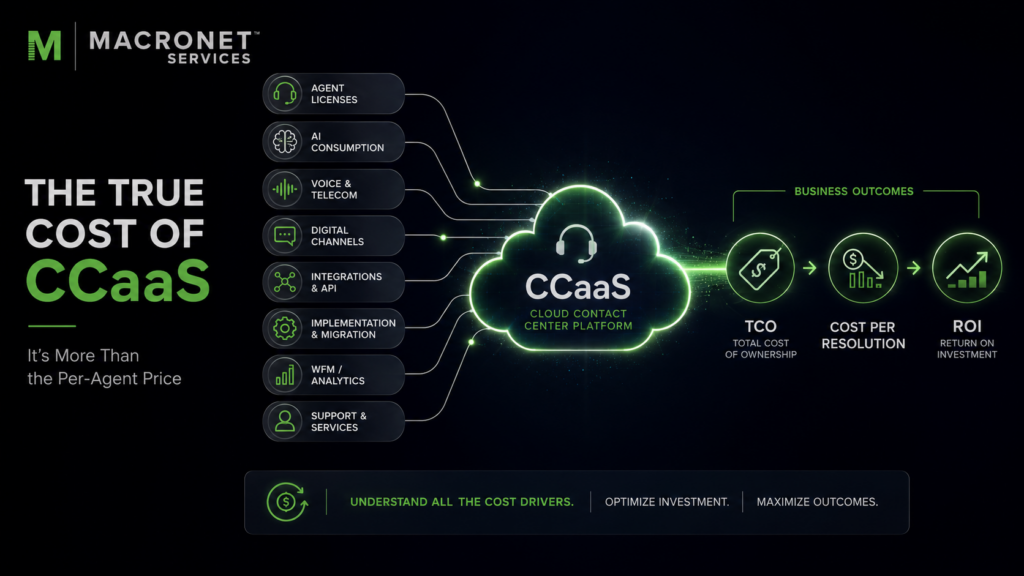
The advertised per-agent license is no longer enough to understand CCaaS economics. In 2026, total cost is a hybrid of seats, channels, telecom, AI consumption, WEM and analytics, integrations, implementation, support, usage commitments and contract structure. Increasingly, the most useful economic metric is cost per successful resolution – not simply cost per seat or cost per deflected contact. |
Pricing research was checked against current vendor sources on August 31, 2026. Public list prices change frequently and are not the same as negotiated enterprise pricing. All pricing in this guide should be validated during procurement.
How Much Does CCaaS Cost in 2026?
Contact Center as a Service (CCaaS) pricing in 2026 is no longer captured by a single per-agent number. For the major enterprise platforms that publish list pricing, current starting and packaged prices span roughly $69 to $249 per agent or user per month, but that range is not an apples-to-apples market price. Zoom currently cites a $69 starting price for Contact Center, Genesys publishes named-user tiers from $75 to $240, Talkdesk lists plans from $85 to $225, NICE lists $110 to $249 packages, and Five9 lists $119 and $159 entry bundles before moving to quote-based higher tiers. Several other enterprise providers, including Avaya Infinity, Vonage Contact Center and 8×8 Contact Center, do not publish a current dollar list price for the enterprise offering.
The bigger problem is that those numbers represent different billing units and different scopes. Five9 says its published prices are per concurrent user, while Genesys publishes named-user prices but also offers concurrent and hourly interacting models. Talkdesk publishes per-user edition prices while also offering per-hour login consumption and concurrent pricing. Zoom supports a shared concurrent-license pool. NICE contract terms explicitly define a concurrent-agent model based on peak logged-in active users. In other words, even before AI usage is added, the major CCaaS platforms can measure and bill human access in materially different ways.
| The answer..
A credible CCaaS budget should model at least eight categories: platform licenses, telecom and numbers, digital-channel usage, AI consumption, WEM/analytics/add-ons, implementation and integration, support/administration, and contract/overage risk. Comparing only per-agent list prices can produce the wrong vendor decision even when the arithmetic is technically correct. |
This matters more in 2026 because AI spending is rising far faster than overall customer-service budgets. Gartner reported in August that surveyed customer-service leaders increased AI spending 38% while their overall service and support budgets rose only 2%. Yet Gartner separately reported that only 24% of service and support leaders in another 2026 survey demonstrated positive financial returns across their AI use cases. The procurement problem has therefore shifted from “Can we afford CCaaS?” to “Can we prove that the combined human-and-AI operating model creates measurable economic value?”
Why the Advertised Seat Price Is Not the Real Cost of CCaaS
A CCaaS subscription is best treated as one layer of an operating architecture. The base package may include routing, voice, digital channels, reporting and selected AI capabilities, but the commercial structure can also separate telephone service, phone numbers, SMS, transcription, storage, advanced WEM, premium support, professional services, CRM adapters, API usage and autonomous-agent consumption. Talkdesk, for example, explicitly defines service fees as license fees, usage fees and professional services; its usage fees can include AI interactions, call minutes, phone-number line access, SMS and transcription. NICE terms separately define minimum recurring commitments, non-recurring professional-services charges and network connectivity. Five9 identifies WEM, storage, connectivity, support and professional services among areas that can sit outside a base bundle.

The result is a simple principle: the more AI and enterprise workflow execution you add, the less useful “price per agent” becomes as a standalone metric. That does not make seat price irrelevant. It means seat price has to be normalized inside a larger total-cost model.
Named vs. Concurrent vs. Hourly vs. Consumption-Based CCaaS Pricing
Named-agent licensing
Named licensing charges for individually licensed users. It is easy to forecast and administer, and it works well when most licensed employees use the platform every working day. Genesys defines a named license as tied to a specific identifiable user and currently publishes its CX 1 through CX 4 prices on that basis. Dialpad Support also publishes per-user prices. The tradeoff is utilization: if 500 people need accounts but only 300 are ever active at one time, the enterprise may pay for significant unused seat capacity.
Concurrent licensing
Concurrent licensing charges against simultaneous or peak usage rather than every individual account. This can be attractive for shift-based contact centers, BPOs, seasonal operations and environments with part-time staff. Genesys says concurrent billing is based on maximum simultaneous users during the billing period, with short shift-change peaks disregarded under its rules. Zoom provides a shared concurrent-license pool and reports peak concurrency. NICE defines its concurrent model around the peak logged-in active configured users on the highest-volume day in a month. Five9 goes further: its current public Digital and Core prices are explicitly stated per concurrent user.
| Concurrent-license break-even example
Assume 500 people need access. If a named license costs $100 and a concurrent license hypothetically carries a 30% premium, 500 named users cost $50,000 per month. If peak concurrency is only 300, 300 concurrent users at $130 cost $39,000 – 22% less. But at 420 concurrent users, the bill becomes $54,600 and named licensing would be cheaper. The break-even in that example is about 77% concurrency. This is an illustration, not a vendor quote; the actual premium, peak-counting rules and overage terms must be taken from the proposal. |
The most common mistake is assuming “concurrent” means the same thing across platforms. It does not. Buyers should define exactly what event starts and stops a billable concurrent session, how supervisors and administrators are counted, whether API users count, how shift changes are handled, how overages are measured and whether peak usage permanently resets the commitment.
Hourly and interaction-based licensing
Hourly models can make sense for low-volume knowledge workers, occasional agents or extended enterprise users. Genesys advertises an “Hourly Interacting” option that charges only for time spent handling interactions. Talkdesk also states that it offers per-hour login consumption pricing. These models deserve attention when the organization wants to extend customer-service capabilities beyond a traditional full-time agent population.
Consumption and outcome pricing
The newest pricing models increasingly disconnect cost from human seat count. Zoom Virtual Agent offers an optional outcome-based pricing model tied to resolved or successfully routed interactions across voice and chat. Dialpad prices AI agents using conversation credits and describes a conversation as billable when AI retrieves information or executes real work such as scheduling, routing or an order lookup. These models illustrate a broader shift from paying only for software access toward paying for digital labor, usage and business outcomes.
2026 CCaaS Public Pricing Comparison
The following table uses current public vendor information as of August 31, 2026. It is deliberately labeled “public pricing,” not “market pricing.” Large enterprises normally negotiate discounts, custom packages, ramp schedules and usage commitments, and the plans are not feature-equivalent. The purpose is to show how dramatically the billing models differ before negotiation begins.
| Platform | Current public price signal | Primary pricing basis | What the buyer should notice |
| NICE CXone | $110 / $135 / $169 / $209; Ultimate $249 + $0.25/session | Per agent; concurrent model also documented | List packages are transparent, but professional services/network connectivity and minimum commitments can be separate. |
| Genesys Cloud CX | $75 / $115 / $155 / $240 | Published as named user; concurrent and hourly also available | Annual commitment shown; AI Experience tokens and usage/fair-use economics matter. |
| Five9 | $119 Digital; $159 Core; Plus/Pro/Enterprise quote | Published prices per concurrent user; min. 50 seats | 3,000 AI minutes per bundled seat + usage; WEM may be named-basis. |
| Talkdesk | $85 Digital; $105 Voice; $165 Elite; $225 Industry | Per user; concurrent and hourly also offered | Published edition prices assume minimum three-year commitment; telco and usage fees extra. |
| Zoom Contact Center | Starts at $69 Essentials / $99 Premium / $149 Elite | Named or concurrent | AI Virtual Agent can use optional outcome-based pricing; advanced features may be add-ons. |
| Dialpad Support | $80 / $115 / $150 annual pricing | Per user for Support plans | AI Agents are separately conversation-credit based; enterprise terms can vary. |
| Avaya Infinity | Quote-based | Named or concurrent depending bundle; Hybrid concurrent-only | Current Infinity service description includes minimum-agent commitments, peak usage and fair-use overages. |
| Vonage Contact Center | Quote-based | Enterprise quote | Priority/Premium plans plus add-ons; AI/virtual assistant, WFM and integrations can alter scope. |
| 8×8 Contact Center | Quote-based | Custom mix-and-match plan | No current public dollar list price on main pricing page; AI-enabled self-service and WEM are part of available capability set. |
Source note: Pricing links used for this table: NICE | Genesys | Five9 | Talkdesk | Zoom | Dialpad | Avaya | Vonage | 8×8
The comparison immediately shows why “Which CCaaS vendor is cheapest?” is usually the wrong question. A $119 concurrent seat cannot be compared directly with a $115 named seat, and neither can be compared directly with hourly, token, conversation or outcome-based pricing. Buyers first have to normalize the billing unit, included scope and expected usage assumptions.
How AI Has Changed CCaaS Pricing
Traditional CCaaS economics were dominated by predictable human-seat subscriptions. AI has added a second meter. Depending on the platform, that meter may count tokens, minutes, sessions, conversations, successful actions, resolutions or other usage units. The result is a hybrid budget: fixed software capacity plus variable digital labor.
| Vendor/model | AI billable unit | What the public model says | Procurement implication |
| Genesys | AI Experience tokens | All CX packages include an organization-level allocation; CX4 adds 30 tokens per named agent. Current resource-center pricing shows additional USD tokens at $1 each. Agentic Virtual Agent consumption is metered per interaction. | Forecast interaction mix and token conversion rates, not just token quantity. |
| Five9 | Included AI minutes + usage | Five9 states 3,000 AI minutes per bundled seat plus usage. | Clarify which AI functions draw down the pool, pooling rules, overage rates and whether voice/digital use the same meter. |
| NICE | Seat + session/consumption | Ultimate is publicly listed at $249 per agent/month plus $0.25 per session. | Define exactly what constitutes a session and which agentic capabilities are included versus consumption-based. |
| Talkdesk | License + usage wallet | Terms permit usage charges for AI interactions, call minutes, phone numbers, SMS and transcription; customer rate cards provide actual usage rates. | Require the full rate card and model expected monthly consumption before signing. |
| Zoom | Optional outcome-based AI pricing | Virtual Agent can be priced against resolved or successfully routed interactions across voice and chat. | The contract must define “resolved,” “successfully routed,” repeat contact and edge cases. |
| Dialpad | AI Agent conversation credits | Billable sessions are tied to AI interaction and value-producing work such as information retrieval or action execution. | Understand whether transferred sessions are still billable and how credits are pooled and replenished. |
Genesys is a useful example of why the unit matters. Its current pricing page includes 250 AI Experience tokens per named-license organization or 350 for concurrent organizations, while CX4 includes additional agent-level tokens. The Genesys resource center currently lists additional USD tokens at $1 each and applies different token conversion rates by AI feature. A buyer who says “we have 10,000 tokens” still has not answered the economic question; the organization needs to know which use cases consume those tokens and at what conversion rate.
Zoom and Dialpad illustrate the more consequential shift from paying for AI capacity to paying for an AI business event. Zoom ties its optional model to resolved or successfully routed interactions; Dialpad says credits are used when AI delivers work in a billable conversation. Those models can align spending more closely with outcomes, but only when the contract defines the outcome precisely. A “successful route” is economically different from a successful resolution. A conversation that triggers a tool call and then transfers to a human may still be billable. A resolution followed by a repeat contact tomorrow may not be a resolution from the customer’s perspective.
For a deeper technical discussion of autonomous customer-service agents, enterprise actions and outcome-oriented service, see the Macronet Services 2026 guide to Agentic CCaaS. This pricing guide focuses on the commercial and economic consequences rather than repeating the architecture discussion.

The Telecom Costs That CCaaS Pricing Comparisons Often Miss
Voice remains a communications service even when AI is answering the call. A CCaaS proposal therefore needs to state whether PSTN service is bundled, metered or brought by the customer; whether inbound toll-free and outbound usage are priced differently; how DIDs and toll-free numbers are billed; what international and mobile destinations cost; how taxes and regulatory surcharges are passed through; and who owns and controls the numbers. Those details can materially change the monthly bill in a voice-heavy operation.
The current vendor documents make this explicit. Talkdesk’s usage pricing maps billable resources to contact-center calls, BYOC, phone numbers, SMS/MMS, voicemail and speech transcription. NICE separately defines “Network Connectivity” as services connecting agent locations to the platform or enabling telephone and data communications. Five9 identifies connectivity, TFNs and DIDs as an additional service area. In other words, “voice included” should never be assumed to mean “all voice transport included at no additional cost.”
Enterprise network design matters as well. Remote agents, branch offices, large campuses and data centers may depend on redundant internet access, a Tier 1 ISP, SASE SD-WAN, private cloud connectivity or other network controls to maintain predictable media quality and application performance. BYOC can create commercial leverage or preserve carrier relationships, but it also changes troubleshooting ownership and failure domains. Buyers evaluating these options should normalize the communications architecture along with the software quote. Macronet Services covers the underlying voice architecture in its enterprise SIP trunking and AI-era voice guide.
Hidden CCaaS Costs: What Commonly Sits Outside the Base License
“Hidden cost” does not necessarily mean the vendor concealed a fee. More often, it means the buying team compared proposals before forcing every provider to price the same scope. The demo included advanced analytics, automated quality management, WFM, a premium CRM adapter, generative summaries and international voice, while the initial pricing table did not. By the time the project reaches a final order form, the apparent $20-per-seat difference between vendors may have disappeared.
| Cost area | What to normalize in the quote |
| WFM / WEM / QM | Confirm whether workforce management, quality management, screen recording, performance management and coaching are included and on what licensing basis. Five9 notes WEM may be sold on a named basis even when CCaaS is concurrent. |
| Recording & storage | Model retention periods, screen recording, transcription, archival and regulatory requirements. Fair-use allocations can be exceeded. |
| CRM & enterprise integrations | Distinguish included adapters from paid connectors, professional services, custom APIs and ongoing maintenance. |
| Digital messaging | Price SMS/MMS, WhatsApp and other third-party channels by expected monthly volume and country. |
| AI & transcription | Separate included allowances from overage rates; identify every feature that draws from the same pool. |
| Professional services | Include discovery, design, configuration, integrations, migration, testing, training and cutover. |
| Premium support / TAM | 24×7 support may be included in one bundle while a technical account manager or managed admin is extra. |
| Compliance & security | PCI, secure payment, data residency, special encryption, private connectivity and regulated-industry requirements may alter architecture or price. |
| Sandbox / non-production | Determine whether test environments, load testing, simulation and development orgs are included or separately licensed. |
| Legacy exit | Include early termination, maintenance overlap, carrier disconnect, data extraction and number-porting costs. |
How Much Does CCaaS Implementation Cost?
There is no defensible universal implementation percentage. A 75-agent digital support center with a standard CRM connector is a different project from a 5,000-agent global voice environment with hundreds of queues, multiple carriers, regulated recording, custom workforce rules, legacy IVRs and dozens of integrations. The more useful approach is to build implementation from the work breakdown rather than apply a generic multiplier.
A complete one-time implementation budget should include vendor professional services, third-party integration work, internal IT and contact-center labor, call-flow and IVR redesign, data migration, number porting, security and compliance review, testing, training, change management, parallel operations and legacy exit. AI adds its own work: knowledge preparation, prompt/workflow design, tool permissions, evaluation datasets, simulation, guardrails and production monitoring. These are not reasons to avoid AI; they are reasons to compare a real implementation to a real implementation.
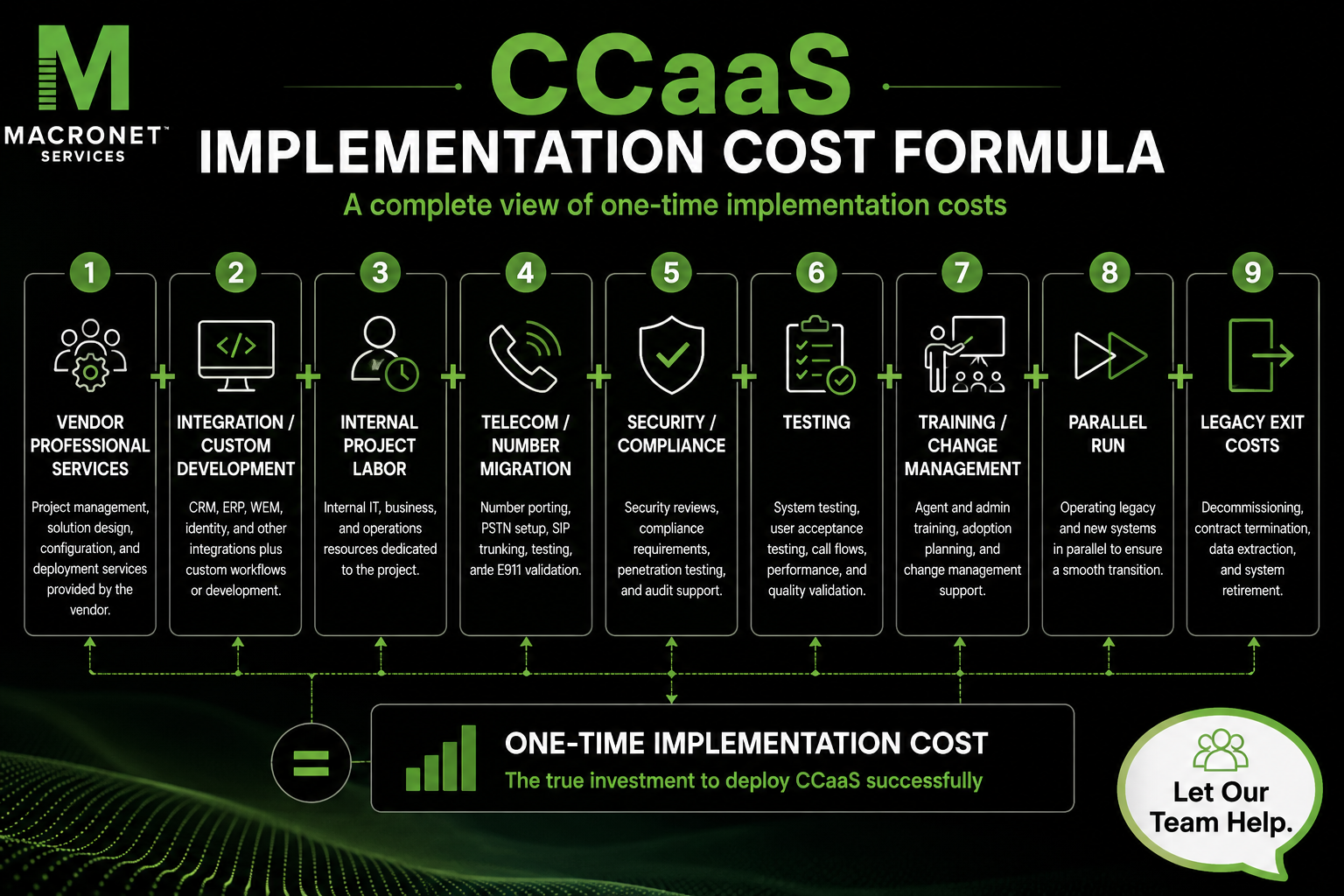
For procurement teams, an important discipline is to require professional-services assumptions in writing. How many flows, queues, integrations, reports, countries, numbers and training sessions are included? What is the hourly rate for out-of-scope work? What constitutes acceptance? How are delays caused by the vendor versus the customer treated? Those questions prevent a low initial SOW from turning into a sequence of change orders.
Build a Three-Year CCaaS TCO, Not a One-Year License Comparison
A three-year model is usually a better decision tool than annual recurring revenue alone because implementation, ramp, contract term, consumption growth and legacy retirement occur on different timelines. The model should separate one-time costs from run-rate costs, then expose the variables that can change with volume.
| Three-year TCO formula
3-year CCaaS TCO = platform subscriptions + telecom/numbers + digital usage + AI consumption + WEM/analytics/add-ons + support/administration + implementation/integration + training/change + parallel-run/legacy-exit costs + forecast overages – committed credits or contractual concessions. |
| Illustrative 500-agent cost model | Year 1 | Year 2 | Year 3 | 3-year total |
| Base CCaaS licensing | $900,000 | $900,000 | $900,000 | $2,700,000 |
| Telecom & numbers | $180,000 | $180,000 | $180,000 | $540,000 |
| AI & automation consumption | $240,000 | $240,000 | $240,000 | $720,000 |
| WEM / analytics / add-ons | $120,000 | $120,000 | $120,000 | $360,000 |
| Support / admin / monitoring | $90,000 | $90,000 | $90,000 | $270,000 |
| Implementation & migration | $450,000 | – | – | $450,000 |
| Integration / data engineering | $180,000 | $60,000 | $60,000 | $300,000 |
| Training & change management | $90,000 | $30,000 | $30,000 | $150,000 |
| Parallel run / legacy exit | $150,000 | – | – | $150,000 |
| Illustrative total | $2,400,000 | $1,620,000 | $1,620,000 | $5,640,000 |
Important: This table is an illustrative normalized business-case model, not a Macronet Services market benchmark and not a representation of any specific vendor quote. Its purpose is to show that the base license can represent less than half of three-year TCO once the complete operating environment is included.
The model also highlights why a discount can be misleading. A vendor that reduces licenses by $100,000 per year but requires $500,000 more integration work is not cheaper over the decision horizon. Conversely, a platform with a higher subscription may lower total operating cost if it removes third-party products, simplifies administration, improves resolution efficiency or materially reduces telecom expense. TCO is the common denominator.
The Metric That Matters More in the AI Era: Cost per Successful Resolution
Seat price assumes human labor is the unit of production. Agentic and autonomous service makes that assumption less reliable. A customer issue may be resolved entirely by AI, handled entirely by a human, or move through an AI-plus-human workflow. The economic metric should therefore follow the work, not the seat.
| Cost per successful resolution
Cost per successful resolution = total allocated service-delivery cost / number of customer issues that meet the organization’s definition of successful resolution. |
The numerator can include platform subscriptions, AI consumption, telecom, allocated agent labor, BPO cost, support and operational tooling. The denominator should not be “contacts contained.” It should represent issues actually resolved. A useful definition may require that the requested business outcome was completed, policy was followed, no avoidable escalation occurred and the customer did not recontact the company for the same issue within a defined window.
This distinction matters because a cheap interaction can create an expensive customer journey. If a bot ends a session at $0.40 but the customer then calls twice, the business did not create a forty-cent resolution. Conversely, an AI agent that costs more per interaction but completes a return, changes a reservation or resolves a billing dispute without repeat contact may be the lower-cost operating model. That is the economic bridge between this article and the broader move toward Agentic CCaaS.
How to Calculate CCaaS and Contact Center AI ROI
ROI should begin with an operational baseline, not with a vendor’s projected automation percentage. Gartner’s 2026 research is a useful warning: customer-service organizations are increasing AI spending rapidly, but Gartner says most organizations still struggle to realize tangible savings, and only a minority of surveyed service/support leaders demonstrated positive financial returns across AI use cases. The business case therefore needs to identify exactly where cash cost, capacity, revenue or risk changes.
| Benefit category | What may improve | How to keep the ROI credible |
| Labor capacity | Reduced AHT/ACW, more contacts per paid hour, fewer seasonal hires or outsourced hours | Count realized capacity or avoided spend; do not automatically treat productivity as headcount savings. |
| Repeat-contact reduction | Higher first-contact resolution and fewer avoidable recontacts | Measure at issue/journey level, not only session containment. |
| Self-service / autonomous resolution | Issues completed without human handling | Use successful resolution and escalation-quality measures. |
| Revenue | Higher conversion, saved cancellations, collections, retention, upsell | Attribute conservatively and separate correlation from causal impact. |
| Legacy retirement | PBX/CCaaS licenses, maintenance, carriers, third-party WEM, data centers | Use actual contracts and termination dates. |
| Operational resilience | Reduced outage impact, faster changes, geographic flexibility | Monetize only where there is a defensible historical or risk-based value. |
| Quality / compliance | Automated QA coverage, reduced errors, better auditability | Tie to measurable labor, remediation or risk cost where possible. |
| Simple three-year ROI formula
3-year ROI = (three-year quantified benefits – three-year TCO) / three-year TCO. Also calculate payback period and NPV if the project is material. Keep “soft benefits” visible, but do not mix them into hard-dollar ROI unless finance agrees with the valuation method. |
The strongest business cases distinguish cash savings, cost avoidance, labor capacity, revenue impact and risk reduction. For example, saving 90 seconds of after-call work may create meaningful capacity without reducing payroll. That can still be highly valuable if the business avoids overtime, absorbs growth, reduces BPO spend or improves service levels. The CFO should be able to see which benefit category is actually funding the project.
CCaaS Contract Negotiation: Where the Economics Are Won or Lost
The price sheet is only one page of the commercial agreement. The most expensive surprises are often caused by the definitions and commitments around the price. Talkdesk’s current master subscription agreement, for example, says license fees are generally based on provisioned subscriptions rather than actual usage, payment obligations are non-cancelable, quantities cannot be decreased during the service term unless otherwise stated, and renewal uplift can be specified in the order form. Avaya Infinity’s service description illustrates a different enterprise construct: a Monthly Minimum Agent Commit, monthly peak agent usage, usage overages and a monthly maximum that can reach 150% of the committed agent count before a change order is required.
| Commercial issue | Question to answer | Negotiation objective |
| Committed seat/unit count | How many named, concurrent, hourly or usage units are contractually committed? | Negotiate a ramp and realistic baseline rather than buying future-state capacity on day one. |
| Downcount / true-down | Can quantity decrease at renewal or after business contraction? | Get explicit rights; do not assume SaaS flexibility means commercial flexibility. |
| Overage mechanics | How are peak users, minutes, messages, tokens or sessions measured? | Cap or tier overages and require usage visibility before charges accrue. |
| AI billable definition | What is a session, conversation, resolution, route, action or token? | Attach definitions and examples to the order form where possible. |
| Included allowance | What is pooled, per-user, per-org or fair-use? Does unused volume roll over? | Model normal and peak months and negotiate buffers. |
| Price protection | What happens to seat, telecom and AI rates over the term and renewal? | Set renewal caps and protect future seat/usage additions where feasible. |
| Professional services | What is in scope, what is acceptance, and what triggers change orders? | Tie milestones to deliverables and identify rates for additional work. |
| SLA / credits | How is uptime measured and what service credit applies? | Ensure credits are meaningful and the claims process is practical. |
| Telecom / surcharges | Which carrier rates, taxes and pass-through fees can change? | Separate controllable vendor rates from regulatory/carrier pass-throughs. |
| Data / exit / numbers | Can recordings and data be exported? Who owns telephone numbers? What exit help is available? | Protect portability and avoid creating a commercial barrier to future migration. |
One of the most important disciplines is to negotiate against normalized demand rather than vendor packaging. If Vendor A prices 500 named seats and Vendor B prices 325 concurrent seats, the procurement team should not compare the bottom-right totals until it has modeled both vendors against the same staffing profile. The same principle applies to AI: 100,000 “conversations” are not equivalent to 100,000 “resolutions.”
How to Compare Two CCaaS Quotes Apples to Apples
The normalization worksheet should convert every proposal into the same operating assumptions. Start with the same user population, peak concurrency, channel volumes, call minutes, countries, numbers, SMS/messages, recording retention, WFM requirements, integrations, AI use cases and support model. Then force each quote into fixed recurring cost, variable recurring cost and one-time cost.
| Normalization step | What must be made equivalent |
| 1. License basis | Named / concurrent / hourly / usage; supervisor/admin rules; peak definition |
| 2. Scope | Voice, digital channels, WEM, analytics, outbound, recording, QA, AI, integrations |
| 3. Telecom | DID/TFN, inbound/outbound, international, BYOC, SIP/PSTN, surcharges |
| 4. AI consumption | Billable unit, included pool, overage, transfer/failure treatment, outcome definition |
| 5. One-time services | Implementation, integrations, data, training, porting, testing, custom development |
| 6. Recurring services | Premium support, TAM/admin, storage, third-party products, private connectivity |
| 7. Contract | Term, ramp, minimums, uplift, overages, true-down, renewal, termination, exit |
| 8. Output metrics | Annual run rate, Year 1 cash, 3-year TCO, cost/contact, cost/successful resolution |
| Best procurement question
“Using our actual staffing, interaction volumes, telecom profile, AI use cases and contract term, show us the expected monthly invoice for a normal month, a peak month and a month in which AI consumption exceeds the included allowance.” |
What Should a Pricing-Focused CCaaS RFP Require?
The RFP should require more than a package name and a per-seat price. It should force vendors to disclose the billing unit for every component, the included quantities, the overage rates, the proposed commitment, the implementation assumptions and all pass-through charges. AI needs its own pricing schedule because the same autonomous workflow may invoke voice, transcription, model inference, knowledge retrieval, tool actions and human handoff.
Macronet Services has separately covered the technology requirements that should be addressed when adding AI to a CCaaS procurement. See our guide to AI requirements for CCaaS RFPs, and use the Macronet Services CCaaS RFP template as a starting point for a broader sourcing exercise. The pricing section should be customized to the organization’s actual volumes rather than sent as a generic spreadsheet.
What Should an Enterprise Buyer Do Next?
The practical sequence is to establish the current-state economic baseline before requesting final quotes. Know the real number of people who need access, the actual concurrency curve, monthly interaction and telecom volumes, required channels, WEM scope, integration inventory, AI use cases and contract constraints. Then require at least two or three credible suppliers to price the same demand model.
Next, normalize the quotes into three-year TCO and cost per successful resolution. Do not force every provider into the same commercial model if a different model is genuinely more efficient; instead, convert the different models into the same expected business volumes. A usage-based provider can be compared with a seat-based provider as long as both are modeled against the same demand.
Finally, test the variables that could break the business case. What happens if voice minutes are 20% higher? If concurrency is 15% higher in peak season? If AI resolution is half the vendor’s assumption? If AI usage doubles? If the project needs six additional integrations? A vendor decision that survives those sensitivity tests is much stronger than one built around the lowest optimistic quote.
Have a CCaaS Quote? Let Macronet Services Benchmark It.
List pricing is only the starting point. Macronet Services helps enterprises normalize CCaaS proposals across named and concurrent licensing, AI consumption, telephony, WEM, integrations, implementation, contract terms and multi-year TCO. If you already have a quote – or are preparing an RFP – Macronet Services can help determine whether you are comparing equivalent solutions, where commercial risk is hiding and whether the structure is competitive.

Conclusion: In 2026, CCaaS Price Is a System, Not a Seat
CCaaS pricing used to be relatively easy to summarize: count agents, select a package and multiply by a monthly seat rate. That model still exists, but it no longer describes the full economics of a modern contact center. Named and concurrent licensing coexist with hourly consumption. AI adds tokens, minutes, sessions, conversations and outcomes. Telecom still matters. Professional services and integration determine how much of the promised functionality actually reaches production. Contract terms determine whether the economics remain attractive after the first year.
For business leaders, the answer is not to demand a single universal price. It is to create a disciplined demand model, require suppliers to price the same operating reality, calculate three-year TCO and judge the result against successful customer resolution. That approach makes it possible to compare very different CCaaS architectures without being misled by the headline number.
For organizations evaluating autonomous agents as part of that future operating model, the next step is the Macronet Services Agentic CCaaS guide, which examines the technology, architecture and leading platforms behind the shift from interaction management to enterprise resolution. Please don’t hesitate to reach out for a conversation about your CCaaS strategy and how we can help.
CCaaS Pricing FAQs
What does CCaaS stand for?
CCaaS stands for Contact Center as a Service. It is a cloud delivery model for contact center capabilities such as voice, digital channels, routing, analytics, workforce tools and increasingly AI, with pricing typically combining subscriptions and usage-based charges.
How much does CCaaS cost per agent in 2026?
Public enterprise CCaaS prices commonly start around $69-$119 per user or agent per month, while more complete suites can reach roughly $150-$249 or move to custom pricing. Those figures are not directly comparable because vendors use different named, concurrent, hourly and consumption models, and they usually exclude at least some AI, telecom, implementation or add-on costs.
What is CCaaS pricing and how does it work?
CCaaS pricing is the commercial model used to charge for cloud contact center software and related services. A modern quote may combine named or concurrent agent licenses with telecom usage, digital messages, AI consumption, WEM, integrations, storage, support and implementation, so the headline seat price is only one part of total cost.
What is the average cost of CCaaS?
There is no single defensible average for enterprise CCaaS because scope and billing units vary too much. A better planning method is to model base licenses, telecom, digital usage, AI, WEM and analytics, integrations, implementation, support and expected overages over the full contract term.
How much does CCaaS cost for 100 agents?
Using current public list prices of roughly $69-$249 per seat as a simple illustration, 100 seats would represent about $82,800-$298,800 per year in base subscription cost before negotiated discounts and before telecom, AI, implementation and other charges. The real amount can be materially different if the platform uses concurrent licensing or if only a subset of agents requires premium functionality.
How much does CCaaS cost for 500 agents?
At 500 seats, simple public-list-price arithmetic using roughly $69-$249 per month produces about $414,000-$1.49 million per year for the base subscription alone. Enterprise deals at this size are normally negotiated, however, and concurrency, AI consumption, telecom, WEM, implementation and volume commitments can change three-year TCO far more than the published seat price.
What is named-agent licensing?
Named licensing assigns a license to a specific identifiable user. It is predictable and simple to administer, but it can be inefficient when many employees need accounts and only a smaller percentage are active at the same time.
What is concurrent-agent licensing?
Concurrent licensing charges against simultaneous or peak active usage instead of total user identities. It can reduce cost for shift-based, seasonal and BPO environments, but the buyer must understand exactly what starts and stops a billable concurrent session.
What is the difference between named and concurrent CCaaS licensing?
Named licensing is based on how many individual users are licensed, while concurrent licensing is based on how many users can be active at the same time. The less overlap there is between shifts and user activity, the more attractive concurrent licensing can become, even when the per-concurrent-user rate carries a premium.
How do you calculate how many concurrent CCaaS licenses you need?
Use measured peak simultaneous platform activity, not average staffing. Analyze interval-level login and interaction data across normal days, seasonal peaks, supervisors, overflow teams and business-continuity scenarios, then add a reasonable operating buffer based on the vendor’s specific concurrency definition.
Is concurrent CCaaS licensing always cheaper?
No. Concurrent licensing is cheaper only when lower peak concurrency offsets any premium charged for a concurrent seat. The correct calculation compares actual concurrency, vendor-specific billing rules and total committed quantities rather than simply comparing per-seat rates.
What is usage-based CCaaS pricing?
Usage-based CCaaS pricing charges for actual consumption rather than only for fixed seats. The billable unit may be minutes, messages, sessions, AI tokens, conversations, actions or another measurable event, which can align spending with activity but also make budgeting more variable.
What is outcome-based pricing for contact center AI?
Outcome-based pricing charges when an AI interaction reaches a contractually defined result, such as a successful resolution or routing outcome. It can align vendor economics with business value, but the contract must define what counts as success, how repeat contacts and transfers are treated, and when an outcome becomes billable.
How much does contact center AI cost?
There is no universal contact center AI price because major platforms meter AI using different units, including tokens, minutes, sessions, conversations, usage credits and outcomes. The most useful comparison converts each model into forecast annual spend and expected cost per successful resolution.
How are AI voice agents priced?
AI voice agents may be priced per minute, per session, per conversation, through token or credit consumption, or by outcome. Buyers should also confirm whether PSTN, speech-to-text, text-to-speech, model inference, enterprise tool calls and transfers are included in the same charge.
How do you compare AI pricing across CCaaS vendors?
Normalize each vendor to the same expected customer journeys and monthly volumes. Identify the billable unit, included allowance, overage rate, average units consumed per journey, treatment of failed or transferred interactions and expected successful-resolution rate before comparing annual cost.
Does CCaaS include telephone service?
Sometimes, but not always and not necessarily without usage limits. Voice pricing may include or exclude carrier minutes, DIDs, toll-free service, international calling, E911 and taxes or surcharges, so telecom should be a separate line in the TCO model.
Are telephony minutes included in CCaaS pricing?
Some CCaaS packages include an allowance or bundled carrier service, while others meter voice separately or let the customer bring its own carrier. The quote should state inbound, outbound, toll-free and international rates as well as any fair-use limits or geographic exceptions.
Are SIP trunks included with CCaaS?
Not necessarily. Cloud CCaaS may use the provider’s carrier network or a bring-your-own-carrier model instead of a traditional customer-managed SIP trunk. Enterprises retaining their own voice providers should model SIP or PSTN service, SBCs, routing, redundancy and operational support separately.
What is BYOC in CCaaS and can it reduce cost?
BYOC means Bring Your Own Carrier. It can reduce cost or improve geographic coverage and carrier control for some enterprises, especially those with strong existing telecom contracts, but it may also introduce SBC, integration, support and operational responsibilities that must be included in TCO.
Does CCaaS include workforce management?
It depends on the vendor and package. Workforce management, quality management, screen recording, analytics and coaching may be included in premium tiers, sold as add-ons or licensed on a different user basis than the core CCaaS platform.
Are CRM integrations included in CCaaS pricing?
Standard connectors may be included, but custom workflows, premium adapters, API usage, implementation services and ongoing integration support can carry additional cost. Buyers should distinguish the right to use a connector from the professional services required to make it work in production.
Do call recording and storage cost extra with CCaaS?
They can. Recording capability may be included while retention, screen recording, transcription, archival, compliance storage or higher-capacity tiers are separately charged. The quote should model the organization’s actual retention policy and expected interaction volume.
What are the biggest hidden CCaaS costs?
The most commonly overlooked costs are telecom usage, AI consumption, WEM and quality tools, digital messaging, recording and storage, integrations, professional services, premium support, test environments, number migration and contract overages. These are not always concealed; they are often simply outside the advertised base license.
How much does CCaaS implementation cost?
Implementation varies too widely for a universal percentage to be reliable. A credible estimate should be built from the required design, configuration, integrations, data migration, telecom and number porting, security work, testing, training, cutover and internal project labor.
What is the difference between CCaaS implementation cost and migration cost?
Implementation is the cost to configure and launch the new CCaaS environment, while migration also includes the work required to move away from the existing environment. Migration can add number porting, dual-running periods, legacy contract termination, data conversion, retraining and decommissioning costs.
What should be included in a CCaaS total cost of ownership model?
A CCaaS TCO model should include platform subscriptions, telecom and numbers, digital-channel usage, AI consumption, WEM and analytics, integrations, implementation, support, administration, storage and expected overages. It should also include any costs required to keep legacy systems operating during migration.
Why should companies calculate three-year CCaaS TCO?
Three-year TCO captures costs that a one-year license comparison misses, including implementation, ramp periods, AI growth, annual uplifts, contract commitments and legacy-system retirement. It also makes it easier to compare vendors that package the same capabilities in different ways.
How should a company calculate CCaaS ROI?
Calculate quantified benefits over the same period as TCO, then compare the two and measure payback. Keep cash savings, cost avoidance, labor capacity, revenue improvement and risk reduction separate so finance can see which benefits are actually realizable.
What is cost per successful resolution?
Cost per successful resolution is the total allocated cost of delivering service divided by customer issues that meet a defined resolution standard. It is especially useful in AI-enabled contact centers because it can compare AI-only, human-only and blended AI-plus-human journeys on the same business outcome.
Will AI agents automatically reduce CCaaS seat costs?
Not automatically. AI may reduce handled volume, after-call work or peak staffing requirements, but human agents may still need licenses for escalations, complex work and new responsibilities. The business case should model actual changes in concurrency and staffing rather than assuming every automated interaction removes a paid seat. For a deeper look at autonomous agents and platform architecture, see the Macronet Services Agentic CCaaS guide.
Are longer CCaaS contracts cheaper?
They can be, because vendors may offer better unit pricing or commercial concessions for multi-year commitments. The tradeoff is reduced flexibility, so buyers should negotiate ramp schedules, renewal caps, termination protections and quantity-adjustment rights rather than focusing only on the upfront discount.
What are CCaaS overage charges?
Overage charges apply when usage exceeds a committed or included quantity, such as minutes, messages, sessions, AI credits or concurrent capacity. Contracts should define the measurement period, rate, pooling rules, alerts and whether higher-volume tiers reduce the marginal overage price.
What are true-down rights in a CCaaS contract?
True-down rights allow the customer to reduce committed quantities under defined conditions or at renewal. They are important because SaaS technology can scale down easily even when the commercial contract does not, and without explicit language a customer may remain obligated to pay for unused capacity.
Is CCaaS cheaper than an on-premises contact center?
CCaaS can lower infrastructure ownership, upgrade and data-center costs, but it is not automatically cheaper in every environment. The correct comparison includes licenses, carriers, hardware, support staff, maintenance, refresh cycles, integrations, migration and the economic value of faster access to new capabilities.
How can a company benchmark a CCaaS quote?
Benchmark the entire commercial structure, not just the seat price. Normalize the quote for the same staffing profile, concurrency, channels, telecom volumes, AI usage, WEM, integrations, implementation scope, contract term and renewal assumptions, then compare three-year TCO and cost per successful resolution.
How can businesses negotiate better CCaaS pricing?
Normalize competing quotes against the same operating profile, negotiate commitment and ramp as aggressively as unit price, define AI billing precisely, cap or tier overages, control renewal uplift, protect number and data portability, and secure meaningful downcount or true-down rights where possible.