Starlink Mobile: How SpaceX Could Transform Telecom with Spectrum, Satellites and Enterprise Networks
For most of its existence, Starlink has been relatively easy to categorize. It is a low-Earth-orbit satellite broadband network designed to deliver high-speed internet where terrestrial connectivity is unavailable, unreliable or prohibitively expensive.
That description is rapidly becoming inadequate.
SpaceX is assembling the pieces of a much broader telecommunications platform. Starlink already provides fixed broadband, business connectivity, maritime, aviation and mobility services. Its Direct to Cell network allows conventional mobile devices to communicate with satellites. SpaceX has secured rights to acquire a major portfolio of approximately 2 GHz mobile spectrum from EchoStar, and in October 2026 agreed to acquire Grain Management’s nationwide 800 MHz spectrum portfolio, subject to FCC approval. Grain explicitly described the purpose of the transaction as enabling Starlink Mobile to reach customers from both the ground and space.
That combination deserves more attention than the familiar question of whether Elon Musk intends to challenge AT&T, Verizon and T-Mobile.
The larger possibility is that Starlink could become one of the first major communications platforms designed around the assumption that terrestrial and satellite networks should operate as parts of the same system.
If that happens, Starlink would not simply become another mobile carrier. It could help redefine what a telecommunications carrier is.
1. Starlink Is Becoming Something Bigger Than Satellite Broadband
The telecom industry has historically been organized around the physical network used to deliver a service. Mobile operators built cellular networks. Cable companies built hybrid fiber-coax systems. Telephone companies migrated from copper to fiber. Satellite operators developed specialized satellite networks. Enterprise carriers assembled WAN services from fiber, Ethernet, MPLS, broadband, wireless and partner infrastructure.
Starlink has an opportunity to approach the market from a different direction.
Instead of allowing the access technology to define the service, SpaceX can increasingly ask which network path is best suited to connecting a particular user, device or application at a particular moment.
That distinction becomes important when a network can exist both on Earth and in orbit.
Starlink Mobile currently operates more than 650 satellite-to-mobile satellites and says the system is supporting data, voice, video and messaging services across six continents. The company is working with mobile operators around the world, while future Starlink Mobile generations are intended to provide much greater broadband capability directly to ordinary phones.
The technical achievement is substantial. Smartphones were not originally designed to communicate directly with satellites moving rapidly hundreds of kilometers above Earth. The link must overcome limited handset transmit power, weak antenna gain, Doppler effects, timing differences and continual satellite motion while behaving sufficiently like a cellular connection that the user does not need specialized equipment.
Starlink has demonstrated that this architecture can work commercially by integrating satellite coverage into existing mobile networks. Under the initial model, the terrestrial carrier continues owning the subscriber relationship and supplies licensed spectrum, while Starlink extends that network into areas beyond tower coverage.
That model alone could make Starlink an important supplier to the mobile industry.
But SpaceX’s spectrum strategy suggests a larger ambition. By securing access to spectrum that can ultimately be used within its own architecture, SpaceX gains the potential to operate not merely as the satellite extension of somebody else’s mobile network, but increasingly as a mobile network operator itself.
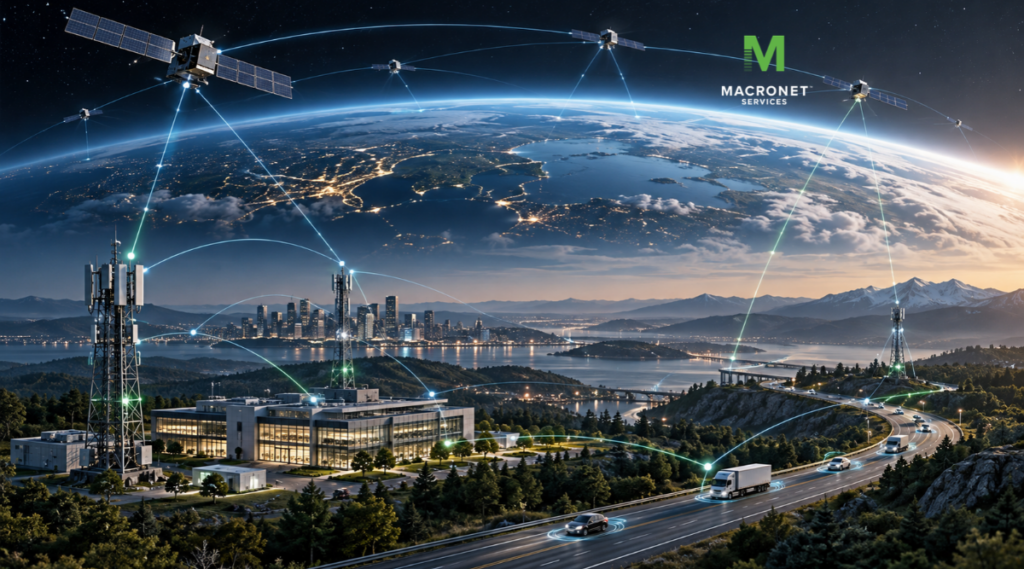
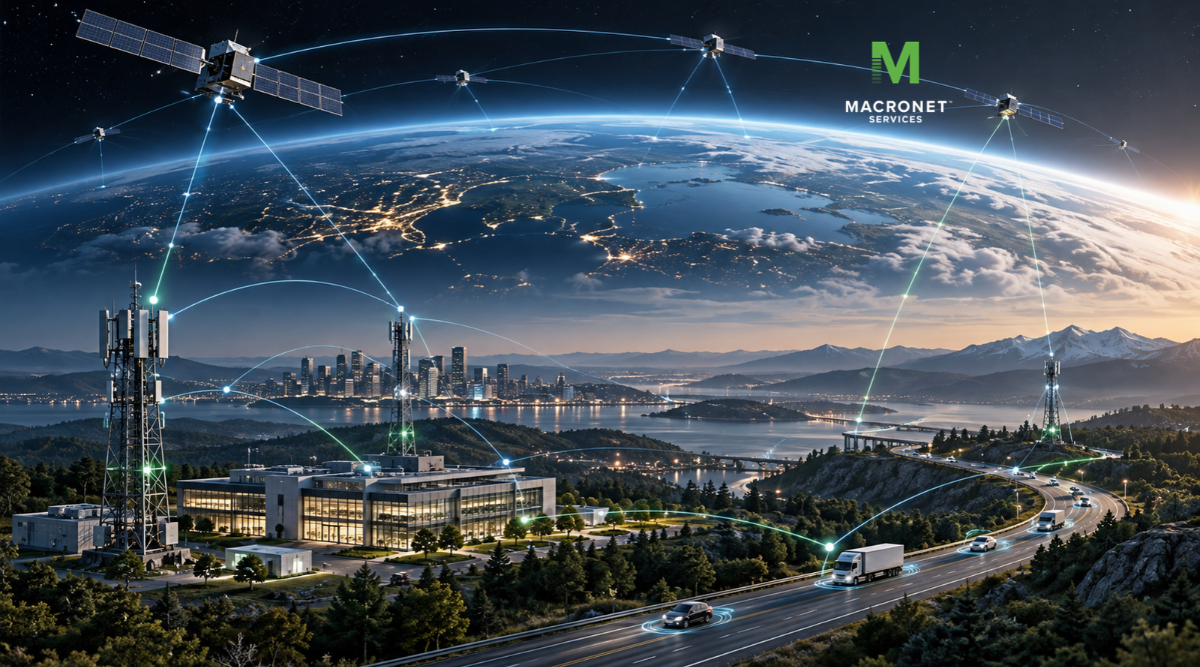
A future subscriber could therefore connect through different physical systems without necessarily changing services. Inside an office, the phone might use a terrestrial Starlink Mobile cell. On a highway beyond terrestrial coverage, it could transition to a Starlink satellite. At home, another Starlink access technology could provide broadband. A vehicle or industrial asset could remain connected as it moves between these environments.
The physical network changes underneath the service.
This is the strategic idea that makes Starlink more consequential than the arrival of another wireless competitor.
Traditional carriers built terrestrial networks first and are now adding satellite coverage around their edges. Starlink built a global satellite network first and can selectively add terrestrial infrastructure where satellite connectivity is insufficient.
The two models may ultimately converge, but they approach convergence from opposite directions.
2. The Spectrum Strategy: Why 800 MHz and 2 GHz Matter
Understanding SpaceX’s strategy requires understanding spectrum.
Different frequencies behave differently. Lower-frequency spectrum generally travels farther and penetrates structures more effectively. Higher frequencies usually offer more opportunities for capacity, especially when wider channels are available, but they tend to attenuate more quickly and can be more sensitive to obstructions.
There is therefore no single ideal frequency for building a nationwide network. The most effective mobile networks combine multiple bands.
SpaceX’s agreement with EchoStar gives it rights to acquire 40 MHz of AWS-4 spectrum at 2000–2020 MHz and 2180–2200 MHz, together with 10 MHz of H-Block spectrum at 1915–1920 MHz and 1995–2000 MHz. The agreement was subsequently expanded to include up to 15 MHz of additional unpaired AWS-3 spectrum at 1695–1710 MHz. The FCC approved the transaction in May 2026, and the licenses were transferred into a trust for SpaceX’s benefit. Final transfer to SpaceX is currently targeted for November 30, 2027.
The October 2026 Grain transaction adds a different type of asset. Grain agreed to sell SpaceX its nationwide 800 MHz portfolio, subject to FCC approval. Low-band spectrum is especially valuable because it can support broad terrestrial coverage and better penetration into buildings than higher-frequency alternatives.
The two assets are therefore complementary.
The 800 MHz spectrum can help address one of satellite-to-phone connectivity’s inherent limitations: the user does not always have a usable view of the sky.
A satellite may provide extraordinary geographic coverage, but radio propagation still obeys physics. A handset deep inside an office building, underground or surrounded by dense construction may have difficulty maintaining the required satellite link. A terrestrial base station transmitting at low-band frequencies is much better suited to many of those environments.
The approximately 2 GHz spectrum plays a different role. It gives SpaceX a substantially larger block of mobile spectrum that can support higher-capacity terrestrial and non-terrestrial applications.
What matters is not simply how many megahertz SpaceX acquires. It is how those frequency bands can be combined with the assets Starlink already operates.
Low-band terrestrial spectrum can improve coverage and penetration. The roughly 2 GHz holdings create another mobile capacity layer. Starlink’s existing satellite frequencies support much higher-capacity broadband to purpose-built terminals. Optical inter-satellite links provide transport between spacecraft. Fiber, gateways and Points of Presence connect the space network into terrestrial infrastructure.
Viewed individually, these are telecommunications assets. Viewed together, they begin to resemble the spectrum and transport architecture of a hybrid carrier.
This does not mean 14 MHz of paired low-band spectrum somehow gives SpaceX the terrestrial capacity of Verizon, AT&T or T-Mobile. It clearly does not. The incumbent carriers possess large portfolios spread across low-, mid- and high-band frequencies.
The more interesting question is whether Starlink needs to reproduce those portfolios in order to disrupt the market.
If satellites can serve the geographic areas that are expensive to cover terrestrially, low-band spectrum becomes valuable not because it replaces the entire incumbent network, but because it allows Starlink to build terrestrial coverage selectively where satellites perform least effectively.
That is a different network-design problem.
3. How a Hybrid Terrestrial and Non-Terrestrial Network Would Work
The technical foundation behind this convergence is increasingly described as the integration of terrestrial networks, or TN, with non-terrestrial networks, or NTN.
Historically, the two environments were largely separate. A mobile phone connected to a terrestrial cell site, while satellite communications generally required specialized terminals and separate services.
3GPP formally incorporated support for non-terrestrial networking into Release 17, including 5G NR-based satellite connectivity and satellite support for IoT technologies. The work addresses challenges such as Doppler shift, satellite latency and mobility between terrestrial and non-terrestrial network components.
Starlink is pushing that convergence into commercial infrastructure.
Imagine a user inside an office in Boston. The phone could connect to a nearby terrestrial Starlink Mobile radio because the low-band signal provides better building penetration and local capacity.
The user leaves the city and travels north. As long as terrestrial coverage remains efficient, the phone continues using the ground network.
Farther into rural New England, traffic density falls and the economics of building terrestrial infrastructure begin deteriorating. Instead of losing service when the terrestrial footprint ends, the handset could transition to the Starlink satellite network.
The application does not have to change. The subscriber does not need a different phone number or a separate satellite device. Ideally, only the access path changes.
This does not mean terrestrial and satellite systems are technically equivalent. They are not.
Terrestrial networks can reuse spectrum aggressively across small geographic cells, which makes them extraordinarily effective at serving dense concentrations of users. Satellite beams cover much larger areas, making capacity allocation and interference management very different.
A sophisticated hybrid network would therefore use each technology where its economics and physics are strongest.
Dense metropolitan areas would rely heavily on terrestrial infrastructure. Suburban and rural areas could use progressively wider terrestrial cells supplemented by satellite coverage. Extremely remote areas might require little terrestrial infrastructure at all.
Starlink therefore introduces altitude into the traditional cellular coverage model.
That could change the amount of terrestrial infrastructure required to offer a credible national service.
4. Starlink Still Needs Towers, RAN and a Mobile Core
Spectrum is not a network, and satellites alone do not make SpaceX a conventional mobile carrier.
If Starlink intends to offer terrestrial cellular service, it will still need a radio access network. Radios and antennas have to be placed on towers, rooftops, poles, small cells or other physical structures. High-demand locations will require denser infrastructure than rural markets.
This is precisely why the 800 MHz spectrum matters. Its propagation characteristics can allow each terrestrial deployment to cover relatively large areas, but the radios still have to exist.
Behind those radios, traffic needs transport. In many environments that will continue to mean fiber because fiber delivers exceptional capacity, predictable performance and low latency.
Starlink, however, has another option.
A remote terrestrial Starlink cell site could potentially use Starlink itself as backhaul, avoiding the need to extend fiber into locations where doing so would destroy the site’s economics.
The network would still require a mobile core. Subscriber authentication, session management, mobility, policy, roaming, voice, messaging, eSIM provisioning and emergency services do not disappear merely because part of the radio network is in orbit.
The existing Direct to Cell partnership model demonstrates the distinction. Starlink can provide the satellite radio layer while the partner operator retains the customer’s mobile core and subscriber relationship.
If SpaceX sells a fully independent Starlink Mobile service, it must assume much more of that responsibility itself.
That includes the less glamorous but essential parts of telecom: billing, fraud prevention, number portability, device certification, lawful intercept, emergency alerts, 911 routing, customer support and network operations.
These operational requirements are one reason becoming a major carrier is much harder than launching satellites.
But SpaceX may have an advantage in how it builds those systems.
Legacy carriers often operate technology environments accumulated over decades of mergers, acquisitions and network generations. SpaceX has the opportunity to build a more software-centric mobile platform without carrying the same amount of legacy architecture.
The difficult question is not whether Starlink still needs terrestrial telecom infrastructure. It does.
The more interesting question is how much of it SpaceX needs when satellites can provide the geographic layer that a conventional carrier has historically been forced to create entirely from Earth.
5. The Backhaul Advantage Could Change Rural Economics
Coverage gaps usually exist for economic reasons, not because carriers lack the technology to eliminate them.
Every cell site has a business case. The operator must consider tower costs, radio equipment, power, permitting, maintenance, transport and the number of subscribers likely to use the site.
Those economics become increasingly difficult as population density falls.
Backhaul can be particularly problematic. Fiber may be inexpensive when existing infrastructure passes nearby, but extending new fiber for miles simply to reach one rural tower can fundamentally alter the investment case.
Starlink attacks that problem in two ways.
Where traffic demand is extremely low, the satellite can provide coverage directly and eliminate the terrestrial site entirely. Where terrestrial cellular coverage remains desirable, Starlink can provide the transport behind the tower.
This model already exists commercially. Starlink markets cellular backhaul to telecom providers, and Starlink Transit uses bonded gateway systems capable of up to 20 Gbps symmetric capacity. Local providers can receive capacity through Starlink and redistribute it over mobile networks, fixed wireless or terrestrial fiber.
The strategic significance is substantial.
A carrier no longer necessarily needs to build terrestrial transport before it can build terrestrial wireless coverage.
This does not make fiber obsolete. Dense cell sites generating large volumes of traffic will continue to benefit enormously from fiber backhaul.
Starlink’s advantage comes from avoiding the most expensive fiber extensions.
That changes the marginal economics of network expansion.
Instead of asking whether enough subscribers exist to justify extending terrestrial infrastructure all the way to a remote location, the carrier can ask what combination of terrestrial radio and satellite transport provides the most economical service.
That same architecture is valuable for disaster recovery. If terrestrial backhaul fails but the radio site remains operational, satellite connectivity can become an alternate transport path. Portable base stations can be deployed without waiting for fiber restoration. If the local terrestrial network itself is unavailable, direct-to-device satellite service may still provide a baseline communications layer.
Satellite therefore becomes more than an emergency add-on. It becomes part of normal network design.
6. From Connectivity to Services
Owning infrastructure is valuable. Turning that infrastructure into services is where the larger commercial opportunity emerges.
Starlink is already moving beyond raw broadband.
Its enterprise portfolio supports primary connectivity, backup, interim deployments and replacement of 4G and legacy VSAT services across tens of thousands of business locations. Priority plans include a 99.9% network-availability SLA.
Its Private Networking service takes the strategy further. Enterprise customers can connect directly to Starlink at more than 50 global Points of Presence, allowing traffic to traverse the Starlink constellation and exit directly into the customer’s private network without crossing the public internet. Starlink also supports configurable site isolation, larger MTUs and quality-of-service capabilities.
Those are characteristics of an enterprise network platform, not merely a satellite ISP.
The terrestrial-mobile opportunity could broaden the service model again.
For consumers, Starlink could eventually integrate fixed broadband, mobile connectivity and mobility services into a relationship built around continuous availability rather than the particular network being used.
The value proposition becomes more interesting than a conventional broadband-and-mobile bundle.
A customer could potentially remain within the same Starlink environment at home, while driving, while traveling through remote territory and while using dedicated Starlink equipment on a boat or recreational vehicle.
The access method changes according to the environment. The service relationship remains intact.
The enterprise opportunity is even more significant because large organizations already operate across a mixture of locations, employees, vehicles, IoT devices and remote facilities. For a deeper treatment of how connected devices create business value, see Macronet Services’ IoT Solutions for Business: Complete 2026 Guide.
If Starlink can connect more of those endpoints into the same management and private-network environment, it moves progressively higher in the telecom value chain.
The long-term product is therefore not necessarily satellite broadband, cellular service or even a particular WAN technology.
It is connectivity delivered across whichever combination of infrastructure best meets the requirement.
7. The Enterprise Opportunity: From Backup Circuit to Network Platform
Starlink’s easiest entry into enterprise networks has been as an alternative path.
That remains extremely valuable.
Two terrestrial circuits purchased from different carriers may still share a conduit, pole line, building entrance or local fiber route. Commercial diversity does not always create genuine physical diversity.
Starlink provides a very different failure domain because the local path travels through the air rather than through the same terrestrial rights-of-way.
A company can therefore keep fiber as the preferred connection while using Starlink as a physically diverse secondary path.
SD-WAN can orchestrate the two, shifting traffic according to application policy and real-time performance.
In this design, Starlink does not have to outperform fiber. It complements it.
Starlink also addresses another persistent enterprise problem: service availability at new or difficult locations.
Terrestrial connectivity may take weeks or months to provision when construction is required. Starlink can frequently be installed without waiting for the local carrier to extend infrastructure.
That can change the timeline for bringing retail stores, construction projects, clinics, warehouses or temporary facilities online.
Private networking makes the enterprise proposition much more important because Starlink endpoints no longer have to behave like unrelated internet connections. They can increasingly act as access points into a larger private network.
Over time, that raises a strategic possibility. Instead of an enterprise purchasing individual circuits based primarily on what infrastructure happens to be available at each site, the organization could define performance, availability and security requirements while a networking platform determines which access path best satisfies them. This is closely related to the architectural principles Macronet Services examines in its Multi-Cloud Networking: The Complete Enterprise Guide.
Fiber could remain preferred at major facilities. Starlink could handle remote or temporary sites. Mobile connectivity could support field operations. Satellite could provide resilience or geographic extension.
The enterprise network becomes progressively less dependent on one physical access technology.
That is where Starlink begins to compete not only with satellite providers, but with portions of the traditional enterprise-carrier market.
8. Starlink Could Supply the Telecom Industry as Well as Compete With It
A common mistake is to assume Starlink must choose between partnering with carriers and competing against them.
Telecommunications has never worked that way.
Carriers routinely compete for retail customers while purchasing fiber, roaming, towers, transport and wholesale services from other companies that also compete with them elsewhere.
Starlink can occupy the same kind of position.
Its current mobile partnerships already demonstrate the model. Starlink Mobile works with carriers including T-Mobile, Rogers, KDDI and operators in numerous other countries, with reciprocal global connectivity forming part of the strategy.
The terrestrial operator can continue serving the customer in places where its network works well, while Starlink extends coverage beyond the terrestrial footprint.
Backhaul creates another wholesale opportunity. A carrier can use Starlink to connect remote radio sites without exposing Starlink directly to the end customer.
Starlink Transit expands that model into high-capacity transport. A local telecom provider can receive multi-gigabit capacity from Starlink and redistribute it through its own mobile, fixed-wireless or fiber infrastructure.
This matters in the same way that backbone and transit relationships matter in conventional Internet architecture. Macronet Services explores those economics and routing relationships in Tier-1 ISPs and Global Enterprise Networks: Performance, Resilience, and Risk Explained.
This means SpaceX does not have to own every retail subscriber in order to participate economically in the service.
A customer may buy mobile service from a conventional carrier while Starlink provides satellite coverage beneath it. A regional ISP may retain its local customer relationship while Starlink provides transport. An enterprise network provider may manage the WAN while using Starlink at difficult locations.
Starlink can therefore become strategically important to telecom even if its direct retail market share never approaches that of the national carriers.
The more useful metric may eventually be how much communications traffic depends on Starlink somewhere in the path.
9. Vertical Integration Could Change Telecom Economics
Starlink’s most unusual advantage may be how much of the production system SpaceX controls.
SpaceX designs and manufactures satellites, operates the constellation, builds much of the networking software, manufactures user terminals, operates ground infrastructure and launches the satellites on its own reusable rockets.
That gives the company a feedback loop that traditional satellite and telecom operators generally do not possess.
A new satellite technology can be designed, manufactured and launched by organizations within the same company. Capacity additions do not depend entirely on an external launch provider’s schedule. Terminal design and manufacturing can evolve alongside the satellite architecture.
The benefit is not simply reduced cost. It is engineering velocity.
Telecommunications infrastructure traditionally involves numerous suppliers, each optimizing a particular layer of the network. A carrier may depend on one vendor for radios, another for routing, a tower company for physical sites, a fiber operator for transport and a satellite provider for non-terrestrial coverage.
SpaceX can increasingly optimize across multiple layers of the system.
If additional capacity is required in a region, the answer might involve satellite capacity, terrestrial spectrum, a new gateway, local fiber, software-based beam allocation or some combination of them.
The relevant optimization target becomes the economics of the entire service rather than the economics of one infrastructure layer.
Starship could amplify this advantage if SpaceX succeeds in operating it at high cadence. Larger launch capacity would enable larger satellites and potentially lower the marginal cost of adding substantial capacity to the constellation.
That does not guarantee Starlink will always be cheaper than terrestrial infrastructure. It will not.
The structural advantage is that SpaceX has more options available when deciding how to expand the network.
10. The Incumbent Carriers Still Have Enormous Advantages
None of this makes AT&T, Verizon or T-Mobile obsolete.
Terrestrial cellular networks remain extraordinarily efficient in dense environments.
A carrier can divide a metropolitan area into thousands of sectors and cells, reusing spectrum repeatedly to create enormous aggregate capacity. Satellite networks cannot match that geographic density in the same manner.
The incumbent carriers also possess far deeper terrestrial spectrum portfolios than Starlink. Years of acquisitions and auctions have given them combinations of low-, mid- and high-band frequencies specifically engineered for different coverage and capacity requirements.
Indoor coverage remains another challenge for direct satellite connectivity. Walls, roofs, underground spaces and dense urban construction all complicate the satellite link. That is precisely why terrestrial low-band spectrum is so strategically useful to SpaceX.
The incumbents also possess infrastructure that cannot be recreated quickly: enormous installed customer bases, nationwide tower footprints, extensive fiber networks, mature mobile cores, device-distribution relationships, roaming arrangements, retail operations, enterprise sales organizations and decades of operational knowledge.
Starlink does not need to defeat all of those strengths.
In fact, attempting to duplicate the incumbent model everywhere would likely eliminate much of what makes Starlink strategically different.
The better strategy may be selective competition.
Terrestrial infrastructure can be concentrated where subscriber density, capacity and indoor coverage justify it. Satellite can carry more of the burden as geography becomes expensive to serve conventionally. Wholesale relationships can be used where incumbent infrastructure already works exceptionally well.
This is why the relevant question is not whether Starlink can build another Verizon.
It is whether Starlink can deliver a competitive nationwide experience without needing to build another Verizon.
11. Starlink Could Reshape the Structure of the Telecom Industry
The larger transformation occurs when the boundaries among telecom categories begin to erode.
Historically, mobile, satellite, enterprise WAN, broadband and wholesale transport were treated as separate businesses because each relied on substantially different infrastructure.
Starlink increasingly participates in all of them.
That matters because the access network itself can become less visible to the customer.
Enterprise networking has already moved in this direction. SD-WAN allows applications to use multiple underlying circuits based on performance and policy. Cloud computing similarly abstracted physical servers from the applications consuming them.
Hybrid TN/NTN architectures could create a similar abstraction lower in the network.
The customer defines what connectivity is required. The network determines how to deliver it.
For an enterprise, that could mean fiber at a major office, satellite at a remote plant, mobile connectivity for employees and different technologies for vehicles and sensors – all connected into the same larger architecture.
For consumers, it could mean a handset moving from terrestrial coverage to satellite without the user having to think about which network is carrying the session.
For carriers, it could mean selecting satellite or terrestrial backhaul according to economics rather than treating satellite as a specialized exception.
The FCC’s 2026 decision involving the EchoStar licenses explicitly acknowledged the growing convergence between satellite and terrestrial wireless technologies.
That convergence is likely to create new regulatory questions, but it also reflects an important industry reality.
Satellite connectivity is moving from the edge of telecommunications toward the core architecture.
The winning providers may therefore be those that can orchestrate multiple types of infrastructure rather than those defined by a single network.
12. What Starlink Could Become Over the Next Five to Ten Years
There are several credible paths forward, and they are not mutually exclusive.
The first is that Starlink becomes the world’s dominant satellite overlay for conventional mobile carriers. In this model, terrestrial operators retain most subscribers and infrastructure, while Starlink becomes the default coverage layer beyond the economic edge of terrestrial networks.
That alone would be transformative.
The second possibility is that Starlink develops into a meaningful national mobile carrier of its own. The EchoStar spectrum rights and proposed Grain acquisition give SpaceX a foundation for terrestrial deployment that did not previously exist.
Success would still require a major terrestrial buildout and mature mobile operations, but the economics would differ from those of a conventional greenfield carrier because Starlink already possesses the satellite layer.
The third and most strategically interesting possibility is that Starlink becomes a global connectivity platform spanning consumer broadband, mobile, enterprise networking, backhaul and wholesale transport.
Under that model, SpaceX does not choose one telecom category. It participates selectively across several of them.
A consumer may buy Starlink directly. A mobile carrier may buy Starlink coverage. An ISP may purchase Starlink transport. An enterprise may use Starlink private networking. All of them ultimately consume different capabilities from the same broader infrastructure platform.
That is what could make Starlink genuinely different from previous challengers to the telecommunications industry.
Conclusion: Starlink Could Redefine What a Telecom Carrier Is
The conventional question is whether SpaceX can challenge AT&T, Verizon and T-Mobile.
That is too narrow.
The more consequential question is whether Starlink changes the architecture on which telecom services are built.
SpaceX now has a large LEO communications network, direct-to-device technology, global ground infrastructure, inter-satellite optical networking, enterprise services, carrier backhaul and high-capacity wholesale transport. It has also secured rights to acquire significant mobile spectrum and is pursuing additional low-band spectrum that could support terrestrial Starlink Mobile coverage.
Individually, none of these capabilities creates a new telecom model. Together, they begin to.
Traditional networks have always been constrained by the need to extend physical infrastructure toward the user. Fiber has to reach the building. Backhaul has to reach the tower. Cellular sites have to be constructed close enough to users to create coverage.
Starlink changes part of that relationship because a substantial portion of its infrastructure already exists overhead.
That does not remove the need for terrestrial networks. Fiber will remain the best solution for many high-capacity fixed locations. Dense terrestrial mobile networks will remain the most efficient way to serve large concentrations of users. Wi-Fi will remain indispensable indoors.
The future is not satellite replacing terrestrial infrastructure.
The future is increasingly likely to be satellite and terrestrial infrastructure operating together.
For enterprises, this means satellite should no longer be evaluated only as emergency connectivity for remote locations. It can become part of WAN resiliency, rapid site deployment, fleet connectivity, IoT, private networking and broader multi-access architectures. Organizations evaluating those changes should consider them within a wider assessment of the network’s resilience, cloud connectivity, carrier diversity and business requirements; Macronet Services covers that process in Network Infrastructure Assessment Services: A Complete Guide for AI-Ready Enterprises.
For telecom companies, the implications are even larger. Once phones, branches, vehicles and network infrastructure can move among terrestrial and satellite paths, the historical line between the two networks begins to matter less.
Customers ultimately care about whether the connection works, whether it performs as required and whether it is economically viable.
The provider capable of choosing the best underlying network without forcing the customer to think about that choice gains a significant strategic advantage.
SpaceX may indeed become another major mobile carrier.
But that may ultimately be the least interesting outcome.
Starlink’s larger opportunity is to become a communications platform in which space-based and terrestrial infrastructure are no longer separate networks that occasionally intersect.
They become different parts of the same network.
And if SpaceX succeeds in making that architecture operationally and commercially seamless, Starlink will not simply have entered the telecommunications industry.
It will have helped change how the industry works.
Evaluate Where Starlink Fits in Your Enterprise Network
Macronet Services helps enterprises evaluate network architecture, carrier strategy, cloud connectivity, resiliency, emerging access technologies and telecom economics. As terrestrial and non-terrestrial networks converge, we can help determine where Starlink, fiber, wireless, SD-WAN and other connectivity options fit into a practical future-state architecture. Please reach out to us anytime for a conversation.