
AI Voice Agents for Contact Centers in 2026: Costs, Architecture, Platforms and ROI
AI Voice Agents for Contact Centers: The 2026 Guide to Costs, Architecture, Platforms and ROI
Why AI Voice Agents Have Become a 2026 Contact Center Priority
AI voice agents have moved from experimental demos into the center of enterprise contact center planning. Gartner reported in August 2026 that surveyed customer-service leaders increased AI spending by 38% even though overall service and support budgets grew only 2%. Respondents also expected generative AI voicebots, no-code agent builders and agentic AI platforms to become increasingly valuable over the next two years. The implication for business leaders is clear: voice automation is no longer a side project. It is competing directly for budget with labor, CCaaS, telecom and other core operating expenses.
At the same time, enthusiasm is running ahead of proven economics. Gartner separately found that only 24% of service and support leaders demonstrated positive financial returns across their AI use cases. Verint’s 2026 contact center research similarly shows the tension: 87% of leaders are increasing customer-facing AI spend, while 38% of consumers surveyed still do not believe AI has improved their service experience. The opportunity is substantial, but so is the execution risk.
For enterprises evaluating voice automation, this creates a better question than “Which AI voice agent sounds the most human?” The better question is:
Which architecture can resolve meaningful customer requests reliably, securely and economically across our actual telephone, CCaaS and enterprise application environment?
What Is an AI Voice Agent?
Quick answer: An AI voice agent is software that can conduct a natural spoken conversation with a customer, understand the customer’s goal, access approved enterprise information, take permitted actions and either complete the request or transfer the interaction to a human with relevant context.
That definition matters because “voice AI” covers technologies with very different levels of capability. A conventional IVR asks callers to choose from predefined options. A traditional voice bot can recognize natural language but often remains bounded by scripted intents and flows. A generative AI voice bot can create more flexible responses. A true AI voice agent goes further by deciding what information or tools are needed, taking actions across enterprise systems and working toward a business objective within explicit guardrails.
IVR vs. Voice Bot vs. AI Voice Agent

This distinction is also why voice agents should be evaluated as part of a broader AI contact center architecture. Macronet Services explores that larger shift in Agentic CCaaS: 2026 Guide to AI Contact Centers, where the focus is not simply conversation but end-to-end customer resolution across AI agents, human agents and enterprise systems.
How AI Voice Agents Actually Work
From the caller’s perspective, a good AI voice interaction should feel simple: ask a question, have a natural conversation and get the problem solved. Underneath that experience, however, multiple technical layers have to operate in near real time.
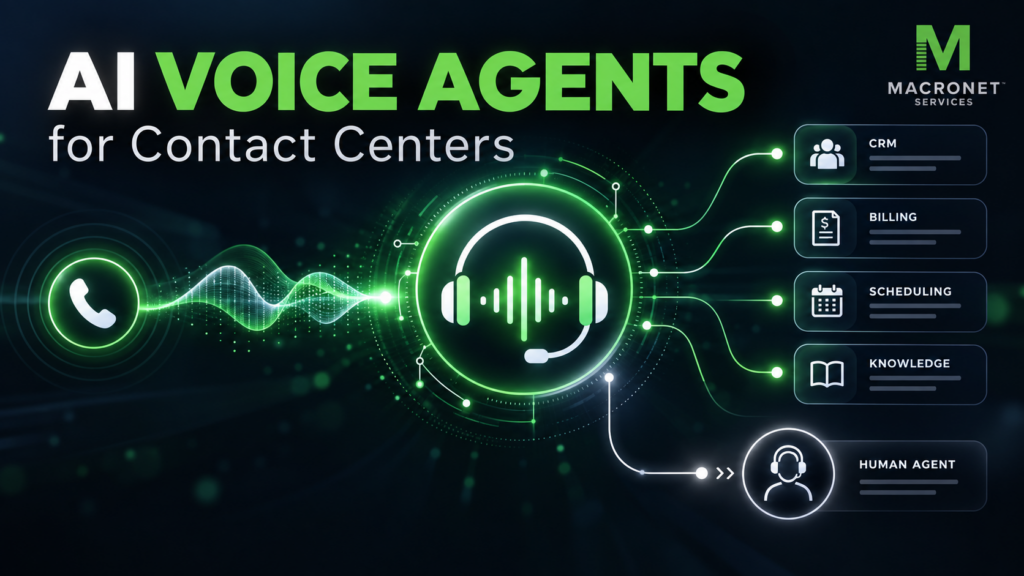
A typical enterprise call path looks like this: caller → PSTN/carrier → SIP and media routing → CCaaS or voice platform → speech and reasoning layer → enterprise data and tools → action → synthesized speech → caller. A human agent, supervisor or specialist may enter the path whenever policy, confidence or customer preference requires escalation.
The telephone layer matters because the public switched telephone network remains the universal way customers reach most enterprise contact centers. Telephone numbers, toll-free services, international routing, SIP, codecs, session border controllers, call recording, emergency services, carrier failover and media quality still exist even when AI answers the call. The model can be excellent and the customer experience can still fail because of poor routing, packet loss, latency, an SBC configuration problem or an awkward transfer path.
For a deeper treatment of that infrastructure, see the Macronet Services guide SIP Trunking in the AI Era: The CIO’s Guide to Enterprise Voice, which explains how carriers, SBCs, cloud communications, analytics and AI voice applications fit into the modern enterprise voice architecture.
The six layers of an enterprise AI voice architecture
1. Telephony and media
PSTN connectivity, telephone numbers, SIP signaling, RTP/SRTP media, SBCs, codecs, carrier routing, recording and geographic resiliency.
2. Speech and conversation
Speech recognition, speech generation or real-time multimodal models, turn-taking, barge-in, interruption handling and natural prosody.
3. Reasoning and orchestration
Intent understanding, policy selection, planning, workflow logic, tool choice, confidence thresholds and escalation decisions.
4. Knowledge and customer context
CRM records, identity, interaction history, knowledge bases, policies, product information, account data and retrieval-augmented generation.
5. Enterprise action layer
APIs and tools that can schedule, cancel, update, refund, order, authenticate, retrieve, pay, route or otherwise change a business system.
6. Governance and operations
Identity, authorization, logging, security, testing, evaluation, versioning, monitoring, cost controls and human oversight.
Why Voice AI Is Harder Than Chat
Voice creates a stricter engineering problem than text chat because the system has to make several decisions while the customer is still experiencing time in real time. A two- or three-second pause in chat may be acceptable. The same delay in a phone conversation feels broken. The voice agent has to listen, detect when the caller has finished speaking, interpret meaning, decide what to do, retrieve information, possibly execute a tool, generate a response and begin speaking quickly enough that the interaction still feels natural.
It also has to handle the messy reality of human speech. Customers interrupt. They change their minds. They speak over the system. There is road noise, office noise, children, television, speakerphone echo, poor mobile coverage, accents, names, account numbers and industry terminology. A caller may begin with a simple status question and suddenly introduce a complaint, payment problem or request to speak with a person.
The leading CCaaS vendors are clearly designing around these challenges. Five9’s June 2026 Voice AI Agents release emphasizes real-time responsiveness, purpose-built voice architecture, governance and contextual human handoff. Zoom’s 2026 voice-agent guidance similarly positions modern voice agents as a move beyond rigid IVR toward natural interactions that can resolve customer needs. These capabilities are advancing rapidly, but enterprise buyers still need to test them in the acoustic and network conditions their customers actually experience.
Latency should be measured end to end
A vendor may quote model latency, speech latency or time-to-first-audio, but the customer experiences the entire chain. The meaningful measurement starts when the caller stops speaking and ends when the caller hears an appropriate response. That measurement should include carrier and media transport, speech processing, model reasoning, tool calls and text-to-speech generation. Enterprises should test latency under normal load, peak load and degraded conditions, not only during scripted demonstrations.
The Real Value Is in the Enterprise Action Layer
The easiest AI voice agent to build is one that answers questions from a knowledge base. The more valuable agent is one that can finish work. That means the architecture must safely connect the conversation to enterprise systems.
Consider a caller asking why an equipment shipment is late and explaining that it is needed for a customer meeting tomorrow. A knowledge bot can provide tracking information. A more capable AI voice agent can authenticate the caller, retrieve the order, check carrier status, determine that the delivery is at risk, review replacement policy, verify inventory, create a replacement shipment, upgrade delivery, update the CRM and confirm the new delivery commitment. The difference is not better speech. It is the ability to execute a controlled business process.
Genesys introduced its Agentic Virtual Agent in 2026 around this shift from conversation to autonomous action. Its large action model strategy is designed to determine next steps and execute work across systems within guardrails. Talkdesk’s 2026 research highlights the same execution gap from another angle: in a vendor-sponsored survey, 98% of organizations reported AI somewhere in the customer journey, but only 15% combined agentic AI with cross-departmental orchestration to resolve needs end to end. The numbers should be read as vendor research, but the underlying point is important: isolated AI does not automatically create operational resolution.
Human Handoff Is a Core Capability, Not a Failure State
Enterprises should resist the idea that every transfer to a human is a failed AI interaction. Gartner reported in August 2026 that 87% of surveyed customers considered access to a human agent essential when companies use generative AI for customer service. The strongest design is therefore not “AI at all costs.” It is controlled autonomy with an excellent human escape path.
A high-quality handoff should transfer more than the audio call. The human agent should receive the customer’s authenticated identity when appropriate, reason for contact, summary of the conversation, actions already attempted, relevant records retrieved, tool results, sentiment or urgency indicators when useful, and any unresolved objective. The customer should not be forced to retell the story simply because the system crossed an organizational boundary.
This also changes how automation should be measured. A call in which AI collects identity, resolves two routine tasks and then transfers a complex exception with full context may create more value than an interaction that is technically “contained” but leaves the customer dissatisfied or causes a repeat contact tomorrow.
Three Ways to Deploy AI Voice Agents
Enterprises do not have to adopt voice AI through a single architectural model. In practice, three approaches are emerging, and the best one depends on the existing contact center, the required level of control and the urgency of the transformation.
1. Native CCaaS voice AI
The enterprise uses voice agents built into, or tightly integrated with, its primary CCaaS platform. The provider can own routing, telephony integration, recording, analytics, human handoff and AI administration inside one operational environment. This can simplify support and reporting, especially for organizations already committed to the platform.
Examples of how quickly this model is evolving include Five9 Voice AI Agents, Zoom Virtual Agent and its Agent Architect/Performance Suite, and Genesys Cloud Agentic Virtual Agent. These are not directly equivalent products, but they illustrate the move toward deeper native autonomy inside enterprise contact center suites.
2. AI voice overlay on an existing contact center
The enterprise keeps the current CCaaS or hybrid contact center and introduces a separate AI layer for selected call flows. This can accelerate adoption and reduce the need for a full platform replacement, but it creates architectural questions around call routing, data ownership, analytics, transfer context, troubleshooting and who is accountable when a customer journey spans multiple vendors.
3. Composable voice AI
The enterprise assembles telephony, speech, model, orchestration and application components from multiple providers. This can maximize flexibility and model choice, but the organization assumes more integration, testing and operational responsibility. Composable designs can make sense for high-volume or differentiated customer journeys, especially when the AI experience itself is strategic intellectual property.
The key procurement question is not which architecture is fashionable. It is which party owns each operational responsibility: carrier service, signaling, media, AI reasoning, tool execution, identity, logging, quality management, incident response, human handoff and customer data.
How Much Do AI Voice Agents Cost?
There is no single industry price for an AI voice agent because providers bill different units and include different layers of the stack. Some price by minute, some by session or conversation, some use credits or tokens, and some are beginning to align charges with outcomes or successful resolutions. The enterprise may also pay a CCaaS license, PSTN usage, recording, transcription, storage, premium support and implementation fees on top of the AI charge.
The pricing shift is visible in the market. Dialpad publicly describes conversation-based pricing in which AI Agent Credits are consumed when the AI retrieves information or executes a real action. Zoom announced optional outcome-based pricing for resolved or successfully routed interactions across voice and chat. These models are notable because they move the commercial discussion away from human seats and toward the work performed by automation.
For a full breakdown of named, concurrent, hourly and AI-consumption pricing, see CCaaS Pricing 2026: Costs, AI Fees, Hidden Charges & ROI. That guide includes a broader method for normalizing platform, telecom, AI, implementation and contract costs.
The AI voice quote should answer eight questions
- What exactly is the billable unit: minute, session, conversation, token, credit, action or outcome?
- What event starts billing?
- What event stops billing?
- What usage is included in the committed price?
- What is the overage price and can usage be pooled?
- Do unused units expire or roll over?
- How are failed interactions, abandoned calls and human transfers billed?
- What business outcome determines whether the billed unit actually created value?
The hidden costs of AI voice
The AI line item may be only part of the economics. Voice-heavy deployments can add PSTN minutes, toll-free costs, telephone-number rental, international termination, SIP or BYOC services, recording and storage, analytics, CRM/API consumption, integration work, custom security controls and ongoing testing. The contact center may also need to retain human capacity for complex work and exceptions even as automation grows. This is why cost per AI minute should never be confused with cost per customer resolution.
The Metric That Matters: Cost per Successful Resolution
Containment is useful, but it is not the same as success. An AI system can prevent a customer from reaching a human while still failing to solve the underlying problem. That distinction becomes critical when AI pricing shifts toward usage and outcomes.
Cost per successful resolution = total cost of delivering the service ÷ number of customer issues successfully resolved.
The numerator should include the costs that actually move with the operating model: AI consumption, platform fees, telecom, human labor when escalations occur, support and relevant operational overhead. The denominator should count resolved customer objectives, not merely interactions that ended without an agent.
A useful business case compares at least three paths: human-only, AI-only and AI-plus-human. The most economical path may vary by journey. Password resets and order-status inquiries may favor high automation. Complex billing disputes, vulnerable-customer interactions or unusual technical problems may favor a hybrid model. The goal is not to maximize AI usage. It is to minimize the cost and effort required to achieve the right outcome without damaging customer trust.
AI voice ROI should include more than labor avoidance
Labor savings can be significant, but an enterprise voice AI business case should also consider extended service hours, shorter queues, lower abandonment, increased first-contact resolution, reduced repeat contacts, faster after-hours response, improved routing, revenue conversion, collections, appointment adherence and reduced customer effort. Some of the most valuable benefits may be capacity and revenue benefits rather than direct headcount reduction.
Where AI Voice Agents Create the Most Value
The best early use cases usually have high volume, clear success criteria, reliable enterprise data and actions that can be safely bounded. They should also be expensive or frustrating enough that automation creates visible economic or customer-experience value.
Order and delivery service
Track shipments, explain status, change delivery preferences, create approved replacements and update customer records.
Appointment and field-service scheduling
Authenticate, book, reschedule, cancel, confirm location and send reminders.
Account and billing service
Explain balances, retrieve invoice details, update simple account information and route exceptions.
IT and employee service desk
Password-reset guidance, ticket creation, status, device or access workflows, and routing to specialists.
Reservations and travel changes
Retrieve itineraries, explain options, rebook within policy and escalate exceptions.
Proactive service
Notify customers about disruptions, recalls, appointments, renewals or next-best actions where outbound consent and policy permit.
Highly regulated, emotionally sensitive, high-dollar or irreversible transactions can still use AI, but the autonomy envelope should be narrower. In those journeys the AI may authenticate, gather information, summarize and assist a human rather than execute the final decision independently.
Security, Governance and Compliance Are Part of the Product
AI voice agents interact with identity, customer records and business systems, which means governance cannot be bolted on after launch. The NIST AI Risk Management Framework provides a useful voluntary structure for governing, mapping, measuring and managing AI risk. For enterprise contact centers, that translates into explicit permissions, tool-level authorization, logging, evaluation, escalation rules, change control and ongoing monitoring.
The enterprise should define an autonomy envelope for each customer journey. The agent may be allowed to retrieve an order status freely, for example, but require additional authentication before changing an address and human approval before issuing a large refund. The system should also distinguish between read access and write access, low-risk and irreversible transactions, and actions that require dual control.
Payment workflows deserve special attention. The PCI Security Standards Council states that sensitive authentication data such as card verification codes must not remain in audio recordings after authorization and recommends suppressing or redacting audio when technology allows. Voice AI architecture therefore has to account for recording controls, DTMF or secure payment capture, data retention and where cardholder data is exposed.
Outbound AI calling also introduces telecommunications compliance questions. The FCC has ruled that AI-generated voices are treated as artificial or prerecorded voice under the Telephone Consumer Protection Act. Organizations using AI for outbound calling should have legal counsel review consent, disclosure, recording and state-specific requirements before deployment. This is an area where product capability and legal permission are not the same thing.
AI Voice Agents Need an AgentOps Lifecycle
A traditional IVR is usually changed through relatively deterministic configuration. An AI agent can behave differently when wording, context, model version, enterprise data or tool response changes. That makes testing and observability an ongoing operating discipline rather than a one-time implementation task.
NICE Cognigy’s 2026 Simulator announcement is a useful example of where the market is heading: large-scale simulation and evaluation before and after production deployment. Zoom’s Agent Performance Suite likewise emphasizes simulation, validation and tracking metrics such as resolution, containment and cost per resolution. Buyers should treat those capabilities as operational requirements, not optional developer tools.
A mature lifecycle includes design, connection to tools and data, permissioning, test generation, simulation, approval, deployment, monitoring, evaluation, versioning and rollback. The test program should verify both what the agent does and what it refuses to do. An agent that successfully performs an authorized refund but also performs an unauthorized refund is not 50% successful. It is unsafe.
How to Run a Meaningful AI Voice Agent Proof of Concept
The biggest mistake in a voice AI proof of concept is letting the vendor define success through a polished demonstration. A credible POC should use real customer journeys, realistic audio, actual enterprise integrations and measurable acceptance criteria.
Choose two or three journeys that matter economically and represent different levels of complexity. Use anonymized production-like data and connect to the actual CRM, ticketing, scheduling or order system whenever feasible. Include callers with different accents and speaking styles. Add background noise, interruptions, silence and changed intent. Test authentication, wrong data, unavailable inventory, slow APIs, tool failures and transfers to humans. Repeat the same scenarios enough times to determine whether the system is consistent rather than merely impressive.
The scorecard should measure successful resolution, task accuracy, transaction accuracy, policy adherence, escalation quality, transfer context, end-to-end response time, interruption handling, recovery from tool failures, repeatability, observability and cost per resolution. If the POC cannot produce these metrics, the enterprise is not yet testing a production system.
25 Questions to Ask an AI Voice Agent Provider
- Which customer journeys can your voice agent resolve end to end in production today?
- How do you define a successful voice resolution?
- What is the measured end-to-end response latency under normal and peak load?
- How does the agent handle barge-in, interruption, silence and changed intent?
- Which speech, language and model providers are used, and can we choose or change them?
- What happens if the primary model or speech service is unavailable?
- Who provides PSTN connectivity and telephone numbers?
- Can we bring our own carrier or SIP provider?
- Who controls SIP routing, media routing and SBC policy?
- What carrier, region and media failover options are available?
- Which CRM, ERP, ticketing, scheduling and payment systems can the agent read and write?
- How are custom enterprise tools exposed to the agent?
- How are identity and tool permissions enforced?
- Can high-risk actions require customer re-authentication or human approval?
- How do you prevent duplicate or partially completed transactions after a failure?
- What information and context transfer to the human agent?
- Can customers reach a human immediately when they request one?
- How are calls, transcripts, prompts, tool calls and decisions logged?
- How do you test hallucinations, prompt injection and policy violations?
- Do you provide simulation, regression testing, production evaluation and rollback?
- How are PCI, recording, retention and sensitive-data controls handled?
- What exactly is the AI billable unit and what starts and stops billing?
- How are failed calls, abandoned calls and human transfers billed?
- What production references can you provide at similar call volume and complexity?
- What SLAs, support responsibilities and incident-escalation processes apply when telephony, AI and enterprise applications span multiple vendors?
These questions should be incorporated into a broader procurement process. Macronet Services provides additional requirements in AI in CCaaS RFPs: Essential Features for Next-Gen Contact Centers and a CCaaS RFP Template for 2026 that can be adapted to the organization’s current-state environment and target architecture.
A Practical Deployment Roadmap
Enterprises should avoid launching voice AI as a technology-wide mandate. Start with the customer journeys and economics. Identify where call volume, customer effort, staffing pressure or after-hours demand creates a clear problem. Then define what a successful resolution looks like and which actions the AI would need to take.
The second phase is architecture and controls: carrier path, CCaaS integration, identity, enterprise tools, data boundaries, human handoff and governance. The third phase is the POC described above. The fourth is controlled production with limited traffic, close observation and explicit rollback criteria. Only after resolution quality, customer experience and economics are stable should the enterprise scale additional journeys or traffic.
This staged approach also protects the business case. A voice agent that works well for one journey does not prove that every call type should be automated. Each new journey should earn autonomy based on risk, performance and value.
AI Voice Agents Are Becoming Part of a Larger Resolution Layer
The long-term significance of voice agents is larger than IVR replacement. As AI systems gain access to enterprise applications, customer context and controlled tools, the contact center begins to shift from a system that routes interactions to a system that orchestrates outcomes.
That is the connection to Agentic CCaaS. A voice agent may be the conversational front end, but the broader platform can coordinate specialized AI agents, human employees and business systems behind the scenes. The customer may simply say, “My order did not arrive and I need it tomorrow.” The enterprise resolution layer decides which data to retrieve, which policy to apply, which agent or workflow should act, whether approval is required and how to confirm completion.
For CIOs and CX leaders, that means the strategic decision is increasingly about ownership of orchestration. The winning architecture will not necessarily be the one with the most natural voice. It will be the one that combines reliable conversation with enterprise execution, governance, observability, resilient communications and provable business outcomes.
Conclusion: Judge AI Voice by Resolution, Not by How Human It Sounds
AI voice agents are advancing quickly enough that most large contact centers should now evaluate them. But the evaluation should begin with customer journeys and business outcomes, not a synthetic-voice demo. A production-grade voice agent has to perform across telephony, speech, reasoning, enterprise applications, security, human handoff and operations simultaneously.
The economic standard should also rise. Enterprises should know what the agent costs, what it resolves, when it escalates, what happens when systems fail and whether the customer’s objective was actually completed. Cost per successful resolution is therefore a better long-term metric than cost per minute, containment rate or the number of calls that never reached a human.
The organizations that get the most value from AI voice will not be the ones that automate the greatest percentage of calls as quickly as possible. They will be the ones that choose the right journeys, build the right control plane, preserve excellent human service and continuously measure whether AI is making customer service better and the business more efficient.

AI Voice Agent FAQs
What is an AI voice agent?
An AI voice agent is software that can converse with a caller using natural speech, understand the caller’s goal, retrieve approved enterprise information, take permitted actions and either resolve the request or transfer it to a human with context.
How is an AI voice agent different from an IVR?
Traditional IVR relies on menus, keypad input and predefined call flows. AI voice agents can understand natural language, generate responses, use customer context and execute approved actions across enterprise systems.
What is the difference between a voice bot and an AI voice agent?
A voice bot may recognize speech and answer questions but often remains tied to scripted intents. An AI voice agent can reason about a goal, use tools, take multi-step actions and adapt the workflow within guardrails.
Can AI voice agents replace contact center agents?
They can automate many routine and structured interactions, but they are better viewed as part of a human-plus-AI operating model. Complex, emotional, high-risk and exceptional situations still benefit from human judgment and empathy.
Can customers still reach a human when an AI voice agent is used?
They should be able to. Gartner reported in 2026 that 87% of surveyed customers considered access to a human essential when companies use generative AI in customer service.
How much does an AI voice agent cost?
Pricing varies by provider and may be based on minutes, sessions, conversations, credits, actions or outcomes. Enterprises should also include PSTN, CCaaS, recording, integrations, implementation, support and human escalation costs when calculating total cost.
What is outcome-based AI voice pricing?
Outcome-based pricing ties some or all AI charges to an agreed result such as a resolved or successfully routed interaction rather than simply charging for time or consumption. The contractual definition of the outcome is critical.
What is cost per successful resolution?
Cost per successful resolution is the total cost of delivering customer service divided by the number of customer issues actually resolved. It can be calculated separately for human-only, AI-only and hybrid journeys.
Are AI voice agents the same as Agentic CCaaS?
No. An AI voice agent is a conversational worker or channel. Agentic CCaaS is a broader architecture that can coordinate voice agents, digital agents, human agents and enterprise workflows to resolve customer objectives.
Do AI voice agents need a CCaaS platform?
Not necessarily. They can be native to a CCaaS platform, deployed as an overlay on an existing contact center or built in a composable architecture. Each model creates different integration and operational responsibilities.
Can an AI voice agent use our existing phone numbers?
Often yes, but the implementation depends on the carrier, CCaaS platform, SIP design and number-routing architecture. Enterprises should determine who owns the numbers and how calls are routed before changing platforms.
What is BYOC for AI voice agents?
Bring Your Own Carrier allows an enterprise to retain selected carrier services and connect them to the CCaaS or AI platform rather than buying all PSTN service from the application provider. It can improve control, coverage or commercial flexibility in some designs.
Why does latency matter for AI voice agents?
Voice is interactive in real time. Delays that are tolerable in chat can feel unnatural on a phone call. Buyers should measure the entire response path, including telephony, speech, reasoning, tool execution and speech generation.
What is barge-in in voice AI?
Barge-in is the ability for a caller to interrupt the AI while it is speaking and have the system stop, listen and respond appropriately. Good interruption handling is important for natural conversation.
Can AI voice agents update CRM or ERP systems?
Yes, if the architecture provides approved integrations or tools. The AI can potentially retrieve and update records, schedule appointments, create tickets, process approved changes and perform other actions within defined permissions.
How should an enterprise secure AI voice agents?
Use strong identity, least-privilege tool access, transaction limits, audit logs, approved data boundaries, model and prompt controls, simulation, monitoring and human approval for high-risk actions. NIST’s AI Risk Management Framework is a useful governance reference.
Can AI voice agents take payments?
They can participate in payment workflows, but PCI DSS and recording controls require careful architecture. Sensitive authentication data should not remain in audio recordings after authorization, and secure payment capture methods may be required.
Are AI-generated outbound calls regulated?
Yes. In the United States, the FCC has stated that AI-generated voices are treated as artificial or prerecorded voice under the TCPA. Organizations should obtain legal advice on consent, disclosures and applicable federal and state requirements.
How should AI voice agents be tested?
Test real journeys with real integrations, diverse speech patterns, background noise, interruptions, changed intent, authentication, slow or failed APIs, human transfers and repeated scenarios. Measure resolution, accuracy, latency, policy adherence, recovery and cost.
What is the best first use case for an AI voice agent?
A high-volume, well-defined journey with reliable data, measurable success criteria and low-to-moderate transaction risk is usually the best starting point. Appointment changes, order status, account information and routine service requests are common examples.
What metrics should be used for AI voice agents?
Useful metrics include successful resolution, first-contact resolution, repeat contact, transfer rate, transaction accuracy, policy adherence, customer effort, response latency, abandonment, cost per resolution and customer satisfaction.
What happens when an AI voice agent fails?
The system should fail safely. It should avoid duplicate or unauthorized transactions, preserve context, transfer to an appropriate human or fallback flow and log enough detail for diagnosis and recovery.
How long does it take to deploy an AI voice agent?
Timelines vary widely. A narrow informational use case can be fast, while a production-grade enterprise deployment with telephony, authentication, multiple integrations, compliance controls, testing and change management can require a substantial implementation program.
Should an enterprise buy native CCaaS voice AI or a specialist AI platform?
There is no universal answer. Native CCaaS can simplify operations and handoffs, while specialist or composable platforms can offer flexibility and faster innovation. The decision should be based on journey requirements, existing architecture, governance, economics and operational ownership.
How can Macronet Services help with AI voice agents?
Macronet Services can help enterprises assess use cases, evaluate CCaaS and AI voice platforms, design carrier and SIP connectivity, benchmark pricing, build RFPs, structure proofs of concept, negotiate contracts and coordinate implementation.