

Carrier Diversity vs Path Diversity: Why Two ISPs May Not Be Redundant
Two Internet service providers do not necessarily mean two independent networks. Understanding the physical infrastructure behind each circuit is essential to buying genuine enterprise Internet resilience.
An enterprise seeking redundant Internet connectivity requests proposals from four telecommunications providers. Each offers a dedicated fiber connection, a service-level agreement, and access to a national or global Internet backbone. From a procurement perspective, the company appears to have four independent options. Selecting any two should protect the business against losing its primary Internet connection.
But what if three providers intend to deliver service over the same regional fiber network? What if two circuits use different strands in the same underground cable? Or what if separate routes converge at a common telecommunications facility?
The enterprise may have several choices of Internet service provider without having the same number of independent physical networks.
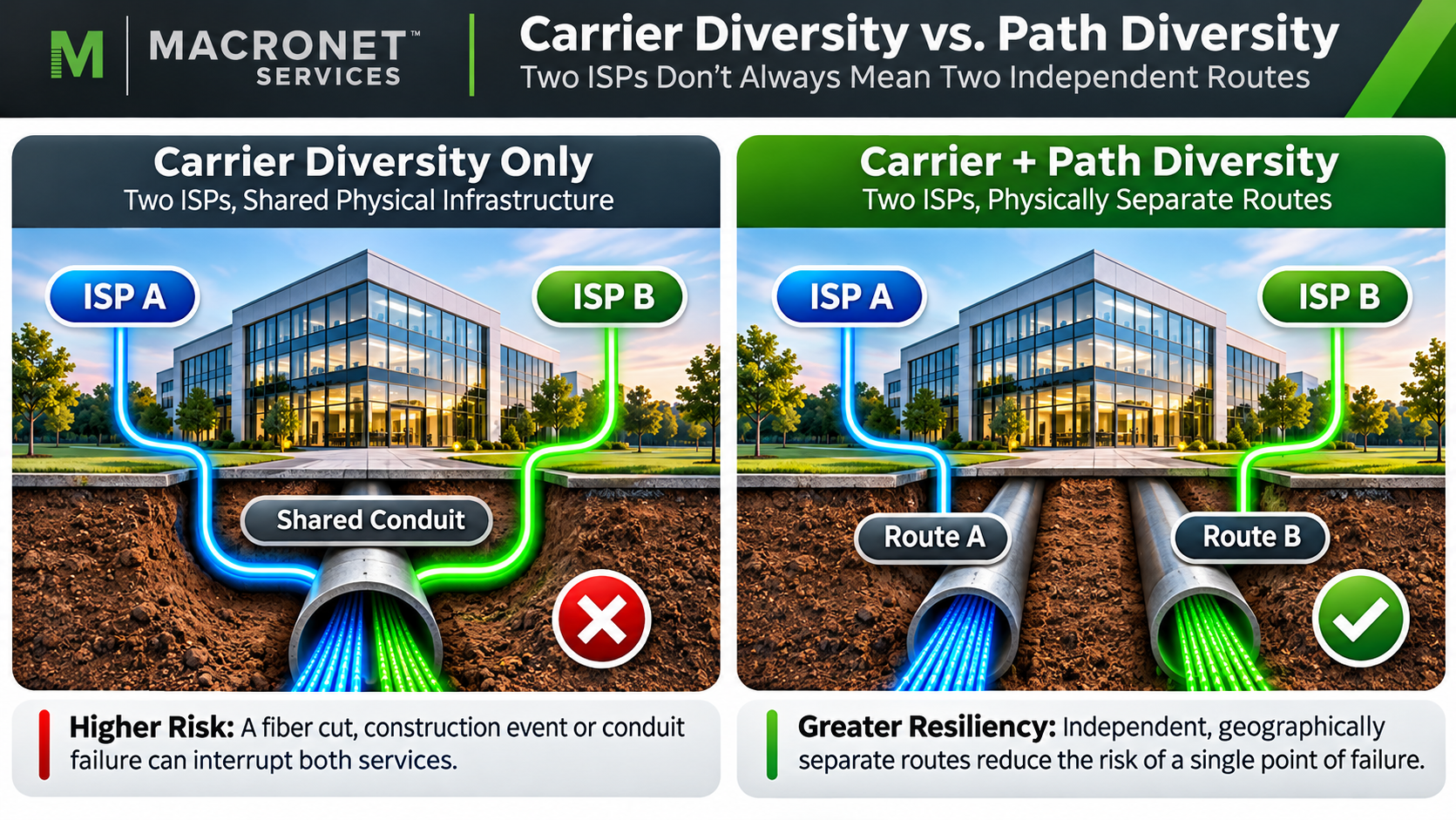
Carrier diversity means using different telecommunications providers, while physical path diversity means separating the infrastructure carrying their connections. Two different ISPs can provide carrier diversity without providing physical path diversity—and one cable cut or facility failure may interrupt both services.
That distinction matters as businesses depend on cloud platforms, SaaS applications, voice communications, digital transactions, and AI-enabled systems. Network availability is no longer simply an IT performance issue. For many organizations, an interruption directly affects operations, revenue, and customer experience.
This guide examines how competing ISPs actually deliver connectivity, where apparently independent circuits can share risk, and how enterprises can evaluate the evidence before purchasing a second circuit. For a broader discussion of equipment redundancy, failover, SD-WAN, and overall design, see Macronet Services’ Dual ISP Redundancy: How to Design Truly Diverse Internet Connectivity.

Carrier Diversity vs Path Diversity: What Is the Difference?
Carrier diversity and physical path diversity are complementary forms of resilience. They address different classes of failure, and neither is a substitute for the other.
Carrier diversity involves using separate telecommunications providers to reduce reliance on one company’s backbone, routing systems, operations, or commercial relationship. A business might purchase Dedicated Internet Access (DIA) from two national providers that operate independent autonomous systems and Internet backbones. If one provider has an outage confined to its own network, the second connection may remain available.
Physical path diversity, also called fiber route diversity, concerns the actual cables, conduits, route corridors, and facilities transporting a service. The objective is to separate paths so that a defined physical incident affecting one does not also disable the other.
A carrier can deliver two circuits over separate physical routes. Conversely, two competing ISPs can use the same regional access infrastructure. The brand names on the contracts do not answer the physical-diversity question.
| Network configuration | Principal protection | Important remaining risk |
| Two ISPs sharing one local fiber cable | Certain failures isolated to one ISP’s backbone or operations | A common cable cut can disable both |
| One ISP using two separate physical routes | Specified local fiber or access-network failures | Provider-wide incidents and shared upstream systems |
| Two ISPs using independently routed local fiber | Provider-specific failures and specified local infrastructure failures | Shared intermediate facilities or transport dependencies |
| Two ISPs with separate routes and relevant facilities | Broader access, facility, and provider failure scenarios | Site-wide, regional, application, and other residual risks |
The correct design depends on what the business must survive. A facility that cannot tolerate a street-level fiber cut has a different requirement from a company concerned primarily about a nationwide provider routing incident. A critical enterprise may need protection against both.
Macronet Services explores the backbone characteristics of major global providers in The 8 Leading Global Tier 1 ISPs. Those differences matter, but they should be evaluated alongside the local infrastructure delivering each service.
Why Two Different ISPs May Use the Same Fiber Infrastructure
The disconnect between carrier diversity and path diversity is rooted in telecommunications economics. National and global providers invest in backbones connecting metropolitan areas, data centers, Internet exchanges, and major points of presence. Few own direct fiber into every commercial building where they sell service.
Extending fiber to a property can require excavation, construction permits, utility access, rights-of-way, splicing, building modifications, and long-term maintenance. In many locations, it is more economical to purchase existing local access than build another network.
The provider selling the circuit may not own the local loop
Consider a national ISP quoting 10 Gbps DIA to an office building. The provider owns its backbone but lacks a direct fiber entrance at that address. To reach the customer, it buys a wholesale Ethernet access service from a regional fiber operator. The regional network carries the traffic to an interconnection where it enters the national ISP’s network.
The customer receives a circuit, invoice, support agreement, and Internet service from the national ISP. Yet the physical access path is operated by another company.
Now suppose a second national ISP also quotes the building. That provider may purchase its local access from the same regional operator. Depending on how the services are engineered, the two circuits may share a cable, conduit, building entrance, or intermediate aggregation facility before diverging toward their respective backbones.
The retail providers can be different while the local access network remains the same. This arrangement is neither inherently defective nor unusual; it simply means that carrier names alone are insufficient evidence of physical separation.
On-net, near-net, and off-net are not diversity certifications
Carrier proposals often classify a location as on-net, near-net, or off-net. The terms, which vary somewhat by provider, generally help describe existing network presence, construction requirements, and service-delivery arrangements.
They do not establish independence from another circuit. Two providers may both have on-net service in a building but use common underground infrastructure. An off-net proposal could be delivered through an independent regional fiber network that approaches from a different direction—and could therefore provide more valuable access diversity.
The relevant question is not simply whether the ISP can serve the address. It is which physical infrastructure the ISP plans to use, who owns it, and what that infrastructure shares with the incumbent circuit.
The Hidden Carrier Relationships Behind an Internet Circuit
A DIA service can involve several companies even when the customer deals with only one. The retail ISP may contract with a local access operator, that operator may rely on another transport supplier, and the traffic may cross a network-to-network interconnection (NNI) before reaching the ISP backbone.
Commercial simplicity for the customer can conceal technical dependencies that matter to resiliency.
The local access operator
The local access operator supplies the connection between the customer and a relevant carrier facility. If two proposals identify the same access operator, that is a reason for further engineering investigation—but not proof that the routes are shared. One operator may own two genuinely separate networks.
Likewise, identifying two different access companies is not proof of independence. Different companies may lease the same underlying fiber, use a common duct bank, or occupy the same utility corridor. Ownership helps reveal the delivery chain; physical routing determines whether a single incident could affect both paths.
The regional transport network and interconnection
A circuit may traverse several intermediate facilities before reaching the selling ISP. Two independent local loops could converge on the same transport equipment or central office farther upstream. A network protection scheme might reroute a service after a failure, but that does not automatically establish independence from the enterprise’s other circuit.
An NNI is another point where the physical architecture deserves scrutiny. Two retail ISPs using one regional access company might interconnect in different locations—or in the same facility. Those designs provide different levels of independence even if the final DIA offers appear similar.
In its technical discussion of circuit design and network edge architecture, APNIC explains why engineers should trace physical and logical paths through serving facilities, exchange locations, and interconnections. That is the right level of scrutiny for business-critical locations.
Why Different Fiber Routes Can Still Share the Same Risk
Two cables that enter a building from opposite sides appear diverse on a site drawing. But suppose both terminate at the same central office several miles away. An incident affecting that facility could interrupt both services. The routes are independent with respect to some street-level cuts, yet not with respect to the shared facility.
The engineering discipline behind this distinction is often described using Shared Risk Link Groups (SRLGs). The Internet Engineering Task Force’s RFC 4202 explains that links may be grouped when they share a resource whose failure could affect all of them. Its example is two fibers in the same conduit.
The idea is broader than any one physical object. A pair of circuits might share a cable near the building, a splice enclosure farther away, or a transport facility upstream. Each shared dependency represents a potential correlated failure.
The FCC’s definition of physically diverse circuits in 47 CFR § 9.19 similarly distinguishes physical separation from merely logical diversity. The rule applies to covered 911 infrastructure, not to enterprise Internet circuits generally, but the underlying engineering distinction is relevant: logical separation does not remove a common physical point of failure.
This is why an assertion that two paths are fully redundant is too vague to be useful. Diverse between which endpoints, across which facilities, and against which failures? A credible design answers those questions explicitly.
How to Verify Whether Two ISP Circuits Are Physically Diverse
Verifying physical fiber diversity is partly an engineering exercise and partly an information-gathering challenge. The enterprise usually does not own the infrastructure outside its property. Route records can be held by several providers, and some details may be commercially sensitive or restricted.
The assessment should begin with the existing connection. The customer often knows the retail ISP, bandwidth, service address, and demarcation point, but may not know the local access owner, building entrance, serving facility, or wholesale transport arrangement. Without that baseline, the next provider has little against which to compare its proposed route.
For a critical site, a qualified review may seek route diagrams, GIS or KMZ records where available, building-entry drawings, the identities of underlying access operators, and the serving locations relevant to the specific failure scenarios. A physical survey can supplement those records at the customer premises.
An evidence-based way to evaluate diversity claims
A carrier’s sales designation is not the same as engineering proof. The following distinctions help procurement teams evaluate what they actually know.
| Evidence presented | What it can support | What it cannot, by itself, prove |
| Different ISP names or AS numbers | Distinct retail or routing organizations | Separate physical access routes |
| On-net or off-net classification | A proposed delivery arrangement | Independence from another circuit |
| Identification of the access provider | Who supplies part of the underlying service | Separate cables, conduits, or facilities |
| Engineering route maps or as-built drawings | The physical path within their documented scope | Independence beyond the scope shown |
| Scoped written engineering attestation | Specific separation characteristics the carrier confirms | Protection from every possible shared risk |
A carrier may decline to release detailed fiber maps. That does not automatically mean the service lacks diversity. It may instead be possible to obtain a narrower written engineering attestation confirming that a proposed circuit does not share a designated outside-plant cable, route segment, or serving facility with the incumbent.
A precise, limited statement is more valuable than an unsupported promise of complete redundancy. The carrier should disclose what it can substantiate, what it cannot verify, and any known exceptions.
Unverified does not mean nondiverse. It means the organization has not obtained enough evidence to treat the independence as proven. For a high-consequence site, that distinction can determine whether the design is acceptable.
The companion Dual ISP Redundancy guide provides a more comprehensive verification methodology and sample procurement language. Here, the key buying principle is to grade a proposal by both its architecture and the quality of evidence supporting it.
Comparing Two ISPs: A Practical Carrier Diversity Example
Consider a hypothetical distribution center that depends on cloud inventory systems, warehouse automation, digital order processing, and business communications. It already purchases 5 Gbps DIA from Provider A and wants a second connection so that a localized cable failure does not halt operations.
Engineering review establishes that Provider A’s local loop is supplied by a regional fiber operator called Access Network X. The business then receives three proposals.
Provider B is a national ISP with an independent backbone, but its proposed circuit also uses Access Network X. Provider C is a facilities-based regional carrier whose fiber approaches the property from another street. Provider D is a national ISP proposing service over Provider C’s regional access infrastructure.
At the retail level, the buyer sees four different providers. At the physical access level, the choices are substantially narrower.
| Proposed retail ISP | Local access delivery | Main opportunity | Essential verification |
| Provider A: incumbent | Access Network X | Established primary service | Current route and serving facilities |
| Provider B: national ISP | Access Network X | Independent retail backbone | Whether the local cable and facilities are shared with A |
| Provider C: regional ISP | Provider C’s own access network | Potentially different building approach and fiber route | Route separation and upstream facilities |
| Provider D: national ISP | Provider C’s access network | Potential blend of provider and access diversity | Independence from A across the required scope |
All providers and network arrangements in this example are illustrative.
Provider B could be an excellent commercial offer, but the use of Access Network X creates a question about shared physical risk. The proposal should not be rejected solely because both services use that operator: Access Network X might have two separately engineered routes. The issue is whether the operator can document the relevant separation.
Provider C may provide the most direct escape from the existing local fiber corridor, but the company must still examine shared upstream facilities. Provider D might combine that alternative local infrastructure with a separate national backbone, although this depends on the actual route and interconnection arrangements.
The buyer should therefore evaluate which proposals satisfy the defined business continuity requirement before normalizing price and bandwidth. If survival of a local cable cut is mandatory, an unverified shared-cable proposal should not score as equivalent to a documented independent route simply because both are 5 Gbps DIA services.
Why the cheapest second circuit may not be the best value
Suppose Provider B has the lowest monthly recurring charge. If it ultimately uses the same local cable as Provider A, it may add protection from certain backbone failures but provide no protection against a cut of that shared cable.
A more expensive proposal using a truly independent fiber corridor may eliminate the specific single point of failure that matters most to this distribution center. The higher cost is then an investment in reducing an identified business interruption risk—not merely a premium for a different carrier logo.
The best proposal is the lowest total-risk solution that meets the agreed technical requirements, not automatically the least expensive or most geographically elaborate design.
What to Require Before Selecting a Second ISP
The time to investigate path diversity is before the enterprise commits to a service. Correcting an inadequate design after installation may require additional excavation, new building entrances, a new access supplier, or a replacement service order.
Initial quotations should be treated as commercial qualifications, not necessarily final route-engineering commitments. They establish whether a provider can offer the required bandwidth, estimated cost, construction timeframe, and contract terms. For critical locations, there should be a defined technical review before final acceptance of a diversity-dependent solution.
A good sourcing process makes the provider identify what it will deliver and the limits of the diversity it is willing to confirm. It should also address material exceptions discovered during construction. If an apparently diverse proposal must be rerouted through a shared facility, the enterprise should know before accepting the resulting design.
It is equally important to distinguish a carrier’s service-level agreement from a physical-diversity promise. An SLA may specify availability objectives, restoration targets, and service credits. It does not necessarily guarantee separate conduits or independent local fiber networks. Macronet Services discusses those contractual considerations in Tier 1 ISP SLAs: Understanding ISP Service Level Agreements.
Enterprises should also consider how the design will be maintained. Providers periodically rearrange circuits and move traffic across different facilities. Where physical separation is material, the agreement should address change notification and review to the extent the provider is willing and able to support those obligations.
Physical Path Diversity Is Not the Same as BGP Routing Diversity
A network team may see two distinct autonomous-system paths and conclude that its Internet connectivity is redundant. That observation is useful, but it answers a different question.
BGP describes routing relationships at the IP layer. Traceroute can reveal some IP forwarding behavior. Neither reliably identifies the buried fiber, ducts, splice locations, or transport infrastructure carrying the service.
Two BGP sessions to different providers can share the same access cable. A successful firewall or SD-WAN failover test demonstrates that the network can move traffic under the tested conditions; it does not show whether both circuits would survive a failure of a shared underground route.
Routing independence and physical path independence must therefore be evaluated separately. The routing considerations are explained in Macronet Services’ BGP Multihoming: The Complete Enterprise Guide to Dual ISP Connectivity.
Carrier and Path Diversity in Data Centers and Cloud Connectivity
The same issues arise in colocation and private cloud connectivity. A data center may advertise access to dozens of carriers, but carrier density does not guarantee that every off-site connection follows a different physical route.
Providers may share building entrance infrastructure, metropolitan corridors, or intermediate facilities before reaching the data center. The presence of multiple carriers creates opportunities for resilience; the physical delivery arrangements determine how much independence those opportunities provide.
AWS makes this distinction explicit in its Direct Connect Layer 1 engineering guidance. For maximum resiliency, AWS discusses different last-mile providers, diverse physical routes, separate facility entrances, separate Direct Connect locations, and requesting fiber maps to check for common failure points.
Microsoft’s ExpressRoute reference architecture likewise recommends considering different carriers, independent paths, and peering locations for workloads requiring protection from carrier-level outages.
Redundancy inside the hyperscaler’s environment does not prove that the enterprise’s own access path is diverse. Two private cloud connections may terminate on separate cloud networking equipment while still sharing a vulnerable terrestrial segment near the enterprise location.
For the broader sourcing and architecture implications, see Macronet Services’ Data Center Connectivity: Carriers, Cloud On-Ramps, Cross Connects & Internet Access.
What If Physically Diverse Fiber Is Not Available?
Some enterprise locations have only one practical terrestrial fiber corridor. Building a second can require substantial capital, permitting, and negotiations with property owners or utilities. In those cases, insisting on fully independent fiber may be economically unrealistic.
Alternative access technologies may offer a more useful improvement. Fixed wireless, microwave, cellular, or satellite service can potentially avoid the precise terrestrial infrastructure on which the primary circuit depends. They have their own limitations, however, and a cellular tower or wireless provider may still use shared regional fiber backhaul.
The backup must also be capable of carrying the applications that matter during an outage. A modest wireless connection may be sufficient for an administrative office’s essential cloud traffic but unsuitable for a distribution center’s full production load.
Resiliency should be designed around the service the business needs to preserve, not an abstract requirement to acquire a second connection of the same type.
The Business Case for Carrier and Physical Path Diversity
Physical diversity is a business continuity investment. Additional cost may include construction, separate building entrances, higher recurring carrier charges, new equipment, and the engineering work required to substantiate the design.
Those costs should be compared with the financial and operating consequences of the failures the investment is meant to prevent. A manufacturing facility that cannot reach production systems may face expensive downtime. A smaller administrative office might continue operating effectively on a lower-capacity backup connection.
It is also important not to assume that combining two circuit SLA percentages produces a reliable overall availability figure. Simple availability calculations often presume independent failures. That assumption is invalid when the circuits share a cable, facility, or other common point of failure.
The objective is to reduce correlated risks where the business impact justifies the expense and to document the remaining exposures. This kind of analysis belongs within a broader Network Infrastructure Assessment for AI-Ready Enterprises, especially when cloud adoption and AI-enabled applications are making connectivity more operationally critical.
How Macronet Services Helps Enterprises Evaluate Carrier and Path Diversity
Selecting the right ISPs requires more than determining which providers can quote bandwidth at an address. A meaningful comparison considers the underlying access networks, physical routes, interconnections, contract terms, and the particular failures the business cannot afford.
Macronet Services brings experience in global network architecture and telecommunications sourcing to these decisions. The team helps enterprises assess available carriers, investigate access-network dependencies, compare technical and commercial alternatives, and develop sourcing strategies aligned with business requirements.
The objective is not simply to purchase more connectivity. It is to obtain the network performance, independence, and resilience an enterprise actually needs—and to understand the limits of what can be verified.
Are Your Two ISPs Really Independent?
Two Internet providers do not necessarily mean two physically independent connections. Macronet Services can help assess existing connectivity, identify shared infrastructure risks, and evaluate carrier alternatives.
Contact Macronet Services to Discuss Your Network Diversity Requirements
Frequently Asked Questions About Carrier Diversity and Path Diversity
What is the difference between carrier diversity and path diversity?
Carrier diversity uses different telecommunications providers to reduce dependence on one company’s network and operations. Path diversity separates the physical routes and relevant infrastructure carrying the services. Two ISPs may operate independent Internet backbones while sharing local fiber, so carrier diversity does not automatically establish physical path diversity.
Can two different ISPs use the same fiber cable?
Yes. National providers often buy local access from regional fiber operators. Two ISPs may use separate fibers within one cable, or otherwise share conduits and facilities. Damage to that common infrastructure can affect both connections.
Are two Tier 1 ISPs enough for Internet redundancy?
Two Tier 1 ISPs can reduce exposure to certain backbone and provider-specific failures. Their physical access paths may still share infrastructure, however. The local loops, intermediate facilities, and other material dependencies must be evaluated before concluding that the connections meet the enterprise’s resilience requirements.
How can I verify fiber route diversity?
Begin with the existing service’s access owner and route information. Compare prospective carriers’ available route drawings, building entrance arrangements, serving facilities, and engineering attestations against the incumbent circuit. State the endpoints and failure scenarios being evaluated, and record any shared or unverified dependencies.
Is it better to have two ISPs or two diverse fiber routes from one ISP?
It depends on the risk. Two genuinely separate routes from one ISP may withstand a local cable cut that disables two retail ISPs using the same cable. Two ISPs with independently routed access and suitable facility separation can provide broader protection against both provider-specific and physical failures.
Does BGP multihoming guarantee physical path diversity?
No. BGP establishes Internet routing relationships; it does not certify cable or conduit separation. Two BGP connections can share a local access cable even when their routing paths differ. Physical diversity requires separate engineering evidence.
Conclusion: The Most Important ISP Diversity Question Is What’s Underneath the Service
Two different ISPs can provide separate contracts, backbones, routing organizations, and support teams while relying on the same fiber infrastructure near the customer’s property. That arrangement can reduce some risks without addressing the physical failure that matters most to the business.
The opposite is also true: separate physical routes from a single carrier may provide meaningful protection against construction damage but leave provider-wide dependencies in place.
The most effective enterprise connectivity strategies start by identifying unacceptable failure scenarios and then evaluating which proposed architectures can withstand them. That requires looking beyond carrier names and monthly charges to the underlying local loops, transport arrangements, facility locations, and quality of engineering evidence.
True Internet resilience is not measured by how many ISP names appear on an invoice. It is measured by whether the network’s critical failure paths are independent enough to keep the business operating when something goes wrong.