Cloud On-Ramps from Colocation: AWS Direct Connect, Azure ExpressRoute, Google Cloud Interconnect and OCI FastConnect
Cloud adoption has fundamentally changed where enterprise applications run, but it has not eliminated the need to design the networks connecting them. A business might operate its ERP platform in Oracle Cloud Infrastructure (OCI), customer applications in Microsoft Azure, analytics in AWS, and AI workloads in Google Cloud—while retaining production systems in colocation facilities and connecting offices through a global WAN. Each environment may work well independently. The real challenge is moving application traffic and data among them reliably, securely, and at a sustainable cost.
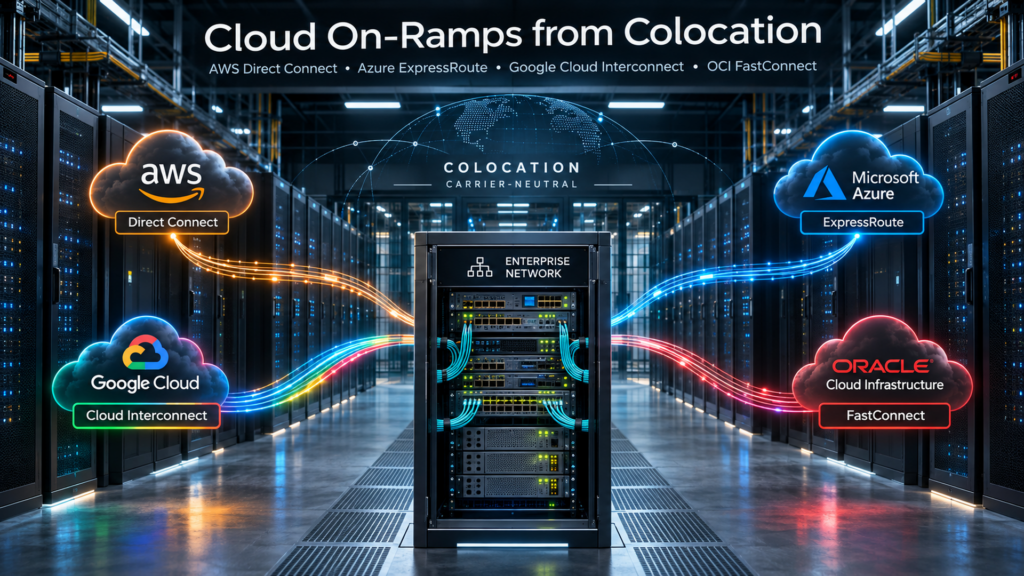
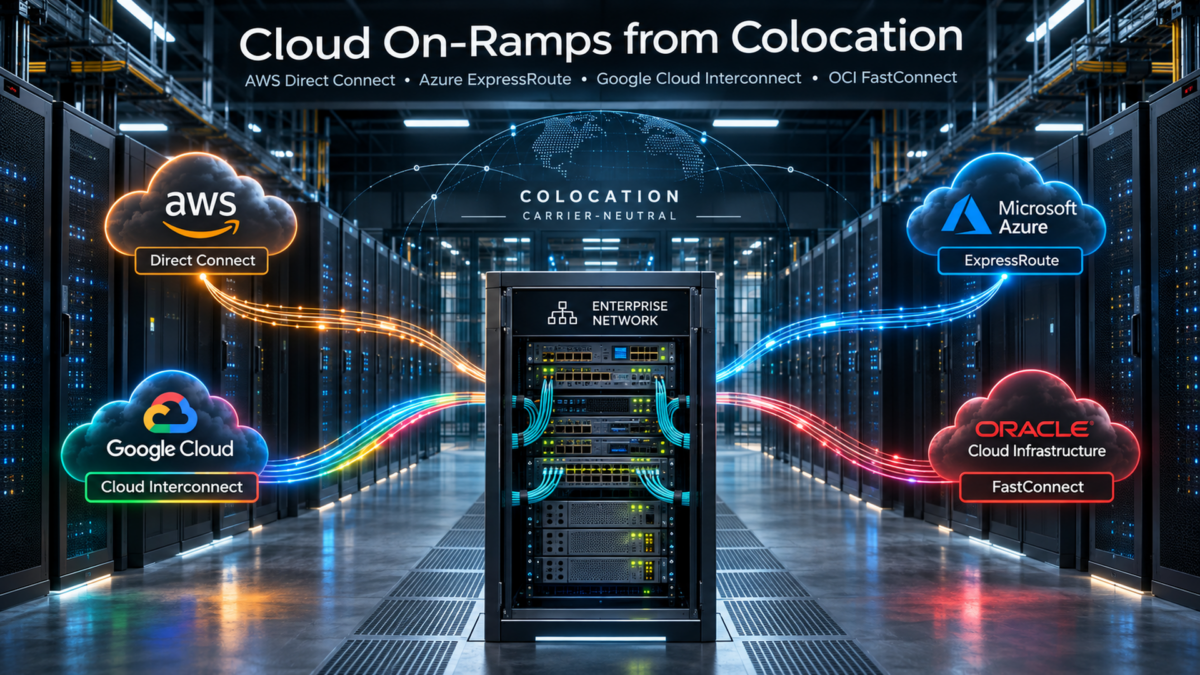
That is the strategic role of cloud on-ramps from colocation. Rather than reaching every cloud workload across an ordinary Internet path, an enterprise can establish private connectivity into the hyperscaler’s network through AWS Direct Connect, Azure ExpressRoute, Google Cloud Interconnect, or OCI FastConnect. Those services are important, but none is a complete network architecture by itself. The enterprise must still select the right facility, transport, gateway, routing policy, security controls, and recovery paths.
A well-designed on-ramp can make colocation an effective neutral interconnection hub for private infrastructure, cloud services, and the leading global Tier 1 ISPs. A poorly designed one can concentrate risk, add avoidable backhaul, or expose the business to data-transfer charges that dwarf the port price. This guide explains how to make those decisions, with an emphasis on the engineering and commercial choices that hyperscaler product descriptions often leave to the customer.
What Is a Cloud On-Ramp—and Where Does It Actually Connect?
A cloud on-ramp is a physical or partner-delivered private network interconnection into a public cloud provider’s network. In a colocation environment, it typically connects customer networking equipment—or a carrier’s or cloud fabric’s infrastructure—to a hyperscaler interconnection point. A logical connection and routing configuration then provide reachability to the intended cloud services.
This is an important distinction from simply purchasing a dedicated Internet circuit. A cloud on-ramp usually avoids the public Internet as the transport between the enterprise and the hyperscaler’s network edge. It does not mean that packets are automatically encrypted, that every cloud service is reachable, or that application latency is guaranteed to be lower than over every possible Internet path.
Three locations must be distinguished in every design: the enterprise location, the cloud network-entry location, and the region containing the workload. They are often different. A company might connect at an Ashburn interconnection point while reaching applications in other AWS Regions through the AWS backbone and gateway architecture. The same general issue applies to ExpressRoute peering locations, Google Interconnect locations and VLAN attachment regions, and OCI FastConnect locations. An on-ramp near the enterprise may not be the most efficient route to the applications it needs to reach.
The physical, logical, and routing layers
Start with a router in a carrier-neutral colocation rack. If the hyperscaler has an eligible network presence in that building, the customer and data center operator arrange a physical cross-connect, often a single-mode fiber connection through a meet-me room. If the cloud edge is elsewhere, a carrier or fabric provider extends the connection over its own network. Our Data Center Cross Connects guide explains the physical cabling, meet-me-room, and LOA-CFA process.
Over that underlying link, the cloud provider provisions a logical service: an AWS virtual interface, Azure circuit and peering, Google VLAN attachment, or OCI virtual circuit. In common direct and Layer 2 delivery models, BGP then exchanges IP reachability between the enterprise and the cloud. In some managed Layer 3 models, the intermediary provider handles cloud-facing BGP. Finally, the relevant cloud gateways, route tables, and security controls must allow the intended end-to-end communication.
A fiber link can therefore be operational while applications remain unreachable. An established BGP session is also not sufficient proof: the return route may be missing, a gateway association may be incomplete, or a firewall may reject the packets. The full route—from the application server in colocation to the cloud workload and back—must be tested.
Four Ways to Deliver a Cloud On-Ramp
The hyperscaler product determines the cloud-facing service; the delivery model determines how the enterprise reaches it. These are separate choices, and they materially affect both cost and operational control.
1. Direct physical cross-connect
A customer colocated at an eligible cloud interconnection site can connect its router to the hyperscaler’s edge using a physical cross-connect. This offers direct control over the customer equipment and handoff and can be attractive for high, sustained bandwidth. However, it also requires the appropriate facility, optics, ports, routing expertise, and an independent resilience design. A 10 Gbps port is not necessarily economical for a customer needing only a few hundred megabits.
2. Carrier-delivered private connectivity
A telecommunications provider can extend private access from an enterprise location or colocation site to a supported cloud edge. Delivery may be through Ethernet transport or a managed Layer 3/IPVPN service. This often fits companies already operating global carrier networks, since cloud access can be integrated with established WAN operations. The critical diligence question is which parts of the path are owned, leased, or shared: two carrier invoices may still depend on one local fiber route.
3. Software-defined cloud exchange fabric
Platforms such as Equinix Fabric and Megaport can deliver virtual connections to supported cloud services over a physical fabric connection. Adding or resizing a logical connection can be much simpler than ordering another fiber cross-connect. But virtual flexibility does not erase the physical underlay. Several logical cloud paths can share a single customer port or provider switching fabric—and therefore the same failure domain.
4. Managed cloud routing and NaaS
Some platforms go beyond transport and provide virtual routers or managed routing functions that connect cloud endpoints. This can reduce the need for enterprise-owned routers in each market, but the customer needs to understand who controls BGP, segmentation, overlapping address remediation, and troubleshooting. Our Network as a Service enterprise guide explains the broader shift toward programmable, usage-aligned networking.
Many global enterprises use all four approaches. A primary campus may justify dedicated physical access; remote business locations can use carrier transport; a fabric can provide agile access to secondary clouds; and managed routing can simplify selected intercloud flows. The appropriate mix is determined by the traffic and the business requirements, not by a preference for one provisioning portal.
The Four Hyperscaler Services Compared
The following comparison is a starting point for design, not a claim that equal advertised port speeds produce equal application throughput. Published capacities are location- and provider-dependent, and several services distinguish physical ports from logical connections.
| Design dimension | AWS Direct Connect | Azure ExpressRoute | Google Cloud Interconnect | OCI FastConnect |
| Access models | Dedicated and Hosted Connections | Provider circuits and ExpressRoute Direct | Dedicated and Partner Interconnect | Direct, partner, and third-party provider |
| Direct physical speeds | 1, 10, 100, 400 Gbps | Redundant Direct port pairs: 10, 100, and eligible 400 Gbps | 10, 100, 400 Gbps | Up to 400 Gbps at eligible locations |
| Lower-capacity delivery | Hosted from 50 Mbps; select partners up to 25 Gbps | Provider circuits from 50 Mbps | Partner attachments from 50 Mbps | Partner-dependent virtual-circuit capacity |
| Logical construct | Private, public, transit VIFs | Circuits; private and Microsoft peering | VLAN attachments | Private and public virtual circuits |
| Core routing resources | Direct Connect Gateway, VGW, Transit Gateway, Cloud WAN | ExpressRoute gateway, FastPath, Virtual WAN | Cloud Router and VPC routes | DRG attachments, route tables and distributions |
| Selected cost distinction | Pay-as-you-go or eligible flat-rate Dedicated pricing | Metered, Unlimited, Local models | Physical connection, attachment and applicable outbound transfer | No separate per-GB charge for private-peering FastConnect traffic |
| Resilience | Multiple ports, edge devices and locations | Dual-path circuits; geographic diversity and Metro options | SLA-specific connections, edge availability domains and regions | Separate edge devices, locations and providers where supported |
The most meaningful comparison is not which product is “best.” Each reaches a different cloud. Enterprises should instead compare how to reach the required workloads, which gateways and routes are needed, whether the proposed paths are independent, and how charges change as traffic grows.
AWS Direct Connect: Connection and Gateway Design
AWS offers Dedicated Connections with physical port capacities of 1, 10, 100, and 400 Gbps, and Hosted Connections through authorized partners from 50 Mbps to 25 Gbps where supported. Dedicated Connections allow multiple eligible virtual interfaces on a physical connection; hosted connections generally provide a single virtual interface and are rate-policed to their assigned capacity. A hosted service can be economical for a modest bandwidth requirement, while a dedicated port may be appropriate for larger or more complex deployments. See AWS connection options.
The choice of virtual interface determines the network function. A private VIF reaches eligible private VPC resources through the appropriate gateway model. A public VIF reaches supported AWS public-service endpoints, but is not general Internet transit. A transit VIF, used with a Direct Connect Gateway, provides connectivity to eligible AWS Transit Gateway or Cloud WAN architectures. A company with many AWS accounts and VPCs often gains more from a deliberately designed transit architecture than from proliferating individual point-to-point connections.
The Direct Connect Gateway is a key distinction: it can allow a physical connection at one Direct Connect location to reach eligible networks in multiple AWS Regions, subject to associations and service restrictions. For a globally distributed enterprise, this can avoid unnecessary dedicated ports in every region; it does not remove the need to design the underlying WAN and cloud route tables. AWS also provides documented route-preference BGP communities for private and transit VIFs, which can influence the AWS-to-enterprise return path. The enterprise must separately control its outbound path.
AWS’s Resiliency Toolkit supplies reference models for higher-availability connections. These requirements should be assessed alongside separate customer routers, cross-connects, and carrier paths. Buying two virtual interfaces on one physical port is not equivalent to physical diversity.
A major 2026 pricing change makes older Direct Connect comparisons incomplete. In September, AWS introduced flat-rate pricing for eligible 10 and 100 Gbps Dedicated Connections, with geographically tiered data-transfer-out coverage and an optional redundant port-pair configuration. The conventional pay-as-you-go model remains available. Which is cheaper depends on transfer volume, source Regions, locations, and resilience needs; we model the break-even point below.
Azure ExpressRoute: Circuits, Peering, FastPath and Reach
Azure ExpressRoute supports provider-delivered circuits and ExpressRoute Direct, which provides dedicated redundant physical ports at supported Microsoft peering locations. The distinction matters: a 10 Gbps logical circuit and a pair of dedicated 10 Gbps ExpressRoute Direct ports are not the same commercial or physical object. Microsoft’s connectivity models explain the supported transport arrangements.
Azure Private Peering connects eligible enterprise routes with private Azure VNet resources. Microsoft Peering serves supported Microsoft public endpoints and is not unrestricted Internet access. ExpressRoute should not be treated as the default transport for Microsoft 365; Microsoft generally recommends optimized Internet connectivity and restricts ExpressRoute-based Microsoft 365 use cases.
Cloud-side design usually includes ExpressRoute virtual network gateways or a supported Virtual WAN hub arrangement. ExpressRoute FastPath lets eligible data traffic bypass the gateway’s packet-processing path while the gateway retains control-plane functions. This can improve performance, but availability and supported features vary by circuit model, gateway, and workload; it is not a universal switch that improves every ExpressRoute connection. See FastPath documentation.
Azure also has a distinctive geographic and commercial decision. Local, Standard, and Premium circuit options differ in regional reach and service limits. Microsoft offers Metered and Unlimited Data pricing, and Local has specific included-transfer treatment. Global Reach may connect supported enterprise networks via Microsoft’s backbone, but it introduces its own geography and billing conditions. Enterprises should design around actual Azure workload regions before choosing a peering location and circuit SKU.
Standard circuits have redundant connectivity to Microsoft’s edge, but that does not eliminate customer-side single points of failure or automatically protect against a whole peering-site outage. For high-impact workloads, assess separate circuits and paths into suitable distinct peering locations, including ExpressRoute Metro where it is available and appropriate.
Google Cloud Interconnect: VLAN Attachments and Regional Routing
Dedicated Interconnect provides physical 10, 100, or 400 Gbps connections at eligible Google facilities. Partner Interconnect lets an approved carrier or fabric provider deliver lower-capacity service without requiring the customer to colocate at a Google edge. A key design difference from AWS is Google’s model of VLAN attachments associated with Cloud Routers and specific Google Cloud regions.
Cloud Router exchanges routes using BGP, but it is a managed control-plane service, not a packet-forwarding virtual appliance. Google’s distributed VPC infrastructure forwards the traffic. Regional and global VPC dynamic routing settings influence which learned routes are available across regions. A company with interconnects on both U.S. coasts needs to understand this behavior so applications do not take an unnecessarily indirect path. See the Cloud Router overview.
Google’s location model is financially important. An attachment can reach resources outside its attachment region, but traffic may incur standard cross-region transfer charges in addition to its Interconnect charges. For large data flows, putting the logical attachment in the wrong region may be a recurring cost problem, not just a latency issue.
Google also specifies topology requirements for its availability SLAs. An eligible 99.99% Dedicated Interconnect design uses at least four connections and can meet requirements through either a qualifying single-region topology within one metro using designated facility/edge-domain combinations, or a multiregion topology spanning two metros. It is inaccurate to say that every 99.99% design must use two metros. The precise rules are in Google’s 99.99% availability guide.
The provider offers Cross-Cloud Interconnect as another route between supported hyperscalers, but that is not identical to Dedicated or Partner Interconnect from enterprise colocation. Its pricing and geographic coverage should be evaluated separately.
OCI FastConnect: DRG Architecture and Data-Movement Economics
OCI FastConnect supports direct physical colocation connectivity, integrated partner connections, and third-party transport into an eligible Oracle interconnection location. It has private virtual circuits for VCN access through OCI’s Dynamic Routing Gateway (DRG) and public virtual circuits for eligible OCI public service endpoints. These serve different network functions and should not be treated interchangeably.
The DRG is central to private connectivity. Its attachments, route tables, and route distributions determine how prefixes learned from FastConnect can reach VCNs and other eligible networks. An enterprise can use this to consolidate connectivity for several OCI application networks while maintaining segmentation. The DRG is not unrestricted transit between every external attachment: designs intended to pass traffic directly between unrelated FastConnect or VPN attachments must be validated against Oracle’s restrictions.
Oracle’s October 2026 addition of IPv4 NAT on DRG attachments offers an additional option for certain overlapping-address situations. September enhancements introduced FastConnect traffic draining for controlled maintenance, plus other supported cross-connect-group and interface behaviors. These are useful to enterprise teams managing acquired networks, router upgrades, and service cutovers. See Oracle’s networking release notes.
The most important commercial distinction is that FastConnect private peering has no separate charge based on the amount of data transferred in either direction. Oracle bills the applicable provisioned port or virtual-circuit capacity, while partner transport, cross-connects, and other network services can have their own charges. That makes OCI worth close examination for workloads moving large volumes of data, but it is not a claim that all OCI networking or all intercloud data movement is free. Oracle’s FastConnect FAQ and cost estimator define the treatment.
For detailed OCI deployment and routing discussion, see Macronet Services’ Complete Oracle FastConnect Guide. The practical enterprise decision is how FastConnect integrates with the global WAN, other clouds, and the chosen colocation ecosystem—not simply how to order one Oracle port.
Five Practical Cloud On-Ramp Architecture Patterns
The technology becomes most useful when considered as a set of practical network patterns. The following designs are not mutually exclusive; a multinational enterprise might implement several at once.
Pattern 1: One private on-ramp for a primary cloud
A business keeps application servers in a colocation facility and runs its database in AWS. A dedicated or hosted Direct Connect connection, a private VIF, and the right gateway associations provide controlled access to the application VPC. This is efficient for a limited hybrid footprint, particularly when traffic volume is understood. Its weakness is the dependence on a single physical and logical path unless a backup is separately engineered. Even a comparatively simple deployment should document how applications recover from circuit maintenance or failure.
Pattern 2: Redundant connections for critical applications
A financial-services enterprise uses Azure for production applications and AWS for analytics. Each cloud receives appropriately redundant connections, and the enterprise terminates the paths on distinct network devices and, where justified, geographically separate cloud edge locations. BGP policies determine normal and failure routing. This improves access resilience, but must not be confused with application failover between Azure and AWS; such recovery also requires replicated data, suitable platform services, and tested procedures. The engineering question is which failures are survivable, not merely how many lines appear on the diagram.
Pattern 3: Carrier-neutral multicloud hub
A large company operates OCI databases, Azure business applications, AWS analytics, and Google Cloud AI services. A colocation hub connects to all four through some combination of physical links, partners, and a cloud fabric. Customer-operated or managed routing can enforce segmentation and integrate the cloud networks with the WAN. This centralizes policy and makes provider choice more flexible. But it may also concentrate physical failure domains and create unnecessary hairpinning if high-volume traffic between two clouds must detour through the hub. Cloud-to-cloud transit needs explicit routing and security design; simply connecting four on-ramps to one switch does not make them mutually reachable.
Pattern 4: Regional cloud access integrated with the global WAN
A manufacturer has operations in the Americas, Europe, and Asia-Pacific. Rather than backhaul Singapore traffic to a North American hub before reaching an Asian cloud application, it establishes regional access where economics and traffic justify it. Global carriers interconnect business sites and regional hubs. The gain can be lower latency and better regional survivability; the trade-off is additional ports, transport, contract administration, and operating overhead. This is where the site’s Tier 1 ISP overview and Multi-Cloud Networking guide provide complementary context.
Pattern 5: Hybrid native cross-cloud and colocation connectivity
An organization uses OCI databases consumed by AWS applications while keeping other enterprise systems in colocation. Where a supported AWS-to-OCI native interconnect meets the requirements, that application path can bypass enterprise-operated colocation transit. The on-ramps still serve the private data center, branches, and other providers. This reduces unnecessary intermediate routing for eligible flows while preserving a neutral enterprise edge. It also introduces more than one operating model, so monitoring and incident ownership must be documented carefully.
The design choice is therefore a traffic-flow decision. Before requesting quotes, identify source, destination, cloud region, monthly volume, peak bandwidth, latency tolerance, encryption requirement, and acceptable interruption for each major application flow. Those inputs make architectural trade-offs visible in a way that a collection of port prices cannot.
BGP Routing, Segmentation and Traffic Engineering
BGP is how the enterprise and cloud edge generally exchange reachability for direct or Layer 2 interconnections. But it is the combination of prefix advertisements, cloud route tables, gateway attachments, and enterprise policy that determines whether applications actually communicate. For deeper treatment of autonomous systems, route selection, communities, and routing security, read our BGP Routing Explained: The Enterprise Guide to Internet Routing.
Consider a company advertising 10.40.0.0/16 from colocation and connecting to a cloud VPC at 10.80.0.0/16. If the enterprise router accepts the cloud prefix but the VPC lacks a return route to 10.40.0.0/16, the forward path may work while the response fails. If a stateful firewall lies in the middle, inconsistent return paths can also break established sessions even when both cloud circuits and BGP peerings show as healthy.
Route preference is directional. AWS supports specific BGP communities on private and transit VIFs to influence how AWS prefers customer-advertised paths. Azure’s treatment of advertised communities differs, and Microsoft does not generally accept customer-supplied BGP communities as a way to set its return-route preference. Google Cloud Router’s regional or global routing behavior affects where learned prefixes are installed; OCI DRG route tables and distributions decide which attachments can exchange routes. Engineers should never assume one hyperscaler’s route-control method maps directly onto another.
The decision to build active-active or active-standby paths should reflect actual traffic behavior. Two 10 Gbps connections carrying 14 Gbps in normal aggregate traffic cannot maintain that rate after one fails if the surviving path supports only 10 Gbps. BGP may restore reachability correctly while performance deteriorates. Similarly, a lower-bandwidth VPN backup can preserve access to selected critical transactions without supporting every bulk data job.
Address overlap deserves attention before multiple cloud environments are combined. Two independently deployed networks using the same 10.20.0.0/16 cannot become directly reachable merely by announcing their prefixes to a shared router. Renumbering, segmentation, translation, or application-layer mediation may be necessary. The least disruptive remedy depends on which systems can change addresses and which cloud constructs support the planned translation.
A disciplined architecture filters routes at each boundary and prevents unintended transit. A route learned from AWS should not automatically be re-advertised to Azure or OCI. Likewise, Internet routing tables should not leak into private cloud BGP sessions. Prefix limits, default-route behavior, accepted path attributes, and operational monitoring should be included in design documentation and acceptance tests.
Resilience: Four Cloud Circuits Can Still Be One Failure Domain
High availability begins with an accurate map of the entire physical and logical path. A company might purchase Direct Connect and ExpressRoute from different partners, receive two invoices, and assume it has diversity. Both services may still share one building entrance, leased metro loop, patch panel, cloud-fabric access port, or customer router. That is the difference between carrier diversity and physical path diversity, explored in Carrier Diversity vs Path Diversity: Why Two ISPs May Not Be Redundant.
The relevant failure domains include customer routers and power, cabinet pathways, cross-connects, building entrances, local carrier loops, intermediate aggregation sites, cloud exchange fabrics, cloud edge devices, and—where critical—the colocation site itself. Redundancy should survive the specific events the business is paying to protect against. Separate physical routes are more valuable than additional logical circuits if fiber damage is the dominant risk. A secondary metro may be justified when the business must survive loss of an interconnection facility.
Provider SLAs require precise interpretation. AWS has High and Maximum Resiliency models with different qualification requirements. Microsoft provides redundant edge paths in an ExpressRoute circuit and offers additional diversity options. Google has explicit 99.9% and 99.99% topologies, including its newer qualifying single-region Dedicated Interconnect option. OCI redundancy depends in part on available edge locations and the partner’s portion of the access path. None of these automatically guarantees the complete application, carrier, or enterprise facility.
An availability test should do more than observe that BGP reconverges. It should measure the interruption experienced by real applications, verify the surviving route and throughput, and confirm that encryption, firewall state, DNS, and dependent services remain functional. Planned changes should include a rollback path. For critical systems, simulate router failure, private-circuit failure, and the loss of the primary cloud entry point where practical and contractually permitted.
Network availability and application availability are separate outcomes. A perfectly healthy private circuit cannot compensate for an unavailable database, failed identity provider, or a cloud workload without a recovery strategy. Conversely, a resilient application might continue through an on-ramp outage using an independent VPN or other delivery path. The architecture should align with the enterprise’s recovery-time and recovery-point objectives, not a port-count target.
Latency, Throughput and Encryption: What Private Connectivity Actually Changes
Private connectivity can reduce exposure to unpredictable Internet routing, but it does not defeat geography. A physically nearby interconnection point may send traffic across the hyperscaler’s backbone to a workload thousands of miles away. A partner-delivered connection can also take an indirect route through a distant provider hub. For latency-sensitive applications, measure the actual endpoint-to-endpoint round trip under representative load rather than assuming the private label guarantees the shortest path.
Throughput also depends on more than port capacity. A 10 Gbps circuit can be constrained by a cloud gateway, firewall, VPN device, destination virtual machine, disk subsystem, or the number of concurrent application flows. High-capacity, long-distance transfers expose the bandwidth-delay product: at 10 Gbps and 60 milliseconds RTT, roughly 75 MB must be in flight to fill the path. A single TCP flow may underutilize a circuit that performs well with many parallel sessions. LAG capacity is aggregate; it does not necessarily permit one flow to occupy several member links.
MTU must be consistent with the full path, including virtual interfaces, carrier transport, firewalls, tunnels, and cloud gateway behavior. Jumbo frames can improve efficiency for some bulk flows but are not a universal setting. Encapsulation and IPsec overhead can reduce the usable payload MTU, so path-MTU validation and realistic throughput testing should be part of deployment acceptance.
Private is not the same as encrypted. All four hyperscalers provide private network access, but end-to-end traffic encryption cannot be inferred from that alone. Eligible direct links may use MACsec to protect a particular Ethernet segment. IPsec can encrypt traffic between designated tunnel endpoints, and TLS can protect application communications independent of the underlying transport. The correct combination depends on data sensitivity, regulatory needs, throughput, and which party controls each link. A third-party carrier path may require additional measures beyond MACsec on the cloud-facing port.
The practical recommendation is to test the actual workload: a database transaction, a storage replication job, or a cloud application session—not merely ping or an interface counter. Measure baseline RTT, packet loss, aggregate and single-flow throughput, gateway utilization, and encrypted performance. Include load, route changes, and backup-path operation in the acceptance plan.
Cloud On-Ramp Pricing: Model the Complete Path, Not the Port
The price of a private cloud connection consists of several independent components. The hyperscaler may bill for a port or circuit and outbound data transfer. A colocation operator bills for physical cross-connects; a carrier or NaaS provider may bill for metro transport or virtual fabric services. Cloud gateways and processing resources can add separate charges, and the enterprise still has equipment, optics, monitoring, and maintenance costs. The correct procurement question is therefore the three- or five-year total cost of the required application path.
A practical monthly formula is:
Cloud connectivity TCO = cloud port/circuit + outbound data transfer + partner/fabric transport + colocation cross-connects + cloud gateways/processing + customer equipment/operations.
One-time installation, construction, and change costs should be amortized across the term. Redundancy can increase several line items, and annual contract escalators matter. Our Colocation Pricing Guide for 2027 and How to Read and Compare a Colocation Quote explore these larger commercial issues.
The transfer direction must be explicit. AWS pay-as-you-go and Google Cloud Interconnect have applicable outbound charges; inbound data is treated differently. Azure offers metered, unlimited, and Local variants. Oracle’s no-per-GB FastConnect statement applies to private peering, not every possible OCI networking service. A 10 Gbps quote from one provider is not financially comparable to another unless regions, traffic direction, data units, gateways, and third-party services are normalized.
Example 1: A 1 Gbps hosted AWS deployment
Consider a midsized company buying two 1 Gbps AWS Hosted Connections for redundancy and moving 20 TB per month out of AWS. For illustration, assume 730 hours, AWS hosted port-hour pricing of $0.33 per port-hour, and $0.02 per billable GB of eligible outbound traffic. The last rate is a scenario assumption, not a universal AWS rate. Assume carrier transport of $750 per path, colocation cross-connects of $300 each, and $400 in allocated network operations. Those provider-side figures are hypothetical, not carrier quotations.
| Illustrative monthly component | Calculation | Cost |
| Two AWS 1 Gbps hosted connections | 2 × $0.33 × 730 hours | $481.80 |
| Outbound transfer | 20,000 GB × $0.02 | $400.00 |
| Two carrier access services, assumed | 2 × $750 | $1,500.00 |
| Two cross-connects, assumed | 2 × $300 | $600.00 |
| Equipment and operations allocation, assumed | Fixed | $400.00 |
| Total | $3,381.80 |
The critical finding is that only about 26% of this modeled cost is paid for the two AWS ports and outbound transfer. The assumed carrier and facility services dominate the total. A less expensive cloud port cannot compensate for an unnecessarily long or costly transport design. Before accepting a proposal, also confirm that the two hosted paths are truly independent rather than two logical services over the same local access.
Example 2: AWS flat-rate versus pay-as-you-go at 300 TB/month
Now consider a high-volume enterprise using two dedicated 10 Gbps AWS Direct Connect ports for a survivable 10 Gbps service and exporting 300 TB decimal, or 300,000 billable GB, from an eligible U.S. AWS Region through a Northern Virginia connection. Under the published non-Japan dedicated port rate of $2.25/hour, the two pay-as-you-go ports cost $3,285/month at 730 hours. At an illustrative $0.02/GB outbound rate, transfer adds $6,000, producing $9,285/month of AWS Direct Connect charges before other services.
AWS’s September 2026 flat-rate alternative lists an eligible Tier 1 10 Gbps redundant port pair at $10.96/hour. At 730 hours the arithmetic is $8,000.80/month, with no additional Direct Connect data-transfer-out charge for covered source Regions. Under the same stated assumptions, that is $1,284.20/month less than pay-as-you-go, or about $15,410 annually. The port-pair offers 10 Gbps of usable capacity with a standby connection; it is not an aggregated 20 Gbps service.
| AWS-side scenario, 730-hour month | Monthly total |
| Two 10 Gbps dedicated ports, pay-as-you-go, plus 300,000 GB at assumed $0.02/GB | $9,285.00 |
| Eligible Tier 1 10 Gbps redundant flat-rate port pair | $8,000.80 |
| Illustrative flat-rate saving | $1,284.20 |
The break-even outbound volume is approximately 235,790 billable GB, or 235.79 TB decimal, per month: the $4,715.80 fixed-charge difference divided by $0.02/GB. Below that volume, the modeled pay-as-you-go service has lower AWS-side charges; above it, flat-rate wins. This calculation is location-, tier-, and rate-specific. Traffic originating outside the chosen flat-rate geographic tier can still incur outbound charges, and additional AWS gateway processing, SiteLink, carrier, colocation, or customer equipment fees remain separate. See AWS flat-rate pricing and AWS pay-as-you-go pricing.
What changes with Azure, Google, and OCI?
Azure requires the enterprise to compare Metered, Unlimited, and Local within the applicable geography and circuit model. Microsoft publishes the relevant rates on its ExpressRoute pricing page. It is not valid to compare a metered provider circuit against an ExpressRoute Direct port pair as if the physical facilities and included services were identical.
For Google, a published U.S. 10 Gbps Dedicated Interconnect physical connection is $2.328/hour and a 1–10 Gbps VLAN attachment is $0.10/hour. In a 730-hour month, one connection and one such attachment amount to $1,772.44 before outbound transfer, partner transport, and other services. The published U.S./Canada Interconnect outbound rate is $0.02/GiB for eligible traffic; cross-region charges may apply when the workload and VLAN attachment are in different regions. Google’s current pricing page provides the complete framework.
For OCI, private-peering FastConnect has no separate per-GB transfer charge in either direction, but the appropriate Oracle port-hour cost and any third-party connectivity charges remain. That can be attractive for sustained data movement, though workload placement and cloud-compute/storage economics still matter. Even when OCI does not charge for a given private-peering movement, another hyperscaler sending that data may charge on its side.
These examples should not be turned into a universal cost ranking among cloud providers. They are most useful for exposing which charges can be optimized through connectivity architecture. A facility with higher rack rent but direct access to needed cloud edges can be less expensive than a cheaper facility requiring several metro extensions. Likewise, moving a compute function closer to a large dataset can sometimes save more than negotiating another discount on a private port.
Selecting the Right Colocation and Carrier Ecosystem
A colocation provider’s statement that it offers “AWS, Azure, Google, and OCI connectivity” is not enough. The buyer must identify how each service is delivered. One hyperscaler might be directly available in the building, another through a campus extension, and others through a carrier or remote cloud fabric. All may be legitimate choices, but they have different prices, demarcations, and failure domains.
A useful procurement exercise begins with the applications and their cloud regions, then works backward to the enterprise WAN. The facility comparison should examine direct versus remote on-ramps, actual on-net carriers, cloud-fabric access, diverse building entrances, meet-me-room arrangements, cross-connect recurring and installation charges, remote hands, and expansion capacity. Advertised carrier logos do not demonstrate that every provider has an independently routed local loop into that specific building.
Facilities should be evaluated by risk-adjusted, all-in cost, not rack price or the number of cloud logos. For example, Facility A may be $1,000/month less expensive for space but require $3,000/month in additional transport to reach the needed cloud networks. Facility B could be $2,000/month cheaper overall despite its higher colocation charge. The differences can become more significant when the enterprise needs physically independent paths or higher future capacity.
Commercial terms deserve the same attention as topology. Enterprises should compare cross-connect MRCs and NRCs, annual escalators, service activation dates, rights to add or change carriers, remote-hands fees, termination rules, and the process for disconnecting unused links. A cloud circuit that has been cancelled at the hyperscaler may continue to generate carrier or colocation bills if the other service components are not separately terminated.
Our Colocation RFP Guide provides a structured approach to technical and commercial facility evaluation. The earlier Data Center Connectivity guide provides the broader context for on-ramps, carriers, Internet access, and cross-connects. The ideal facility is the one whose interconnection ecosystem supports the actual network architecture and future business requirements, not simply the one advertising the broadest cloud menu.
From Order to Production: Provisioning, Testing, and Operational Handoff
Cloud connectivity projects cross several organizational boundaries. The enterprise owns requirements and often its routers; the colocation operator delivers physical cross-connects; a carrier or fabric partner may supply transport; the hyperscaler manages the cloud-side service. A single accountable project plan should identify who owns every handoff and the condition that makes it “complete.”
Order sequencing differs. AWS and Google Dedicated Interconnect commonly involve a Letter of Authorization/Connecting Facility Assignment (LOA-CFA) for physical connection work. Azure provider circuits are coordinated using the ExpressRoute service key, while ExpressRoute Direct has separate dedicated-port procedures. OCI direct FastConnect requires the proper service limits, port resources, and Oracle authorization process. Those cloud-side prerequisites should be checked before booking a production migration window.
Acceptance testing needs to progress from physical to logical to application. First verify optics, interface status, fiber polarity, and the carrier’s service delivery. Next validate VLAN IDs, virtual circuits or attachments, peer IPs, ASNs, and BGP sessions. Then confirm the actual routes accepted on both sides, cloud gateway associations, VPC/VNet/VCN route tables, DNS, security policies, and the return path. Finally, test production-like application flows, expected throughput, encryption overhead, and controlled failover.
The most common “green dashboard, broken application” scenarios are predictable. A BGP session may be established while its intended prefix is absent. A VCN route table can omit the DRG destination. A VNet connection can be incomplete. A partner might declare its Ethernet transport ready even though the hyperscaler-side logical service is not. Two private links may be healthy but a stateful firewall on the asymmetric return path may reject packets. Troubleshooting by network layer is more effective than escalating indiscriminately across providers.
Go-live should be conditional on agreed application acceptance criteria, not a provider’s circuit-ready notification. For critical systems, include baseline latency and throughput, simulated primary-path loss, recovery behavior, and sufficient surviving bandwidth. Document the physical and logical path, circuit IDs, BGP peerings, prefixes, route policies, cloud gateways, demarcations, monitoring, escalation contacts, and change procedures. Decommission old VPNs, cross-connects, and carrier services deliberately to avoid stranded recurring charges.
What Changes in 2027: Native Multicloud, NaaS, and AI Data Movement
The cloud interconnection market is becoming more programmable. In April 2026, AWS Interconnect – multicloud became generally available with Google Cloud; connectivity with OCI reached general availability in July 2026. AWS–Azure connectivity entered public preview in August 2026. These are not interchangeable states of maturity, and coverage is regional: native interconnect availability must be verified for the exact region pair. The official AWS regional availability guide is the appropriate starting point.
Native cloud-to-cloud products can remove a colocation hairpin from selected application flows. They do not automatically provide WAN access from factories, offices, private data centers, and independent networks. Colocation continues to be valuable as a neutral enterprise edge—especially where multiple carriers, security domains, and legacy systems need to converge. The design opportunity is to use native interconnects where they are appropriate, and avoid routing unrelated traffic through a central hub merely because that was the traditional method.
In April 2026, AWS Interconnect – last mile also reached general availability with Lumen, integrating eligible enterprise-site access with AWS provisioning. On November 12, 2026, Google announced a preview of Partner Cross-Cloud Interconnect for last mile with Lumen, initially in Northern Virginia. These developments are notable precisely because they extend automation beyond cloud-to-cloud traffic toward private data centers and other enterprise sites. Preview availability, carrier footprint, and covered geography should be verified rather than assumed.
Network as a Service is developing in parallel. Platforms can expose existing private connectivity and virtual routing through portals and APIs, allowing approved connections or bandwidth tiers to be provisioned more flexibly than traditional individual circuits. This is not magic on-demand fiber construction: the physical underlay must still be available. Enterprises should examine route control, provider dependencies, contract terms, burst economics, and the difference between customer-controlled virtual routing and fully managed service. The Macronet Services guides to NaaS and adaptive network control explore these operating models in greater detail.
AI adds traffic-pattern complexity rather than one universal demand for “faster cloud.” A company using a hosted model API may have modest network requirements. Another moving multi-terabyte datasets between colocation storage and GPU clusters can require large, intermittent transfers. Distributed inference may be latency-sensitive; checkpoint and training-data movement may be more sensitive to throughput and data-transfer charges. Our AI Colocation guide examines the physical infrastructure side of that decision. The networking question is whether data should move, compute should move closer to data, or the application should use a different placement strategy.
The likely result is not the disappearance of cloud on-ramps. It is their integration with native cross-cloud connectivity, carrier networks, programmable fabrics, and managed routing. Enterprises that design around application flows, security boundaries, and total cost will be better prepared than those that treat each new service as an isolated circuit purchase.
How Macronet Services Helps Design and Source Cloud Connectivity
Macronet Services helps enterprises evaluate, design, and competitively source global WAN, colocation, Internet, and multicloud connectivity solutions. That includes the complete architecture around AWS Direct Connect, Azure ExpressRoute, Google Cloud Interconnect, and OCI FastConnect: cloud-entry location, physical and virtual transport, BGP and gateway design, carrier and path diversity, security requirements, and lifecycle cost.
Our approach is provider-independent in its technical evaluation, drawing on access to leading global colocation and telecommunications ecosystems rather than requiring the customer to fit one preferred platform. We can compare direct physical on-ramps, carrier-delivered services, interconnection fabrics, NaaS, and emerging native services against the same application and resilience requirements. Our qualifying network design guidance and sourcing assistance is provided at no consulting cost to the client; purchased network, colocation, and cloud services retain their normal charges, and separately scoped professional services are identified in advance.
If your organization is planning a new cloud connection, relocating a data center, or redesigning a global multicloud network, request a cloud connectivity design and competitive quote. The goal is not simply to purchase a cloud port; it is to build an end-to-end network that serves the business efficiently and reliably.
Frequently Asked Questions About Cloud On-Ramps
What is a cloud on-ramp?
A cloud on-ramp is a private connection into a public cloud provider’s network, delivered through a dedicated physical port or a partner’s network. In colocation, it connects a customer or carrier edge to AWS Direct Connect, Azure ExpressRoute, Google Cloud Interconnect, or OCI FastConnect. The private path avoids ordinary public-Internet transit to the cloud edge but is not automatically encrypted or redundant.
Do I need to colocate equipment to use Direct Connect or ExpressRoute?
No. A carrier or approved connectivity partner can extend the service to the customer’s data center or office. AWS Hosted Connections, provider-delivered ExpressRoute circuits, Google Partner Interconnect, and OCI partner FastConnect are examples. Colocation is most useful when the enterprise wants a neutral place to aggregate several cloud services, carriers, and routing or security systems.
Can one colocation facility connect to all four hyperscalers?
Yes, many carrier-neutral facilities can provide AWS, Azure, Google Cloud, and OCI connectivity. But the delivery models may differ: one cloud edge may be physically on-site while others are reached by a campus extension, carrier circuit, or interconnection fabric. Ask where each physical handoff resides and which providers and paths carry the traffic.
Is a cloud on-ramp the same thing as a cross-connect?
No. A physical cross-connect is a fiber or copper path between termination points within a data center or campus. A cloud on-ramp includes the physical or partner-delivered access plus logical cloud provisioning and routing. A virtual cross-connect is a logical service across an interconnection fabric; it still depends on physical network infrastructure.
What is the difference between AWS Direct Connect and Azure ExpressRoute?
Both provide private network access, but the services have different port and circuit models, gateway constructs, routing capabilities, regional reach, and pricing. AWS uses dedicated or hosted connections and private, public, and transit VIFs; Azure uses ExpressRoute circuits, private or Microsoft peering, and gateway or Virtual WAN integration. Choose the solution required by the application’s cloud, then optimize its delivery model and total cost.
What is Google Cloud Router’s role in Cloud Interconnect?
Cloud Router exchanges dynamic routing information using BGP between Google Cloud and the enterprise or partner. It is a control-plane service, not a conventional virtual router forwarding packets. VPC routing configuration and the region of each VLAN attachment determine where learned routes are available and can affect both network paths and interregional costs.
Why is OCI FastConnect attractive for data-intensive applications?
For private FastConnect peering, Oracle charges for the provisioned port or virtual-circuit capacity without a separate per-gigabyte data-transfer fee in either direction. Partner transport, colocation cross-connects, and other services still have charges. The result can be favorable for sustained, large data transfers, but it should be evaluated in the context of the complete application and multicloud bill.
Do private cloud on-ramps provide lower latency than VPNs?
They may provide more predictable performance and less exposure to Internet route variation, but the actual latency depends on geographic distance, the provider’s path, cloud gateway processing, and the destination workload. A private link at a nearby edge can still reach a distant cloud region. Test representative application traffic rather than assuming a private service is always the lowest-latency route.
Are cloud on-ramp connections encrypted?
Not necessarily. Private connectivity and encryption are separate properties. Eligible physical connections may support MACsec on the relevant Ethernet link; IPsec protects traffic between tunnel endpoints, and TLS protects application sessions. Enterprises should establish precisely where encryption begins and ends, especially when traffic crosses a third-party carrier or fabric.
What is the difference between carrier redundancy and path diversity?
Two carrier contracts do not guarantee two independent paths. They may share a building entry, leased local loop, conduit, aggregation site, or customer router. True path diversity requires verification of the components that could fail together. Our Carrier Diversity vs Path Diversity guide examines the practical checks.
Is BGP required for cloud on-ramps?
BGP is typically used for route exchange with the cloud edge. In direct or Layer 2 models, the enterprise commonly operates the BGP session; in selected managed Layer 3 models, the provider performs that task. BGP status alone does not establish application reachability. See our BGP Routing Explained guide for routing fundamentals and policy behavior.
How much does a cloud on-ramp cost?
There is no universal monthly price. The full cost can include cloud port or circuit charges, data transfer, a carrier or cloud fabric, physical cross-connects, cloud gateways, and customer equipment. Redundancy and contract terms add cost. Compare the same traffic volumes, billable units, regions, and end-to-end architecture; don’t compare published port-hour rates as if they were complete service quotes.
When is AWS Direct Connect flat-rate pricing cheaper?
It depends on how much eligible outbound data the enterprise transfers, the selected AWS Region and Direct Connect location, port speed, and flat-rate geographic tier. AWS introduced flat-rate pricing for eligible 10 and 100 Gbps Dedicated Connections in September 2026. Our worked example gives a break-even of roughly 236 TB decimal per month under its specific assumptions; it is not a universal threshold.
Can AWS, Azure, Google Cloud, and OCI connect directly without a colocation transit hub?
Some cloud pairs now support managed native interconnection in selected regions. As of November 2026, AWS Interconnect – multicloud supports Google Cloud and OCI generally in eligible locations, while Azure connectivity is in public preview. Native paths may reduce enterprise-operated cloud-to-cloud transit, but they do not automatically connect private sites, WANs, or every cloud region.
How does Network as a Service change cloud connectivity?
A NaaS or cloud exchange platform can expose existing network connectivity and sometimes routing through programmable services. This can speed adding a cloud endpoint or changing an available bandwidth tier. It does not eliminate physical access constraints or the need for security, route control, and diverse paths. Read our Network as a Service enterprise guide for a broader comparison.
How should an enterprise select and source a cloud on-ramp?
Start with application source and destination locations, peak bandwidth, monthly data movement, availability targets, encryption requirements, and acceptable recovery behavior. Compare direct cross-connect, carrier, fabric, and managed options using the same network and pricing assumptions. Verify the underlying physical path and cloud-region reach, then test applications before production. Macronet Services can help design and competitively source the complete solution.
Conclusion: Design the Network, Not Just the Connection
Cloud on-ramps are becoming a strategic layer of enterprise infrastructure because applications, data, and compute increasingly reside in different places. AWS Direct Connect, Azure ExpressRoute, Google Cloud Interconnect, and OCI FastConnect provide the cloud-facing access, but the business outcome depends on the entire path: colocation location, carrier ecosystem, logical service, gateway design, BGP policy, physical diversity, encryption, and data-transfer economics.
The next generation of managed cross-cloud services and programmable NaaS will simplify some connections and change the role of traditional colocation transit. It will not remove the need for independent engineering judgment. Enterprises that evaluate application flows and the full lifecycle cost—rather than purchase bandwidth in isolation—will be better positioned to support resilient hybrid and multicloud operations through 2027 and beyond.