IT Asset Management (ITAM): Software, Audits & Cost Savings
Why IT Asset Management Has Become a Business Imperative
Most organizations know how much they spend on technology. Far fewer can confidently explain exactly what technology they own, where it is located, whether it is being used, and whether it continues to deliver value.
Consider a multinational enterprise operating hundreds of locations, multiple data centers, thousands of network devices, cloud environments, and an expanding collection of software subscriptions.
Over time, infrastructure is added, offices are relocated, employees change roles, applications are deployed, and technology providers are replaced. Yet the documentation and asset inventories intended to track these changes often fail to keep pace.
The result can be a fragmented picture of the enterprise IT environment.
Organizations may continue paying for telecommunications circuits they no longer need, maintain equipment that has reached the end of manufacturer support, purchase software licenses that duplicate existing capabilities, or overlook technology assets that introduce cybersecurity and compliance risks.
This is why IT Asset Management (ITAM) has evolved from a relatively straightforward inventory function into an important component of enterprise technology governance, financial management, cybersecurity, and infrastructure modernization.
For CIOs, CTOs, IT directors, and financial leaders, accurate asset information provides a foundation for making better decisions about technology investments.
However, implementing IT asset management software does not automatically guarantee an accurate inventory.
Automated discovery platforms can identify and organize substantial amounts of information, but inaccessible devices, incomplete configurations, outdated records, and discrepancies between management systems can create significant gaps.
Establishing a reliable asset inventory frequently requires professional auditing, data reconciliation, and an understanding of the infrastructure being evaluated.
Macronet Services helps organizations address these challenges by combining IT asset management technology, professional asset auditing resources, and extensive enterprise network engineering expertise.
Beyond establishing an accurate inventory, our engineers can help clients identify opportunities to reduce unnecessary technology spending, modernize aging infrastructure, improve network resiliency, and develop more efficient enterprise connectivity architectures.
The objective is not simply to document the technology an organization already owns. It is to use that information to make better business and technology decisions.
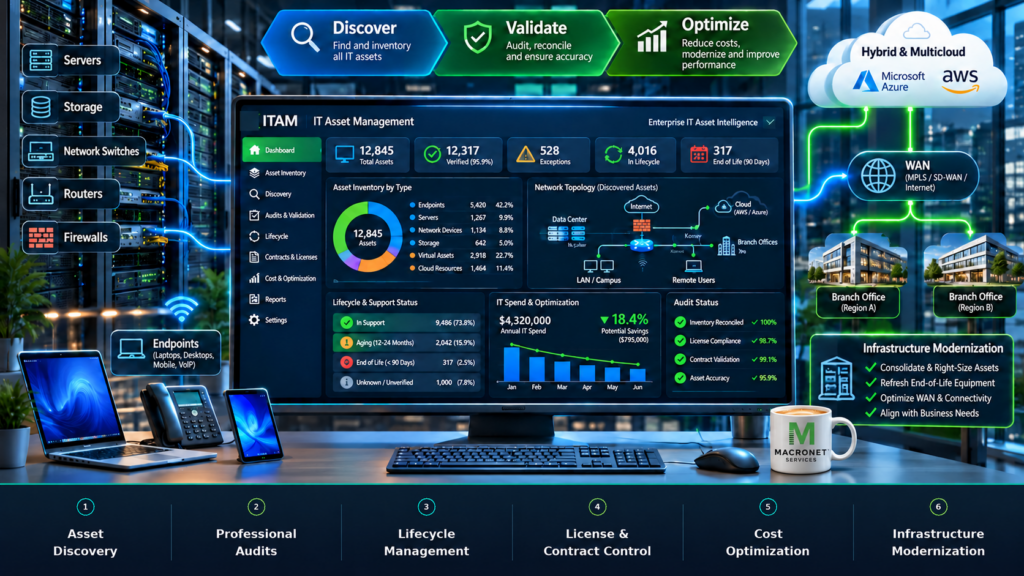
This guide explains how IT asset management works, what modern discovery platforms can accomplish, why professional asset audits remain important, and how accurate asset intelligence can support cost optimization and infrastructure transformation.
What Is IT Asset Management (ITAM)?
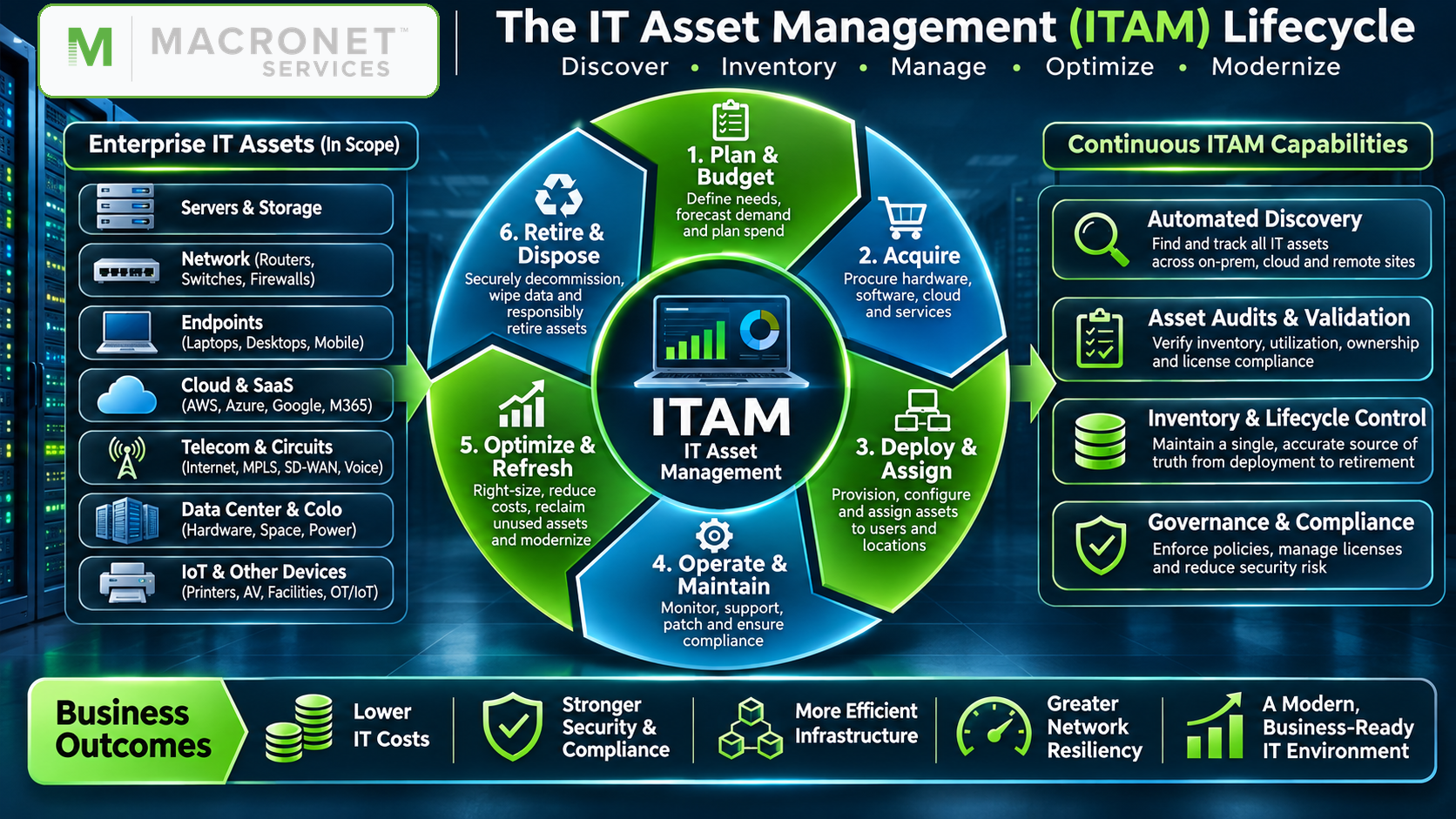
IT Asset Management (ITAM) is the process of discovering, tracking, managing, and optimizing an organization’s technology assets throughout their lifecycle, from acquisition and deployment through maintenance, replacement, and retirement.
An effective ITAM program provides a reliable understanding of the hardware, software, cloud resources, and other technology assets an organization owns, leases, subscribes to, or operates.
It connects technical inventory information with financial, contractual, operational, and lifecycle data to support better decision-making.
For example, an enterprise may know that it operates 500 network switches across its facilities. A comprehensive ITAM solution should help the organization understand considerably more:
Which models are installed? Where are they located? What software versions are running? Which devices are approaching end of support? What maintenance agreements apply? When should the equipment be replaced?
The same principles apply to servers, firewalls, endpoints, software licenses, cloud resources, and other technology investments.
The IT Asset Management Lifecycle
ITAM encompasses the entire lifespan of a technology asset.
The lifecycle begins with planning and procurement, when organizations identify requirements, evaluate alternatives, negotiate agreements, and acquire equipment or services.
Once deployed, assets should be associated with appropriate ownership, location, configuration, warranty, and contractual information.
During operation, organizations monitor lifecycle status, track changes, maintain relevant records, and identify assets approaching replacement or retirement.
Eventually, equipment is reassigned, upgraded, decommissioned, or disposed of. Effective asset management helps ensure that retired systems are appropriately removed from service, sensitive data is securely handled, and related financial obligations are reviewed.
The international ISO/IEC 19770-1 IT Asset Management standard establishes requirements for organizational IT asset management systems, while ISO/IEC TS 19770-10:2025 provides implementation guidance.
These standards offer a useful foundation for developing repeatable, auditable, and scalable ITAM processes.
ITAM vs. HAM, SAM, CMDB and ITSM
Several related technology disciplines are frequently confused with IT asset management.
| Discipline | Primary Purpose |
| ITAM — IT Asset Management | Manages technology ownership, costs, contracts, risks, and asset lifecycles |
| HAM — Hardware Asset Management | Tracks physical technology assets from acquisition through disposal |
| SAM — Software Asset Management | Manages software licensing, entitlements, installations, and usage |
| CMDB — Configuration Management Database | Maintains configuration items and relationships supporting IT services |
| ITSM — IT Service Management | Manages the delivery and support of IT services |
Hardware Asset Management and Software Asset Management are generally components of a broader ITAM strategy.
A CMDB serves a complementary purpose by documenting configuration items and their relationships to IT services.
For example, ITAM may track a firewall’s purchase price, warranty, and maintenance agreement, while a CMDB documents how that firewall supports business applications and connects to other infrastructure.
Integrating these disciplines can provide a more comprehensive understanding of the enterprise technology environment.
What IT Assets Should Enterprises Track?
An effective IT asset inventory should include the technology resources that support business operations, along with the information required to manage their operational, financial, and lifecycle responsibilities.
For large enterprises, these assets may be distributed across offices, remote employee locations, data centers, colocation facilities, and public cloud environments.
The scope frequently extends beyond traditional hardware and software.
Essential Categories of IT Assets
| Asset Category | Examples | Important Information |
| Network Infrastructure | Routers, switches, firewalls, wireless access points | Manufacturer, model, serial number, firmware, location, support status |
| Servers and Storage | Physical servers, storage arrays, backup appliances | Configuration, operating systems, capacity, warranties, lifecycle |
| End-User Devices | Laptops, desktops, tablets, smartphones | Assigned users, configurations, locations, replacement dates |
| Software Assets | Operating systems, databases, enterprise applications | Licensing, entitlements, versions, utilization, renewals |
| Cloud Infrastructure | Virtual machines, storage, databases, cloud networking | Resource identifiers, accounts, ownership, configurations, costs |
| SaaS Applications | Collaboration, CRM, cybersecurity, AI applications | Subscriptions, users, licenses, usage, contract terms |
| Telecommunications Services | DIA, MPLS, Ethernet, broadband, SIP trunking | Carriers, service IDs, bandwidth, locations, costs, contract dates |
| Data Center Assets | Racks, dedicated hardware, cross-connects | Facility, rack location, power, dependencies, recurring charges |
| IoT and Operational Technology | Sensors, cameras, industrial controllers | Device identity, ownership, connectivity, support and security status |
Not every category will be supported natively by every ITAM platform.
Organizations may need integrations with network management, endpoint management, cloud administration, procurement, and financial systems to establish a comprehensive inventory.
Telecommunications services deserve particular attention because they cannot necessarily be discovered through conventional network scanning.
A discovery platform may identify a router and its interfaces but lack information about the underlying carrier, contractual bandwidth, recurring charge, or termination date.
That information typically requires reconciliation with carrier records, invoices, contracts, and existing service inventories.
What Information Should an IT Asset Record Contain?
Knowing that an asset exists is only the beginning.
A useful inventory should associate assets with appropriate identification, ownership, technical configuration, operational status, lifecycle information, and financial details.
For a network router, relevant information might include its serial number, hostname, management address, software version, location, responsible team, maintenance agreement, support expiration, and business function.
A cloud resource may instead be identified by a provider-specific resource ID, account, region, owner, and configuration.
A telecommunications circuit might be associated with a carrier service identifier, installation address, monthly recurring charge, bandwidth commitment, and contract expiration.
The inventory should also record where information originated, when it was last updated, and whether it has been independently verified.
These details transform a basic equipment list into a resource that can support operational, financial, and strategic decisions.
How Automated IT Asset Discovery Works
One of the most valuable capabilities of modern IT asset management software is automated asset discovery.
Automated discovery identifies and collects information about technology assets across enterprise networks, connected devices, management systems, and cloud environments.
Rather than relying entirely on spreadsheets and manual reporting, organizations can use discovery technologies to maintain a more current understanding of their infrastructure.
However, different technologies require different discovery methods.
Agent-Based vs. Agentless Discovery
Agent-based discovery involves installing software on supported devices, such as servers, laptops, and workstations.
These agents collect information about hardware, operating systems, installed applications, and other relevant attributes.
Agent-based discovery can provide detailed information and may support remote devices that are not continuously connected to a corporate network.
However, agents require deployment and maintenance, and many infrastructure devices do not support them.
Agentless discovery collects information without installing dedicated discovery software on every target device.
Instead, it relies on supported management interfaces, authentication protocols, network queries, and integrations with existing systems.
For enterprise infrastructure, common discovery methods include:
- SNMP: Collects supported information from routers, switches, firewalls, and other network devices.
- SSH: Provides authenticated access to supported network appliances and operating systems.
- WMI and WinRM: Support discovery of Windows system information.
- APIs: Retrieve information from cloud platforms, virtualization systems, and management applications.
- Network scanning: Identifies reachable devices, addresses, and available services.
- Passive discovery: Observes network communications to identify connected assets without actively querying every endpoint.
Where supported, SNMPv3 provides stronger authentication and privacy protections than earlier versions. Discovery permissions should be appropriately restricted.
Organizations frequently benefit from combining multiple methods because no single approach provides complete visibility into every technology category.
Why Automated Discovery May Be Incomplete
Automated discovery can significantly improve inventory coverage, but it should not be assumed to identify every asset.
Network segmentation, firewall restrictions, inaccessible management interfaces, missing credentials, unsupported devices, and remote endpoints can limit visibility.
Cloud resources may be omitted when the required account permissions or integrations are unavailable.
Specialized industrial and operational technology environments introduce additional considerations because some devices cannot safely tolerate conventional active scanning.
The NIST Guide to Operational Technology Security addresses these reliability and safety considerations.
Even when discovery operates successfully, the resulting inventory may contain duplicate records, incomplete ownership information, and inconsistent asset identifiers.
A laptop might appear in several management platforms under different identifiers, while equipment removed from service may remain listed as active.
This is why automated discovery must be accompanied by effective data management.
Data Normalization and Reconciliation
IT asset normalization standardizes information such as manufacturer names, device models, operating system versions, and asset classifications.
IT asset reconciliation compares records from different systems to determine whether they refer to the same asset and to resolve conflicting information.
For example, a network discovery platform may identify a switch through its hostname and management address, while a procurement system identifies it by manufacturer and serial number.
Reconciliation helps connect these records into a more complete asset profile.
Organizations should avoid relying exclusively on temporary identifiers such as IP addresses, which may change or be reassigned.
The objective is to create a reliable inventory while preserving information about data sources, verification status, and unresolved discrepancies.
Continuous Asset Discovery
IT environments change constantly. Equipment is installed, replaced, moved, or retired, while virtual infrastructure and cloud resources may change even more frequently.
Asset discovery should therefore be an ongoing process rather than a one-time project.
The CIS Critical Security Controls v8.1 recommend complementary discovery techniques and, under Safeguard 1.3, daily or more frequent execution of active discovery tools where applicable.
Organizations should establish discovery schedules appropriate to their environments and processes for investigating newly discovered assets, resolving discrepancies, and updating inventory records.
Automated discovery provides asset visibility. Accurate asset management requires reliable data, effective reconciliation, and ongoing governance.
Why Professional IT Asset Audits Are Still Essential
Automated IT asset discovery is valuable, but software alone cannot guarantee that an inventory accurately represents the technology operating within an organization.
This is why professional IT asset audit services remain an important component of comprehensive IT asset management.
An IT asset audit examines, verifies, and reconciles technology records against the actual environment, available documentation, procurement information, and other authoritative sources.
For example, discovery software may identify a network switch but not establish whether the device is physically located where the inventory indicates, whether its maintenance contract is active, or whether the equipment remains necessary.
Professional verification can help resolve these uncertainties.
What Does an IT Asset Audit Include?
The scope of an audit depends on the organization’s size, infrastructure, and objectives.
A comprehensive engagement may include reviewing automated discovery results, reconciling existing inventory records, validating asset identification and locations, examining lifecycle information, and comparing relevant equipment or services with associated contracts.
Some audits require physical verification of selected assets. Others can rely more heavily on remote inspection, management system records, and targeted reconciliation.
The appropriate methodology should reflect the client’s requirements and the level of confidence needed.
For example, a company operating dozens of offices may need to verify network equipment across its locations.
A data center audit may involve reconciling rack inventories, equipment identifiers, and network documentation.
A telecommunications assessment may require comparing carrier service records with invoices and contracts.
These activities can identify problems that conventional automated discovery may overlook.
Common Problems Identified During IT Asset Audits
Professional audits may reveal equipment missing from the official inventory, duplicate records, inaccurate locations, unsupported devices, outdated asset classifications, and incomplete ownership information.
Financial discrepancies may also emerge.
An organization might discover maintenance agreements associated with retired hardware, telecommunications services supporting closed facilities, or subscriptions that are no longer required.
Consider an enterprise that believes it operates 1,000 network devices.
During an audit, additional devices are identified, duplicate records are reconciled, and several appliances are found to be running unsupported software.
The immediate benefit is a more accurate inventory.
The broader benefit is the ability to evaluate operational risks, maintenance expenses, equipment replacement requirements, and potential modernization opportunities.
Measuring Inventory Accuracy
Organizations should establish measurable standards for evaluating asset information.
Useful measures include inventory coverage, record accuracy, ownership completeness, unresolved reconciliation exceptions, and the time elapsed since records were last verified.
An important distinction is that inventory coverage should not be calculated solely against the discovery tool’s own results.
If the discovery process missed equipment, comparing discovered assets against that same incomplete list would create a misleading impression of completeness.
Professional audits can help establish an independent basis for evaluating inventory accuracy.
The resulting reports should also document which asset categories, locations, and systems were included in the assessment.
What Should an IT Asset Audit Deliver?
A professional IT asset audit should produce more than a spreadsheet containing equipment records.
Depending on scope, useful deliverables include a reconciled inventory, verification results, documented exceptions, relevant lifecycle findings, and recommendations for improving asset management processes.
For network infrastructure, findings may also identify equipment approaching end of support, missing maintenance coverage, or discrepancies between deployed equipment and contracted services.
The NIST IT Asset Management Practice Guide, SP 1800-5 emphasizes integrating information about physical and virtual assets to improve organizational visibility and management.
The Macronet Services Approach to IT Asset Auditing
Macronet Services offers access to ITAM technologies and experienced audit professionals who can help organizations reconcile, document, and validate their technology assets.
Our enterprise network engineering expertise provides an additional advantage.
Once the asset inventory has been established, our engineers can help evaluate what the information reveals about the broader infrastructure, including aging equipment, network resiliency, unnecessary connectivity expenses, and modernization requirements.
These findings can also inform a more comprehensive Network Infrastructure Assessment.
The objective is to provide clients with dependable information that can support meaningful improvements—not simply populate a software platform.
How accurate is your IT asset inventory?
Macronet Services can help your organization evaluate ITAM platforms, coordinate professional asset audits, and identify opportunities to optimize existing infrastructure.
Request an IT Asset Assessment
IT Asset Management Software: Features That Actually Matter
Selecting the right enterprise IT asset management software requires understanding the organization’s operational requirements, technology environment, and business objectives.
Some companies primarily need automated hardware discovery and inventory management. Others require software licensing oversight, cloud asset visibility, contract tracking, or integration with existing enterprise management systems.
A multinational enterprise operating extensive network infrastructure may have substantially different requirements from a midmarket company with a smaller IT organization.
The most expensive platform is not necessarily the most appropriate solution.
Essential ITAM Software Capabilities
Organizations evaluating ITAM tools should consider several core capabilities.
| Capability | Business Value |
| Automated asset discovery | Reduces manual inventory effort and improves visibility |
| Centralized inventory | Consolidates relevant asset information |
| Data reconciliation | Resolves duplicates and conflicting records |
| Hardware lifecycle tracking | Supports warranties, maintenance, and replacement planning |
| Software asset management | Tracks licensing, installations, and entitlements |
| Cloud and SaaS visibility | Improves oversight of supported cloud resources and subscriptions |
| Contract management | Associates assets with financial and contractual obligations |
| Reporting and analytics | Identifies lifecycle risks, inventory gaps, and optimization opportunities |
| Systems integration | Connects ITAM with existing operational and financial platforms |
| Security and access controls | Protects sensitive infrastructure information |
Not every platform provides all these capabilities natively.
Some require additional modules, integrations, licensing tiers, or professional implementation services.
Evaluating Integration and Data Quality
Enterprise ITAM platforms frequently depend on information already maintained within network management, endpoint management, procurement, financial, and IT service management systems.
Organizations should evaluate how these integrations operate, which information is synchronized, and how conflicting records are resolved.
A platform that advertises integration with an existing application may not necessarily support every data field or workflow required by the organization.
Reporting quality is equally important.
Dashboards showing aging equipment, unsupported software, unidentified assets, and upcoming contract renewals can provide valuable management information.
However, sophisticated reporting cannot compensate for unreliable underlying records.
How to Select an ITAM Platform
The selection process should begin with a clear definition of the problems the organization needs to solve.
A company struggling with network inventory accuracy may prioritize infrastructure discovery and professional validation.
An organization facing major software renewals may emphasize license tracking and financial reporting.
A business preparing for an acquisition or data center migration may require broader discovery and inventory reconciliation.
Where practical, organizations should evaluate representative technology assets through demonstrations or proof-of-concept testing.
This helps determine whether the platform can collect the required information, integrate with existing systems, and support ongoing management processes.
Macronet Services can help clients evaluate multiple ITAM technology options based on their requirements, rather than assuming one platform is appropriate for every environment.
How IT Asset Management Reduces Technology Costs
One of the most compelling business benefits of ITAM is the opportunity to improve financial visibility and reduce unnecessary technology spending.
Hardware purchases, software subscriptions, cloud consumption, telecommunications services, and maintenance contracts are frequently managed across separate systems.
Without reliable asset information, organizations may struggle to identify expenses that no longer deliver value.
Software License and SaaS Optimization
Software subscriptions can accumulate as departments adopt new applications and employees change roles.
An effective software asset management process helps compare license assignments, usage information, contractual obligations, and business requirements.
Consider a hypothetical enterprise that identifies 200 unnecessary software subscriptions costing $40 per user per month.
Eliminating those subscriptions could produce an annualized reduction of $96,000, assuming the subscriptions can be canceled without penalties or minimum purchasing commitments.
Actual savings depend on contract terms and whether the applications remain necessary.
Organizations should also recognize that low utilization does not automatically indicate that a license is unnecessary. Some applications support infrequent but important business activities.
Hardware and Maintenance Optimization
Accurate asset inventories can help organizations identify equipment available for redeployment, avoid unnecessary purchases, and review maintenance agreements associated with retired hardware.
Lifecycle information also supports more predictable capital planning.
Instead of replacing equipment only after failures occur, IT leaders can evaluate manufacturer support dates, operating requirements, maintenance expenses, and potential alternatives.
The objective is to optimize total cost of ownership while balancing reliability, performance, and security.
Telecommunications Expense Optimization
Telecommunications services represent another important opportunity.
An enterprise may maintain accurate records of its routers and firewalls while lacking equally reliable information about the circuits and carrier contracts supporting those devices.
This can result in continued spending on unused services, outdated agreements, or unnecessary connectivity.
Combining ITAM information with carrier invoices, service inventories, and contractual records can help identify discrepancies.
Macronet Services has extensive experience evaluating telecommunications expenses, connectivity contracts, and enterprise network architectures.
Our Telecom Expense Management: The Definitive Guide for Mid-Large Enterprises provides a deeper examination of how organizations can improve financial visibility and identify opportunities to reduce recurring telecommunications spending.
Before disconnecting any service, engineers should confirm its operational purpose, network dependencies, contractual obligations, and contribution to redundancy.
Cloud Infrastructure Cost Optimization
Cloud environments introduce additional financial complexity because resources can be provisioned quickly and billed according to consumption.
Accurate asset information can help organizations identify resources without clear ownership, unnecessary instances, and services that warrant further review.
However, cloud asset management should complement—not replace—Financial Operations, commonly known as FinOps.
The FinOps Foundation’s Usage Optimization guidance describes approaches involving rightsizing, workload management, and reducing unnecessary resource consumption.
Effective optimization combines asset information with billing data, utilization metrics, application requirements, and engineering analysis.
Calculating ITAM Return on Investment
Organizations evaluating ITAM should compare expected financial benefits with the full cost of implementing and maintaining the program.
A basic calculation is:
ITAM ROI = (Total Financial Benefits − Total Program Costs) ÷ Total Program Costs × 100
A credible analysis should distinguish between realized savings, cost avoidance, and operational efficiency improvements.
Identifying unnecessary software licenses creates a potential savings opportunity. Actual savings occur when the licenses can be eliminated and the associated expenses are reduced.
Similarly, redeploying existing equipment may avoid a future purchase without immediately reducing current expenses.
These distinctions help executives develop realistic expectations about the financial value of ITAM.
How ITAM Supports Cybersecurity, Risk Management and Compliance
IT asset management supports cybersecurity by helping organizations identify the devices, software, systems, and services that must be protected.
Without an accurate understanding of the technology environment, security teams may struggle to identify unmanaged devices, unsupported systems, and assets operating outside established controls.
This problem becomes increasingly important as organizations expand across remote offices, cloud environments, and distributed networks.
Asset Visibility and Cybersecurity Frameworks
The NIST Cybersecurity Framework 2.0 includes asset management outcomes within its Identify function.
Specifically, ID.AM-01 addresses maintaining hardware inventories, while ID.AM-02 addresses inventories of software, systems, and services.
CIS Controls 1 and 2 similarly emphasize enterprise and software asset inventories.
These frameworks reinforce the importance of maintaining visibility into the technologies that support business operations.
Shadow IT and Unmanaged Devices
Shadow IT refers to technology used without appropriate organizational oversight or approval.
Examples include unauthorized software, unmanaged network equipment, independently purchased SaaS applications, and cloud resources created outside established processes.
Automated discovery and integrations with security, identity, endpoint, and financial systems can help identify certain categories of unauthorized technology.
However, no single discovery approach should be assumed to identify every external service or subscription.
Organizations may need to correlate multiple sources to establish a more complete picture.
End-of-Life Infrastructure and Vulnerability Management
Accurate lifecycle information helps organizations identify equipment and software approaching or exceeding manufacturer end-of-support dates.
Unsupported systems may continue functioning, but they can introduce additional risk when security patches or technical assistance are no longer available.
ITAM can also improve vulnerability management by associating security findings with asset ownership, business criticality, operational dependencies, and lifecycle information.
However, ITAM does not replace vulnerability scanning, security monitoring, penetration testing, or other cybersecurity controls.
Its value comes from providing reliable information that helps security teams prioritize and manage risk.
Professional asset audits strengthen this foundation by helping verify that security and operational inventories reflect the actual environment.
Using IT Asset Intelligence to Modernize Network Infrastructure
One of the most valuable opportunities associated with enterprise IT asset management is using accurate infrastructure information to guide network modernization.
Many organizations operate networks that have evolved over decades through acquisitions, office expansions, equipment refreshes, cloud migrations, and changing business requirements.
The resulting infrastructure may include aging routers, inconsistent hardware standards, legacy WAN technologies, multiple telecommunications carriers, and connectivity services that no longer align with current business needs.
An accurate IT asset inventory provides the foundation for understanding this environment.
ITAM establishes what technology exists. Network engineering determines whether that technology continues to represent the best solution for the business.
This is where Macronet Services’ extensive experience in global enterprise network design and technology sourcing creates substantial additional value.
Identifying Aging Equipment and Infrastructure Risks
A validated network asset inventory can reveal equipment approaching end of support, devices operating inconsistent software versions, outdated security infrastructure, and maintenance agreements that warrant review.
For example, an enterprise operating 150 locations may have routers and firewalls purchased across several technology refresh cycles.
Rather than replacing equipment individually as problems arise, engineers can evaluate the complete environment and develop a coordinated modernization strategy.
Some locations may require hardware replacement, while others may benefit from consolidated network functions, alternative connectivity services, or a redesigned WAN architecture.
Recommendations should consider reliability, security, application requirements, expected financial value, and implementation risk.
Evaluating WAN Infrastructure and Connectivity Services
Many enterprises operate a combination of MPLS, Dedicated Internet Access, Ethernet, broadband, and wireless connectivity.
Over time, these services may have been purchased through different providers and renewed under separate contracts.
A verified inventory helps establish which services support each location, what they cost, and whether they continue to meet business requirements.
Engineers can then evaluate opportunities to consolidate unnecessary services, improve connectivity performance, and develop more flexible network architectures.
For example, some organizations may benefit from replacing portions of a legacy private WAN with an SD-WAN architecture using appropriately designed Internet connectivity.
Others may require dedicated private services for particular applications, geographic regions, or operational requirements.
The right solution depends on performance, resiliency, security, carrier availability, and economics.
Evaluating Global Tier 1 ISPs
As enterprises increasingly depend on cloud applications, SaaS platforms, and geographically distributed infrastructure, Internet connectivity becomes a critical business consideration.
An IT asset and telecommunications audit can help organizations understand which Internet providers serve their locations, how much bandwidth is contracted, and which services are approaching renewal.
The next step is evaluating whether those providers deliver the necessary geographic coverage, network performance, resiliency, and commercial terms.
For multinational organizations, this may involve examining global Internet backbone providers, points of presence, peering relationships, routing characteristics, and local access options.
Macronet Services has extensive experience designing global networks and working with leading Tier 1 Internet service providers.
Our comprehensive guide, The 8 Leading Global Tier 1 ISPs (Updated 2026), examines major global Internet backbone operators and the technical considerations involved in selecting enterprise connectivity.
Importantly, choosing a Tier 1 ISP does not automatically guarantee the best connection at every location.
Local fiber availability, last-mile access, routing policies, latency, service-level commitments, and physical infrastructure diversity all influence the actual service experience.
Combining verified infrastructure information with carrier expertise allows enterprises to evaluate these factors more effectively.
Improving Network Redundancy and Resiliency
An IT asset audit may also reveal weaknesses in an organization’s network redundancy strategy.
For example, a location may have connections from two different Internet providers but still depend on a common underground conduit, shared last-mile infrastructure, or a single network appliance.
In that situation, the organization may be paying for redundant services without eliminating important single points of failure.
A validated inventory helps document network equipment, interfaces, carrier services, and locations.
Engineers can then evaluate the architecture using carrier information, physical path verification, and failover testing where appropriate.
Our article, Carrier Diversity vs. Path Diversity: Why Two ISPs May Not Be Redundant, explains why purchasing connectivity from different providers does not necessarily guarantee true network redundancy.
ITAM supports this analysis by improving infrastructure documentation, but verifying actual physical diversity requires additional engineering information.
Supporting SD-WAN, SASE and Network as a Service
Accurate asset information can also help organizations evaluate newer network architectures.
SD-WAN can provide centralized policy management and more flexible use of multiple WAN transport services.
SASE combines networking and cloud-delivered security capabilities to support distributed users, locations, and applications.
Network as a Service (NaaS) introduces alternative commercial and operational models for consuming certain networking capabilities.
These approaches address different requirements and should not be treated as interchangeable.
A validated inventory helps engineers understand existing connectivity, equipment capabilities, contractual commitments, and potential migration dependencies.
Our Network as a Service (NaaS) Enterprise Guide provides additional information about flexible connectivity models and enterprise network modernization.
Optimizing Data Center and Multi-Cloud Connectivity
IT asset intelligence can provide valuable input when enterprises consolidate data centers, expand cloud infrastructure, or redesign connectivity between environments.
A comprehensive inventory helps identify the equipment, systems, and connectivity services associated with different facilities.
However, architecture decisions also require information about application dependencies, traffic patterns, performance requirements, and operational risk.
For example, engineers may determine that an existing network unnecessarily routes cloud traffic through a central data center, creating additional latency or complexity.
Alternative architectures might involve regional Internet access, private cloud connectivity, or improved interconnection between facilities.
Our Multi-Cloud Networking: The Complete Enterprise Guide examines the technical considerations associated with these environments.
Macronet Services can help enterprises evaluate such alternatives alongside carrier availability, network resiliency, performance, and overall cost.
Turning Audit Findings into a Modernization Roadmap
The objective of combining ITAM with network engineering is to translate reliable infrastructure information into practical recommendations.
Aging routers may justify a phased equipment refresh. Unnecessary telecommunications circuits may create opportunities to reduce operating expenses. Inconsistent network infrastructure may support a standardization initiative.
Other findings may lead to broader projects involving WAN redesign, improved Internet redundancy, data center consolidation, or cloud connectivity modernization.
A practical roadmap should prioritize these opportunities according to business impact, operational risk, financial value, and implementation complexity.
Macronet Services helps organizations move beyond understanding their existing assets toward determining how their infrastructure can be optimized and transformed.
IT Asset Management for Cloud, SaaS and AI Environments
Cloud computing, SaaS applications, and artificial intelligence are expanding the scope of enterprise IT asset management.
Traditional hardware may remain deployed for years, while cloud resources can be created and deleted within minutes.
Software subscriptions can be purchased by individual departments, and AI applications may be embedded within existing software or consumed through cloud APIs.
These developments create new challenges for maintaining asset visibility and financial accountability.
Cloud Asset Management
Cloud asset management involves identifying and maintaining information about relevant cloud resources.
This may include virtual machines, storage, databases, networking components, and other managed services.
Discovery frequently relies on cloud APIs, administrative platforms, and billing integrations.
Useful information includes resource identifiers, accounts, regions, configurations, business ownership, operational status, and associated costs.
However, discovering a resource does not establish whether it is necessary, appropriately sized, or financially efficient.
Those determinations require additional usage data and engineering analysis.
SaaS Asset Management
SaaS applications create similar challenges because subscriptions may be purchased independently of centralized IT procurement.
An effective SaaS management strategy helps organizations understand which applications are in use, who owns them, how they are licensed, and whether subscriptions remain necessary.
Discovery may involve identity systems, application administration interfaces, procurement records, and financial information.
Organizations should recognize that no single source necessarily identifies every subscription.
Shadow AI and AI Asset Governance
Enterprise AI adoption introduces another important category of technology assets.
Employees may use generative AI applications, subscribe to AI-powered services, or integrate models into business workflows without centralized oversight.
This can create shadow AI, where organizations lack sufficient visibility into which AI technologies are operating and what information they access.
The NIST AI Risk Management Framework addresses AI inventories through Govern 1.6, which calls for mechanisms to inventory AI systems according to organizational risk priorities.
Traditional ITAM platforms may provide some relevant information, but comprehensive AI governance generally requires additional processes and controls.
ITAM, FinOps and Technology Financial Management
ITAM and FinOps increasingly overlap as technology spending shifts toward subscription and consumption-based models.
ITAM emphasizes ownership, contracts, asset lifecycles, and inventory information.
FinOps focuses on financial accountability and maximizing the business value of technology spending through collaboration among finance, engineering, procurement, and business teams.
Combining these disciplines can help organizations evaluate cloud resources, SaaS subscriptions, licensing commitments, and AI-related infrastructure costs.
Macronet Services’ experience in enterprise connectivity and cloud networking can provide additional value when the resulting information identifies opportunities to improve the underlying infrastructure.
IT Asset Management Implementation: From Discovery to Continuous Optimization
Successful ITAM implementation requires more than purchasing software and conducting an initial discovery scan.
Organizations must establish reliable information, integrate data sources, resolve discrepancies, and develop processes that keep the inventory accurate over time.
A practical enterprise implementation can be organized into six interconnected phases.
A Six-Phase ITAM Implementation Framework
| Phase | Primary Objective |
| 1. Assess | Define requirements, scope, existing challenges, and success criteria |
| 2. Discover | Identify assets using appropriate discovery methods and data sources |
| 3. Reconcile | Normalize information and resolve duplicates or conflicting records |
| 4. Validate | Verify inventory accuracy through appropriate audit procedures |
| 5. Optimize | Identify lifecycle, financial, operational, and infrastructure improvements |
| 6. Govern | Establish ongoing processes that maintain inventory accuracy |
Although presented sequentially, these activities often overlap.
Assess the Current Environment
The first phase establishes why the organization needs ITAM and what outcomes it expects.
Some companies prioritize network inventory accuracy. Others need better software licensing oversight, infrastructure lifecycle management, or financial visibility.
The assessment should define which asset categories, locations, systems, and business processes are included.
Clear success criteria are essential to preventing unnecessary complexity.
Discover and Reconcile Assets
The organization then collects relevant asset information through automated discovery, existing management systems, and other appropriate sources.
Reconciliation standardizes records and identifies discrepancies.
For example, information from network management platforms may need to be matched with procurement records, location inventories, and maintenance agreements.
The result should be a consolidated inventory with clearly documented gaps and exceptions.
Validate Inventory Accuracy
Professional validation helps establish confidence in the collected information.
Depending on scope, this may involve remote verification, physical inspection, document review, and reconciliation against independent sources.
Macronet Services has access to experienced asset auditing professionals who can support these activities.
The objective is to establish a reliable baseline for future asset management.
Optimize Technology Investments
Once an accurate inventory has been developed, organizations can evaluate opportunities to improve costs, lifecycle planning, and infrastructure efficiency.
Macronet Services engineers can help interpret findings that relate to network architecture, telecommunications services, and infrastructure modernization.
Recommendations should be prioritized according to expected business value, operational risk, implementation requirements, and financial considerations.
Establish Ongoing Governance
An inventory can begin losing accuracy shortly after implementation if organizations do not establish effective maintenance processes.
ITAM should therefore be connected to procurement, deployment, change management, contract administration, and decommissioning activities.
Asset owners should have clear responsibilities, and organizations should establish procedures for investigating discrepancies and maintaining records.
Success should be measured through meaningful indicators such as inventory coverage, record accuracy, ownership completeness, and the resolution of identified issues.
How Long Does ITAM Implementation Take?
Implementation time depends on the environment’s size, asset diversity, geographic distribution, existing data quality, integration requirements, and audit scope.
A limited deployment may be substantially simpler than a multinational implementation involving thousands of assets and multiple management platforms.
For large organizations, a phased rollout can provide early results while establishing processes that support broader adoption.
The objective should be a reliable, sustainable program rather than the fastest possible deployment.
How Much Does IT Asset Management Cost?
IT asset management pricing depends on the number and types of assets being managed, required software capabilities, implementation complexity, and whether professional auditing and validation services are included.
Organizations should evaluate the total cost of establishing and maintaining a dependable ITAM program rather than comparing software licensing fees alone.
ITAM Software Pricing Models
Common commercial approaches include per-asset licensing, per-device licensing, recurring subscriptions, feature-based pricing, and negotiated enterprise agreements.
Some platforms combine several of these approaches.
Organizations should understand precisely which asset types count toward licensing, how virtual and cloud resources are treated, and whether additional modules or integrations require separate fees.
Professional Audit and Implementation Costs
Professional IT asset audit expenses generally depend on the scope and complexity of the engagement.
Remotely reconciling inventory records involves different activities from physically verifying equipment across multiple facilities.
Implementation costs may also include platform configuration, data migration, integrations, training, and ongoing administration.
A comprehensive proposal should identify the responsibilities, assumptions, deliverables, and exclusions associated with each service.
Comparing ITAM Total Cost of Ownership
A meaningful financial comparison should consider software licensing, implementation, integration, professional auditing, ongoing administration, and support.
For many enterprises, a multiyear evaluation provides a more useful perspective than the initial subscription price.
Organizations should also evaluate contractual flexibility, renewal provisions, scalability, data ownership, and the ability to export inventory information.
The U.S. Government Accountability Office’s 2026 report on software asset management at the Department of Veterans Affairs highlights the importance of implementation planning and governance in achieving intended benefits, including cost savings.
The broader lesson applies to enterprise ITAM initiatives: purchasing technology is not enough. Financial value depends on reliable information, effective processes, and the organization’s ability to act on the findings.
Macronet Services can help organizations evaluate ITAM technology and professional audit options based on their requirements.
Why Choose Macronet Services for IT Asset Management?
Macronet Services helps enterprises approach IT asset management as more than a software implementation.
Our capabilities combine three important components of an effective ITAM strategy.
Access to Multiple ITAM Technology Platforms
Organizations have different requirements for hardware discovery, software asset management, lifecycle tracking, integrations, and reporting.
Macronet Services can offer multiple ITAM technology options, helping clients evaluate platforms suited to their operational environments and business objectives.
Rather than assuming one solution is appropriate for every organization, we help clients identify the capabilities needed to address their specific challenges.
Professional IT Asset Auditing Resources
Accurate inventories require more than automated discovery.
Macronet Services has access to experienced audit professionals who can help organizations examine existing records, reconcile discrepancies, and verify asset information. These professionals have extensive experience auditing even the most complex networks of Fortune 1000 companies. The teams also include highly experience Solutions Architects who understand the technical details and add immense value to both audits and to technology strategy.
This provides clients with an opportunity to combine sophisticated technology with professional validation.
Enterprise Network Engineering and Infrastructure Modernization
What further differentiates Macronet Services is our extensive experience in global enterprise network design, telecommunications, data center connectivity, cloud networking, and infrastructure optimization.
Our engineers can help organizations evaluate what their asset inventories reveal about network performance, equipment lifecycle risks, connectivity expenses, and modernization opportunities.
We can also design alternative solutions and source competitive proposals from multiple network service providers, allowing clients to evaluate different technologies, architectures, and commercial terms.
This means an ITAM engagement can become the starting point for broader infrastructure improvements.
A Coordinated Approach to Technology Optimization
Macronet Services helps organizations connect accurate asset information with practical technology decisions.
The engagement can begin with evaluating ITAM software, establishing an inventory, or conducting professional validation.
From there, our engineers can help clients identify opportunities to improve infrastructure efficiency, reduce unnecessary spending, strengthen network resiliency, and support future business requirements.
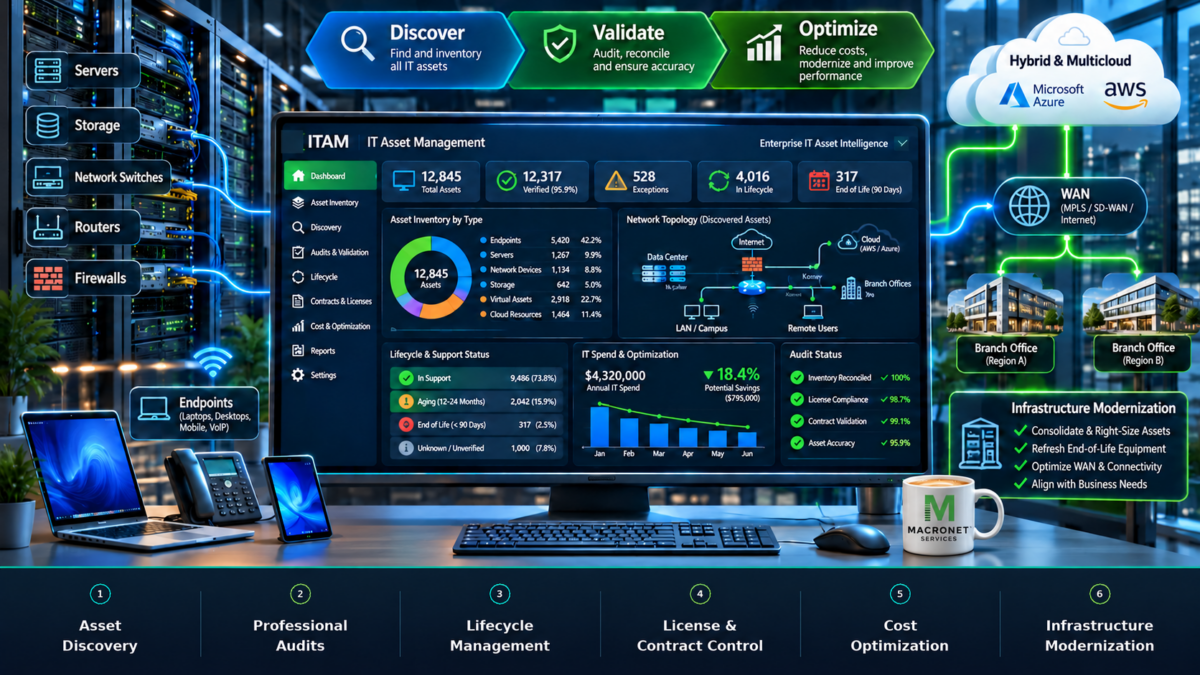
Discover what you own. Validate what you know. Optimize what comes next.
Request an IT Asset Management Consultation
Whether your organization is evaluating ITAM software, struggling with inaccurate inventories, preparing for an infrastructure refresh, or looking to reduce technology spending, Macronet Services can help determine the appropriate next steps.
Contact Macronet Services to Discuss ITAM Solutions, Professional Audits and Network Optimization
Frequently Asked Questions About IT Asset Management
What is IT asset management (ITAM)?
IT asset management is the process of discovering, tracking, managing, and optimizing technology assets throughout their lifecycle. It includes hardware, software, cloud resources, and associated financial and contractual information. ITAM helps organizations improve technology visibility, control costs, manage operational risk, and plan infrastructure investments.
What is the difference between ITAM and a CMDB?
ITAM focuses on asset ownership, lifecycle management, costs, contracts, and accountability. A CMDB documents configuration items and relationships supporting IT services. The two disciplines complement each other and can share relevant information.
What IT assets should businesses track?
Organizations should track relevant servers, network equipment, endpoints, software licenses, cloud resources, SaaS applications, and other technology investments. Telecommunications circuits, maintenance agreements, and data center infrastructure may also be included, depending on the organization’s requirements.
Can automated IT asset discovery identify every device?
Automated discovery can identify many technology assets, but completeness depends on accessibility, permissions, supported protocols, integrations, and device capabilities. Organizations should combine appropriate discovery methods with inventory reconciliation and professional validation.
What is included in a professional IT asset audit?
A professional IT asset audit may include reviewing discovery results, reconciling inventory records, verifying equipment and locations, examining lifecycle information, and investigating discrepancies. Deliverables typically depend on the agreed scope and may include validated records, exception reports, and recommendations.
How often should organizations conduct IT asset audits?
Asset inventories should be maintained continuously, while professional audit frequency should reflect infrastructure complexity, operational risk, and business requirements. Major acquisitions, data center migrations, equipment refreshes, and significant inventory discrepancies can justify additional verification.
How can ITAM reduce technology costs?
ITAM can identify unused software subscriptions, unnecessary hardware purchases, outdated maintenance agreements, and telecommunications services that warrant review. Actual financial savings depend on contractual obligations and whether identified improvements can be implemented.
How does ITAM improve cybersecurity?
ITAM helps security teams identify devices, software, and services requiring protection. Accurate inventories support vulnerability management, lifecycle planning, unauthorized asset detection, and security governance. ITAM complements rather than replaces dedicated cybersecurity controls.
Can ITAM platforms manage cloud resources and AI applications?
Some ITAM platforms support cloud asset discovery, SaaS visibility, and software inventory management through appropriate integrations. AI governance may require additional systems and processes because traditional ITAM tools do not necessarily identify every AI application, model, or associated risk.
How much does IT asset management cost?
ITAM pricing depends on asset counts, required capabilities, licensing models, integration complexity, and professional service requirements. Organizations should evaluate software, implementation, auditing, and ongoing administration costs when comparing proposals.
What should businesses look for in an IT asset management provider?
Organizations should consider the provider’s technology options, discovery capabilities, integration expertise, professional auditing resources, and ability to support ongoing asset management.
Macronet Services offers additional value through extensive enterprise network engineering expertise, helping clients use accurate asset information to identify opportunities for infrastructure modernization, improved resiliency, and cost optimization.